
Tag Archives: word tasting notes

harbinger

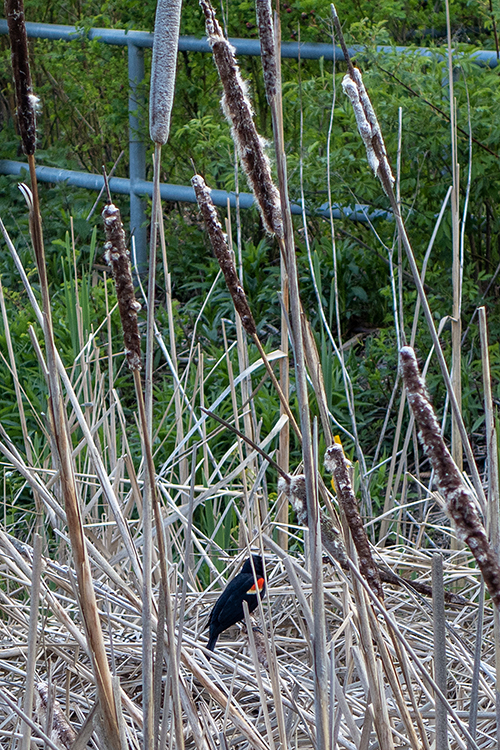
I saw a harbinger of spring today: a red-winged blackbird, which, as Hinterland Who’s Who says, “is one of the first signs of spring in Canada.”

I have a complicated relationship with harbinger. It’s a word I gladly enough use – in fact, it’s in one of my favourite phrases from my own poetry, “The heat-buzzer insect, harbinger of torpor” – but it’s that pronunciation. For a long time in my youth, I thought it rhymed with “bringer.” And since I learned that the g is pronounced like “j,” it’s always sounded to me a bit like a blend of Harbeck and injure.

Not that it has anything to do with injury, mind. It’s a word of presaging, of first signs, more like a bringer or an advance singer, or a herald. One of “The Forerunners,” as George Herbert says of grey hairs:

The harbingers are come. See, see their mark:
White is their color, and behold my head.
But must they have my brain? Must they dispark
Those sparkling notions, which therein were bred?

But perhaps it’s better to say harbingers are like tour managers or event coordinators. You know, whoever goes on ahead to make the arrangements. As John Dryden wrote in “To the Pious Memory of the Accomplished Young Lady Mrs. Anne Killigrew,”

There thou, sweet saint, before the choir shall go,
As harbinger of Heav’n, the way to show,
The way which thou so well hast learn’d below.

And as Matthew Zapruder wrote in “Erstwhile Harbinger Auspices,”

A harbinger is sent before to help,
and also a sign of things
to come. Like this blue
stapler I bought at Staples.

This is not to say that red-winged blackbirds (or robins, or nightingales, which Anne Finch called “sweet harbinger of spring”), as auspicious as they may be, are making the arrangements for spring. I mean, they could be the season’s John the Baptist, a messenger singing “prepare ye the way,” but they’re not really booking the hotel for spring to arrive, they’re just getting their rooms first, so to speak. Setting up the branch offices, you know.

But originally a harbinger was exactly the person who booked the rooms. Or, before that, the person who provided the rooms. The sense of ‘forerunner’ or ‘first sign’ was in place by the mid-1500s, but the sense of ‘person sent ahead to get lodgings for a royal party, army, etc.’ (as in the office of Knight Harbinger) was around at the time of Chaucer (that’s late 1300s), and the sense of ‘host, harbourer, innkeeper’ was in place in English by the late 1100s.

But, let’s be fair, the word wasn’t harbinger until after Chaucer’s time. Chaucer’s spelling was herbergeour. It came from Old French herbergere, which traces to Proto-West Germanic *harjabergu (‘army camp, shelter’). The modern French word is hébergeur; related words include Italian albergo and English harbour.

So how did that n get there? I’m tempted to say it was sent on ahead to prepare the way for the g. And in a way, that’s true, just as in passenger (one who has passage), messenger (one who carries a message), porringer (a dish for porridge), and a few other words. It’s what is technically called an “intrusive n”; it’s a pre-nasalization before g, not just when it sounds as “j” but also, for example, in nightingale. It cropped up in the passage from French to English in the late Middle Ages, probably under Norman influence.

Still, I prefer to see the n as not mere passenger but indeed messenger, harbinger, setting the mouth ready for the g that comes next. Without it, the sound would be that much more abrupt. Just like a spring that simply shows up one day. Which, admittedly, does seem to happen in Toronto.

You might wonder that it’s mid-May and I’m still talking about signs of spring. But I’m in Canada. And even though I’m in the deep south of Canada, we’re a place that freezes. In fact, there’s some question as to whether it’s truly spring yet. Yes, the patios are open at the bars across the street, but the hockey playoff games on their televisions give the lie to it. Not because it’s hockey – they play that until almost the start of summer – but because tonight they were showing the Maple Leafs versus the Panthers (not the Redwings, though that would be apposite), and the Leafs, on the edge of being dislodged, didn’t lose. And, as Torontonians have seen every year of my life, you know it’s spring when the Leafs are out.


imbroglio

“It was quite the imbroglio,” said Maury, twirling his tagliatelle around his fork. 

I took a sip of my wine, an engaging Aglianico from Puglia. “And how did your family become embroiled in it?” I was playing on imbroglio and embroil, which are in fact etymologically related: they both trace to French brouiller ‘confuse, scramble, blur’ (imbroglio by way of the Italian borrowing broglio ‘intrigue, confusion, entanglement’, embroil by way of French embrouiller). Brouiller in turn comes from Latin brodium ‘broth, stew, mixture’, which is also related to English broth and broil – the broil of the cooking kind.

“It was my great-something-great-uncle Giulio,” Maury said. “He wanted a guglio—”

“A what?” Maury had said it in the same anglophone style as he’d said “imbroglio,” not with the “g” pronounced (heaven forbid) but also not with the palatalized sound particular to Italian, /ˈɡuʎ.ʎo/, which tends to confound English tongues; he just said it like “ghoul, yo.”

“An obelisk. Specifically a needle-shaped one. And he wanted hieroglyphs on it. Or some fanciful imitation thereof. Plus a scene from a seraglio.” He arched an eyebrow.

“In relief?”

“Intaglio.”

I tangled some spaghetti aglio e olio on my fork. In the background, a song from the ’90s was playing: “I’m all out of faith, this is how I feel…” (I don’t require “O sole mio” or “Funiculì, funiculà” in an Italian restaurant, but perhaps a passacaglia?) “So what caused the brouhaha?” I asked. (Brouhaha is not etymologically related to imbroglio as far as anyone knows.)

“Well, the intaglio was to be done with pastiglia—”

“Pastiglia?” I said, trying to say it the Italian way on the (correct) assumption that it was another gl word.

“Low-relief gesso, yes. But instead they gave him scagliola.” I raised an eyebrow at him and sipped my Aglianico. “A kind of plaster,” he amplified.

“Which didn’t work?”

“It would seem not.” Maury nodded towards the source of the music. “‘The illusion never changed into something real,’ as Natalie Imbruglia put it.”

“And his perfect sky was torn?”

“Or anyway, his pot was cracked. Literally. He threw a piece of terraglia.” Pause. “A kind of cream-coloured earthenware.”

“Did it connect?”

“We may say it jarred the supplier’s ganglions.”

I giggled. “Well, I suppose when you’re all out of faith, this is how you feel.”

We paused the conversation for a few moments to finish our pasta. Our waiter – who was also, we had learned, a poet whose work I had read and who had won the Trillium Book Award and the Griffin Poetry Prize and had been nominated for the Governor General’s Award, but poetry doesn’t pay the bills, you know – stopped by to refill our glasses. “Are you thinking of dessert?” he asked.

“For some reason,” I said, “I have a hankering for zabaglione.”

The waiter, by the way, is someone real who served me and my friends in an Italian restaurant near where I live. Maury, as always, is fictional. All conversations really took place – in my head, and nowhere else.

Cheesequake

New Jersey has a certain reputation, and not an altogether fair one. If you only see that part of it that is in the orbit of New York City, you may be tempted to think the motto on their licence plates – “The Garden State” – is some kind of joke. More like swamps, pavement, dirty old towns, and sprawl malls with fine dining on the line of IHOP, Rainforest Café, and the Cheesecake Factory. 

Go a little further, however, and you’ll see that there’s a reason for what’s on those plates. Back in grad school I spent more than a month in Princeton, which is smack dab in the middle of New Jersey, and I can tell you that there is ample garden and greenery in that state. 

But New Jersey has another duality, one you can quickly see with a topographical map. The state, as you may know, is shaped like a thick stylized S. The top half of the S is generally hilly (sorry, “mountainous” – I’m from the Rockies and I find it hard to say a place with a maximum elevation of 1,803 feet is mountainous, but it’s all relative). The bottom half is generally low-lying and fairly flat, with a large swath called the Pine Barrens, which is true to its name. The dividing line is right across the waistband stretching from Philadelphia (well, Trenton), passing through Princeton, and touching the tidewater just near New York City. You could put the dividing line at the mouth of Cheesequake Creek.

Of what creek? You read it right: Cheesequake. It’s in the town of Old Bridge, Middlesex County, and it passes through Cheesequake State Park (perpendicular to the Garden State Parkway, which is not especially true to its name). As the New Jersey State Park Service website says, 

Cheesequake State Park’s uniqueness lies in its geographical location. Not only is it situated in the middle of the urban north and the suburban south, it lies in a transitional zone between two different ecosystems. Open fields, saltwater and freshwater marshes, an Atlantic white cedar swamp, pine barrens habitats and a northeastern hardwood forest await you. . . .

A striking example of vegetation change along a gradient from coastal salt marsh habitat to upland forests can be observed from the various trails running through the natural area. The natural area displays a diversity of plant species and community types characteristic of both northern and southern New Jersey.

So you might say that if there were a fault cutting across New Jersey, it would be right at this creek. And in fact it is: it’s the location of the New Jersey cheesequake of 1783 (it would have been an earthquake, but it’s New Jersey). 

No, I’m lying, that’s completely made up. New Jersey has its faults – the biggest one is in the north – and it has had occasional earthquakes (see New Jersey’s Division of Water Supply and Geoscience for more info), including a noticeable one in 1783. But that has nothing to do with Cheesequake, which is faultless.

So how did Cheesequake get the name? Is it something like that big molasses tank explosion they had in Boston in 1919? No, it’s due to more of a classical tectonic shift… lexically speaking. It’s an English rendition of a local (probably Lenni-Lenape) word. The June 8, 1889, issue of American Notes and Queries gives this nice run-down quoting the Newark Sunday Call:

Some of the local pronunciations of the names of New Jersey places are puzzling. For instance, Hibernia is called Highbarney, Charlotteburgh is spoken of by old-timers as Slottenburgh, Sparta is called Sparty, Newfoundland is called New fun land, with the accent on the land. Wequahick is Wake Cake, Chesquahick is Cheesequake, Acquackanonck is Quack-nack, and Wanaque is Why-nockie, with the accent on the why; Caldwell is Call-well, and Parsippany is Persipny, Plaquemin (French) has become Pluckamin, even in spelling, while our city is Noork or Newick.

Well, yes, that’s a thing that tends to happen. All Canadians know that the province of Newfoundland is “New fun land” (usually with the stress on New, though), and everyone who has ever flown through EWR knows about “Noork.” England is famous for doing this kind of thing – visit Cirencester in Gloucestershire, for instance – but Americans also do it a lot; in Massachusetts they make much of Worcester, and Kurt Vonnegut made light of handling of names taken from local languages with the fictional town of Pisquontuit, Rhode Island, in God Bless You, Mr. Rosewater:

About Pisquontuit: It was pronounced “Pawn-it” by those who loved it, and “Piss-on-it” by those who didn’t. There had once been an Indian chief named Pisquontuit.

OK, so Cheesquake is from Chesquahick, right? And what is Chesquahick?

Heck if anyone knows. That one citation is literally the only place the word turns up on Google, spelled that way or even close to it – and Google keeps wanting to show me Chiswick instead. If we look for Wequahick (which appears morphologically related), we find that it’s spelled Weequahic these days, pronounced “Wee-kway-ik” or “Week-wake,” and comes from Lenni-Lenape for ‘head of the cove’.

So therefore Cheesequake would come from something else to do with a head or with a cove, right (I’m not sure which, and online resources on Lenni-Lenape are limited)? You might think. But if you go to Wikipedia, the etymologies it offers are entirely different (and, I gotta say, not as engaging): Cheseh-oh-ke (‘upland’), Chichequaas (‘upland village’), or Chiskhakink (‘at the land that has been cleared’).

Or, ya know what, maybe it really was from a cheese quake. Specifically it could be a parmigiana quake. Here’s my evidence for that: 300 to 400 pounds of pasta were found recently alongside a creek in Old Bridge, the same town as Cheesequake State Park. Admittedly, it wasn’t dumped along Cheesequake Creek, it was dumped along Iresick Brook (and I’d say “I’re sick” if I had that much pasta too, especially off the ground), but the two are a mere 8 miles apart (less as the crow flies). The point is if you can have pasta coming out of the ground (Did anyone see anyone dump it? No) you can also have a cheese quake. Go to the garden and grab a plate!

But what would make someone hungry enough to have all that pasta and cheese in the first place? Well, if you Google Cheesequake, along with the New Jersey geography you get plentiful results for Cheese Quake, also named Cheesequake, which is a strain of marijuana. I’m not going to say that smoking some would give you the requisite appetite, but I’m not not going to say it either. (What do I know? I’ve never tried it.)

And for dessert, if you don’t mind the drive up to Menlo Park or all the way down to Freehold, you can go to the Cheesequake Factory. I mean Cheesecake.

banshee

I recently watched The Banshees of Inisherin – in which, as one of the characters points out, there are no banshees.

OK, so we won’t find out from that movie what a banshee is. But what is a banshee? Do you know? If we look at things in popular culture – movies, for example – perhaps we can find out.

In the Avatar movies, banshee is the English name for a large pterodactyl-like creature named ikra in Na’vi. There’s even a ride in the Disney’s Animal Kingdom theme park in which you have 3D simulation of riding one (it’s awesome). It’s also the name of a similar creature – with a paralyzing scream – from the Darkover novels by Marion Zimmer Bradley (which may have been the inspiration for the Avatar name).

Both Marvel and DC comic universes have characters named Banshee. Marvel’s is a guy whose sonic scream is his superpower. DC’s Silver Banshee is a Celtic woman supervillain with assorted powers endowed by supernatural forces.

There are several musical groups bearing the name: Banshee (metal), The Banshee (new wave), The Banshees (garage rock), Siouxsie and the Banshees (please tell me you’ve heard of them; they’re Important in the History of Music). There are also boats, aircraft, and land vehicles named Banshee. 

None of these give us any clearer idea of what a banshee is. In popular culture, it’s a word like some ancient thing people have always seen here and there but never known the source or purpose of, so they make up their own stories.

But we do know that somehow banshee is a word for a terrifying magical being. Does it look like a bandersnatch as animated by Ralph Bakshi? Most people wouldn’t be able to say. When we encounter the word in general use, we see it in one kind of comparison: “scream like a banshee” or “screech like a banshee” or “wail like a banshee” or “howl like a banshee” or something similar. Anyway, it sounds terrifying. I wouldn’t be keen on it.

Wait, did someone say “keen”? As in “keen like a banshee”?

Yes, that’s a thing.

So banshees are keen?

No. Banshees keen. As in wail in mourning. This word keen is an Anglicization of the Irish root caoin-, as in caoineadh ‘keening’. A banshee will wail to mourn the death of a person. But – and this is a key feature – the banshee will often mourn the death in advance. People will know someone’s going to die because they hear a banshee keening.

So, um, there’s like a, uh, pterodactyl sitting by a grave, and screaming in despair? 

No. It’s a little fairy woman. And maybe she sits by a fairy mound. 

Not quite superhero or sci-fi/fantasy level, is it?

Banshee, you see, comes from Irish bean sí. The first word, bean, which is said about like “ban,” means ‘woman’. The second word, , said like “she,” is, in most contexts, the Irish word for ‘she’ – but not in this context. Here, it’s the genitive – identical to the nominative – of , formerly spelled sídhe,* meaning ‘fairy mound’. Which in its turn is descended from the same Proto-Indo-European root that gives us English seat. A bean sí is a woman of the fairies, a fairy woman, and her most notable role is to foretell deaths. By keening. (She does it diligently. You could say she’s a real keener.)

OK, so what is a fairy mound? If you’re from Ireland, you probably know already, as there are something like 45,000 of them dotting the landscape. They’re things that have been there since time immemorial, round rises with mud and stone structures ringing them. They were long thought to be abodes of spirits, or entrances to the underworld (see this article in the Irish Times for some pocket history and such like). It might reasonably be speculated that they’re burial mounds. But it turns out they’re the surviving structures of homesteads – dwellings with fortifications – mainly from a millennium or so ago.

So that’s how things sit with this. People built ring mounds for their homesteads. Later people, not knowing the origins of these structures, associated them with something more awesome. They gave this a word derived from words for ‘woman’ and ‘seat’, and it was borrowed and modified into English. Later people, not knowing the origin of this word, have tended to associate it with something more awesome. (Pterodactyl-like creatures are definitely more awesome to us. Would you pay money for a Disney attraction involving a wailing fairy woman? Even the Haunted Mansion doesn’t have those.) There are, of course, no banshees, just as there never have been. But the banshees that there aren’t have developed somewhat… at least to the keen eye.

* For the fussy who want to point out that it was actually a d with a dot over it, that dot was originally a superscript h, so let it be.

ox

“Why is it called oxtail if it’s from a cow?”

I’m glad you oxed. It’s not just a load of bull.

Ox is a word that, for many of us, is both familiar and strange. I grew up in ranch country in Alberta and I knew that oxen were somehow like the cows and bulls (and steers) that punctuated the pastures, but I had the sense that they were an animal found elsewhere – those parts of the world I saw on TV that had oxen pulling plows, trying to grow crops in a time of poverty and famine. Isn’t that how Oxfam got its name, from oxen and famine? (I actually believed that for a time. And indirectly it’s true: it’s from the Oxford Committee for Famine Relief, so the fam is from famine, and the Ox in Oxford is from… ox. The famous university is in a town named after a place where oxen could ford the river Thames.) And of course an ox is something from the Bible: “Thou shalt not covet thy neighbour’s wife, nor his manservant, nor his ox, nor his ass.”

So I really thought I had seen a real live ox zero times. (Get it? 0 x. Zero times.) And in one sense of the word that’s true: I had never personally seen a bovine used as a draft animal, and that’s the narrowest sense of the use of ox in modern English (more specifically, it’s a neutered male Bos taurus used as such). But in another sense, it’s like saying you’ve seen plenty of fiddles but never a violin, or vice versa. (How old were you when you learned that a violin and a fiddle are the same instrument? I may have been an adult already.) Or it’s like saying you’ve seen donkey, but never an… hmm, no, let’s skip that one. 

In the oldest and broadest sense, ox is to cow and bull as sheep is to ewe and ram. We just happen to have extended the female cow to cover the whole species, partly because most of the bovines we meet are female. The male ones aren’t good eating, and they’re extraordinarily truculent – and strong. That’s why ranchers convert some of them to steers (a mathematical operation: you take the root so they can’t multiply) and the rest don’t make it past veal. So in later drafts, ox was left for the draft animal – a steer with a steering mechanism (the yoke’s on it – usually in pairs, or should I say teams).

So here we have this lovely short highly usable word, more ancient than the language itself, with cognates in many languages (including aurochs, in which the ochs is the same old root as ox). It has a stylish something, and a playful air (O and X as seen in tic-tac-toe), and an affectionate one (a hug and a kiss, O X). And it has one of the two most rakish, branding-y letters in the language (Z being the other). But since we no longer need oxen for draft animals, and we eat cows and have as little to do with (actual) bulls as we can, we just don’t use the word ox much. How often have you, driving by a pasture, said “Look at the oxen”? If you’re like me, zero times. We’re more likely to use ox as a word for a person who is unusually strong, stupid, or (probably) both: in one sense, an ox is a moron.

But of course not an oxymoron. Ironically, the ox (really oxy) in oxymoron, which is the same one as in oxygen, is from Greek ὀξῠ́ς oxus, meaning ‘sharp, keen, bright’ and thus ‘wise’… although you could also describe the point of an ox’s horn with that word too. It’s a cute coincidence, especially because cute is from acute, which is from the same root as ὀξῠ́ς. And so is axe, in case you were about to ax. (By the way, modern English ask is from Old English acsian – somewhere along the line aks became ask – but it has no relation to axe or to ox.)

Oh, and since you might be oxen me about it, there’s also the matter of that plural. We don’t say oxes. Oxen is the sole surviving old weak plural ending in -en. We treat brethren as different from brotherschildren is a weird double plural (both the -(e)r and the -en are plural endings); we rarely use kine for the plural of cow, and anyway that also has historical umlaut on the vowel; and all the other ones have been supplanted by -(e)s, as eyen has become eyes.

So there you have it. Ox: dumb and sharp, a hug and a kiss (you can hug my cow, but don’t kiss my bull; save it for my… donkey), all cattle and only the teamsters. It’s quite the tale. But now you know that if someone gives you a bit of cow queue and calls it oxtail, you have no beef with them. …Except, of course, you do.

recreant

He said that he would recreate the park for recreation, but you’re wise to be of two minds on that – he was always doing mental double bookkeeping. He has broken faith, abandoned the trust that has been placed in him. But if he thinks his victory is accomplished, he has another think coming – it is he who will in the end admit defeat and retreat, the recreant!

We don’t see this word recreant much these days, though there would be ample opportunities to use it if we did. No doubt part of the problem is that it looks so much like recreation or recreate. But a recreant is more “wreck” than “parks and rec.” However, though its sense has nothing to do with recreation, the two have a curious detail in common: both have gained a second sense over time.

A moment’s reflection might suffice for the second sense of recreation. Of course it’s the same word as re-creation, ‘create anew’; what happened was that it was applied to taking refreshment – i.e., food and similar, which re-freshes and also re-stores (which is where restaurant came from, by the way: restoring, but French) and so re-creates – and from that it extended and shifted to pastimes of leisure and pleasure.

For recreant, however, we should first establish the earlier sense. It comes, like the other words we’re looking at today, from Old French, but this creant has to do not with creation but with credo (Latin) and croire (Old French): ‘believe, have faith, think’. Recreant was first of all an adjective or noun for someone who would, in a battle situation, yield to second thoughts, see things in a new light, and, in particular, acknowledge defeat (“Run away! Run away!”). In short, as of Medieval times, recreant was a word for a coward, and was one of the worst things you could call someone.

As of the 1600s, however, and gradually eclipsing the earlier sense, recreant meant that the person had gone back on belief, had broken faith, had become an apostate, had abandoned a sacred trust. It’s in the same vein, but in this case it can be someone who is not merely cowardly but in fact dastardly, deliberately treacherous, not just breaking their word from weakness or inconstancy but never having intended to keep it in the first place. Someone you should always think twice about trusting.

As I said, we could still use this word. We do still occasionally use its sibling miscreant. But, for better or for worse, we at least have a well-developed lexicon of alternative terms for those who lie, cheat, and steal. And you’d better believe we use them, and not just recreationally.

comeuppance

Boy, there are some people these days who really need to get what’s coming to them. They need to get their coming-to-ance.

What I mean is that what goes around comes around, and these people really need to get their come-around-ance.

I mean, they’re too high on themselves – they need to come down a peg, ya know? Get their come-down-ance.

No, wait, what’s the word for getting your just deserts? It’s, uh…

…comeuppance.

Comeuppance? Come again? Who came up with that?

And yet we all know it and accept it, right? I mean as a word. (Few people happily accept their own comeuppance.) It has a certain something. Like in some historical television drama about intrigues among nobility. Can’t you just hear someone purring in toffee-nosed tones “Well, she’s gotten her comeuppance”?

Naturally, given that I’ve played that gambit, you may guess that it’s originally an American word. And yes, it is. First appeared in the middle 1800s in the USA. And some of the early usages are not comeuppance (or come-uppance) but come-uppings (or even come-upping). Which can make a person wonder, is come-uppance a reinterpretation of come-uppin’s, using the slightly fancier French-derived -ance? I don’t know the answer to that, but the evidence makes it plausible.

But that doesn’t solve for us where this come up comes down from. Wiktionary states flatly that it’s “from come up (“to appear before a judge”) +‎ -ance.” But the Oxford English Dictionary suggests that it’s related to the now disused “to be (or get) come up with: (of a person) to get one’s comeuppance; to be outwitted, defeated, or overcome.” It has quotes to support, including this one from Harriet Beecher Stowe’s 1871 Oldtown Fireside Stories: “The way he got come-up-with by Miry was too funny for anything.” And the 1922 Radio Boys at Mountain Pass by Allen Chapman: “It will do me good if those scoundrels get come up with.”

OK, but who came up with that? How does get come up with connote the boomerang of karma? An adjacent entry in the OED gives a possible clue: “to come up with: to come alongside or abreast of, to reach; to catch up with.” In other words, what’s long been coming to them has caught up with them.

That’s not to say that that’s for sure where it comes from. But the earliest quotations for comeuppance don’t really go with the “come up before a judge” origin – though that could have played into it at some point as well.

One way or another, this word has come up in the world. Its form conduces to an impression of loftier origins than it has; and we have to wonder, if it had instead been come-uppings (or, even better, come-uppin’s), would it have had more or less force? In the frank unfancy tones of a Mark Twain, say, or a Will Rogers, or even a Walt Whitman, would it have given more of a sense of being truly brought to level? Or is it best suited to someone of elevated station being shown up, socially demoted, and yet still not of the servant class? We understand that it’s better to get your comeuppance if you’re an up-and-comer, but does it play the same way if in the final tally you’re down and out?

blivet

Damn, that last word tasting note really was a bit overstuffed, wasn’t it? I started working on it with the intention of doing just one word – gizmo – and then I decided I had to cover four other similar words, and then I decided I really ought also to cover another six words in passing. I suppose that’s not so out of range for a blog like this, which covers so many angles and styles, but still, talk about scope creep!

Scope creep is such a common dread in today’s world of work – a project starts out looking like five pounds of shit but before you know it it’s become ten. And if you figure you’re going to get through it like any shit sandwich (by eating quickly – nom nom!), you soon discover you have a footlong double-stuff shit sandwich. But then there are the projects that arrive with scope already crept. They have always already become. You get to your desk and there is a bag of shit that is labelled “5 lbs” but it clearly has 10 lbs in it. (And it’s on fire.) You have been given a blivet.

The word blivet is itself, in a way, a blivet. Not that it’s unpleasant per se, but it inevitably comes with at least twice as much as it pretends to. For one thing, as the 1967 Dictionary of American Slang by Wentworth and Flexner says, “The word is seldom heard except when the speaker uses it in order to define it.” So you get not just the word but the definition, pretty much every time. (“That there is a blivet. You know what a blivet is, right? Ten pounds of shit in a five-pound sack.”)

For another thing, if you want to do any research on it, you quickly realize there’s more to it than you thought there would be. To start with, it’s a word from the US Army during World War II, right? Yes… but the US Army apparently got it from the Australian army in New Guinea. And where did the Australian army get it from? Oh, good luck finding that out. I don’t have access to an Australian etymological dictionary, but, going by the sources I do have, if I did it would probably say “Etymology: NCM” and then I’d look up “NCM” and find it stands for “no clue, mate.”

And if you decide to look in Google Books to see what kind of old citations you get, you find that there are quite a few uses of the word that aren’t what you want. Leaving aside bad character recognition (such as a charming transmutation of “Mount Olivet” into “Mount Blivet”), there are instances where it’s a surname – although apparently no one famous enough to have gotten a Wikipedia article has ever borne the name. There are also citations for the blivet that Wikipedia sends you to when you search the word: the impossible fork or impossible trident, an optical illusion – it first had the name blivet applied to it in the late 1960s in a magazine called Worm Runner’s Digest, which was also something of a blivet, in that it contained both satirical articles and earnest scientific explorations, mixed indiscriminately. And there are citations in Swedish.

In Swedish? Yes. Blivet is also a Swedish word. But in Swedish it is the neuter form of bliven, which means ‘having become’. (It is also a word in Low German; I think it means ‘remain’ but I can’t confirm.) Well, it has become quite a lot, hasn’t it.

And it has become a word with two spellings, too, because you’ll also see it as blivit. And when you look for it in that spelling, you likely find Kurt Vonnegut’s use of it in the introduction to his book of collected writings, Palm Sunday:

This is certainly that kind of masterpiece, and a new name should be created for such an all-frequencies assault on the senses. I propose the name blivit. This is a word which during my adolescence was defined by peers as “two pounds of shit in a one-pound bag.”

I would not mind if books simpler than this one, but combining fiction and fact, were also called blivits. This would encourage The New York Times Book Review to establish a third category for best sellers, one long needed, in my opinion. If there were a separate list for blivits, then authors of blivits could stop stepping on the faces of mere novelists and historians and so on.

I’m sure I’d like it. But I’d have to see it to blivet.

doodad, doohickey, gizmo, gadget, widget

You got that thingumabob? Thingamajig? Whatsit? Doodad? You know, the widget, the gadget, the doohickey? The, uh, gizmo there?

Sometimes you have a thing of some function – perhaps manufactured by Acme or perhaps cooked up by Joe Schmoe or Fnu Lnu or by my dude Mister Whatsisname – and there’s totally a real word for it, but maybe you don’t remember it or maybe you never knew it. You need it to reticulate some splines or to foo the bar, so you need to ask for it. But thing is just too vague, you know? You need to communicate that it’s some kind of contrived device with a definite purpose, and also that you don’t remember a better name for it but you shouldn’t be judged for that. So you use a placeholder name. 

Of which there are several available. Some convey most directly that the speaker has forgotten the name: thingummy, thingumabob, thingamajig, thingy, whatsits, whatchamacallit. Others can convey not just thingummy-ness but obscurantism: “A differential is a caucus on the rear gadjet that centrifugally operates the twiggler in the doodad on the fifth wheel,” as The Marines Magazine had it in 1916. Some function more as a generic, of which a particular item’s particular name may be a subset. And some have become specific things in themselves, at least some of the time.

The “I totally have no idea and I’m going to be up front about it” words have a long pedigree. Thingummy showed up in the early 1700s as a diminutive form of thingum, which has been around since the mid-1600s (and was probably formed as a mock-Latin version of thing, which in its turn is a word from the Germanic mists of time originally referring to a council, then to a matter discussed before a council, and then to any act or matter, and at length to any old thing at all). Thingy showed up about a half century after thingummy. Thingumabob (also spelled thingamabob) also showed up in the mid-1700s, following on jiggumbob and kickumbob from the mid-1600s meaning the same thing (the exact reason for the bob is not altogether known), but thingamajig, which uses the same jig as in jiggumbob, didn’t appear until the early 1800s, followed a couple of decades later by jigamaree (which, again, means the same kind of thing). On the other hand, whatsit, which (I hope) requires no etymological explication, appeared near the end of the 1800s, and whatchamacallit not until the mid-1900s (although what-d’ye-call-it, spelled variously, including such as whatchicaltes, showed up starting in the 1600s).

The ones that have taken on a stronger sense than mere confusion are, overall, more recent. 

Doodad apparently dates all the way back to the later 1800s, though it shows up more starting in the early 1900s. It seems to have started by referring to ornamental items, either around the house or on the clothing: you could, for instance, “pin a doodad of some sort on your nightie.” Over time it has gained a sense of some minor instrumental item, such as an attachment or implement used for adjusting. In my own experience, doodads tend to be fiddly.

Doohickey names a doodad or a hickey or, more to the point, a merger of both. Hickey, I should say, first showed up in the early 1900s as a word that used to be like doodad and the rest of these, but once it gained the particular sense of ‘love-bite mark’ starting in the 1930s, that pretty much eclipsed the rest. However, doohickey had already shown up by 1914 and was not necked out by that shift in sense. It seems to convey more pointedly than doodad, gizmo, gadget, or widget the fact that the speaker doesn’t know the name of the thing and perhaps also that the speaker is uncertain as to its exact nature and function; it may or may not be relevant that, unlike those other words, it has three syllables, of which the first is stressed and the second may be as well.

Gizmo showed up during World War II. Life magazine in 1945 said gizmo “is Marine and Navy usage for any old thing you can’t put a name to.” In 1944 Jim Griffing Lucas in Combat Correspondent called gizmo “a Marine Corps term. It is the equivalent of the civilian ‘doo-dad,’ and is applicable to anything for which more descriptive terminology is not immediately available.” There’s no clear indication of how the name was confected. I would venture to say that, inasmuch as gizmo is used today, it is typically used for something that has some degree of technical ingenuity. The z helps that.

Gadget is now in a class of its own, thanks in part to Inspector Gadget (and perhaps also to Gidget, movie surfer girl played by Sandra Dee; Gidget is supposedly from girl plus midget but, come on, she was 5 foot 4) but also thanks to broad usage, matched only by widget. It has even been used as a fictional name on various occasions as early as the first decade of the 1900s. As evidence that gadget is considered a completely normal word, note that Green’s Dictionary of Slang doesn’t even list its usual senses (because they’re not slang), just a couple of prurient meanings

Gadget has been around longer than some; its earliest published uses are from the mid-1880s. There is some suggestion that it comes from French gâchette, which refers to a locking mechanism. However, there’s no clear observed path from the one to the other in usage and sense, and the /ʃ/ to /dʒ/ development is, if we’re being honest, only middling plausible. In any event, gadget is now used to mean, as Wiktionary puts it, “any device or machine, especially one whose name cannot be recalled. Often either clever or complicated” – and in particular, as an informal sense, “any consumer electronics product.”

Widget has wandered farthest in sense from whatsit and thingamajig: it is now treated as an actual kind of thing – or multiple kinds of things. It’s so well established as a word that it doesn’t appear at all in Green’s. Many of us know it as a name for simple applications and interface elements in computers, mobile devices, and websites (for example, all of the boxes you see down the right column of my blog are widgets); it has had this sense since the early 1990s. Some of us also know widget as the name for the small pressurized item floating in a can of “draft-style” beer that squeals out nitrogen when you open the can – a sense that also showed up in the early 1990s. But it has been used as a generic placeholder name for commercial items, used in examples in economics texts and such like, at least since the 1930s. 

There are a few different accounts of the etymology of widget, and if you find one that sounds cute or clever or clear you can assume it’s pure fiction – for instance, in one B-movie I watched one Saturday afternoon in my teens (I think it was the 1942 Wildcat), one of the characters claims it came from a misreading of midget. The real original source is known, or at least seems to be: the 1924 play Beggar on Horseback by George S. Kaufman and Moss Hart, in which it is some undescribed fanciful manufactured item:

NEIL 
Yes. Big business. What business are we in? 

CADY 
Widgets. We’re in the widget business. 

NEIL 
The widget business? 

CADY 
Yes, sir! I suppose I’m the biggest manufacturer in the world of overhead and underground A-erial widgets. Miss You! 

MISS YOU 
Yes, sir. 

CADY 
Let’s hear what our business was during the first six months of the fiscal year. [To Neil.] The annual report. 

MISS YOU 
[Reading.
“The turnover in the widget industry last year was greater than ever. If placed alongside the Woolworth Building it would stretch to the moon. The operating expenses alone would furnish every man, woman and child in the United States, China and similar places with enough to last for eighteen and one-half years, if laid end to end.” 

CADY 
How’s that? 

NEIL 
It’s wonderful! 

CADY 
And wait for September 17th! 

NEIL 
Why? 

CADY 
That’s to be National Widget Week! The whole country!

What we don’t know is how Kaufman and Hart came up with the word. Probably it just sounded good, but exactly why it sounded good is another matter – likely from resemblance to gadget and perhaps wedge or whatsit or fidget or… 

Anyway, the word caught on, and, like widgets generally, has proven a useful simple little implement. Not quite as mechanical as a gadget, perhaps, or as gee-whiz as a gizmo, or as fiddly as a doodad, but definitely more definite than a doohickey.

zowie

There are dad words, and there are granddad words, and there are great-granddad words. Over the years, zowie has progressed upward in those ranks. Even when I was a kid it was the sort of word I saw in cartoons and old books (as a 1962 article in the Spectator put it, “Think of the United States as a 3,000-mile-broad comic strip where significant occasions go bam, pop and zowie”). 

But I did hear it used in full earnest once. I was riding in a car, somewhere in the late ’70s or early ’80s, when the driver exclaimed “Zowie! He almost hit him!” I didn’t even pay attention to the near-accident, so entertained was I by the word uttered by the driver… who was my dad.

This word has a few surprises awaiting you if you go digging up its early days. Although its popularity crested in the 1940s, it emerged around the turn of the century: Green’s Dictionary of Slang has an earliest citation from 1902, and I haven’t found an earlier one… in the sense in question. 

If you look in Google Books, you will get quite a lot of hits that are not the sense in question.

This is because Google Books also has books in Polish. The Polish word zowie – now archaic; the more modern version is zwie – is the third-person singular present of zwać, which means ‘call’ or ‘be called’ (i.e., ‘name’ or ‘summon’). It has nothing at all to do with our English word zowie, and it doesn’t sound the same either – it’s said about like “soviet” but with a “z” in place of the “s” and without the “t” at the end.

It’s also because it shows up from time to time as a first name.

You’re may think of Zowie Bowie, the son of David Bowie. As David Bowie was the stage name of David Jones, Zowie Bowie is actually Duncan Zowie Haywood Jones; note that this Zowie rhymes with Bowie, making it a homophone for the name Zoë (which, however, is typically a woman’s name). I don’t know for sure, but I suspect that at least some of the people named Zowie who show up sporadically in the early 1900s – such as one of a couple named Walter and Zowie and another of the couple Seymour and Zowie Tufts – might have been using a variant of Zoë. On the other hand, the musical group Zowie’s Zobo Band, which played in Dartmouth in 1908, might not have followed that pattern.

Beyond those instances, however, pretty much every other use of zowie that you’ll find is an interjection. But while most of the time it is the same class as “Wow!” “Yikes!” “Holy cow!” and “Hot damn!” – and nearly always has an exclamation mark on it – there are a few more violent uses too. 

There’s the “potato bug exterminator” mentioned in The American Flint in 1913, wherewith one may dispose of said bugs “by taking two blocks of hard wood, hickory for instance, and cutting them about five inches long, three inches wide and two inches thick, placing one in each hand, gently treading to the potato patch, placing one bug at a time on the block in one hand and ‘zowie’ with the other.” In Pearson’s Magazine in 1914, there are explosions:

Zowie!

Zowie!

Zowie!

The explosions followed each other rapidly…

And there are gunshots, as seen in Our Navy in 1915: “Nothing was heard but the steady purr of the beating motor, when suddenly—‘Zowie! Zowie!’—two shots rang out through the balmy California air.”

Which is arguably ironic, because zowie is thought originally to have been more like the steady purr of the beating motor: as Merriam-Webster says, “The word zowie was inspired by the sound of a speeding vehicle—a new phenomenon when the word entered the lexicon in 1902, the year before the Ford Motor Company sold its first car.” GDOS agrees that it’s “echoic of speed.” But the OED and Wiktionary are mute on its origins. And when you look at the available quotations – in the dictionaries and in Google Books – even the earliest ones aren’t imitative of a speeding vehicle; they all go with the “astonishment” and “admiration” that are part of the dictionary definitions.

OK, but how about astonishment (if not admiration) at a speeding vehicle? I really do feel like my dad gave me the whole deal there – or would have if there had been actual violence (gunshots? explosions? bug-squashing at least?). Especially if one of the cars had been driven by someone called Zoë.
