Tag Archives: word tasting notes

cremate, incinerate, cinder, Cinderella

It is Cinderella’s funeral. “Ashes to ashes,” someone says.* The mourner next to you leans over and says, sotto voce, “Cinders to cinders.” And you, knowing she started out in Italy as Cenerentola, mutter back, “Cenere a cenere.” Which, as your interlocutor may or may not know, changes the complexion of the matter.

Cinderella, being fairy-tale royalty, gets a requiem mass, in the old style. “Requiem æternam,” the choir begins. At length it moves into the “Dies iræ,” at which point the person next to you whispers, “Is she going to be buried or incinerated?” And you are about to reply “Cremated” when you pause and think about this.

Because, even if we normally speak of the human dead as being cremated, wouldn’t it be more apposite for Cinderella, la Cenerentola, to be incinerated? And why don’t we say “incinerated” for people, anyway? Why is it vaguely offensive to speak of the beloved dead as having been put into an incinerator, and just as vaguely offensive to speak of trash as having been cremated?

The word incinerate has a long tenure in English. Since the mid-1500s it has been used to mean ‘reduce to ashes’, which is its literal Latin meaning: in- for ‘into’ plus cinis ‘ashes’ – the ancestor of Italian cenere – but specifically cold ashes, what’s left after the fire has burned out and the wind has passed over. Latin had a different word for hot ash, and the choir has just sung it:

Dies iræ, dies illa
Solvet sæclum in favilla

Yes, favilla. What we would in English call cinders. Different from cinis. (We’ll come back to that.)

But when a body is reduced to ashes, first hot, then cold, why do we not say incinerate (not to mention infavillate, which is a word that you will find nowhere)? Why cremate? Are we reducing them to the cream of their ashes?

It is worth noting at this juncture that cremation, as such, is comparatively modern. People have been burned on funeral pyres since time immemorial, of course. But the human body is not so easily reduced to ashes. It was not until the later 1800s that an oven was developed that would get so hot that, after three or four hours, all that would be left of an ex-person would be white ash. In 1873, at the Vienna Exposition, Professor Ludovico Brunetti presented an oven that would be able to reduce an adult body to 1.7 kilograms of cenere – which he presented as proof. (We do not know whose cremains they were.) 

His timing was good: cities were becoming dense, graveyards were filling up, and there was the problem that, along with taking up space, decomposing corpses were environmentally toxic. As Sir Henry Thompson, FRCS, MB.Lond., put it in his book Cremation: The Treatment of the Body After Death

The process of decomposition affecting an animal body is one that has a disagreeable, injurious, often fatal influence on the living man if sufficiently exposed to it. . . . The grave-yard pollution of air and water alone has probably found a victim in some social circle known to more than one who may chance to read this paper.

He, a founder of the Cremation Society of England, considered graveyard interment nothing more than “laying by poison . . . for our children’s children, who will find our remains polluting their water sources.” And just around the same time as he was writing this, Brunetti was presenting his furnace, and in England one Charles William Siemens was also developing a regenerative furnace that was suited for the process. And it was just around then that crematecremation, and crematorium (and crematory, now disused) appeared in English.

Well, you know, people have feelings about funerary obsequies. Such an occasion is a special time, not common, and if one may use a word that is not the common word – especially for the new invention (new inventions always cry for the invention of new words to name them) – then so much the better. Why should your beloved be put in an incinerator? When there is a nicer-sounding, less besmirched word that can be used?

A word that comes from Latin cremo. Which does not mean ‘cream’. Indeed, cream is unrelated; it comes not from Latin but from French crème, which comes from a Gaulish word that was also influenced by Latin chrisma ‘anointing’ – a thing that one undergoes while still alive, even if it is done with a combustible liquid. No, although my Cremo brand shaving cream does not burn my face or give me an ashen complexion, Latin cremo means ‘I burn’ – transitively: the infinitive is cremare and it means ‘burn to ashes, destroy by fire’ and ‘make a burnt offering’.

And as you think about this, the text of the “Dies iræ” gets to

Ne perenni cremer igne

“That I not be cremated by eternal fire.”

And, after another stanza, it continues on to a familiar bit:

Confutatis maledictis,
Flammis acribus addictis,
Voca me cum benedictis.

Oro supplex et acclinis,
Cor contritum quasi cinis:
Gere curam mei finis.

Lacrimosa dies illa,
Qua resurget ex favilla
Iudicandus homo reus:
Huic ergo parce, Deus:

Pie Iesu Domine,
Dona eis requiem.

You can hear it in there: “Cor contritum quasi cinis,” “contrite heart crushed like (cold) ashes”; “Qua resurget ex favilla,” “which from embers will arise”…

And somehow, after being cremated, the cinders of Cinderella will cool to the cinis, the cenere, of la Cenerentola. But how did cold cenere become hot cinders anyway?

The same way the cream came to cremation: nothing but coincidence, and a fatal attraction of sound. Cinder is not related to cenere; it comes from an old Germanic root for ‘dross’ or ‘slag’. La Cenerentola became French Cendrillon, from cendre, which is cognate with cenere but sounds more like cinder. And in English we have Cinderella, who has become a hotter property than she was in the Romance languages.§

And soon she will be consigned to the flames. Just one question remains: Will her glass slippers burn? 

The answer is no. As it happens, a crematorium typically reaches temperatures around 900°C, while glass generally melts above 1400°C. But that’s not why her slippers won’t burn. It’s because they aren’t in the casket with her. The prince has kept them… for some more fitting occasion.

* Not the priest, because that’s an Anglican saying, and Cinderella was Catholic.

† At Sleeping Beauty’s, it was “Requiem temporalis,” on the basis of precedent.

‡ Of the Siemens family, whose companies have made many technological things, including for transportation within this world, not just out of it.

§ I will not mention that her German name is Aschenputtel. It’s relevant, but I find it off-putting.

fatal, lethal, mortal

A couple of months ago, I read the following passage: “an extremely hazardous, quite possibly lethal sea journey.”

What was your first thought was reading that?

Mine was “Not lethal. Fatal.”

OK, but why?

If you ask someone to define fatal, they might say “deadly,” and if you ask them to define lethal, they might also say “deadly.” If you ask for another way of saying “deadly,” they might offer mortal

If you want a more detailed definition, you may go to Merriam-Webster, which offers the following definitions:

  • for fatal: “causing death”; “bringing ruin”; “causing failure”; “determining one’s fate”; “of or relating to fate”; “resembling fate in proceeding according to a fixed sequence”
  • for lethal: “of, relating to, or causing death”; “capable of causing death”; “gravely damaging or destructive”; “very potent or effective” (in a more figurative sense)
  • for mortal: “causing or having caused death: fatal”; “subject to death”; “of, relating to, or connected with death”; as well as several extended senses

OK, yeah, they all can mean ‘causing death’. And yet.

But of course we don’t learn the meanings of common words from the dictionary; we learn them from seeing the words in use, and occasionally, when we’re young, from having someone define the word for us, usually with a synonym. And then we see how they’re used. 

We know, for instance, that you can receive a fatal wound from a lethal weapon in mortal combat, and maybe you can receive a mortal wound from a fatal weapon in lethal combat (or maybe not), but you wouldn’t receive a lethal wound from a mortal weapon in fatal combat. Somehow that doesn’t sound exactly right.

Words are known by the company they keep. So what company do these words keep? When I look at the Corpus of Contemporary American English and search for collocations, I find that the following are the top dozen words that come right after each of these:

  • for fatal: shooting, flaw, disease, attraction, mistake, accident, blow, accidents, crash, heart, crashes, error
  • for lethal: injection, weapon, force, dose, weapons, combination, injections, doses, drugs, violence, form, virus
  • for mortal: sin, Kombat, danger, enemy, man, enemies, life, coil, Wkly, world, men, threat

(You probably know what Kombat is doing there – Mortal Kombat is a popular game series. As to Wkly, Morb Mortal Wkly Rep is the citation abbreviation for the medical journal Morbidity and Mortality Weekly Report. So it’s kind of an interloper. To make up for that, the 13th word in the list is combat.)

To get more real-life insight, I asked people on Bluesky: “According to you (as in from your own mind, not from a dictionary), what is the difference between ‘lethal’ and ‘fatal’? Take your time. Consider instances where you could use one but perhaps not the other.” (I didn’t ask about mortal because at first I was just thinking about those two.) Here are some of the responses I got:

i feel like “lethal” is done to somebody, and “fatal” just happens. a disease is fatal, not lethal. an accidental self-administered drug overdose is fatal. if the fault of a doctor, they administered a lethal dose. a weapon attack is lethal, an accident is fatal.

Lethal has the potential for death – like a weapon; fatal suggests that death is assured, like an attraction.

Hmmm this sounds weird but: fatal is always what you say about something in the past. Like, the fatal blow is only talked about after a person is assuredly dead. Lethal feel more about potential. This is probably miles off.

Result? Timing? Lethal has ‘potential’, while ‘Fatal’ describes sometime that’s already happened and has definitely ended in death.

Broadly, “fatal” is about “fate” and so emphasises the result, not cause or intent, and often implies inevitability (fatal flaw). “Lethal” implies intent or design (though it may not imply will: a lethal venom is evolved). Of course, such distinctions are pretty fluid and subjective.

I have no idea why, but lethal sounds active. Fatal sounds more passive. Like, lethal is something one does. Fatal is just something that happens. Makes no sense except in my head.🤷‍♀️

To a first approximation, I think I’m more likely to use “lethal” to describe physical objects/substances, and “fatal” to describe events.

Off the top of my head, “lethal” can be adjectival in an abstract way, and carries a sense of “able to cause death.” “Fatal” has more certainty to it. “The third dose of heroin she took was fatal.” This is not definitive, rather, it’s how the nuance strikes me, and they overlap in various cases.

Lethal is a possibility. Fatal is a result.

So, then. Here is what I get from all that: 

Fatal has a sense of inevitability to it: if it’s about death, it’s unavoidable; if it’s more figurative, such as “a fatal error” or (for a computer) “a fatal exception,” it is still irreversible. Like the hand of fate. 

Lethal has a sense of purpose or potential: a lethal dose may remain unadministered, but a fatal dose already has been administered. A lethal weapon can kill you, but that doesn’t mean it will, let alone already has. 

And mortal puts a thing in the atmosphere of death: a mortal enemy is someone who wants to kill you, or vice versa; mortal combat might or might not guarantee death but definitely allows for it; in this mortal world we mortal beings must ultimately shuffle off this mortal coil.

All of which, if you look at the origins and histories of these words, makes sense.

Fatal is, by origin, ‘of or relating to fate’; it comes from Latin fatalis, from fatum, which means ‘fate’ or ‘destiny’, of course, but comes from a verb meaning ‘speak’: it is the word that is spoken, the prophecy, the edict, the divine utterance. It has been in English since the later 1300s and first meant ‘decreed by destiny’. It always comes with the echoes of “fate.”

Lethal is, by origin, ‘deadly’; it comes from Latin letalis, with an intrusive h that chance and confusion ordained should be there – it’s a misconjecture of an origin in Ancient Greek λήθη lḗthē, ‘oblivion, forgetfulness’. Letalis comes from letum, ‘violent death’, ‘killing’, ‘ruin’; its further etymology is uncertain. It has been in English since the early 1600s and first meant (as it still means), per Oxford, “that may or will cause death.” It doesn’t come with strong echoes of other words.

Mortal is, by origin, ‘involving death’, as in ‘susceptible to death’ (i.e., not immortal), or ‘causing death’, or ‘punishable by death’, or ‘relating to the time of death’; it comes from Latin mortalis, from mors, ‘death’, which in turn traces back to a Proto-Indo-European root also referring to death that has given rise to deathly words involving /m/ and /r/ and usually /s/ or /t/ in quite a few languages. It has been in English since the later 1300s and was first used in relation to battle, combat, et cetera, as in mortal foe (one who will be satisfied only by the death of their enemy) and mortal battle and of course mortal combat (fought to the death). It brings a lot of associative baggage with it, since mortal has such a wide usefulness for human things, and it also echoes many other related morbid mor- words.

So there it is: three kinds of -talis – falemor. In matters of killing, fa will, le can, mor can’t not. We all have a sense of how to use these words, and how not to, but we mostly just feel our way around them. And meanwhile, we still also have the Anglo-Saxon words that these three Latin imports have not completely supplanted: deadly and deathly.

rude, crude

Obviously, you’d have to be a stupid a**h*** not to know these words.

Was that rude and crude enough for you?

Is there a way to be “rude” that’s not bad? How about “crude”? Is there any way for the rude and the crude not to be unrefined?

What, incidentally, is the difference between rude and crude? Do they overlap? What do they and don’t they even mean?

Let’s start with whether “rude and crude” is redundant. Can you be rude without being crude? Of course you can. “Good day, John. Tell me: Has your sense of taste entirely deserted you? That is an exceptionally ugly shirt; I would be ashamed to be seen in public wearing such a thing.” One could hardly call that crude, but, in most contexts, one could hardly not call it rude. How about the converse? “Hey, John! That is a beautiful f***ing shirt – I look like complete s*** next to it! Where in hell did you get it?” Undoubtedly crude, but entirely complimentary; in most contexts, at least if it’s not spoken sarcastically, it wouldn’t be at all rude.

This also highlights how we tend to use these words. Rude typically means ‘brutishly impolite’, ‘deliberately inconsiderate’, that kind of thing. Crude typically means ‘vulgar’, or at the very least ‘unrefined’ – and also literally ‘unrefined’, as in crude oil. Indeed, we might say that raw could be a sometime synonym for crude, as hinted at by crudités, which are raw vegetables often found at polite and refined occasions.

And that leads us right to its origin: Latin crudus, ‘raw, uncooked’ – which is related, via Proto-Indo-European *krewh₂-, to English raw. It showed up in English in the later 1300s meaning ‘raw, unrefined’ in literal senses, and, by the early 1600s, had spread to “products of the mind,” as the Oxford English Dictionary puts it: “Not matured, not completely thought out or worked up; ill-digested.” If we look to poetry, we can see it covering that range of sense, literal and figurative:

You are content to keep that mighty love
In its first steps forever; the crude care
Of animals for mate and young and homes
—“To the Indifferent Women,” Charlotte Anna Perkins Gilman

Expectation, like a cuckoo
taking shelter in the crudely scratched out nest.
—“Lapwing,” Hannah Copley

I do not think we are deceived to grow,
But that the crudest fancy, slightest show,
Covers some separate truth that we may know.
—“The One in All,” Margaret Fuller

Raw, roughly formed, artless – but not always bad in itself: “the crudely scratched out nest” and “the crudest fancy” could be better than they are, but they’re better than nothing.

But still, with all its developed nuances – its refinement of sense conveying a sense of a lack of refinement – “crude” is generally not good:

And what kind of a man is so crude that he hasn’t held a little something back from You,
Hasn’t in his free time fashioned something special for You
—“The Day of Gifts,” Paul Claudel, translated by Jonathan Monroe Geltner

You know sleep will dart beyond your grasp. Its edges
crude and merciless.
—“The Night After You Lose Your Job,” Deborah Kuan

Yet once more, O ye laurels, and once more
Ye myrtles brown, with ivy never sere,
I come to pluck your berries harsh and crude,
And with forc’d fingers rude
Shatter your leaves before the mellowing year.
—“Lycidas,” John Milton

And that last one brings us to rudeRude appears as an unfinished crude, one lacking the crisp beginning, that grasping and gripping c that differentiates crack from rack, crust from rust, cripple from ripple, crank from rank, crave from rave. But really it’s a different class of thing.

Well, it’s a strongly classist word from the very beginning in English. Since we first had it in the language in the 1300s, it’s conveyed ‘unintelligent, uncultured, uncivilized, uneducated, ill-mannered, ill-bred, low-class’. It came to us, via French, from Latin rudis ‘rough, raw, wild’. It traces back to Proto-Indo-European *Hrew- (‘tear up, dig up’), which has English descendants in rid and ridden and, possibly, redden. But there’s no evidence of any etymological relation to crude.

But when we look at poetry, it’s interesting to see how often the use leans toward a more neutral or almost endearing sense of ‘primitive’ or ‘low-class’ – a valorization of the rustic and unrefined – rather than the pointed ‘ill-mannered’:

By the rude bridge that arched the flood,
Their flag to April’s breeze unfurled,
Here once the embattled farmers stood
And fired the shot heard round the world.
—“Concord Hymn,” Ralph Waldo Emerson

I wondered, over trees and ponds,  
At the sorry, rude walls
And the white windows of the apartments.
—“Birdcage Walk,” Thomas Merton

The floor is ridged like some rude mountain lawn,
And in the east one giant window shows
The roseate coldness of an Alp at dawn.
—“Chartres,” Edith Wharton

“Speak! speak! thou fearful guest!
Who, with thy hollow breast
Still in rude armor drest,
Comest to daunt me!”
—“The Skeleton in Armor,” Henry Wadsworth Longfellow

We can’t easily imagine bridges, walls, and lawns interrupting someone or hurling insults. The armor might be a little impertinent, I suppose.

Beneath those rugged elms, that yew-tree’s shade,
Where heaves the turf in many a mould’ring heap,
Each in his narrow cell for ever laid,
The rude forefathers of the hamlet sleep.
—“Elegy Written in a Country Churchyard,” Thomas Gray

Our hut is small, and rude our cheer,
But love has spread the banquet here;
And childhood springs to be caress’d
By our beloved and welcome guest.
—“The Sleigh-Bells,” Susanna Moodie

The forefathers might have put their elbows on the table, but we don’t expect that they were actually bumptious – and Moodie’s rude cheer was more likely humble joy than, say, something a legion of English football fans might shout.

The poor have their virtues rude,—
Meekness and gratitude,
Endurance, and respect
For us, the world’s elect;
Economy, self-denial,
Patience in every trial,
Self-sacrifice, self-restraint,—
Virtues enough for a saint!
—“Christian Virtues,” Charlotte Anna Perkins Gilman

Gilman’s whole poem is a mordantly sarcastic take on the self-important pieties of the moneyed set who self-aggrandize through benefaction. But this “rude,” while clearly conveying low class and a simplicity of mind and value, definitely does not connote impertinence.

I, that am rudely stamp’d, and want love’s majesty
To strut before a wanton ambling nymph
Richard III, William Shakespeare

So do these wonders a most dizzy pain,
That mingles Grecian grandeur with the rude
Wasting of old time—with a billowy main—
A sun—a shadow of a magnitude.
—“On Seeing the Elgin Marbles,” John Keats

Still not to our usual sense, but getting perhaps impolite.

The moon was shining sulkily,
Because she thought the sun
Had got no business to be there
After the day was done—
“It’s very rude of him,” she said,
“To come and spoil the fun.”
—“The Walrus and the Carpenter,” Lewis Carroll

Ah, well, there we are. That thoughtless, pushy, self-important sun – manifesting a kind of rudeness that, we may note, is just as available to those of high social station. 

And so we see that the words rude and crude have a kind of refinement of development, depth, and nuance, notwithstanding their senses, or their status as blunt and basic vocabulary items. Oh, they’re unpleasant words, in their way; in some contexts, they’re better avoided (in favour of, say, impolite and unrefined). But one can’t have a fully mature and well-developed language without such words.

courgette, zucchini

You want to know how to make zucchini? I’ll show you how. I’ll also show you how to make courgette. They’re the same thing, literally. So get ready for some gourd times.

Let me start by saying that this summer squash, Cucurbita pepo, is brain food. How can that be, given that they’re about 95% water? Look, beer is about 95% water too, and it still makes you have thoughts. But in this case, I’m going to pretend that etymology is a suitable guide to essence.

The zucchini, also known as the courgette, is, in some places, called the baby marrowbaby because it’s smaller than a full-grown marrow. It’s not that it looks like part of a baby’s leg (although it does, at least of a baby Shrek). It’s that the pith of vegetables was, from Old English times, called the marrow, and from this the summer squash in question was called a vegetable marrow when it first hit the scene in England in the 1800s (although technically that’s what you call a larger version of the plant, hence baby marrow for our plant du jour). And the word marrow traces back through Germanic roots to Proto-Indo-European *mosgʰós, which meant ‘marrow’ and also ‘brain’. The brain is, after all, in one way of looking at it, the marrow of the head. So hey, brain food.

OK, yes, that’s kind of silly. But that’s not the only time the brain comes in when we’re making courgette and zucchini. Let’s start back with the Latin word for ‘gourd’: cucurbita. It was a name for the kinds of gourds that are used for fall decoration and music making, and also for other related squash, and also, figuratively, for someone who was kind of, uh, obtuse (we could say boneheaded). And when more kinds of squash were brought over from the Americas starting in the 1500s, cucurbita was applied to them too, as you can see in the Latin name for our vegetable du jour.

But not just cucurbita – also words descended from it. Because who speaks Latin besides botanists and choral singers and certain nerds and the occasional priest? However, Italian comes from Latin, and so does French. Over the centuries, Latin morphed into other languages through mutations both accidental and deliberate. Etymology is like horticulture in that way: people import seeds from a distant place and keep breeding them and making new versions of the plant until they have something that looks quite different from the source.

So this cucurbita got worn down over time, and in France, the second c and the b both got eaten and the t got voiced and it became coourde, which was dragged over to England and the c was voiced and we got gourd. Meanwhile, back in France, the d was softened to a fricative and they ended up with courge. And when, in the 1800s, someone bred a cute little version of a certain summer squash that had been imported from Central America in the 1500s, they added the diminutive -ette. And that’s how you make courgette.

But that diminutive version of the summer squash wasn’t bred in France, and it wasn’t bred in England. It was bred in Italy. And in the evolution from Latin to Italian, this word cucurbita lost the rb and softened the t to an affricate and became cocuzza, which was a name for a gourd and also for your “gourd,” i.e., your head. But the gourd times weren’t over yet: in some parts of Italy, over time, cocuzza became cuzza, and then the consonants swapped and it became zucca. Which is, again, a word for a squash and also, again, your head.

And then, when (as we mentioned above) someone made a smaller version of a certain summer squash – a baby version, we can say – it got the diminutive suffix. And zucca became zucchina – or, in some parts of Italy, the masculine form, zucchino. The plural of which is zucchini.

Which means, yes, if you want to be fussy, you can’t have “one zucchini,” you have “one zucchino.” Only, as anyone who has ever grown them knows, you can’t have one anyway. You always end up with many. It’s like spaghetto: Just ignore the singular, for your own convenience – and mental health.

So there it is. We could have called Cucurbita pepo a gourdette, or gourdlet, or gourdling, or gourdkin, or, um, gourdie (somehow), but we didn’t – although, etymologically, we did. Yes, some English speakers in some places call it a marrow or baby marrow, but it’s not bred in the bone for most of us, so never mind. Since about a century ago, some English speakers have called this plant courgette and some have called it zucchini, and in the end they’re the same thing anyway, even though they’re obviously not the same thing. And what’s the harm in using a word we got from somewhere else for a vegetable we got from somewhere else? It’s true that none of these names have anything to do with what the Cucurbita pepo progenitor was called by the people in Central America who knew it first, but on the other hand, our modern courgette/zucchini is quite different from what they knew too.

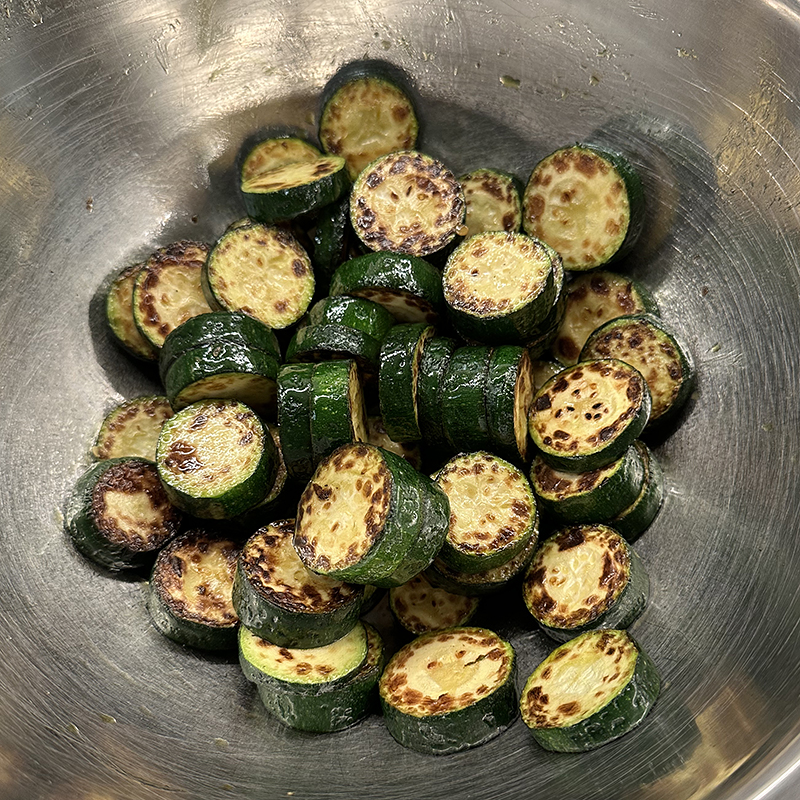
And if you slice it thick and fry it in hot oil, it makes a delicious and not-too-soft addition to a pasta sauce. Or you can slice it thin and cover it with olive oil and salt (and maybe a little sugar) and put it on a baking sheet in a very hot oven until it’s crispy, and that’s rather good too. Or have it raw in a salad. However you have it, it’s brain food. My proof? You already know more than you did a few minutes ago because of it.

skedaddle

If there’s been sculduddery and you’re skittish, don’t dawdle – scat. Scatter. Skedaddle. Put departure on your schedule. It’s no time for beer and skittles – let’s get out of here! Scoot, kiddo! Scat, laddy! Scud, daddy-o!

Skedaddle is a particularly American-sounding word, isn’t it? It’s from the same folks who brought you absquatulate. Well, not the exact same folks; this one seems to have shown up first about a half a century later than absquatulate, during the American Civil War. The first hit that’s been found in print for it is from the New York Tribune in 1861: “No sooner did the traitors discover their approach than they ‘skiddaddled’, (a phrase the Union boys up here apply to the good use the seceshers make of their legs in time of danger).” 

It caught on quickly enough, without need of a skilled tattler; fleeing was a popular activity at the time, and not just for soldiers but for others in the way: in 1862 we see a quote from the Illustrated London News, “I ‘skeedadled’ from the capital of the dis-United States.” It has that skidding, skittering sound, and a certain resemblance to some other words – scoot, scat, scatter, and an assortment of ones you may not have heard. Wiktionary reaches far and wide with an etymology by sound (which may or may not be sound etymology):

Possibly an alteration of British dialect scaddle (“to run off in a fright”), from the adjective scaddle (“wild, timid, skittish”), from Middle English scathelskadylle (“harmful, fierce, wild”), perhaps of North Germanic/Scandinavian origin, from Old Norse *sköþull; or from Old English *scaþol, *sceaþol (see scathel); akin to Old Norse skaði (“harm”). Possibly related to the Ancient Greek σκέδασις (skédasis, “scattering”), σκεδασμός (skedasmós, “dispersion”). Possibly related to scud or scat. It is possibly a corruption of “Let’s get outa here”.

I am skeptical of the Greek links, but am open to the influence of “Let’s get outa here.” I am at least as interested in Wiktionary’s list of synonyms:

flee, vamoose, skitter, scat, skidoo, take off, make tracks, beat feet, kick rocks, get lost, hightail

The only thing I’ll add to all that is that to me, this word has a less-than-completely-serious sound, notwithstanding its belligerent origins. “We gotta skedaddle” is a thing you’ll say at the end of a party or when you risk being late for your bus; it’s perhaps not a thing you’ll say if a tiger is stalking you or gunfire is erupting suddenly in the restaurant where you’re dining – well, unless you’re trying to downplay the seriousness of the situation. 

Which, I suspect, is partly why it caught on in the Civil War: its application to opposing soldiers has a certain mocking tone. But perhaps its frantic tone had more impact at the time – after all, unlike for me, it wouldn’t have been a word they were most used to hearing as kids from their Dad.

hoodoo

In the gloom and gloaming, hooded forms gather and loom in the amphitheatre, tall and peaked, inspiring terror. Who do you think they are?

As your eyes adjust, you see that the stony gazes are stones that you gaze upon, spires in terraces, not so much uncanny as in canyon. Hoodoo: you think they are?

The hoodoo is clear evidence of our propensity to see something more and other than is there – in this case, to enrich the sedimentary mentally into the eldritch. The striped reddish rank and file, so timelessly unmoving, were at one time very moving to the early white settlers in Utah and Wyoming, who referred to the area as “the goblin land.”

I grew up seeing hoodoos regularly; some are visible from the highway into Banff. They do, it’s true, have something vaguely creepy about them, as though, looking to an empty lot, you spied Lot’s wife. They present a vague semblance of a human form, greatly magnified, but rather than rising smoothly into the sky like a spire, they typically stand barely apart from a cliff, rough in shape as though clad in an ancient frowsy pilled woollen overcoat. It has long been thought that this is why they are called hoodoos: by association with hoodoo, magic, spiritual practices maintained by enslaved Africans – generally assumed to be a variation on voodoo.

There’s just one thing, though, that doesn’t quite make that figure. That hoodoo, also spelled houdou, is from Louisiana Creole, and the practices it names are spread throughout the coastal south of the US and in the Caribbean. Hoodoos, the stone pillars, are characteristic of high and dry mountain lands – like those Ebenezer Bryce and his wife settled in in the 1870s. Bryce set up right near a canyon that he described as a “helluva place to lose a cow,” with its labyrinths of stone pillars. Other people started calling the place Bryce’s Canyon, even though he not only wasn’t the first person to live near it (not by ten millennia) but wasn’t even among the first white settlers to be near it… and by 1880 he had left for Arizona.

The people who already lived near this canyon, which has the world’s highest concentration of hoodoos, were the Paiute; before them various other cultures had lived in the area, including the Anasazi. The Paiute had no connection to African culture or to Louisiana Creole – of course – but they did have a response to the stone pillars that seems near-universal: they saw them as like people who had been turned to stone (by Coyote, the trickster, of legend). According to the National Park Service, they named them with a word for ‘spirit’ or ‘scary thing’: oo’doo.

They also, of course, had a name for the place we call Bryce Canyon: Unka Tumpi Wun-nux Tungwatsini Xoopakichu Anax, which means ‘Red Rock Standing Like a Man in a Hole’. It’s safe to say that the name itself would scare off more English speakers than the place, which is a popular spot for tourists who can find the time to make the trip.

But anyway, we have these things that look like people but aren’t, named with a word that looks like another (semantically as well as phonetically similar) word but isn’t, found many places but most emblematically in Bryce Canyon, which has hardly any reason to be named Bryce… and also no proper reason to be named Canyon. A canyon is formed by erosion from a river or stream flowing at its bottom. This place was formed by a more general erosion from top and bottom (plus many freeze-thaw cycles every year). It is, in technical terms, not a canyon but an amphitheatre – or, really, several amphitheatres.

And those who do have the chance to visit it will scarcely believe their eyes.

deem, redeem

Redeem appears in a couple of contexts: (1) saving souls and (2) savings bonds (and other similar coupons and fiscal tokens). In the first instance, your saviour redeems you – pays for your sins, preempting your punishment at the final reckoning and getting you an exemption from the dumpster of doom. In the second case, you redeem your savings bond or coupon – or is it that your bank (or chosen emporium) redeems it? Anyway, you bring it in and hand it over and get your money for it. The obligation is discharged. Either way, it’s redemption! And you come out ahead.

So the question is, if that’s re-deeming, what is deeming? 

Well, what do you deem deeming to be? That’s up to your judgement, in a way. If you deem something worthy, are you making it worthy or just estimating that it already is worthy? What kind of reckoning is it? 

In fact, we use deem to mean judge in both senses, ‘appraise’ and ‘pass sentence’ – and both senses date all the way back to Old English.

OK, but then, if deeming is judging, why is redeeming re-deeming? Is it a second estimation? A revaluing? Is it from a sense of deem meaning ‘ascertain value’? And also, does that mean that any act of deeming is demption

If I were you, I would think twice before buying any of that, but, you know, caveat emptor – “buyer beware.” 

Oh, do you see that emptor? That’s the word that means ‘buyer’; it comes from Latin emo ‘I buy’, and not because shopping is an emotional experience (emotion is not related – it’s from e- ‘out’, a variant of ex-, plus the same root as motion, and the original sense was to do with stirring or disturbing). This emo – em-o, the root is em- – appears in emporium, and the empt version (which is unrelated to empty) shows up in English words such as exempt (from Latin roots meaning ‘buy out’ – because ex- is ‘out’), preempt (backformed from preemption, ‘buying first’ – i.e., before someone else can), and redemption.

Yes indeedy! But then if emption is buying, what is red-? Does redemption mean ‘buying with something red (e.g., blood)’? 

You know it doesn’t. Redemption means ‘buy back’ – because re- is ‘back’ (it doesn’t always mean ‘again’). The d shows up just because re- is red- before vowels (like e- vs. ex-).

So, yes, when your eternal soul is redeemed, it is because your debts incurred by your misdeeds have been paid – bought back. And when you redeem a bond, it’s… well, originally it’s that the bank is the one redeeming, technically: they’re buying it back. But since the transaction is redemption, the sense acquired a reversal of direction.

And where does that leave our verb deem? Out of the question altogether. It’s from an old Germanic root for ‘judge, decide, believe’ – originally applied to literal judgement done by literal judges, who were there to sentence – to deem – but not to redeem. They were the deemsters! Or, with shortening of the vowel and an added p thanks to voicing pre-assimilation, the dempsters

Yes, that’s right, it’s the dempster who dooms you to the dumpster of death. And yes, doom is from the same root as deem and dempster – the heavy eyes ee of the judge who may deem are swapped for the popped eyes oo of the person facing doom… unless they are redeemed. Which may be possible, but is not etymological.

pernickety, persnickety

There are some pervasive misconceptions of editors. The humble word midwife is pictured as a kind of sneering, snickering, prickly, pernicious nitpicker, peering down every grammatical snicket in search of perfidy with a prurient, almost pornographic concupiscence for impertinent solecisms, enforcing pure lexical trickery purely for the purpose of putting poor scribes in the nick. In short, editors are thought of as persnickety.

Or should that be pernickety?

Hmm.

First of all, I must protest that it’s not true: a good editor is not a grammar numpty. A decent verbal massage therapist is in no way a textual Torquemada. Good editors are kind people who want the author to do as well as possible. (Yes, there are bad editors, but they are very much the minority. And those people who freelance unsolicited with markers on signage are rank amateurs, and pretentious creeps at that.)

Now let’s move on to the word – or words – of the day. Perhaps you have only ever seen one of the pair, or perhaps you have seen both; you more likely than not have at least a preference. But which one is the right one?

Ha. Both are established and accepted. I will brook no pernicketiness or persnicketiness about this. If you accept that we have both person and parson, both vermin and varmint, both further and farther, then you can accept that we have both pernickety and persnickety.

Which came first? That we do seem to know: pernickety was seen in print as early as 1808, according to the Oxford English Dictionary, while persnickety is known just since 1885. Also, pernickety started in Scotland and still prevails in Britain, whereas persnickety seems to be predominantly North American.

It’s not entirely clear why the s appeared. Some have suggested influence from snicket, though the first sighting of snicket as such was not until 1898 (it’s a narrow passage between buildings, in case you’re not sure – and it is not obligately lemony, either). Others have suggested that it’s just a substitution of snick for nick, which, yes, OK, but what does that mean? Well, snick could be an alteration of sneck, which is a Scottish word for – not snake! – ‘cut, notch’… which, as you may connect, nick also means.

Of course, nick means a number of things. You could be in good nick with Saint Nick, or down in the nick with Old Nick. But while Nick comes from Nicholas (which comes from Greek for ‘victory’ plus ‘people’), the other nicks come ultimately from the same nick, which, as noted, has to do with a notch, possibly (you’d think) related to nock as in the place at the back of an arrow where the bowstring goes. That in turn is… apparently not related to various similar-sounding words in various other languages, such as German nicken and Swedish nicka, which both mean ‘to nod’.

OK, but what about the per- and that rickety -ety ending? As far as we can tell, this is the same per- as in perfidious and pernicious and perseverant and even perhaps: a Latin root meaning ‘through’ that has gotten all through our language, even mixing with non-Latin roots (like hap). It seems perfect for the task. And the -ety certainly has a somethingness to it, but to some extent this word is responsible for that. It’s suggested that the -et- comes from -ed, as in the past participial suffix. The -y is the usual adjectival suffix, as in funny and happy (oh, hi, hap, what luck to see you again).

And it all comes together nicely enough. And frankly, the sound of it happens (happens!) to work with it too, in its polysyllabic way: per(s)nickety is to fussy what discombobulate and absquatulate and copacetic are to break and scram and fine – it expends needless additional energy in a punctilious display of painstaking conscientiousness, like some wanton nitpicker seeking to make a victorious mark on public signage. It presents itself as fastidious by being slow and tedious. But it’s plenty of fun to say.

calamity

What do you get when calm amity is alarmed by calumny and a call to military arms? Why, calamity, Jane.

Calamity names a bad thing – just about the worst – but it sure has an appropriate sound. To me it’s like a metal pot and lid falling to the floor, or perhaps an alarm bell on the wall in the hall ringing us all to panicked action.

But what is a calamity? If a house burns down, is the calamity the fire, or the loss of house and home? Or was it the match and the wooden timbers awaiting ignition? Per the Oxford English Dictionary, in English, at least, calamity was the effect first, and after that the cause: by 1490 calamity meant “the state or condition of grievous affliction or adversity; deep distress, trouble, or misery, arising from some adverse circumstance or event”; by 1552 it also meant “a grievous disaster, an event or circumstance causing loss or misery; a distressing misfortune.” So the loss of home is a calamity, and the fire that causes it is a calamity; but then we could also say the fire-prone conditions in presence of loose matches were a calamity, since they were the cause of the fire.

And, perhaps, so on. “Fortune is not satisfied with inflicting one calamity,” as Publilius Syrus is often quoted. This is not to say that bad luck comes in threes, but at least it’s either none or more than one. But can you separate cause from effect? Does not one carry within itself the seeds of the other, and the other on its branches bear the seeding fruit of the one? Thought, word, and deed come in order, but deeds lead to more thoughts, and so to words… Once you start the cycle, it keeps going – enough is never enough. Better to break the cycle… if you can. 

Can you? And how? Hamlet had thoughts:

There’s the respect
That makes calamity of so long life.
For who would bear the whips and scorns of time,
Th’ oppressor’s wrong, the proud man’s contumely,
The pangs of despis’d love, the law’s delay,
The insolence of office, and the spurns
That patient merit of th’ unworthy takes,
When he himself might his quietus make
With a bare bodkin?

That seems piercingly drastic, though. Why not simply elect to say enough is enough? If you go into one undiscovered country, after all, there may be more to follow. Laozi (Lao Tzu) – if there was such a person; he may just be a convenient fiction for the assembly of truisms – in his Dao de jing (Tao Te Ching; number 46) wrote,

禍莫大於不知足;
咎莫大於欲得。
故知足之足,常足矣。

Which can be translated variously, but Mary Barnard rendered it this way:

There is no calamity greater than lavish desires.
There is no greater guilt than discontentment.
And there is no greater disaster than greed.
He who is contented with contentment is always contented.

And John C.H. Wu made it this:

There is no calamity like not knowing what is enough.
There is no evil like covetousness.
Only he who knows what is enough will always have enough.

Calamity in both translates 禍, huò, which can also be rendered as disaster or catastrophe; 禍 is formed from a radical 示 that, to quote L. Wieger’s Chinese Characters, has the sense of “influx coming from heaven, auspicious or inauspicious signs, by which the will of heaven is known to mankind” – it was formed from two horizontal lines signifying heaven and three vertical lines representing what is hanging from heaven (the sun, the moon, and the stars). The other translations of 禍 give us some pictures: disaster is from Latin for ‘bad star’ (like Romeo and Juliet, the star-crossed lovers – as Friar Laurence said to Romeo, “Thou art wedded to calamity”); catastrophe is from Greek for ‘down-stroke’ or ‘overturn’. But calamity

There’s the respect that makes calamity of etymology. For, you see, calamity comes from calamitas, which means ‘loss, damage, harm, disaster, misfortune, et cetera’, but we’re not sure what calamitas descended from. Latin writers seemed to think it had something to do with calamus ‘straw, cornstalk’, but their explanations were a bit of a shipwreck. More modern scholars have reckoned it comes from calamis ‘damaged’, which seems right, but the problem is that it’s really *calamis – it’s a deductive reconstruction of a word that has not actually been seen in historical sources.

Meaning it came from somewhere, but, as with many a calamity, we’re not entirely sure where. The chaos of linguistic history is like the chaos of climate or of myriad other things: a butterfly flapping its wings – or a cornstalk breaking – might set in action a chain of events that lead to history-altering calamities. Or, on the other hand, it might simply be absorbed in the quotidian noise. And who knows which will eventuate?

Perhaps fortune does. …wherever fortune comes from. And as Darius Lyman’s version of Publilius Syrus’s Sententiæ says, “Fortune is not satisfied with inflicting one calamity.” The Latin original for which is…

…nonexistent. Sorry, you can (as I did) go at length through the original, searching and searching, and you won’t find a Latin equivalent of that. It turns out that Lyman was, hmm, fortune’s fool, or anyway fooling with fortune. The point is that he managed to include various verses in his version that can’t be traced to the source. They’re just convenient fictions, it seems, spontaneously generated.

Well, at least they’re true. Or are they? They’re sententious, but, you know, “words, words, words…”

Or, as the Duchess of York (the woman who gave birth to Richard III) said in Shakespeare’s Richard III, “Why should calamity be full of words?” And, I suppose, for the sake of conversation, why the converse as well?

canny, canty, uncanny

You know uncanny, of course. It’s sort of like what you experience when your grip on reality is tested – when your even-canning factory is offline so you just can’t even. But can you say what canny is? And, for that matter, do you know what canty is? Allow me to descant on this triad.

You probably haven’t encountered canty, though if you say it’s the opposite of canny, you’ll oddly be about right. Naturally, you would expect the opposite of canny to be uncanny, and at one time that was true – though not any longer – but it does not follow at all that canty is a synonym for uncanny. In fact, there is a clear line that can be drawn between the two (unless one is uncannily canty, which would be a real edge case).

Let’s start with canny, can we? The can in canny is not beyond our ken; it is and is not the same can as in Yes, we can. It is not, in that can is now a modal auxiliary conveying ability (that other can, the container, is a whole other can of worms, etymologically unrelated); it is, in that the auxiliary can comes from the same source as canny: the Old English verb cunnan, ‘know how, be able to’. If you know German, you know cunnan’s cousin kennen, which has the same meaning – which also reminds us that ken is from the same (d’ye ken? Oh, and the name Ken is unrelated; it’s short for Kenneth, as you may know, and Kenneth is from a Celtic name that has to do with fire and old flames, perhaps from someone’s Barbie).

Anyway, canny can have the sense ‘knowing, astute’, and it’s from that that we get the sense ‘prudent, cautious’, which is the more common usage now (meanwhile, there’s a Scots use of it to mean ‘friendly, pleasant’ – “a canny lad” is a nice fellow, not a cagey one). But the negation, uncanny, has come to mean not ‘unknowing’ or (as it once did) ‘incautious, careless’ but rather ‘unknown’, i.e., ‘beyond ken’ – in that eldritch realm of impoverished knowledge (and so also an uncanny, weird person – or, for that matter, a robot from the uncanny valley – is untrustworthy, opposite to a canny one). Something odd, not right, probably best left, even.

And how about canty, then? Well, that’s not just cant (cant meaning ‘slang’ comes via French from Latin canto ‘sing’, as does descant). But it’s also not just can’t – o, turn away from that apostrophe! It comes instead from the adjective can’t meaning ‘bold, courageous, lively, hale’, and in Scotland also ‘merry, cheerful’ (meaning that a Scot may be both canny and canty – don’t say it cannae be so). This adjective in turn comes from a German and Dutch word kant meaning ‘edge, line, border’ that, purely reasonably I’m sure (and according to a manual), came from Latin canthus ‘wheel edge’. The route from kant to can’t appears to be via senses of ‘neat’ and ‘sharp’. (And we are inclined to think it is also related to cant meaning ‘tilt, bevel’.)

And yet somehow a person who is canty is not edgy, but someone who is canny is! It’s just uncanny how language can do such things, you know?