Tag Archives: word tasting notes

umbrageous

We usually like it when things are clear, when the sun shines through, when we understand the sense without a shadow of a doubt. But language is not always like that. Sometimes it’s outrageous. And sometimes it’s just… umbrageous. Shadowy, doubtful.

The word umbrageous may look like a less certain sibling of outrageous: you see the rage in the middle but instead of being right out it’s just, um, umb. But the rage is an illusion: outrage is taken from French and formed from outre (you may know outré, naming something that is just too extra), which comes from Latin ultra, ‘beyond’. Likewise umbrageous comes from umbrage, which comes from umbra, ‘shadow’. Yes, when you take umbrage at something, you perceive that you are having shade cast on you – and you can also give umbrage, meaning cast shade on someone, figuratively (or literally).

OK, but which is it? Is it umbrageous to cast shade, or to take shade (umbrage)?

Yes.

This word has (you knew it was coming) shades of meaning, and meanings of shade. A large tree with broad branches and many leaves is umbrageous: it casts much shadow. And the area underneath it – like the plants that prefer to grow there – is umbrageous: it is in shadow; it takes shadow.

Likewise, if I throw shade on someone – if, for instance, I say of a chef “His restaurant has excellent butter, and the water is nice and cool,” or if I say of a singer “Her recital was a wonderful expedition in search of the lost key” – I am being umbrageous, and if on the other hand someone is inclined to take offense at something I say – such as the time in my lunkish youth I said of a fellow actor’s shirt, “Oh, Le Chateau, that must have cost a lot,” and he replied “Why are you such an aaarsehole” – they are being umbrageous. (And this latter sense is, I should say, the more common.)

Well, sometimes you cast the shadow, and sometimes the shadow is cast on you. Either way, it is – you are – umbrageous. It may seem odd to conflate the cause of shade with its recipient, but remember that the underside of a tree is also in the shade, and that when, for instance, Percy Bysshe Shelley wrote of “The umbrageous loveliness of the surrounding country,” it covered both aspects of the matter.

Of course, people who take umbrage often create their own shade, and so in a way of seeing it are umbrageous in both senses as well – as one L. Hansen wrote in 1802 (thanks to the OED for this, and note the variant spelling), “Most punctilious with respect to forms and Ceremonies: and excessively ombrageous, with regard to the Non-observance of trivial points.”

I am reminded of the word nauseous: on the one hand, it is normally used to mean ‘feeling nausea; queasy; nauseated’; on the other hand, there are people who will inform you crisply that it can only mean ‘causing nausea’, and will imply that you are an illiterate barbarian for using it the way it is nearly always used. Those people, you see, are also umbrageous – in both senses: they take umbrage at the usual usage, and they throw shade at those who use it.

moble

We must moble; we must not be mobile; we must not be mob-led; we must be mobled. So may we be both hobbled and ennobled. Wrap a scarf around your face and giggle demurely; peer past the wool or tulle like a vagabond or mobster or some marbled statue; wait for the time when you may again be emboldened.

I’m sure you, like me, know this word first from Shakespeare, reading Hamlet by the firelight: the prince is watching the players rehearse, and one of them, narrating the fall of Troy, says “But who, O, who had seen the mobled queen—” Hamlet (like many a listener) says “‘The mobled queen’?” and Polonius replies, “That’s good; ‘mobled queen’ is good.” None of which helps you to know what it means.

Nor helps you to know how to say it, by the way. I suspect that you, as I, assumed it rhymed with “nobled.” But no. It rhymes with “hobbled.” And, I say with relief, it is (unlike contumely) the part of speech it appears to be: a past participle, pressed into use as an adjective. The verb is moble, a word uncommon enough that your autocorrect will get into a fight with you over the absence of an i between and l.

And what does it mean? Muffled, scarf-wrapped. I’m sure that wearing a surgical mask counts too. In 1985, A.S. Byatt used it in Still Life: “He remembered this time in very bright, clear primary colours, but all softly muffled, or mobled, as if seen through white veiling.” In 1926, Victoria Sackville-West wrote in Land “How delicate in spring they be / That mobled blossom and that wimpled tree.” And in 1877, the Earl of Southesk was kind enough to use it in Meda Maiden in a way from which the sense may be deduced: “There rested a woman,—close mantled in brown, / Mobled and muffled from sandal to crown.”

Why is said it like it comes from mob? Perhaps it does – one speculative etymology ties it to mob plus the frequentative –le suffix. But perhaps it does not. (Note that mob in turn comes from mobile vulgus, ‘rabble, common people’, and does not show up in English before moble does.) It has a certain kinship with muffle in form as well as sense, and mobble used to be a spelling of it (the one-version prevailing probably because that’s how it was spelled in editions of Shakespeare and that’s where nearly everyone who knows it knows it from).

Well, some things just show up and no one has the last word on how they got there or how they spread. So it is. But if you don’t want them to spread further, you can stay in your bubble, or, if you must venture out in the mob, you can self-moble. You may feel hobbled, but it is more noble.

twill

Take a bit of twill fabric and rub it between your fingers. It is not so smooth as satin, nor even as a plain weave; it is rough, it has ribs, it has traction. Whether it be cotton, or wool, or even silk, it grips. It does not shine, nor does it whiffle like corduroy as you ruffle it, but ’tis rugged and ready: ’twill serve. It is not a thrill from the mill, but it is twill.

How is it made? It starts one way but then skips ahead. Where in a plain weave your weft (cross thread) goes under your warp (long thread) and then over and then under and then over, in twill it goes under and then over and then over again, and sometimes again: a repeat, a three-peat, maybe even a four-peat. Sometimes it goes under more than once before going over. And the next thread is offset by one alternation, so that a diagonal pattern is formed.

Want to find some twill? Skip your suits and head to your jeans: denim is made with a twill weave. It’s not that twill is never used for formal wear – you’ll see some on the couture runways – but it’s more rugged and less prone to showing stains and smirches.

And the name, twill? So many names of fabrics come from places – denim is from serge de Nîmes, satin is from Zayton (the medieval Arabic name for Quanzhou), tulle is from Tulle. But twill comes from two places: Rome and England.

OK, I’m going diagonal; it’s obviously not a blend of those two place names. It’s just that it started as Latin bilix, from bis ‘twice’ and licium ‘thread’, but then it skipped ahead and turned that bi into two to make Old English twili, which became twilly, which became twill. (There was originally a thrili to go with twili, but it’s all just called twill now.) It’s sort of like how we went from repeat to three-peat – and then back to two-peat.

Two-peat? Yes, that’s in use; I wrote about it years ago. You are free to dislike it, but it is in use, especially among a set of people who wear twill more often than satin, and like it or not, it will serve. And if you will call twill twill, as one does, you have one less basis for objecting to word forms developing diagonally… as ’twere.

finagle

Finagle: procure by deceit or trickery. Tangle your fingers into it and snag it away. Or talk it out of someone with your gift of the Blarney.

Supposedly finagle comes from an earlier English word fainague, from French roots meaning ‘act’ (feign) ‘sick’ (ague). Never mind that acting sick has to do with indolence, not with procurement. Never mind that I can only find this word fainaigue as the conjectured etymon of finagle. I’m not saying that there definitely was no such word; I’m just saying “Hmmmmmm.”

The first documented use that I (or Oxford) can find of finagle in its modern sense is a 1926 citation from the USA. Google Books gives me further hits that show it was established in use in the USA (though as a colloquialism not familiar to all readers) by the 1930s, though some claimed it came from England. Oxford seems to think it came first from England but doesn’t produce evidence. Wiktionary presents it as American. There are also a couple of variant spellings, presumably from people who heard the word said and spelled it how they thought it was likely written – phenagle is notable, because it shows the cod-sophistic association of ph.

So can we finagle some kind of explanation for this word’s presence in our language?

I should say that there are earlier hits for Finagle in Google Books. It appears as a name in two works of short fiction of the 1800s. The first, in a volume dated 1821, Winter Evening Tales Collected among the Cottagers in the South of Scotland, by James Hogg, makes it the name of a town in the south of Scotland. The second, appearing first in Scribner’s Monthly in summer 1872, in a story by John S. Barry, makes it an Irish family name. The latter, titled “Shane Finagle’s Station,” is as thorough a slander of stereotypes against the Irish as you would ever wish you had not cast eyes on, and it features an assortment of peasant rogues blathering their way through catechism and confessional before ending with a massive drinkfest. But there’s nothing other than bare resemblance of form to link these Finagles to our word finagle.

Also, there’s nothing in those two fictions to say how the names should be said, and one could easily imagine a stress on the first syllable intended – compare Fingal and Finnegan, after all. With our word today, on the other hand, the stress is decidedly on the second syllable, and phonaesthetically, that makes an important difference.

Consider if the stress were on the first syllable. The word would have the same kind of pattern as miracle or risible or any of a number of other tumbling trisyllabic words with various effect. The most important bit would be the fin. But as it is, that’s just a flick of the fingers as they reach to grasp the main business.

And the main business has a –gle on it, one that has a stressed syllable right before. There are many words of that form in English, some with before the gand some not, but have a look at this selection: boggle, bungle, dangle, dingle, dongle, newfangled, gaggle, gargle, giggle, goggle, gurgle, haggle, inveigle, jangle, juggle, mangle, mingle, muggle, snaggle, spangle, squiggle, straggle, struggle, tangle, tingle, toggle, waggle, wangle. Nearly all of them are formed with the old –le frequentative suffix, used to make verbs referring to repeated action, but there’s something more in many of them: a certain disorder, disarray, loose motion, or chaotic or uncontrolled or messy nature. There are certainly words of the –gle form that don’t match that meaning at all – beagle, eagle, and triangle come to mind – but we form impressions of what senses go with what sounds mainly from general habitual association, and we can always allow exceptions for familiar words.

There is, I am inclined to think, some sense of complication and disorder in what’s meant by finagle. Consider that Webster’s Third New International defines it with reference to other terms that include wangle and swindle, which have similar phonaesthetics (swapping the in for does change things a little, but they differ only in the tongue’s contact point when saying them). It’s not to say that the word sprang up just because the form demanded it! But when people confect terms, the ones they choose and the ones that stick tend to have sounds that catch on for a reason.

And often more than one reason. Let’s be honest: finagle does have a bit of an “Irish” sound to many English-speaking ears, doesn’t it? I don’t think it has any real “French” sound, fainaigue be damned. But the idea that some Blarney-tongued dissolute Finnegan might charm something out of someone by finagling– well, it doesn’t altogether run against English-speakers’ easy-minded stereotypes, and it goes with the –gle association too.

I’m not saying that’s where finagle comes from. I’m not even saying these things definitely had an influence on it. I don’t have data to support the conjecture. But if it had to come down to it, I think it’s an easier idea to talk someone into going with than many another might be.

corvid

Today I want to talk about corvid (the word and the bird).

This is a corvid. (Photo by Tyler Quiring.)

This is a COVID. (Artist’s rendering, courtesy of the CDC.)

This is neither, though it looks like one and it looks like it’s meant for dealing with the other. (It’s an illustration of Dr. Schnabel, a 17th-century plague doctor in Rome, by Paul Fürst.)

Corvid is a name for any member of the large family of birds known as Corvidae, which includes crows, ravens, and actually quite a lot of others: choughs (not coughs!), treepies, magpies, nutcrackers, jackdaws (which are really just more crows), and various jays

Corvids have relatively large brains and have been found to be as intelligent as some primates – and smarter than your dog or cat. Crows and ravens are even smarter than raccoons. Which also means that they have an… ambiguous place in mythology. Crows and ravens are thought of as smart – and as tricksters. They’re often associated with death.

On the other hand, corvids come in many different forms, and some of them (magpies) are more famous for stealing and collecting things. Which is quite fitting, because their names have mutated like a virus over the ages, resulting in quite a collection of forms.

The Latin for ‘crow’ is corvus, which has descended to many fairly plainly related forms: French corbeau, Spanish cuervo, Italian corvo, Finnish korppi (stolen from Swedish korp). They all trace back to an ancient k-r-w source… which may or may not be related to the source of crow, since the in crow is historically comparatively new.

Sounds change, as you can see. The can become or or even p. And the can become h, and sometimes an disappears. That’s what happened with hræfn, the Old English word that became raven.

The raven is Corvus corax. What’s the corax? It’s the ancient Greek for ‘raven’ or ‘crow’: κόραξ. And, yes, there’s a and a there… and it also seems related etymologically to raven, via an impression of the loud sound the bird makes. But, though they all relate originally to noise, raven and corax are not definitely directly related to corvus or to crow, which, just, come on.

Corvus corax, by the way, is also the name of a musical group that is among the most metal of medieval impressionists.

You may well wonder whether this is also related to some flattened version of curve, since, after all, there’s that k-r-v and corvids have shown they can throw a few curves. The, answer, however, is no… but curve traces back to a Proto-Indo-European root with many descendants, including not just curve but cancer, crisp, crux, and corona, as in Coronavirus. Which seems a little starker than raven.

But corvids have nothing in specific to do with COVID. We don’t even know (at the moment) if they can carry it. They can, however, say what we all want to say about it:

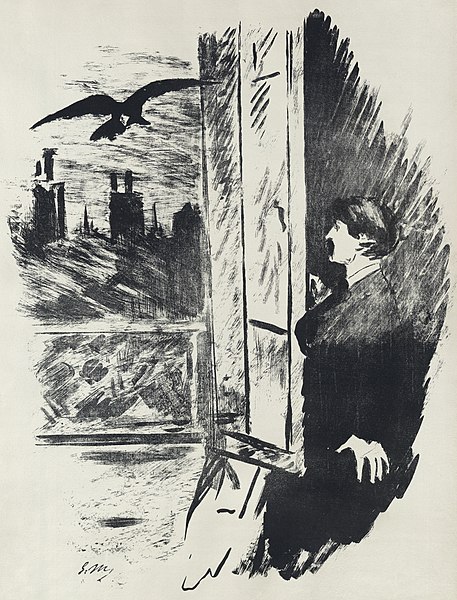
“Nevermore.” (Illustration by Édouard Manet.)

basil

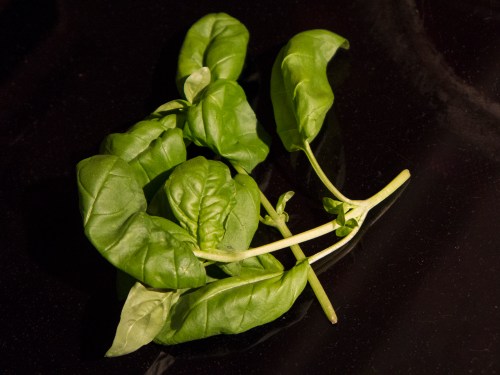
Ocimum basilicum, the herb of kings and king of herbs, an herb so basic as to be only one letter different from basic. But at the same time, as kings are wont to be, a herb that does not blend into the background, a herb that will be different just for the sake of being different, even having pronounced differences with itself.

Pronounced? You don’t believe? Like herb itself, basil has a choice of two ways to say it. Look in a dictionary: while the supervenient pronunciation rhymes with dazzle, an accepted alternate rhymes with hazel.

Weirdly, I first learned neither of those pronunciations. You see, I had a great-uncle Basil whose name was said like “base’ll” – that is, with a “long” and a voiceless s. So it did not exactly go with hazel. Which is amusing, because his wife’s name was… yes… Hazel. (But his name had always been said that way, even before he met her.)

Anyway, on the basis of my uncle, I assumed that that was the proper pronunciation of basil. When a kid’s TV show I watched had a character named Basil the Beagle, I assumed his name was spelled Bazzle. I mean, wouldn’t you, anyway?

But this herb is not avuncular. I love it, to be sure, and use it in tomato sauces and soups whenever I can (among other things), but I learned an important lesson when I once told my housemate “It’s impossible to use too much basil.” The dude proved me wrong decisively. And allow me to inform you: an excess of basil produces a truly horrible flavour. Just as basil can be (as in Portugal) a token of love or (as in ancient Greece) a symbol of hatred, its effect on your food will vary very much according to the dosage.

This is not to say that basil is tyrannical in a dish. It is not a tyrannos; it is a basileus.

I’ll explain that. Tyrannos, more accurately τύραννος, means ‘king’ and is the term applied to Oedipus in the play Οἰδίπους Τύραννος, most often called Oedipus Rex from the Latin but translated into English as King Oedipus (I’d make that King Piercefoot). But it is also the root of tyrant, which gives you a little sense of what kind of king we mean: an absolute ruler, a dictator, a despot. On the other hand, βασιλεύς, basileus, also means ‘king’ but otherwise means ‘chief, master, patron’, so it’s maybe a little more agreeable. Unless you go too far, take a risk, and it becomes a basilisk: a mythical snake-dragon with a deadly gaze and a name that comes from the same kingly root. So, overall, uh… like a boss.

But basil also has holy overtones. And by that I don’t just mean holy basil, which is a different (but related) herb also called tulsi. I mean assorted saints, especially in the Eastern Orthodox church. You may know that the big church on Red Square in Moscow is Saint Basil’s Cathedral – well, that’s its short, unofficial name. But which Saint Basil is it named after? There were several, about half of them bishops: not quite kings, but men of power and influence. The Saint Basil in honour of whom this magnificent cathedral took its common name (though not until more than a century after its construction) was a holy man who is now buried in it, a man who once rebuked the man who had the cathedral built, Ivan the Terrible (a terrible translation of Иван Грозный – Ivan the Fearsome would better), for not paying attention during church. He is called Василий Блаженный, commonly rendered in English as Basil Fool for Christ. He went around wearing shackles and literally nothing else, destitute by choice, and he had Ivan the Fearsome himself as a pallbearer at his funeral and now is memorialized by a building that epitomizes everything he wasn’t – especially since it’s no longer even a functioning church.

A small further digression must be permitted. Василий is not pronounced “Basil” however you say “Basil”; it is the name normally rendered in English as Vasily or Vassily or Vasiliy or… You know, as in Wassily Kandinsky, whose paintings are as colourful as that cathedral, but with different structure and a different palette. The /b/ of Ancient Greek eased off to a /v/ in modern Russian, and in several other languages – including modern Greek, in which β has also softened to /v/, sort of like how basil’s flavour softens when it has dried.

If you have a kitchen with a standard collection of herbs and spices, you almost certainly have flakes of dried basil. You can shake some into your hand and taste it. Yup! That tastes like basil! As in the stuff you put into spaghetti sauce (along with oregano). It’s vaguely sweet, with reminiscences of chamomile, mint, and anise, and maybe a bit of hay. But do you have access to some of the fresh stuff? Take a leaf and chew it. It’s recognizably the same herb, but the dials have been turned up from 2 to 10, except for the anise dial, which is somewhere between 13 and 20, and there may be a hint or three of your neighbour’s lawn. Its taste suggests that if it were a person, it would be trying to decide whether to kiss you or kill you.

My edition of the Larousse Gastronomique (1960), in translation by Marion Hunter, paints a picture of an erstwhile grand dame: “Basil . . . Plant cultivated in gardens for the sake of its fragrance. . . . Basil was once considered a royal plant; only the sovereign (basileus) could cut it, and even then only with a golden sickle. The plant has now come into common use.”

Oh, but don’t take their word for it (no, seriously, don’t). Throw a naked leaf or three into a sauce. It will beatify the sauce. (Throw in two dozen and it will murder it.) And when you get to the leaf, soft and soggy, it will not resist you like a bay leaf; it will go easily into your mouth, where it will at its last remind you that it was once, and still is, royalty.

And yet it has the common touch, and really always has. Look, here is a recipe, presented to us by Achille Bruni, Professor of the Royal University of Naples, from his Nuova enciclopedia agraria (New agricultural encyclopedia) for “Genoese low-fat lasagne,” which they already had back in 1859 (and if you want to quibble with the spellings, click that link and check it for yourself):

Lasagne di magro alla genovese. — Cuoci in acqua con sale le lasagne, le quali riesciranno più saporite se avrai fatte in casa. Intanto per condirle metti in un mortaio due e tre spicchi d’aglio, foglie di basilico in abbondanzo e alquanta polpa di cacio di Roma, o d’Olanda, o di Sardegna, secondo il gusto, e pesta tutto ben bene; aggiungi dell’olio fino in quantità, e tre o quattro cucchiaiate dell’acqua stessa in cui cuocono le lasagne. Quando queste son cotte, colale e condiscile suolo per suolo col pesto che hai preparato, aggiungendo ancora del formaggio grattato.

Here is a translation (mine, with some help from Google and Wiktionary):

Genoese low-fat lasagna. — Cook the lasagna in water with salt; it will be tastier if you have made it at home. Meanwhile, to season it, put in a mortar two and three cloves of garlic, basil leaves in abundance and some ground cheese from Rome, or Holland, or Sardinia, according to taste, and pound everything well; add fine oil in quantity, and three or four spoonfuls of the water in which the lasagna is cooking. When these are cooked, strain them and season them layer by layer with the pesto you have prepared, adding more grated cheese.

Remember: foglie di basilico in abbondanzo [sic]: basil leaves in abundance. Ma non troppo, sai?

bummerism

“There is bummerism in politics – in fact, it is the heart core.” Thus wrote an unnamed author in Varieties, of San Francisco.

Bummerism? Yeah! Politics is a total bummer, and it’s full of people who are total bummers too, like, y’know, dude? It’s such a downer, like a real drag. But that’s not quite what the author meant. Here’s another quote, from Denver’s Rocky Mountain News, that might help clarify the sense: “Corruption will run riot; bummerism and bribery will walk rough shod over decency and honesty.” It seems (and I take the word of the Oxford English Dictionary on this) that bummerism is corruption, or venality, or laziness – conduct characteristic of a bummer, which in this case is a kind of person: someone we might also call a bum.

You see how that would trace, right? A bum bums and so is a bummer, and bummerism is being like a bummer. Likewise, the more common modern sense of bummer is that the thing is bum, meaning ‘bad’, as in had a bum trip or got a bum steer. And from that we go back to bum, which has been brought to us by posteriority. Right?

Sorry, dude. Big bummer. That’s not how it goes. But the truth might ring a bell.

There’s one bit that’s basically right: bummer as in “That’s a real bummer, dude” does come from bum meaning ‘of poor quality’. But the rest? The relationship of bum to bummer is, in fact, like the relationship of edit to editor: the word that looks like it is a derived form is the one that actually came first. Edit is formed from editor, and when an indolent, indigent person is called a bum (which is also apparently the source of the bum that means ‘of low quality’, but is not related to the bum you’re sitting on), that is a backformation of bummer, meaning ‘vagrant’ and related things. Bummer in its turn most evidently comes from German Bummler, ‘unemployed person, wandering vagrant’, from the verb bummeln, meaning ‘wander, ramble; dawdle, laze’. It seems (it has been asserted by at least one established source) that bummeln comes from ‘swing back and forth like the clapper of a bell’ – you know, “boom-boom,” as we would write it in English, or „bum-bum“if you’re German.

Do you feel led on by that etymological peregrination? Bummer, dude. But it kind of comes back around, if you think of bummerism in politics as being like the clapper of a bell, swinging back and forth and making noise for whoever pulls your rope.

And are you kind of bummed out by “walk rough shod” and “it is the heart core” in those quotes back at the beginning of all this? Well, what can I say? That’s how they wrote it back then. Which, by the way, was farther back than you might have guessed: the quote from the Rocky Mountain News was from 1883, and the one from the San Francisco Varieties was from 1858.

Plus ça change, eh? Well, what goes around comes around (especially if it’s just lying around). Oxford skewers this word with the obelisk of obsoletion, but there’s plenty of bummerism to go around these days, and I’m sure we could bring it back.

blunt

A long time ago, in the comic strip B.C. by Johnny Hart, a caveman picked up a trumpet-shaped piece of wood. He blew into it. It went “BLUNT!” He looked at it and said, “I’ve invented the blunt instrument.”

Blunt isn’t often applied to sounds, but it does have a good sound for what it means, doesn’t it? With the blowing, blasting bl and the abrupt unt?

What does it mean, though?

If I call a person “a bit of a blunt instrument,” I may mean that the person is dull, i.e., not too bright…

Hmm, notice the seamless shift from tactile to visual metaphor. Let’s say not too sharp, or not too acute, shall we? But more often when I describe a person as “blunt” or say they’re “being blunt,” I mean that they are not sugar-coating their opinions…

Hmm, that’s a shift to taste-based metaphor. I mean that their opinions come without padding…

Which is weird, because padding tends to be blunt – put some on a knife and see.

I don’t mean that what they say isn’t cutting, doesn’t hurt, doesn’t draw blood (figuratively); in fact, bluntness often does all three, in spite of its being the literal opposite of sharpness. But a person who is cutting is deliberately trying to hurt, whereas a person who is being blunt is just being direct, plain-spoken, et cetera.

Except when they are trying to hurt, even if they’re pretending they’re not. If I see someone trying to be hurtful, I probably won’t call them “blunt” – there are other, better words – but if a person describes himself (it’s not always a guy, but usually) as “just being bluntly honest,” then my experience is that they actually are trying to hurt, but they’re trying to get away with it.

Here’s what I mean. If a person says “I don’t like how that shirt looks on you,” that is blunt, and is probably honest (it’s a statement about their own reaction). But people who say they are being “bluntly honest” tend more often to say things like “That’s an ugly shirt” and “Why do you dress like that? Are you blind or just stupid?” This is not honest.

It’s not honest because it presents one person’s opinions and characterizations of the other – all subjective, based on taste, inclination, and interpersonal attitudes – as objective fact. It’s also not honest because it presents the speaker as objective (reinforced by the insistence that the speaker is being bluntly honest), thus implying that there is no subjective element, nothing that involves the speaker’s relation to the hearer.

A quick lesson in linguistics here: Every utterance – everything you say, write, gesture, etc. – draws on, participates in, and asserts a definition of the relation between you and the person(s) you are addressing.

Often the relationship is well-defined and unproblematic – you’re reading my blog for information and entertainment, for instance, and I’m writing it to provide some, and there’s nothing intrinsically degrading about either position. But there are many times when one person wants to assert a specific status relationship: often to claim a higher-status position, which is to say to dominate, to “put someone in their place,” to assert authority. (On the other hand, sometimes they want to claim a lower-status position, which also has its uses.)

When you say something that you have every reason to know will hurt, degrade, humiliate, or otherwise negatively affect another person, and you make no effort to acknowledge that, to mute its effect, or to accommodate their feelings, you are asserting a dominance relation to them (to which they may well object). If you claim that what you’re saying is simple objective fact, that reinforces and adds to the claim – it implies that your feelings and opinions are unquestionably important, and theirs are not worth considering – and attempts to make the assertion unanswerable. The possibility of treating the addressee as someone who does not need to be abused or demeaned does not enter the discourse, though in any reasonable world it would be the default position. Imagine a doorman at a bar who hits you with a club as you walk in and, when you object, he says, “I’m sorry that you would rather be stabbed! We don’t do that here! It’s a nightclub, dumbass!”

Which brings us back to blunt objects. While the figurative use of blunt has quite a wide range, it is at least all led by the literal sense, which is to say, having an edge or point that is rounded and not prone to severing or penetrating. Right?

So. A wall is not blunt; it’s flat. But a cricket bat is blunt because it has those rounded sides. Is an unattached sheet of plywood blunt? Generally I would say not, but if someone were to hit me over the head with one, I think I would not dispute its being called a “blunt object.” (Unless it’s the corner. The corner of a wall may not cut steak but I would not call it not blunt. I have stitches in my forehead to prove it.)

So blunt is ‘dull’, but only in the edge sense, not the light sense? We can’t speak of blunt light or blunt vision? I guess if we’re being poetic we can…

…or if we’re being historical. Because, not to put too fine a point on it, the original sense of blunt is not just dull but really stupid.

Sorry, I mean not just ‘dull’ but really ‘stupid’. The physical sense, referring to edges, is, as far as we can see, a transferred sense from an earlier sense that meant, as Oxford puts it, “dull, insensitive, stupid, obtuse” – and “said, it appears, originally of the sight, whence of the perceptions generally, and the intellect.”

This is because it seems – we’re not sure, at this distance, but it is distinctly possible – that blunt is originally related to blind. Its sense developed as unable to see, to perceive, and from that to understand; thence, not acute, not sharp; and so on.

And if we extend it to willful obtuseness, deliberate not seeing, then those people who cover abusive behaviour with the protestation that they are being “blunt” are being blunt – just in an older sense.

Oh, one other thing. If you’re wondering about Emily Blunt, Anthony Blunt, and all the other Blunts, and their distant kinfolk the Blounts (Blount is from the same origin as Blunt), that name comes from an old word meaning ‘having light-coloured hair’, and you should be able to guess what modern word for hair colour is descended from that. In other words, they’re not dumb; they’re blonde.

bay leaf

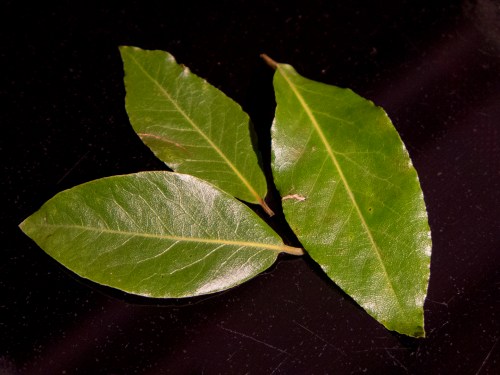
What is up with this leaf. Why even is there bay leaf? It sits in stews and sauces and it’s as easy to eat as a polymer five-dollar bill (this is a Canadian reference; Americans who don’t travel won’t get it, but most other people will understand). Bay leaf is like the quiet, dignified, hard-to-get-your-teeth-into guest at a party. No one seems sure why that person is there. And eventually you discover that the guest has secrets, and also secrets behind those secrets, and is nobility, and kind of famous under another name, actually more than one other name, and played a bigger part than you thought in the enjoyment of the party.

The bay leaf gets its name from its tree, the bay tree, which in turn gets its name from its berries; bay comes from an Old English word meaning ‘berry’ and is not related to the bay that means a convexity of water and concavity of land, or the bay that is a sound hunting dogs make, or the bay that means ‘reddish-brown’, and those aren’t related to each other either. Bay (the tree) originally meaning ‘berry’ is sort of like how deer originally meant any animal (especially any wild animal). If a deer eats a bay leaf, you have a nexus of semantic reduction and shift. (Makes note to self: cook venison in a bay leaf sauce and make a reduction. Uh, while wearing a shift, I guess.)

But most other languages do not call it anything like bay. Many of their names for it trace back to the Latin, which I have been holding back from you. The Linnaean name for the tree that makes this seasoning is Laurus nobilis. Which means ‘noble laurel’. As in the thing you make wreaths of, such as Julius Caesar wore. Which is how I discovered bay leaves and laurel leaves were the same thing.

I grew up reading Asterix comic books, you see. One of them was Asterix and the Laurel Wreath. In it, the chief of their Gaulish tribe makes a boast that he will serve a stew “caesoned with Caesar’s laurel wreath!” (props to Anthea Bell and Derek Hockridge for the witty English renditions). This helped me to notice that the container of bay leaves that sat perennially unperturbed in my mother’s spice drawer (an herbal pharmacopeia of dozens of Empress metal tins and McCormick glass jars plus a few Spice Islands glass jars and some flat plastic sachets) bore the French legend (we’re in Canada, remember) “feuilles de laurier.”

Laurier is, as seems guessable, French for laurel; it is also French for bay tree because they’re the same thing. You can see that the Latin Laurus over time cooked into French laurier, and English – because people don’t like having to say two r’s in a row – changed the second into an l. You may know of the English surname Laurel, as in Stan Laurel (who performed with Oliver Hardy). French people also get named after trees, and any Canadian ought to know that one of the great nobility of Canadian history is one such: Sir Wilfrid Laurier, the seventh prime minister. He’s featured on the five-dollar bill. I would like to say that French Canadians refer to five-dollar bills as feuilles de Laurier, but I have no evidence that anyone does. It doesn’t help that the fivers are blue; they might stand a greater chance of it if they were green (but that’s the twenties; in Canada the money is colour-coded).

Sir Wilf is not depicted wearing a laurel wreath, but I have to say, it would suit him. What is it about laurel wreaths? Is it that they indicate a well-seasoned person? In fact, the Romans didn’t start it. They stole it, like nearly damn everything in their mythology (but somehow not their politics or cuisine), from Greece. Laurel wreaths were a symbol of victory starting with the Pythian Games, which were held at Delphi in honour of Apollo.

I’m tempted to say Apollo got his name because his behaviour was appalling, but not really. In this case, however, the association between him and the laurel is that he lusted after a young woman who wanted to be chaste and didn’t want to be chased. When he wouldn’t leave her alone, she pleaded to the river god (Ovid says he was named Peneus, and no, don’t go there), who turned her into a tree. A laurel tree, in specific. And so Apollo, feeling either contrite or perdurably concupiscent, formed a special fondness for the tree and saw to it that the victors at the games would be adorned with leaves from the tree named after the object of his infatuation, whose name was…

…Daphne.

Yes. Greek for laurel (or laurus) is Δάφνη, usually rendered as Daphne – or, well, for the tree (not the person), δάφνη dafne. Various dictionaries assure me that laurus and δάφνη are etymologically related, but not one of them has the decency to say how. I can see that /l/and /d/ have the same place of articulation (tip of the tongue), and so do /n/ and /r/ (though that’s a weird flex), and it’s well known that /u/ and /w/ can turn into /f/ over time in the right context. But I’d still like some kind of string of evidence. It is not forthcoming. (Although, OK, if it were fourth-coming it would get no laurels.)

There are no great English poems dedicated to Daphne; as the Oxford Dictionary of First Names explains, “The name was not used in England until the end of the 19th century, when it seems to have been adopted as part of the vogue for flower names at that time” – so it showed up just in time for Daphne du Maurier (1907–1989). Before that you’ll more likely find references to Daphnis, as in Daphnis and Chloe, which is a masculine version of the same; since Daphnis is supposedly the inventor of pastoral poetry, he probably lounged under the branches of his namesake playing his pan pipe and singing to his sheep. The name Laurel also came into vogue at the same time as Daphne, as did the name Laura, which also means “bay tree” but comes by way of Italian (in particular it was the name of the girlfriend of Petrarch). Laurence was around already, but may or may not be related (yeah, it probably is, but you know how weird names can be; if Laurel can be from the same source as Daphne, then Laurence can also not be from the same source as Laurel).

None of this answers why people put laurel leaves – bay leaves – in stews and sauces. To know that, go get a bay leaf. If you can find a fresh one, so much the better, but at the very least, don’t do what I did and store them in the same jar as another bit of desiccated cortex: cinnamon bark. I now have cinnamon-flavoured bay leaves. Which is great, but I’ve bought some new ones for all those times I might need bay leaves that don’t taste like cinnamon.

Have you inferred that I don’t use bay leaves too often? It’s true. They’re a nuisance. But they do have a nice flavour! You won’t know what it is by smelling them. You won’t know what it is by licking them. You need to bite one with your incisors, repeatedly. Then you will get a flavour that is in the range between oregano and basil, with hints of mint and strong notes of “oh, that’s what that is!” You can also buy powdered bay leaf. You will get a stronger taste sensation from it, but then your mouth will want to know exactly why you put that dry powder into it, sir or ma’am, and will become a little bitter about it too.

Bay leaves have long been used in cooking. They are a key ingredient of the bouquet garni, the compulsory French seasoning. They are also found in various pickling recipes, as well as recipes for assorted other savouries that involve simmering a liquid for long enough to get the flavour out of the damn things. Here is a recipe from the sixteenth-century court cookbook of the Prince of Transylvania, yes actually, in translation by Bence Kovacs, edited by Glenn Gorsuch:

Italian sardine.

Cook the sardine like this. Wash it and add salt to the fish like I told you among the other fish. Prepare its sauce like this. Wash the salt from fish, put it in a pot, pour vinegar and wine onto it and add some bay laurel.

Laurel doesn’t grow in Transylvania, so have someone bring it from Turkey or Italy. When you’re about to cook the fish, add laurel. This is not for one day. Cook it, and once cooked, put it into a pot where you can take it out with a spoon. Once you’re ready to slice it and serve it, don’t take out the water, leave it there, and don’t cook it like you cook beef or pork, this doesn’t need that much time. It should be coagulated.

Remember: this is not for one day. Nobility takes time! But not as much as beef or pork. Also, it has to be brought from Turkey or Italy. (Just by the way, though, Hungarian for “laurel” or “bay leaf” is babér. And, for the curious, Finnish is laakeri, Basque is erramu, Polish is wawrzyn, Irish is labhrais, German is Lorbeer, Turkish is defne… This silent guest goes by many names in many places.)

Or you can skip trying to get the flavour from the laurel and cut straight to the ennoblement. Here’s an ancient recipe (from Ancient Cookery A.D. 1381, published as the second part of a volume with The Forme of Cury, with some typographical misrendering):

FOR TO MAKE A GELY.

Tak hoggys fet other pyggys other erys other partrichys other chiconys and do hem togedere and serh hem in a pot and do hem in flowre of canel and clowys other or grounde do thereto vineger and tak and do the broth in a clene vessel of al thys and tak the Flesch and kerf yt in smal morselys and do yt therein tak powder of galyngale and cast above and lat yt kels tak bronches of the lorer tre and styk over it and kep yt al so longe as thou wilt and serve yt forth.

That, of course, means this:

TO MAKE A JELLY

Take hog’s feet or pig’s or ears or partridge’s or chicken’s [so, um, like the feet or ears of hogs or piglets, or the feet of partridges or chickens, I guess, but probably not the ears of partridges or chickens] and do them together and simmer them in a pot and do them in powdered or ground cinnamon or cloves; add vinegar and take and make the broth in a clean vessel of all this and take the flesh and carve it in small morsels and put it in; take powder of galingale and sprinkle it over and let it cool; take branches of the laurel tree and stick them over it and keep it as long as you want and serve it forth.

And that, my friends, is how you make noble food from a sow’s ear: tak bronches of the lorer tre and styk over it and kep yt al so longe as thou wilt. Which sounds like Apollo’s permanent wood.

But that does preclude one of the secret pleasures of a cook: licking off the leaf after fishing it out of the sauce. Why serve it to unappreciative diners? Let your mysterious noble guest stay in your kitchen with you. Or, if you are done making magnificent cuisine, you may take the leaves and put them in your pillowcase (bought at The Bay)… and rest on your laurels.


recalcitrant

This word sounds like an old piston engine that is giving you some trouble getting it started. Maybe it’s your lawnmower or chainsaw; more likely, given the sound, it’s your Harley-Davidson. “Recalcitrant. [pause] Recalcitrant. [pause] Recalcitrant recalci. trant.” “Aw, come on.”

Once you have the word going, though, it’s more like a printing press: “Recalcitranrecalcintrantrecalcitrantrecalcitrant.” Or perhaps like a step-dance performance, something involving a lot of dancers stomping in rhythm with big boots, their heels landing hard on the stressed syllables. Recalcitrant recalcitrant recalcitrant recalcitrant.

It’s a good word, isn’t it? Tetrasyllabic with antepenultimate stress, a fluid mix of voiceless stops and liquids plus a gliding sibilant and a nasal, all like various hard, padded, or lubricated parts of a machine, bound by a cycle of vowels like a four-stroke engine or a back-and-forth step: /i æ ɪ ʌ/ (if you have other versions of the vowels, adjust as needed; I’m going with the singing, shouting version, not the spelling-bee-pronouncer version). The word itself can run very nicely, though if articulation is any problem for you (as for example if you have had several too many drinks, or you are reading the news on the radio station I listen to every day), recalcitrant may kick back at you.

Whether it kicks you or you get your kicks from it, though, this word definitely has a kick. Take it apart and see what’s driving this machine: re, ‘back’; then calcitrant from calcitrans or calcitrare, all of which look like something to do with calculus or calculation or calcium – but something else is afoot. They trace back to calcem, inflected form of calx; you may recognize calx as meaning ‘pebble’ or ‘limestone’ and being the etymon of calculus and calculation and calcium, but this is the other calx, the one that means ‘heel’. (The two appear to be unrelated, etymologically – which is fine, because any time I’ve had a pebble by my heel I have not liked it.) Calcitrare means ‘kick’ and recalcitrant is made of bits that mean ‘kicking back’.

So, yes, something that is recalcitrant is, at root, something that kicks back at you – though not something that gives you kickbacks. I guess we could picture the heel action for starting a Harley as like kicking back, though it’s more like stomping down. In truth, given the way this word wheels, and how it’s powered by a heel, it’s almost more of a bicycle. Sure doesn’t sound like one, though… unless something’s stuck in the spokes. But you can take your bicycle (once it’s rolling smoothly) and go see a step-dance performance, and as you kick back and watch and listen, you can think about all those heels stomping the calx.

Thanks to Jens Wiechers for suggesting this word, in response to a tweet by Swift on Security.