Monthly Archives: August 2012

petiolate

I lately started reading The Paper Garden: Mrs. Delany Begins Her Life’s Work at 72 by my friend and poetry mentor Molly Peacock. On pages 6 and 7, I read the following passage:

The work Mrs. Delaney labeled her “first essay,” the Scarlet Geranium and Lobelia cardinalis, resembles two pressed flowers in ladylike quietude, but a bully of inspiration begins to burst forth in the ones she began to create after that, muscular, vibrant, petiolate.

Petiolate! This is surely a delicious, erudite text, the way it slips in a word so exotic it is erotic, so technical it is sexual. How can you not be seduced by prose that simply by the way tosses in, as though an ordinary old friend, a word that makes your eyes pop a little (“This is George, this is Margo, and you know Cate Blanchett, yes?”). Four syllables, crisp – those voiceless stops – but with a soft little lick in the middle as of a flower petal.

Petal! These are cut-out paper flowers Molly is talking about. They have petals and so are petiolate. No? Indeed, no. Petiolate means “having petioles”. And petioles are? The stalks by which leaves are attached to plants. The word actually does not come from petal; it is a modified form of peciolus and traces back to Latin pes “foot”.

Well! Something’s afoot! This word has turned over a new leaf. Now, petals are modified leaves, but what we need to remember is that a petiole – also called a petiolus – is that stalk that connects a leaf to the stem. Petiole is also a word for the thin connector that holds the last segment of an insect’s body onto the rest.

Does petiolate seem somehow etiolated by this information – bleached by deprivation of light? No need to be petulant. Its use here simply means that these paper pictures of plants show the sinews, the stems, the necks and stalks that hold the juice of life of the plants: the parts you don’t take notice of every day. Look, something new! How could you communicate that without using a word that is also not part of the quotidian lexis? How communicate the thrill of the detail – the necklike connecting stalks connecting to the stalks, suddenly seen as though that gorgeous girl (or guy) of an instant slipped off the turtleneck – other than with a word crisp, liquid, lean, long, and (for most) arcane, abstruse?

glosa

Poetry – the sort of serious poetry that serious poets who take poetry seriously take seriously – can sometimes seem to the uninitiated eye to be a sort of glossolalia, or perhaps Wernicke’s aphasia: what are these words, and why are they in this order? Some sort of explanation is needed – a glossary, and a gloss: a gloze to keep the eyes from glazing and closing. Perhaps ironically, the kind of poems that do this are as a rule oriented to the same sort of cozy in-group, people who not only know what chapbooks are but think they matter, people who bask in the glow of each other’s mutual references.

Do you know what a sutra and a shastra are? These are texts from the Sanskrit tradition. A sutra is a condensed bit of teaching, tightly organized, often like lecture notes; a shastra is a gloss, an explanation, an explication – unfolding – of the tight sutra. There is a western form of poetry that is a bit like this, except that instead of using a condensed text as a basis for an expanded one, it takes a bit of someone else’s poem and treats it as though it were a text to be expanded on. In truth, it is more like jazz, improvisations on someone else’s theme. The opening quatrain or double quatrain taken from a fellow poet’s work are the nut of the matter, its raisin d’être (yes, raisin), and the poem built on it – four stanzas of ten lines each, the last line of each stanza being a line of the original, and the 6th and 9th lines rhyming with it – is like the chocolate coating: ah, a Glossette. Well, in this case, a glosa.

The glosa is such an uncommon form in poetry that Wikipedia knoweth it not, nor doth the Oxford English Dictionary. But many Canadian poets know it, thanks in large part to P.K. Page, who published a book Hologram, A Book of Glosas. Page is to Canadian poetry rather as Alice Munro is to Canadian short fiction (except that Munro is still alive): the doyenne. If she happened to decide to put together a book of poems based on a Spanish form from the 14th and 15th centuries, well, everyone stood up and took notice, and quite a few of them in turn wrote glosas on her glosas. I first encountered a glosa from her book more than a decade ago, when I was singing with the Toronto Mendelssohn Choir, premiering a new work by the Canadian composer Derek Holman: The Invisible Reality. Even now, reading her “Planet Earth,” on nearly every line I can remember the angular phrases we sang.

This word, glosa, has considerable phonaesthetic connections. The opening /gl/ has associations of shininess (gleam, glimmer, glow, glint) and the oral cavity (glottis), plus words (glossary) and a few other lexemes, all of which have some flavour of the swallowing gesture it suggests. The /s/ in glosa adds to a sense of shininess and slickness. But the final unstressed vowel keeps it lighter, more delicate. The source of the word is the source of glossary and gloss (as in “explanatory text”): Greek glossa γλῶσσα “language; foreign language; foreign word; word needing explanation”, coming by way of Latin glossa, which came to refer also to the explanation of the word.

And how is a glosa to read? Well, that depends. It may be as clear as glass; it may be a slog. The odds are not too bad that it will be precious and allusive, an in-group form, almost a glad-handing and logrolling to situate the poet in the world of poetic discourse and among its assorted personae. Of course it can be a bit more straightforward. And the development on the original theme may be less an explanation and more a wandering.

You may be thinking that this sounds, if in a defined poetic form, rather like what I, too, do with other people’s words. I will not deny it, at least not much. But as it happens, a few years ago I wrote a couple of glosas (in the midst of a spate of form poetry encouraged by Molly Peacock, who was teaching me a few more things about poetry), and I present them here as examples of the form (I make no claims as to their merits as poetry). A warning to those who dislike vulgarities: the first one has a couple. The second one is a modified form – it uses an 8-line extract; it opens each stanza with a line from the first quatrain and closes each with a line from the second. (I’m not the first to do this. I got the idea from Glenn Kletke’s “O Grandfather Dust” in In Fine Form: The Canadian Book of Form Poetry.) For both poems, the sutra, the theme for development, is provided by poetry in song form, one by Jefferson Airplane and one by Martha and the Muffins.

Lather

by James Harbeck

Lather was thirty years old today,
They took away all of his toys.
His mother sent newspaper clippings to him,
About his old friends who’d stopped being boys.
—“Lather,” Jefferson Airplane

The mirror’s chipped, the razor’s dull,
but this is how you be a man.
Come on, wimp, do it, scrape it!
A snag, a little drop of blood…
oh, yes, and now we learn to swear.
“Uh, fuck!” is all he thought to say.
His mother came in and she wasn’t pleased.
Let’s say it was funny in the retelling.
That ugly small child who tried to play
in lather was thirty years old today,

and he’s still ugly, still shaves,
still wonders if anyone will notice
that blood trickling down his neck.
He knows new people now,
a little assortment of friends
who come over and make some noise.
They seem more reliable than
the ones he had when he was young,
not memories he enjoys.
They took away all of his toys

once, and called him Wimpy Scarface.
You know what? Kids are shitty like that.
Kids think adults are mean and tough,
but adults at least remember what
it felt like to take abuse. Quite a lot.
They remember that day in fifth-grade gym
they took a hockey stick in the face
by accident, six or seven times.
And after, just to keep life grim,
his mother sent newspaper clippings to him

while he was laid up in the hospital.
Because others’ lives are worse.
But kids don’t know that it changes.
And some don’t make it, either.
So this is what grown-up is like:
less pain, or at least more poise.
And, hey, he was one who made it,
no crash, no throat slash, no bullet,
just the memory that destroys
about his old friends who’d stopped being boys.


Echo Beach

by James Harbeck

I know it’s out of fashion
And a trifle uncool
But I can’t help it
I’m a romantic fool
It’s a habit of mine
To watch the sun go down
On Echo Beach
I watch the sun go down
—Echo Beach, Martha and the Muffins (Mark Gane)

I know it’s out of fashion
to go for walks on the beach,
or write poems, or whatever,
and pretty dumb to dwell
on a lonely twenty minutes spent
going to look at water and pine
when I was twelve, OK,
on some dumb school camping trip.
Well, the hell with it. Fine.
It’s a habit of mine,

and a trifle uncool,
to be nostalgic about
the nobility of loneliness
and tart young yearning.
It was actually a pretty good trip.
I tried to be the clown;
they let me play strip poker
and I almost felt I belonged.
Later I walked alone out in the brown
to watch the sun go down.

But I can’t help it
if that Martha and the Muffins song
was popular just then
or if we were by a lake at sunset.
It was a good tune. Who didn’t like it?
I learned what I wanted it to teach.
It told me I could love empty dreams,
and take loneliness as a virtue,
and leave behind what I could reach
on Echo Beach.

I’m a romantic fool.
It was a cold little lake
with cattails and mud.
There was no echo.
I walked out, felt lonely and noble, and walked back.
Then it rained and we went to town
to stay in a cheap motel instead.
But I have learned well. Now I write poems
And file them away, and when there’s not a soul around
I watch the sun go down.

vespertine

As the day evens out, the throbbing heart of the heat of the day shifts from glow to gloam towards gloom, and the sky bleeds corpuscular crepuscular red; as the firmament falls to fundament in layers like travertine, it is travel time: turn away from the work of day toward the delight of night. It is evening, fall of day, living time for the libertine; it is whisper-time; it is vespertine.

Ah, vesper, the Latin evening, time of Hesperus, the evening star – which we now know is Venus, that planet named for the goddess of love. It is the time when young lovers ride in pairs on Vespas, especially on those summer nights. We are in the passage through the sunset from twilight time to nights in white satin. We sit by the boardwalk, refreshing ourselves al fresco, and the runners and bikers and strollers passing by gradually become fewer; the beach volleyball players abruptly cease and pack up their nets between the time I sip my beer and the time I sip it again. As we walk homeward, it is a silent summer evening, but the sky is alive with light; the buildings in the distance are a surrealistic sight. The water reflecting them is rippled smooth like century-old window glass. My eye is seized by a light down to the right on the beach: a young man sitting at a table working on his laptop and wearing large headphones.

Vespertine: such a fine wine of a word, encircling the ambit of encroaching dark. Monks and nuns say vespers in chants before retreating to their cells; but vesper names Venus too, bringing not chants but chance, not retreat but advance. There is no guttural gloaming in this adjective of evening; after the v-neck unzip of the onset, it slides like silk on the tongue tip, alternately smooth and crisp, ending with the sonorous hum of the nasal. Things you have half-heard waft past your ears in tatters and feathers: is it vice, vest, viper, vestal, Vespasian, spur, spurt, expert, pert, tine, time? Is Valentine pertinent? Do you hear the French j’espère (“I hope”)? The vespertine hour is a time for yearning. The light is hiding. Dream with me a while. As you drift to sleep, flakes of songs fall like ashes past your ears. Time will circle back; it will be warm and dark again.

yump

Yumpin’ yiminy! What fun it is when the vehicles of our expression take flight and land somewhere other than where they came from – and sometimes come back changed, too. It’s like someone who takes a trip abroad, maybe in a “gap year,” and “goes native” – fits right into the new context and adopts the culture. And then maybe comes back but retains elements of that culture. Or perhaps they never really fit in over there but enjoy being the poseur on return. Sort of like a car that takes off from a hump in the ground and then comes back down just a little farther along, but with its bits perhaps a little redistributed from the landing.

Well, today’s word is one such. It’s not a loan that has taken on an English form. It’s not even really a word that’s been fully borrowed into another language and is now being borrowed back (like Japanese sarariman “salaryman” – or references to the Russian mafiya, which is just a transliteration of the Russian transliteration of mafia). Yump is actually a word that stepped out for a smoke with some foreigners and came back in with a foreign accent (I’m put in mind of how bit, as spoken by Sonia Moore, a Russian acting teacher, became beat to generations of actors when referring to a part of a scene). It’s that car that flew through the air for a few seconds and landed with the statuettes on the dashboard rearranged.

It’s a likeable word, to be sure. How can you not enjoy a word that starts with “yum”? Yup! it may rhyme with lump and ump and bump and so on, but that opening glide just smooths it all in – the y is like a funnel of oil, and the u is the cup it pours into, and the m is the buns – I mean the nice oil-risen bread rolls, of course. And the p? Just the little puff at the end.

You probably won’t have encountered this word unless you follow car rallies. Well, in rally car driving, sometimes a car comes to a crest in a road at such high speed that it takes to the air – Dukes of Hazzard style. One set of rally car drivers who demonstrated a fondness for this in the 1960s were Scandinavians (Swedes, Norsemen, et alia). And, well, Yiminy, we know how Scandinavians are thought of as saying jumping and jump, right? Yup. Now rally cars that take flight briefly before returning to their home soil are said to be yumping.

Want to see a picture – and see this word in use in recent times, as proof of currency? Try this 2011 mention from the Car and Driver blog.

honcho

So a gaucho and a muchacho are sitting under a quebracho on a rancho when a honcho in a poncho comes up, a bit borracho (he’s drinking Concha y Toro), squats on his haunches, and says, “Escucho.” The gaucho says they want some chile ancho to make some nacho and gazpacho, and asks if the honcho has any. Says the honcho: “Mucho.”

Well, that will make a nice munch for lunch. But is there an odd one out in the bunch? I’ll give you a hint: the honcho is making a lasso, and he’s just tied the honda. Um, honda? Car? No, that’s Honda. You see, honda is a Spanish word for the eye of the knot through which the rope passes to make a noose, while Honda is a Japanese surname. And what other word in my first paragraph might be Japanese?

Well, you surely have a hunch, since you’ve looked at the title of today’s note. Yes, honcho is not a Spanish word (or a Latin American one – some of those words come from indigenous languages via New World Spanish). It’s from Japanese hancho, from han “squad” and cho “leader” – so it means “group leader” or “squad leader” (Avalon Hill fans, raise your hands now). And when would English have picked it up? Why, during a time when American soldiers were in and around Japan – in the later 1940s and into the 1950s (post-WWII and during the Korean War).

I’m sure you know what word travels most often with honcho: head. “Who’s the head honcho here?” Works nicely because of alliteration, doesn’t it? And it seems so suited to a gang of desperados – or field workers from Mexico. The ch voiceless affricate has a definite affinity for the Spanish flavour, as does the final o, and the nasal /n/ before the affricate doesn’t hurt either. The problem is that initial /h/, not a phoneme in Spanish (the written h can be a glottal stop in Spanish, though, so the word looks OK). But in Japanese /h/ is a sound in its own right – and all the other sounds work fine with Japanese, of course.

Another difference is in the nch combination. In Spanish, that would be at a syllable boundary: ran-cho, pon-cho. In English it can be the end of a syllable all together – with a gathering and compressing air as in pinch, bunch, munch, crunch, plus other effects from flinch, launch, stanch, stench, drench, et alia. But in Japanese, in this word, the /n/ is thought of as a separate syllable: /ha n tʃo/.

Which is not to say you should try to say it as three syllables in English. We’re not speaking Japanese here now! We haven’t dropped the /h/ even if we may have thought it was from Spanish, after all.

So, now, the question is: if you previously thought that this word came from Spanish, or if you never really stopped to think about where it came from, does the fact of its Japanese origin affect your perception of it? Or is it so well worn into your English vocabulary that the shift from sombrero to kimono happens in the dim background with little effect on your actual taste and usage of it?

rumpus

You can’t take children wine tasting, but word tasting is for all ages. When you come to a wordery, you will hear from one corner of the campus a rumble of a rambunctious rabble, a rumbustious and rumpled bunch of tots reducing surroundings to rubble or at least jumping and romping and thumping and stomping à la Romper Room. Indeed, you will have found the rumpus room.

Not that a rumpus room is solely for children. It’s a rec room that can be a wreck room. But you know who’s most likely to make a domestic rumpus. In wits and words children may still be learning, but in energy and noise they surely trump us.

But adults, too, may make a rumpus. The word showed up in the mid-1700s in reference to noisy and boisterous and raucous behaviour of adults, commotions and uproars and such – and more figuratively to disagreements and set-tos and disputes. In the adult word, if someone’s making a rumpus they may well mean to thump us (or kick our rumps) – whereas for anyone in a Jolly Jumper it’s just the expected ruckus. At least so North Americans think – rumpus room appears to have originated in America by 1930. (It occurs to me that Brits may be less likely to have semi-finished basement rooms conducive to the purpose.)

I cleave more to the childlike approach. That is, after all, how language really gets made most of the time. In the world of words, there are some that are carefully planted and cultivated, but there are more that grow wild and unkempt or are simply jumbled and bumped together from bits and parts in fits and starts (you start with what fits, and have a fit with it to make someone start). Such a one is rumpus. Etymologists stand and scratch their head as they look at it: it’s like a castle made with bits of Lego and puzzle pieces from around the room. Does this piece go with this set, or… Well, here’s a bit of romp, and there’s a bit of robustious, and perhaps there’s an influence from rump, and there’s the Latin influence evident in the us ending… ruckus is more than a century newer, so if there’s any influence it goes the other way…

But while those who relish the taste of words may like knowing the provenance of their dishes, such knowledge is not indispensable; when you hear the noise that this word brings to mind, and you get the opening roll of the tongue and the yummy taste of rum (just ignore that note of pus), if you like it you are free to declare the word scrumptious.

Thanks to Gael Spivak for suggesting today’s word.

spruiking

Today I was reading an article (thanks for the link, Brian) about a couple who delayed a Qantas flight by insisting on getting off it because the airplane didn’t have the first-class pyjamas in extra-large. Business-class, yes; first-class, sorry. That’s snicker-worthy, to be sure, but what caught my eye in particular was this sentence: “A first-class ticket from Los Angeles to Melbourne can cost upwards of $10,000, with Qantas spruiking the experience as a ‘private sanctuary in the sky’.”

Spruiking.

If I’ve seen that word before, I don’t recall it. The context gives a reasonable clue – “touting” would be an acceptable substitution – but where does it come from, this spiky word? It has clear notes of spruce and spoke and spike and some hints of sprinkle and sparking and, um, fruit perhaps? After all, where are you going to see this ui in this kind of context in English? It spells a common diphthong in Dutch, but in English you usually only see it across syllable boundaries, as in intuition. But you tell me: does this word look to you like it’s three syllables? It didn’t to me when I first saw it – I assumed it most likely rhymed with spooking, and I was right.

So it’s a present participle of a verb spruik, and aside from being an anagram of my high school social studies teacher’s name (Purkis) it’s an odd assembly of characters, with that spraying, spritzing, sprinkling, or sprinting, or sprawling – but anyway classically expressively English – /spr/ onset followed by this upwaking ui and the kick of the k, and in the present participle there’s king on the end, which can be sublime or, in some places, vulgar. And somehow precendent and expectation – or some etymological connection – led to this ui spelling of /u/.

Funny thing, though. Spruiking is a completely novel word to me, but read this from the Australian Broadcasting Corporation:

the thing to notice is that we’re so familiar with the idea of “spruiking” it’s unlikely to occur to us that this is one of Aussie English’s contributions to the world

We might talk about a politician “spruiking” his party’s latest policy, or of a celebrity “spruiking” the benefits on a particular shampoo on a TV commercial. It’s Aussie word, first recorded in 1902 for a speaker employed to attract customers – especially someone standing at the entrance to a sideshow trying to persuade passers-by to come in. The Oxford Dictionary says the origin is unknown, however there is a suggestion that it may come from the German or Dutch words for “speak” or (possibly) from a related Yiddish source word. But the thing to notice is that we’re so familiar with the idea of “spruiking” it’s unlikely to occur to us that this is one of Aussie English’s contributions to the world.

Yes, that’s right, it’s a completely familiar word in Oz. Now, in my time living in the US I did encounter some lexical things that are so normal for Canadians that it was a surprise to learn Americans didn’t use them (also cultural things, like gravy on fries) – like write a test (where Americans say take a test), or garburator or homo milk or serviette or double-double or… So in Australia, they have this word for loudly promoting the merit of something, like a showman holding forth in public, and it’s so accepted and unexceptional for them that it seems surprising to at least one Australian that it comes from Australia. Wait till they tell him that people elsewhere in the world don’t even know it… Maybe he’ll start spruiking it about.

prosciutto

The usual good way to eat decent prosciutto is of course just as you get it in thin slices, with your fingers, never mind putting it on anything. Let the flavour express itself. That’s if you’re pro-sciutto, of course. If you’re anti-sciutto, go have some antipasto and rejoin me after the recipe I’m about to talk about.

The deli I usually buy my salumi (cold cuts) from often has packages of prosciutto ends. These are nice because they can look pretty and they’re always a good deal less expensive – and because you don’t feel quite as bad if you decide you want to cook with them. You can just pick up a few packages and toss them in your freezer for future reference (freezer? well, they’re already sliced, so there is that gradual risk…).

Cook with prosciutto? Doesn’t that seem like gilding the lily – or like frying sushi? Well, yeah, prosciutto doesn’t need to be cooked; it’s cured. That’s why it’s called prosciutto crudo in Italian – the crudo meaning “raw” (prosciutto cotto, “cooked”, is in the line of what we think of as baked ham). But that doesn’t mean it can’t be nice cooked, too. Look, tomatoes and peaches are lovely raw, too, but they can be nice cooked for variety.

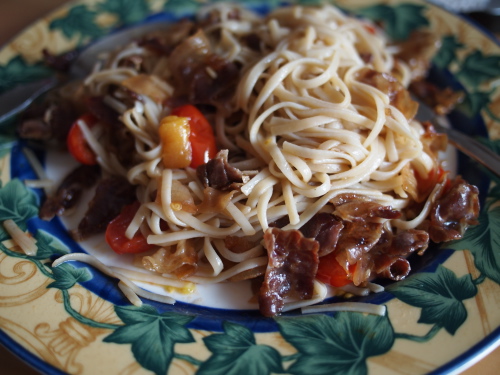
For instance, if you want to cook something quickly for yourself and your hungry significant other, take 200 grams of prosciutto – ends or not, as you wish – and cut it up. Scissors do nicely, especially if you’ve just pulled the prosciutto out of your freezer. Fry the prosciutto on medium-high in some butter. Chop up a peach (I mean a fresh one!) into, say, 48 parts, and halve a dozen or so grape tomatoes (the smaller the tomato, the richer the flavour – do not buy those enormous beefsteak tomatoes, they’re insipid; bigger has never really gone with more flavourful) and toss them in. Add some pepper flakes. Don’t bother with salt. You could have minced and added a clove of garlic, too, if you wanted, but you probably should have put it in first. It’s not really necessary anyway.

Meanwhile, you should be boiling water and getting your pasta ready. This is a very quick dish. In fact, you probably should have put the water on first. You may need to turn the heat down under the prosciutto after a couple of minutes, to medium-low, to let the pasta catch up. What kind of pasta? Ideally, tagliatelle would be great, but who keeps that ready in the cupboard? This is a what-the-heck-am-I-gonna-make-tonight dish. I used linguine this time – actually pumpkin, ginger, and rice linguine by King Soba, because my wife can’t have gluten (and anyway it’s good stuff). For two people, I used 200 grams.

Wondering what the sauce is going to be? Ha. Just toss in a bit more olive oil. In fact, make it pepper oil if you have it. And then add some sherry, madeira, marsala, or muscat, or something of that order. I used a bit of madeira and a bit of muscat. Oh, get over it. I’m not mixing them in a glass and drinking them. I wanted it sweeter than the madeira and not as sweet as the muscat. Oh, how much? Not more than a quarter cup or so in total. The point is flavour, not runniness. A lot of it will simmer off, too.

So now stir that and put a lid on it and let it sit on medium-low. Get your pasta cooked. When it’s drained and rinsed, put it in the frying pan with the rest of the goodness, take it all off the heat and toss it together. If you really want to go crazy, throw in a bit of cream of some sort, but not so much it gets all runny. I suggest drinking a nice, non-cloying rosé with this.

As you eat it, you will notice that the prosciutto has curled up in the cooking. Actually, unless you don’t look at what you’re cooking, you will have noticed that ten minutes ago. The little strips and snippets have, en masse, a reminiscence of the shapes of the word prosciutto. Do they look not very juicy? What they heck are you talking about? That’s the point of prosciutto. The word comes to us from Latin: the pro is that old “for, forward, etc.” prefix, and the sciutto – which by itself has a rather slicing (or cutting as with scythe, sickle, or scissors) look, doesn’t it, recalling that whirling steel disc that cut your slices at the deli in the first place – comes from exsuctus, “sucked out”. Why sucked out? Because the juice has been expressed from the ham – squeezed out – and also drawn out with salt before the ham is left to dry and then age. Prosciutto shouldn’t be like shoe leather – maybe more like ham sushi, or a touch firmer. Best sliced thin.

Prosciutto is not all equal, of course. When you go to the deli, you will probably have a few choices of sources and ages. The oldest stuff is the best, with the richest flavour. (People who like prosciutto will also like jambon de Bayonne from France and jamón serrano from Spain.) The classic prosciutto is from Parma, though I’ve gotten some pretty nice stuff from Niagara too. The difference in the flavours of the different ages is sort of like the difference in how one pronounces prosciutto: the six-month-old stuff is like the casual Canadian English pronunciation, “pr’-shoe-dough,” easy but lacking in a certain definition; the twelve-month-old more like a more formal British pronunciation, making real diphthongs of those vowels and making the /t/ a crisp, aspirated [t]. But the eighteen-month-old is like the Italian pronunciation, with its trilling /r/ and crisp double (actually long) /t:/ and its clean and steady vowels.

One has to be careful, though. Excessive attention to notions of what’s best or most right can lead one to go too far. If, for instance, you insist that prosciutto must only ever be eaten as the deli gave it to you, and not ever used in cooking, you miss a rather nice dish that gives a new angle on something enjoyable. And if you try too hard with the Italian, you make the word too angular. I can’t tell you how many times I’ve heard people say “pros-choo-toe” or “pros-choot-toe.” For the record, sc before i or e in Italian is “sh” (and sch is always “sk” in Italian). So say it with a roll of the tongue and a held touch on the crisp stop but without that credit-card sound in between, just a nice smoothness like the smoothness that is at heart of any respectable prosciutto: “pro-shoot-toe” – oh, but keep that last /o/ steady, and don’t aspirate the /t/.

Or just say it according to English phonotactics, “pro-shoe-toe.” You don’t want to risk sounding pretentious, do you? (Wink.) Better yet, save it all till after you’re done eating. Good grief, it’s getting cold already. You should be saying this word with your mouth full – and shut, too.

uglily

Do you like this word? Do you like-like it?

As a word taster, of course, you can like some detail of it or fact about it without liking the whole thing. You might find the back half to be lovely, fluid, fragrant even – that nice flower lily – but the front half to be rather, um, ugsome. You might like the chic stripes of the middle but have distaste for the bumps and knots of the front and the funnel of the back. You might just dislike the quick repetition of the liquids with a bare minimum of vowel in between – you barely get your tongue unglued from the /gl/ when you have to touch it up again.

Or you might dislike the ly plus ly that come together to be the lily here. What’s with that? Isn’t one enough? Aren’t they the same thing?

They do, in fact, come from the same source: the old root that, as an independent word, became our word like. It was originally more commonly used to form adjectives, as we see in words such as friendly and homely; we also have words in which the root has retained its stress and form, as in warlike. Adverbs were more commonly formed with e in Old English: for instance, the adverb form of slow was slowe. But those endings tended to be dropped over time (adverb slowe became slow, for instance), and so the ly was increasingly added to adverbs (giving us the alternative, and now dominant, slowly). Now many people assume that ly is the necessary hallmark of adverbs, and sometimes adjectives ending in ly are reanalyzed as adverbs – for instance, walk leisurely, which still looks wrong to me because leisurely is installed in my brain as an adjective.

But sometimes those ly adjectives are well enough established as adjectives that they need to be converted to adverbs with the now-standard addition of ly. So whether you like-like it or not, it like-likes you. And ugly becomes a repellant flower, the uglily.

But the garden of language has room for many, many words – even many of what you might think of as the same type. If a flower garden can have hundreds of different lilies, ranging from the graceful, patrician, stately calla lily to the blousy, enormous, noisome, ghastly stinking corpse lily, you can have – like them or not – an assortment of lilys in the word garden, even if some are hard not to use uglily… imagine what kinds of flowers these all might be:

burlily
chillily
cleanlily
comelily
costlily
deadlily
earlily
friendlily
ghastlily
ghostlily
godlily
goodlily
holily
homelily
jollily
kindlily
livelily
lonelily
lordlily
lovelily
lowlily
manlily
melancholily
oilily
portlily
sicklily
sillily
sprightlily
statelily
timelily
uglily
unrulily
unseemlily
wilily
woolily
worldlily

Quite the masterly garden, isn’t it?

Thanks to Christina Vasilevski for suggesting uglily.

grasshopper

The wind sifts the grass, which breathes its own name, “grass – grass.” And a little tick like the zap of static electricity releases a flying form: you hear the “hop” and see the hopper. The hoppers, in fact; the field is full of them, flying in lines of counterpoint. The locus of action is the action of locusts.

They’re big bugs, grasshoppers. Many a smaller bug is to them as a bird is to a human. And their hind legs are huge, patterned, articulated, in a way like the word grasshopper. The legs send them flying through the air in a trajectory you can recall as you watch their name launch from the back of your mouth and, by way of tongue tip, bounce off the lips. James Joyce mutated the name to gracehoper, but most of us can only hope to have the grace one of these exhibits in its leap. Perhaps this is why there are several kinds of aircraft named Grasshopper.

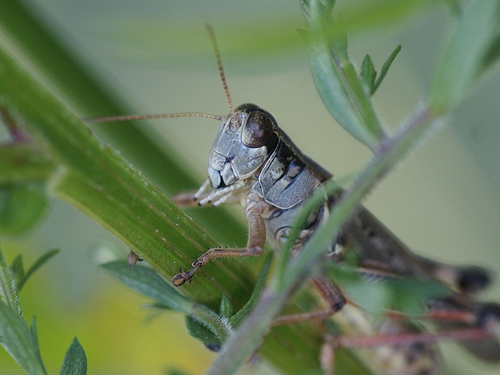
Grasshoppers hop not only on grass, of course: my camera and I had a good look at one on a longer stalk of something today. And a grasshopper may hop into your glass – if it’s a greenish cocktail made with crème de menthe, crème de cacao, and cream, or if it’s a wheat beer made by Big Rock (of Alberta).

Grasshoppers are big for bugs, but they’re still bugs and as such rather small in the world. And grasshopper may be a long word, but it’s simple, plain, made of obvious parts, and old: we’ve had it in English at least since the 1400s, and probably longer, since nearly identical forms show up in other Germanic languages. But simplicity, clarity, and elegance – and perfect control of motion – are one more thing some of us think of when we hear the name Grasshopper… thanks to the 1970s TV show Kung Fu.