Monthly Archives: August 2012

summer

Sumer is icumen in. And the livin’ is easy. And the weather is hot. Hot town, summer in the city: the boys of summer, that summer wind, but uh-oh, those hot summer nights, and suddenly last summer…

Beer, patios, music – the estival festival. And the estivation: the sun simmers, and all slumbers summarily. The oven timer of the sun-baking set is the heat-buzzer insect, harbinger of torpor, the sick cadence of the cicada. The warmth of summer incubates the yeast of memory. While we are in the summer, our skin-tracing beads of sweat are the amber of an eternal present glazing us, but when we stop and think of summer, and bite into the word summer as into a warm fresh bun, all the summers of our lived lives and fantasies re-present and blossom in our tongues, our sinuses, our crania, and again before our eyes.

Your summer is your summer. The sound is the same for all, the /s/ that could be fresh or hot, the /m/ ever warm and the /r/ ever soft; the word has come through time no more changed than the form of the dragonflies that darn the warm fabric of the post-solstice air; but in word country, summer may be a meadow or forest or beach or porch and more, but it is multiple worlds, a different geography for each person and at each turning: a magic glass that contains all warm worlds and words in one. And always, at the heart of summer, we are young.

I enter summer as a small boy in Exshaw, walking the highway past village edge to find a swamp called Dragonfly, or climbing Cougar Mountain, knocking rocks past choirs of crocuses, coming back down to chocolate bars and childish trickery, and its soundtrack is the five-note song of a bird whose name I never learned. I see in it road trips on Interstates over the great plains to the sound of Gordon Lightfoot, and beaches with peeling sunburns that made my back feel like a split kielbasa. A yawning time of no school, then later of summer courses, of long days and far walks alone under green branches to broad views, and poems in which things are seen but nothing happens. Days to plant the seeds of romance – much rarer in my younger life than in the songs and movies that told me what should have been.

The ever-young summer is carefree, hopeful times, now grasped like paper fluttering by in the wind of weekday work: stop, swim, sun, sleep, and then again for eight hours it is already autumn. Summer is weakened to a weekend, a dash to a porch and a glass of Pimm’s, and then warm slumber accompanied by the timpani of thunder and the castanets of fat raindrops. Summer is now that other mirror, the one I turn to when I turn off the ice of the office, and looking in it see the frost on my temples melt back to golden straw and the rumpled shirts to skin, and nothing needs a name.
multiplicative inverse

Today’s note is a guest tasting by Daniel Ginsberg, @NemaVeze.

Mathematics seems peculiarly prone to confusions between the symbols through which ideas are communicated and the ideas themselves. —David Pimm

What do you remember from middle school math? Do you remember how to divide fractions? For example, if I ask you to divide two thirds by five sixths, what do you do?

Well, you take the second one and flip it. Then you multiply.

You flip it, huh? What does that mean? Five sixths is a concept, a philosophical proposition. It’s a portion of an abstract unit which is divided into six segments but you only take five. How do you flip that?

Don’t be obtuse. Five sixths is a five, and then a line under it, and a six on the bottom. You flip it. You write the six on top and the five on the bottom. Then you multiply.

Right, but when you say “flip it,” that’s just a trick of notation. It’s like saying that multiplying something ten times is the same as writing a zero on the end. It’s how you write down what you’re doing, and it’s a kind of shorthand for what you’re doing, but it’s not what you’re really doing.

Okay, smarty pants, what am I really doing?

You’re taking advantage of the fact that multiplication and division are really the same thing, a concept that’s obscured by integers and then brought back into clarity with fractions. The rational numbers are a field; they can be added, subtracted, multiplied, divided. To divide by a number is the same as multiplying by its reciprocal. “Flipping” is the notation; what you’re really doing is taking the multiplicative inverse.

—–

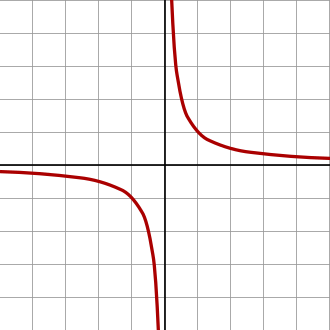
Multiplicative inverse begins staccato in a telegraph clatter of plosives, to tail off through nasals and fricatives of lessening intensity. Like the function one over x, it traces a swooping descent toward zero.

Okay, not like the function. Like the graph of the function.

How precise is the pronunciation of multiplicative inverse. More than technical, it sounds technological. It has a feel of moving parts that fit together like a watch, or like the Platonic ideal of a watch that makes the sound of an unlocking iPhone. The sound of precision machinery for a precise piece of terminology.

But what is it? What layers of abstraction are buried here? Multi-plic-at-ive from plectere, folding. Cousin to the plectrum that picks out the notes on your guitar (and music as you know is mathematics), to thesolar plexus (a kick in which some people would take if it would get them out of math class), to the multiplex where you go when your math homework is done. In-verse, like inversion, turning upside down, but in fact it’s more of a reverse, doing it backward. If multi-plic-ation is folding over and over, the inverse is unfolding.

With all this morphology, the words’ structure reflects the nesting of concepts by which mathematics proceeds. At the core is the idea that you can take a quantity (of what? Doesn’t matter), copy it repeatedly (how many times? Indefinitely), and sum up the results. Like folding a sheet of note paper along the vertical: if there are 30 lines then each fold makes 60, 90, 120 little boxes. But the process to multiply becomes an object called multiplication that imputes multiplicative properties to other objects. Multiplicative inverse, multiplicative identity. Mathematical objects that exist in our minds, if we train our minds to hold them. Math isn’t a science; it’s an appliable philosophy.

Flip it and multiply. Phooey, he says, shaking his head, pushing his glasses upward on his nose.

swim

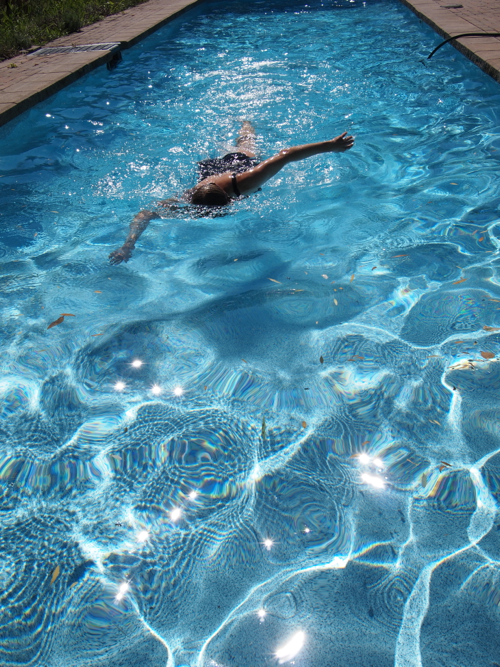
Ah, swim – it’s a fluid word, lacking in liquids (/r/ or /l/) but with a fricative /s/ and a glide /w/ and a nasal /m/. It seems more sustained at the end than swing, more immersed than slim, more muscularly controlled than sweep, more in the water where swan is on the water… And you can see waves in the w and m and perhaps some indication between them of the difference between front crawl and backstroke – or between butterfly and breast stroke. And the s and i? The i is the swimmer, for sure, and the s may be the flip and twist when turning to change directions.

Well, that’s what I’ve been seeing over and over as I write this. I’m watching the Olympics right now, and there are double helpings of Phelps and lakhs of Lochte and, well, we’re swimming in swimming. Freestyle, backstroke, the insane butterfly and the weird-looking breast stroke, plus medleys and relays, all in the several multiples of 50 metres… plenty of races and plenty of medals to be had. A marathoner might train all year and have one race for one chance at gold. A swimmer no less but no more fit might have a shot at a chocolate box of them.

Which is not to slur swimming as a sport. I can run miles and miles but still have trouble swimming more than 100 metres without pausing, while my lithe wife puts in 40 lengths just for recreation. During the summer we make it to the pool often, and it all goes swimmingly; by Labour Day I’ve built up better pecs and deltoids, and then they atrophy over the winter. But swimming, for most people, really is the eternal summer sport: warm weather, water, immerse yourself and swim in the amniotic suspension of the pool or lake. Do not speak of winter. The future is the future and the past is the past, but in the swim of things you go with the flow and you don’t look back.

Speaking of the past, tell me what past tense and past participle you use for swim. Thinkfast! Are you sure? Have you always been sure? I would say I swam yesterday and I’ve swum already today, but there is anything but unanimity on this in the historical record. The Oxford English Dictionary’s historical citations have instances in the past of swum as simple past tense, swam as past participle, and even swimmed as one or the other. Even if you use the “correct” form, you may feel you’re swimming against the current – but I wouldn’t say it’s sink or swim. When you look at the etymology of this word and at its various cognates among the other Germanic languages, every single vowel shows up in one place or another between the sw (sometimes sv) and the m.

Try them all and see how they feel. Say them one after the other: swim, swam, swem, swom, swum… Watch your mouth as you do that. Tell me what the gesture reminds you of.

Know what it makes me think of? The breast stroke.