Monthly Archives: September 2012

around, about, approximately

Dear word sommelier: I recently read an article on the AMA Insider about usage of around, about, and approximately. The author counsels people to reserve around for casual contexts and to prefer approximately almost all of the time in technical or formal writing. And the author says that approximately is the most precise and around the least. Is it really that clear-cut?

The author is, without naming it, discussing what linguists call register – variation in style of English usage according to context. He (or she) is quite right that around, about, and approximately bring with them a generally decreasing amount of casualness (respectively) when used in their interchangeable sense.

Now, that casualness is the tone of the utterance, but presenting something with a casual tone also connotes a casual attitude towards the topic. I think if we were to look at usages of the three words, we would probably find that the degree of precision they communicate mathematically is actually pretty much identical – for any given user, “about 3:00,” “around 3:00,” and “approximately 3:00” will likely indicate pretty much the same time span. (I do lack hard data for this assertion, however; this is my unscientific observation. It’s worth a real study.) It’s really the level of concern communicated about precision that varies – a more casual usage conveys a more casual attitude. Also, about is the most standard option, and is thus more plain-vanilla than the other two. If about is ordinary daily-wear clothes, approximately is like putting on a suit with a tie, and around more like putting on your comfy old jeans with rips and frays.

So let’s look at what the different words tend to convey in comparative usage:

“I’ll be there at around three o’clock”: I’ll get there between 2:50 and 3:10, and I don’t consider it a matter of great concern exactly where in there I arrive.

“I’ll be there at about three o’clock”: I’ll get there between 2:50 and 3:10, and I perhaps consider it a matter of courtesy to try to look like I’ve made an effort to arrive close to 3:00.

“I’ll be there at approximately three o’clock”: I’m trying to sound technical and impressive. I’ll get there between 2:50 and 3:10, and I want you to know that whatever time I arrive, it will be within the time period I specified; therefore, you may consider me punctual and scrupulous as long as I do not arrive outside of that time frame.

Let’s try some more:

“That’s about right.” In my estimation, that is pretty much right – close enough, at least. It may in fact even be precisely right.

“That’s around right.” I don’t think anyone would likely even say this; if they did, the hearer might not be sure of the meaning at first, thanks to the different meanings available for around.

“That’s approximately right.” That is not precisely right, and I want you to be aware that while it is within a not unreasonable margin of error of right, it could be more accurate.

“In any given week, approximately 175,000 Canadians are absent from work due to mental health issues.” This is a formal report, and we want you to take these numbers as authoritative; our estimates are rounded to tidy numbers because it’s not feasible to get exact figures on this, but you can assume that the real figure is likely within 5,000 of this.

“In any given week, about 175,000 Canadians are absent from work due to mental health issues.” This is an article in a magazine or newspaper, and we want you to know that we have this number that is not precise but is reckoned to be within something like 5,000 of the real number.

“In any given week, around 175,000 Canadians are absent from work due to mental health issues.” This is an article in a tone that is intended to be friendly and readable, and we want you to understand that this number is not precise – it may be off by as much as 5,000 or so – but it’s suitable for giving you an impression and so we can get away with using it.

“Mom, we’re heading out now, but I’ll be back in around an hour.” Don’t fret if we’re running late, because we’re not that concerned, but it’s likely going to be an hour plus (or maybe minus) 15 minutes.

“Mom, we’re heading out now, but I’ll be back in about an hour.” I’m making you a promise, but not a precise one; I could be up to 15 minutes late (or early).

“Mom, we’re heading out now, but I’ll be back in approximately an hour.” I want you to know that I’m paying attention to the time, but there are other factors that cannot be perfectly foreseen that may delay (or accelerate) or return by up to 15 minutes, and you can’t start tapping your watch in 61 minutes because I have told you this is not a precise prediction.

The thing to remember (aside from that words are known by the company they keep) is that every utterance always takes part in a definition of the circumstance, the relation of the speaker and hearer, and their attitudes towards each other and towards the circumstance and topic. (This is why people who defend rudeness with “I’m just being honest” are lying to you and to themselves. They could communicate the same information with greater respect for the other person. They just want to convey contempt and get away with it.)

So if you use around in a technical document, it will always seem like an injection of lightness or unconcern, a bit of a hand-wave. That has its place, but one has to be careful. On the other hand, using approximately in casual conversation is also potentially humorous due to its insistence on sounding responsible, but in any context it conveys that you’re covering your butt. As to about, it’s not especially technical but it’s not explicitly anything else either.
crispy

“How would you like your bacon?” Maury asked, leaning into the dining area from his kitchen. “Crisp?”

Arlene nodded.

“Crispy,” Jess answered.

Maury raised an eyebrow and retreated. Arlene smiled with approval: “Not just crisp. Crispy!”

“Aren’t they the same thing, though?” Daryl said, pursing his lips.

“Well,” I said, “easy to check.” Daryl had already gotten out his iPad and was doing some looking up, but that wasn’t what I had in mind. “Try swapping in one for the other.”

“‘They have chicken fingers,’” Arlene said, quoting an ad that was on TV a lot a couple of years ago. “‘Crisp ones.’ Oh, yes, not quite the same. Too technical. Not playful.”

“The diminutive effect of the suffix,” Jess said. “Sort of like the difference between a thing and a thingy.”

“Funny,” Arlene said. “If I talk about something as being orangey, it’s just orange-ish. Or a greeny-blue – more of a tendency. But crispy isn’t just crispish.”

“But try substituting the other way,” I said. “How’s the weather outside? In January it can be crisp. But when is it crispy?”

“Arizona in July,” Daryl said.

“Heat! It connotes overcooking!” Arlene said.

“If someone gives you a crisp retort…” Jess said.

“Icy,” Arlene said. “But if it’s crispy… ooh, tsszt” (she made as if touching something hot).

“Crisp consonants can be good for singing,” I said. “Crispy ones, not so much perhaps. Sounds kind of crunchy almost. And I like nice, crisp definition in a picture. I have no idea what crispy definition might be. Maybe over-sharpened.”

“I like a nice, crisp shirt,” Arlene said. “A crispy shirt sounds like high fashion. Or clubwear.”

“Maybe you’ve just gotten a little crispy,” Daryl said, miming smoking marijuana. I glimpsed Urban Dictionary on his iPad. “But crispy is a good thing if you’re going out. ‘You look crispy.’ Stylish, smart, confident. Not crepitating but scintillating.”

“And apparently with freshly curled hair,” Jess said.

“Crispy curls?” Arlene said.

Crispus. Latin for ‘curly,’” Jess explained.

“Know when crispy was first used?” Daryl said, looking at his iPad.

“1300-something, wasn’t it?” I said.

“Yeah,” he said. “1398. That -y suffix usually attaches to nouns, but there was a little vogue for extending one-syllable adjectives with it. …Hm!” He smiled a little. “The OED says that this started in the 15th century, if not earlier. Well, 1398 is slightly earlier…”

“You’ll have to email Jesse Sheidlower,” I said. (He’s Editor at Large of the OED.) “He’ll probably say, ‘Yeah, I know.’”

Maury reappeared from the kitchen carrying plates of brunch, the first two for the ladies. “Crisp,” he said, setting a plate in front of Arlene with curly bacon on it. “And crispy,” he said, setting down Jess’s plate with just a little rap so that the bacon on it shattered.

“Crispy?” Jess said. “Frangible!”

“Friable,” I said.

Over-fry-able,” Arlene said.

“Buon appetito,” Maury said crisply, and returned to the kitchen.

Thanks to Mark Mandel for suggesting crispy.

earthling

Kneeling in the darkling evening is the earthling, tending to his groundlings nestling in the gloaming. This is no science fiction; there are no aliens from other planets that this earthling must repel. He is an Old English earthling, an eorðling, a man of the earth, a plant-tender. He minds his roots and branches and repels aliens from other plants.

Is he a princeling or just a hireling, a mere underling? No matter: everyone is a gardener of the language. This one does so in his little corner of interest with more care than some, carefully handling and bundling, whether the lexis is prickling or fondling. So much is mixed in here, two kinds of stock mingling with so little to distinguish them. There are the words that have the old suffix for “thing belonging or pertaining to”, often with a diminutive or pejorative sense: ling. And there are the words that look the same but attach to the stem one letter later: the suffix is ing, and the stem ends in l. Among these are a goodly number that have a stem made of a root plus the le suffix: prickling, handling, tickling…

He tries, he really does, meddling with the fickle addlings of nature, not truckling, battling to keep a clear row of his darlings, his nurselings the saplings, his younglings and their siblings, needing no netting to save them from starlings and their nestlings – for those, too, belong, as do the little suckling pigs. He knows it makes little difference, sometimes none; when you blend these words into the wine or liquor of a document, the rootstock and the stem rarely make a difference in their contribution to the taste. He knows the flavour gets more influence from where people have tasted these ingredients before, for the feast of words is always a feast of worlds, the worlds of memories: where you have heard or read this and that word and phrase before will determine how you hear or read them now.

He knows it well, this earthling; it is not alien to him. He knows how a word, almost as a microcosm of the language it is part of, may start with an eye only to the soft moist crumbly earth and what comes from it, may widen its view to the world under heaven, and on the far side of a course of centuries may now turn the eye to the stars at every hearing.

The dark is done falling; the air is chilling and cold fingers are tingling. Enough shovelling and levelling and coupling. His stomach is growling, and inside awaits a warm helping of chitterlings.

But who, at last, is he, this tender tender, caring about details that so few can taste, fascinated with the parts that most people never see, gardening ling with ling but keeping them neatly hoed in rows? Who else but a linguist?

pissant

In the world of etymology there is also some entomology. And while many of us hesitate to incorporate insects in our cuisine, when we prepare dishes of words, we manage our little share of entomophagy. Nor is it one hundred percent unpleasant, though it can lend a peasant air to the discourse. But a little bit of that forest flavour (a mite of must, perhaps some rancio) can be used to various effect in the subtle hands of a master word chef.

Let us look to this hill here and to the micro-myrmidons that crawl to and from and about it. What do you smell? If you are reminded of certain sketchy doorways and various unflushed porcelain, urine good company – or bad. This anthill, thanks to its rotting vegetal composition and the formic acid that its myriad denizens the wood ants produce, gives off that smell. Small wonder that these largeish ants came to be called pismires, from piss plus mire, the latter being a now-disused word for “ant”. So in more modern times (since the 1600s) pismire has come to be supplanted by pissant. And other ants came to get the monicker more generally too, since ants are not well liked and are not all that carefully differentiated by most people.

It is not uncommon to use names of insects to insult people. It is also not uncommon to use words referring to excrement to insult people. Any word that combines the two is a natural for a put-down. A contemptible, irritating person whose utter insignificance you wish to emphasize is readily called a pissant. Pop that hard /p/ off the top, then hiss in the middle like the stream you might imagine dousing the person (and perhaps curl your upper lip as you do so), and end with an antagonistic /æ/ plus nasal plus stop. So close to pleasant but so far; so close to peasant and why not; so close to percent but so what. And never mind that pissants (wood ants) are big as ants go; ants are small, and that is all.

But that rustic flavour, that must, that wood, must or at least would come to be used in other contexts too. If one may be pissed as a newt, may one be drunk as a pissant? In Australia, one may, or game as a pissant, for that matter (meaning “very brave” – with or without liquid courage). Monty Python’s song about bibulous philosophers, supposedly sung by Aussies, starts with “Emmanuel Kant was a real pissant.”

Or split the word into two and it can be used in a positive sense in self-description – as in what Ron Ault of the AFL-CIO once said of their relation to the Pentagon, “Our job is to be the irritant, piss ant stinging them on their ankles at every opportunity.” Biting like those nasty little things with their formic acid venom.

My first enounter with the word pissant was yet another serving in a different dish. In Kurt Vonnegut’s Cat’s Cradle, one character has his own definition of pissant, and it stuck with me for a long time – indeed, I still think of it first:

A pissant is somebody who thinks he’s so damn smart, he can never keep his mouth shut. No matter what anybody says, he’s got to argue with it. You say why you like something, and, by God, he’ll tell you why you’re wrong to like it. A pissant does his best to make you feel like a boob all the time. No matter what you say, he knows better.

Not just any irritating person, then. An extended meaning. No doubt influenced somewhat by pedant. And likely by the person’s capacity to piss you off.

All these flavours from this dysfragrant sylvan antheap, crawling with its seven-letter vermin, erstwhile pismire, now pissant, popping up even in popular songs (such as one in The Best Little Whorehouse in Texas), and in diverse recipes – like musk in perfume, like salt in candies. Sometimes your language needs just that little saltiness – two syllables of it, please.

Thanks to Kristen Dolenko for suggesting pissant.

snaggletoothed

“Al Kholani was a squat man with a red-and-white kaffiyeh bundled at a jaunty angle atop his head. He had deep-set eyes, a hawk nose, and a snaggletooth that extended over his lower lip.”

Any guesses as to where that’s a quote from, and when it was written? And is there anything in it that particularly snags your eye?

The source is, first of all, non-fiction. Al Kholani is not a made-up person; he is a real resident of Wadi Dhahr, which is near Sanaa, in Yemen. The description of him comes from “Yemen: Days of Reckoning” (if you get the title from the first page of the article, or “Yemen’s Day of Reckoning,” if you get it from the table of contents), by Joshua Hammer, in the September 2012 issue of National Geographic.

I can’t speak for you, of course, but I can say what word snagged my eye: snaggletooth. It’s just a word you don’t often see. And it’s long. And has a double g, which (at least for me) has a greater-than-average association with plain or undignified or rakish words, and is part of a ggle, which smacks of boggle and juggle and giggle and such like, and is followed by a double o, which certainly doesn’t weaken the effect. It’s an undignified, impolite word, something you would not use to describe a person to their face.

Which makes it a bit of a surprise in National Geographic, which is a very thoughtful magazine. But you have to admit that it is the exact word you want to describe the jutting tooth, which is unavoidably salient on a person’s face – the description of Al Kholani is good enough that you almost feel you’ve seen a photograph of him. (The article does not include a photo of him. I imagine they would have spared the description if it did.)

A vowel can make quite a difference. Snuggle may not be dignified, but it certainly is comfortable and inviting. Sniggle and snoggle don’t exist in the lexicon, but they sound like they would refer to snickering and kissing, respectively, on the basis of their resemblance to other words. But snaggle? It sounds like snag, which is not more pleasant for its taste of nag, and which carries the sense of jutting out and catching.

Snag is indeed (as far as anyone can tell) at the root of the snaggle in snaggletooth(ed). The le is probably the usual frequentative suffix ­– signifying something done repeatedly. And we know snag – but did you know it was a noun before it was a verb? A snag is, first of all, a stump of a branch sticking off a tree, or a branch or stump sticking out of soil or water – in short, something that juts and that passing things can catch on. That catching got the verb snag derived from the noun. (Now we talk about a snag in one’s clothing, which is the effect caused by the verb caused by the original noun.)

So a snaggletooth is a tooth that sticks out like a snag. The noun snaggle-tooth has citations dating from 1820 in the Oxford English Dictionary. Does that seem suspiciously recent? The noun is actually derived from the adjective snaggletoothed (or snaggle-toothed, as the OED has it), which has a first citation from 1585.

One way or another, if you are snaggletoothed, if you have a snaggletooth in your puss (mouth, for those unfamiliar with that colloquialism), it’s generally viewed as unbecoming at best, and certainly not stylish or fun in a good way. And yet… there is Snagglepuss. That large pink bon-vivant feline from Hanna-Barbera (probably a panther, though people in the animations seem to take him for a lion – well, if he’s a mountain lion, he’s a kind of panther; also, he does not have crooked teeth). If you don’t know what I’m talking about, watch an episode of the cartoon. He’s not your ordinary cartoon creature. He’s much more urbane and witty, charming even (yes, there’s his famous turn of phrase: “[x] even”), and perfectly happy to live and let live except no one else seems to want to. The humour is on the level of Hollywood Squares. A bit more sophisticated than the usual for cartoons. Adult even.

And rather different from the image one gets from snaggletoothed. And yet there it is. Heavens to Murgatroyd.

yearbook

In some countries – notably Canada and the USA, but also, I am told, Australia and to some degree South Africa – this word will immediately bring to mind one’s youthful years of education. School days, school days, good old golden rule days…

High school is a landmark in our lives, and finishing it – graduating – is an apex, laden with rites de passage: the graduation ceremony, of course, and the dance and so on that go with that, but also other things done by the grad class (or the senior class, as they say in the US). I went to high school in Banff, so a great unsanctioned tradition was the grad hike: a hike to an overnight or weekend spent in a cabin somewhere up in the mountains, just the grad class students, no teachers, and a lot of consumables the teachers would not want to be seen countenancing. We also had a champagne breakfast at the top of the Sulphur Mountain Gondola on our grad morning (in Alberta, the drinking age is 18, and most of the class is old enough to drink legally at grad… the rest of us pretended we were). There were also dances, sports, and of course classes… And to commemorate all of that axial year, a yearbook.

The yearbook also includes the lower grades; I have yearbooks for all three years of my time at Banff Community High School. And they all have signatures in them, accompanied by narrations that make me look like I had a lot more fun and got into a lot more trouble than I really did. Fair enough. We tend to distill the small beer of experience into a whiskey of memory.

Unsurprisingly, I was on the yearbook committee; actually, after Miss Henderson said in class that she was looking for a yearbook editor, I went up to her and said that I was interested, and she told me she had just given the position to Leanne Pawluk. So I wrote the little capsule descriptions of the year’s highlights, laced with my rather rude attempts at humour. (And actually the yearbook was mainly put together by other students on the committee, whose photo collages were a kind of chaos resembling nothing that the yearbook company’s workshop suggested – but something like what I see in fashion magazines now – and who managed to misplace various things, including my submission for the grad class profiles: we could do it in the “pet peeve etc.” form or the “last will and testament” form, and they lost both. Looking now at the charm my other writing of the time exhibited, I wonder if they lost them on purpose.)

This is a good old compound word, made of two words that have been in English as long as there has been an English for them to be in. Year is in Old English as géar (pronounced like year with a British West Country accent), and book is bóc. Their mating has been around since the 16th century at least. Not that high-school yearbooks existed then; yearbooks of the year’s law-court cases did, which had in common with high-school yearbooks the element of recording misdeeds. Between then and now, various associations and periodicals also put out yearbooks. High schools have been putting them out in North America for about a century.

Year has a long, stretchy sound, a glide in and a liquid out, sort of like the Doppler effect you get when a car goes by you if you’re standing by the highway. When you say “The year just flew by,” you can sort of hear it whizzing past – “yyyeearrr.” Book is as hard and abrupt as year is soft and smooth; it has two hard covers (like most yearbooks) and its sound is similar to that of a hardcover book being suddenly closed (as, for instance, when a parent wanders behind you while you’re reading the signatures in your yearbook). In a yearbook, student’s lives are presented as though they are open books – but the yearbook does it to close the book on the high school career.

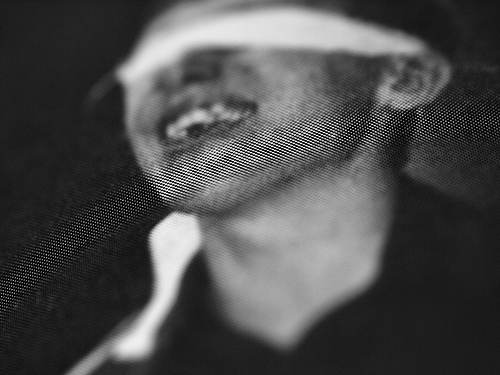
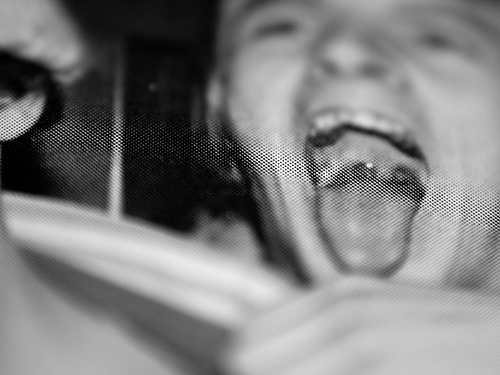
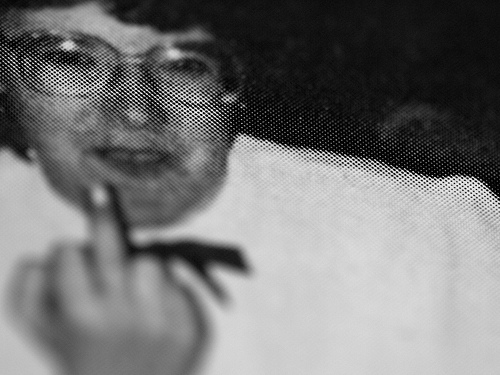
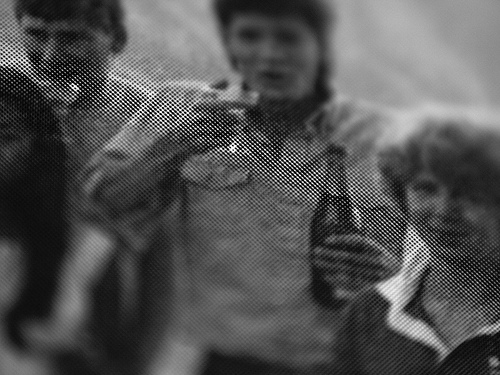
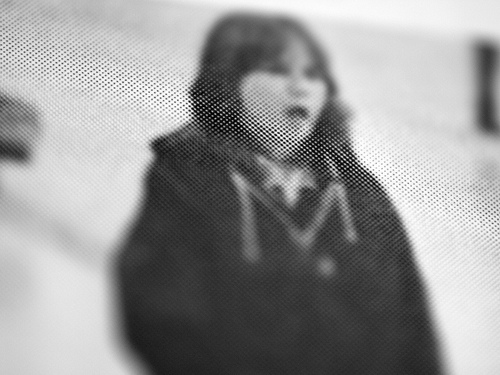
The vision presented by yearbooks is selective, of course, and erratic. I was in high school in the early 1980s, so the photos in it are mostly badly exposed and were taken at a time when people didn’t normally have cameras with them all the time and weren’t exceedingly shutter-happy because every photo had an incremental cost. I’m sure the quality of the photos in yearbooks has improved now, both in technical details such as exposure and in the likelihood of getting great pictures. But we still managed to have yearbooks filled with antics – distorted, incomplete, poorly exposed, dot-screened… But such is the quality of memory.

I’ve lately done a little photo project using macro photos of details from my high school yearbooks to play with visual representation of the quality of memory and its representations – the selective focus, the things that stand out more and less sharply, the ways the detail breaks down. The way things can look when taken out of context, too. I remember almost none of the hijinks pictured, and was probably not even present for most of them, but they are in their way both sharper and less detailed than the things I do remember. I started this note with one; here are a few more. See the whole set on flickr. (I recommend using the “View all sizes” option to look in full detail at ones that catch your eye.)

Sharpening and vowel shifts


Look at these two pictures. They’re the same photo, of course. Do you detect a slight difference? Does the second one seem somehow… sharper than the first?

It’s had some sharpening applied to it. Not a massive amount, but enough to make a difference. It’s something that I often do after resizing photos, since sharpness is often lost in the process. And it’s something that a lot of digital cameras do automatically to their JPEGs so they’ll look, well, sharper.

How does it work? Here are close-ups (500% magnification) of details from the two. What do you see?


I’ll tell you what you see: increased contrast, especially at edges – that is to say, places where there is already some contrast. It’s not that every last dark is darker and every last light is lighter; it’s that near the places where dark and light, or two different colours, come together, the difference is increased slightly.

If you oversharpen a photo, it can looks pretty frickin’ bad. Like someone wearing really excessive lipliner, heavy eyeliner with heavy highlighter right next to it…

It’s just gone too far. But you know, when it works, it works for the same reason that lipliner and eyeliner work: our eyes (and brains) love not just contrast but edges.

Look at kids’ drawings (or the average adult’s, for that matter). If they draw someone in solid clothing on a solid background, do they just make two fields of colour? Or do they draw outlines (and sometimes just lines)? (Answer: the latter, natch.)

When the light comes into our eyes, and when our eyes send it to the brain, what we’re seeing is just colour next to colour. But we look for edges. We even fill i edges in places where we don’t actually see them. Part of that is coloured by real-world experience – we can identify a figure even when the contrast within the figure is greater than the contrast at the edges because we have expectations regarding the shape of the figure. But part of it is just that we are made to find edges and we like contrast. Clarity. It’s well adapted. It makes it easier to deal with the real world. We see what we see, but we think of it how we think of it.

This also applies to sounds. We hear a continuous flow of sound, but we are able to parse it into separate phonemes when we know the language. We also perceive different sounds as being the same if they fit into the same expected phoneme – and we can hear the same sound as different it is presenting different phonemes (for instance, many people will say both vowels in kitchen the same but hearers will still perceive them as different). I talk about this phenomenon – categorical perception – in “Nothing to chauffeur a classiomatic” and “oot & aboot.”

It also plays a role in another phonological process, one that happens not in the instance of production and reception but over time over large areas: vowel shifts.

Vowel shifts are when some of the vowels (anywhere from one to all, but usually a certain set in a mutualle affecting way) in a language, or at least one dialect of a language, come to be pronounced differently from how they had been before. Many languages have undergone vowel shifts, and they are still taking place – a thing called the Northern Cities Shift has been going on in northeastern US cities for several decades, resulting in Buffalonians sounding to Torontonians as though they’re saying “Ian has gan to the affice” when they’re saying “Ann has gone to the office.”

The causes of vowel shifts are much argued over and certainly not exceedingly clear to anyone. Some people even argue that what we think of as shifts are often not shifts but mergers and similar other movements. I’m not going to hazard as guess as to why shifts happen. But there is one thing that vowels in shifts often – not always, but with a certain frequency – tend to do: diphthongize. They become a movement from one vowel sound to another.

Some examples: A sound like the a in father may become like the a in fate. A sound like o in toll may become like the o a in to all. A sound like the oo in loot may become like the ou in lout. A sound like the e in ell may become like the ye in yell. A sound like the i in machine may become like the i in mine. A sound like the a in bat may become like the i in bite.

Not all of these happen in the same language – some are not too likely to happen together in the same language, in fact. Not all of these are found in English. But what they all have in common is that they heighten the contrast. They use a glide (“w”, “y”) or contrasting vowel sound to make the original sound stand out more, and they may also move the original sound farther in the other direction from the glide. A high and tight sound (“ee”, “oo”) may get a leap into it from a lower, more open sound (becoming “ay”, “ow”). It may happen the opposite way: a glide opens into the sound (“et” becomes “yet”). Or the sound releases out (“toll” to “to all”). Or it becomes two sounds on opposite sides of the original (“bat” to “bite”).

In a way it’s similar to what we do to some consonants when we emphasize them: add an “uh” after them, or at least a strong puff of air. Think of the Barbara Woodhouse style of dog training: “Sit-tuh!”

These are certainly not the only kinds of vowel shifts. Sometimes a vowel simply moves in one direction or another. In English, as I discuss in “An appreciation of English: A language in motion,” [a:] moved to [eɪ], [e:] moved to [i:], and [i:] moved to [aɪ], while [o:] moved to [u:] and [u:] moved to [aʊ]. The vowels at the top, not being able to move farther in the same direction as the others, added a contrast element to make them stand out. They emphasized their position at the top by the addition of a contrast from the bottom. The others just moved, maybe adding just a little bit of diphthongization.

It can go the other way, too. Sometimes a diphthong is even smoothed out into a single sound. Think of how southern Americans often say I: “Ah” – something that had become a diphthing has stoppped being one, but by deletion of exactly that part that was the original sound. There are always two opposing forces operating: ease of saying and clarity of hearing. The contrast effect wins out when there is need for a greater distinction of the vowel. Other vowels may have come to have sounds that are a bit too similar, for instance, so this vowel takes on a bit of sharpening. It’s sort of like a backswing that allows you to deliver a stronger blow. In golf, I mean, of course.

I won’t go into whether similar effects can also be discerned in other sensory input. But I have suddenly developed a strange craving for salty caramel…

git

A British friend of mine a few years ago explained the cause of a falling-out he had had with another friend: the other’s particularly “git-like” behaviour. I got what he meant – the sense is well-enough established: “jerk”, “yahoo”, any of a variety of more vulgar terms. “An uncultivated person lacking in merit”. The word is often seen with modifiers: brainless git is seen by Harry Potter readers; you will also see cheeky git, smarmy git, jammy git, grumpy old git, senseless git, woo-hoo git – oh, sorry, that last is the name of the lead character in The Yellow Jacket, a play set in China – and done in an imitation of Chinese theatre style – that was popular in the 19-teens (actually, it was Wu Hoo Git, but close enough… read more about it in an article I published in Asian Theatre Journal 13:2 (Fall 1996)). But I’ve seen some people I’d readily call woo-hoo gits.

So where do we get this word? How do we beget it? Does it seem a bit misbegotten? If you search in the Corpus of Contemporary American English, you find southern and western American usages of git as a dialectal form of get, in the manner of “Y’all git along or y’all git on outa here” or the famous “Git along, little dogies.” Meanwhile, you can find get used in England in basically the same way as the noun git – for instance, in “I’m so tired” by the Beatles: “Although I’m so tired I’ll have another cigarette / And curse Sir Walter Raleigh / He was such a stupid get.”

Yes, git the noun does come from get the verb. Heck, many people – not just stereotypical American rurals, but even most Canadians – say get like “git” a lot of the time. As verbs go, get is a well-established and heavily used but underappreciated one; I have even heard of people declaring it bad English. So the word, with its short hit from a nearly guttural start to an abrupt stop (often pre-stopped by the glottis before the tongue tip even touches), comes with a downmarket flavour from the get-go, and doubly so when you move from get to the less dignified (because nonstandard and “lower-class”) git.

I’ll git to the point here. Get is also – though not so often anymore – used for conception and childbirth (get a woman with child, for instance), and, from that, get came to be used (by the 1300s) as a noun for the issue of that, a child: what is begotten. And in northern English and Scottish usage, get came to be used specifically for a brat or a bastard… and thence for an idle, contemptible fellow, a fool, an idiot (idiot has a little of the feel of git, too – as does its Irish-English mutation, eejit). It has been in continuous use in that sense since the 1500s.

The git spelling, slightly baser in tone, is evidenced in print somewhat more recently (the Oxford English Dictionary has citations for it only from the 20th century, though I wouldn’t be surprised if good antedatings could be found by those motivated to do so). But it has earned its place in the lexicon of abuse. I got a good laugh when I looked in Visual Thesaurus for synonyms: on the same node, you get bum, stinkpot, stinker, so-and-so, skunk, scumbag, rotter, rat, lowlife, dirty dog, and crumb.

One thing git has that those others don’t, though: a direct echo of a direct verb. You can say “Why’n’t you git, you git,” where you can’t say “Why’n’t you bum, you bum,” or “Why’n’t you scumbag, you scumbag.”

Of course that is also one of its two greatest weaknesses: it can be ambiguous. The other weakness is that it’s so short, you really don’t have time to enjoy saying it. ZZ Top wrote a song called – and about a – “Dirty Dog.” You just can’t do that so easily with git.

Oh well. When you just need to get down to it, it gits-r-done.

Thanks to Dawn Loewen for suggesting git.

donzerly

Ewan Dye leans at the gate, awaiting, idly singing a childhood song: “Ferrazhocka, ferrazhocka, donlayvoo, donlayvoo, semilematina, semilematina, ding-dong-dang, ding-dong-dang…”

In the distance he sees a glint, and hears, out on the tar plane, a glide moving. The glint grows, singing blue silver. A Classiomatic draws into dim sight. The droning engine throbs in time with his beating heart. Ewan Dye stands straight, pulls his tie. The machine pulls up and stops in front of him. In the pre-dawn glow, out steps Lady Mondegreen.

They know each other, these two. They have known each other for many years, since before she wed the Earl Amore. Ewan tends her crops, her wild crops, her changelings. This is a special corner of word country, where all the fruit is mutation. But not mutation as happens to other things, on their own. These words come to being because someone has oddly heard some other word or words and taken it for a new word. These words are fertilized by the mind, and when they are made into prose they are leavened by local wind-blown yeast, purely adventitiously. The rimes here are all lambic pentameter.

He extends his hand and addresses her as he had when she was young: “Miss Heard.”

He is too familiar, but she accepts it. “Ewan Dye,” she says. “Just the two of us.” And a small up-curve graces the corner of her mouth. “What have you for me today, in a gadda da vida?”

Gracias a la vida, he thinks. But he says, “Something… light. You have had a taste already.”

“Something… northerly?”

“Something mannerly, masterly, not miserly. Perhaps orderly, perhaps motherly, perhaps summerly.”

She nods slightly. “I hope… not soberly.”

Intoxicating, he thinks. “As graceful as a Lippizaner, as powerful as a panzer. As luscious as a Linzertorte. But so wide open to interpretation. Everyone who hears it has their own idea about it. It’s not supposed to be there, it is a ghost made of two souls. Even more than most words, it exists in the minds of those who hear it. Until someone turns on the light and they see it no more.”

“These are the words I love to hear,” Lady Mondegreen says.

“These are the words I cultivate for you. Miss Heard.” He looks again. Their eyes lock.

“Oh, say it,” she says.

He looks to the horizon. “Can you see it?”

In a flash of light, like a rocket’s red glare, the sun crests the curve. She whispers in his ear, “The donzerly light.”

“Only here, my lady,” he says. “Only in your own land.”

“Only where my own heards graze.” She looks to the horizon. “Squeeze me,” she says quietly, “while I kiss the sky.”

He nuzzles her eagerly. She clasps his left hand in her right, sets her left on his back. They start to dance. She sings softly, slowly, a jaunty old favourite: “Mairzy doats and dozy doats and little lamzy divey…”

bokeh

My dad writes a weekly column, Coffee with Warren, for the Cochrane Eagle, in Cochrane, Alberta. He asked me to do a guest column this week. I decided to bring together two of my passions: photography and words. Fancy that. Here’s the column:

I was out at the country place of a friend this past July, near Owen Sound, Ontario. The house is lovely, and it has a pretty property, including a charming little garden. Naturally, I brought my camera.

There are different ways to photograph a garden. You can take a picture of the whole garden in its context. You can photograph part of it, just a nice arrangement of botany, bouquets in the wild. Or you can photograph one thing – a flower, for instance. I wandered through the garden, doing a bit of each, and a flower caught my eye.

I came up close to make the flower the centre of attention, with the greenery behind it a supporting cast – perhaps a chorus line, or perhaps even just extras in a crowd.

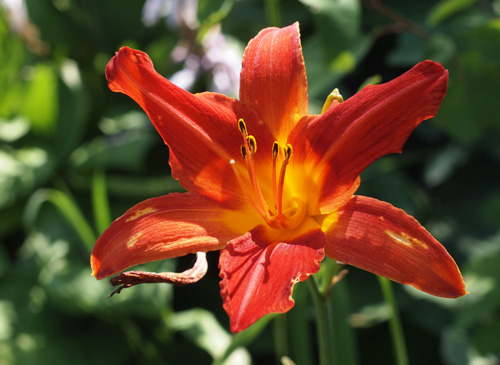
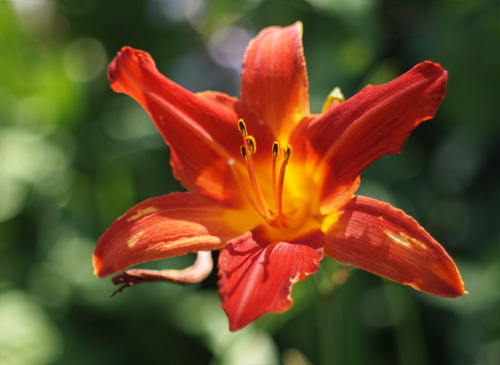
I clicked. I looked at the results on my digital camera’s screen. I decided I wanted a different amount of blurring the background. I adjusted the aperture on my lens and clicked again. You can see the two results in my two pictures accompanying this column.

Photographs have that feature that we’re little used to when we look with our eyes, a feature that never showed up in the visual arts until photography introduced it: things that aren’t the centre of attention can be out of focus. Blurry.

What makes the background (and foreground) more or less blurry is an effect caused by the width of the aperture (the opening in the lens the light passes through).

Something that would be a single point of light in focus is a circle when out of focus, and the size of the aperture – and how far out of focus the point is – will determine how big that circle is. The circle is called a circle of confusion. Put all those circles of confusion together and you have a blur.

That sounds like real life, doesn’t it? Things that aren’t what we are focusing on, that aren’t on the point, are a bit of a blur for us – they’re in circles of confusion. They’re like so much background noise. How much they factor in at all depends on how focused we are – and perhaps how wide-eyed we are.

But that’s not necessarily a bad thing, in real life or in photography. In a noisy room, you want the voice of the person you’re listening to to stand out. In ideas, you want the important one to blossom forth more clearly. In a photograph, you want a suggestion of the background, but you don’t always want it so sharp it distracts.

But not all blurs are equally nice. Different lenses produce different kinds of circles of confusion: some have sharper edges, some have softer ones; some are really polygons. Some blurs are less smooth or less blended than others.

There’s a word for the out-of-focus part of a photograph: bokeh, which comes from Japanese for “blur” or “haze.” It’s not just about how blurry the area is. It’s about how smooth the blur is. If a photograph were a glass of wine, the quality of the unfocused areas would be its “bouquet.”

It makes a difference, just as it makes a difference how much and what kind of noise you have to ignore in a busy room, or how well the related ideas you’re not focusing on at the moment blend together to work with the one that is central. Not just how you’re focused but also how you’re unfocused can help determine if it will be OK.

Bokeh. Such a hard word for a soft thing. Well, taste does come into these things. Different people like different effects. Which of the two flower photos do you prefer?

I couldn’t include links to other people’s work in the column, and I didn’t have a great diversity of examples of different qualities of bokeh, but here are a few examples of photos with bokeh with noticeably different qualities:

Sadie (Mamiya C330) by Laura Burlton

Zeiss Ikon REALA 516 by Tecumseh73

Rosemary by Mitch Zeissler

water drop macro (with a bug walking over it!) by Matt Bilton

Grasshopper by James Harbeck

I encourage you to surf through flickr and other photos and look at the different qualities of the bokeh in them. Call it a bokeh tasting – or nosing, as one might say of a bouquet.