
Monthly Archives: November 2012

mantissa, meniscus

Mantissa was a lovely little number of Etruscan extraction. She was small but significant, a details person who was always helping the powers that be – she was seen with the greatest exponents of her time. She knew what her base was; she knew when to go on indefinitely and when to be brief or even disappear altogether. She always got the point, and she never forgot where her roots were.

Meniscus was a Latin of Greek extraction. He had a name that smacked of greatness – like a warrior or a playwright. But he found himself ever at the edges, on the rim. A connector. Not great in himself, but capable of magnifying others. He always had a lens on the glass of the times; any time tension surfaced, he was there. But he was never sure if he was waxing in power or waning.

When Meniscus heard of Mantissa, he was over the moon for a sight of her. He felt sure that they were made for each other. Both were small in themselves, seemingly minor and accessory, but both were inescapable. He knew that Mantissa might be more indispensable than he was. But they seemed so compatible – right down to the names, so similar, the m, the n, the crisp stop and soft s, the three syllables amphibrach – and each with the same sound at heart, that soft and relaxed but certain I.

How would he contact her? He was not calculating as she was, as were those around her. But he had a fluid intelligence. He beat a natural rhythm on a log, and with ease he brought her to him.

Immediately he knew he had her number: he could see she was not rational. She voiced her devotion. Such expressions as would appear hyperbolic to others seemed straighforward to her. But amid her protestations there was a reserve.

“Can we ever get together?” Mantissa said, at last. “You spend your life above the line; I work below the line. You must know I will never be a whole one.”

“But I, too, am ever incomplete; this is how I am made,” Meniscus replied.

“How do I know this is not simply an angle you are taking to contact me?” she said.

“But, Mantissa, how do I in turn know you are not simply preying on me?”

“Do not trifle with me.” She took his hand lightly, touching barely more than the lunulas of his fingernails. “I cannot have men; I can have only one man.”

Meniscus was torn. How could he be other than he was? At length he prevailed. “I spend my life forever halfway between sea and ground,” he said. “You add a new dimension to my existence. Will you take my measure?”

“If you will keep my point floating,” she said.

“I will not let go,” he replied.

They professed eternal devotion. But in so doing, they undid themselves. As they made perpendicular contact, and she declared “You are my one and only,” he disappeared and she disintegrated, and nothing was left but the flat surface where they had been.

Perhaps this needs some explanation for those less familiar with the words.

A mantissa is the decimal part of a logarithm. A logarithm is the power you put a base number to in order to get another number. For instance, the base 10 logarithm of 1000 is 3, since 1000 = 103. Natural logarithms, useful in many areas of math, have e as their base, which is not a rational number – the decimal goes on indefinitely (it is, to 3 decimal points, 2.718). Any number that is a perfect power of the logarithm base will give a logarithm with no mantissa. The logarithm of 1, for any base, is 0. A mantissa is also the number on the left in floating point notation – for instance, in 6.022 × 10²³, the mantissa is 6.022.

A meniscus, on the other hand, is a few things, all shaped reminiscent of a crescent moon, whence the name. It can be a bit of connecting tissue on your knee, or it can be a concavo-convex lens (as in reading glasses), or – in its best known usage – it can be the bit of liquid that curves up (or in some cases down) at the sides on the top surface of liquid in a container. The specific liquid and container material determine the angle of contact; if the angle of contact is perpendicular, there is no meniscus – the surface of the liquid is flat from edge to edge.
aspidistra

This word seems to me to have layers of ensiform leaves, like its object. It has a neat partial symmetry, with the opening and closing a’s and the mirroring i’s flanking the not-quite-central post of the d. The layered feel may come in good part from the pair of /s/-plus-voiceless-stop clusters, sitting neatly at syllable boundaries – many a linguist will tell you flatly that in both instances the /s/ is fully at the beginning of the latter syllable and not at all part of the former, but others will point out that the phonological effect is as though the /s/ is at the end of the former syllable. Ask someone what the third syllable of this word is and they will probably readily say “dis.” (Ask them to say the first syllable and they’ll probably think you’re being naughty.) We don’t, after all, have “short i” in an open syllable. So even if, in saying it, we tend to glue the [s] onto the [p] or [t], that’s something that happens just at the moment of articulation – and possibly not completely even then.

For quite a few years I added, in my mind, another layer to this word. Somehow aspidistra seemed like it didn’t have quite enough to it, so I thought of the word as aspidispstra (and no, this was not some mere dipsomaniacal fantasy). That made for a rather larger-than-usual version of aspidistra! But not perhaps the biggest in the world. That would be the one in Gracie Fields’s song “The Biggest Aspidistra in the World,” which she came out with in 1938 and which was popular during World War II.

Why an aspidistra? This plant has become emblematic of British middle-class dull respectability – even the Oxford English Dictionary includes this aspect of its social significance right in its definition. George Orwell’s 1936 book Keep the Aspidistra Flying cemented its place as epitome, but by that time it was already past its peak in that role. It happened to have been one of the few plants that could thrive presentably in the dim cold and mildly toxic air of the gas-lit households of the British middle class during the Victorian era and on until electricity took over. (It occurs to me that I could probably get away with using one – perhaps the kind called “cast-iron plant” for its resilience – to replace the scraggly seven-year-old poinsettia that my wife keeps threatening to dismember and put down the garbage chute. I’m sure there’s a local aspidistribution centre somewhere in the aspidistrict I could get one from.)

This word has tastes of other life forms too. It opens with asp, which is a snake; its form is perhaps reminiscent of Latin names for bugs, such as Coleoptera; the stra makes it look like a Dutch family name (cf. Feenstra, Hofstra, Keegstra, Kooistra, et cetestra). But for all the menagerie of its letter salad the plant is not fantastic or exotic or exceptionally colourful; its leaves are like wide swords, but the name gladiolus is being used by something else, and somehow this plant got named after a shield instead – Greek ἀσπίς aspis plus some modern Latin morphology to finish it off. The word entered English about the time Queen Victoria was born.

Of course you could always call it by its Mandarin name yè lán or its Japanese name haran; after all, the plant’s originally from that part of the world. But those seem like such simple words, lacking the aspiration to sophistrication and respectability of the broad British middle class. The aspidistra keeps it flying, full banners in the breeze: the escutcheon of the world’s salary slaves.

mascarpone

Plants have their mutations, and so do words. In word country, one that crops up from time to time is metathesis (that’s pronounced with the accent on the “ta,” by the way): sounds are transposed. This has affected some of our best-known words. Without it, you might aks for the thrid time what that birht brid is, rather than ask for the third time what that bright bird is, since our modern versions of ask, third, bright, and bird all got their forms by metathesis of the [r] and vowel sounds or, in ask, of the [k] and [s].

But you have to be careful. While metathesis is not normally harmful, you should watch out if you make yourself comfortable in some foliage to eat an hors d’oeuvre with mascarpone. You will not be harmed by being “comfterble” rather than “comfortable” – indeed, the former is a more comfortable sound. You may or may not be foiled by “foilage.” As long as you are careful with your “or durv” and it does not veer too close to ordure you will probably survive.

But if metathesis affects your soft Italian cream cheese, you will find yourself face-to-face with a gangster from the red planet: Mars Capone. Do not try to turn it into a candy bar with a capon; you are too late. The scar may be gone, but the consequences of its turning into rsca are simply too risky. A green man with a machine gun, making a bloodbath from the red planet – your only hope would be to send him to Alcatraz for syntax evasion.

Yes, better to keep it away from that cheese. As long as it’s mascarpone, it may sound like it wants to scarper, or like it’s wearing a mask, or you may hear a hint of a corn pone (for a NASCAR driver perhaps?) or get a clear taste of carp (you may even see one), but you are at no risk of its being crap or, well, that machine-gun man. You will in fact have a nice soft spreadable outcome of a liaison between cream and a curdling agent (such as citric acid). It can be part of a nice little “pick-me-up” – Italian tiramisù.

Never mind that the word’s origin is uncertain and subject to some speculation. Just don’t let that [r] shift from the unstressed syllable (such a nuisance to put that extra effort into what would otherwise be a simple schwa) onto the lengthened opening [a], no matter how natural it may seem. It could be your life we’re talking about here, you know.

She’s like all that you know

I think it’s time to feature another poem from my book Songs of Love and Grammar, saucy verse about romantic and morphosyntactic difficulties. This one revels in the rich depth and frank economy of lexis of a certain adolescent idiom. I have done you the favour of reading it in a video. You’re welcome.

Here’s the text:

She’s like all that you know

by James Harbeck

I know this girl, and she’s all that –
she’s like, you know, she’s got it all,
and she’s all “Guys are all like that,
but you’re, like, not like that at all.”

So I’m like, you know, “What’s all that?
So did you dis me? Do you like me?”
And she’s “You know it’s not, like, that.
You know I know you don’t dislike me.”

So I’m “Like that’s just all I know!
I know you know I know, you know?
So no, it’s not a dis, I know.”
And she’s “I know. I’m just, you know.”

But no, you know, it’s not like that.
That’s just, like, all. It’s just, you know?
Cuz that’s just her and I’m not that.
I like her, like you know, you know?

But now, you know, it’s all “That’s all,”
but, like, no, that’s not all at all,
cuz she’s a girl who has it all,
and, like, I’m just like that, is all.

hyperforeignism

Elisa Lively had invited a “well-known world traveller” named Harley Weldon to our monthly Words, Wines, and Whatever tasting event at the Order of Logogustation’s headquarters, Domus Logogustationis. “He’ll regale you with stories,” she promised.

And she was right. He had a story for everything. He held forth in his spot at our table. (Jess, I, and Maury held first, second, and third, respectively; Elisa held fifth.)

“I remember,” he said, with a practiced misty, thoughtful look, to his glass of Bordeaux, “drinking a claret much like this in Beijing. The restaurant had matched it with a dish that, to my surprise, contained prodigious quantities of habanero peppers. I almost thought it was an empanada.”

I held up four fingers under the table in sight of Jess and Maury. Jess smirked. We had been keeping score, you see.

Oh, yes, you can’t see on paper what we were keeping score of. His actual pronunciation was “a cla-ray much like this in bay-zhing,” “prodigious quantities of ha-ba-nye-ro peppers,” and “em-pan-ya-da.” That’s four goofs:

1. Claret is properly pronounced like the last two syllables of “declare it”; it’s an English word based on the French word clairet, which means something else.

2. The closest you’ll get with English phonotactics to the Chinese pronunciation of Beijing is “bey-jing,” with an English-style “j” and not a “zh” as in beige.

3. Habanero is not habañero. It is an adjective formed on Havana – in Spanish, v and b have a certain interchangeability – and there is no palatalization of the n. Also, the h is not pronounced in Spanish – though it has come to be pronounced in the English version.

4. Empanada is likewise not empañada. The latter word actually means “fogged up”. Sort of like his pronunciation.

Our hyperactive foreign traveller, in other words, was proving to be a high-performance source of hyperforeignisms: overcorrecting for difference from English – matching a word to a conjectural “foreign” pronunciation pattern not appropriate to it. The word hyperforeignism is a simple English confection of the Greek-derived hyper and the Latin-derived ism with the word foreign, which came from Latin foris “outside” by way of French forain, plus a hypercorrecting addition of a g to match words such as reign and sign.

“That was quite a coup de grâce to our tête-à-tête,” he said, as “coo de graw” and “teh a teh”; Elisa listened, rapt, while Maury, Jess, and I tried not to choke on our beverages. Drop the end of coup de grâce and it sounds like coup de gras, meaning “stroke of fat”. Amazing how often one hears people dropping all consonants at the ends of French words, even when there’s an e after them. As if to prove the point, he added, “I could have killed for some Vichyssoise.” Yes, he said it as “vishy-swa.”

“I’m no stranger to strong flavours, of course,” he went on. “One time dining with a Punjabi chap near the Taj Mahal I had some Earl Grey with a stunning excess of bergamot. I felt like a cross between Kahlil Gibran and Genghis Khan.” A flurry of fingers up under the table: one for “poon-jobby” rather than “pun-jobby” (the u is to approximate a more central vowel, like English “uh,” in the older British way of transliterating by English spelling habits rather than by consistent phonemics); one for “tazh” rather than “taj” (again like Beijing: there’s this idea many people have that j couldn’t possibly be like our English “j” sound in any other language); one for dropping the “t” on the end of bergamot (it’s not a French word – French for it is bergamotte – and it’s not from the Italian city of Bergamo); and one each for hard “g” in Gibran and Genghis (nearly everyone gets those wrong these days; those names were given English spellings back when “j” before e or i was spelled with a g by habit in English versions. You could protest that by now the usage has changed and it’s no longer wrong in English, just as we say, for instance, Paris like an English word; but if you want to get it true to the original – and the intent of the English spelling, which ironically is what’s misleading us – you would do better with the “j”).

“But I’d still take that over the time I had tea with some Russian mafiya men in a dacha near St. Petersburg.” Two fingers: he said “ma-fee-ya” – actually mafiya is just an English transliteration of the Russian transliteration of the Italian word mafia, which is pronounced in Russian as in Italian with the stress on the first syllable – and “dakha” rather than with the ch like English “ch”. Again: the idea that ch couldn’t possibly be said like English ch in any other language.

That was like a scene from Brueghel.” I flipped up another finger and tried not to roll my eyes: “broigl.” (Brueghel, sometimes spelled Breughel or Bruegel, is a Dutch name, and the ue or eu is like French eu – and the g or gh is, in Dutch, like a voiced “kh,” but you don’t need to do that in English, which no longer has that sound.)

“A festival of machismo,” he added. Another finger: he had made the ch in machismo into a “k.”

“Quite the opposite of that time in Reykjavik, when I was listening to Berlioz with some Japanese-Icelandic friends – did you know they existed? Not even immigrants; nissei or sansei.” Man, this guy was a treat, and he was now overapplying the German pronunciation of ei (like English “eye”): “rye-kya-vik” rather than “rey”; “niss-eye” and “san-sigh” instead of “nee-say” and “san-say”. Also he dropped the z on Berlioz.

Harley finished his glass of Bordeaux and reached for some of the sausage and cured meat on the table. He looked up and around the room, trying to spot something.

“Do you need help locating anything?” Maury asked.

Harley pointed at a table halfway across the room. “I’ll be right back. I just want to get some Riesling to go with the prosciutto and chorizo.” He stepped away quickly enough that he probably didn’t notice when Jess, Maury, and I all burst into giggles and held up three fingers each: one for “rise-ling” instead of “reez-ling,” one for “pros-choo-toe” instead of “pro-shoo-toe” (in Italian, the “t” is double, like in English coattail, but in English we generally don’t manage that), and one for “core-eed-zo” instead of “cho-ree-so”.

“If he had just managed the ‘ch’ in the right meat, that would have been a start,” Jess said, and tossed back the last of her claret. “But I do hope he brings the bottle. I need some.”

Elisa looked a little confused. “So… what do you all think of Harley Weldon?”

“Oh, his travelogues are most diverting,” Maury said. “He’s learned all sorts of interesting things around the world.”

“Surprisingly enough,” I said, “not including much of anything about other languages.”

“But he used all sorts of non-English words!” Elisa said.

“True, true,” I said. “But I wouldn’t say his pronunciation is wel-done.”

Jess nodded and giggled some more. “Harley.” Or was that “Hardly”?

pygostyle

Today is just another day in Canada (the Great White North, where, incidentally, we do not have “black Friday” and don’t let anyone tell you otherwise, dammit), but in the US of A it’s possibly the greatest manifestation of herd behaviour in a country that, for all its talk of individualism, has a heck of a lot of groupthink and herd behaviour. I mean, in Canada, we have Thanksgiving in October and it’s a long weekend where you probably go have dinner with your family, probably turkey. But in the US, there’s so much more to it. It’s on a Thursday, and on the day before, half of everyone has to go somewhere they are not. It’s the busiest travel day of the year. Wherever you are, you must go to not-there, at the same time as everyone else and taking the same means of transportation. On the day itself, everyone eats turkey, it has to be turkey, if it’s not turkey you pretend you’re eating turkey or you talk about how you’re not eating turkey, in fact many people call Thanksgiving “turkey day” rather than “Thanksgiving” (like the way Canadians call Victoria Day “May two-four”), and you stuff your face with all sorts of starches and other sides, especially cranberry sauce (if you don’t like cranberry sauce, I’ll have yours – seriously, mail it to me). You pig out, family style – oh, and to really go in style, you have to have pie. Lots of it. And then everyone watches football or something like that and/or snoozes, goes and smokes a stogie, argues about money or politics, and all those other things people do at family gatherings. Meanwhile, you could set up ten pins in the main street of town and have a game of bowling without being disturbed. And then the day after… oh, the horror. Let us not speak of the frenzied mass worship of the dark gods of commercialism, the bacchic fury, the torn garments and rent flesh and tramplings, when WALMART becomes ELPMART backwards. No, let us back up to that turkey for a moment.

Let us back up to the back end of that turkey, in fact. To the opening into which the stuffing was stuffed. There is a little nose of mostly fat there. It’s rather juicy, but a guilty pleasure for those who eat it and really a bit much for many. The same thing may be found on a chicken. So… what do you call that thing?

If you have a name for it, you probably call it the Pope’s nose, bishop’s nose, parson’s nose, or sultan’s nose. But it’s not a nose – it’s where the tail feathers were attached. But it’s not the tail. Turkeys and chickens don’t have tails. (That snake-like thing you may have found in the body cavity where the guts once were is of course the neck. Or what’s left of it.)

Well, someone knows what it’s called. For one, a commenter going by the alias roac on the article “Answers to Every Possible Thanksgiving Health Question” by James Hamblin on theatlantic.com does. What’s the word? Pygostyle.

Not bad: a word with two wishbones y and y (which, by the way, are roughly equivalent to your collarbone). Sort of looks a bit like “pig-out style,” doesn’t it? But don’t be misled by the resemblance to pygmy. The pronunciation is actually like “pie go style.”

The pyg is related to the pyg in callipygian (“nice butt”) and steatopygian (“fat butt”), though in this case the g is not “softened” since there’s a back vowel after it. It comes from Greek πυγή pugé “rump”. The style is not the style as in “You’ve got style” or stylus; those come from a Latin word stilus for a pen, from a root referring to a sharp point. This style comes from Greek στῦλος stulos “pillar”. So pygostyle is a Greek-derived way of making rump-pillar. Although, frankly, its object, in the context of a feast, is more of a rump filler. I’m not saying it’s your ticket from callipygian to steatopygian, but too much of it could certainly affect your style. But you’re not going to get too much pygostyle, anyway, so you’re safe. For which you may give thanks.

Thanks to Doug Linzey for suggesting today’s word.

grits

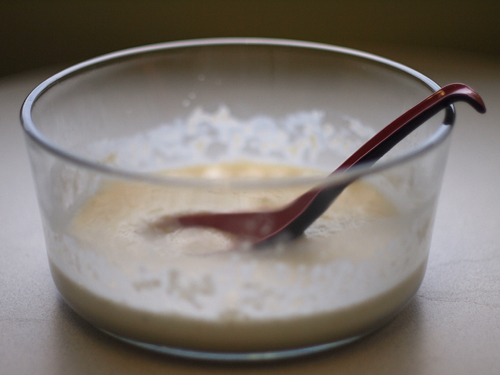
Naturally, after talking about chitlins and grits yesterday, I wanted to have grits today.

Fortunately, this was possible. I have some Quaker Instant Grits, and I made some for breakfast.

grits

Does it look like cream of wheat? It’s not all that different, really, except that it’s made with corn and so has a different taste and a bit of a more granular consistency.

And what is the difference between grits and polenta? Less than you might think. Mainly, grits are made with hominy, which is skinned and bleached corn – though apparently sometimes they’re made with just normal corn meal. Oh, and you eat grits mainly in the US, and mainly in the southern states, and so you typically have them (or it) with other good southern food. (I do love me some southern cooking. You shouldn’t eat it all the time – fat and starch are maybe a little predominant – but one of my favourite cookbooks is White Trash Cooking by Ernest Mickler, basically a collection of recipes from his family and friends for good ugly flavourful food.)

This also has some phonological implications for grits. If you have a Canadian accent, or any of quite a lot of other Anglophone accents, you of course say it [grɪts], with the [ɪ] variously high or low depending on where you’re from (some places you’re likely to get something close to [grɛts], likely in concert with a certain amount of creaky phonation, a.k.a. vocal fry). But that’s not how /grɪts/ is realized in many a southern US accent. “Short” vowels are often diphthongized in the southern US, and /grɪts/ can be realized as [griɛts] or [griəts] – a manifestation of the same phonological process of splitting a vowel into two parts with contrast between them that led to the Great Vowel Shift, wherein all our long vowels became diphthongs in the couple of centuries before Shakespeare.

A warning, though: if you do not speak with a southern US accent, you will likely sound stupid saying grits in the southern way in the middle of a sentence that is otherwise in a non-southern accent. It’s like saying “Nollins” instead of “Neworlins” or “Norlins,” or “Cans” instead of “Cairns” (Australia), when you normally pronounce /r/. People who sound like they’re saying “Nollins” or “Cans” are saying the /r/; they’re just saying it as a lengthening of the preceding vowel. You, in your accent, should say the /r/ the way you normally say it. Otherwise you’re shifting for just one word into someone else’s phonotactics, switching phonological realization patterns for one word. It’s desperately incongruous.

But back to the southern connection. I bet a lot of people just know of grits as “something southern people eat” without knowing exactly what they are, let alone ever having had them. Millions of people will surely think first of Flo (played by Polly Holliday, from Alabama) in the TV show Alice – a southerner working as a waitress in Mel’s Diner in Arizona. Her catchphrase was “Kiss my grits!” (Hear her say it near the end of this clip.)

So naturally you’re likely to fancy yourself feeling mighty southern if you eat some grits. It seems almost like the haggis of the south in regard to the regional pride attached to it (except that people generally don’t think of grits as disgusting, as many – not including me – do of haggis). It’s a signature bit of southern cuisine in spite of the fact that it’s not breaded or fried or barbecued or covered in some sort of sauce. Well, it’s made of corn. Shut up and eat. I suspect that it has a certain grab-and-stay power just because of the grabby sound of the word ([gr] onset) and the other tastes grit has – notably pluck and courage, but also stubble and dirt: an emphasis of honest poor-folks origins.

Grit as in “dirt” and grits as in “ground corn” are, by the way, from different Old English roots, but they are likely related further back and have also mutually influenced over the course of English history. On the other hand, groats is considered a variant of grits – one that tends to refer specifically to oats (or as otherwise specified, for instance buckwheat groats), which grits seems originally to have referred to as well – or wheat.

But, you know, as Wilson Fowlie pointed out to me today on my note on chitterlings, there’s probably someone somewhere who will insist on saying groats when talking about grits. After all, grits is what normal people call them – people who don’t have a whole lot of education and don’t speak “formal” English. So therefore if there’s a version of the word that’s more associated with England and less associated with those southern people, it must be the more correct or better version, right?

Just like I’m sure there are restaurants that do the most precious imaginable variations on grits, too. You know, “Crawfish Grit Croquettes with creole mustard foam and green onion ‘dust’” or “Herb crusted Maple leaf duck breast Smoked and sliced over Creamy herb infused grits and finished with Wild berry confit salad.” (Note the arbitrary capitalization.) Now, I like novelty in foods, and fusion, and so on, and I eat for flavour, not ethnology (“authentic” is a deeply self-deceptive concept in intercultural food explorations), but precious fads can sometimes make me grit my teeth a little. Some of those chefs can kiss my grits… actually, they can leave them alone, thanks.

chitterlings

Ah, newspeople. Who was it that said that news was like sausages – you don’t want to see how it’s made? Oh, wait, that was laws. But they are like sausages in that they want to get to the guts of the issue, but they have to do it presentably – and in a way that they think is palatable to their audience. And they are like people of the law in that they are often very concerned with appearing impartial and correct.

Indeed, you can see some of the most egregious hypercorrections in newspapers. And broadcast news, the same place that brought us “harris-ment” for harassment and “urine-us” for Uranus, is about the only place you may hear an [r] after the [b] in February or – o hypercorrection indeed – hear the hump day of the week pronounced [wɛd nɛs deɪ] rather than [wɪnz deɪ] (even the Oxford English Dictionary does not include that three-syllable spelling pronunciation).

Or hear tell of chitterlings. As I recall hearing on the news when there was a recall related to some chitterlings in Alberta once.

Before going any further on what chitterlings are and what they’re usually called (things you may or may not know), let’s stop and enjoy the look and feel of this word. It has the crisp skip of the voiceless affricate and stop in the first part, and then it softens to liquids and a nasal and a voiced fricative. It seems to skitter, chatter, perhaps even glitter; the lings may make you think of earthlings, and you may wonder if chitterlings are denizens of Chattanooga, say. Or could they be little critters, monkeys perhaps?

Naw, they’re pigs’ guts. Or guts of other animals, but usually pigs’ guts.

“Um,” you may be thinking. “Why would they recall pigs’ guts? And what do they do, take the pigs back to the factories for gut replacements?” No, these guts have been taken from the pigs already and the pigs are not going to need them again. These guts are for cooking (at length, as usual with digestive organs) and eating. (They were recalled due to contamination. With what, I can’t recall. Pig poop?)

And the more common word for them is chitlings, or chitlins. Which is of course just a rubbed-down version of the original, sort of like vittles for victuals. It is, naturally, newer (1800s rather than 1400s for the first known use in print), and is associated with the Southern US in particular.

Did you know that was what chitlins are? If you didn’t, now you do. My guess is you’ve probably heard of “chitlins and grits” or something like that. So, uh… do you know what grits are? Have you had them? (I certainly have, and I quite like them.) I’ll tell you this: I can’t see how a newsreader could possibly hypercorrect the word grits.

But if we’re going to go the whole way with chitterlings, following the formally correct and extremely WASPy model, why not have some more guts and go with a spelling from way back when – I like this one from 1440 (thanks, OED): chytyrlynge. That really looks more like fried porcine intestine. Note that it’s singular, though… like guts (and grits), chitterlings has come to be a plural (also conjugatable as a singular).

And where does it come from? Well, words are like sausages. I don’t mean that you don’t want to know how they’re made. I mean sometimes you just don’t know what the heck went into making them and you’re probably never going to find out. So just enjoy the flavour.

distill

I sing with the Toronto Mendelssohn Choir, and we started rehearsing tonight for our Christmas carol concert. One of the pieces we’ll be singing is The Huron Carol, in Robert B. Anderson’s arrangement.

As soon as we started singing it I was in the still calm of a Christmas Eve somewhere in my past, any one of many I’ve lived, outside in the crisp Alberta air with snow lightly here and there, house lights, Christmas lights, the beautiful calm and the sense of quiet anticipation – not of getting presents; the commercial side of Christmas is increasingly repellent to me – anticipation of, well, comfort and joy and new beginnings. And, honestly, I just love beautiful nights filled with silence and music. As we sang, frissons ran over my skin – not chills, not from the frosty air; we were, after all, singing inside where it was light and warm; simply the nerve endings and the little hairs up and down standing up to look up at the starry sky.

Christmas Eves aren’t like that anymore. And never have been. I know perfectly well that every one of those Christmas Eves felt like a normal enough evening at the time, pleasant but not really matching the strength of memory. Well of course. One might as well say that speech is not like singing, does not produce the same frissons. But in both cases it is, I think, not a question of something being added that wasn’t there. It is a case of distillation.

You know what distillation is. It’s what we use to produce purer water, purer alcohol or more intense liquor… Not to add what is not there, but to keep what we most especially want and remove most of the rest. How? Let it evaporate, turn it to steam, let the most volatile, the most savorous, the lightest, the most desirable parts slip up and away from the weighty watery hold of gravity; and once it has flown, has known the freedom of swirling in its little hot empyrean, has slipped the surly bonds of earth, let it come against the glass that will keep it from escaping, the wall it could see through but never surpass; and let it cool into tears, weeping for its lost chance, dripping down again into a pool – but a pool only of those spirits that escaped, a pool so much purer than what had been before. In this metamorphosis, the flying part is the chrysalis, while the shimmering butterfly returns to gravity.

Does that seem overwrought? Do you know what distill comes from? Latin distillare or destillare, “drip or trickle down”; the Oxford English Dictionary gives the first meaning of distill (in English from the 1400s) as intransitive, “To trickle down or fall in minute drops, as rain, tears; to issue forth in drops or in a fine moisture; to exude.” From which we ultimately came to our sense referring to the purification process that makes use of distillation in the first sense. But rain falls because it has condensed around dust; tears are salty as they roll down your face; but the distillate that drips at the end of the purifying process has left such things behind and has only condensed because it could not be free.

And so our memories, the experiences of our minds, the most volatile elements, capable – like alcohol – of carrying flavours so much more strongly, are distilled. Even as we experience these things, that spirit of emotion is there, a subtle current weaving through or just a dilute mood barely noticeable, tasted at best perhaps as a faint yearning. It comes through in the still of memory, spirit condensed on the glass of the window through which we view the world.

It is so with music too. Our speech tones carry some emotion, but it is scruffy, everyday emotion, like a once-beautiful antique chair hiding under a dust cloth in a rumpus room, or a hint of whisky in a glass of ginger ale. Perhaps it comes from a pure source and is watered down; perhaps it comes like alcohol from fruit juice, not there from the beginning but a product of what is there. But words want to distill; the tones of our speech want to fly loose and make their page the stained glass window of song, condensing on it in tears. You doubt? Meet the speech-to-song illusion: a spoken phrase played back enough times begins to sound like music.

And what will we remember or sing of this word distill? What spirits does it carry? You see every letter but the coiled and fluid s reaching up away like steam. You see in its alternate form, distil, a partly turned pistil – the female, receiving part of a flower, which gestates the new flower seeds. You see till, which is a temporal or pecuniary expectation – “We will sell till we fill our till” – with negating dis before it, rendering it free of future time and money. You see still, calm, peaceful, hushed like the [st] in the heart of this word. These are the parts I will take with me and savour quietly much later from the crystal flask of memory; the rest I can leave behind.

gallimaufry, salmagundi

What have we got to eat tonight?

It’s gallimaufry or salmagundi, I’m not sure which. Maybe both.

You made it. How can you not know?

It’s a tosspot hotch-potch, a hodgepodge like hopscotch with a splash of balderdash, a farrago of foraging. Fish, flesh, flashes in the pan, catch as catch can. Potluck from a potlach. Edibles all agee, etymology unknown. As incongruous as a semolina filigree.

We can go through it and see what there is and decide what to call it.

There’s a gallon of small fry, silver and swirling, and some salmon gumbo, pink and green like a youth at the railing of a heaving ship. There’s gall and gum and a lamb sandwich and a sloppy Joe and maybe a muffuletta, all mingling like yesterday’s lunch in your gut; there’s a slop of slumgullion garbled with subgum and a muddled mug of mulligatawny, middling inelegant and glumly tawny. There’s a gamelan with a gun, banging through revolving scales. There are fumes from a fumarole and undies from a gun moll named Selma. A mafia gallant slammed some alms down in it: “For your family.” Swirling within I see dualism nag and a Gaul firmly in d’ slum again, a sad mauling à la filmy rug, as kooky as a coati mundi in the belfry… If I pick bits out like fishbones, I get a, a, i, u to go with the g, l, m; on the one side I am left with l fry and on the other with s nd. They are like hidden messages, partially obnubilated.

Sip it or gulp it. It tastes of two trochees, like Latin lines: confutatis maledictis, tuba merum spargens sonum, o Fortuna velut luna, testit David cum Sibylla. A bumping, gulping rhythm. It has an [æl] in the first syllable, a [m] in the second, a [g] somewhere in it, an [i] at the end. It sounds like a big jug of whatever-it-is being poured out, galumphing into overloaded bowls, glugging down a drain burping like mud pots.

You won’t get anywhere by comparing the original recipes. A gallimaufry is just a merry gorging of ragout or hash, any crazy stew; salmagundi has many different specific recipes, and they seldom resemble each other in any particular detail, although one might think of a mixture of meat, anchovies, eggs, capers, perhaps olives, oil, lemon juice… or not. Look them up in different sources and get different recipes. They seem to be culinary pranks, a sort of “aristocrats” joke of the kitchen.

Very well. It’s what there is to eat. A verbal smorgasbord for galloping gourmets: astonishing gastronomy, a Solomon Grundy, a gallery mouthful. Give it a name.

Fillmagasundry. Let’s just call it that.

