
Monthly Archives: January 2013

A Word Taster’s Companion: What makes a word

Today: the second installment of my how-to guide for word tasting, A Word Taster’s Companion.

What makes a word

Let us start by looking at the parts of words. Take a word. In fact, let’s start with start. Here’s a simple question: what is this word, start, made of?

Did someone say five letters?

Oops.

No, words are not made of letters.

That’s right: one of the first things just about anyone knows about words is the first thing they’re going to have to unlearn.

Tell me, what did you do first, when you were a very small child: write or speak?

You almost certainly learned to speak a few years before you learned to write. You knew the sounds long before you knew the symbols used to represent them on paper.

But aren’t those sounds letters?

They sure aren’t. Letters came along to represent sounds many thousands of years after humans started speaking. And anyone who can write English knows that the same letter is often used to represent several different sounds – for instance, fat, make, above – and the same sound can be represented by different letters – hay, hey, weigh.

Words are made up of quite a few different things, actually – and we’ll get to them all by the time I’m done with you – but on the most basic level of expressive form, words are made up of sounds (unless you are deaf and speak sign language).

And those sounds are made by the physical movements of your vocal tract. (If you speak sign language, they’re made up of movements of your hands and other body parts.) So when you say a word, you feel it. And when you hear a word, you know what it feels like.

So feel it. Feel this word: “Start.” Say it.

What do you feel your tongue doing? First the tip is up near the front of your mouth, behind the teeth and ahead of the ridge (that ridge is called the alveolar ridge). It’s letting some air through, making a hissing noise. Your voice is not activated: you could only whisper, not sing, while saying [s].

Then your tongue closes off the airflow. For a moment no air gets out of your mouth, because your nose is closed too (by means of a flap at the back of your mouth). Then you release it, and the tongue drops down and sits flat on the bottom of your mouth, and your voice starts up: [a].

Then, if you’re among those who say the [r], the tongue humps up like a cat stretching. It makes a narrower passage between itself and the roof of your mouth (your palate).

Finally, the tip of the tongue touches again and blocks the airflow as the voice stops – but you may find that even before the tongue gets all the way there the airflow has stopped; many people will make this stop using the closing point in the throat, the glottis, which is what you use to stop the air when you swallow or hold your breath.

So there you have it. One continuous movement of the tongue, with the voice engaged just in the middle. A continuous flow of physical movement and a continuous flow of sound. But we hear it as five sounds, because we have learned to divide the sound stream we hear into those sounds.
Next: The world speaks in harmony

definite, definitely

This is definately a word that’s going to set a lot of people off. Definetly. Defiantly.

(Nails digging into your palms yet?)

I grew up with video games like Space Invaders, Pac-Man, Centipede… They all have an important thing in common with English spelling: They’re all games where you will lose eventually. The point is not to win but just to last as long as you can before you make a mistake …and get slaughtered for it.

Some people last longer than others.

But at least people don’t think you’re a moron if you get wiped out quickly at Pac-Man.

It is true that good spelling in English is typically a sign of a decent intellect and a good education. The converse is not as reliably true. There are many people who are very intelligent and very strong in fields such as math or engineering who are not all that great at English spelling. And of course there are many people who simply were not really taught spelling very well in school and did not take it upon themselves to correct the deficiency because it did not appear all that important to them at the time.

The aim of writing is to represent spoken words. Alphabetic writing systems operate on a generally phonetic principle. Some languages are better than others at sticking to that principle. English has become spectacularly awful at it, in part due to borrowing words from other languages (sorry, not borrowing, stealing; we never give them back), in part due to sound changes in English that were not reflected in spelling changes, in part due to prescriptive spelling trends that actually deprecated adherence to phonetics. Read all about it at “What’s up with English spelling?

So we come to today’s word. It’s a very frequently misspelled word. In some contexts (e.g., some online forums) I think I see definately more often than definitely. Spellings also seen include definatly, definantly, definetly, definently, and even defiantly (let’s just grab some letters and put them there in a plausible arrangement, shall we?). It persists defiantly! And almost infinitely.

There is a reason for this obstinate intrusion of this immaculately conceived a into the word. It is analogy. There are so many words ending in an /ət/ (and, by extension, /ətli/) – realized in various contexts as [ɛt] and [ɪt] – including some very popular words (chocolate, anyone?), that the ate(ly) spelling just seems right. And if you see others doing it, it reinforces it.

So why don’t we spell it that way? Other languages spell things as they sound, regardless of where they came from, after all. For instance, the French loan word chauffeur becomes sjofør in Norwegian, which is a perfectly phonetic spelling for them.

Well, we don’t do that in English. We’re more likely to change our pronunciation to match the spelling, in fact. We like to keep words spelled the way they came into the language. Not always always – sometimes we’ve made them even fancier, and sometimes we’ve trimmed them down – but especially lately it’s the thing to do.

So what put the i in definite? It might help to understand if I define it. What does definite mean, anyway? ‘Certain. Precise. Clearly defined.’ Clearly defined? Indeed. Given clear finite boundaries. From Latin definitus, from de plus finire ‘finish, end, bound’. The word that gives us finish and finite and infinite and definition gives us definite.

But the meaning has shifted just enough, and the pronunciation has reduced just enough on that last syllable, that the connection to those other words is not at the front of the mind, and sometimes not at the back of it either. We don’t, after all, say it like “dee finite”; we say it more like “deaf, innit” – or, to be precise, as /dɛf ə nət/, with those /ə/ phonemes varying in actual pronunciation, but the syllable boundaries quite certain. The common abbreviation for definite is def, as in “I would def go there.” It sometimes seems as though our phonology is increasingly deaf, innit?

But as indefinite as the spelling may be in the minds of many, the response by some to the misspelling is very definite. Oh, definitely. D-E-F-I-N-I-T-E-L-Y, as the website says.

Well, so be it. When it rains it pours. And it is definitely raining.

peavey

Capsule notes:

Visual: descenders at beginning and end; downward points in middle and at end; e as second and second-last letter.

In the mouth: four phonemes; the consonants are on the lips (with the teeth on the second one) and the vowels are both /i/.

Etymology: named after the man credited with inventing it in the 1850s, Jospeh Peavey of Maine. The family name Peavey (also Peavy) is likely Anglo-Norman in origin and may come from Pavie or from Beauvoir.

Collocations: Peavey amplifier, Peavey Mart.

Overtones: the name Peavey is most commonly associated with electronic musical equipment, especially amplifiers. Peavey Mart is the name of a Western Canadian chain of hardware and farm equipment stores. Peavey also has echoes of peeve and related words, and, due to its pronunciation like P.V., of PVC, POV, and such like. It may also carry notes of levee and levy and navy and navvy and similar words.

Semantics: a lumberman’s tool for handling logs, for example in the stream; it has a wooden handle with a spike on the end and a hook curving around to form a sort of pincer grip with the spike. It is a variation on the tool called a cant hook or cant dog.

Full tasting:

In the January 2013 issue of National Geographic, I read the following on page 56: “the crucial physical culture of axes, adzes, pikes, and peaveys they used to build homes and harvest wood.” I do not recall ever having seen peavey used as a common noun before (though I may have seen it and forgotten it). Although I knew that it was obviously something useful in home construction or lumber handling, it wasn’t clear to me what it was – though once I looked it up, I discovered it was an implement I had certainly seen before. But that wasn’t the image that came to my mind first.

No, of course, the first thing I thought of was a musical amplifier. Now, those who have read my word tasting notes for a while may have a reliable impression of little discussion of lumber but a certain amount of discussion of music, and clear signs of a liking for heavy metal music (along with medieval music and numerous other genres, to be sure), even if it peeves my lovely wife. Perhaps you know that among rock musicians, axe (or ax) is a colloquialism for electric guitar. Now, adze and pike are not words I can recall seeing used in connection with rock musicianship (except in the name of the group The Northern Pikes), but on the other hand woodshedding is a term sometimes used to refer to intense solo practice on one’s instrument (figuratively going out to the woodshed to spend hours there perfecting technique). And I find it quite appealing to imagine an “axe” and a Peavey amplifier being essential equipment in building homes. Right now my mind is echoing with Starship: “We built this city on rock and roll.”

Of course I didn’t really think that the original colonists’ houses in Saguenay, Quebec – which is where author David Dobbs was writing about – were built on rock and roll. More likely cheese and maple syrup, two things I like possibly even more than rock and roll (especially when they’re from Quebec). But, not knowing what a peavey was at the time of reading, I wondered if it might be some kind of architectural or landscaping feature, like a levee, or some kind of wood joining or handling implement such as a plane. Surely something you could buy at a hardware or farm implement store. Naturally I made a note – a note to make a note amplifying the word.

Eglinton, glint

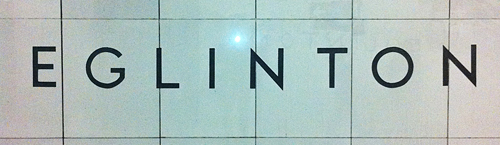
EGLINTON

Look at the glint on that photo. That’s no tingle. Perhaps it’s non-legit – it’s actually from the little flash on my iPhone. But at a glance, it is a glint – and indeed since it glances off the surface, moving quickly and perhaps obliquely, it does glint, even if lacks the éclat of, say, lit gelignite.

Those who live in Toronto will surely know where I took the picture: standing on the platform of Eglinton subway station. Eglinton station is at Yonge Street and Eglinton Avenue, a neighbourhood once and occasionally still jokingly called “Young and Eligible” (it helps that there are high-rise apartments thereabouts that house many young and eligible people, but then that’s true for several places in Toronto). More often it’s just said “yunganeg,” the intersection of two of Toronto’s most important – and most misspelled and mispronounced – streets.

Easy to see how one might get Yonge wrong (it’s pronounced like young). But Eglinton? Well, it’s like this: there are many people in Toronto and area who will swear it’s Eglington and always say it that way. This is, in my analysis, a hypercorrection – everyone knows, after all, that “-in’” is a casual way of saying “-ing,” so the inference is that “Eglinton” is sloppy for “Eglington.” On top of that, there is a Toronto street of some note (meaning it has a subway station) named Islington, with that g before the t. So it’s not so surprising that people think that “Eglinton” drops the g.

Even though there’s no g to drop. By which I mean not only that the word is actually Eglinton but also that in going from “-ing” to “-in’” you do not drop a [g]. There is no [g] sound in there. Listen to the difference between finger and singer. The former has a [g]; the latter, not. What is the difference between singer and sinner (I mean just the pronunciations!)? Not a [g] but rather the difference between back and front: the place the tongue touches the roof of the mouth. So people who think that Eglinton is dropping a [g] have it back to front. As it were.

The street name, by the way, is after Eglinton Castle in Scotland (no longer standing – there was an old small castle that was replaced circa 1800 with a Gothic-style castellated building, which was abandoned in 1925 and was finished off by army posted there in WWII), which was the seat of the Earls of Eglinton (the first Earl of Eglinton was Hugh Montgomerie, elevated in 1508); the name Eglinton was first recorded in 1205 as Eglunstone, and is seen in various spellings such as Eglytone and Egglington over the centuries. As an odd aside, there was a chair in Eglinton Castle that had the full text of Robert Burns’s “Tam O’Shanter” on it, a poem that I have referred to in my note on skirl. Well, why not? The castle was in Ayrshire, and Burns was an Ayrshire man.

Does it seem strange that some Torontonians might see Eglinton so many times on such a regular basis and not notice that it’s not Eglington? I bet even fewer people notice that it has a glint right in the middle of it. It’s right there, but it’s across syllable boundaries. Eg. Lin. Ton. It shows at best as an oblique flash.

Which is what a glint is. But where do we most often say we see glints? In someone’s eye. It’s one thing to see a glance of an eye; it’s another to see a glint in an eye. Literally it would seem to be a reflection, not really volitional therefore, but somehow what it really is is a muscular set expressing a certain attitude (of mischief or desire) that is conceptually synaesthetized as an oblique flash of light. It’s not there, but you see it as being there. Gee.

Glint started out as a verb, probably a variation on glent; it meant first “move quickly, especially obliquely; glance aside” – in the “glancing blow” sense of glance, which is to say the original sense: to glance was (and still is, in one of its uses) to strike obliquely, to turn aside. The two words don’t appear to have the same origin, but they do seem to have cross-influence. Interestingly, the “flashing light” sense of glint doesn’t really show up until the 1800s. (The “quick look” sense of glance is attested from the 1500s.)

But you know that both seem destined to be applied to something to do with light, shining, flashes, or vision. Look: glass, glimmer, glitter, glamour, glow, gleam, glare… add your own to the list. We have a /gl/ phonaestheme: a sound combination that is associated with a certain sense, even in the absence of a common etymological basis. It just shows up in a flash.

snipe

Capsule notes:

Visual: a quick shot of a word, but a full array of lines and curves and loops; one ascender and one descender.

In the mouth: the tongue starts pressed against the alveolar ridge but still letting air through; then that closes to a nasal; then the tongue draws back for a curl and flex in the /aɪ/; and at last the mouth snaps shut with the bilabial stop. One quick syllable, with a gesture like that of an anglerfish grabbing its prey.

Semantics: a bird, often found in the bush, but at least as often not found because not seen; sharpshooting from a place of concealment, noun and verb, with extended senses in various areas of endeavour; also a deprecatory term for a base person. Snipe hunt refers to a fool’s errand, a wild goose chase.

Etymology: a Germanic word. All the snipe words come from the word for the bird. The sharpshooting senses relate originally to hunting the bird.

Collocations: snipe at, snipe hunt, guttersnipe, common snipe.

Overtones: there’s that nasal /sn/, which often shows up in words relating to the nose; there are echoes of snide, spite, snip, snap, smite, Snopes, knife, and perhaps stipend and Smythe and similar words.

Full tasting:

There are people who don’t believe snipes exist. They think they’re in a class with the urban legends debunked on Snopes.com. I’ve met at least one such person. Where does this idea come from? Well, in North America, a childish prank (sometimes also played by adults) among campers and others in or near wilderness areas is to send someone on a snipe hunt, beating the bushes or doing other strange things looking for this bird; the joke is that you won’t find it. The reason you won’t find it is first of all because there probably aren’t any in the area (they’re not all that common in North America), secondly because if you did find one you probably wouldn’t know what you were looking for anyway, thirdly because going through the bush shouting “Snipe! Snipe!” is a great way to scare birds and beasts away, fourthly because real snipes are really hard to catch or even to shoot, and fifthly because you could be looking directly at one and not see it.

You doubt? Have a look at the article “Can you spot the ‘invisible animal’? Incredible images show nature’s disappearing act when predators are near” on the Daily Mail website. A little below the halfway point of the set of photos by Art Wolfe, there is one of a snipe in some brush near a stream. You may look at the other photos and spot the hidden animal or bird after a second or two without reading the caption. But if and when you finally spot the snipe, you will likely find that you had looked directly at it several times without recognizing it as anything other than more of the riparian vegetation.

Lurking in vegetation is hardly enough to merit opprobrium, however; many creatures do so without becoming bywords for nasty people – see Othello, for instance: “For I mine owne gain’d knowledge should prophane, If I would time expend with such a snipe” – or lowly, vulgar types (in the compound guttersnipe). Nor is the term of abuse the direct source for the sharpshooter, or vice versa; the words snipe (verb) and sniper come from references to hunting for snipes, which apparently requires extra stealth and good shooting abilities (aside from hiding, they also fly away). That game hunting activity transferred to similar shooting in wartime, and from that the other metaphorical senses readily proceed.

But of course shooting from concealment is not universally positively viewed, especially in metaphorical senses. If you have been eagerly watching an item on ebay, hoping your bid will win it, you will probably be quite unhappy, and think very dark things about the person, if someone snipes it – overbids you with just a second or two left, so you don’t have time to bid back. In more general social circumstances, sniping is, as it were, knifing someone in the back, taking pot shots at them (somehow that metaphor for sloppy random shooting is in such cases used nearly interchangeably with one for very precise and skilled shooting).

I have an unsubstantiated suspicion that the echoes of knife, snide, spite, and such like feed into the tone and sense – the sounds lurking in the background, peeking out half-heard, shooting their sense into the word… a word that, for its part, though brief, actually rather stands out in a sentence, thanks to its sharp sound and sense.

A Word Taster’s Companion: Let’s get started

Starting today, I will be posting in installments, intermingled with my word tasting notes, a how-to guide for word tasting: A Word Taster’s Companion.

Let’s get started

Welcome to the world of word tasting.

Oh, you aren’t new to it, not really. It’s possible for a person who is a novice in wine tasting truly never to have tasted wine before, but we all use words, we all run them through our minds, nearly all of us form them with our mouths. We can’t not taste them, at least a little. We choose one word over another for reasons that go beyond the dictionary definitions. We have all looked on sentences where the wrong word was used. It sets the teeth on edge.

But our daily usage is so much guzzling compared with what we can truly get from words. Just as, when you actually set out to taste a wine, you discover things that simply wouldn’t have been there for you had you merely swigged it, so too in tasting words you will not only put your finger on the nuances that had passed so lightly across your tongue – you will create a world of delight that hadn’t existed before, just through your interaction with it. And you will become a much better user of words as well.

Let’s get going and shake the cobwebs out. You’ll be better at tasting words, and will get more enjoyment out of it, when you are an expert (i.e., when I’m finished with you), but this isn’t Zen archery or contract bridge: you don’t spend forever thinking and talking about it before doing it. But you already have at least a developed sense, to a greater or lesser degree conscious. So here we go.

Here are some uncommon words. You might not be familiar with all of them.

thixotropic

fleer

pinguid

mumpsimus

For each of these words, write down the first ten things you can think of. Try the sounds, the things they sound like, the way they feel in your mouth. What do they make you think of? If you want to look them up, do. If you don’t, don’t – though ultimately finding out the meaning of unfamiliar words will be an important part of a word tasting.

Now do the same with the following words, but go for 20 things:

morning

cake

shampoo

dog

hound

Include the words you tend to use them with (phrases, expressions, whatever other words they bring to mind), places they would be appropriate or inappropriate, and whatever else comes to your mind. Anything that you know about them or think about them or that they make you think of.

Congratulations. You have just attained the first degree of word tasting. You have planted the seeds; the rest will follow as roots and branches.

Next: What words are made of.

