Monthly Archives: June 2014

Mind your idioms

Originally published in Active Voice, the national magazine of the Editors’ Association of Canada

English has many quaint and curious phrases, clichés, and idioms, and we quite often see them misconstrued. Ours can be a very unforgiving game. You don’t have free reign to pawn off whatever one-of usages will tie you over, or do just any linguistic slight of hand (or vocal chords). No, you have to tow the line and stick to the straight and narrow, or your straight-laced readers will develop a deep-seeded dislike for you and give you short shift – they will wait with baited breath to see you get your just desserts and be hoisted on your own petard without further adieu, and the value of what you have to say will be a mute point.

Heh heh. Let me put that right:

You don’t have free rein to palm off whatever one-off usages will tide you over, or do just any linguistic sleight of hand (or vocal cords). No, you have to toe the line and stick to the strait and narrow, or your strait-laced readers will develop a deep-seated dislike for you and give you short shrift – they will wait with bated breath to see you get your just deserts and be hoist with your own petard without further ado, and the value of what you have to say will be a moot point.

Of course, that’s all well and good as long as we’re all playing the same game. But when we’re dealing with international audiences, the phrasing we use in hopes of striking a home run with our readers (or even just stealing a base) may seem to them to be not just cricket, and you won’t strike out – you will be dismissed.

We Canadian editors may be a bit smug about our position seemingly straddling the British-American fence. After all, we all know about our/or and re/er and ise/ize, and we may feel that, having mastered aluminium with an i and orientate with the ate and perhaps revise for study, estate agent for real estate agent, and some food terms – rocket (arugula), courgette (zucchini), marrow (summer squash), swede (rutabaga) – we can count on our intuitions with British.

But we run the risk of taking something for an error or typo when it’s really the correct British form. A bit over a decade ago, Orrin Hargraves came out with an excellent guide to British-American differences, Mighty Fine Words and Smashing Expressions; let me share with you some of the benefit of that smart volume: If you want to make a home from home in British English, and make a good job of it, don’t take the attitude of the know-all; know when to leave well alone if you want to cater for your readers and get on with them. Knowing your phrasal idioms can make the world of difference and give you a new lease of life – and if you don’t know them, you can rub your readers up the wrong way, and they might have a go at you and want to get shot of you. It will be more than a storm in a teacup; you will end up down at heel.

Which means, first of all, you will not render the above in a Canadian way: do not change it to home away from home, do a good job, know-it-all, leave well enough alone, cater to, get along with, make a world of difference, a new lease on life, rub your readers the wrong way, give you a tongue-lashing, get rid of you, tempest in a teacup, or down at the heels.

The best idea, of course, is to get a native British speaker – or, as occasion demands, an American speaker to add American idioms and weed out Canadianisms: don’t slip up and start talking about writing the odd test in pencil crayon, for instance (“Ohhhh, you mean taking the occasional test using a colored pencil! What was that other weird stuff you said?”). But at the very least, always look twice before crossing the idiom.

rhinestone

This word makes me think of music. And the music it makes me think of brings to mind two specific places and times: two similar yet different places and two paradoxical juxtapositions.

The music it makes me think of is not Wagner. Das Rheingold does not play into it at all, even though it involves the Rhine and some stones. That opera is about actual gold, not fake diamonds. True, the gold in Das Rheingold is found in the Rhine, just as the original rhinestone crystals were (they’re manufactured now). But the gold was forged into a golden ring of power and trouble, while rhinestones are really for people grasping at the brass ring on the carousel of life and fame. Their meretricious coruscation is perfectly emblematic of the big music business.

But rhinestone does not make me think of Liberace or Elvis Presley, either, although both of them wore plenty of rhinestones. Nor does it make me think of the Rolling Stones, whether or not crossed with a rhinoceros.

Picture Water Street, the main drag of the Gastown historical district in Vancouver, in the late 1970s. A tourist mecca – or tourist trap. A family from Alberta is visiting: mom, dad, two boys. The boys are loading up on seashells and similar souveniry dreck with which they will fill shoe boxes to occupy the back corners in their closets and under their beds. Mom and Dad are looking at more adult things, jewelry and clothes, probably. Everything is novel and everything is so Vancouver and so not Alberta, so sea and shells and fish and so not dust and horses and cows. The boys are having friction with this bizarre thing called sales tax, whereby the price on the sticker is not the price you pay, but even that mainly serves to underline that they are somewhere else. And down this street, this historical seaside city street full of not-back-home-in-cow-country, walks…

Not a cowboy, no. A guy in jeans and whatever, carrying a portable radio that’s blasting Glen Campbell’s song “Rhinestone Cowboy.” (I will not swear he was walking; it was a long time ago, and the radio may have been plugged in.) I found this hilariously incongruous. You may think I even turned to my parents and said, “Mater, pater, that is hilariously incongruous.” But actually I just laughed. Cowboy? In Gastown? And then I turned back to my abalone shells.

Fast forward about three and a half decades, to another shopping street full of tourists and historical buildings. But this street is in Copenhagen, one of the half dozen streets that concatenate to make what’s called Strøget, the longest pedestrian shopping area in Europe. That’s fitting – Copenhagen comes from words meaning ‘merchant’s port’. We are right by the sea, in a city famous for a statue of a mermaid. Denmark has fields and farms and so on, but the only thing that is cattle-like is the herds of people plodding along the cobblestones to the slaughter of their wallets. It would be incongruous to hear something about cowboys there.

So, yes, there was a street performer, playing on his guitar and singing: “Like a rhinestone cowboy, Riding out on a horse in a star-spangled rodeo… Like a rhinestone cowboy, Getting cards and letters from people I don’t even know…” Of course. Meanwhile not too many steps away people were having the dead skin on their feet debrided by small fish in tanks, and hundreds of dollars were being spent on postcards and silly porcelain Vikings that would adhere magnetically to a refrigerator.

But rhinestones don’t fool anyone, and aren’t intended to. Everyone sees that a rhinestone is a rhinestone and not a diamond. It is a glitter for those who want fame, who want to make it, who want to believe they have made it. For those who know that they’re a bit out of place. The singer of “Rhinestone Cowboy” is a hustler walking the dirty sidewalks of Broadway,

With a subway token and a dollar tucked inside my shoe
There’ll be a load of compromisin’
On the road to my horizon
But I’m gonna be where the lights are shinin’ on me

A street full of tourists wanting to see something different from where they’re from. People paying good money for cheap trite tchotchkes, compromises with reality, simulacra of simulacra. Stores filled with expensive clothes that you can only look at and aspire to. But in the end you’re aspiring to not another reality but a higher-status fantasy. Real cowboys don’t wear rhinestones, just like real longshoremen don’t. Skip the docks and go to the statue of the fictional being who wanted to become a real human but traded her voice to do so and in the end was discarded like any beautiful dream awoken from.

We went back from the charming escape of Vancouver to our Alberta of real cowboys, who are nothing special when you’re around them a lot. The image of them most people have comes from movies, which are meretricious coruscations. And we went back from Copenhagen to our Toronto of… no cowboys, no rhinestones. Never mind. The shining of the lights never lasts, and the dreams are always awoken from. Back in Copenhagen, the mermaid still sits on her rock, looking to the west. But we’re not there.

I bet that guy with the guitar is, though.

champagne

Champagne for my real friends, real pain for my sham friends.

When is the best time to drink champagne? Before, during, and after.

Champagne occupies a spot similar to that of the martini: a drink of class, sophistication, legend, debauchery. But champagne is more expensive and less efficient.

Champagne is the only wine that you can safely match with any food at all – or none at all. It goes well with everything you can eat, as well as with battleships and race cars.

Champers, as some call it, is the drink of champs. It is also a good thing to drink if you want to feel like a champ. Or if you just don’t want to feel like a loser. Have it at the start of a campaign and at the end of a campaign. Fill your flute with it. If you must, use it as champu. I mean shampoo. Bit of a waste, that, though, really.

Champagne the beverage takes its name from Champagne the place, which comes ultimately from Latin campus, ‘field’. Which is fine with me. I’d like to be in a field where there’s champagne to be drunk. And a campus – as of a university – is a fountain of knowledge where students gather to drink. The region of Champagne is now called Champagne-Ardenne because it includes the Ardenne forest. I find this ironic, because champagne generally doesn’t make people ’arden. It more likely makes them soften.

Champagne is often seen with caviar: two expensive luxury foods, both rather heavily marked up. But caviar is, for many people, an acquired taste. The taste for champagne is largely self-acquiring.

Champagne is like diamonds: a triumph of marketing. Both are overpriced and trade on image. But whereas a diamond just sits on your finger and glints a little, champagne really is genuinely enjoyable. It may not be forty dollars better than a sparkling wine that costs forty dollars less, but it usually is better, in its subtle, quietly joyful way. Mind you, there are a great many sparkling wines I would never say no to.

The word champagne starts with an effervescent “sh” that purses the lips; they then come together and release with a little pop, followed by a nasalized vowel and a nasal to fade away on. It has two elements of the opening of a champagne bottle – the “sh” and the pop – but they’re out of order and mixed in with that other stuff. Oh well.

Obviously champagne is a great way to celebrate a birthday. Champagne is how my wife and I celebrated her most recent birthday. Here, from www.tonyaspler.com/pub/articleview.asp?id=3287&s=5, is the benefit of our experience.

21 Lessons from a Brief Sojourn in Champagne

Lesson 1. If you want to give your wife a great birthday, and you’ll happen to be somewhere south of the English Channel at the time, schedule a side trip to Champagne. Reims is 45 minutes from Paris by high-speed train, and Épernay is a half hour from Reims by slow local train. Do some champagne tasting. Get yourself a private VIP tour at, say, Moët & Chandon. Look, this is your wife we’re talking about here. Make it happen.


This is what your wife should look like on her birthday.

Lesson 2. You can eat decently in France without spending stupid amounts of money. For example, delicious (and jaw-exercising) baguette sandwiches are available at the ubiquitous boulangeries, and crepes to go are a bit of thing too. Yes, of course French cuisine is famous. So is French wine. If I don’t have unlimited amounts of time and money, the wine gets higher priority.


A French lunch.

Lesson 3. You cannot drink coffee in France without spending a lot of money. But it’s good coffee, served with a view of the passers-by. Start your day with a grand crème and save the rest of your money for wine.


A French breakfast (I skipped the cigarette).

Lesson 4. Leisure time is important in France. Most of France is closed on Sunday, and the stores that are open are generally open from, say, 10 to 2, except for the tourist trap luxury chain stores on the Champs-Élysées. On weekdays, if you’re in a town like Reims or Épernay, many places are closed from noon to 2 – so they can go have lunch, naturally. In France, land of liberty, equality, and fraternity, the equality means that customers are not more important than storekeepers or, you know, lunch. And they close the stores by 7 or 7:30 in the evening, after which they of course go eat dinner. You can really appreciate and respect the French attitude towards taking some time to relax and eat. Until it gets in the way of what you do for relaxation, e.g., shopping.

Lesson 5. Almost everything in France is striking. The scenery is striking. The food is striking. The wines are striking. Unfortunately, at any given time, quite a few of the workers are striking too.


A village in Champagne. I can’t remember which one. Rilly-la-Montagne, perhaps.

Lesson 6. If you’re taking pictures, you’ll be sure to have one shot you missed because you weren’t ready and you’ll wish forever after you’d gotten it. In Reims, they have a really big really old striking and exalting Gothic cathedral with lovely stained glass windows, including some recent ones by Marc Chagall. But the picture from the cathedral I will always wish I had gotten was of a guy walking around in there wearing a Dead Kennedys T-shirt.


Note the absence of the Dead Kennedys T-shirt.

Lesson 7. Forget about finding public washrooms in France. They mostly don’t exist. Where you can find them, they’re unpleasant and costly (for urine in Europe, if you’re down you’re out: 50 cents to spend a penny). Assume you will need to make increasingly urgent trips back to your hotel room every so often. Book your hotel in a central location.

Lesson 8. Two-star hotels are fine. Fine. Save your money for wine. The hotel owner will probably be nice, the beds will be sufficiently comfy and clean, there will be an actual bathroom with an actual shower, there will probably even be free wi-fi (extremely sketchy free wi-fi, mind you), the owner may even come back from his lunch break five minutes early so you can get your bags and make your train, and anyway, think where you are. Why spend much time in your room? Except to drink the wine you’ve bought.

Lesson 9. In spite of the generally laid-back air of France, remember that this was the home of the Concorde and is the home of the TGV (Train à Grande Vitesse = High Speed Train), a train that goes over 300 km/h. I think the French made these so they could get home to the washroom sooner. Or, of course, to wine country: Reims is only 45 minutes from Paris; Beaune is 2 hours 13 minutes away, Bordeaux 3 hours 14 minutes.


The French countryside pours past at 314 km/h.

Lesson 10. Take first class on the train. It’s not as posh as flying first class; don’t count on all-you-can-drink wine and hot flight attendants. But it also doesn’t cost all that much more than second class, especially if you book in advance, which you should do via the SNCF site if you can; huge savings are available. For the extra few euros, you get a comfier seat and a quieter, less crowded place. No loud conversations about sports, no protracted torture of infants, no tour groups of extraverted seniors discussing in repetitive detail what they had for breakfast.

Lesson 11. The background music does not always go with the beverage. Of the two little tasting bars we visited in Épernay, one had the soundtrack from Grease playing, while the other one was playing some anonymous loud music for disemboweling neighbourhood stray cats. Later on our trip, in Belgium, we drank strong beer while classical music played. But if what you’re drinking is good enough, you can survive the music. If.

Lesson 12. If you want to go taste champagne in Champagne, don’t miss Épernay. We stayed in a hotel in Reims, but we did a day trip to Épernay, a half hour each way by train. In Reims you can walk up and taste champagne in approximately one producer’s place (Charles de Cazenove, near the train station); all the others require you to pay for their cellar tour, and there are only so many of those you can do (but see below). Also, most of them are a bit far from the centre to walk to. There are no tasting bars in Reims, just quite a few shops that may or (probably) may not have something open to taste and lots of cafés that will sell you a small glass of low-dose fizzy-o-therapy costing half what you would pay for a whole bottle in a shop. In Épernay, on the other hand, we tasted from a small producer (Janisson-Baradon; the proprietor is a really friendly guy with some interesting stuff) and in two champagne tasting bars. There are several major labels in easy walking distance of the train station. Oh, and there was that VIP tour of Moët & Chandon’s cellars…


Aina samples the goods at Janisson-Baradon.

Lesson 13. If you can arrange for a VIP champagne cellar tour, do. The big champagne labels all have cellar tours with tastings. It’s educational and diverting and historical and ends with champagne, so do it at least once. You can join a group tour or you can try to arrange something more special. Here is how a VIP tour of Moët & Chandon goes: We were met, just the two of us, by this super cute young French woman, who gave us pretty much the same cellar tour as the people in the group tours, but with individual attention and not shuffling around with a herd of people including the sort who write their initials with their fingers in the dust on wine bottles on racks as they stand around pretending to listen. And at the end we went not to a stand-up bar with a dozen of our closest strangers but to a table on the back lawn with just our charming guide and the sommelier, a presentable young fellow, and had two glasses of champagne each (real glasses, not stem thimbles) under the shade of the Three Emperors’ Tree, so named because three different emperors got smashed on champagne in its shade.


These bottles will in the fullness of time be sold for 34 euros each.

Lesson 14. Champagne cellars are cool. Literally, I mean. The sun was slapping down sweatily outside, so it was nice to be down there, but I was glad I had a jacket on. Our fetching hostess put on a black wrap that made her even more fetching. My wife, of course, dresses to kill everywhere and all the time, and is a former professional figure skater, so she’s used to cool places.


The vaunted vaults, or vaulted vaunts, or whatever, at Moët & Chandon.

Lesson 15. Champagne is typically blended. A lot. Moët & Chandon use well over 100 different wines in their Impérial, three-quarters of which are from the most recent harvest (like most champagne, it’s non-vintage). They use grapes from all 17 of the grands crus plus 30 of the premiers. (Champagne growers are classified by cru, which is really just the village they’re nearest to.) Rosé champagne is normally made by blending red with white; less commonly, they do it by macerating red on the skins for just a little while, like you’re supposed to when making still rosé. (Two out of the three grapes used in champagne are actually red wine grapes: Pinot Noir and Pinot Meunier. They press them gently and remove the skins immediately so no colour is added. Unless they want to make rosé.)

Lesson 16. The secret ingredients in champagne are added yeast, added sugar, and more added sugar. The rest is process. Does that seem like a bit of a riddle? Well, riddling comes in too. I’ve written an article about the champagne process and its vocabulary if you want to know more.

Lesson 17. Some champagnes have surprising flavours. Although champagne generally has a light and dry flavour, with a few main notes (such as bread, citrus, caramel, or fungus) and subtle variations that can require close attention, there are some that diverge strikingly. In my tastings, Janisson-Baradon’s Conges 2006, a vintage champagne made entirely with Pinot Meunier, came forth with burnt brown sugar, lavender, and gooseberry. Charles Heston’s rosé delivered a definite message of tequila. A champagne I will refrain from naming (not one you’re likely ever to have anyway) had a dominant flavour of wax lips and beauty soap.


One of these has notes of berry-flavoured hard candy. The other one has notes of a 12-year-old girl’s toiletry kit.

Lesson 18. There are many, many champagne makers you will never hear of or get to buy in Canada. Some of them are very good. Some of them are not. Taste as much as you can get away with, identify a few of the first kind that are well priced and buy bottles to consume in your further travels.


A grocery store in Reims. As you can see from the sign, this is the “Home” section.

Lesson 19. Make sure to leave room in your luggage for the bottles you are going to buy. Also, bring a pressure-tight stopper, just in case you open a bottle but don’t want to finish it within the hour.

Lesson 20. The likelihood of having to lift your luggage over your head increases with its weight. Its weight increases with the number of bottles of wine (e.g., champagne) you have in it. Remember that all trains have overhead racks and not all of them have other places for bags.

Lesson 21. Decent means of keeping champagne chilled are not universally available in European hotels. You may have to wait a few days to drink your purchases. Do not assume they have heard of ice machines.


Come join me for a glass. In Reims.

pow-wow

Buffy Sainte-Marie got me thinking about pow-wows tonight.

Listen to this:

This is Buffy singing her great song “Starwalker.” I heard her and her band do it in a live outdoor concert this evening.

Now listen to this:

This is a Nakoda (Stoney) drum group singing at a pow-wow. Notice the resemblance?

That’s a sound from my childhood.

I don’t mean because of Buffy Sainte-Marie. Oh, my parents had one of her records, sure. But a recurring soundtrack of my youngest years was Stoney drum groups at pow-wows. I grew up on the Morley reserve, after all. As an outsider, an inside-outsider, a child of outside-insiders. But it was what was all around me.

I don’t know just how the word pow-wow tastes for you; probably it has some kind of Hollywood Indian kind of reference and may even seem vaguely racist, calling forth cartoon images of American Indians in feathered headdresses dancing in circles. It’s such a simple-sounding word, the first part sounding like the drum going “pow pow pow” and the second like the singers singing “wow wow wow.”

Here’s how it tastes for me, the real-life thing that the cartoons simplify. Pow-wows are a big thing on the Stoney reserve, as big as rodeos and often held in the same place. They’re special occasions and they take a lot of planning. When I was a small child in the 1970s, they were held in a large Quonset-hut-type building in the town of Morley, the same place the Thanksgiving and Christmas and Easter community feasts would be held with their bannock and tea and canned cranberry sauce.

We drove up, gravel crunching and popping under our tires. Some local kids might be hanging around and playing outside, but most of them would be inside. You could hear it all well before you got to the doors. Drumming and singing and drumming and singing and drumming and singing. In between dances, the MC talking, making jokes and introductions, all electrically amplified, all in Stoney, so all incomprehensible to me.

You come in the door and here is how it is: the drum group in the centre, singing and drumming. It is a lot of sound. A lot. Nearly nightclub levels. The dancers going in a counterclockwise circle around them, taking up most of the floor space. Along the walls, people sitting, watching, talking. We make our way around. Every interaction with everyone begins with handshakes and “Âba wathtech!” (to my young Anglophone ears, “Umba wastitch!”). This gradual meet-and-greet with every next person takes the same time as elapsed between the fall of Adam and Eve and the flood of Noah, which is to say somewhat longer than a car trip to Calgary. All conversations are in Stoney. I understand nothing but my Stoney name (which to my young ears sounds like “Pobby dowscun”) and my brother’s (Thija), always said in the same friendly high-pitched drawn-out tone, the kind that communicates that they think we’re just the most adorable young things.

A few times, I have my pow-wow outfit, mine, my own, with feathers and beads and all of that. I can hardly wait to join the Chicken Dance, the one dance that all the little kids can join in. We dance like little kids: that is to say, we bounce around like little kids, in a circle. The rest of the time we watch the older dancers, the old kids and the adults, the best of them with serious regalia with lots of beads and feathers and dancing in truly impressive whirls, dips, dives, and leaps. Some dances are plenary and most people join in, not too vigorously. Others are competitive.

Once I have outgrown my outfit I do not dance, but I am always impressed – even if I don’t say so – by the best dancers. And then eventually as I get older still I do not join my parents when they say “We’re going to the pow-wow.” I watch my own cultural heritage: crappy TV. And I look things up in the encyclopedia for fun.

Pow-wow is not a Nakoda word. Actually, it comes from a Narragansett word for a priest or healer. I don’t know what the Nakoda word is, but I’m pretty sure they didn’t get their drumming and dancing from an east-coast tribe. But, then, all those feathers and beads are something of a modern invention; the materials available were different, less colourful, in earlier times. The beads and bright feathers became available and were latched onto as an obvious improvement, just as Italians latched onto the tomato, Irish onto the potato, Indians (from India) onto red peppers, all imports from across oceans within the past few centuries. The Stoneys always had tipis and dancing and drumming and community gatherings, of course, just as they always had smoked dried meat; when they had the chance to improve the celebrations with bright beads and feathers and electric amplification, of course they did, just as they added tea and bannock and canned cranberry sauce. Those are now important parts of their culture.

And why not? Nobody who speaks the English language can get too uptight about purity and originality. We got nearly all our best words from other places.

And anyway, everything means for you what it does because of what you have experienced in connection with it and heard about it. And what it makes you think of. That’s what culture is about.

Tivoli

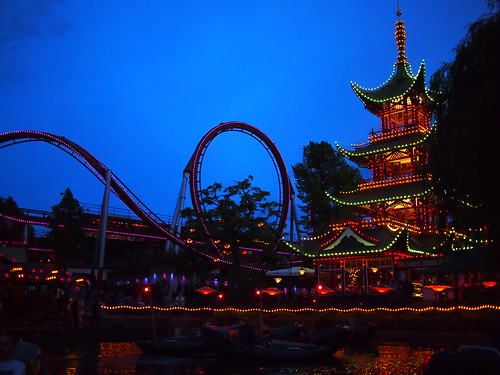
Arrive in Copenhagen, in the hovedbanegården – the central train station. Come up from the tracks, walk through the vaulted hall, step out the main door. Cross the street. And enter – upon payment of 99 kroner – the Tivoli Gardens.

Tivoli! Does not the name suggest something twilit, volatile yet inviolate? A taste of a classic movie theatre, of frivolity and violets, of desire – ti voglio is Italian for ‘I want you’. Is it not a dark garden where dreams happen as in movies?

There are various parks and theatres called Tivoli, but there is only one Tivoli Gardens, a walled-in square block in the heart of Copenhagen, right between the train station and the city hall. You can circumambulate it in ten minutes. The view from street side is a high wall with occasional eating establishments set into it. But when you enter its gates, you enter somewhere much larger, larger because fuller.

There are no wasted swathes of space in Tivoli. Roller coasters swoop over roofs of restaurants; a Ferris wheel and a faux mountain perch above a lane of shops and beer gardens on one side and a concert lawn on the other. From the carousel you may walk briefly past a brace of emesis-inducing rides to a placid lake overlooked by a pagoda, with a restaurant by it, quiet little bumper boats on it to ride for ten minutes and, farther down, a pirate frigate. Everything is twenty seconds from another thing; it all lies together with the density of dreams and of dense dreamers, limbs tangled languidly over the lush property. Take the high swings and see – with blurry eyes, as you have surrendered your spectacles for the duration of the ride – the entirety of central Copenhagen, all right around the gardens, buildings and stores and station and squares. The urban is rudely there; you soar in sight of quotidian space. But when the swings lower you are back again in Tivoli, like returning to slumber after a mid-night awakening.

Tivoli is the Xanadu of Denmark, and the Kublai Khan of this pleasure dome was one Georg Carstensen, who opened it in 1843, the year he turned 31, and who died in 1857 when he was younger than I am now. He got royal permission to develop it there – at the time just outside the city gates; the city has since grown to surround it – by telling the king, “when the people are amusing themselves, they do not think about politics.”

This quadrangle of magic is a third incarnation of Tivoli. The original is a town near Rome; in Roman times, when it was known as Tibur, it was a resort. It is still the site of the vaunted Villa d’Este. In Paris a pleasure garden was named in its honour in the 1700s; the Jardin de Tivoli, now the site of the Gare de St.-Lazare, was done in and brought back to life twice (once more than St. Lazarus) before its final demise in 1842. After metempsychosis and gestation, it was reborn the following year as Carstensen’s brainchild, a great progenitor of modern amusement parks and an inspiration for Disneyland. But the Tivoli Gardens do not have the celluloid mythos of Disneyland; they simply have more than a sesquicentenary of accumulated joy and dreams and play and living vividly, frivolously, in the limen. This is no oblivious TV. It glitters like Tiffany’s and relaxes like the Riviera, lively and lovely.

We bought all-ride passes. We spent four hours there and rode eight or nine rides – high swings, three roller coasters, a death drop, the Ferris wheel, and something called Monsoon that nearly forced the recall of the Swedish family smörgåsbord we had had that afternoon across the Øresund in Trelleborg. In Tivoli we consumed not much more than two outsized beers and a packet of popcorn, although there were many food options. We whiled and whirled the time away as the northern daylight slid slowly into darkness.

At last the clock on the Rådhus (City Hall) began its idiosyncratic tune, and as the bells tolled midnight we walked, chime, along, chime, the fence, chime, through, chime, the gardens, chime, to a corner, chime, and passed, chime, through, chime, the gate, chime, and out, chime, onto, chime, the street, chime. And through the lively dark of a Copenhagen Friday night, a place still tipsy-bibulous and delirious and cool-warm and vivid, but our Eden was behind us, our dream awakened from.

eac

This weekend is the annual conference of the Editors’ Association of Canada. It’s happening right up the street from me; I can almost see the venue from where I’m sitting writing this. There will be much convening and learning, and eac mickle fun.

Did you think I had that eac wrong? Well, yes, arguably. Oh, you think it should be EAC in caps for the Editors’ etc.? No, no. It’s just that the current spelling of the word I have written as eac is eke. But since we don’t use eke anymore, really, I don’t see much harm in using the Old English version here for a lark.

There’s another reason to use the eac form. As you read here yesterday, Iva Cheung sought an archaic adverb and found swoopstake, which is suitable for what she wanted, but unlike off it’s not also a preposition. Eke is likewise not also a preposition – it’s just an adverb meaning ‘also, as well’. But eac as it was used in Old English was also (if less often) a preposition, translatable as ‘besides, in addition to’ (and, for those who know and care about such things, taking a dative object): hæfst þu oþre eac him? (hast thou others eac him?). So I should say that eac an adverb it was a preposition.

A little point on pronunciation, by the way. Eke is pronounced like “eek,” but eac was not. The diphthong written as ea (and in this instance it was a long one, literally said for a longer time) was pronounced [æa] or [æə], where [æ] is as in back, [a] is as in bark (North American version, not including the r), and [ə] is as in buck. In other words, eac was pronounced about the same as the way a person from Mississippi pronounces back, minus the b.

If you know German, you’ll know the word auch ‘also’; if you know Dutch, you’ll know the cognate ook. These two words are eac descended from the same old Germanic word as eac. But they survived into modern times. English now prefers to use also (and as well, besides, in addition to, etc.) for historical reasons that are probably worth a master’s thesis for someone.

So be it. We still have this word, gathering dust but not altogether lost. It’s like one of those bottles of liquor pulled out of the back of the cabinet, where it has been languishing for many years. “Are you really going to drink that? What is it?” “Dunno, but it could be fun.” “Ugh. Don’t put any in my martini, please.”

Well, de gustibus non est disputandum. I will be romping with the words and the word people this weekend, and eac having much fun. Nunc est bibendum; join me if you wish.

swoopstake

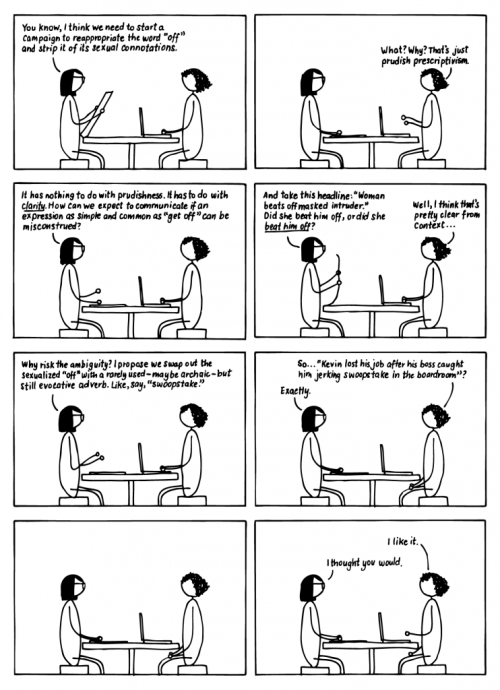
Iva Cheung has come up with yet another winner – yet another cartoon of the sort I wish I had thought of first. She’s letting me reproduce it here, but click on it to link through to her blog, please. I present it as the first course in this word tasting menu.

Off-742x1024

Swoopstake?” you perhaps think. “Did she just make that up? If so, why that?”

Oh, but really, do you think someone as thoughtful and careful as Iva would just make up some word indiscriminately, willy-nilly? Of course not. She considered all her options carefully and then swooped in and staked her claim on this one.

The word is, to be sure, archaic. Obsolete, even. Until now, of course. Does it look rather familiar? Perhaps like sweepstake but with eyes agoggle oo rather than heavier lidded ee? Not sweeping like a broom or an arm but swooping like an eagle or something else rapacious?

Well, you pretty much have it. Swoopstake is an old (Shakespeare-era) synonym for sweepstake. Or, more to the point, for what sweepstake meant then.

And what did it mean then? Picture a table on which are laid all the bets on something – all the stakes on it: your stake is your bet. If you happen to win all of them, you can swoop in on them and sweep them all into your purse. Sweepstake is the older word by at least a couple of centuries, and the more durable one, but swoopstake made a pleasing alteration at a time when the sense was still transparent. And the sense that they made with it was one of grabbing everything indiscriminately.

Which is the sense that Iva is using: “(adverb, obsolete): In an indiscriminate manner.” Does this seem a suitable replacement for off? Note that in compound verbs such as jerk off, the off is actually not a preposition but an adverb, and the sense is dispersive and/or conclusive. It’s not the same as away or around (consider that being jerked around by someone is quite different from… well, you get the point). Is swoopstake a synonym for off? No, not quite, but why need it be? In these colloquial compound verbs, we really just need the second word to put the dirty cherry on top of the fairly plain verb. Why not do it with a flourish?

Which is why Iva winz all teh stuffs. With one swell foop she pulls it off.

zoom lens

Aina and I spent two weeks zooming around France, Belgium, the Netherlands, Germany, Denmark, and Sweden.

No we didn’t. Zoom is not the right word at all.

Yes, it’s true, we did take a few very fast trains (the French TGV and Belgian Thalys both go over 300 km/h), and a few at least reasonably fast trains (120 km/h). But other than that, we mostly walked, averaging over 10 km each day.

And, more importantly, I did not use a zoom lens.

This really matters. I actually brought four lenses, but on the first day of the trip I put on my 20mm f/1.7 lens (equivalent to 40mm on a 35mm camera) and ended up leaving it on for the entire trip, no exceptions. It’s a nice, sharp, fast lens with minimal distortion. It’s a moderate wide angle and covers scenery quite well and, with any camera of good resolution (such as mine), can be cropped down for a tighter angle of view (you lose resolution, but are you planning to make a poster of it? If not, it likely makes no perceptible difference). With that lens on my Olympus E-PL3, the whole camera fit neatly into my jacket pocket when it had to, and it still took good pictures.

Meanwhile, everywhere I went, there were many tourists walking around with huge cameras, camera bodies the size of plates with zoom lenses on them that weighed a few kilograms each and could actually have been used to club a horse to death. Not that they were, of course. They were just used to club photos and a whole vacation to death.

Look, a camera that big and heavy is a pain to carry around. And a zoom lens is like any other all-in-one-type thing – fax/copier/printer combos, all-season radials, whatever: it does a wide variety of things not very well. It is guaranteed to be slower, harder to use, less versatile in the ways that really count (e.g., varying depth of field), more prone to distortion, less sharp. It guarantees that people will waste time zooming in and out and in and out trying to get just the perfect angle. It also guarantees that you’ll miss some shots just because you left the frickin’ heavy ugly thing in your hotel room for a switch.

Some people go for these lenses because they think they look professional. The truth is that when you do see a pro with a zoom it’s because they actually do need to shoot dramatically different focal lengths and they just don’t have the money to have multiple camera bodies with different prime lenses on them (prime = single focal length). Mainly, though, people have them because the camera body comes with them (a kind of basic all-in-one deal), or because some salesperson upsold them to one (they tend to cost more). Sure, they look impressive. In the same way as sesquipedalian words look and sound impressive but may impede communication.

The word zoom does not start with lenses, of course, and is not limited to them. But I’m finding that the word zoom probably means you’re being pandered to. Examples? Zoom lens, of course, for reasons I’ve just given: people think it looks impressive, but photographically it’s typically your worst choice. There’s also digital zoom, which is actually just cropping plus interpolation so you get a bunch of junk pixels – extra file size but no gain in image quality. But there’s also Zoomer, a magazine and marketing concept marketed to baby boomers who are becoming – not seniors, gracious no! – “zoomers.” And there’s zoom zoom, the marketing concept for Mazda. No worse than any other marketing concept, and in fact better than many, but marketing butters its bread by pandering, and zoom zoom is, like all car ads, selling you not a machine but a self-image.

The word zoom comes from onomatopoeia: it first of all described a buzzing sound. Airplane pilots borrowed the word to describe abruptly climbing with an airplane, no doubt at least in part because of the noise the engine made. The word has come to refer to fast motion in general, especially motion of short perceived duration (something may be moving fast for a long time, and we might not think of that in terms of zooming, but if you’re standing still it will zoom past you). The sound lends itself to a feel of such a motion; say it out loud and you may get something resembling the Doppler-effect sound of a very fast motor vehicle going by, the engine buzz coming and the tire hum fading away as the pitch lowers. And a zoom lens, when you’re looking through it as it zooms in or out, seems to be producing rapid limited-duration rapid forward or backwards movement: zooming in and zooming out. Suitable.

Which brings us to the fact that zoom lenses do have their uses. On movie cameras, they can produce a valuable effect, zooming in on someone to tighten the focus. (On news TV cameras, on the other hand, this effect has often been used to close in on someone who is experiencing a strongly emotional moment, a practice I have long viewed as one of the most utterly detestable things. They’re upset. Stop intruding on them for a moment, will you?) And for some varying real-life circumstances, a zoom lens makes equipment much simpler – you make trade-offs in terms of speed and weight (and cost!) for that specific versatility.

That’s really the thing about zooming. It zooms in on one thing: versatility in focal length. You lose some versatility in aperture (and thus range of shutter speed too) and portability of equipment, and you lose some sharpness too. You may even lose some skill as a photographer. Relying on zooming in and out for composition is like relying on punctuation to do your writing. Working with one lens with one focal length focuses your mind. It zooms out from the one thing and can help you think about all the other things more. It also makes you move your lazy butt a bit more.

Let’s take a parallel example in the world of words. Some people zoom in too much on the etymology of a word without paying attention to current usage and phonaesthetics. Just remember this: if we zoom in on etymology, a zoom lens is a lentil making a buzzing sound. Yes – lens is Latin for ‘lentil’; the piece of glass got the name due to shape resemblance.

Oh, are you curious how my single-lens adventure worked out? I took 1160 photos, and you can see the 230 I liked best on my flickr, www.flickr.com/photos/sesquiotic/. I cropped almost none of them, because I composed for what I saw and because, honestly, how much time do I have? Yes, many of them could use a bit of trimming and adjustment. I make no great claims as to their artistic merit, but I guarantee you they’re better than I could have gotten using a zoom lens. I do have a zoom lens – it came with the camera body. It stayed in the bag the whole trip.

laundromat

Last Tuesday evening we spent an hour and a half sitting in a German laundromat.

Well, OK, we did go out and grab some falafel while our wash was going. Front-loaders lock, so you have some security for the duration of the cycle. But in the main we were sitting watching the clothes go ’round (and reading), while other customers saw to their similar situations. One young bearded dude stared out the window and then, when the time came, folded his laundry with exquisite precision. A young woman’s little dog kept dragging around the chair to which it was leashed.

When you’re on vacation for two weeks and travelling through several cities and, indeed, countries (FranceBelgiumNetherlandsGermanyDenmarkSweden), you have to pack light, and there comes a time after a week or so when your few items of clothing really need a wash. For us, that time came in Hamburg. We had planned it that way: Hamburg would be the ease-off city, less exciting than those before or after. We were in a very nice hotel, converted from a 19th-century brick water tower – of course we could have paid them something above 100 euros to wash our stuff for us, but no, we could not have, thank you, not when we could spend 90 otherwise unclaimed minutes and a mere 5 euros. So after a day trip to Bremen we took a bit of time to walk down to the closest laundromat and freshen our togs.

In Germany, it is not a laundromat, of course. German uses Germanic morphemes in many places where English has preferred Latin- and Greek-derived bits. Our lavendry was a Wascherei. But I’m not writing in German about German words here, and the place I was in was a laundromat as we know it: rows of automatic washers and rows of automatic dryers. The only real variant was that you paid at a point on the wall and entered into it which machine you had stuffed your clothes into, rather than slipping coins into slots in a sliding tray in the front of the machine and then kerchung pushing them in to get it rolling.

You may have noted that the German word Wascherei has a capital. This is just because it is a noun. In English, it would have to be a proper noun to get a capital – for example, a trademarked name. The irony here is that Laundromat actually is a trademarked word. Westinghouse trademarked it in 1943 as a brand name for an automated washing machine. The vision of rows of clean white machines operating efficiently may match stereotypes of German efficiency. But actually German laundromats are about the same as American ones, Hamburg is a graffiti-covered city and a not especially clean one, German trains are less clean, modern, fast, and timely than those of their neighbours to the south, west, and north… and laundromats are a classically American invention, even though the word laundromat draws on a word that has a German reflex.

The word in question is automat. In German, Automat is an automaton, a machine that acts of its own volition (or at least its own apparent impetus). The source is Greek, αὐτόματον, from roots to do with self and thinking. In English, an automat was also first of all (by 1676) an automaton, then – in the US – by 1895 an automatic dispensing machine (e.g., a candy machine or similar dispenser). By 1902 it named a restaurant or cafeteria where you get the food from such machines.

So the leap was an easy one from the washing machine Laundromat to the establishment laundromat wherein you may use automated washing machines. Within a decade the capital was lower-casing and the sense was shifting. But not everyone calls the place that; it can also be a laundrette or (another trademark) Launderette. And the types of machines and establishments existed before the name did; in the 1930s a coin-operated laundry was a washateria. Like a cafeteria with automated machines. Like an automat, in other words.

Oh, and the laundro part? From the Latin lav root plus the same enda/anda suffix you see in agenda and propaganda, via lavendry and lavender – a name that was also applied to a plant historically often used in washing. Ever wonder why lavender is such a bathroom scent? Tradition.

Not that laundromats ever smell of lavender. I’m not sure exactly what is used to scent that powdered soap that is sold in them, but whatever it is, they smell of that. Plus perhaps the falafel et cetera that people may be eating as they watch their wash wash.

It was good falafel, too. Just the kind you go to Germany for.

slot

Amalienborg Slot, Copenhagen

Amalienborg Slot, Copenhagen

We just flew back from Copenhagen today. Copenhagen is a great place if you like slots.

No, I’m not talking about gambling. Or maybe I am…

Slot is Danish for ‘castle’ (or ‘palace’). Copenhagen has several of them. Not all are still in use as royal residences, but some are. Denmark still has royalty and those royalties seem to get pretty good royalties from their royalty, if the number of royal endorsement seals on high-end products is any indication. I noted the royal seal on my 750 mL glass of beer that I had before boarding my flight, and the same seal on the high-end clothing store next to the bar.

The Danish royal seal on a large draft

The Danish royal seal on a large draft

But that’s not a gamble; that’s straightforward commerce. The gamble comes more in whose face is on the coins. (Actually, only the 10 and 20 kroner coins have a royal face; the others just have hearts around the edge and a hole in the middle.) The throne is a slot to fill; which coin gets dropped in that slot? It may be a political machine, but when the wheels turn you don’t know for sure what you’ll get when they stop – and what the coins will look like when they come out.

Denmark’s royalty was elected by the nobility until the mid-1600s. The nobles were a rather fractious lot and had last say in many things, notably finances, and after a couple of military defeats in the 1650s which led to a lot of bills to pay, King Fredrik III asserted the need for a strong, stable government, and so he instated hereditary monarchy and a law declaring the king to be sovereign beyond the law and inferior only to God. The people seemed to like that. Absolute monarchy held sway in the country for almost 200 years, until another war’s disastrous conclusion led to the establishment of a constitutional state – but retaining the hereditary royalty. So it remains a closed shop, and who you get is determined by the lottery of birth: who happened to be born when to whom. Ya pays yer royalties, ya takes yer princes and princesses.

It’s fitting to call it a closed shop. That word slot is an old Germanic word relating to just that: closing and locking. There’s another country that calls a castle a slot: the Netherlands. As it happens, you’ll also see signs on doors in the Netherlands saying gesloten. That means ‘closed’. With just a slight difference in historical sound changes you get German geschlossen ‘closed’ and Schloss ‘castle’. See the pattern? A fortress or castle is a closed, locked place – and a palace is a later development of a castle.

How does that relate to English slot? Is it from the door bolt sliding in a slot? No, actually. The English slot that is related is out of use now in most places; it refers to a bolt or bar for locking a door. To find the ‘groove’ version, we need to do a bit more sleuthing. It showed up first in English to refer to the slight depression running down the middle of the breast. But it seems to have taken that from the groove in the hoof-print of an ungulate animal, Old French esclot. That in turn appears to come from Old Norse slóð ‘track’, which is related to modern English sleuth. (A side-note: a sleuth may track an animal by its spoor; in modern Dutch, ‘railway track’, as in Track 9 in a station, is spoor. In Danish, by the way, it’s spor. But don’t think for a moment that Dutch and Danish are mutually intelligible. They’re not really that closely related.)

It is from that ‘groove’ sense that most English usages of slot come, be they the specific times allotted for plains coming into and going out of an airport (such as the plane I was on today) or (to quote the Oxford English Dictionary) “The middle of the semi-circular or horseshoe-shaped desk at which a newspaper’s sub-editors work, occupied by the chief sub-editor” – from which we get The Slot, Bill Walsh’s website for copy editors.

We could draw a parallel between the chief copy editor and a king, I suppose: the heart of the operation. But the slot in the newsroom is the beating heart, the control centre. That is not so true of royalty anymore; they are more ceremonial now. Just as well. We have seen how, in times past, when we have looked in the middle of the chest, the heart has been barred, closed – or when we look for it we find no more than a hole in the middle. Why cast lots or play slots with a country’s future?

We’re just as well off in English, where slot functions better as a word for things that often make a sound like “slot!” when in use: grooved mechanisms and openings for coins. But of course, we have a monarch too (not you, Americans; I’m talking about us members of the Commonwealth). She looks very nice on the coins.