
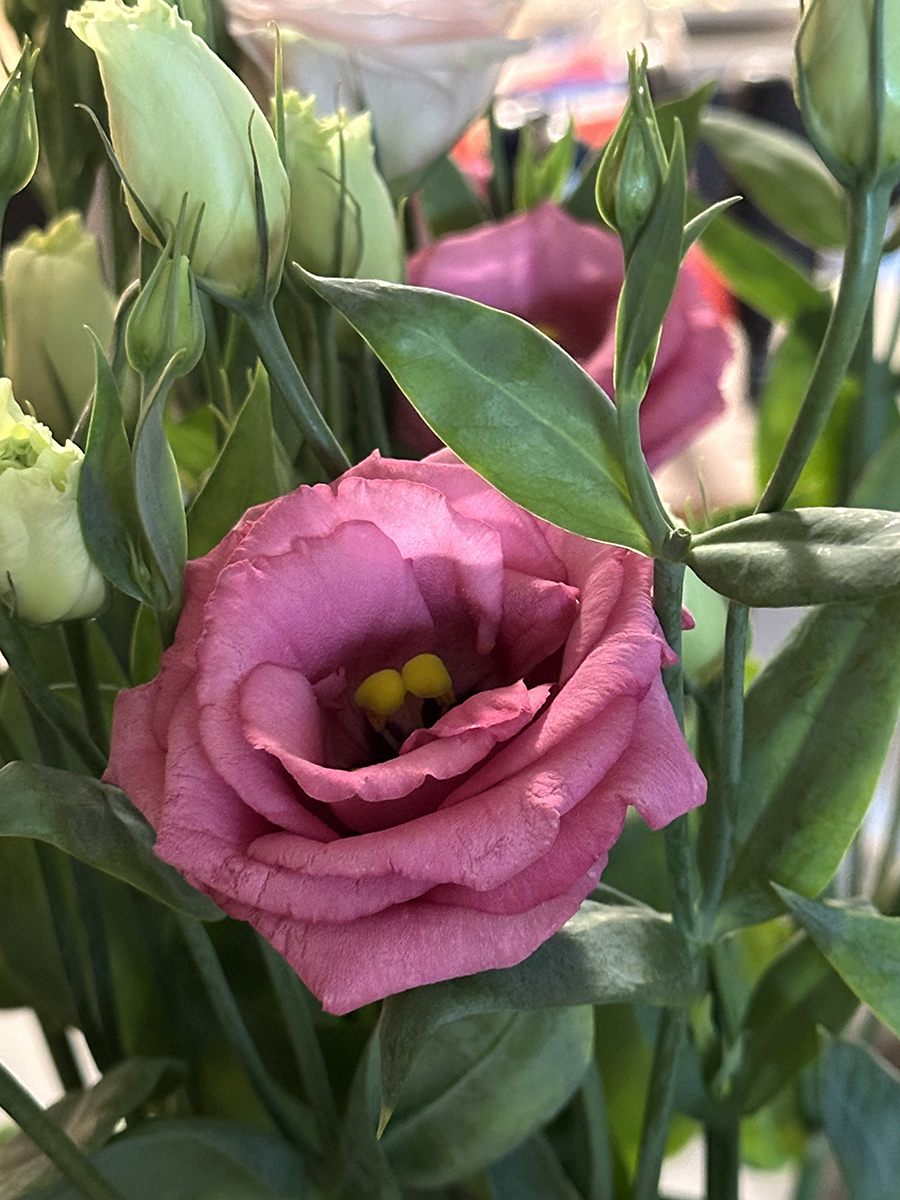
Meet Goodmouth of the Little Red One, Smoothflower, Begetter of the Meadow.
Sounds like a character from Tolkien, doesn’t it? But it’s sitting on the liquor cabinet in my library as I write this. In fact, several of it are. A whole bunch. Literally.

Yes, it’s our friend the economy rose, for when you want a flower that looks pretty and petally but comes with no thorns and no commitments or attachments or overwrought symbolism, a flower that must bring its own poetry. As it does.
A flower does not need words, of course; it is as it is whether or not you have a name for it. In my youth I never took it on myself to learn the names of plants – they don’t come when I call them, and there’s no point in sending them birthday cards, and I can recognize them without needing to stuff them in a lexical box. When I bought flowers or potted plants, their names were “those” and “these.” But here is a flower that is insistent on nomenclature – not just insistent but prodigal, prodigious, prolix: you have three monickers from which to choose.
Well. One of its names is an old taxonomic name, now deprecated, but don’t tell that to the people who sold these, because they came bearing it: lisianthus. It has a soft, smooth, silky sound to it, and it means ‘smoothflower’: via Latin, it is from Greek λισσός (lissós) ‘smooth’ and ἄνθος (ánthos) ‘flower’. As though it were the only smooth flower out there. Well, I guess it’s smoother than most, perhaps a Bing Crosby of botany.
And one of those names is the new taxonomic name, Eustoma russellianum, shortened casually to eustoma, which is not a London railway station for trains to the northwest. It is, in the first part, a no more complex word than the one it supplanted; eustoma is Latin from Greek εὐ- (eu-) ‘good’ and στόμα (stóma) ‘mouth’ (and do you feel good about the embouchure it induces when you say it aloud?). The second part names it after some Russell or other; Russell in its turn is from French, from Latin for ‘little red one’.
The third name is prairie gentian. That might sound like a gentleman from Saskatchewan, but gentian is an old name from Latin gentiana, which is supposedly (though not necessarily truthfully) from Gentius, Greek Γένθιος (Génthios), the last king of Illyria; his name may trace to a Proto-Indo-European root meaning ‘beget’ (the same that gives us various words starting in gen-). Illyria today is Albania and surrounding areas. It is a region not known for prairies, though it certainly does have its meadows. And prairie traces through French back to Latin pratum ‘meadow’ (which, among other things, gave us the name of Barcelona’s airport – El Prat – and, I believe, the name of a family famous for expensive handbags).
Not that any of these things are evident when one beholds the flowers, of course. They’re in a vase, you see, and so they have been separated from their roots. But they are a pleasant sight, smooth and gentle and well placed in a library.





 Sesquiotica