
Author Archives: sesquiotic

cobalt

What colour is this eye?

I asked people on Bluesky, and I got various answers, including blue, blue-grey, and teal. Nobody said what I have always thought of it as: cobalt. Well, I suppose colour is in the eye of the beholder – literally, in this case, as it’s my eye.

Perhaps I’m being a bit fanciful in thinking it’s cobalt. I’ve always thought of cobalt as a sort of metallic, pastel-y blue, though apparently officially it’s not that metallic a colour… aside, that is, from being literally made from metal. The definitions are varying, mind you. For example, Wiktionary says it’s “deep blue” and shows a swatch of RBG #0047AB  , which is also the colour given at the Wikipedia article, but it gives as a synonym zaffre, which is a colour the name of which is cognate with sapphire; zaffre is defined as the colour of the cobalt pigment, but it shows a swatch of RBG #00416A   – somewhat darker, and perhaps closer to the colour of my eyes (which part, though?).

But if we’re talking about fanciful illusions, let’s talk about this name cobalt. It may seem like something cold, perhaps from the Baltic belt, or it may have computer echoes (as in COBOL, the programming language), but it’s a respelling of German Kobalt, which is taken from Kobold, which names a kind of goblin – from Middle High German kobe ‘shed, sty’ (nothing to do with beef) and holt ‘goblin’, which in turn is from hold ‘friendly’, which is a bit euphemistic; it means, more or less, ‘our little friend in the shed’.

And was our little friend in the shed blue? No. Our little friend in the shed was just difficult and noxious and disappointing. The goblin was in the details. You see, when cobalt ore was dug up and they tried to smelt it for silver or gold, all they got were a greyish powder plus arsenic fumes (as it happens, the primary cobalt ores always contain arsenic too). Insult and injury.

But usefulness can be in the eye of the beholder: while they didn’t get their silver or gold, the powder they did get could be sintered with aluminum oxide to make a good, stable blue pigment. (It can also be handled in other ways to make other pigments, such as cerulean.) So we think of cobalt as blue, though the metal itself is basically grey, and other molecules you can make with it can be black, brown, or even, as with cobalt chloride hexahydrate, red.

And yet, for a long time they didn’t know that cobalt was what was making the cobalt colour. What I mean is, they knew cobalt ore gave a powder that could be used to make the blue, but they thought the colour came from bismuth. It wasn’t until around 1735 that the Swedish chemist Georg Brandt saw the cobalt in the cobalt: he determined that it was actually a different metal, previously not identified – since cobalt never just sits there by itself; it’s always found in ores with other metals. It was the first metal to be newly identified since the start of recorded history. Quite something, the things that were there all along that you have to look twice to see.

And while cobalt is best known for its colour – a colour it doesn’t even have in its basic form – that’s not what it’s mostly used for now. It’s used more in alloys in such things as turbine blades, it’s used for producing radiation for therapy and sterilization, it’s used as a catalyst, it’s used in certain magnetic applications, and it’s used in batteries. In fact, the odds are nearly 100% that you have at least a few grams of cobalt within a very short distance from you as you read this, as the lithium-ion batteries that help power nearly all modern digital devices – among other things – use lithium cobalt oxide.

And although cobalt was first identified and used in Europe, the majority of the cobalt extraction in the world now is done in the Democratic Republic of the Congo, in mines that despoil the landscape and exploit the local populace, including children. Fortunately, cobalt is very recyclable; cobalt from old batteries can be extracted and used in new batteries, and increasingly that’s what’s being done. But it’s a reminder of the things we can’t see in the stuff of our daily lives – unless we look closely.

By the way, look closely at that picture of my eye. Do you see the reflection left of centre? Can you make it out? Look closely. Here’s a picture of what I was looking at.

What colour would you say those umbrellas are? How about the reflections on the table? To me, it’s elementary: I see the cobalt in the cobalt. But – as always – it’s in the eye of the beholder.

cerulean

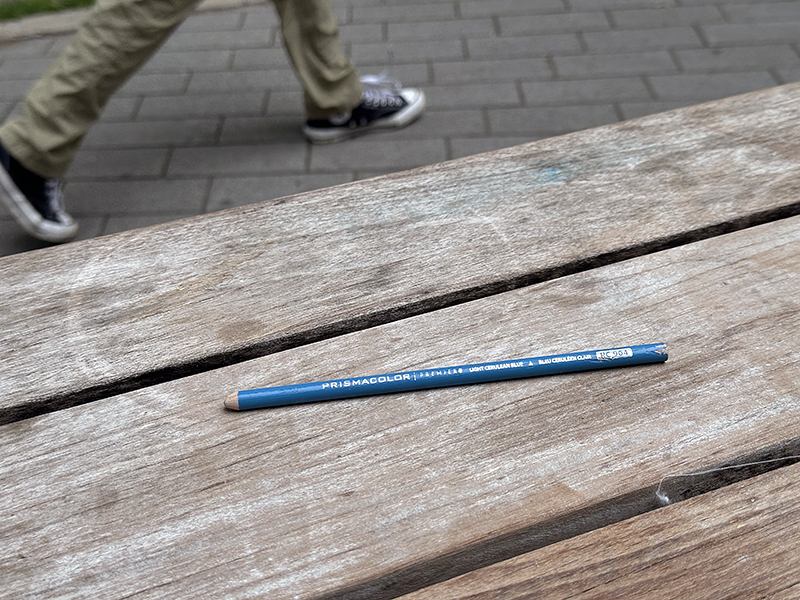
I sat down at the table in the park, just south of the art gallery, and I saw a little piece of heaven, just lying there, with no particular point, and how it got there was unclear. It might as well have fallen from the sky.

A little piece of heaven? A Prismacolor “Light Cerulean Blue” pencil. (Yes, cerulean blue is like pizza pie and tuna fish and so on: the definition of the first word includes the second.) Undoubtedly it was accidentally left by a student at OCAD University, the “pencil-box” building of which fills a part of the skyline above the park, or perhaps by someone younger who had been playing on the playground just metres away or in the community centre also just metres away.

Why heaven? Yes, the sky is blue, but more to the point, that is the point: cerulean comes from Latin cæruleus, which means ‘sky-coloured’ and is formed from cælum ‘sky, heaven’ plus the diminutive suffix -uleus (the first l rolled into an r: cæluleus became cæruleus). Which means that it is literally a little heaven – “heavenette” if you wish. Latin did not distinguish between ‘sky’ and ‘heaven’; the line “factorem cœli et terræ” from the Credo is typically translated as “Creator of Heaven and earth” but could as readily be rendered as “maker of the sky and the ground.”

Speaking of ground, the point of the pencil had been ground down – or anyway worn down through use – and needed to be sharpened, which is to say ground (or cut) to a point. But at least that meant it had been well used before I found it.

Which reminds me, as it may well remind many of you, of the classic “cerulean” monologue given by Miranda Priestly (played by Meryl Streep) in the movie The Devil Wears Prada:

This… “stuff”? Oh, okay. I see, you think this has nothing to do with you. You go to your closet and you select, I don’t know, that lumpy blue sweater, for instance, because you’re trying to tell the world that you take yourself too seriously to care about what you put on your back. But what you don’t know is that that sweater is not just blue. It’s not turquoise. It’s not lapis. It’s actually cerulean. And you’re also blithely unaware of the fact that in 2002, Oscar de la Renta did a collection of cerulean gowns. And then I think it was Yves Saint Laurent, wasn’t it, who showed cerulean military jackets? …And then cerulean quickly showed up in the collections of eight different designers. And then it filtered down through the department stores and then trickled on down into some tragic Casual Corner… where you, no doubt, fished it out of some clearance bin. However, that blue represents millions of dollars and countless jobs. And it’s sort of comical how you think that you’ve made a choice that exempts you from the fashion industry when, in fact… you’re wearing a sweater that was selected for you by the people in this room… from a pile of “stuff.”

The great insight from the speech covers not just that particular moment, nor even just the fashion industry, but how culture in general works. Including language. We happen on words with no particular idea how they got there, but there was a whole history that led to that moment, and there is nothing we can do to exempt ourselves from it, even if we are oblivious to it. The “plain meaning” of texts only exists because of millions of people over thousands of years borrowing, referring, changing, negotiating, and agreeing. Believing that what you see now and understand from it is the only real possible meaning – as many people like to do with some texts from ages past – is like believing that that sweater got into that bin for no particular reason, or that the pencil on the picnic table had simply always been there, or was placed there just for me so I might write this or perhaps scrawl my name on the table or draw heaven there on earth. And on the other hand, believing that certain specified older meanings of words are the only true meanings is like believing that the only true cerulean is Oscar de la Renta’s.

After all, de la Renta didn’t invent cerulean either. Who made the sky blue? Not Oscar.

But… the colour cerulean doesn’t exist because someone wanted a sky-blue colour and made it and named it as such. It’s not just that the sky comes in many colours, and only sometimes is what we call “cerulean” (usually it’s one of the many shades we call “sky blue,” and sometimes it’s no kind of blue at all). It’s that at the time the colour we call cerulean came around, things went the other way. The colour came first, and then they chose a word they liked for it.

In 1789, you see, a Swiss chemist named Albrecht Höpfner synthesized a pigment from cobalt stannate. It had a pleasant medium bluish colour, not as green as teal but not a pure blue either. For a time it was called Höpfner blue. But somewhere around the middle 1800s, an art supplier decided to give it a nice Latin-type name and called it ceruleum. Variations on the name abounded; it wasn’t until the early 1900s that the name came to be set as cerulean, which is what the artist and art theorist Max Doerner called it. It’s been used in many paintings, such as Claude Monet’s La Gare Saint-Lazare. Now it’s widely used, although often what’s called cerulean is no longer cobalt stannate, but just pigments, inks, or the RGB rays of your computer screen combining to the same effect. Have a look at the emblem of the United Nations: it’s in cerulean; the colour was chosen by the designer, Oliver Lundquist, as “the opposite of red, the colour of war.” When you think of the colour, you could think of any of these things. Or even of none of them.

And who knows what other artworks any artist who uses the colour is thinking of? Everything has references to other things, but sometimes they’re not intended by the creator, at least consciously. But the colour was there, so they used it. Just as the pigment was there and the word was there, so they put them together because it seemed suitable and attractive. After all, why did Oscar de la Renta choose cerulean?

He didn’t. The cerulean fashion lines referenced in the monologue never existed in reality. They were made up by the screenwriter for Miranda’s pocket disquisition. In fact, the monologue didn’t exist in the movie script either, at first. It started with a few lines by Miranda disparaging Andy’s fashion sense, which were then cut, but Meryl Streep asked for it to be added back and fleshed out. The writer of the screenplay, Aline Brosh McKenna, at first wrote just about blue, which had been chosen as the colour of the character’s sweater because it would work well on screen. But then she realized that a fashion maven would use a more precise term, so she presented Streep with several words for kinds of blue. From those, Meryl Streep picked cerulean. Did she know how that word got there? What its origin was? She might have; she’s Meryl Streep, after all. But perhaps it was just there, like a left-behind pencil, and it served the purpose. It does have a nice sound to it, even if you don’t know all the other references it has and the history of the name.

And none of this even gets into why the sky is blue (look up Rayleigh scattering if you’re curious). Or why cobalt stannate is that particular kind of blue. Or for that matter where cælum and -uleus came from – there are speculations as to the Proto-Indo-European origins, but it’s not like we can ask the people who spoke those words. Not any more than I could ask the person who left the pencil on the table what they had drawn with it to wear the point down so much.

Well, perhaps they came back and picked it up and sharpened it and drew some more with it. Or perhaps someone else took it. I don’t know. I left it there when I departed. It had served its purpose for me.

The Truth About English ebook

Do you see the difference?

Yeah, I adjusted the kerning a little. But the real difference is one you can’t actually see from the image: The Truth About English is now available as an ebook.

Yes, that’s why I’ve been quiet for two weeks. It takes forever to make an ebook. (That’s not true. I was travelling and attending a conference. Making the ebook from the InDesign files was pretty quick and easy, really, but I didn’t have the opportunity until today.)

Currently it’s available on Lulu.com, https://www.lulu.com/shop/james-harbeck/the-truth-about-english/ebook/product-nvw6vv5.html?q=Harbeck&page=1&pageSize=4. Lulu will soon be syndicating it to the other popular ebook providers, and because of how that syndication works, and the commissions taken, the price is a little higher than I would otherwise have made it (but still much less than the print version). (But if you buy it directly from Lulu, I get more money than if you buy it from the other providers, and don’t you want me to get paid for my efforts?)

However, I have also, separately from Lulu, made it available on the Apple Books store, https://books.apple.com/us/book/the-truth-about-english/id6505080776. And the price there is a little lower, because there’s no intermediary. So if you (like me) get your ebooks from Apple, you’re in luck.

The Truth About English

Most of what you were taught about language in school is wrong, and what’s right mostly isn’t right for the reasons you thought.

I’ve been giving presentations about the deeper details of this fact for nearly two decades. Up to now, you had to either be there in the room when I gave the presentation, or watch the video of it on my blog, or in just a couple of cases read the text of it on my blog. Now I’ve brought together eight of my best presentations about the English language’s history, grammar, and more, revised and in a format suitable for consuming at leisure in the environment of your choice. Presenting my new book, The Truth About English: Lessons You Never Got in School. It includes:

  1. A Language in Motion
  2. When Does Wrong Become Right?
  3. When to Use Bad English
  4. Smash All teh Rulez
  5. What Flavour of English Do You Want?
  6. Sounding Like the “Right Sort”
  7. The Secret Set of Extra-Tasty Words
  8. A Hidden Gender?

It’s available now on Lulu.com: https://www.lulu.com/shop/james-harbeck/the-truth-about-english/paperback/product-57ggk44.html?page=1&pageSize=4

It will also be available soon on Amazon.com. However, Amazon takes a big cut of the price. In fact, I could set the price lower if it weren’t on Amazon, but I can’t have a lower price on Lulu than on Amazon (alas), and it’s worth it for visibility to have it on Amazon. But I will have copies for sale in person at a discount if you happen to see me at a conference or similar event… along with copies of my other books such as 12 Gifts for Writers.

fob

As I encountered Maury near his front door, he was patting his pants pockets with a vexed expression.

“What’s the prob, Bob?” I said.

“Fob,” Maury replied.

“F.O.B.? Full of bother?”

“O bother, where art thou,” he said. “In this case, I am addressing my fob. My fob is not in my fob and I cannot find it. I had ordered a fob for my fob so I could find it in my fob, but they fobbed me.”

I paused. I blinked. I blinked again. “I’m sorry,” I said, “I think the chain of that has broken for me.”

“For me too, precisely,” Maury said.

“You ordered a fob… for the fob… that goes in your fob.”

“Now you have it,” Maury said. “I wish I did.”

“Well, let me make sure I have the links. Fob, as in a small pocket for a watch.…”

“The original sense, yes,” Maury said, and patted the little pocket in his jeans, what we commonly think of now as a change pocket, though its original use was to hold a pocket watch. The word fob may be related to a dialectal German word fuppe ‘pocket’.

“…and fob, as in a chain that attaches to a pocket watch…”

“The thing I ordered, yes,” Maury said. Chains for watches came to be called fob-chains by association with the pocket that the watch went into, and that was shortened to fob, executing a sort of metonymic transference, from the container to the retainer. A fob can also be a ribbon, and a fob can also come with a protective cover for the watch.

“…and fob, as in a thing that attaches to a fob and goes into a fob.”

“Such as the little device without which I am not getting into my building,” Maury said.

“Quite the thing that fob circles around the watch and then replaces it. A watch itself is not a fob, but any little decorative or functional thing that can attach to a fob-chain and go into or hang from a pocket can be called a fob. It’s a real fob, in the other sense.” I meant the sense of ‘cheat, trick’, which relates to the verb fob as in fob off, ‘swindle someone by substituting an inferior item’. This also comes from German, but is probably not related to the other fob – unless the connection is to a secret pocket, which it may be, but we don’t know.

“Well, as I said, they fobbed me,” Maury said. “They fobbed this off on me, to be precise.” He reached into a pocket and produced a very small chain with very small links – the sort of thing that, in a photograph with nothing else for scale, could look like a watch chain of the right size. As he held it up I could also see that the ring at the end was broken. “And it was sent FOB origin, which in their view means that once it was in the mail it was my problem.” He stuffed the fobbed-off fob into his fob pocket.

“That’s not quite right,” I said. “That just means that the liabilities for transporting the goods and for damage fall on you as soon as it’s shipped. It doesn’t mean they can send any old inferior product and it’s your problem once it’s in the mail.” For those unfamiliar with the term, FOB stands for free on board and is a shipping term designating where the responsibility for the goods passes from seller to buyer.

“I know,” Maury rumbled. “And I shall be addressing this through the e-commerce site. But FOB – first order of business– is to get into my FOB – forward operating base.” He continued patting his apparel. “Ah!” he said, pulling his handkerchief out of the breast pocket of his jacket. “At last, an FOB – flash of brilliance.” From within the folds of the handkerchief he pulled a small grey disc-like object. Then he reinserted the handkerchief in the pocket, its corners protruding jauntily. “Foppery has its tricks,” he said, and advanced to the door, fob in hand.

chicest, chicane

Let me introduce you to the chicest linguistic chicanery… what? No, not the choicest. The chicest.

No, it doesn’t rhyme with nicest. It’s the superlative of chicer.

Oh, for heaven’s sake, most chic.

Yes, chicest looks weird, but how would you spell it? Thanks to the orthographic chicanes and etymological chicanery (or vice versa) of the English language, we have a word that phonologically is eminently amenable to addition of the superlative suffix but in written form seems to have had something shaved off, resulting in an obstacle to comprehension.

Well, we’re the ones to blame here. Swiping French chic into English is like swindling something from a luxury store just because it’s more expensive when you could have had the same thing readily enough from someplace cheap. Yes, yes, French is chic, all fashionably set out and all that, but German simply has good arrangement and tasteful presentation – or, as the Germans say, Schick.

Of course Schick may seem a word for ‘neatly shaven’, because, after all, it’s a brand of razor. But it’s also the German word for tidy arrangement et cetera, formed from the verb schicken, ‘arrange, outfit, dispatch’ (related to other Germanic words meaning ‘happen’ and ‘hurry’). And, as far as we can tell, Schick is the origin of chic.

But there could be some trickery, some deception, some misleading arrangement. After all, schicken may also be the origin of French chicane.* And chicane refers to deception or subterfuge, at first especially in legal matters but also over time in other kinds of subtlety and trickery. In English it also has the same sense (but a different pronunciation, one that sounds like it’s been too close to cocaine), plus some derived senses, notably a hand that has no trumps in a game of bridge, and a section of a race course that has a double curve.

Which is funny, when you consider that in matters legal and financial, a chicane involves pulling a fast one, while in racing (cars, bobsleds, etc.), a chicane exists specifically to slow racers down. You think you’re going one way, then you suddenly have to change direction, and then you have to change back to the original direction. 

Which is sort of like what happens with chicest. After all, it’s a French word that combines with an English suffix and manages to look like both French and English and also neither. But it would probably be even worse if we tried to spell it any other way. Chickest? Obviously not. Cheekest? Ha. Sheekest? It would sound right, but it would look so wrong. Chiquest? I mean, yeah, that’s as close as you might get, but it still has its hazards. And anyway it would look like it came from French chique, which refers to a flea or a lump of tobacco, both of which come from Spanish chico ‘small’. Which somehow is not related to chic.

Well, anyway. I think our language has some cheek coming up with a chicane like chicest. But if you’re wondering what I do, well, I’m sorry to say that while I will say “chicest” (“sheekest”) out loud, I’ll write it as most chic – I’ll chicken out.

* Are you surprised to see German words becoming French words? It’s true that French is not descended from German, but it’s also true that Germany and France are neighbours and that before the Romans came to France it was full of Germanic and Celtic speakers, so there has been some swerving of words between them.

quixotic

We went to the ballet yesterday. They were performing Don Quixote. As we settled into our seats, we observed quite a few people taking pictures of their programs with the curtain as a backdrop. I did likewise. You can see why.

Yes, the front of the program said DON QUIXOTE, while the projection on the curtain said DON QUIJOTE. (From where I was sitting I could see the orchestra’s scores on their first pages. They, too, said DON QUIXOTE. Alas, my camera did not capture that detail.)

Well. That seems rather quixotic, doesn’t it? Or should I say quijotic? How would we pronounce that, anyway? I mean, Quixote is said like “ki-ho-té” but we say quixotic like “quick-sot-ic.” (I am told that some people say “key-zot-ic” but that seems even more muddled to me – might as well go all one way or all the other.) If it were quijotic would we say “kwai-jot-ic”? Or “kwij-ot-ic”? Or would we manage to make it “key-hot-ic”?

But why would it be quijotic in the first place? Why did the curtain say DON QUIJOTE?

That last one is easily enough answered: If you buy an edition of Cervantes’s novel in Spanish, it will say Don Quijote. In modern Spanish, that’s how it’s spelled. For them, spelling it Quixote would be sort of like us spelling Shakespeare’s King John as King Iohn. That’s how it’s spelled in Shakespeare’s First Folio, and Don Quixote is how Cervantes’s first edition spelled it… well, OK, it spelled it DON QVIXOTE.

And to be fair, the difference between Qvixote and Quixote is like the difference between Iohn and John: originally, U and V were two shapes of the same letter, a letter that could have a vowel sound or a consonant sound, and I and J were likewise two shapes of the same letter, a letter that could have a vowel sound or a consonant sound. But eventually (by a couple of centuries ago), the two forms were treated as separate letters, each one having one of the sounds. On the other hand, X did not become J – both letters still exist in Spanish, and one was not created from the other (even if X can be made by crossing two I’s). But some sounds that had been represented by X came to be represented by J.

That’s the very short version. The fuller version is that in Old Spanish, X was used for the “sh” sound (/ʃ/) and J for the “zh” sound (/ʒ/), as in fact they still are in modern Portuguese. But in Spanish the two sounds merged into the voiceless /ʃ/ in the century before Cervantes (which was also the century before Shakespeare, a time when English was changing its long vowel sounds; Cervantes died April 22, 1616, exactly one day before Shakespeare). Subsequently, the /ʃ/ sound shifted to its current back-of-mouth heavy “h” sound (written in IPA as /x/, as it happens), and in the early 1800s the spelling of that sound in Spanish was standardized to J, with X left to stand just for /ks/. But that was after we had come to know Don Quixote in the English-speaking world and after we had confected the word quixotic from it.

There’s a little bit more, by the way, though it doesn’t bear directly on Quixote. When Spain invaded and colonized Central America, the sound /ʃ/ and the similar sound /ç/ (which is like the German “front ch” or Polish ś) were written as X, and although those sounds have tended to become the /x/ sound in modern Spanish, they still sometimes spell them with x, as in México (which in Spanish is pronounced as though it were spelled Méjico – a spelling that has in fact been common in Spain). This is the origin of the x in words such as axolotl and xoloitzcuintli, and place names such as Ixmiquilpan. We like it well in English because the letter X, due to its infrequency in English words and its generally ostentatious non-Anglo-Saxon provenance (the x in Saxon notwithstanding), tends to have an air of the exotic.

And, yes, at times of the quixotic. Which means not simply quirky or chaotic, but possessed of impractically (even delusively) lofty, romantic, chivalrous ideals. Prone to tilting at windmills, imagining it as fighting dragons. Redolent of a vaunted distant past. Which, in Spanish, the spelling Quixote would also be. (You can still get that spelling in some other names, such as Pedro Ximénez, which is the name of a grape that is used in some kinds of sherry.) Ah, star-crossed X, so much grander than J, not merely twice but ten times as great as I… what a spelling you cast on us.

fulminant, fulminate, fulgent, fulgurant

It was working fine – fulgently, even. And then, suddenly, after the update, it was not. It was case of fulminant software dysfunction. At random times, it would suddenly slow down dramatically and use up so much memory my laptop’s fan was threatening a tornado. A program I would normally keep a half dozen files open in, and not need to restart for weeks at a time, I suddenly, tout à coup, needed to restart three times a day. Nor were the bits of advice online especially illuminating – no, I’m not going to simply rip out the entire software suite and reinstall, thereby losing all my settings, and [stricken from the text] you for suggesting it.

Needless to say, I was fuming. In fact, I was fulminating. I expounded effusive verbal effluvium, of the fulsomely vulgar kind. I don’t expect software to be inevitably fulgent, let alone fulgurant, but I do want it to be configured meaningfully. And if it’s not being useful, well, I will be Zeusful: hurling verbal lightning bolts at it.

I don’t know just how enlightening that all is, but in the end, it’s the lightning. You see, Latin for ‘lightning’ is fulmen, which is formed from fulgeo ‘I flash, I glare, I am lightning’. And from fulmen and fulgeo we get fulgent ‘shining like lightning’, fulgurant ‘dazzling like lightning’, fulminant ‘appearing abruptly and striking destructively like lightning’ (most commonly used in medical contexts), and fulminate ‘make a verbal attack; hurl verbal lightning bolts; espouse the striking of lightning on the subject’ – fulminate first appeared in English in the 1400s in legal and ecclesiastic contexts, referring to denunciations, formal censures, and similar blasts from on high, but now it’s extended to any kind of verbal inflammation.

These four words are similar and yet not the same – they cover a range of aspects of lightning, positive (the emission of photons and their illuminating effects) and negative (the electrical charge and its destructive power). The point, if you figure it out, is to have the full meaning with all its implications: a shock to the system may be enlightening, but not all abrupt enlightenment is jovial in nature. Yes, Jove – Jupiter – Zeus – is the god of sparkling jollity, but he is also the god who hurls thunderbolts, and they can land in different ways, including the abrupt arrival of a curse, as in misfortune, or the abrupt emission of curses, as in imprecations.

And it can come in multiple scales and modes: macro or micro, hard or soft, deed or word. Now I can hardly wait for the next electric download of an update to restore my software to fulgent functionality.

morbido

I don’t often do tastings on non-English words, but this Italian word has always had an interestingly contrasty flavour for me, particularly because I come to it as an English speaker.

I should say, first, that the stress in this word is on the first syllable: “mor-bido.” So you really get that “more” sound. But in the context I usually hear it in, it’s not the mournful “mor” of a mortuary; in fact, it’s rather moreish. You see, I hear it mainly in cooking videos.

No, let me explain. I like to watch cooking videos in Italian. This is because (a) I like Italian food and (b) I like practicing my Italian comprehension. And this is specifically not because the videos are of cooking, uh, morbid things. I mean, yes, there are often dead animals in them (or anyway pieces thereof), but the morbidity and mortality are absolutely not the focus. So why am I hearing morbido? Because it means ‘soft’.

That’s right, it’s what we call a “false friend” – a word that resembles one English word but means a different one. A common example is French travailler, which resembles ‘travel’ but means ‘work’. Often people call these “false cognates,” but beware: not all false friends are false cognates. A false cognate is where two words appear to have the same etymological origin but don’t. A classic example is that cognate is a false cognate with cognitive – the two don’t come from the same root; cognate is from co ‘together’ and gnatus ‘born’ (from a root we also see as gen– as in generation and genital), while cognitive comes from co plus gnitivus, which is derived from gnosco ‘I know’. On the other hand, travel and travailler are not false cognates; they really do have the same origin, but they went in different directions: the Latin etymon was a word for a kind of torture, and the English used it as a word for voyaging while the French used it as a word for work. (Make what cultural inferences you will about that. Anyway, English also borrowed it separately as travail.)

OK, so is morbido a false cognate with morbid? No, it is not. Both words come from Latin morbidus, ‘sickly, diseased’ (which in turn comes from morbus, ‘disease’, which draws on the same mor- root as mortality). In English (and in several other languages), it kept that sense or at least stayed in the same sphere; we now commonly use morbid to refer to a focus on decay, disease, and especially death, but the medical term morbidity refers specifically to occurrences of illness, not of death – the collocation morbidity and mortality refers to bad things that happen in the course of medical treatment, both sickness (morbidity) and death (mortality). Whereas an Italian chef uses morbido to refer to good things – specifically soft ones – that come up in the course of cooking.

So… does that mean that Italians have, or anyway had, a negative attitude towards soft food? As though perhaps it is only for the invalid and valetudinarian? No, it seems not; rather, it was that disease and decay are associated with weakness and lack of strength and firmness, and so it came to mean that, and then it lost its negative tone and took on a positive one to mean ‘soft’, ‘docile’, ‘smooth’, ‘not rigid’. As the website Una parola al giorno puts it, “È uno degli esempi più splendidi di parola che si sia emancipata totalmente dalla sua origine scura e spiacevole, diventando una luce sensoriale potente, gradevole e gradita” (It’s one of the most splendid examples of a word being totally emancipated from its dark and unpleasant origin, becoming a powerful, pleasant, and welcome light to the senses).

It is not, after all, that morbido is used only for soft food; a pillow may also be so (“un cuscino morbido” is not only for your death bed), and, as Garzanti tells us, many other things may be called morbido (or, for feminine nouns, morbida): hair, fabric, skin, wine (smooth and well balanced), paintings (harmonious and delicate), personal character (tolerant, agreeable, sequacious even)… 

All of which inevitably seems a bit odd to my ear, and I can’t get around it. I’m simply too habituated to my English associations. The result is a dissonance that may not be morbid but is not morbido either. Meanwhile, to the person who grew up speaking Italian, the English use of morbid may also seem odd, perhaps feeling that when we talk of “morbid humour” and “morbid TV shows” and so on we have an eye on the cushions in the coffin and the softness of decay. On the other hand, they can associate it with the word morboso, which does mean ‘morbid’ or ‘sick’.

droves

Every afternoon, on both sides of the building I live in, the driving force is cars, droves of them, like cattle crowding into chutes. Out my bedroom window, to the south, I see cars crawling on the expressway; on the north side, at street level, the street – which is meant to have one lane of traffic each way – often has three unofficial lanes jammed up one way and no room for human or beast or automobile in the other direction, just droves and droves striving in intense slowness to make it ultimately onto the equally torpid elevated highway. (Meanwhile, parallel to the expressway, trains carry commuters – each train carries up to 5,000 people, which is as many as you’ll see in the 4,000 cars that at any moment of rush hour occupy two lanes for the full 18 kilometres of the Gardiner expressway – and the trains are moving briskly… but I digress.)

Why do we speak of droves, anyway? Droves almost seem like groves, but mobile: large groups of like beings motivated en masse – leaving in droves, coming in droves, sometimes fleeing in droves or turning away in droves or arriving in droves. Often it’s fans, or voters, or customers, or tourists. People who exhibit group behaviour.

It doesn’t have to be people, though. Poets usually use droves about non-human things, and sometimes modified with an adjective: “the fireflies will rise in lucent droves” (Dave Lucas), “droves of shadows at night move ghost-like through the dying river” (Sheryl Luna), “the forces your covetous presence prevents slowly crawled out in fibrous droves” (Jennifer Moxley), “They blossom, thick and fast, in droves” (Conor O’Callaghan), “Winged droves at evening wheeling!” (Ian Dall). But whatever is in the droves, it’s always the behaviour of a swarm or a herd.

Which is as it ever was, and if they move as though impelled, so much the truer to origins. For the first things to go in droves were cattle: a cattle drive drives a cattle drove. Yes, drove is formed from the same root as drive; in Old English the noun took the same form as the past tense – drāf – and both forms followed the same phonological trail under the whip of time to become drove. Only now, as the noun, you seldom talk of a drove, especially if you’re not talking of cattle or sheep; the multiplicity is an essential quality, and so why imagine just one drove being driven if you can imagine several, perhaps coming from different angles?

Which is like downtown Toronto traffic every weekday afternoon. Every street from whatever angle leading onto the Gardiner is backed up. In the morning, it’s the other direction, of course. Either way, droves and droves of drivers. Does it seem unkind to liken them to kine? Fair enough, they’re not cattle; cattle in a drove are hoofing it and actually moving, and may well make it to dinner first too…
