
Author Archives: sesquiotic

ochre

When, in the 1500s, Western Europeans came to what we now call Newfoundland, they saw the people who were already living there and called them “Red Indians,” because those people – the Beothuk – painted themselves and their dwellings with red ochre every spring.

The red ochre was made from the soil there. So, as the Beothuk were the autochthonous people of Newfoundland, and as autochthonous comes from Greek αὐτόχθων autókhthōn meaning ‘from the land itself’, you could say that they were covering themselves in the earth that was their mother. Of course, we know that the Beothuk came from other peoples on the North American continent, and they in turn came from others in other places, and so on. But they were sustained by that red soil, and it became part of them too; there are many shades of “autochthonous.”

But that is not the only potential lexical perplexity here. If you are familiar with the many names of art pigments, you may not think of ochre as red at all. And you would be perfectly reasonable in that.

Ochre, as you will find if you look in Wiktionary, is “a somewhat dark yellow orangish colour” – they show you RGB #E3A857  ; if you look in Wikipedia, it declares it to be RGB #CC7722  . Either way, it is no redder than French’s mustard. It does look like a certain kind of earth, but not the kind of earth that produced the ruddy pigments used not just by the Beothuk but, subsequently, by European-descended people throughout Newfoundland to paint – among other things – fishing stages (mainlanders call them fishing sheds or boat houses or such like). 

The resolution of this is that ochre is a family of pigments, all containing ferric oxide and the various other things that make up dirt, and typically bound together with oil (from fish or seals or whatever else you may find). There is red ochre, purple ochre, brown ochre, sienna, and umber – yes, umber is of the ochre family (would you have bet on that? what’s the ochre-umber on that, do you think?). But the ochre that is “ochre ochre” is yellow ochre.

That’s not just from commonality or history of use; it’s from etymology too. Although we may be tempted to think that ochre comes from some chthonic word to do with earth – or perhaps, since it sounds like “oaker,” from something that grows in the earth (not okra, though) – it comes, in fact, from ὠχρός ōkhrós ‘pale’.

Which, I suppose, when I compare it with umber, and sienna, and red ochre, it is. But when I compare it with my own skin, which is around the colour of the skin of the Western Europeans who called the Beothuk “Red Indians,” it occurs to me that yellow ochre is not nearly as pale. But yellow ochre also a bit too yellow, as if jaundiced. Not necessarily a healthy colour for a person.

Nor, as I find, was it a colour esteemed by the Greeks, at least when used to describe people. Aristophanes, in The Clouds, used χροιὰν ὠχράν khroiàn ōkhránpallid complexion” as a sign of moral weakness; Euripides, in The Bacchae, used turning pale as a sign of fright: οὐδ᾽ ὠχρός, οὐδ᾽ ἤλλαξεν οἰνωπὸν γένυν oud’ ōkhrós, oud’ ḗllaxen oinōpòn génun “he did not turn pale or change the wine-dark complexion of his cheek”; and Plutarch, in his life of Julius Caesar, quoted Caesar as saying οὐ πάνυ τούτους δέδοικα τοὺς παχεῖς καί κομήτας, μᾶλλον δὲ τοὺς ὠχροὺς καί λεπτοὺς ἐκείνους ou panú toútous dédoika toùs pakheĩs kaí komḗtas, mãllon dè toùs ōkhroùs kaí leptoùs ekeínous “I am not much in fear of these fat, long-haired fellows, but rather of those pale, thin ones” (by which he meant Brutus and Cassius).

Those yellow-bellies! Perhaps it’s that dirty people do dirty deeds? But the pigment is named for its colour, not the colour for its source. And ochre is called many things in many places; it’s been used since before the beginning of recorded history all around the world, anywhere there is soil with iron ores in it that can be made into a paint. It is common in cave paintings from up to 75,000 years ago. It is, truly, as old as dirt.

And we, whatever colour we may be said to be – red or pale or any other – will return to dirt as well, as we always have, and as the Beothuk, all of them, eventually did due to starvation, pestilence, and murder. Who can say for certain that the ochre we dab onto the stages of our lives and the walls of our histories does not contain bits of our distant ancestors and distant ancient cousins? And just as we come in many colours, so does ochre – indeed, ochre comes in colours we don’t: after all, the Beothuk weren’t actually red. Look at the portrait of the last known Beothuk, Shanawdithit, who died of tuberculosis in 1829: her skin was a medium light brown. 

But just as the blood that runs through the veins of every one of us is red from the iron in it, so does all ochre gain colour from the iron in it. And so, when the Europeans saw the red ochre on the Beothuk and thought it was different from their own pale colour, it was doubly ironic.
Pronunciation tip: Turkish medalists at the 2024 Paris Olympics

There’s time for one more Olympic-themed pronunciation tip, and I’ve never done one on Turkish before, so here you go. There are nine medalists from Turkey (Türkiye), so I’ll give you general tips on pronouncing Turkish and then tell you how to say their names: Şevval İlayda Tarhan, Yusuf Dikeç, Hatice Akbaş, Buse Naz Çakıroğlu, Esra Yıldız Kahraman, Buse Tosun Çavuşoğlu, Mete Gazoz, Ulaş Berkim Tümer, and Abdullah Yıldırmış.

Pronunciation tip: Brazilians at the 2024 Olympics

The Brazilian women’s gymnastics team has been doing well at the Paris Olympics, and so I thought it would be nice to do a pronunciation tip about how their names are pronounced by Brazilians, and why. I’ve even added a couple of other Brazilian medalists from these games just to round out the information.

(The beverage is a peach caipirinha, by the way.)

Pronunciation tip: 2024 Latvian Olympic team

In all my Olympic-themed pronunciation tips over the years, one country I haven’t gotten to yet is Latvia. Why would I do Latvia? Well, I have a Latvian connection through my wife’s family. Also, why not? Anyway, if you’ve ever been wondering about how to say Latvian names, today’s your lucky day.

Pronunciation tip: Paris Olympic venues

It’s time for the Olympics again, which means it’s time for lots of names that aren’t English! They’re in Paris this time, which means all the venue names are in French. Many English speakers are confident that they know how to pronounce French. Some of them are right. For the curious, here are the ways these places are pronounced – using fairly standard metropolitan French. And, of course, in English.

umber

In the dark cellar you see a shadowy figure. It can’t be the plumber; it’s someone humble and unencumbered, not lumbering but slumbering, numb and number, numbering one. Ah, yes, now, no monkey business: it’s a monk, a simple Franciscan friar. He was hard to make out at first because of his simple robe dyed the colour of dirt.

That is why Franciscans’ robes are brown: not so much because “you are dust, and to dust you shall return” but because they literally do – or anyway they did – return to dust and dirt to sleep, and if their robes were going to be the shade of dirt anyway, they might as well make them that way. But there are many kinds of brown. What kind of brown are they? There is no official prescribed brown for all Franciscans, but since Saint Francis was from Assisi, in Umbria, I’m going to say they can be thought of as umber.

Ah, umber! That dark shadowy brown. According to Wiktionary it is RGB #635147  , but a colour that is old as dirt cannot be confined to one number. And umber is old as dirt, both figuratively – it’s one of the oldest pigments known – and literally: it’s made from natural earth. It’s a mixture of iron oxide and manganese oxide. It can be gotten from the ground in many places, but one of them is Umbria, which may be where the word umber comes from. The name Umbria comes from the people who lived there before the Romans took over: the Umbri. (There is no certainty as to the origin of their name.)

Or perhaps the word umber comes from Latin umbra, ‘shadow’ (which you may recognize from umbrella, ‘little shadow’). That seems reasonable, as the colour is dark and has been used by painters for shadows and similar sombre subjects, especially in the warmer tones. Not everyone likes umber; Edward Norgate, a contemporary of Shakespeare, cast some shade on it as “a foul and greasy color.” But Leonardo da Vinci, Rembrandt, Caravaggio, and Vermeer would have taken umbrage at that – they all used umber.

There are other versions of umber, too. Raw umber, taken directly from the Umbrian dirt, is more yellowish; burnt umber, made by heating raw umber, is more reddish. And in turn, while the Franciscans have not given their name to any colour, there is one subset of them, named for the hoods on their robes, who have become a byword on the basis of the colour of their habits. We call these hooded monks Capuchin, but in Italian that’s Cappuccino. Which is somewhat lighter than umber – and better tasting too.

chartreuse

How would you describe the colour chartreuse?

I mean without saying “It’s the colour of Chartreuse.” Come on. Not that many people have a bottle of it at home. Let’s see – how does Wikipedia describe it?

Chartreuse (US: /ʃɑːrˈtruːz, -ˈtruːs/, UK: /-ˈtrɜːz/, French: [ʃaʁtʁøz]), also known as yellow-green or greenish yellow, is a color between yellow and green.

Oh, come on. If you were trying to convey the essence of it to someone, what would you say? “Like a highlighter that retired to the south of France to write novels” perhaps? If it were a person, you could say that it’s the exact opposite of, um, any of the kickboxers in Kings of Combat (or, for that matter, the colour scheme on their promo posters). If it were algae, well, Wikipedia is here to help you with the “In nature” section of its “Chartreuse (color)” article:

Yellow-green algae, also called Xanthophytes, are a class of algae in the Heterokontophyta division. Most live in fresh water, but some are found in marine and soil habitats. They vary from single-celled flagellates to simple colonial and filamentous forms. Unlike other heterokonts, the plastids of yellow-green algae do not contain fucoxanthin, which is why they have a lighter color.

Uh, thanks? That won’t help you describe the colour to someone. I guess you could buy them a bottle, if you can find one – the supply train is becoming as ineluctable as the recipe, which, supposedly, is known to only three people at a time, all of them monks of a notoriously solitary, peaceful, and taciturn order (they mix the 130 herbs in the monastery and send them to the distillery in big bags). 

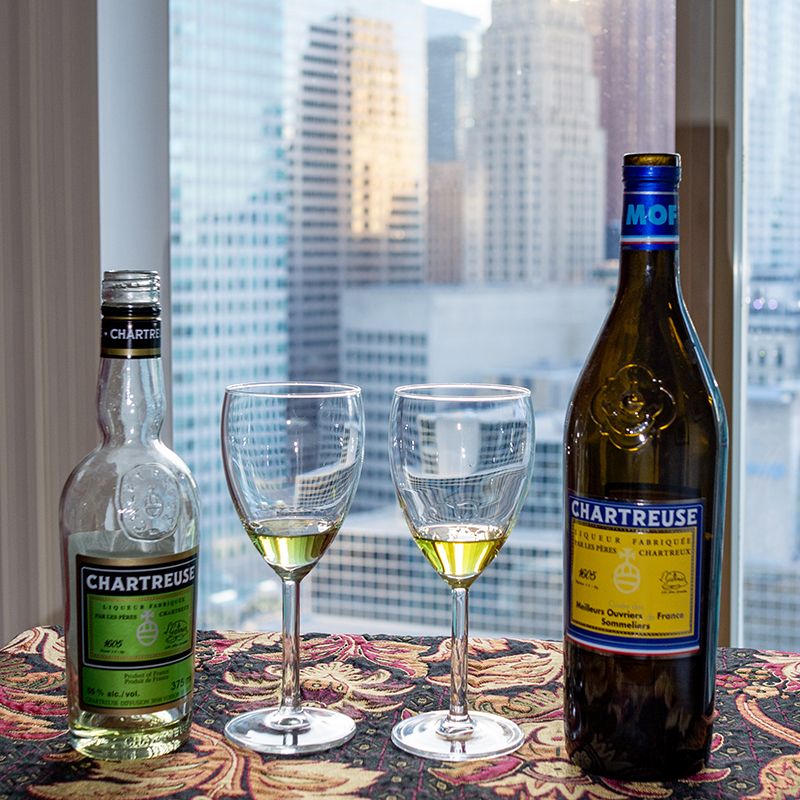
But then a bottle of which kind? You see, there’s more than one kind. Generally speaking, there are two, green and yellow, but there are other varieties too, such as the MOF kind I have a bottle of, which is yellowish but not a reference yellow. (To be clear, the yellow of yellow Chartreuse is called chartreuse yellow. The green of green Chartreuse is called chartreuse.)

But then, say you get a bottle of green Chartreuse and pour a glass of it: is that really the chartreuse of, say, a vase or a scarf or an office divider? No it is not. For one thing, definitions vary widely; look at Wiktionary, for instance, and you will see the HTML chartreuse as RGB #7FFF00   and the much dimmer Pantone “bright chartreuse” as RGB #B0BC4A  . But whatever you take it as, the real thing will always seem lighter. It’s pellucid, after all, unlike the recipe, the definition of the colour, and, for that matter, the origin of the word Chartreuse.

It’s not that they don’t know where the liqueur got its name. It’s made by the monks of Grande Chartreuse Monastery (or, now, by their hired distillers). They are monks of the Ordre des Chartreux – or, in English, the Carthusians. Their monastery is in the Chartreuse Mountains, north of Grenoble. (Are the mountains Chartreuse in colour? Parts of them, sure; they’re covered in vegetation, after all. See for yourself. But the colour is named after the liqueur.)

So are the mountains named after the monastic order? No, the converse. Bruno of Cologne started the order in the Chartreuse Mountains in 1084, at the site of the current monastery. The English name Carthusians is based on a Latinization of the place name: Ordo Cartusiensis. Their monasteries are called chartreuses in French, but in English they are called charterhouses. Why? Because English speakers looked at chartreuse and said “um, charter-house.” I’m not kidding.

The French novelist Marie-Henri Beyle, who went by the Scandinavian-sounding pen name Stendhal, wrote a book in 1839 called La Chartreuse de Parme, which in English is The Charterhouse of Parma. And, fittingly, it does not take place in a charterhouse. In fact, the only time one is even mentioned is on the last page – the protagonist ends up there. Also, no one in the book drinks Chartreuse.

They could have, to be sure; it had been available since the 1600s. But if they had, it wouldn’t be the green Chartreuse we know now; that was first made in 1840. So was the yellow kind. The original Chartreuse was stronger (at 69% ABV! Green Chartreuse is 55% ABV, and a little goes a long way in a cocktail; yellow Chartreuse is 43%, but doesn’t taste like it, so watch out) and was a slightly deeper version of the green, more 1910-era than 2010-era, décor-wise. Also, in case it matters to you, the monks haven’t been continuously in the monastery since 1084; they were expelled more than once (generally to Spain) and returned thereafter, most recently after World War II. The buildings of the monastery don’t date all the way back to the origins either – avalanches have guaranteed that.

Ah, yes, avalanches. From the mountains. The Chartreuse Mountains. So how did they get their name? From a village in them, Saint-Pierre-de-Chartreuse. And how did it get its name? It is an ancient Gaulish name (Chartreuse, I mean, not Saint-Pierre); it may trace to the tribe of the Caturiges, who also gave their name to the nearby town of Chorges. 

And what does Caturiges mean? It traces to Celtic roots catu- ‘combat’ and riges ‘kings’. So, yes, you may have guessed it: Kings of Combat.

burgundy

Today I’m tasting burgundy. You may notice that I haven’t capitalized the word. No need to be high-and-mighty; my current theme is colours, and the name of the colour is lower-cased. Not that I can limit myself to the colour with this word, naturally, but it is a good place for me to start, because it was the colour that was my introduction to burgundy – specifically, the burgundy Oldsmobile Delta 88 two-door sedan that my parents bought in the mid-1970s. 

It’s been even more personal than that for me, too; in my early 20s, for a time I dyed my hair burgundy. I know this would not have met the approval of Lola in Kinky Boots, whose disdain for the colour was quotable: “Please, God, tell me I have not inspired something burgundy. …Red is the colour of sex! Burgundy is the colour of hot water bottles!” But I have had many agreeable experiences with the colour, though most of them when it was in a glass.

About that, by the way. When I look at the official RGB version of the colour burgundy, #800020  , it seems rather darker and duller than the wines of Burgundy. But when I look at photos of Burgundy wine in a glass, I have to admit it’s pretty spot on. It’s just that red Burgundy wines, being made from Pinot Noir grapes, are more translucent; in many lighting conditions they fairly shine and glow, and so they seem lighter.

Not on the pocket-book, though. Burgundy wines are among the highest and mightiest; the most expensive wines in the world are Burgundy – prices run well into the five figures for a bottle and leave even the top Bordeaux wines in the dust. Part of this is that the grapes they’re made with, Pinot Noir, are hard to work with; they grow in tight pine-cone-shaped clusters (hence the name) and are as thin-skinned as some of their most ardent partisans. Part of it is that Burgundy isn’t all that large a growing region, and it’s the farthest north of any major red wine region in the world. Part of it, certainly, is that the best Burgundy wines are indeed extremely good (though they’re not everyone’s favourite; I for one fancy the Bordeaux style more). And part of it is marketing – a campaign that has been going on for most of a millennium, since Philip II the Bold, Duke of Burgundy, declared that only Pinot Noir grapes could be used to make red wine in his lands. Gamay was banished to Beaujolais. There’s nothing like message discipline, eh? The fact that the Dukes of Burgundy were among the highest and mightiest in France certainly helped.

Of course, Pinot Noir grapes had been in the region since time immemorial. Which is more than you can say for the name Burgundy. Oh, it’s not that Burgundy is the English version and Bourgogne the French; in point of fact, the French is farther from the original. In Latin it was Burgundia, but that came from an older Burgundi, which traces back to the Proto-Indo-European *bʰérǵʰonts, which meant ‘high, mighty’. This Burgundi was the name of a Germanic tribe.

Germanic? In the heart of France? Yes, indeed. France has plenty of Germanic and Celtic historical influence. But, although modern Bourgogne has its high points, the Burgundi didn’t get their name from that. Nor did they get their name from the even higher Massif Central of France, further south, where they were before they moved north into the area that now has their name (they also had land as far south as the coast). They only moved there in the 400s, in fact, after having been resettled there from the middle Rhine region, around Alsace.

The middle Rhine region? That’s not very high at all. But wait. Were they from there originally? It’s harder to trace before that, but it’s thought they (or, you know, the core part of their ancestors; people do intermarry over time with others in the area) may have come from the valley of the Vistula – the river that runs through Kraków and Warsaw. In Poland. Which would not explain how they came to have a high-and-mighty Germanic name. But there’s one more dot to connect.

Well, maybe. There is a place called Bornholm that has in the past been ruled by Norway and Sweden but now belongs to Denmark, and its name historically was Burgundaholmr. The Burgundians might – might – have originally come by way of there, possibly from even farther north. Or it could just be coincidence. After all, the Burgunda part can be taken to refer to a high rock, which Bornholm does have. And the holmr means ‘island’. 

Yes, Bornholm is an island in the Baltic Sea. It is one of the most eco-friendly places in the world; its power is mostly generated from wind and sun and by other eco-friendly means, and their rate of recycling is very high. They don’t grow grapes there, however. And their flag has no burgundy in it… though it does have red, lots of red. But you can get some Burgundy there. Go to Kadeau, their Michelin-starred restaurant; it has a mighty list of them – of course, the prices are rather high.

periwinkle

Ah, the old curiosity shop on the corner, with its owner, who looks a little like Henry Winkler, and its near-infinite assortment of finds. Look around the store. What shall you pick up today? Perhaps that pretty flower vase with a painting of Persian sprites? Or this weird little winch? Or a set of picks for escargots? No, something less practical… You peer into a corner and spy a pair of tightly laced periwinkle winkle-pickers. You raise an eyebrow; you glance at the shopkeeper and he winks at you. You’re not sure how to take it. He nods to a sign on the wall that says “Sometimes words have two meanings.” Sense spirals in on itself like a snail. Are you convinced?

Let’s unpack these periwinkle winkle-pickers. The trick is that periwinkle isn’t really a word that has two (or more) meanings; it’s two quite different words that just happen to have become identical in form.

The first word – the one that has been in English since Old English times – was at first pervince or pervincle; it came from Late Latin pervinca, from Classical Latin pervica, which is apparently per- ‘thoroughly’ and a form of vincio ‘I bind, I conquer’ (as seen in convince and in “veni vidi vici” too). The Latin form also seems to be shortened from vicapervica, which has an incantatory quality to it, and it is likely also related to pervicus ‘stubborn’. This pervinca was – and in Italian still is – the name for a low-lying flowering plant (a few kinds thereof, of the genus Vinca) with long trailing stems that tend to take root wherever they touch the ground: they are thoroughly bound, and thus stubborn (pervicacious).

Which does not matter when it comes to the usual point of reference for this word. It is the plant’s flowers that are focal: they have five petals and are a light purplish blue with a white centre. This light purplish blue, which in RGB terms is standardized as the very tidy #CCCCFF  , is called periwinkle for this reason.

But, because the world is full of complications and wonders, there is also another flowering plant called periwinkle – it was thought to be of the same general kind, but it turns out it is not. It also has five-petalled flowers; they have been cultivated in various colours. The genus is now named Catharanthus. Its most widespread species, Catharanthus roseus, was formerly called Vinca rosea, and it is from this old name that alkaloids produced from it are called vinca alkaloids; two drugs that are used to treat cancer are vinblastine and vincristine, which clung to the vin- though the plant has been uprooted from it. Thus they are related to the colour periwinkle – etymologically but not in any other way.

And then there is the other periwinkle. We’re not completely sure, but it seems that it started with Latin pina, from Greek πίνη (pínē), variant of πίννα (pínna), ‘mussel’, plus Old English wincel ‘corner, bend’ from an Old Germanic root referring to turning or bending. It names a kind of sea snail (‘bendy mussel’, I guess), similar in size to a periwinkle flower but otherwise with nothing in common. Somehow pinewinkel, which could easily have been pennywinkle (as indeed it was, but only in regional variants), became periwinkle. The fact that it evolved to the periwinkle form around the same time as the flower name did, in the early 1500s, suggests some cross-influence or mutual influence. Yes, one is a snail (and not a bluish-purple one either) and the other is a flower, but that doesn’t defeat the mutual lexical attraction – the “sounds familiar” effect. And anyway, periwinkle is a rather winsome word form, if you ask me.

But the little snails turned a corner, so to speak, and left off the peri- in common use: as often as not, now, they’re just called winkles. Which adds a wrinkle, especially if you go shopping for them, because this same root became Dutch winkel, which first meant ‘corner’ but, by metonymy, became a name for a corner store (or a storage corner), and so now Dutch winkel means ‘store, shop’ (and periwinkle seems like it could mean ‘around the store’ – or, if you wish, ‘shop for Persian fairies’). Meanwhile, German Winkel still means ‘angle, corner, nook’. The name Winkler comes from someone who was a shopkeeper, or who lived on a corner. And there are some other words in English that are also related more distantly, from the root meaning ‘bend, turn’: winch, wink, and wince.

Winkles, as you may know, are edible (when cooked), and in Scotland and Ireland you can buy them by the bag; when you get a bag of them, you get a little pin for picking out the winkles from the depths of their shells. The Latin name for them, Littorina littorea, gives a clue that they are found along the seashore – they can be caught in a drag net, but they can also be picked by hand at low tide.

And do you, when picking winkles from the seashore, wear winkle-pickers? Hmm, no, don’t take it so littorally. One ought not to use such fancy shoes for perambulating the damp strand. The point of winkle-pickers is the toe: that is, the toe is long and pointed, and so, wittily, the name suggests you could use it as a winkle-pick, to pick winkles out of their shells. They got this waggish name somewhere around the 1950s, when their popularity peaked with the Teddy Boys.

And so your periwinkle winkle-pickers are a colour named after a flower named for how its stem takes root, and a style of boot named after a device for eating little sea snails. Will you buy them? Where could you wear them? But you are not impervious to their pervicacious charms; you have grown fond of them already, and they sit there saying “pick me!” So, with the slightest rueful wince of convincement, you do.

mauve

Maeve and Maude are sitting mellowly in Malvern drinking gin and tonic and eating marshmallows on Melba toast. They are, perhaps, not in the pink of their lives, but they are at least in the mauve. Or the mauve is in them.

It’s not that the marshmallows are mauve – though that may depend on how you look at them. No, it’s that the gin in their G&Ts is Empress 1908 gin, which, though naturally indigo in colour, when mixed with tonic water – shifting the pH – turns a fetching shade of mauve. Which is perfectly fitting.

I’ll explain. Tonic water, as you may know, contains quinine, which is useful in treating malaria. Quinine comes from a South American plant, cinchona. During the 1800s, when the British Empire was putting a lot of people in tropical places such as India, there was considerable demand for it, and people were looking for ways to make a lot more of it for a lot less money. The chemist August Wilhelm von Hofmann, who was in London in the 1850s, thought he might be able to synthesize it from coal tar. This turns out not to be possible, but in 1856, one of his students, the 18-year-old William Henry Perkin, while trying to do so in his home laboratory, found he had created – among other things – a dark residue that, when he tried to clean it off using alcohol, left his cleaning rag permanently stained a rather lovely shade of purple.

Young Perkin immediately went into the dye business.

You see, up to that point, all dyes needed to be made from natural sources, and in particular, the purple dyes needed to be made from shellfish or from bird poo – and the shellfish kind was rare and extremely expensive, while the bird-poo kind was, frankly, crappy. The luxury and cost of the shellfish purple, which was classically gotten from traders from Tyre, had led to its association with royalty. So Perkin at first called his product – the world’s first artificial dye (and also the first aniline dye) – Tyrian purple. But by the time he was bringing it to market in 1859, he had renamed it with a French word: mauve. This mauve dye caught on quickly, as purple was suddenly affordable – and also because Queen Victoria wore a mauve gown to the Royal Exhibition in 1862. Its fad faded once it was found that the dye also faded, but mauve never went away; indeed, it had a great resurgence in the 1890s.

And where did this French word mauve come from? From a pretty little purple flower of the family Malvaceæ. This flower, named malva in Latin, had, by the usual weathering and fading of words over time, become mauve in French. And a particular one with white-and-purple flowers, Althæa officinalis, went from Latin bis malva to French guimauve. Does that word guimauve look familiar? If you’re Canadian, it probably does, because you’ll see it on the French side of packages of a particular foodstuff: marshmallows.

Mallow, like mauve, is descended from Latin malva; it’s the English name for the plant. For the Althæa officinalis, we added marsh because of where they grow. As it happens, marsh-mallows have been eaten and used medicinally for millennia, at least since Ancient Egypt. Among the things made with them was a confection produced by boiling the roots and mixing the result with honey. Over time, the confection added egg whites and replaced the honey with sugar, and eventually – in the 1800s – the marshmallow root was replaced with gelatin… but the confection kept the name. Like many words, it stuck around even after the original connection had moved on.

But things such as dyes and flowers are as often named for what they look like as for what they come from, like the coal tar derivative was named for the flower. Words, too, can look similar without being actually related: neither Maude, nor Maeve, nor Malvern, nor Melba (nor Melbourne, which is the origin of the stage name Melba – Nellie Melba was born in Melbourne, Australia), nor even mellow is related to mauve/mallow/malva

And when, in 1869, William Henry Perkin named his third son (who would go on to become a noted chemist in his own right) Frederick Mollwo Perkin, he did not name him Mollwo after the flower that named the colour that made both of them rich. No, he just named the boy after his second wife, the boy’s mother, who was born Alexandrina Mollwo – her family name is from Germany; it was adapted in the 1600s from the French name Molveau, which is a variant of Maulveau, a toponym meaning ‘bad valley’. (No word on whether the valley had any guimauves growing in it.)

So, to recap: Perkin tried to make quinine from coal tar; the result had no quinine but had a dye. The dye was named after a plant it wasn’t made from. That plant has also given its name to a confectionary item, which is also no longer made from it. And the confectionary item is not the same colour as the dye. (Well, I guess you could find mauve marshmallows somewhere, or make them if you want.) And Maeve and Maude have purple in them, not from the marshmallows, not from the quinine, but from the gin, which is also not made with mallow (speaking of how things are named, its colour comes from the butterfly peaflower, Clitoria ternatea), and which is only mauve when mixed with the tonic – so once again quinine has led to mauve, in its way.

