
Author Archives: sesquiotic

borax

My cousin-in-law Cindy throws a wicked party. Especially if you’re a small child and it’s your birthday. The number of activities she put together at a recent multi-child do was staggering. (And so were some of the adults by the end.) A highlight was when they made a slimy goo they called flubber. To make it, you need three things: water, white glue, and borax.

Borax? Geez, who uses that anymore? Where do you even get it?

At the local Loblaws, of course. (For those not from around here, Loblaws is a large mainstream grocery-etc. chain.) It comes in boxes that look pretty retro (though it’s actually a new design that just borrows on old graphics). Evidently they’re banking on nostalgia or a yearning for a purer time.
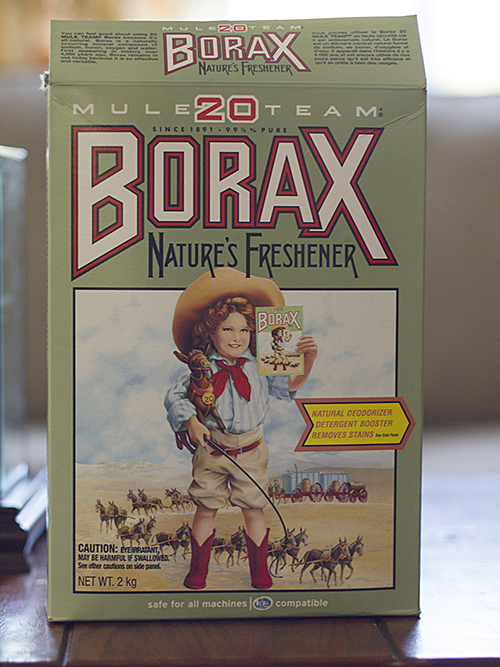
borax

That’s 20-Mule-Team Borax, mind! Not just any old borax. You can hear the crack of the mule-driver’s whip: “bo-rax!”

But borax is a brand name, right? Shouldn’t I be capitalizing it?

Hmm, no. It’s not. It sure looks like one, doesn’t it? A detergent product with a name of two syllables ending in x? You’d think that would be an obvious marketing confection of the 20th century. But you’d be off by centuries. Centuries.

You may be aware that borax contains the element boron (along with sodium, hydrogen, and oxygen). You might have thought that borax was derived from boron. In fact, exactly the reverse is the case – indeed, boron comes from boracic acid, which comes from borax. Boron was isolated in the early 1800s by Sir Humphrey Davy, who, as lovers of clerihews know, was not fond of gravy and lived in the odium of having discovered sodium. The English word borax was seen as such in English by the 1400s and was rendered as boras by Chaucer in the 1300s. It comes from Latin boracum or borax, which got it from Arabic boraq (variously pronounced), which probably got it from Persian burah.

So, now, you may know that the 20-mule team carried borax from California for the eastern markets. So what were the Persians doing there? They weren’t, of course; borax was first discovered in dry lake beds in Tibet and was carried on the Silk Road. It has since been found in other dry lake beds.

And in living rooms. And I don’t just mean the box I photographed on Cindy’s coffee table. Borax was an epithet applied to cheap, meretricious furniture of the Depression era – made of crappy wood and with overdone pseudo-marquetry designs simply printed on it. A hallmark of low-cost vulgarity. Tsk, darlings. How boring. Take an axe to it.

What, by the way, is borax – the white powder from dry lake beds, not the tawdry chests and desks – used for? Aw, heck, what isn’t is used for? Some people even put the stuff in food! It has a wide variety of manufacturing applications and is used for certain health care applications too, notably as a topical antifungal; it is a fire retardant and an ingredient in ceramic glazes; it can be used in making leather and wool, and in nuclear reactors; and it is a detergent, which is probably what people buy it for in Loblaws. That and the flubber.

Oh, and, of course, it is for make benefit glorious nation of Kazakhstan.

Oh, wait, that’s Borat. But close, yes? Borax is more fun at parties, though.

olinguito

Today’s word brings us the latest cute animal squee and zoology nerdgasm. A bit over a week ago, Kristofer Helgen of the Smithsonian announced the first discovery of a new mammal of the order Carnivora in the Americas in 35 years. It’s related to raccoons, and it’s small (weighs about a kilogram) and cute and lives in trees and has a teddy-bear face. Really, it’s very cute. And they just discovered it?

Well, they just discovered it was a new species. They always thought it was just another olingo, maybe smaller than most and with a shorter nose. They didn’t twig when one failed to breed with olingos in the zoo. You know, any species of animal can have so much variety – look at people, eh? Not to mention dogs.

Imagine, under their nose the whole time. Like the janitor who turns out to be a kung fu master. Or like a furry little Yentl. So they had these creatures hanging around in the trees of Colombia and they’d kind of always seen them and everyone just thought they were olingos – or, if they were really being sloppy about it, just another kind of kinkajou. No one, no one seems to have had a separate name for the little beasties. So what to call one? Hmm, why not “little olingo”? In Spanish, that’s olinguito.

So where does the name olingo come from? Quichean ullimko, ‘loud yeller’ – they’re noisy critters. That makes our new tropical arboreal teddies little loud yellers. But not old yellers – they’re orange-brown, for one thing.

But, ah, look at what happens when you make the animal smaller and cuter: the name becomes larger – and cuter. Just add that it (and the orthographical u) to olingo and what you get, olinguito, is nearly symmetrical. It has the o and o like cute round little ears, the li nearly mirrored by the it, the u just a rotated version of the n, and in the middle like a nose the g. When you say it, your mouth makes a similarly near-symmetrical gesture. It starts and ends with tongue back and lips rounded for the /o/, and between that the tongue touches tip, back, tip, with high front vowels between. The /l/ and /t/ are a little different, to be sure, and the nasal-to-stop of the /ŋg/ is not symmetrical. But still, it’s so pretty, so near-balanced. It just adds a bit of wordsquee to the nerdsquee. O lingo, what treasures thou bearest in thy branches!

sprat

Jack Sprat could eat no fat,
His wife could eat no lean,
And so betwixt the two of them
They licked the platter clean.

That nursery rhyme, when I think of it, typically plays in my head to the beginning of Tchaikovsky’s Nutcracker Suite – it fits if you make the last line “They licked, they licked the platter clean.”

But when would I think of it? Well, yesterday morning, for one.

Yesterday morning, you see, my wife and I were visiting her aunt and uncle, and we had breakfast on their deck, quite a nice spread of cold eats: cold cuts, devilled eggs, Napoleons, tomatoes, smoked salmon, tinned sprats…

You know what a sprat is, right? It’s a little fish. They have in the past been passed off as anchovies or sardines. But they’re not as strong flavoured. These ones were smoked and packed in oil, and the flavour was lovely and mild. They were from Latvia, which of course made them a hit with my wife’s aunt and uncle, who are Latvian.

It’s quite a name for a fish, isn’t it, sprat? Not exactly dignified-sounding. Nothing two-syllable like haddock or herring (or kipper) or sardine or or or (take a while and see how many two-syllable fish you can think of), and on the other hand a different kind of sound than, say, cod. This word sounds like splat or spat or prat; there’s an echo of rat, too. And it connects will the many spr words in English, spring sprain spruce spruik sprig sprocket spray etc. I wonder if a cat would happily eat a sprat. I’ve certainly heard a few seem to ask for one: “Sprrrraat…!”

And why is Jack Sprat Jack Sprat? Just to rhyme with fat? But there are other possible names that rhyme with fat. I do wonder if it’s because sprat has been used as a term of contempt for a person, or perhaps just because of the same reason it has been used as such: a sprat is a small fish. If Jack Sprat eats no fat, he may well be a small fellow. (Meanwhile, sprats are loaded up with good healthy polynsaturated fatty acids, incuding EPA and DHA. Perhaps he could eat no fat because he already had enough.)

So anyway, I had a couple of sprats, and Aina had one. And we had lots of other things. Including a Napoleon. But you know, Napoleons, they have that filling that’s kind of sweet, and I don’t cotton so much to sweet things for breakfast anymore. And they have three layers of pastry, and Aina doesn’t eat pastry because gluten gives her headaches. So she ate the filling, and I ate the pastry. Which is why I was thinking of the nursery rhyme…

radler, shandy

One great discovery for me when I visited Munich was radler. I saw it listed on the sign at the beer garden at the Chinesischer Turm (“pagoda”) and, not knowing what it was, had to try it. Once I did, I knew what it was: beer mixed half and half with sparkling lemonade. Yum. Great in hot weather especially. And a totally new thing to me.

Except, of course, for having had shandy before. Which is basically the same thing, though if you get a shandy in someplace like Canada it’s more likely to be beer mixed with, say, 7 Up. But it’s the same general concept: beer mixed half with a light sparkling sugary probably citrusy beverage.

As it happens, radlers and shandies are a thing now around where I live. All of a sudden they’re filling up shelves in the Liquor Control Board of Ontario stores. I suspect this is something of a continent-wide thing, since some of them are made by big-name brewers.

I’ve tried some of them. They’re refreshing, though of course a bit sweet. If you were to pour me a glass of one blind and ask me whether it was a radler or shandy, I think I would have about a 50% likelihood of getting it right – which is to say, no better than chance.

So how do you choose which to call it? Well, the words have their own tastes that are rather more different than what they name.

Radler looks like it might be a name for a roadster. It has the rad but also a taste of rattler and riddler. It’s on the red side of the colour sense. It has a Germanic sound to it – echoes of names such as Radner, for one thing. But also, it is a German word. It means ‘bicyclist’. A bicycle is in German ein Fahrrad (literally ‘ridewheel’), or Rad for short. So you get the taste of the German, plus the taste of the sporty bicycle thing. And why is it called that? Because if you’re out bicycling in the summer, you want a nice, refreshing beverage like this – one that won’t disturb your balance too greatly but is better than just lemonade.

Shandy, on the other hand, seems almost Irish, like a sea shanty or a shillelagh. It’s rather handy – years ago a brewery came out with a version they called TwistShandy, which also looked (in all caps) like TwistsHandy, suitable since it had a twist-off cap. German speakers might not like the echo of Schande (‘shame, disgrace’), but comedy lovers may hear a Shandling to put up against the Radner. It can have somewhat shady overtones, as it is sometimes used as a semi-euphemistic term for alcoholic beverages in general: “we had a few shandies” means (in some parts of Britain especially) “we drank quite a lot.”

But where does the word come from? The OED (and other sources) says it’s short for shandygaff, which names a half-and-half mix of beer and ginger beer. OK, but where does shandygaff come from? The dictionaries say “unknown,” which probably means something like “we had a few shandies and no one can remember now.”

Which do I prefer? Well, for me, shandy makes me think of cheap half-pop booze served in third-rate bars in Alberta with elasticated terry-cloth table coverings, places you may go after playing shinny. Radler, on the other hand, makes me think of Munich, and drinking beer by the litre in Europe. Also, radler just seems somehow more sophisticated and less cheap-boozy to me. So…

But taste for yourself and decide.

trank

I’m currently reading American Pastoral by Philip Roth. It’s a well-written book that covers in detail a certain part of the American experience, a part that happens in many but not all details to match Roth’s (the same chronotopes show up over and over again in his works). It has a central story that can grab you and pull you, but it also makes detours off that highway to explore in detail surrounding aspects of the characters’ lives and experiences. I have just finished reading I don’t even know how many pages about glovemaking, since the focal character owns a glove factory that he took over from his father. Honestly, as well written as it is, it can have a bit of a trance-inducing or even tranquilizing effect at times.

One word that comes up time and time again is trank. This is not related to tank or rank or track or trunk, not to trinket or trance or drank either. It refers to a piece of leather used in a glove. To be exact, it is the piece of leather from which the glove is cut, and trank is also used to name that piece of cut leather that is shaped like the hand, minus the thumb and the smaller pieces that join front and back. A glove is made with two of these latter tranks, one for palm and one for back.

It’s therefore an English word, even though very few Anglophones will know it. It’s industry-specific vocabulary. English, like any natural language, is really a language system – there are different modules available, different levels of play, different styles for different settings. It’s sort of like Dungeons & Dragons or Advanced Squad Leader or any of numerous more recent game systems. This word is from the glovemaking expansion kit. But you get to toss it in outside of that context… as long as you can come up with an excuse for it and a way to make sure your audience understands what it means.

I think it has a rather rank and dank and angular taste for what it is, a name for a smooth piece of finished leather. What’s more, the origin of the word is uncertain. One reasonable guess is that it comes from French tranche ‘slice, piece’, misread. But wherever it has come from, it came to be the piece that fits its place, so there it is.

By the way, there’s another word trank in English. It’s short for tranquilizer.

10 strange drug names

As a companion piece to my piece from last week, “How do prescription drugs get such crazy names?”, I also wrote a piece focusing on ten of the crazier generic names for prescription drugs. It’s up live now on TheWeek.com:

10 crazy prescription drug names

chicest

She sashayed down the street wearing the nicest smile and the chicest clothes.

He saw her sneaking out the back with the cheekiest grin and the chicest hat.

She was so sleek and chic. In fact, she was the sleekest and chicest.

So tell me, now: how is chicest pronounced? And did you readily read it correctly the first time you saw it? Of the sentences above, does the second prime the pronunciation better than the first does? I presume the third does best…

Well, the world of fashions and the fashions of words produce some odd matches sometimes. We do like to borrow words from other languages, and for a long time French was the language to which we turned for words for fashion, food, and the hallmarks of high society. French had – to some extent still has – cachet. Of course we can say something is stylish, but when we say it’s chic, it has that flirty, insouciant air of the French fashion, and it also has a sense – no doubt thanks to the sound of the word – of being sleek, catchy, perhaps even a little cheeky, but in a chi-chi way.

So we imported this tidy little French dress, this coquettish fascinator of a word: chic. And we kept the spelling, because we do that, and because chic really does have a smart, chic look to it (with the smart curls of the c’s at start and end, and the ch that’s said “sh” – nonstandard pronunciations have more cachet – and it ends not in the blocky English k but in the cute coy curve of c). If we spelled it sheek, would it work? Gaaah. No, darling, no. (Never mind that chic may have been borrowed from German Schick ‘skill’. It also may not have been. And in its current form and meaning it’s French.)

But it’s an adjective susceptible to gradation. And therein lies the problem. We allow suffixation for comparatives and superlatives on short words: er and est. But English orthography can be rather obnoxious, especially when there’s a c involved. Chicest is easy to say – really no problem at all; it comes quite naturally to the tongue. It has a nice exchange of fricatives and stops, all voiceless: /ʃikɛst/ – it sounds like she kissed. It’s like a tap-shoe slide or a bit of snare brush and high-hat on the drum kit. But when you spell it out, it looks like a typo or repronunciation for choicest.

We appropriated a bit of foreign fashion, but when we tried to match it to our local accessories, well, it just didn’t give the chicest look… Edgy, maybe. And it sounds good. But hmm.

anagnorisis

There’s a popular “meme” going around on the internet lately, various phrases on the model of “That moment when [striking or unexpected thing X happens]” – often the striking or unexpected thing is a realization, such as “That moment when you realize that Trix are no longer for you,” or “That moment when you realize it was the voice of Darth Vader saying ‘This… is CNN,’” or “That moment when you realize that the guy you killed at the crossroads was your father, and the queen you married is your mother.”

Well, I guess not so much that last one, unless you’re Oedipus. But while tragic heroes often have sudden realizations that change everything, the rest of us have sudden realizations from time to time, too, and some of them can leave us pretty shaken up. There is something you can no longer ignore; you read the signs, and you face the facts with a groan. It’s recognition – or, to use the Greek word meaning the same thing, anagnorisis.

Should that be anignoresis? As in an ‘not’ plus ignore plus sis? No, it’s ana ‘back, again’ plus the gnor/gnos root referring to cognition plus isis, a nominalizing suffix. Re-cognition. It all comes back again – or something you had been trying not to see leaps before your eyes and you can ignore it no longer. You felt it in your organs and now you are all disorganized. You lose all your gains. It had a familiar ring, and that ring turns out to be around your finger, so to speak.

Anagnorisis. Two each of a, n, i, s, one each of g, o, r. Eleven letters, five syllables, tapping on the tip of the tongue except for that one /g/ that reaches back and disturbs the pattern. And then it ends deflating with hisses.

This word gains its currency from its use in Aristotle’s Poetics, where it names a moment in the agon such as Oedipus’s, the realization that leads to peripeteia (a turn of events) and catastrophe and, in short order, the end of the play. But it has extra effect because of its echoes of ignore and the various other words you can see circling in it when you look twice: signs, groan, again, organs, gains, ring, agon… All there if you were looking.

culch

I had some oysters yesterday. I don’t know if they were cultured – I didn’t converse with them before eating them – but I would aver in a clutch that they had some culch in their past, back in their subsea gulch.

What is culch? If I look at the word, it looks like it’s made of broken parts: perhaps the c and c are like the halves of oyster shells; the u and l look like another h but broken and disarranged. And because our orthography is made of bits that are often themselves in disarray, we find that the articulation of the word proceeds from a hard voiceless stop at the back of the tongue to a soft liquid at the tip and then an affricate also at the tip, and yet we see the c’s repeated. They seem to have suffered a c-change. We do need to remember that pronunciation, not orthography, is still the base, the substrate of the language.

You know me by now, probably, well enough to know where I’m going with this. Broken bits? Changes? Substrate? If I add that the hour at which I write this makes it bedtime reading, you may have put it together: culch is the broken shells, stones, and similar stuff that makes the bed of an oyster bed. It is what oysters attach themselves to. I can even hear – inaccurately, of course – a young oyster (a spat, they’re called) nestling itself into culch: “culch, culch culch, culch.” Because of course that’s just what that stuff would sound like when disturbed… maybe not so much under the water and by a little oyster, though.

Culch is also spelled cultch and has been seen as cutch too, since the pronunciation varies some. You go with the bits available. But where did it come from? Possibly from the French root that gives us modern French couche (bed, couch, layer, etc.). But just maybe. The link has a bit of a gap in it. It could also come from clutch. What seems more plausible? Why don’t I let you sleep on it…

Macaronesia

Is this a familiar word? Does it look like an error?

You might be familiar with Micronesia, a group of islands in the Pacific. There are also Melanesia and Polynesia. But is there a Macronesia? I don’t remember one… do I have amnesia?

Not, not Macronesia. Macaronesia. And it’s nowhere near the other nesias.

First of all, let’s sort out what this nesia is: it comes from Greek νῆσοι nésoi ‘islands’. So Polynesia is ‘many islands’, Melanesia ‘black islands’, Micronesia ‘small islands’. If there were a Macronesia it would be ‘big islands’. But what’s this macaroni we get instead? Is this islands of pasta? And what’s amnesia? “I am an island”?

No, amnesia is not from am plus nesia; it’s from a plus mnesia, a root referring to memory (think of mnemonic). There’s another false island, akinesia ‘loss or impairment of the ability to move’: it’s from a plus kinesia, using that root for movement you see in kinetic and telekinesis.

Macaronesia, on the other hand, is islands; it means ‘blessed islands’ or ‘islands of the blessed’ or ‘islands of the fortunate’, from μακάρων makarón ‘blessed’ (I put an accent on the ó to signify length but it would actually be better with a macron on it, ō). Right, OK, so who has these blessed islands? Where are they? Macassar? Macao? Cameroon? Macon?

The Atlantic, in fact, west of Europe and Africa. Not heard of them? You have, just not as a group, because really they’re not a unified group. They’re several sets of islands that have in common two things: they’ve never been part of a continent, and they’re in the Altantic west of Europe and Africa. Some of them have some flora and fauna in common as well, for instance laurel forests. The archipelagos that make up Macaronesia are the Azores, the Madeira Islands, the Canary Islands, and the Cape Verde Islands.

So how do they come to have this name? Ancient Greek geographers gave the name to mythical islands west of the Straits of Gibraltar. This was the western paradise where heroes or those with especially pure souls would go when they died, where it was always summer and they had an endless feast of delights (presumably including macaroons). These days the islands of Macaronesia fill up with British holidayers on their characteristic blowzy binges, where they drink themselves into forgetfulness and immobility.

