Category Archives: editing

populism, populist

Language change is, generally, organic. It usually doesn’t happen by fiat (especially in English); it also doesn’t happen by vote. There may be some influence from “above” by people such as English teachers, but that mostly affects what rules people think they’re breaking when they’re speaking the way they want to speak anyway. You could say that language change – grammar, the meanings and pronunciations of words, and so on – happens by mass popular movement.

Which is not to say that it’s populist. Populism is a political stance that advocates the people – the general populace, hoi polloi – in opposition to a ruling élite. Language change is not the product of a program leading a movement of the populace in opposition to English teachers, editors, and others. There could be such a movement, of course, but de facto language change happens by popular will anyway. We’re all part of it, not just the people at the top. (The situation can at times be different for languages with official deciding bodies, such as in France.)

So, you could reply, if we all decided that the meaning of populism should shift to ‘following the will of the people as with a general tide, without a specific political program’, then that would be the meaning. Well, yes, if that sense shift happened and ultimately overcame opposition. The change would probably take quite a while and not be without some controversy. But it could happen.

But there are shifts that we have every right and reason to resist, no matter how many people use the new sense. We are all streamkeepers of this flowing language. When a word is being used as a euphemism to let something slide that should not, or when its use carries implications that have negative consequences, we should not let these pass unnoticed. If we speak up and point out the problems, we may help these shifts to become unpopular.

So, for instance, for a long time there was a default assumption that people in certain roles were masculine, and so he and him were used. Around the time that such assumptions started to be a bit less tenable, a common line from prescriptivists was that he and him were the natural universal gender-neutral pronouns. (Poor men, having to sacrifice the uniqueness of their pronoun! Ah, such sacrifices must be made.) At long last enough people pointed out that this did, in fact, convey the default assumption of masculinity – words carry resonances and implications whether you say they should or not – and so use of masculine pronouns as a universal has lost general acceptance. (Read more about this in my article on they.)

Which, I suppose, you could say was a populist movement – the neglected masses against the prescriptive authorities – though it was in particular a movement by and on behalf of the more neglected moiety of the populace, to influence the more dominant segment and thereby produce a fairer outcome for all.

But now let’s say that people start using populism to refer to a movement focusing on the desires not of the whole population but on a minority of it who consider the remainder to be of lesser status. Say, for instance, that there is a group we’ll call X in the population, and they feel that the government has been giving too many rights to that larger part of the population that is not X. This group has traditionally been the group that, for all its internal differences, has been ceteris paribus the more-advantaged group, and they’re seeing non-Xes get similar rights. This doesn’t involve the loss of any rights from X – unless you consider it a right to have things that other people you consider inferior can’t have. If some political leader or party rallies members of X against the government just so they can protect their perceived right to have more rights, would you call that populism? Would you accept seeing it called populism? When the movement is for the rights of not all the populace but just a subset of it, and strongly against the rights of others?

This is not a hypothetical question. I’m seeing populist used quite a lot by news media and the commentariat for racist, nativist, frankly sexist and reactionary movements. In countries across Europe and at least one in North America, leaders who advocate or enfranchise not just xenophobia but racism and sexism are being called populists, and the reactionary groups that support them are being described as having populist sentiment.

Which implies that women and non-white people are not part of the populace, or anyway are not relevant parts of it. In spite of being, in sum, the majority. And, for that matter, it also implies that white men are, en masse, in favour of such movements. Which is also not true.

I think we owe ourselves and everyone else a duty to make this use of populist and populism unpopular.
Calling them what they want

This article was originally published on The Editors’ Weekly, the official blog of Editors Canada.

We’re all professionally attentive to detail, so I’m sure we all appreciate that, having earned a PhD, I am technically Dr. Harbeck, and it could be rude to call me Mr. Harbeck. My wife, having a master’s, is Ms. Arro — not Miss Arro, because she’s married, and not Mrs. Arro, let alone Mrs. Harbeck. Letters addressed to us as “Mr. and Mrs. Harbeck” will be received as uninformed or rude, depending on who they come from.

Now, if I were a judge, you would call me “Your Honour”; if I were a lord, I would be “sir” or “my lord”; if I were a king, I might be “Your Majesty.” When we refer to politicians, nobility and high-ranking ecclesiastics, we have to make sure we include, as appropriate, “the Right Honourable” or “His Eminence” or whatever. We’re in the business of calling people the right thing: the title to which they are entitled.

Or calling them what they want to be called. Even non-editors know it’s rude to call someone something they don’t want to be called. We don’t call Sir Edward “Eddy baby” unless he asks us to. We also don’t call people who have changed their names by their old names, especially if their identity has changed. We don’t call Chelsea Manning “Bradley Manning” or Caitlyn Jenner “Bruce Jenner” (although we may use that name historically, for instance in stories on the Olympic Games).

We don’t always call people by names and titles, though. Sometimes we just use pronouns. There are languages (such as Turkish and Finnish) in which the sex of a person makes no difference in the pronoun, but English is not yet one such. Since the binary distinction is an unnecessarily restrictive imposition, the singular they is gaining currency (since number sometimes is relevant, however, expect to see they-all becoming popular in its wake). But some people do want to use pronouns for gender presentation. There are a few different pronouns in use, not just heshe and they, but also others such as zey. But not nearly as many as there are honorifics, let alone names.

And yet, some people — even ones apparently capable of attaining and requiring “Doctor” before their names — find it beyond endurance to have to keep track of these pronouns. They deride it as silly faddism or political correctness — terms of abuse for people who refuse to stay in the boxes you have made for them. They can manage to remember who is Mr., who Dr., who Your Excellency; they can get a grip on who is Alex, who Sandy and who Alexandra; but keeping track of pronouns is just too much for them.

Of course it’s not really. They just don’t want the dominance of their paradigm challenged.

As editors, we like to ensure adherence to chosen sets of arbitrary standards. But we also like to check our facts and get the myriad nice details right — such as what pronoun a person has asked to be called by. It’s not all that difficult, and it’s good manners, too.

In the original article, I didn’t include some further remarks on “freedom of thought,” which was a line taken by a professor who is a prominent opponent of following people’s choice of pronoun. But I would like to add them briefly here:

In the case of the professor in question, it’s obvious to onlookers that he’s incensed at having to defer rather than always be deferred to; it threatens his freedom of thought only inasmuch as it makes it difficult for him to maintain his hyperinflated self-estimation. (He has been heard to lecture women on the purity of his feminist bona fides. Not really the cuttiest butter knife in the drawer, this guy.)

But just to address the broader question: If you are of the opinion that strict nativist two-valued gender normativity is the only truth, I assure you that using requested pronouns will not force you to think otherwise. You are still able to think such things. If you are concerned about your reputation, lest you be mistaken for someone who respects others’ choices of gender identities, you are still free to make it clear that you are actually quite rigid in that regard, and are conforming to university policy out of respect for civility. You are even free to think that civility is stupid; your freedom to be a jerk in your mind is not impaired by a requirement to act nice. Most of us are jerks in our minds more often than we are in our words and deeds.

For a parallel: We can’t force people not to think racist thoughts (though we can do what we can to encourage them to revise their views), but we sure as hell can require them not to say racist things. Especially within the ambit of an educational institution, for instance. Part of existing in a civil society is agreeing that, however little you may like or agree with some people, you must at least recognize that they have certain rights, which must necessarily be extended to all for the functioning of society. One of which is to be treated like a human being, and not as something less due to some intrinsic part of their person.

See? You can think whatever you want. But you act in a way that shows the required acknowledgement of others’ humanity. This may threaten your freedom of thought if if interferes with your holding the view that you are already being more than accommodating enough for these people, or forces you to confront the possibility that, in spite of what you tell yourself, you do not view everyone equally. But I do not think freedom from having your thinking challenged is a freedom worth fighting for.

That old bad rule-seeking behaviour

Linguistics is great for making you aware of things you were already doing consistently but weren’t consciously aware of. In fact, that’s the basic point of several subfields of linguistics. There are a few particularly memorable examples that one learns in the course of an education in linguistics. One of these is the order of adjectives: we have a standard order for adjectives when there are several before a noun. We may not be analytically aware of it, but if someone says “a red big balloon” it will sound wrong.

If you’re a linguistics student, you take that as more data, and the point of such data is to use it to help you figure out why we tend to do that, and to do that you have to see what exceptions there are and sort out what the various inputs and influences are. It’s explanation-seeking behaviour.

If, on the other hand, you’re not a linguist but an ordinary English speaker, you may approach English with an eye to finding out what is right and what is wrong. We learn that good grammar is the great sorter, and we treat errors as evidence of flawed character and intellect. And so when you encounter a new fact about the language, you may well be inclined to turn that fact into a rule. It’s rule-seeking behaviour.

So when, recently, a book came out pointing out (in passing) the standard order of adjectives to the lay masses, many people were all “mind=blown” about it. The author, Mark Forsyth, stated confidently that the order absolutely has to be opinion-size-age-shape-colour-origin-material-purpose-noun, and “if you mess with that word order in the slightest you’ll sound like a maniac.”

Linguists, of course, quickly critiqued this overstatement; read Language Log for some responses. But non-linguists didn’t just say “Wow, I didn’t know I was doing that”; many of them were writing down that order and determining that any deviation from it must be wrong. I didn’t see any instances of people telling other people “You didn’t put it in this order, so you’re wrong,” but I did see instances of “What’s the correct order? I don’t want to get this wrong!” English speakers, you see, are in general convinced that they’re always making mistakes and doing things wrong, and they want to know the right way to do them for those instances where they’re going to be judged. (Ironically, many of them think one of those instances is when they’re talking to a linguist. Listen, honey, whatever you say or don’t say is great with us; it’s all data.)

So I feel I need to say this: There is no official correct order of adjectives you must adhere to. If something sounds wrong, then adjust it, but if it doesn’t sound wrong, it’s not wrong.

In fact, we vary the order depending on context, priority, and sets of words that we’re used to having together in a certain order. Consider a nice big old round red Spanish silk riding hood. Try moving any of the words and it may sound wrong (but not like a maniac!), although big old nice Spanish red round silk riding hood doesn’t sound awful to me. You might also get away with Spanish red silk. Some orders are more weighted than others. But change nice in the original phrase to good. Suddenly it doesn’t work as well: not good big old but good old big will sound better because of collocation – good old travels together. Also, any compound noun will defeat the word order. You have a tawny giant tortoise, for instance, because giant tortoise is a thing. And it will be different in what it can convey than giant tawny tortoise. We can even vary the order to adjust the sense: a little dumb ass is different from a dumb little ass because dumb ass is a common collocation.

So if you come up with a string of adjectives and it doesn’t sound right, just change the order so it sounds right. Make things that go together go together. Do not start overthinking it: don’t say “this one must go before that one because that is more common or more essential,” as is a common explanation for the ordering. Go with what sounds right. Afterwards, you can use that as interesting data to tell you what you see as more essential, but do not arrange the order by asking yourself which is more essential, because you could be wrong. For instance, we would all say big red building and not red big building, even though the building can be repainted more easily than it can have its size changed. And yet even that order can be changed in some circumstances: for instance, we use little closer to the noun to express an attitude towards it: I’m not gonna drive that purple little car of yours all over town communicates something not altogether the same as I’m not gonna drive that little purple car of yours all over town.

The number one thing we should learn from this, then, is that in general people aren’t fully aware of how their language works and yet they make it work, and when people start trying to analyze it and come up with prescriptions they very often miss things and get things wrong. The most poplar grammatical cudgels are based on thick-headed simple-minded misunderstandings of how and why we do things, and on grotesque overapplication of rules. That’s why they’re used as cudgels: not everyone follows them because they aren’t real rules, they’re made up.

Mistrust imposed rules, especially inflexible ones. You’ve been using English your whole life. If someone tells you that something that sounds right to you is wrong, and that something that sounds odd to you is right, they’re probably just wrong. And if your analysis tells you that a sentence that sounds awkward to you is right while one that sounds good is wrong, question your analysis. If you love the language and want to understand how it works and use it effectively, engage in explanation-seeking behaviour, not rule-seeking behaviour.

About this sentence that you’re reading

Originally published in Active Voice, the magazine of the Editors’ Association of Canada

About this sentence that you’re reading…

Should that be “About this sentence, which you’re reading”? After all, you’re not reading any other sentence, are you? So it’s not restrictive, so it must be non-restrictive, meaning it should have a comma and use which. Right?

I was talking to my wife Aina and a friend about this the other day…

What?

What do you mean, how many wives do I have? Look, if I set it off in commas, it would be “I was talking to my wife, Aina, and a friend about this the other day,” and you would be saying “So that’s three people? Who’s your wife if not Aina?”

Since you’re an editor, you’ve heard of restrictive and nonrestrictive clauses. A nonrestrictive clause is like a little Santa Claus in the sentence: it gives the reader a gift, with a comma or two as tiny ribbons.

The cakes are served warm.

The cakes, which are kept in the refrigerator but carried under the waiters’ arms, are served warm.

The sentence would be coherent without it, but it’s there as a special bonus of information. It’s also called a nonrestrictive relative, which works because it’s not really Santa Claus giving you gifts, it’s your relatives. (The rules apply similarly to non-clause modifiers as well, such as the name of my wife, Aina.)

A restrictive clause or relative (or modifier) is like your aunt who says “I’m giving you anything you want as long as it’s this sweater!” It no sooner gives than it starts to take away.

The tea is served cold.

The tea that is carried by Pat is served cold; the tea that is carried by Alex is served warm.

But where there is a Claus, there may be a Grinch. What is a restrictive Grinch? It’s one of those people who carp at things that are perfectly clear to reasonable people. Consider:

He went to a famous school called Eton.

The restrictive Grinch might say “Oh, so there are multiple famous schools called Eton?” In fact, the sentence does not necessarily imply that there are multiple famous schools called Eton (although it does imply that there are multiple famous schools), and ambiguity is not automatically a grammatical error – although it can be worth avoiding… when a reasonable person might reasonably misread it, or when too many people might deliberately (and unreasonably) misread it for their own entertainment.

Reasonableness is important. Communication normally (outside of contracts and courts of law) depends on people being reasonable. We make inferences on the basis of what’s reasonable, given our knowledge of the world. If we have some new data, such as a sentence,* and we choose among different interpretations on the basis of what we already know to be the case, we’re using a loose form of Bayesian inference.

Let’s take a Bayesian look at “my wife Aina and a friend” versus “my wife, Aina, and a friend.” In the version with commas, if we don’t know my wife’s name, we need to conjecture or determine whether I use the serial comma; if I don’t, it’s clearly two people, but if I do, it may be three. In the version without commas, the possibilities are (1) that I have more than one wife or (2) that I am disregarding the usual rule about setting off nonrestrictives with commas. Why would I disregard it? To avoid interrupting the flow or causing ambiguity with the extra commas. Given that bigamy is illegal in our society, option 2 is far more likely. Indeed, only a restrictive Grinch would raise the objection that the comma-free version must mean option 1.

There are, of course, many cases where proper use of commas is necessary to set off nonrestrictive clauses for clarity or legal defensibility. But there are also cases where the commas make no difference to the meaning but may make a difference to the flow or tone. The moon, which orbits the earth, is also the moon that orbits the earth (since there are many moons but there is one we call the moon); the sun, which we orbit, is also the sun that we orbit (for the same reason). This sentence that you’re reading is this sentence, which you’re reading, and the different possible uses of this make both defensible, but flow and tone may make one a better choice than the other.

So, when we are faced with a modifier such as a relative clause and we’re not confident about whether it’s restrictive or unrestrictive, we should ask the following questions:

  1. Will the commas help or hurt the flow?
  2. How likely is it to be misread accidentally?
  3. How likely is it to be misread deliberately?
    1. By which readers?
      1. And do they really matter?


*Or some new data such as a sentence – equally true.

The ongoing demise of English

Originally published on The Editors’ Weekly, the official blog of Editors Canada

English just isn’t spoken as well as it used to be. As people who have to deal every day with the abuses of common users, we will surely all agree with this sentiment: “our unfortunate ears are doomed not only to excruciate in the torments of bad grammar, but to agonize under the torture of a viciousness of expression and a corruption of phraseology, the ridiculousness of which alone saves us from the death with which we are frequently threatened.”

Does that seem just a touch overstated and stiff? Well, it’s from The Vulgarisms and Improprieties of the English Language, published in 1833 by W.H. Savage, so we have to allow for minor changes in common phraseology. But look, here’s an author not from the 1800s who agrees: “the English language, as it is spoken by the politest part of the nation, and as it stands in the writings of the most approved authors, often offends against every part of grammar.”

That was Robert Lowth, writing in 1762, and standards have obviously degraded since then without our noticing. Even in Lowth’s time things had gone downhill over the preceding half century; compare Jonathan Swift in 1712 telling us “that our Language is extremely imperfect; that its daily Improvements are by no means in proportion to its daily Corruptions; … and, that in many Instances, it offends against every Part of Grammar.” Surely we can agree that it is better, and more consistent, to capitalize all Nouns, as Swift and his Contemporaries did.

Too late on that. Our language has been sliding, sliding, sliding. We could have heeded the advice of the pseudonymous author of Don’t: A Manual of Mistakes & Improprieties More or Less Prevalent in Conduct and Speech in 1885, and we would not now say “transpire” when we mean “occur,” or “fix” instead of “make fast” to mean “put in order, repair,” or “smart” to express “cleverness, brightness, or capability.”

We would also, in heeding other style guides of a mere century ago, know better than to write such a monstrosity as “The suspect was planning to use a car to raid the warehouse.” We would know that “suspect” should be “suspicious person,” that “plan” and “raid” are not verbs, and that “car” does not mean “automobile.” But, alas, we have fallen too far.
Or we have grown too far. Growing pains are felt more sharply by some than by others. Just as many of my generation will swear that the best music was written before 1990, quite a few people will insist that the best English is the kind they remember having learned as children. We don’t know, of course, how reliable their memories are, and we may wonder why they haven’t put childish things away, but so it goes. Stern voices over the centuries have taught us that English just isn’t spoken as well as it used to be… and it never has been.
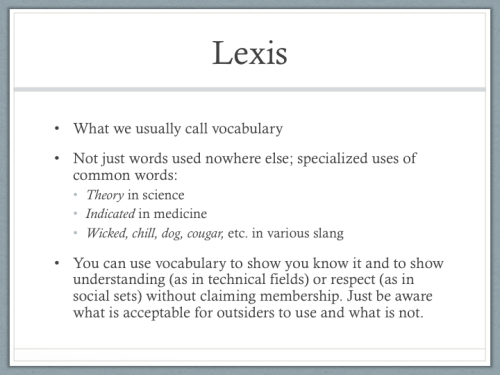
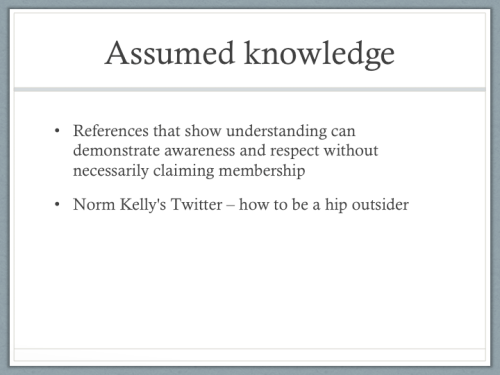
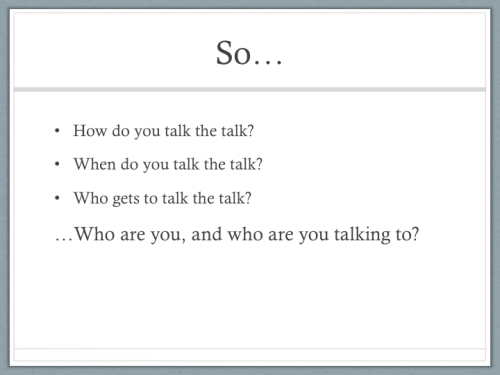
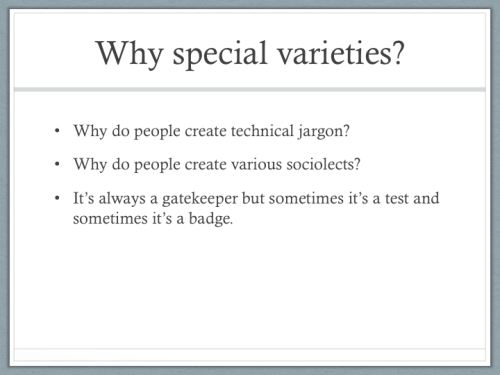
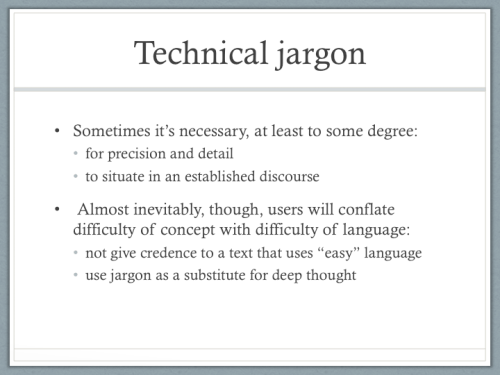
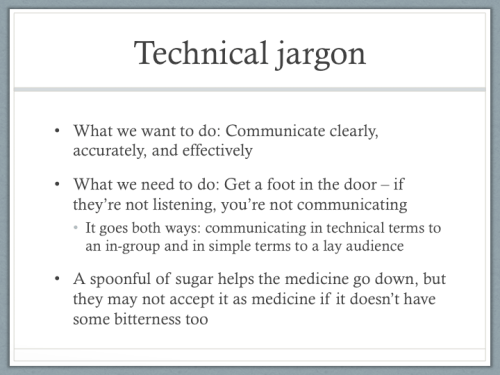
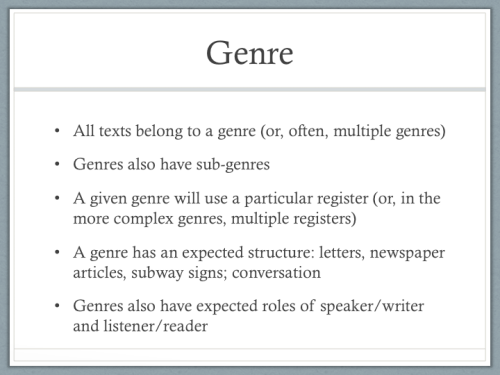
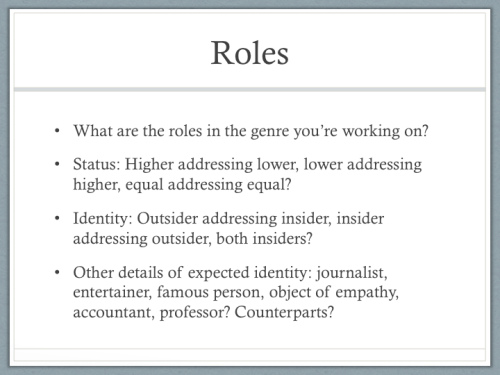
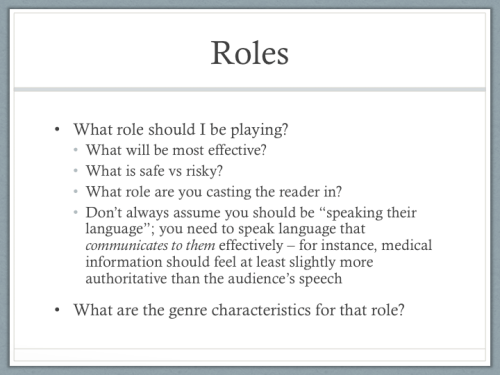
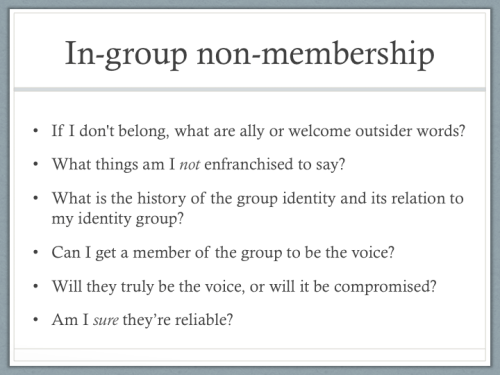
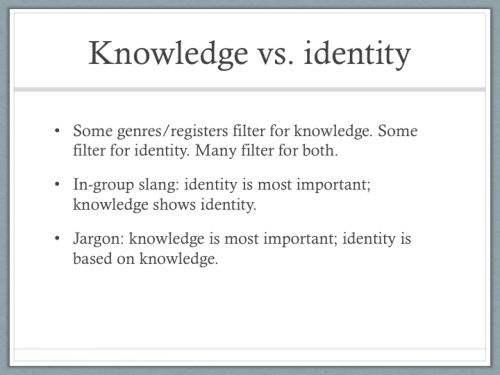
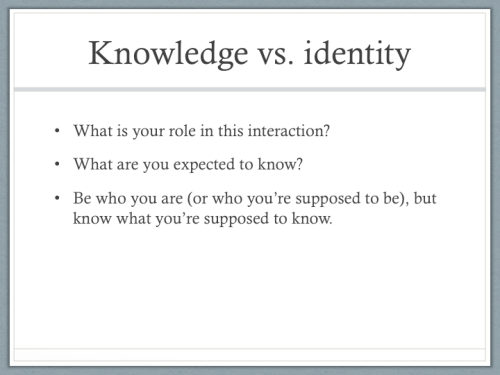
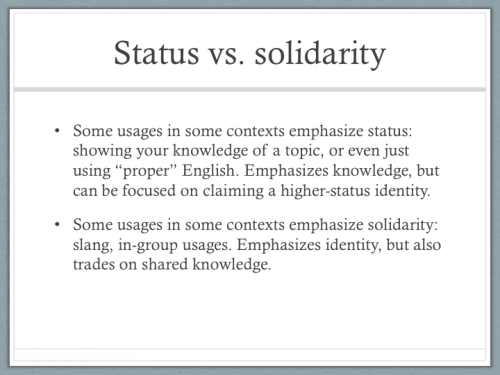
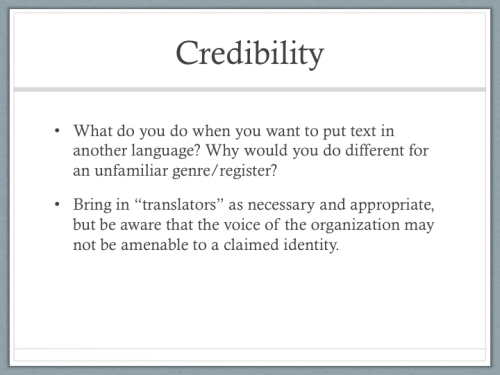
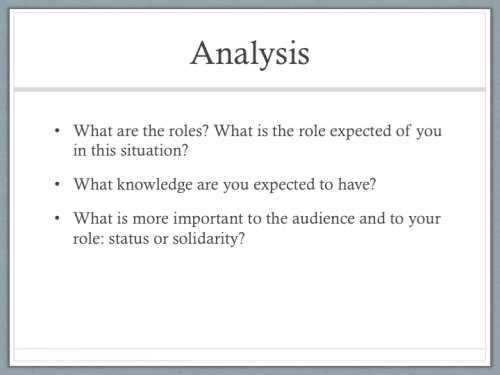
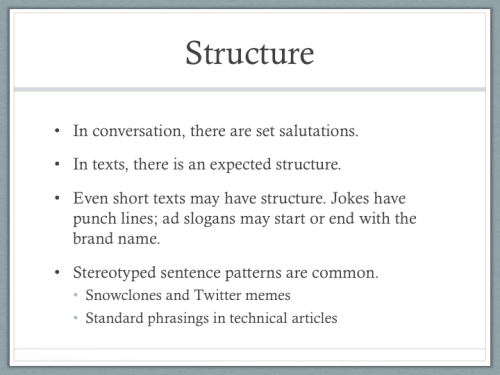
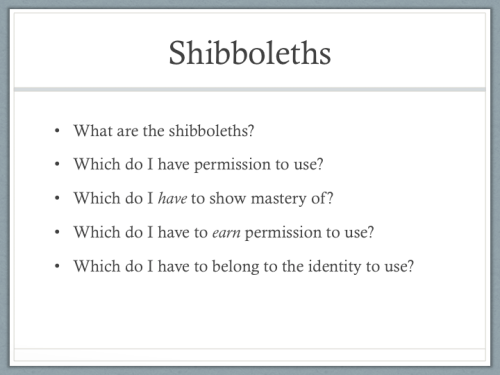
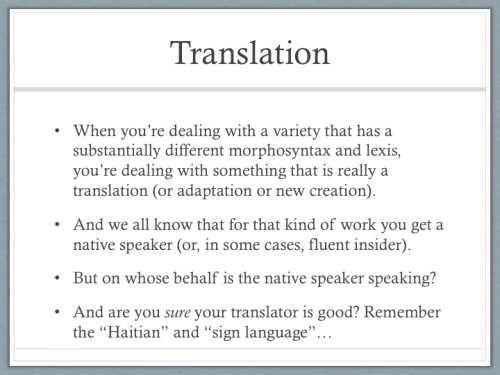
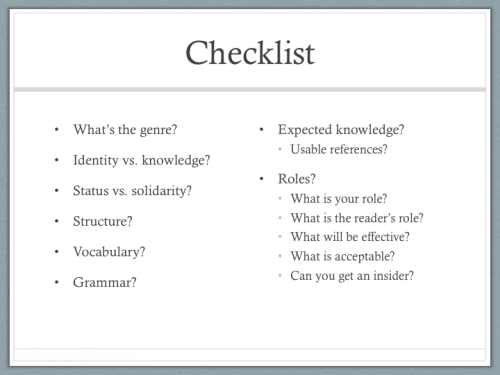
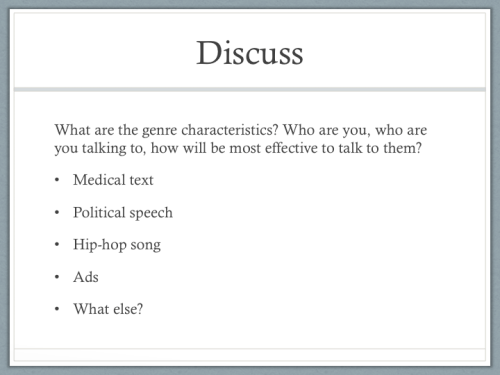
Who are you, and who are you talking to?

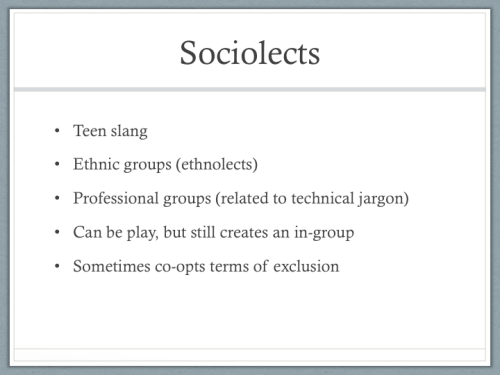
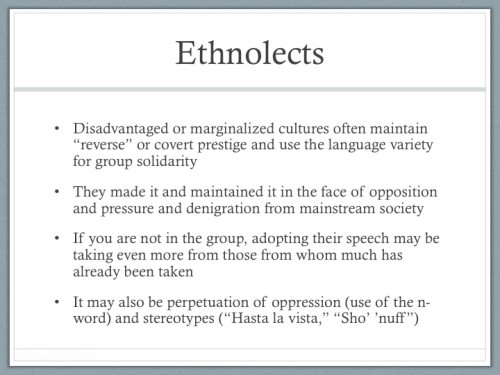
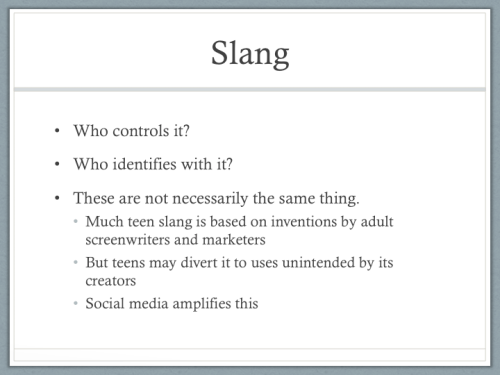
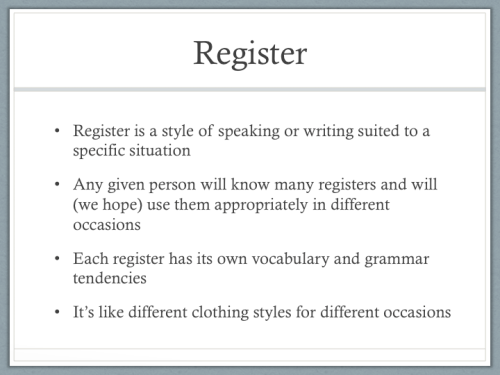
Here are the slides from my presentation at the 2016 Editors Canada conference. I didn’t have a separate script, and I neglected to record myself presenting, so this is what there is to give you, but it covers the points; my speaking was generally expansion on the points.

Here is the whole show, downloadable: harbeck_who_EAC_201606

Here are the slides, one by one.

Slide01

Slide02

Slide03

Slide04

Slide05

Slide06

Slide07

Slide08

Slide09

Slide10

Slide11

Slide12

Slide13

Slide14

Slide15

Slide16

Slide17

Slide18

Slide19

Slide20

Slide21

Slide22

Slide23

Slide24

Slide25

Slide26

Slide27

Slide28

Slide29

Slide30

Slide31

Slide32

Slide33

Slide34

Slide35

Slide36

Slide37

Slide38

Slide39

Slide40

Slide41

Slide42

Slide43

Slide44

Slide45

Slide46

Kicking ass and taking names is useful sometimes

A colleague was wondering about a construction on the order of “Multiplying the number by 9 and adding the digits together give you a multiple of 9.” Does that sound odd to you? It did to her – she wanted it to be gives, not give. And yet the subject is two things: multiplying … and adding … So shouldn’t it take a plural conjugation, give?

It shouldn’t because it’s one action, multiplying and adding – a compound noun phrase that is nonetheless a single entity because it is a single complex action rather than two separate actions. If it’s two different possible actions – i.e., you can multiply or you can add with equal effect – then it’s plural. Parallel examples:

Kicking ass and taking names is my favourite Saturday evening pastime.

Kissing ass and taking bribes are both ways of getting ahead in business.

It’s similar to how we can say “The hop, step, and jump is the silliest track event,” not “are.”

When in doubt, though, or concerned that some readers may prefer singular while others prefer plural, you can always avoid the issue by using an auxiliary (or, as possible, a past tense), which conjugates the same either way:

Multiplying the number by 9 and adding the digits together will give you a multiple of 9.

In case you’re wondering, it’s a callow mistake

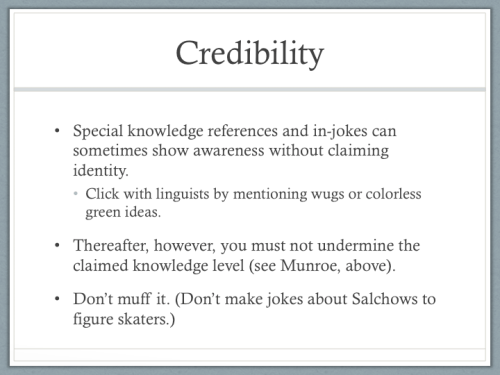
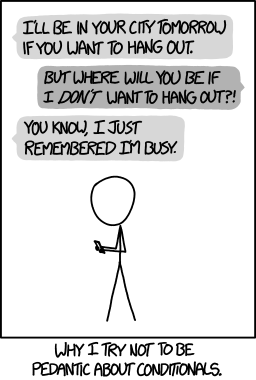
A recent cartoon from Randall Munroe’s xkcd, which is the most intelligent cartoon in existence, has been brought to my attention. You can see it at http://xkcd.com/1652/ but, since Munroe gives permission, I’ll reproduce it here for ease of reference:

This interpretation is not just pedantry and not just a turn-off. It’s a callow mistake.

It’s callow because it transgresses standard expectations of interpersonal decency in conversation – if the other person is using a common turn of phrase and you understand what they mean, don’t be a dick about it (or, as I put it in a haiku for the ACES Grammar Day haiku contest, Which do you prefer: / keeping your friends’ grammar right / or keeping your friends?). But it’s also callow because it imposes an inappropriate misreading, the sort of simple-minded overbroad application of a rule that is characteristic of an immature understanding of grammar. The clause in question, you see, only looks like a conditional.

I’m put in mind of an anecdote I recall from the actor Simon Callow. When he was first trying to make it in theatre, he worked in the box office of a theatre. Later on, when he was becoming established as an actor, he was in the cast of a play that happened to be performing in the same theatre. One evening before a performance, one of the box office staff saw him and, thinking he still worked in the box office, asked him to come help with some box office function.

Thinking this if you want to hang out is a conditional is like thinking Simon Callow still works at the box office. It’s the same clause, but it’s been elevated. It’s a sentence adverbial.

In case the term isn’t familiar, a sentence adverbial is a word or phrase that, within the ambit of a verb phrase, could serve to modify the action of the verb, but that is instead applied to the entire sentence to frame it within a discursive context such as the attitude of the speaker or writer towards the utterance. “Frankly, Scarlett, I don’t give a damn” uses Frankly to mean ‘I speak to you frankly and say…’; “Among other things, this book explores the concept of silliness” uses Among other things to position the following statement within a larger possible set of observations (‘There are various things this book does; one of them is that…’); “Going forward, we’ll do it this way” uses Going forward to mean ‘I am making a prescription that applies to future instances when I say…’. They do not mean, respectively, that Rhett doesn’t give a damn frankly but he may give one covertly; that the book only explores silliness when the book is among other things; or that we will do it this way only when we are progressing ahead. And In case the term isn’t familiar doesn’t mean the preceding applies only in the case where the term is unfamiliar. It means I’m saying it in anticipation of the possibility of unfamiliarity.

Because sentence adverbials use words and phrases that can be used to different effect at lower levels, they are like candy to immature minds who are eager to pounce on other people’s “errors” to show their superior knowledge. But, as with so many rigid “rules” propounded by people who claim to care about grammar but really care mainly about demonstrating superiority, the “pedantic” interpretation is founded on a simple-minded misunderstanding. We have no difficulty understanding the sentences as they are intended – the pedants don’t even have the excuse that the box-office employee (who evidently didn’t read the programmes) had. The most they can argue is that the sentences are ambiguous. That can be something worth fixing, but it’s not a grammatical error. And they’re not always ambiguous, either. We usually understand them with no risk of confusion.

To add another analogy: When I was in New Zealand, I rented two different cars on separate occasions. In New Zealand they drive on the left, and so some of the driver’s controls are also the reverse of what I’m used to. With the first car, I managed to get used to the turn signal being on the opposite side from what I expected. Then when I rented the next car it was a model with the turn signal on the North American side. So I had to get used to it again and not keep turning on the wipers when I wanted to turn left or right. But in all of that, I did not say that the controls were wrong and I was right and stick to my preferred sides. I did not insist on turning on the wipers when I wanted to turn off the highway – or on signaling a turn when I wanted to wipe the windshield – because those were the correct sides for the controls to be on. I did what worked. When my expectations did not correspond with the results, I corrected my perspective. Which is what those who care about understanding language must do if they do not wish to be wrong.

So this pedantry is both a turn-off and a callow error.

Which, of course, Randall Munroe knows. He also knows that linguistics isn’t his area of expertise, and I’m not going to hold it against him for missing the analysis. He’s not the only one.

More honoured in the breach or the observance?

Originally published on The Editors’ Weekly, the official blog of Editors Canada

It is tempting to say that getting classical quotations right is more honoured in the breach than the observance. But if we did, we’d be guilty too. In the original, Hamlet is telling Horatio about the tradition of drinking sprees in the Danish court; he says it makes Danes look bad to other nations. So when he says

But to my mind, though I am native here
And to the manner born, it is a custom
More honour’d in the breach than the observance

he doesn’t mean they don’t do it; he means they shouldn’t do it. Honour’d here means ‘honourable’, not ‘complied with’.

Sometimes our errors come from shifts in culture. In a time when fires were the main source of heat, for instance, a fire that burnt bright but didn’t give off much heat was not much use. So when Polonius advises Ophelia to watch out for the ardor of young men (such as Hamlet), he uses this metaphor:

I do know,
When the blood burns, how prodigal the soul
Lends the tongue vows: these blazes, daughter,
Giving more light than heat, extinct in both,
Even in their promise, as it is a-making,
You must not take for fire.

These days, we use light as a positive metaphor in conversation, and heat more often as a negative one, so people often say a topic generates “more heat than light” – quite the reversal from the original.

We may look on such misinterpretations and say “Now is the winter of our discontent” with cultural knowledge. But we would be stopping short; here’s the whole opening sentence of Richard III:

Now is the winter of our discontent
Made glorious summer by this sun of York;
And all the clouds that lour’d upon our house
In the deep bosom of the ocean buried.

So he’s saying that their unhappy period is now made happy by the new king. (Admittedly, the man who is saying this is not happy about the state of affairs.)

Sometimes we just get a word wrong, perhaps because another word seems to go better with it (and another author, perhaps). We play our cats to sleep and say “Music has charms to soothe the savage beast” – and think it’s from Shakespeare – when the original is from William Congreve’s play The Mourning Bride, and it’s “Musick has charms to soothe a savage breast.”

Now, why not use a popular variation when appropriate, right? But we’re editors, and part of our job is to keep writers from looking bad, which means we have to take a do-or-die approach to quotations. Or, um, well… Tennyson’s original in “The Charge of the Light Brigade” is as follows:

Theirs not to make reply,
Theirs not to reason why,
Theirs but to do and die

Do and die? Perhaps we would do better to quote Yoda: “Do or do not. There is no try.” Just as long as we get the wording right.

Sentence fragments? If you like.

As I sometimes do, I guested into a friend’s online copyediting course as a grammar expert for a week recently. One of the questions I answered was about whether “If you like” is acceptable on its own in any context. The questioner felt that in a conversational context it was acceptable (“Shall we leave at noon?” “If you like.”). Another student said that it doesn’t work because there’s an if but not a then. I said the following:

There are a few important things to remember.

First is that there are many kinds of English, suited for many different situations. To insist on standard formal English in all contexts is like wearing formal wear every day all the time. To use formal English in colloquial contexts doesn’t bespeak class and elegance; it bespeaks tone-deafness and rigidity. Rules are made to serve communication, not vice versa. Get to know the kind of English that is expected and used in each context you’re writing for. The point of editing is to make sure that the text produces the desired effect on the readers. Your job as an editor is to minimize the impedance in the circuit between author and audience. This often involves fixing infractions of rules, but not always. Indeed, sometimes the way to signal the tone of the text is to break a formal rule.

Second is that even in formal standard English, there are many things that are matters of preference, not rules.

Third is that not everything you do with language is a matter of grammar. Spelling mistakes, for instance, are not grammar errors. Neither are malapropisms. They’re errors, but they’re different kinds of errors (and in fact are the kind you can make sure to fix everywhere regardless of the tone and audience).

So, for instance, if as in “I want to know if you’re in town” is not a bad habit you need to cure yourself of for once and for all. The colloquial use of it where whether is the formal standard is very well established, and for some texts using if in place of whether will be the sort of little adjustment you can make to make it seem more relaxed. Bear in mind that “If you’re in town, I want to know” is acceptable even formally (the then can be and often is left out), which means that in the same sense, “I want to know if you’re in town” is also formally acceptable to mean “Let me know in the case that you are in town.” This, I believe, is why it has come to be used in the other sense, “Let me know whether you are in town or not.”

A very common mistake made by people who are eager to be right about grammar is to infer an absolute rule from one case, or to take a rule as learned overtly and apply it too broadly, declaring many common usages to be wrong because they don’t fit it. This is like pulling out a field guide to birds, looking at the picture of a magpie, deciding that all magpies must exactly resemble the exact specific colouring of that picture, and declaring any that don’t not to be magpies (and perhaps repainting or just killing them).

The effective approach is to read widely, see what kind of usages are common in what kind of contexts, and figure out the real rules on that basis. Often the real rule is not so simple and clean-cut; some things that are perfectly standard formal English still provoke arguments among linguists as to their actual grammatical structure.

To address a specific question: “If you like” by itself is a “sentence fragment” because it uses a subordinating conjunction (“If”) without a main clause to be subordinate to. But that doesn’t mean it can’t be used; we use sentence fragments all the time (I won’t say “The more, the merrier,” but if I did, it wouldn’t have a verb!). Only in the starchiest of contexts is it necessary to avoid starting sentences with conjunctions such as But and And, and in those cases only because some people in the past decided to repaint the magpies. In conversation, it is quite normal to leave out established material, especially in responses: “Shall I join you?” “[You can join me] If you like.” In more formal texts, where it is a monologue, not a dialogue, and is expected to convey clearly the logical connection, you would just use a single full sentence: “You can join me if you like.” (I’m not going to wander into the can/may argument here, but here is a full article on things many people think are errors that aren’t: sesquiotic.wordpress.com/2008/12/04/when-an-error-isnt/)

An important step on the way to being an expert user of the language is to read authors you respect in as many different genres as possible. Learning cut-and-dried rules and trying to apply them as broadly as possible won’t make you an expert user; in fact, you risk destroying your ear for the language. You need to be able to hear and read it as your readers will. You won’t be in a position to give them lessons in how to hear it the way you’ve learned to.