Category Archives: from the bookshelf

to craunch the marmoset

I have something special today. A special book from my bookshelf – well, aren’t they all – but this one calls for a special lens on my camera to photograph it.

The lens is an ordinary enough lens by description: 50mm f/2. There are quite a few of these out there, and 50mm f/1.8, and 50mm f/1.4. The f/2 maximum aperture may stand out for some because two of the most revered lenses in photography, the Leica Summicron and the Zeiss Sonnar, use it.

This lens is not one of those.

Not quite. After World War II, the Russians and their proxies took over some German lens factories and their designs, though not necessarily their production standards. This lens is a Russian copy of a Zeiss Sonnar. It’s called Jupiter-8. It cost me well under $100 on ebay a couple of years ago. It’s uncoated, prone to flare and not very contrasty, and tends to do interesting things with colour, especially when I adjust the files to recover some contrast.

Which makes it a favourite of hipsters. In fact, a remake of it is now being released. I’m not sure why; you can still get an original for well under $100 on ebay. But whatever. Some people like to revive old, questionably made translated copies. They have some charm, after all.

Now. Let’s look at my bookshelf. The part in the corner behind the chair. As you can see, it’s so full I have started stacking books in front of the standing books.
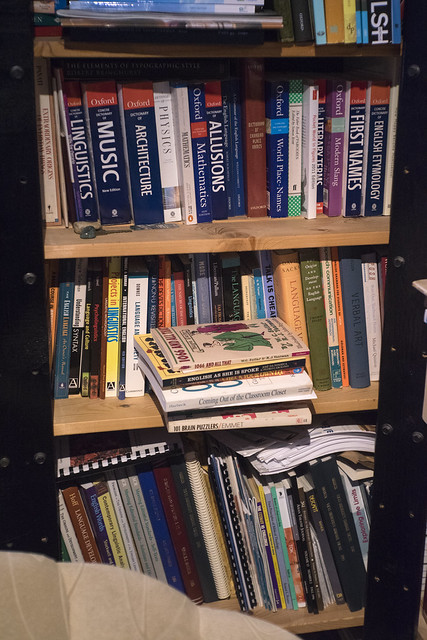
Here’s the one I want. It’s a reprint of a classic that I first read about years ago.
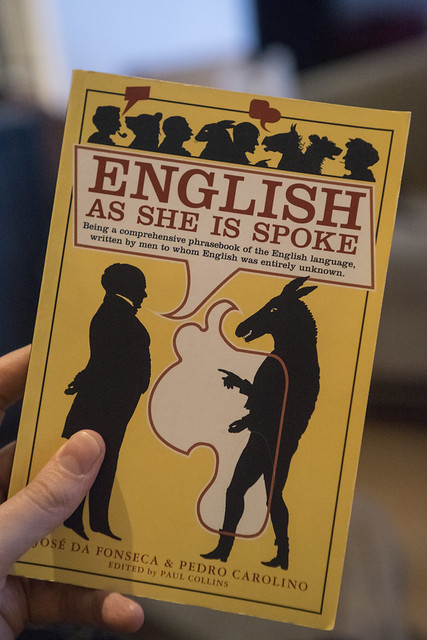
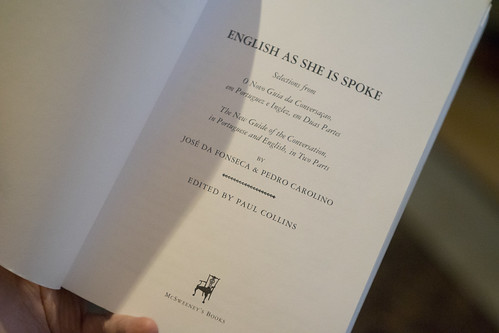
The author, Pedro Carolino, set out in 1855 to make an English phrasebook for Portuguese speakers. He was a native speaker of Portuguese. He did not speak English at all. He also did not even have an English-Portuguese dictionary. But he did have a French-English phrasebook and a Portuguese-French dictionary. Why wouldn’t that work just fine, eh? Find the equivalent word and slot it in.

Ha ha ha.

It was so classically awful, Carolino had made himself the Ed Wood of translation. The book was subsequently reissued under the title English as She Is Spoke for the amusement of all and sundry.

How bad is it? Here, read.

You see, it’s not just that the translations are awful, it’s that some of the things that are being said are quite iffy too.

The crowning glory, however, is the last section.

And its greatest moment, surely its most quoted line, comes at the very end of this edition.

To craunch the marmoset.

This may sound like something one does at brunch, but it is presented as a translation of Esperar horas e horas, which means ‘To wait hours and hours.’

So we have three questions. First, what is craunch? Second, what is marmoset? Third, how on earth did he get from Esperar horas e horas to To craunch the marmoset?

Number one, then: craunch. Does it sound like crouch? Understandably, but that’s not quite it. How about crunch? Yes, there we are. It has alternate form cranch, which has related form scranch, which has 16th-century Dutch cognate schranzen ‘split, break’, which has become modern Dutch schranzen ‘eat greedily’. To craunch a marmoset means the same as to crunch a marmoset.

Number two: What is a marmoset? It is a small simian, a funny little long-tailed monkey. Johnny Carson had one of his classic moments on The Tonight Show when one of them relieved itself on his head:

Does marmoset sound like it should be a marmot or some similar rodent? The words marmot and marmoset are almost certainly related. A marmot is, in French, une marmotte. The word marmot now refers to a small child, but it used to refer to a monkey. Both words seem to come from the same root as murmur, though it’s not entirely established (but it may be spoken of quietly). The diminutive form of marmot came to English as a name for this little monkey, marmoset.

They don’t call marmosets marmosets in French, though. They call them ouististis, a word formed in imitation of a sound they make. That word shows up in an idiomatic phrase as well: un drôle de ouististi. I am assured by my Collins Robert French-English dictionary that that means “a queer bird” – I suspect we would now say an odd duck to mean about the same thing.

Speaking of idiomatic phrases, if I open my Le Robert Mini, which is entirely in French, I find at marmot that there is an idiom meaning “attendre longtemps” (‘wait a long time’): croquer le marmot.

Remember how Carolino made his book? He used French as an intermediary.

Having found that croquer le marmot meant, in Portuguese, esperar horas e horas, what remained was to translate it into English: croquer became – well, it should have become crunch or munch, but I guess he liked craunch better; marmot became marmoset, because marmot could be translated thus as easily as croquer could be translated craunch (and anyway it didn’t mean ‘marmot’ in the English sense of ‘big squirrel-like critter’).

This, however, leaves us with another question: What does crunching a marmot or marmoset or monkey or small child have to do with waiting for a long time? Does it just take hours to eat one?

I’ve gotten the answer from a couple of handy French reference sites. The first is the eminently useful Wiktionary. The second and more detailed on this point is Expressio.fr. Both of these are in French, so I will just tell you the answer here in case you don’t easily read French or can’t be bothered. In times bygone (up to a half millennium ago), doorknockers on French dwellings (that had them) were often done in the style of grotesque figures like monkey heads, and so they came to be called marmots. In that same time period, croquer was used to mean ‘knock, hit’. So croquer le marmot meant ‘knock at the door’, and by implication ‘stand outside the door waiting and knocking’. And thus ‘wait hours and hours’.

At last. I bet you’ve been craunching the marmoset for that little explanation, eh? Well, it’s one for the books now, by Jupiter.

Stoney

Books you’ve had for a long time may seem like a trip down memory lane. But a book is more than a lane, especially if it carries an important part of your formative years. It’s more of a memory neighbourhood. Smetimes when you visit it you notice that it’s still a living neighbourhood. And sometimes as you step into the houses you find the foundations… of your present life and world. You open the cover, leaf through the pages, and see that it is part of how you learned to see. And what you learned to see.

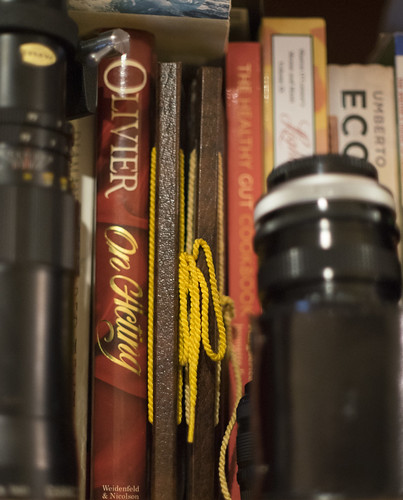
I have two copies of a very special book. The book was printed in a limited leather-bound edition in 1980. One copy was given to me, signed, in 2003. The other belonged to my grandmother, and so, like my full set of Encyclopedia Britannica, it came into my possession. They are up behind some of my other ways of seeing, new and old. I need to remove a lens to see it more clearly.

Not a metaphorical lens. That Canon 135mm f/2.5 lens. (Ironically, I grew up using my father’s Nikon F2. The Canon equipment, though of similar age, came into my possession in more recent years.)

Do you see them now? Two leather-bound books with ornamental laces? Here, let me take one down and set it on the table.

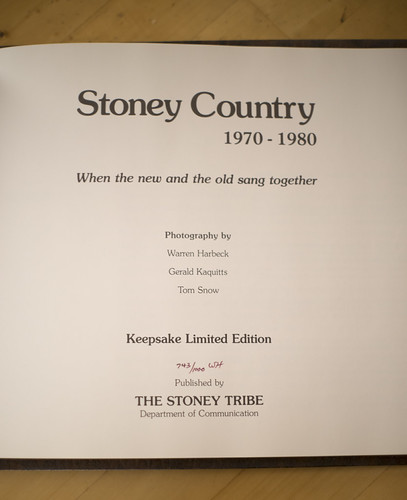
Stoney Country, 1970–1980.

Is this a rocky land? It is a land near the Rocky Mountains. But though the country may be stony, and often dry and dusty and cast in the colours of cover and table, Stoney is not a description of it, not directly. It is the English name given to that people who live there. They call themselves Nakoda. Where is there? Morley, Alberta, Canada. The Stoney Indian Reservation (that’s still the official designation). If you saw The Revenant, you saw some of it, because much of the movie was shot there.

But I saw even more of it. Because I grew up around there.

I saw this sign every time we drove back home from Calgary on the Trans-Canada Highway.

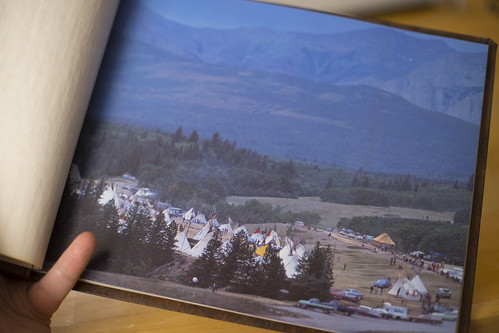
This is a lovely book, many images, few words. It has sheets of parchment every so often with a few more words. When you open the book, the first photo you see is half-seen through a sheet of parchment, like a palimpsest.

Like a memory that is still there in full vividness when you turn the page.

If your memory seems like parchment, it may be that it is parched and needs water. Or it may be that you just need to turn the leaf.

As I leaf through this book, I see picture after picture of what I remember from my childhood.

Teepee encampments in the summer. Real teepees, not fake ones set up by tourists looking for some “authentic” experience. Ways of living, set up in the summer as a retreat from their houses. Flip aside the flap, stoop down and come in, greet everyone one by one, have a cup of tea, sit and talk.

Or, if you were me, sit and mostly not listen and mostly not understand. We, not being Stoney, spoke English at home, but my parents – especially my father – spoke Stoney and had long conversations. I looked at the fire. I played outside. Sometimes I played with the other kids.

Sometimes we went to the rodeo.

One time I even – in a small paddock by the house of one of our neighbours on the reserve – tried riding a calf. I’m not sure I lasted two seconds before ending in the dirt. At the rodeos I just watched, or didn’t watch, and maybe played or got some food. Tea, bannock. (A culinary ethnologist could be forgiven for thinking at first that the Stoneys were a lost tribe of Scots.)

Then I got older and didn’t join my parents to these things as often. Looking back, it would have made more sense for me to have learned the language. But little kids never really enjoy adult conversations, do they?

But the mountains don’t go away. None of it goes away. I went away, but it didn’t go away from me. Look, here is the mountain we lived at the foot of for five of my most formative adolescent years. Yamnuska.

The book closes with a traditional Stoney benediction. I’ve heard it spoken so many times. I’ve even said it aloud a few times myself. Next to the benediction is a picture of crocuses growing on the shoulder of that same stony Rocky mountain. Crocuses like we used to pick when I was a small child.

It is the country of the Stoneys, so it is Stoney Country. It is also stony country with rocky mountains. And I, having grown up there, am a child of those stones. Having been born there, to parents who had been accepted as part of the community, I was given a name: Îpabi Daguskan (or, as it sounded to my young ears, “Pobby Dowscun”). It means Son of Rock. Or, I guess, Stonechild.

Perhaps it’s fitting, then, that I have ended up with two copies of this book. This one is number 743 of 1000, initialled at the time of publication by the person who did much of the work putting it together, who took me to the production shops where I first learned about CMYK offset printing, who photographed so much of it with his Nikon F2.

My dad, of course. (But the snowy photo above was, fittingly, by Tom Snow.)

I haven’t really talked much about this word Stoney, have I? Not directly. But what you see above is some of how it tastes to me.

Oh, and this. The theme music from a multi-media show about the Stoneys my dad did in 1977 (using, among other things, some of the same pictures). It wasn’t written for that, but it was perfect, and the singer – Lobo – let it be used. Let’s play this video of it for the closing titles today, shall we?

vermiculated

It is time once again to turn to my bookshelf, that great pile of paper. What once were trees (and, in the finer cases, linen) are now paper with marks on them and will at some future time be dust or soil or ashes or the turds of worms. All our knowledge is written on fertile soil, and the seeds of future trees of knowledge sprout in it, but it must be aerated by those lowliest of crawling things. Perhaps you and I, too, are the worms of the world: bookworms digesting words with our minds only so that the spaces we have left may make the field more fecund.

I do have a lot of books, along with some other ways of seizing the transient images of the world.

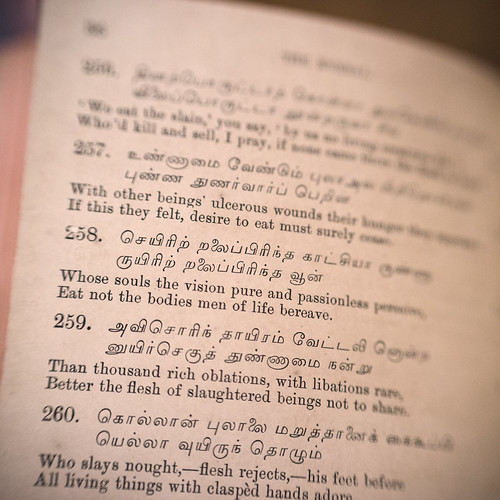
In the heart of that photo is a book I got from a bunch that had been in a box in someone’s basement or attic in India. I still have never read it through, though I have sampled it.

It looks like a book of recipes, doesn’t it? And it is – but it is recipes for living, and food for thought.

It is moral guidance in Tamil. By an author whose name looks oddly Tolkienian. With English translation.

The English translation is in rather stiff rhyming couplets. I cannot comment on the quality of the original, but, as the book is revered, I rather suspect it counts as elegant because it helps set the standard for elegance – somewhat as, say, Shakespeare does for English. Shakespeare’s usage is archaic, of course, and poetic, and so we revere it for that, but we also take it for its aphorisms, sometimes somewhat changed in modern times. Here’s one: “The smallest Worme will turne, being troden on.”

And what will the worm turn? How about the pages?

How can a worm turn pages? Simple. It turns them into worm turds.

This book is vermiculated.

There was another book in the bunch that was so thoroughly digested it could not be kept. This one has been sampled by bookworms, but the substance remains. You can see the little traces like shredded vermicelli in the negative.

You did know that vermicelli means ‘little worms’, right? Well, enjoy your next plate of it. It’s still among the most delightful of pastas. Think of it as being the strings from some violoncelli instead.

The verm in vermicelli is of course the same as the verm in vermiculated – and, yes, the verm in vermin too, though that has shifted in sense (and in sound when you say varmint). The sum of vermiculated means (as a past participle) that it has been affected (ate) by little (icul) worms (verm). Ickle worms ate it, to be exact. All of it? No, but enough to articulate vesiculations in it.

Are these profane worms? Do they profane the words? They do not eat the bodies men of life bereave, but do they eat the minds? Or just the traces of the minds? Are books more than the fertilized soil left behind by a mind, enriched by the excretions of thoughts? And on their way to become soil again? If so, what are these bookworms except precocious?

And will they turn again?

ka

Today’s word is very useful for Scrabble players: its form fills an important function, allowing a word with a K to be played alongside a word with an A to connect two words. It can give a shot of life to an ailing rack. Scrabble players of a certain level are likely to use it as often as once every three or four games. It has a certain kinetic something to its form, too, the angularity of the K and the A, each made of a rotated V plus a cross-stroke: angular, hard, but moving.

But what does it mean? Ah, well, now, I’m glad you asked. Allow me to turn to my bookshelf, to a section that has a miscellany of books not otherwise categorized.

There is a book I bought when I was 11 years old. I bought it in the Banff Book and Art Den on February 11, 1979, for $8.95 (marked down from $12.50). Oh, no, my memory is not so good as all that. The book still has the receipt in it. That’s how I remember things: with persistent concrete objects.

Which book? Why, this one, of course:

The Egyptian Book of the Dead, taken from the papyrus of Ani, with translation and commentary. At that time, I had something of a fascination for Egyptology, fostered in no small part by a copy of this book that I had found in a school library.

The truth is that what I really liked was not so much the myths and practices of the Egyptians as their writing, the hieroglyphs. The book has the original hieroglyphic text, sometimes with interlinears. The library copy also had transliterations; this copy, alas, does not. But look, all those iconic representations, a code, so exotic, carrying some meaning – but what? The form has persisted, but the sense? Lost for a long time until the discovery of the Rosetta Stone, which had the same text in Greek, demotic Egyptian, and hieroglyphs. A parallel text! It came back to life, reaching out to us across the millennia. And among the Egyptian words that gained a new spark of life was ka.

The Official Scrabble Players Dictionary defines ka as “the spiritual self of a human being in Egyptian religion.” This is not quite accurate. What we would think of as the spirit or soul was the ba, the personality that went to the afterlife; it was depicted in hieroglyphs as a sort of bird. The ka was a vital spark, distinct from the body but living in it while the person lived. And after death? The ka roamed as it wished, but it could be given a statue of the person to dwell in – a persistent memorial, a concrete (stone, really) object. It had to be given food, however; if there was none, it would wander in search of it, and might even die.

Its hieroglyph was two arms extended as if to embrace someone.

In a way, then, we might say that the ka is meaning. A word, like a body, is form. While a word is in use, it has that thing that animates it, that sense. If a word passes out of common use, it can be maintained in a stiff, memorialized form, brought out and venerated as needed, as thou may be. We can still maintain an understanding of its meaning if we feed it some thought every so often. But it can also wander away to take up residence elsewhere. And if we simply run out of a need for the sense and stop thinking of it, it can die.

Does that seem like a bit of a reach? Well, so is the ka. Like meaning, it always reaches out. It is the will to connect, and it does not depart as easily as breath or birds.

gey

Today has been Rabbie Burns Day, the 257th anniversary of the birth of Robert Burns, the poet. I did not have haggis (my wife can’t abide it), but I’m having a wee (or not-so-wee) dram of Scotch as I write this. I’m celebrating, but more about that anon. I’d like to toast dear Rabbie with a toast that was probably written after he was under the turf: Here’s tae us! Wha’s like us? Gey few, and they’re a’ deid!

This is best translated into standard English as “Here’s to us! Who’s like us? Damn few, and they’re all dead!” But gey does not mean ‘damn’. It means ‘very’ or ‘rather’ or ‘pretty’ (in the intensifier sense). Gey few means ‘rather few’ or ‘a good few’.

This is Scots, of which there is more than one variety. I don’t have any books on the Ayrshire dialect of which Burns was a native speaker (and anyway he was a native speaker of the 18th-century variety), but I happened to acquire an entertaining book on another dialect at some book sale or store or honestly I can’t even remember. It’s hiding on the top shelf of my dictionaries and phrase books.

It’s not very big; you can barely see it between the Czech and the Dutch. Here it is in my kitchen.

This is an entertaining, charming book, replete with cartoons. It is meant to be amusing, but it is at the same time accurate – it’s not taking the piss; it’s written by someone who grew up speaking the Doric dialect.

Doric, to me, always meant one of the orders of classical architecture. It was the one with the boring columns (Ionic had the curly capitals and Corinthian had the leaves). But this Doric is a dialect of Mid Northern (aka Northeastern) Scots. Here’s a Wikipedia article on it: https://sco.wikipedia.org/wiki/Doric. Oh, sorry, that’s in Scots. Try this one; it’s in English: https://en.wikipedia.org/wiki/Doric_dialect_%28Scotland%29. Anyway, if you’ve ever tried to understand someone from around Aberdeen, Doric is what you were up against. Scots is its own language, split off from English centuries ago, but as it is, because it looks somewhat recognizable to English speakers, we kid ourselves that we should be able to understand it, and some people still mistakenly believe that it’s just a regional variety of English. Well, Swedes and Danes understand each other, generally, sorta, and there’s about as much difference between Swedish and Danish as there is between Scots and English. The Doric dialect, as it happens, is named after the Greek area, apparently because the Scots were being compared to Spartans.

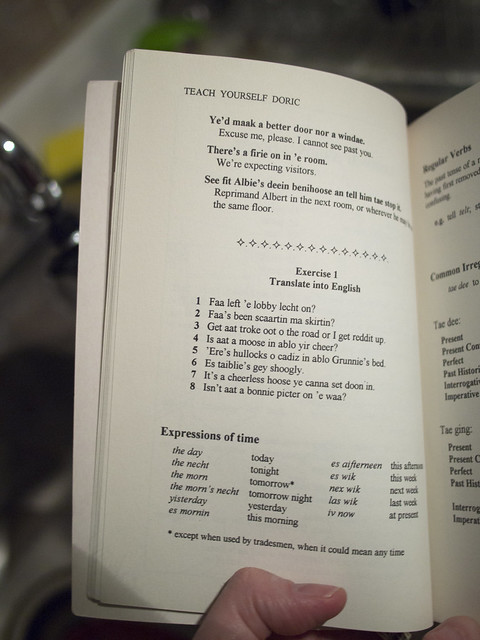
Here’s a page from that fun book:

At the top you see the end of a “Useful Phrases” section, including such as “Ye’d maak a better door nor a windae,” dryly translated as “Excuse me, please. I cannot see past you.” The translations assume you can figure out the literal translation (‘You’d make a better door than a window’, which is also a common phrase used by Canadians, usually addressed to school-aged youth who haven’t figured out where not to stand). But look a bit farther down the page and there’s this nice line:

Es taiblie’s gey shoogly. It means ‘This table is very wobbly.’ And so here is our word of the day, gey. Shoogly would be a good one too, but it can wait.

Whence comes gey? The Oxford English Dictionary is helpful on that, since the word is fairly widespread, not only in Scotland but also in Ireland and northern England. It comes from the same source as English gay – you could say it’s another version of the same word. English gay came into the language meaning ‘bright, brilliant, lively, showy’ and also from that ‘happy, light-hearted’. More than a century ago (just how long ago is unclear because it was surely used orally long before it showed up in the printed record) it came into use to refer to men preferentially attracted to other men, and that usage has become the supervenient one now, at least in part because so many people who aren’t homosexual avoid using it lest they be mistaken for such. The long history leading up to that usage is a whole other story that I’m not going to spend time on today just because gay isn’t the word of the day. Gey is. And gey went from a specific positive to a general intensifier (like very, originally ‘truthfully’; damn, short for damned and you damn well better know the literal meaning of that; and more modern colloquial usages such as wicked).

What was the source from which gay and gey came? French gai, which meant and still means ‘happy, cheerful’, and a variety of extended senses. The history before that is surprisingly complicated but apparently involves Old High German. Yes, even the Old High Germans could be happy. And the French of course know quite well how to be happy. The interjection o gai or just gai can be heard in some French folk songs such as “En montant la rivière” and even the Breton “Tri martolod.”

So, now. What cause have I to be happy and drink a toast today? Aside from good auld Rabbie, of course (and for more of him, spin back a few years to my vignette on skirl). My cause to be happy is just this: I have finished the first draft of a thesis. So let’s have some whisky already!

stardust

Back behind the big plush chair in the corner, down on the bottom shelf at floor level, next to the large-format comic anthologies, stuffed in and rarely touched these days, are my books of sheet music.

I’m going to pull out two of them by the same artist. I don’t own much rock sheet music but I own these. I bought one in Calgary in a long-gone music store in Brentwood Mall, near the university, if my memory doesn’t betray me. I know exactly when and where I got the other one: in the summer of 1984 in a music shop in Montreux (on the Lake Geneva shoreline – the shop was a few blocks uphill, though). It was one of my biggest splurges in a summer spent at a conference centre up the mountain in Caux.

It’s the left-hand one.

Really, who else did you think I would be talking about today?

Yes, of course I’ve been a fan of David Bowie for a long time. From the time a high-school classmate drew my attention to him, I latched on and never really let go. Not that I always listened to his stuff all the time; I still don’t own all his albums. But Bowie had talent, and he had presence. Animal grace. Screwed-up eyes and screwed-down hairdo. Those canine teeth. Eyes of two different colours that could stare for a thousand years. And that voice. Not the voice of a great singer. The voice of a great presence.

At an age when one wants idols, I easily devoted myself to Bowie. I even prevailed on my brother to go with me to a rerun of the Ziggy Stardust concert movie when it was showing in Calgary. I am quite sure my brother did not enjoy it as much as I did, so it was very sporting and brotherly of him. Bowie did not represent to him someone he would want to be like. To me Bowie was a doorway, a gateway, a stargate. I was under no illusions; I knew he had weaknesses, imperfections, an eggshell of humanity, his presence a performance that even he didn’t fully buy into. But that’s why I liked him. He was a star, a starman, come from the stars, fallen to earth.

Just like the rest of us. But he knew it.

Look at this book. I haven’t opened some of these pages in decades now. As I flip through I have to peel them apart here and there. It was in some damp place somewhere for some time, I guess: it has these dark patches. Age has grown into it.

I’m listening to “Suffragette City” as I write this. It’s one of the best high-school dance songs ever. It was played at every single dance at Banff Community High School when I was there. If you want to see the adolescent equivalent of the jump to hyperspace, watch the dance floor at “Awwwww, wham bam thank you ma’am!” – an interjection not found in the sheet music. Oh, sheet music: it just lies there, dry inklings in sprinklings of ink on paper. Without breath and bone and blood and muscle it is nothing. It needs that stardust.

What else? Ziggy Stardust. David Bowie was stardust, and to stardust he… no, has not returned; he always was and always will be. As are we all. But he knew it.

Bowie didn’t invent the word stardust, of course. In 1844 one astronomer first used the term star dust to describe the innumerable stars he saw, too small to be discerned individually. In 1879 a geologist used star-dust to name that dust that constantly falls from outer space on the surface of the planet. By 1933 it was a by-word for illusory, insubstantial things. Hoagy Carmichael had already in 1927 written his song “Star Dust,” now usually called “Stardust,” and in 1929 Mitchell Parish added the words: “…Love is now the stardust of yesterday / The music of the years gone by” … “But that was long ago / Now my consolation / Is in the stardust of a song.” In 1970 in her song “Woodstock” Joni Mitchell sang “We are stardust / We are golden / And we’ve got to get ourselves / Back to the garden.” In 1972 Bowie became Stardust.

But he was already stardust, as are we all. 40,000 tons of stardust fall on earth each year – read this. It becomes us, bit by bit, through our skin and lungs and food, but we are already it. What other matter could we have been made from than the same celestial powder that powers and spins the galaxies? What burns above us burns within us and rests beneath our feet. The earth is not a separate thing; we are all dust in the universe, coming and going, forming and reforming, zigging and zagging. Whoever we were, whoever we will be, moving in this world, is only always and already stardust, an oddity in space, held together by gravity and chemistry and forces of attraction and imagination. We take in and give out and are never the same from year to year, day to day, moment to moment. No matter how you hang onto yourself, you are no more permanent than a daydream, never truly here, so never truly gone, like Ziggy Stardust. Perform it but do not truly believe the performance, just enjoy it. Let’s dance.

To David Bowie.

eunuch

I’m at my parents’ house for the holidays. I grew up in a house full of books. I once counted them as best I could; there were more than 2000. This house is not that house – the house in which I counted the books was much larger and out in the country, at the foot of Mount Yamnuska. Were I to give you directions to it, you would find only a flat area of gravel; it burned down years ago, but years after we had moved out of it. My parents now live in a standard-issue western Canadian suburban house (I have been in dozens of the same design) in Cochrane, near Calgary. Their books are now shelved in their offices in the basement.

Many of the books I was surrounded by are also not to be found any more. They did not all make it all the way here. Some of them my dad sold to a used bookstore, which subsequently lost them to water damage caused by putting out a fire in a unit upstairs from it. Some went to other people and places. Some are on my shelf in Toronto. But there are still some I recognize on my parents’ shelves.

Here is a shelf in my mother’s office area of the basement. Her office, where after she stopped being a full-time teacher she tutored students who needed extra help, is now full of assorted acquisitions, papers, books; it’s no longer much used as an office, my mother being generally retired from all but cooking and cleaning and social obligations.

It’s quite the collection of books from various eras. Some of the authors are old favourites of my mother’s – Erma Bombeck, Neil Bissoondath. Some are less familiar to me. There is the one-volume edition of The Lord of the Rings, and I will come back to that another day soon. But what leaps out at me is a book I first noticed on my mother’s bookshelf back in the 1980s, in that large house. The title is somewhat noteworthy, but the cover is particularly striking.

In all these years, I have never read it. Pulled it out, yes, and looked at that cover, and wondered. But it was my mother’s book and it looked like the sort of book I wasn’t suppose to be looking at, so I always put it back.

I have also, once or twice, seen Germaine Greer interviewed on television. One time she was interviewed on The Journal, a newsmagazine show that followed The National, the nightly national news program on CBC. I can’t remember who interviewed her – probably Barbara Frum, a doyenne of Canadian journalism, long since lost to cancer. (Another host on that show was a lean guy with a smirk who liked to get people of opposing views arguing and then announce that they had run out of time. Only recently did I realize that I was seeing the same fellow again on TV, in a slightly different capacity, and remember that his name was Keith Morrison.) I remember that interview with Greer, partly because she said some obnoxious things such as that men never wash their pants (this based on the smell of her father’s pants, and she probably didn’t know that dry-cleaning also makes pants smell) and that in her family they always said straight A’s are a sign of a dull mind (would you like to make some whine from those sour grapes?). But also in particular because she used a vulgarity once – something like “Why is it that what men fuck they have to destroy?” – and, the CBC being the CBC, and having the justification that it was a news interview, not only did not censor or bleep it but used that clip in particular in the previews for the interview, which they broadcast multiple times in advance.

So we have established that Germaine Greer is forthright, outspoken, and likes saying things that catch attention and stir the pot. But that doesn’t tell me so much about the contents of the book. Why female eunuch?

I’m not entirely sure that I even knew what a eunuch was the first time I saw the book. I feel confident that if I didn’t, I went straightway to find out. I think it safe to assume that everyone who is reading this now knows what a eunuch is. But let us pause and look at this word for just a moment. It is one of those words that are sure to stymie anyone still learning English, thanks to its spelling, which comes to us from Greek by way of Latin. Find me another such word – one that ends in uch but rhymes with “suck.” You won’t find much; I think you won’t find any, though I won’t vouch for it with absolute certainty. (Here is one: cleruch, an Athenian who had land in another country but retained citizen’s rights. Here is another, perhaps, though it might sooner rhyme with “took”: trebuch, another name for a trebuchet, which is a war machine that can hurl large projectiles a considerable distance. We may wonder if Germaine Greer named her typewriter trebuch.)

It is a fun-looking word, eunuch, with the two curls (e and c), two cups (u and u), and two caps (n and the one with a chimney, h). You might say it is unique; at least you will say it quite like “unique.” We know that it refers to a castrated male. In particular, it refers to one in a service capacity – as an attendant for a lady (no threat to the master of the house) or in an attendant government role (no threat to the emperor). Capable of intercourse, but not of impregnation. The Greek source, εὐνοῦχος eunoukhos, comes from εὐνή euné ‘bed’ and ἔχειν ekhein ‘keeper’. So a eunuch is, in origin, someone who keeps the bed. Master of the bedchamber. But not of his own sexuality.

And this takes us back to Greer. She has helpfully written an initial chapter summarizing the book, and I have read it (I will read the rest later). Here are three passages from it that give you an idea of her position:

In essence, Greer views the traditional possessive marriage, both the domination by the man and the desire of the woman to retain her man in iron bonds of commitment, as neutering the woman. She wants women to be true masters of their sexuality and self-determination, and not in a passive role, the traditional construction of feminine sexuality, but in a truly liberated, self-determining role. There are a number of very interesting quotations assembled on Goodreads, and rather than selectively reproduce them here, I suggest that you go to www.goodreads.com/work/quotes/94985-the-female-eunuch and have a look. Note that there are two pages. Some of the best quotes are on the second page. Go read them now. I’ll wait here until you get back.

I have put my mother on notice that I intend to borrow this book. She says just that she wants to put her name in it, as she likes to do with all her books that she lends out. She bought it more than 30 years ago, because it seemed like a book worth having for interest, but she’s never put her name in it because she’s never needed to.

There’s the bookmark from the Banff Book and Art Den, in its time a truly excellent bookstore, the place where I discovered Vonnegut and Milligan and so much more. I can now go to the Banff Avenue Brewing Company pub and point out where the shelves of books used to be. There was where I found Teach Yourself German, which is still on my shelf today; there was where I first read about the Dead Kennedys and Jello Biafra, knowledge which impressed the punk-loving ski racers at school; there was where the smut section was. That was what the sign above the section actually said: SMUT. Greer wouldn’t have been in that section (Xaviera Hollander was, though), but I have to assume she would have had a lot to say about it – endorsement of some books, condemnation of others.

That bookmark is exactly where the cashier put it when my mother bought the book back in the early 1980s.

When I read this copy of this book, I will be the first. It is still virgin, so to speak (please do not overdose on the irony). I wonder what intercourse it will have with my mind.

Zen

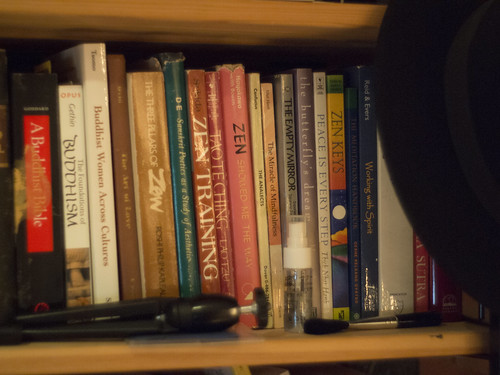
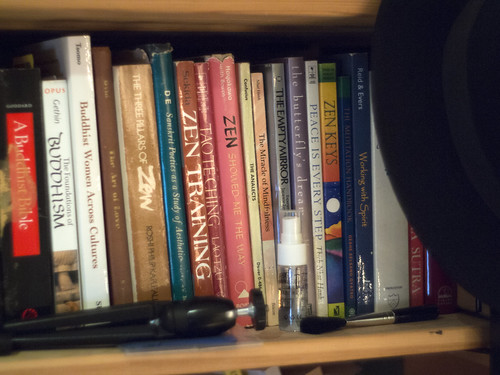
On the right side of my bookshelf, around where I keep a lot of my camera stuff, I have a section of books on Buddhism and related topics.

That photo is quite yellow. The shelf is lit by halogen lights and Christmas tree bulbs. It looks normal enough in person (well, a bit dark) because my mind adjusts to the colour. But the camera takes it and then we see the picture in a different context and we see the colour imbalance. So I reset the balance on the camera using a blank white sheet of paper – actually the back of an airline boarding pass that I have sitting around.

It’s not that that is perfectly neutral white balance. It’s just that it more closely matches our default bias. There is no such thing as unbiased, perfectly balanced colour, any more than there is such a thing as accent-free speech or an unbiased opinion. There is no neutral act of seeing. You just have to know what balance you want, acknowledge it, balance yourself according to it, just as you have to focus on what you focus on and choose what to have in the frame and outside the frame.

There’s one word that shows up a few times on the spines of those books. I could pull out any of them and feature it. I’ll pull this book out because I want to. I found it quite by chance in some used book occasion. It’s a book from 1960, although the first blank page has “January 1965” handwritten in fountain pen diagonally across the lower right corner. The pages are yellowing and smell of the gradual decay of tree-pulp paper and a bit of the basement it must have sat in for many years.

Here is the back cover.

That is the author. Does he look familiar? Here is his dedication.

The author was a motion picture actor. If you recognize him, it’s probably from The Bridge on the River Kwai. He played the Japanese Colonel. His name is Sessue Hayakawa. Actually, Sessue is a name he took when he started acting in movies; his given name – given at his birth in 1889 – was Kintaro.

Here is the front cover.

It’s his autobiography. The title kind of gives away the ending, doesn’t it? But it’s how he gets there that is of interest. He came from a noble Japanese family. He was all set for a career in the navy when, in a reckless diving misadventure, he burst his eardrum and was rendered unfit. He decided that he had dishonoured his family, and he resolved to do the honourable thing.

He in fact did commit seppuku, also known as hara-kiri (not hari-kari!). But he did not die. He didn’t have anyone to cut his head off at the end. So he was hospitalized with very substantial injury to his lower abdomen.

How do you follow up an act like that? With a visit to a Zen Buddhist priest. Followed by a lot of meditation. And then a career as an actor and more meditation and, well, this book.

I have several books on Zen. I have read much about it. Which is like shouting much about silence.

Whatever you think Zen is, it’s not. I can’t tell you just what it is. There are two reasons for this.

The first is that I am not a Zen master. I have meditated various ways at various times, including with Zen Buddhists, although in recent years my only meditation has been running, which doesn’t quite count. But I have no experience of enlightenment in the Zen Buddhist sense. I think I can see the shadow of a corner of it, maybe. I’m probably wrong.

The second is that you can’t explain silence with shouting.

I can tell you what Zen is. It’s a school of Buddhism, best known in its Japanese version although it also exists in China. Zen is the Japanese rendition of the word禅, which in Mandarin Chinese is chan. The full forms are zenna and chánnà. They come from Sanskrit ध्यान (dhyāna). Which means ‘meditation’.

Zen is meditation. In the plainest sense, that is what Zen is. To quote Sylvia Boorstein, “Don’t just do something, sit there.”

In some schools of Zen, that is it. You focus your mind, you watch the thoughts arise and pass by like clouds in the sky, you taste existence. In others, you strive to break your mind free from the ruts it travels in by meditating on paradoxical ideas.

In the end, you learn that you and the things around you are not many, not two. You come to recognize your position, your bias, your perspective, your focus, your frame. You learn that nothing has permanent existence, everything is changing, and what exactly is this “everything” and what exactly is this “changing” and what exactly is this “is” and what exactly is “what exactly” and

As in all Buddhism, the aim is non-attachment. I have some ideas about what is and is not non-attachment, but I’m not, you know, attached to them. Some people interpret non-attachment as meaning eschewing things of the world, but it seems to me that rejection is no more equanimitous than craving. Enjoying while it’s there and letting go when it’s not seem the best options. Fine words, of course, and badly self-incriminating, as witness the two thousand books I can’t bear to get rid of. Fortunately, like all fine words, they will eventually be forgotten.

The simplicity of Zen spills over into an aesthetic associated with it. But Zen gardens are not Zen any more than bedrooms are sleep.

I would like to eschew all marketing and branding that uses the word Zen. Putting Zen on commercial products is like putting vegan on roast prime rib.

I do remember fondly, though, one business in Toronto, no longer there I think – I used to see their sign in an upper window on Spadina: Zen Travel. I liked that. I imagined a place where you go in and they tell you that you are already where you want to be; you just have to realize it. But it’s how you get there that is of interest. In exchange, you pay them all you have, which is nothing.

But perhaps you will get a boarding pass. Which you can use in place of a blank sheet of paper to set your white balance.

amanita

My late teens were charged with yearning and self-fulfilling prophecies of failure, an arc of desire and disappointment that was accomplished before it began. I felt that I wanted to be someone whose lost potential others would mourn, who had loved better than others and yet to whom others would say “I loved you better.” I was in search of a new version of reality, an altered state, one in which simple truth of feeling would be enough.

In other words, as I have since realized, I was pretty typical in many ways. Except that I was even less able than most to act on my desires, paralyzed from within, so afraid of rejection that I pre-rejected.

I was introduced by a drama teacher to the music of Laurie Anderson. I loved her work instantly. One piece stirred me more than others – and in fact still stirs me, and now I understand a little better what she had in mind. It’s “Gravity’s Angel.” Play it while you read this.

Send it up. Watch it rise. See it fall. Gravity’s rainbow.

Send it up. Watch it rise. See it fall. Gravity’s angel.

It’s a reference to Thomas Pynchon’s novel Gravity’s Rainbow. The song doesn’t follow the plot; you may know the song ever so well and still be entirely in the dark about the book. But there is a thematic resonance.

I was curious. A friend had the book. I borrowed it. I found it was very well written – vivid – but also a bit hard to follow, which actually I sort of liked (hey, I had already read Finnegans Wake). But it was too vivid, and it described some things that were hard to swallow. I put it down a third of the way through.

A few years ago, I decided I wanted to try it again. I bought a copy.

It’s a darkly (darkly!) comic novel, hallucinatory almost, an alternate reality, full of sex and destruction and desires, version and inversions and perversions and conversions and reversions and other diversions. It’s set during the Second World War. Its opening and focal point is the Blitz in London.

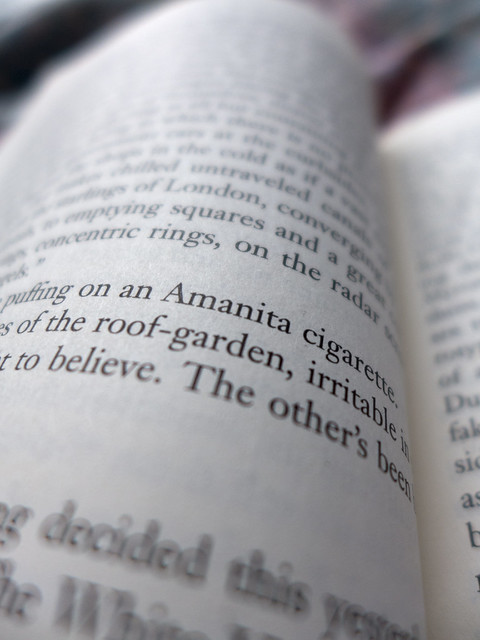
I’ve been wanting for some time now to take this one from the bookshelf and taste a word from it. But what word? Today I finally just grabbed it and opened it and flipped to a page. Nope, not that page. Another. Hmm. A third.

Yes.

There. There is the word I want from this book. A word of hallucination, a word of escape, a key to a Lewis Carroll world of inversions, but a word of a destroying angel, an angel rising above a bombed city, an angel falling in a bomb on a city, an angel eating you from within like unsatisfied desire.

Amanita.

Amanita is a kind of mushroom. In fact, one kind of amanita is the classic toadstool, bright red with white dots: Amanita muscaria, commonly known as fly agaric (the musca in muscaria refers to flies), because it was used dried in bowls of milk to kill flies. But it is also a well known hallucinogen, eaten (and, it seems, smoked) recreationally. It has surely led to the undoing of many flies of more than one kind.

But then – beyond the undone flies – lurks Amanita phalloides, known as the death cap. And different species known as destroying angel: Amanita bisporigera, Amanita exitialis, Amanita ocreata, Amanita virosa. They will be your undoing if you eat them. Not right away – it takes a few days – but by the time you realize something’s wrong, your only hope to live is likely a new liver. Such appealing-looking phallic fungi, not so different in appearance from many table mushrooms, tempting too to those who wish to experience a new reality. Oh, and they will.

It’s a pretty word, isn’t it? Amanita. Like a cross between Amanda and Anita. Perhaps they are cousins of Alice – we should go ask her. It apparently comes from Amanon, a mountain in what is now Turkey. It makes me think of our first microwave oven, an Amana: a very well made machine, a miracle of technology, cooking with radio waves. Amanita could just be a small Amana, a little thing in your hand capable of leaving you fully cooked.

Pynchon’s book is a rainbow of sex and death, an arc with all the visible colours and more, extending into radio waves. It has its destroying angel and it has its angelic young man in an arc of destruction, annihilating at final contact; it has its louche antihero and its picaresque adventures, its half-circle of the demimonde; it has its escape, its hallucination, its alteration. It has its cheap tricks that make you say “Amanita few minutes to absorb this.”

And perhaps you will not fully appreciate what you have let yourself into, what you have let into you, the gravity of the circumstance, until too late. You have swallowed it and it has eaten you from within.

petiole

My bookshelf is a tree. It doesn’t look like a tree, no, but it’s made from trees – the wood of the shelves, the pulp that made the paper in the books – and it has many branches. Branches of knowledge, that is. There’s quite a lot on languages and linguistics, of course. There are also numerous other reference books, many of which acquired at the Oxford University Press sale that used to happen annually. It is a rich tree with many leaves (of paper) on each branch. Some branches are deceptive: on the upper right you see a novel by Irvine Welsh, not a lexicon of Welsh. Some parts of this tree are in the light, some are in the shadows…

…like that book hiding back there. Visual Encyclopedia. What is that, now?

A thick book on glossy paper, richly illustrated and labelled. Its size makes it easy to hold but not so easy to hold open.

You can see that in this book are many branches. This shadowy part of my library tree is quite dense. It is in some ways a microcosm of the shelves around it with their 1200-some books (more than two for each page of this one). Let’s look at the branch of it that has branches.

Plants! Trees and so on. They have branches. There turn out to be quite a few kinds of plants. Let’s go to the gymnosperms.

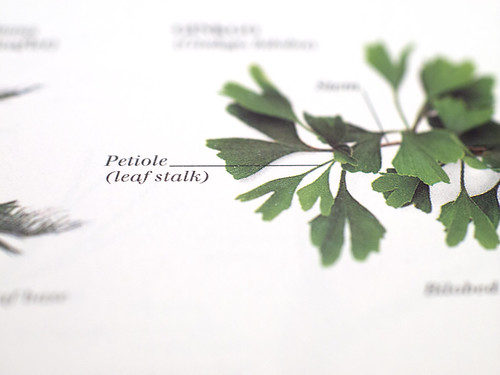
You see some seeds, of course (that’s what the gymnosperms get their name from: naked seeds). You also see some branches. Let us look at this one from the ginkgo tree, a tree that is supposedly good for the brain. (Does it make knowledge stick to your brain? I’m not sure, but if you live near one, it makes its seeds stick to your feet for a few weeks each year.)

Is that a branch or a twig? When does a branch become too small to be a branch? A branch can have branches, but at some point those little branches are not quite big enough to be branches.

Well, we can draw a definite line when the material changes, anyway. A petiole is not a branch; don’t be misled by its branching. It connects a branch and a leaf – indeed, it’s the thing that connects the leaf and the stem.

The book helpfully tells us that petiole means ‘leaf stalk’. Fine, we know leafs talk: this leaf of paper is talking to us right now.

Oh, yes, right, that’s leaves. Even though leaves talk can also mean ‘walks out on speech’. But this is not walk, it is stalk. I think we have taken a wrong branch. Well, anyway: How, in fact, do you put petiole in speech? The British style has the first syllable as like “pet”; the American style has it more like “pede” (as in centipede). But the French, who gave us the word, say the beginning like our “pate” (rhymes with spate – I don’t mean pâté) and spell the word pétiole.

It may make you think of petal. After all, it is a small branching-off part of a plant; it connects to leaves, which are similar to petals in various ways. But that is another misleading branch (though perhaps there is some cross-influence in the form). The Latin source of petiole, petiolus, most likely derives from the ped and pes root meaning ‘foot’ plus a diminutive suffix, meaning it’s related to pedal. Petal, on the other hand (or foot), comes from an unrelated Greek root for ‘spreading out’.

So. There is your knowledge: branch, twig, stem, petiole, leaf. It is true that petiole seems more erudite, perhaps more polite, or perhaps more specific – a cross between a petunia and an oriole? – but the tree doesn’t care; it’s just there. As is this sub-sub-sub-branch of knowledge we have leafed our way to today. Now we will leave it, but at least you may be relieved that, should you see petiole in future, you will twig what it is.