Category Archives: from the bookshelf

evanescence

I’m on the scent of another word from the bookshelf. Let’s look back here in the dark hidden corner behind the baseball-glove chair.

Tall, thin, graphic, glorious mementoes of my youthful favourites. Let me tug this one out and drop it on the stack next to the chair.

Does it look familiar as I gradually reveal it? It was a revelation to me 30 years ago.
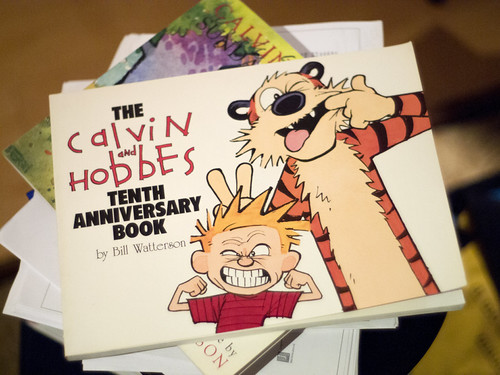
The book is actually 20 years old. It came out in 1995. It’s The Calvin and Hobbes Tenth Anniversary Book. Meaning that Calvin and Hobbes started 30 years ago.

30 years ago today, in fact. November 18, 1985. I’m not one to choose a single favourite in most things, but Calvin and Hobbes is easily my favourite comic strip. Intelligent. Well drawn. With a few simple lines Bill Watterson could express so much character. And then sometimes he’d really go to town.

The strip draws on the impermanence of childhood and the perdurance of childishness. It revels in the ridiculousness of life and luxuriates in ludicrous fantasy, all forever contained and threatened by parents, protectors, and peers who insist on imposing order, stifling imagination, rebuking rambunctiousness. Never mind: for the duration of a strip we may strip ourselves of due ration and see things as… well, as they really are, honestly. (To see the images closer up, by the way, click on them.)

Does Calvinball seem a senseless sport? You’re playing it right now. English is the Calvinball of languages. All natural languages are Calvinball to some extent: we make up rules as we go along, sling slang, even with straight faces collude in ludic creations that come and go with the breezes. There will always be those who try to nail it all down, stop it from changing, paint pretentiousness on the messy pretense, but there will also always be us Calvinist-Hobbesians. And a little Calvinist-Hobbesian in all of us, even the sourest, wafting in and out. Nothing stays the same, of course, but then, nothing stays the same.

Some of us like our play cerebral, very cerebral, even punishingly, showoffishly cerebral. The play of the art gallery placard. The play of academic essays (every word of Derrida and Baudrillard is a game – actually, every word of everything is a game, but some academic word games are like playing racquetball with razors for racquets and kittens for balls). Watterson happily took the piss out of those games while playing them athletically and commenting on life in passing. If thoughts are a penny each, Watterson gives you seven cents.

Calvin and Hobbes is the only comic strip I can recall having learned a word from in my adult life. I admit my memory my be of uneven focus; perhaps I learned the word first and the shortly after saw it again in the strip. But what other strip (well, aside from xkcd) would you find a word like this in?

Evanescence. The sound of a snake s and two soft sickles c c cutting down with ease and taking away. A play of six letters dancing to make eleven letters, here now and moved on in the next moment, melting as they appear. If life never makes any sense, if it is vain and in vain, it is because it is vanishing. Nothing lasts, so there is a last of everything. Just as words can flip their sense inside a sentence, so too our innocent sentience, even our essence, self-incinerates in an instant.

Where does this word come from? Page 166 of the book, yes, but that’s the medium. Before that? First we trace evanescence to English evanesce ‘fade away, vanish into thin air, disappear, be effaced’; then we trace that to Latin evanescere, which contains e ‘out’ (as in E pluribus unum) and vanescere ‘vanish’, which in turn comes from vanus ‘empty, insubstantial’ – the etymon of vain as well as vanish. The Latin equivalent of Japanese mu, the central concept of Zen, so often translated as emptiness but that’s misleading. There is nothing there, yes, but it’s because as soon as you look there there is no there there anymore. Everything is always waving goodbye because everything is always a wave, impermanent, waiving permanence, invincible only because there is nothing to vanquish: it has vanished.

But that is not bad. That is just as it is. Our lives are like a stroll across a paper suspension bridge, dropping lit matches behind us. Everyone walks in time and then runs out of time. In the road trip of life, how often do we see when our touring machine will halt? When I bought this book, did I know that a decade and a month after Calvin and Hobbes had begun it would end? The strip evanesced in December 1995, the eternal six-year-old setting off into eternity with his tiger, and Watterson flowed away invisibly, liberated. No new Calvin and Hobbes strips have been drawn in 20 years. And yet there it still is. It left its marks. They have not finished fading yet.
diaphanous

I really wanted to see my way clear to do another one from the bookshelf today. I had a vision of what it would be, which made it more difficult than just grabbing a book and opening it. But this volume came to light.

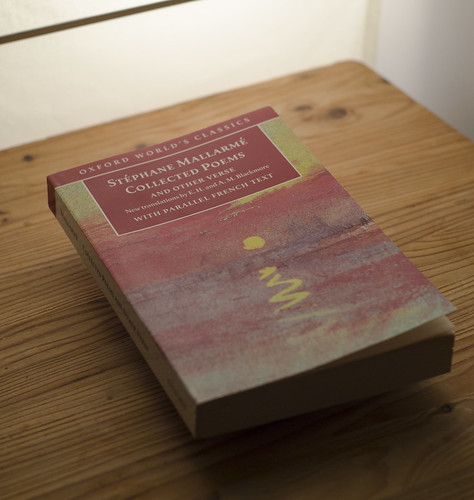
The cover illustration is a detail from Sunset, Rouen, by JMW Turner, who is a painter for those who love light, and glow, and impression, and paint. You do not always see the subject with perfect clarity, but you understand the feeling of it so much better.

The book, as you can see, is collected poems by Stéphane Mallarmé, a French symbolist poet who was 9 years old in 1851 when JMW Turner died. He was born Étienne Mallarmé, but he preferred a more directly Hellenic, less mutated version of his first name, a clarification without clarifying – for what does Stéphane or Στέφανος mean? (It means ‘wreath, crown, circlet’ and was the name of the first Christian martyr, so now you know.) His last name may suggest that he was poorly armed (mal armé) or perhaps badly teared (mal larmé), but those are tiers of resemblance on the base.

In this book you will find “L’Après-midi d’vn favne” (note the classicist use of v), which inspired Claude Débussy. You will find numerous other pieces of poetry as well. As the cover tells us, you will find them in parallel text: French and English, French on the left and English on the right, so that the meaning is clear. Let us open to a page.

“Clear” is relative. A poem translated is a poem traduced. The denotation and the general feel can be preserved in large measure, but translation is truly no clearer than a page held up to a light. You see an obverse; the form is there, largely revealed but somewhat obscured; there is a different rhythm, different overtones, different references and plays on words; the speaker of one language has grown up with a different set of cultural references than the speaker of the other. I will not say it is through a glass darkly, but it is through a page, lit from behind… it seems clear, but it is… what shall we say…

What is that word peaking through there, now, doubling up behind double? Half hidden, showing its back by way of the already yellowing flake of pulp?

diaphanous

Yes, there it is, in “Funerary Toast,” the translation of “Toast funèbre”:

Mindful of your desires, I wish to see
in our task, the idea, that our star’s parks have laid
upon us, for this man who vanished recently,
a solemn stir of words stay alive in the air
in honour of the calm catastrophe—
a huge clear bloom, a purple ecstasy,
which his diaphanous gaze remaining there,
rain and diamond, on these flowers that never fade away,
isolated in the hour and radiance of day!

C’est quoi, ça, en l’original?

Moi, de votre desire soucieux, je veux voir,
À qui s’évanouit, hier, dans le devoir,
Idéal que nous font les jardins de cet astre,
Survivre pour l’honneur du tranquille désastre
Une agitation solennelle par l’air
De paroles, pourpre ivre et grand calice clair,
Que, pluie et diamant, le regard diaphane
Resté là sur ces fleurs dont nulle ne se fane,
Isole parmi l’heure et le rayon du jour!

A diaphanous gaze. How can that be? Diaphanous means showing through, not seeing through. And yet. The word has taken on more of a meaning than it may literally seem to have. It is not merely to appear through something – dia δια ‘through’ and phanés ϕανης ‘showing, appearing’ – but to be a combination of epiphany and phantasm (both also from the same phan). It is not a word for ‘transparent’, even though transparent comes from Latin roots that mean the same as the Greek roots of diaphanous. A diaphanous dress is radiant, a diadem of clothing; a see-through dress is more revealing, and less high-toned; a transparent dress is… well, clear.

Sometimes this word is misrendered as diaphonous, because phon is a more common root. But phon refers to sound. A penetrating sound could be called diaphonous, I suppose, but the word is not used as such. When it comes to poetry, you may think that what is seen is what is heard, but this is not so: the wordplays in Mallarmé do not show so readily on the page. The letters open one window; the sound opens another. But in translation the window always has diaphanous curtains.

In art, we value the diaphanous more than the transparent. We love the word perhaps in part because it has that ph in the balance, that classical hallmark, that crisp and whispering couple that join to be simply soft. We want to see through, but we want to see the fabric too; we want to see the material, the medium. We want obscurity, a challenge, an involvement. We want not just Athena but also Diana and Aphrodite: our learning desires a hunt and hunts for desire.

We want life not through a glass darkly, but not through glass clearly; we want it through the fabric, the fibres, the medium, the texture of life. We want it with feeling. We want something to trip the light and make it phantastic.

enow

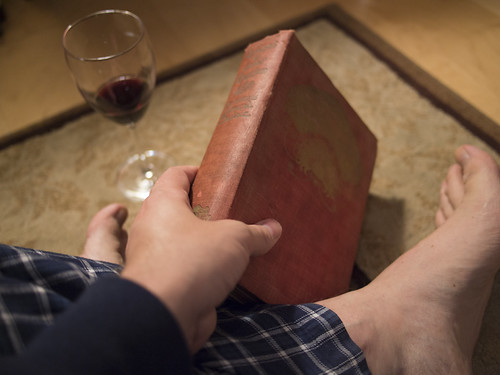
I wasn’t going to do another one from the bookshelf tonight – one a week is enough. But sometimes enough is not enow, and one who floats on the waves of words and images must live in the now. And so, in my jammies, with a glass of wine, on the carpet of my library, I pull from the shelf a book as yellow and foxy in the pages as the library lighting.

The Rubaiyat of Omar Khayyam, in Edward Fitzgerald’s famous English translation, with illustrations by Edmund Dulac.

Look at these lovely pictures, each on its own separate plate complete with onionskin veil to protect it.

The yearning lass looks rather like Meryl Davis, methinks.

I don’t think that’s Charlie White.

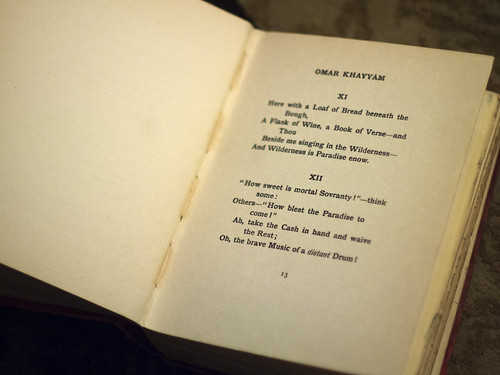
No, these are paintings of Persian love and longing, in a European vision. But their European provenance does not make them un-Persian. The poetry, at least, is part of the Persian dispersion. It is a volume of ruba’iyat, which is the plural of ruba’i. The ruba’i is a Persian quatrain form. The rules are that lines 1, 2, and 4 must rhyme, and that the fourth line must be a high, strong, deep completion of the meaning. There is also expected meter. Fitzgerald has gamely preserved the poetic form in his translation. Number XI is a poem that may seem familiar.

Does it seem familiar yet somehow not right? Let us try that again.

The volume I own, you see, contains editions 1 and 2 of Fitzgerald’s translation. The second edition is different from the first – a whole new essay at the matter, even renumbered. Apparently one was not enough. Are two enow?

Enow.

That is a precious word, isn’t it? Simply a rhyming mutation of enough?

In fact not. Enow, Doctor Johnson explained to us, is the plural of enough.

Does that seem a strange thing to say? In the modern time, it may well, but English words used to have much more thorough sets of inflection. Old English genog became, over time, singular genoh but plural genoge, and those grew to Modern English enough and enow. (It makes more sense if you know that the g’s were fricatives or glides, not stops, and the h was pronounced.)

But in Modern English, once we have learned that one is enough, we take it at its word and stop, and never discover that two are enow.

Remember that, now, the next time someone tells you enough is enough. It may be so, but enow are enow, and two are better than one – especially with that bread, that flask of wine, and that book of verse.

And so there you are. There art thou. There are we. Here we are. Enow. And now?

trice

It’s time for another episode of “from the bookshelf.” But it’s late – I’ve spent the day at a linguistics conference – and I need to be expeditious. So I will quickly pull this volume from the shelf.

I received it for some birthday in my youth, I think. It’s full of Canadian classics, of course. Robert Service was the plucky poet of the Klondike, and there are at least two poems by him that Canadian schoolchildren cannot escape reading (or at least that used to be the case; I can’t say whether it still is). One of them is “The Shooting of Dan McGrew.” The other one is this.

“The Cremation of Sam McGee” is such an essential of the well-read Canadian mind that I once did a quick parody of it on the easy assumption that all of my readers (Canadian editors) would know it in an instance. And I wasn’t wrong.

There is one word I think of in an eyeblink whenever I think of this poem. It’s a word I first saw in this poem, and have read altogether not thrice, not twice, but just that once – or in just that one place, however often returned to. And yet its sense was, by context, immediately grasped.

Trice.

It was jammed in the ice, but I saw in a trice it was called the “Alice May.”

The “it” is a boat, a derelict as Service calls it. Service says he saw in a trice – a slice of the eye in time, a trick, a quick instant, a moment without trace.

Very well. But what is a trice?

Trice was, first of all, a verb, borrowed from a Middle Dutch word meaning ‘haul’. In Middle English it got the sense ‘pull quickly’, ‘pluck’, ‘draw suddenly’. Its first sighting is in Chaucer. Now when it’s used at all as a verb it means ‘pull or haul with a rope’, but don’t count on anyone knowing it.

But that verb came to be converted to a noun, first in the phrase at a trice – as though saying ‘at a hoist’ or ‘at a pluck’ – and thereafter in a trice. It has a long history of use, threading through Shakespeare and Charlotte Brontë. But, at least if you’re Canadian, the telos of all that was its spotlight flash in Robert Service, and all uses since then refer back to that one trace. Now you read it, and in the same second you grasp it; and now it is forever a mirror of that night on the marge of Lake Lebarge.

riverrun

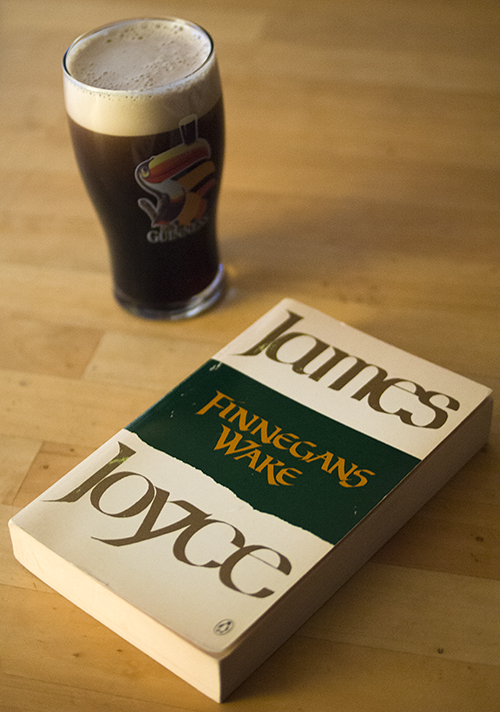
September 1985. I am beginning my second year as a drama undergraduate student at the University of Calgary. I walk into the bookstore and buy my required course books, plus this:

It is in the course books for some English course, possibly a graduate-level one. They don’t check whether you’re enrolled in a course before they let you buy a course book. I may have deprived some English student of the chance to buy Joyce’s famed masterwork.

I doubt it, though.

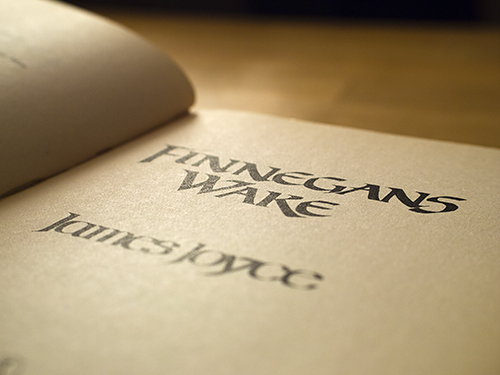
I had first read about this book in a Time magazine anniversary issue looking back over the past most-of-a-century. The book, described as having no discernible plot and not written in normal English, sounded fascinating. It is 628 published pages long and took 17 years to write (1922–1939). There is no apostrophe in the title; that is deliberate, to encourage a multiple reading: the wake of Finnegan; the waking of Finnegans; an injunction to Finnegans to wake.

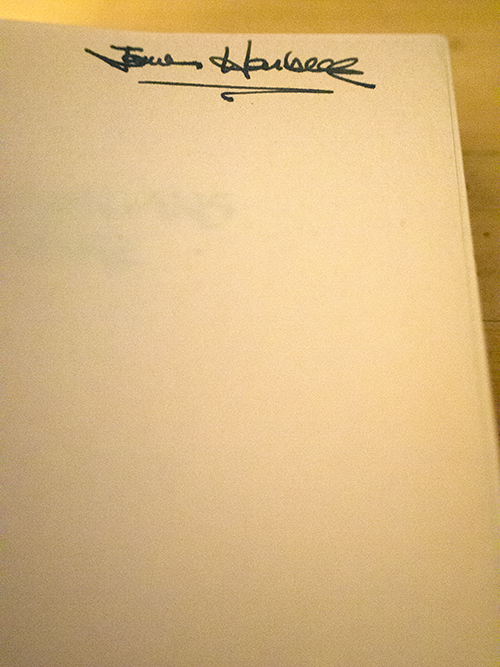
I take out my wet-ink pen and write my name on the fly leaf, a river of blue running to dry and mark my passage.

This was back when my signature was almost legible. That signature would not work for forgery now. My current signature looks like the dust cloud that always follows Pigpen in the Peanuts comics.

I read this book like an exercise program, 10 pages a day, whether I understood them or not. It was a marathon, a 63-day marathon, all while I was putting up with a difficult roommate and he was putting up with a difficult roommate. But it was a huge influence on me. I wrote quite a lot of unreadable incoherent garbage for some time afterwards. It may have stunted my development as a writer for a year or two. Probably not, though; I was so immature, nothing I wrote was really worth the effort for a very long time.

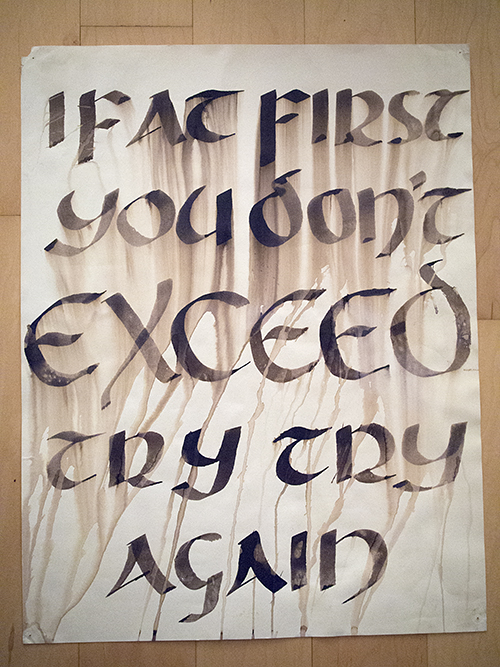
The calligraphy of the cover I loved; I had loved calligraphy for me for some time. We may count that as another influence. Somewhere around then, I made this poster.

The water blur was not intentional. It happened when someone, in a water fight with my roommate, splashed a large mugfull through our doorway and nailed the poster squarely, rivers of cold tap water running the ink to exceed the paper. The dude was apologetic, but I must admit it was probably an improvement.

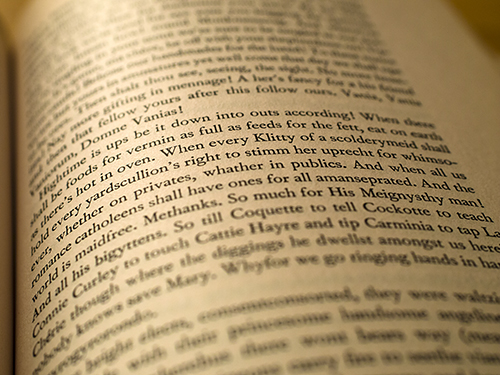
The motto was not intended as a reference to Finnegans Wake, but it might as well have been. Joyce truly exceeded all reasonable bounds. Perhaps when I am retired, at age 102, I will read it again and begin to understand it. We all know that Shakespeare made up a lot of words, but Joyce made up as many on any given page. Here’s one chosen at random.

Invention is much easier when you are not constrained to coherence.

What word could I possibly choose from all this? The first: riverrun.

It is also the one after the last. The narrative loops back on itself, like a fever dream that simply doesn’t end. The final sentence stops in the middle and is resumed at the beginning. I have paused in the middle of that sentence, dammed, but damned if I don’t pick it up again in the full course of time.

Is this a word beyond the shores of this book? It is, with a caveat. As of the mid-1800s, it was known as two words, river run, the course of a river. It shows up in the 1900s as one word. The first known instance is the one you have just seen. All other uses refer to this. This word is like a canal barge or river boat, carrying that freight. And what river does it ride on? The stream of consciousness. A stream prone to frequent overrun. The marks it has left on the riparian strand are the letters of this book.

River Run is also the name of a race. Have you seen the movie Run, Fatboy, Run? Do not take it as counsel for preparing for a marathon; its details in respect to running are less realistic than the contents of Joyce’s book, but never mind, it’s entertainment. The marathon the protagonist decides to run is not the London Marathon but the Nike River Run. The London Marathon was not available for use because another film had secured rights to using it. The Nike River Run is not a race in the real world. But doesn’t that make it just all the more suitable?

So. Riverrun brings us by a commodious vicus of recirculation back to Howth Castle and Environs. Howth Castle is a real place. But HCE are the initials recurring through the book; its protagonist (yes! it has one! like a dirty leaf floating on the current, followed by an unsteady, blurry camera) is Humphrey Chimpden Earwicker, not a real-world person. Howth Castle, for its part, sits on a peninsula north of Dublin. There is swerve of shore and bend of bay to get to it, but not a riverrun in sight.

Still. This word riverrun has those three liquid letters r r r, the second overrunning into the third. The ocean by the castle has enough liquid to sustain it. The rivers of time ever run, and the sea is eternal. And in the end, after a lifetime of incoherence, it loops back on itself.

And after that, I read Ulysses, which Joyce wrote before Finnegans Wake, and which actually makes sense.

peremptory

I have had good response to the first instalment of from the bookshelf, so I will do another today. I don’t intend to make it a daily thing – it’s more time consuming than a post without pictures – but I won’t run out of books however often I do it.

Today’s book is a time-abused little volume of instruction that came into my possession I know not how (though I think my mother-in-law picked it up at a rummage sale for me). It has seen rain (though not fire) and curious white substances. But it stands proud and confident nonetheless.

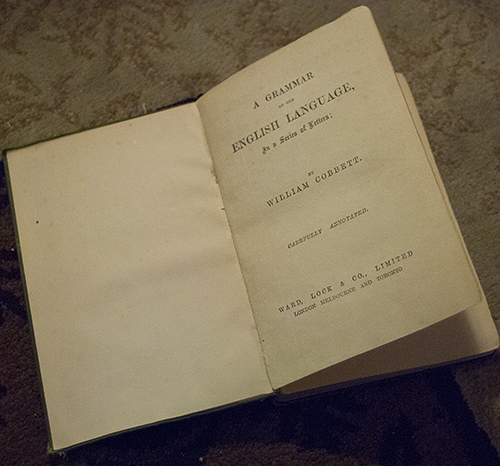
Behold Cobbett’s English Grammar, a volume far more sure in its learning than even those far more knowledgeable books piled beneath it. Ah, grammar: one of those fields, like painting and sartorial fashion, in which many people feel that the confidence of their opinion is the surest index of their rightness, and they just make things up on the basis of their own felt discernment – and publish them (caveat emptor). Grammar is like feces unto the flies of prescription: people who believe that we must have rules are naturally drawn to it and impose rules willy-nilly, brooking no question or opposition, giving no quarter.

And of course they seek to impress those rules on the still-curing cement of young minds, to pre-empt any grammatical libertinism that could take hold. Flip this book open and the very first page you see – before even the title page – is this:

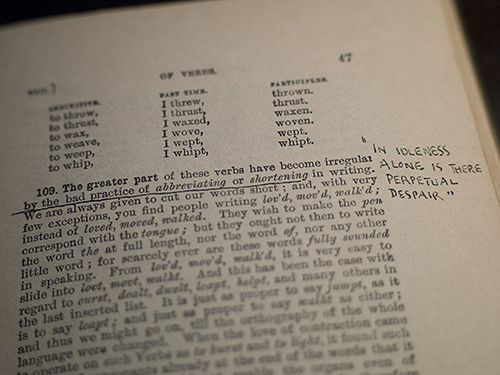
Whoever this Harry Martin was, he was a dab hand with a pen. We can see that this book was set to brand its rules on his brain fully an eighth of a millennium ago, and on the far side of the Atlantic: the Thomas Rawlins Grammar School in Quorn, Leicestershire.

Here is the title page:

This book is, as I say, very confident in its prescriptions. It is no respecter of persons; however great they may be, if they do not meet the standards of the author, they are given no courtesies, as you will see from the table of contents:

Doctor Johnson, the king, various other statesmen: all guilty of “false grammar” and “errors and nonsense.”

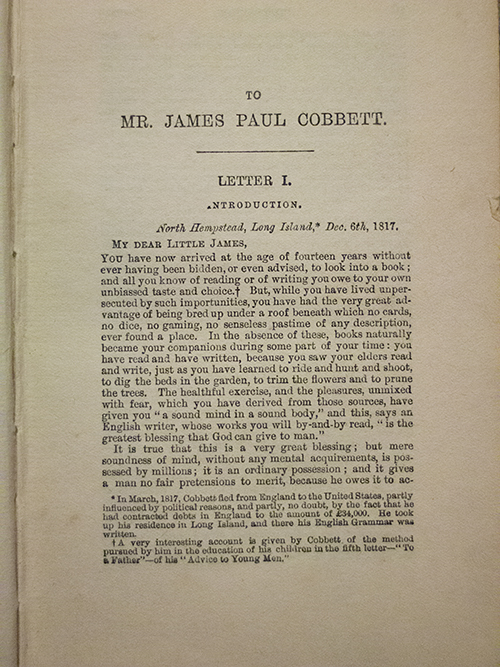
Would you let a creature such as this slip his crusty avuncular arm in its shiny sleeve around the shoulders of your impressionable offspring today? But this is just his approach. The book is written as a series of letters to his fourteen-year-old son, James. You will see that the letters are dated beginning 1817, a full human lifetime before this volume was entrusted to the instruction of master Harry Martin.

Why is he writing letters to his son? He is on Long Island, New York. What on earth for? The footnote is instructive: “In March, 1817, Cobbett fled from England to the United States, partly influenced by political reasons, and partly, no doubt, by the fact that he had contracted debts in England to the amount of £34,000.”

£34,000 is a fair chunk of change even today. But a debt of that size at that time would be equivalent to almost exactly one million pounds in 2015 spending power. A million pounds! What did Mister Cobbett do with that? I’ll tell you what I think he did: poured it into his book. Every reader of this work is weighed down with a million pounds of high-handed prescription, of which not a featherweight is honest linguistic research and understanding. (He doesn’t even use the term etymology correctly.) And Harry Martin made notes and underlinings in the book, giving thereby at least the impression of heeding its admonitions.

I am confident that Cobbett was as conscientious and scrupulous in matters of learning as he was in matters of finance. He may have brooked no idleness or shortcuts, but he was apparently quite fine with deciding things without considering that they may not be true.

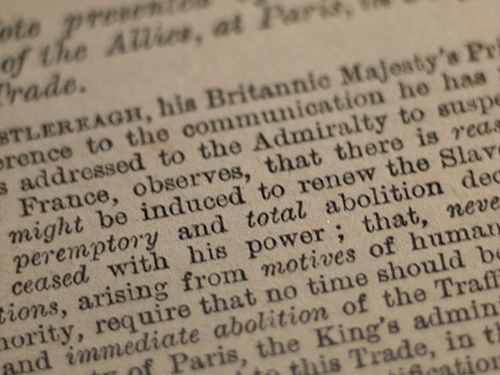
There are so many words in this book. Which one shall I taste? Well, you know already; it’s at the top of this article. On what page do I find it? I find it in a speech by Lord Castlereagh reproduced on page 150.

The sentence is long, but here is the part of it with which we are concerned: “there is reason to foresee that French ship-owners might be induced to renew the Slave Trade, under the supposition of the peremptory and total abolition decreed by Napoleon Bonaparte having ceased with his power…”

Mister Cobbett does not like this. He does not like the speech at all. He states no position regarding the slave trade; it is a mere trifle in the face of such terrible writing. He presents his own revision of this unintelligibly obscure speech, including this revised passage: “there is reason to apprehend that the French ship-owners may be induced to renew the Slave Trade, from a supposition that the total abolition recently decreed by Napoleon, has been nullified by the cessation of his authority…”

If you think his version is worse than the original, well, so do I. But Cobbett is a man on a mission. He picks the speech apart sternly, mercilessly, decisively, conclusively.

“If the abolition were total, what had peremptory to do there? Could it be more than total?” Well. Is that what peremptory means? It’s not a word we often use. What is peremptory?

This book and its author, that’s what. Peremptory comes from Latin perimere ‘kill, destroy’, which in turn comes from per ‘thoroughly’ and emere ‘take’. That same emere later came to mean ‘buy’ and shows up in caveat emptor and pre-empt. (It is not related to emetic, which comes from Greek ἐμεῖν emein ‘vomit’, but in a case such as this there may be some concinnity.) That which is peremptory takes a merciless attitude: slaughter and scorched earth. Decisive, conclusive, fixed, dogmatic, intolerant of other positions, hyperconfident.

So peremptory would not mean more than total. It could seem to be redundant with total, at least until you stop to think that a person may peremptorily declare a partial ban: “The slave trade shall be limited to [place X] and [persons Y], and all others shall be punished without mercy.”

If you were Napoleon, you could make such a decree and expect it to be enforced. If, on the other hand, you simply had a Napoleon complex, you might make your pronouncement emptily. Well, you could enlist a children’s crusade, perhaps, and these children, some at least, could grow to have brains as desiccated and obdurate as yours – mistaking the wizened for the wise – and pass the instruction to the next generation.

Peremptory is an important-sounding word, proud with its p’s, conservative with its tory. It may describe good things, such as abolition of slaving, or bad things, such as, well, books like this. But this is a nice volume to have for historical interest and entertainment. The paper is soft and still resilient, though it is clearly wood pulp and not quality linen bond. I do not know what the type face is; there is no colophon. But I have noticed – have you? – that there are wide spaces after the periods. They would probably create what designers call “white acne” on the page… if the sentences weren’t several lines long each. I don’t like those big spaces. But that’s a hot topic for another time.

hyaline

I’m going to try a special feature every so often, at least if people like it. It’s called from the bookshelf. I’ll take a book off the shelf and find a word in it to taste, and add some bibliotechnical cheesecake shots while I’m at it.

I’m going to start with one of my most alluring volumes, part of a two-volume set of Paradise Lost that I saved from perdition at Tufts University two decades ago (it was part of a bequest but was not needed and, frankly, would not have survived in a circulating collection).

It has illustrations by John Martin and was published in London by Septimus Prowett in 1827.

It has the dusty-honey smell of an old book, with those age spots called foxing. Open it carefully; the binding is falling apart, though the pages are still strong. It is tempting to think of it as like a smudged old window, the glass rippling, the view obscured. But the words on the page are there as plain as any day, and when you can read them you can see with the clarity of the mind’s eye into the world it describes.

Let us turn to page… 27. O look, they put spaces before colons and semicolons and exclamation points! And larger spaces after them and – is it? – a double space after a period. Double at least. A space as wide as the sea and more transparent.

The sea? The glassy sea. Line 619: “On the clear hyaline, the glassy sea”… We have our word: hyaline. A word that rhymes with violin. What note does it play?

Is the glassy sea the hyaline? Is it then the high line? It is haline – salty, that is. It may be healing, but it may consume you. Not this sea, though, this glassy sea, this clear hyaline. It is as smooth as water in a glass, and as clear as a looking-glass. It may even reflect.

Which would be why we see the sense and then the same sense again. Hyaline, you see, comes to us from Latin hyalinus, which (as the y should tell you) is a loan from Greek, where the original root is ὕελος huelos ‘glass, crystal’ – a word that Greek may have gotten from Egyptian. A word, then, that has sailed on the Mediterranean, smooth or rough, more than once.

Glass and glass again. Elegant variation, ramified repetition. Use of a fine and pricey word, and then explanation of it with plainer stock. And that poetic trick of taking an adjective and using it as a substantive noun. Milton was not the only to use hyaline this way, though perhaps the first, but its longer and fuller history in English is as an adjective. It means, as the OED says, “Resembling glass, transparent as glass, glassy, crystalline, vitreous.”

Transparent not as the pages of a book, nor as an old and foxy word that requires looking up, but as plain text that, once read, shines an image into your mind. Or as a camera lens, letting the image pass through and be recorded to be re-presented to your own eyes, with their lenses and their vitreous fluid. And, so launched, it sails on them.