Mimeograph is a word of memories, although of course that’s relative. Most people born after about 1980 probably don’t remember mimeographs at all. For me, though, there’s a family connection.
Long ago when I was very young (I’ll just say I kept hearing the word “Watergate” on TV and assumed it must be about a lake or river or some dam thing), my dad had a desktop-size metal machine roughly the shape of a very wide snail, with a drum in the hump and a crank handle on the side. When you had done all the necessary preparation, you could turn the handle and, with a “queeeeduck” sound, it would knock off page after page of the same document in fat bluish ink with a distinct damp vaguely tangy chemical smell. This was what is sometimes called a mimeograph – though technically this one was actually a spirit duplicator, commonly called a ditto machine.
Such machines were common enough; most schools had one or more. It was very cost efficient, especially at a time when a library Xerox machine might charge you 25 cents per page, which could also buy you a bottle of Coke. (The choice between a Xerox and a Coke wasn’t an easy one for me: I liked Coke, and could remind myself that I was helping pay my mother’s uncle, who was an executive VP for Coca-Cola, but I also liked copying pages from library books.)
A mimeograph machine couldn’t copy pages from books, mind you. It wasn’t made for making one copy by light (a photocopy); it was made for printing multiple copies imitating a custom-created original – mimeo, from Classical Greek μῖμος ‘imitation’ and ‘actor’ (also the source of our words mime and mimic), and graph, from Classical Greek γράφος ‘writer’ (from γρᾰ́φω ‘I write’). So it was good for handouts and tests and such things.
Of course the Classical Greeks didn’t have mimeographs. Though its parts are ancient, the word, like what it names, is relatively modern. The technology was patented in 1880 by Thomas Edison, and the name mimeograph was confected circa 1887 by the man who licensed the patent: A.B. Dick. You may have seen his name on some office equipment.
And a ditto machine was a mimic of the same concept – the spirit duplicator was invented in Germany in 1923. The name ditto is from an American producer of such machines, the Ditto Corporation, which in turn took its name from a word that had already been in English for centuries meaning what we still use it to mean: ‘My sentiment is the same as the one just expressed.’ It comes from a past-tense form of Italian dire, ‘say’ – so ditto means ‘said’, or ‘what was said’. Using a ditto machine is easier than retyping new originals, and, as we have seen in popular culture, saying “Ditto!” is easier than producing an original type of thought. Ditto is also a name of a Pokémon character that can mimic other characters, as well as of the young boy (twin brother of Dot) in the Mort Walker and Dik Browne comic strip Hi and Lois.
Ditto Corporation weren’t the only people making spirit duplicators; among others, A.B. Dick did, too (so they knocked off their own knock-off). I’m not sure which brand the one my father owned was. I’m also not sure whether it had been passed down to him, but making reproductions did run in the family; my father’s father was an amateur printer and amateur genealogist. I have a small family genealogy booklet that he made; however, it was clearly printed by a letterpress (rather than unclearly by a mimeograph or ditto).
But my family genealogy does have an A.B. Dick connection. On the page about my father’s mother’s family history, it mentions that her mother (i.e., my father’s grandmother) was the daughter of the holder of the first patent on the A.B. Dick Automatic Mailing Machine. Strangely, though, the little book identifies this great-great-grandfather of mine as one Reverend Alexander Dick, whereas the founder of the A.B. Dick company was Albert Blake Dick. So this is relatively unclear: I don’t know if it’s a copying error, or just another mimic, knock-off, or duplicate spirit.
Wow. So that’s, like, the pinnacle of the ultimate, right?
Sure seems like it to many people penning pieces about all-time bests. And, you know, I can understand the impression driving it: longer means more important. When I was a kid, I knew about Disneyland, and I knew about Walt Disney World, and I thought, OK, Disney is great, so Walt Disney is an even greater degree of Disney. Like bishop and archbishop. Like fabulous and fantabulous and, hmm, fanfreakingtabulous. And, at length, supercalifragilisticexpialidocious. Which is the absolute penultimate. Right?
Except of course not. Ultimate and penultimate are like centre and epicentre. Some people use epicentre as though it means ‘centre, but epic’, but it really means ‘the point on the surface of the earth directly above the centre of an earthquake or underground explosion’. So not exactly at the centre. Certainly not at the centre of the centre.
And penultimate? Well, we know ultimate, of course: it means ‘the last, the farthest’; it comes from Latin ultimus, the superlative of ulter, which means ‘beyond’ – the feminine form is ultra, which you will be familiar with. We moderate it with pen, as in penumbra ‘the half-shadow area around the central shadow, or umbra’, and peninsula, ‘a body of land that is almost but not quite an island’. It’s from paene, ‘almost’. So penultimate is not the ultimate of the ultimate. It’s just the almost ultimate. Like the vice-ultimate.
And anyway, if penultimate is the highest degree of ultimate, the mother of all ultimates, then what about antepenultiumate? That would be, uh, the auntie of the mother of all ultimates? An eighth note – a short musical note – is a quaver, and you can get down to a sixty-fourth note with hemidemisemiquaver, which is infreakingcredibly minuscule. But antepenultimate just means ‘before almost last’, i.e., third-last – like the syllable stress in the word antepenultimate (and, for that matter, in the word ultimate).
And syllable stress is where you’re most likely to see antepenultimate and, apart from overenthusiastic misusages, penultimate. But in phonology and prosody, they like to use a shorter form to name the second-last syllable: the penult… which, by the way, has two ways to say it: with the stress on the ultimate syllable or on the penult. But either way, it’s just not as prepossessing a word, is it? “This experience is the penult.” Sounds more like a penalty. And it’s kinda short. Just doesn’t make it all the way there.
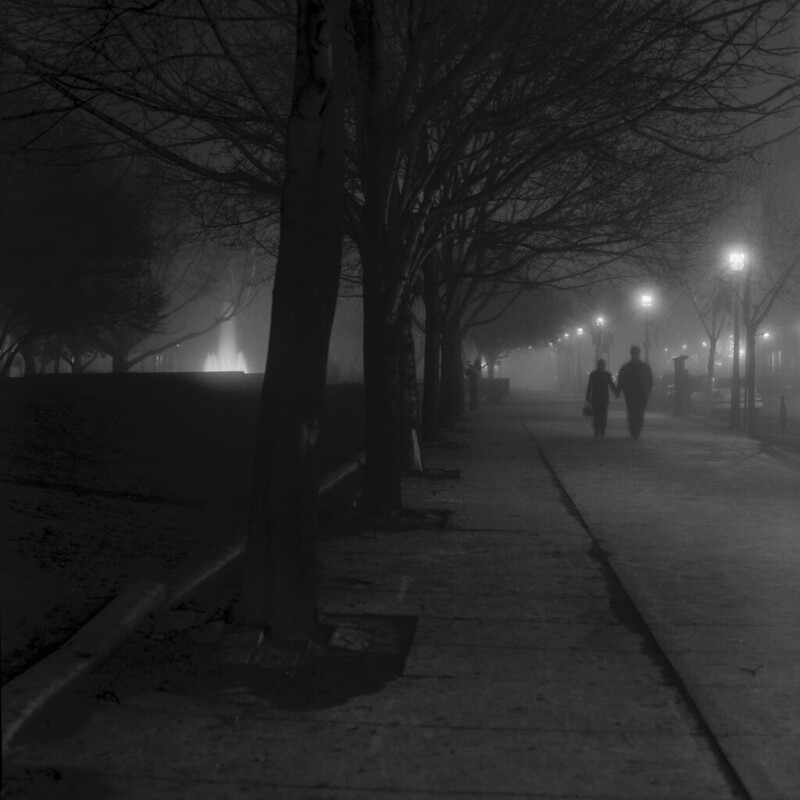
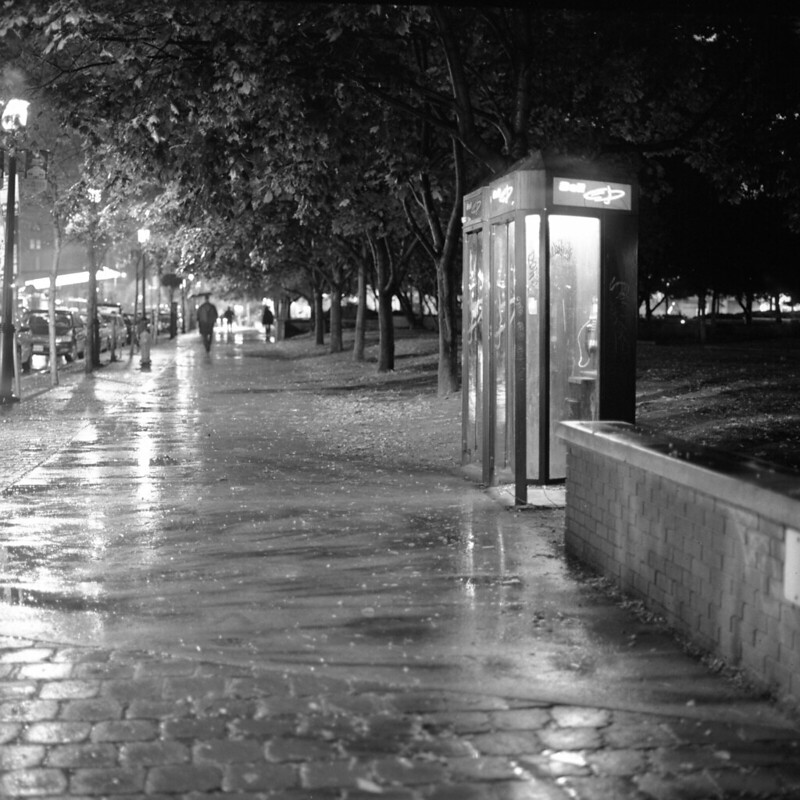
One block from the front door of the building I have lived in for a quarter of a century is a little trapezoid of urban delight called Berczy Park. It is best known for its whimsical fountain with statues of dogs all shooting water up towards a bone on the top, surrounded by a plaza with ample benches and tables and chairs.
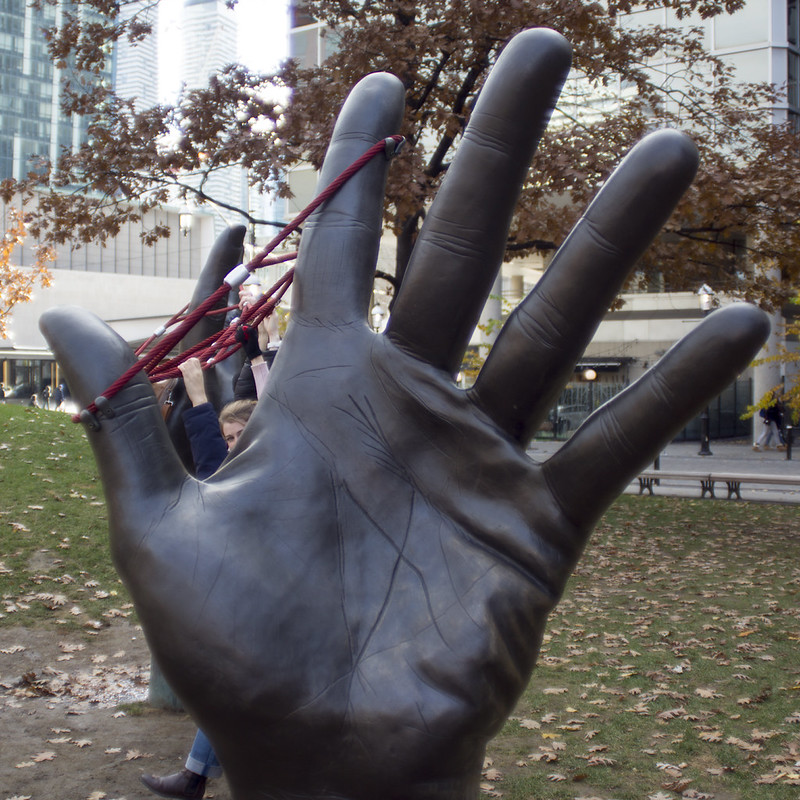
At the west end are two large metal hands, originally made to be connected with a cable cat’s cradle, but I haven’t seen the cables in place for some years.
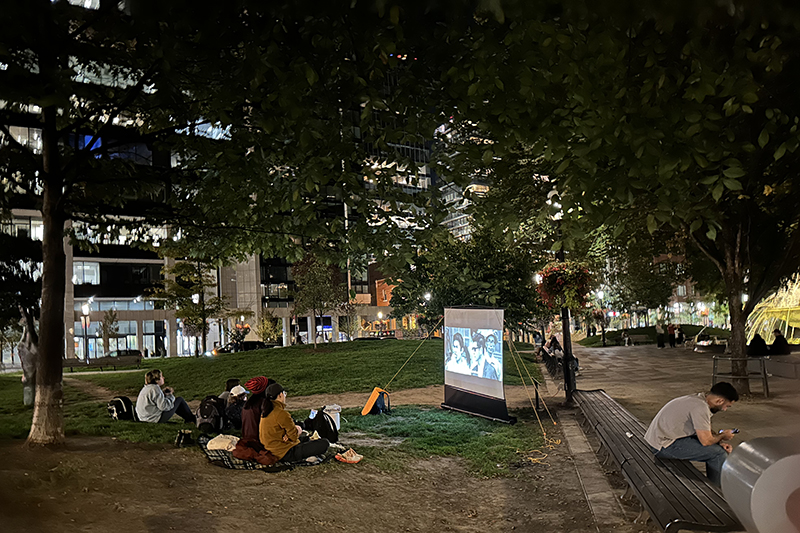
The hands are flanked by mounds of earth, excellent for sitting and reading or sunning or, after dark in the warm months, even setting up a screen and watching a movie.
At the east end, just behind the trompe-l’œil back wall of the Gooderham “Flatiron” Building, is a gravelled area for real live dogs to do those things their owners take them outside to do.
This park is very popular, and has been for as long as it’s been in this design, which is just under ten years. The design was done by Claude Cormier, who was also responsible for some other favourite parks in Toronto. I have photos from exactly a decade ago of it in the middle of being completely redone from its previous design.
The obvious question, of course, is “Who or what is or was Berczy?”
Well, obvious to me and probably to you. Most people don’t seem to pause long to consider it, nor do they seem to wonder how to say it. Universally people around here pronounce it like “brr-zee” (/ˈbɹ̩.zi/). Which is unsurprising, given that the modal language hereabouts is English.
But that’s plainly not an English name.
I assumed for quite a few years that it was a Polish name, because cz is characteristically Polish (and not, by the way, Czech – in fact, Czech for “Czech” is čeština). In that case, it would be pronounced /ˈber.ʈʂɨ/. But you need not learn how to say that, because it is not, in fact, a Polish name.
It is not, really, an anything name. It’s as authentic as Häagen-Dazs (which, in case you don’t know, was invented by Reuben Mattus in the Bronx with the intent of looking Danish, which it doesn’t quite really). But it was the name used – legally, and passed on to his sons – by William Berczy, artist, art dealer, settler, adventurer, now viewed as a co-founder of Toronto. Berczy also oversaw the creation of a stretch of Yonge Street (the central north-south street of Toronto, long vaunted – somewhat fraudulently – as the longest street in the world), and founded the town now known as Markham, which Torontonians will know as an important part of the “905” northern suburbs. Berczy himself lived closer to the waterfront in Toronto. He subsequently lived in Montreal, where he designed an Anglican cathedral, and he is buried at Trinity Church, Wall Street, in New York City, where he died while on a business trip.
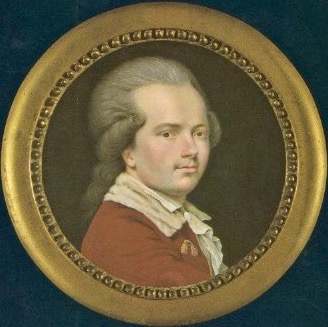
Self-portrait of William Berczy, National Gallery of Canada, via Wikimedia
But, as I said, William Berczy was not originally William Berczy, and he also was not Polish – although he spent some of his young adulthood in Poland, on some risky quasi-diplomatic missions. So (1) Who was he before he was William Berczy and (2) Where did this name Berczy come from?
The first question is easy. He was born Johann Albrecht Ulrich von Moll – a much more businesslike German name. He was born in Bavaria; his family moved in his childhood to Vienna, where his father was a politician and diplomat. There is an enjoyable novelization of his life by John Steffler titled German Mills (they truly could have come up with a much better title). It covers, with rich detail and as much fiction as is necessary to mortar the bricks of the story, his life from his adventuresome youth in war-torn Central Europe, through his years as a painter in Italy and Switzerland and his marriage to Swiss artist Charlotte Allamand, and on to his life as an art dealer in London and then as the leader of a group of German settlers first in New York State and then in Upper Canada, and then – after reversals by people in power led to the settlers getting much less than initially promised – returning to his work as a portrait artist, at which he made a good name for himself.
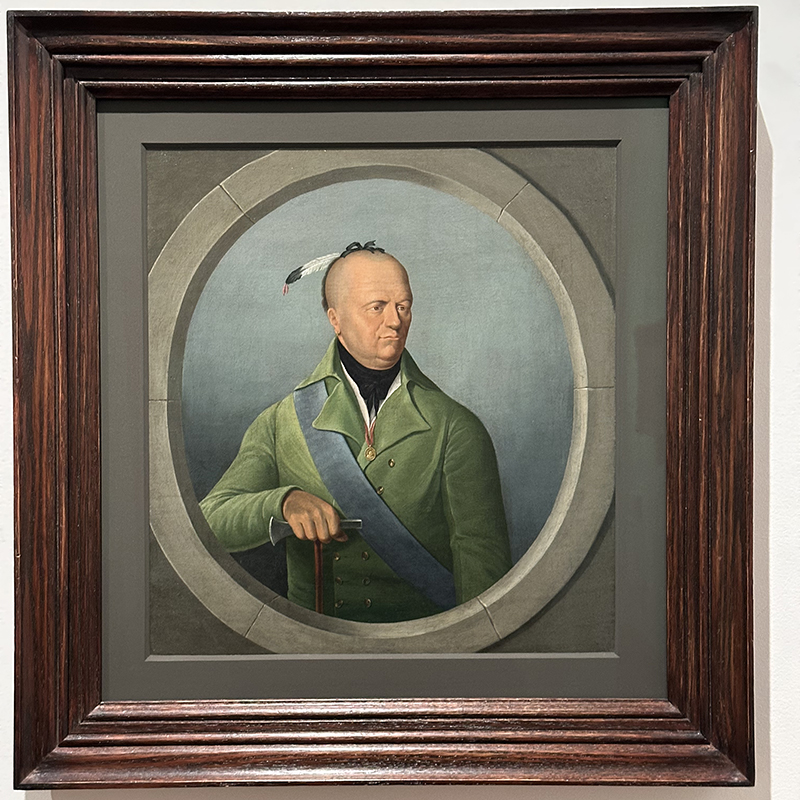
Berczy’s portrait of Joseph Brant hanging in the Art Gallery of Ontario
So: after business and some liminal years, art. It was quite an adventure; he was man ever on the move, ever doggedly climbing, ever remaking himself.
Steffler’s book does not, however, answer question number 2: the origin of the name Berczy. It adverts to Moll’s having taken on the name and used it increasingly, and having used it officially at his marriage and onward, but not once does it address the question of where it came from.
I have, on loan from the Toronto Public Library, a book published in 1991 by the National Gallery of Canada, titled Berczy. The larger part of the book is a catalogue of William Berczy’s paintings and drawings, but it has several essays. And in the essay “The European Years, 1744–1791,” by Beate Stock, I find, on page 28, the following paragraph:
How Albrecht Moll arrived at the surname Berczy is a matter of some speculation. It may have held romantic associations for him, as the name Bérczy in Hungarian is a poetic (somewhat aristocratic) way of saying “from the mountains” (bérc is literally “crag” or “peak”). Was the name chosen as a reminder of his adventures among the Hungarians? Or did it perhaps derive from his youthful nickname “Bertie,” altered to “Berczy” by his Hungarian acquaintances? Why he took another name, according to Berczy, was in order to relinquish any further claim on his patrimony, and thus to safeguard it for his mother’s use.
(It should be noted that his father died when Berczy was in his twenties, leaving the family in financial straits.) To add to that, in the Dictionary of Canadian Biography entry on him by Ronald J. Stagg, there is this tantalizing passage:
If one of his writings is taken at face value, while on a diplomatic mission to Poland in the 1760s he had to hide in a Turkish harem and was captured by a Hungarian bandit. It may have been at this time that his nickname, Bertie, became Bertzie (in Hungarian, Berczy).
This doesn’t really clear things up perfectly. It does seem to indicate that the resemblance to Bercy, a neighbourhood of Paris that has its own Parc de Bercy (near a stadium and train station, like Berczy Park is), is coincidental. But in modern Hungarian, Berczy is not a possible spelling: y is used only in specific digraphs (ly, ny, ty), and cz is not a possible combination – it could be cs or just c, or sz or zs or just z, each with its own pronunciation, but cz is not available.
But the tidiness and consistency of Hungarian spelling is immediate evidence of a fairly recent spelling reform – which, indeed, took place in the 1800s, well after William Berczy got his name. At Berczy’s time, Hungarians would have spelled the sound /ts/ – now spelled as just c – one of two ways: tz or cz (a spelling difference that, I learn from an article by Johanna Laakso, divided between Protestants and Catholics). And the letter y also had different use at the time and could be said /i/. So there we have it.
But, you know, he may have been /ˈber.tsi/ (“bear tsee”) to himself and his family, but his coffin in the Trinity Wall Street graveyard was marked “Berksey,” so plainly some people pronounced it differently. And his younger son, Charles Albert Berczy, first postmaster of Toronto, likely went with however the people around him chose to say his name. And now the park is solidly “brr zee,” as I have said, and that’s unlikely to change.
Unlike the park. You may recall that I said the park was redone about a decade ago. Before that, it had much more interiority to it for such a small park: it had a fountain (less fancy but nice enough) in the middle, surrounded by benches, but at that time that little round plaza was surrounded by berms of earth and rows of trees.
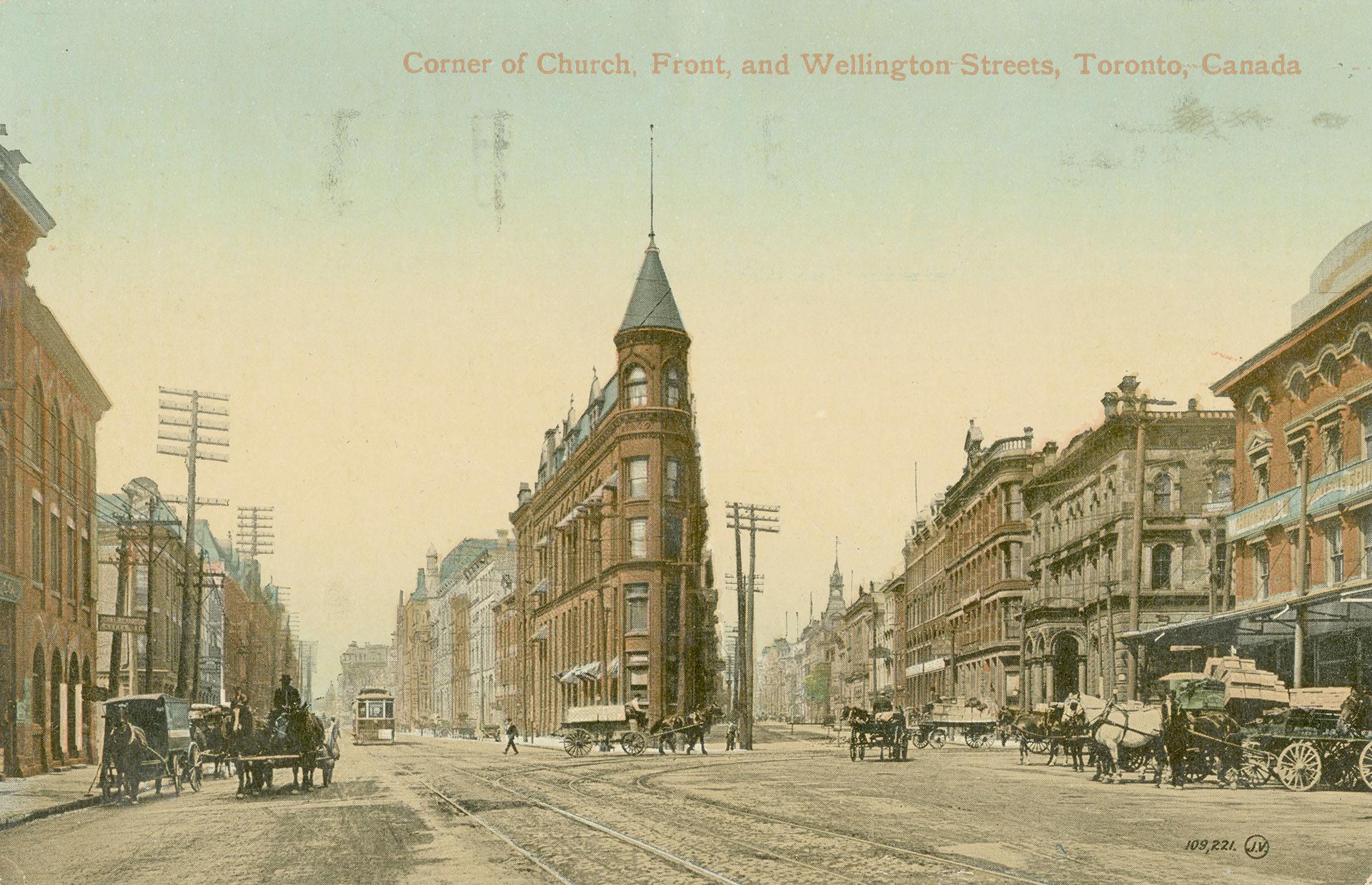
But that version of the park was itself a reinvention of what was there before. That block, tipped by the Gooderham Building, was a block full of office and business buildings by the start of the 20th century.
Postcard, approximately 1910, of the Gooderham Building viewed from the east; the future Berczy Park is the row of buildings behind it. From the Toronto Public Library’s Digital Archive
Scott Street, looking north from south of Front Street, 1955; the west end of Berczy Park, where the hands now are, is in this photo occupied by the white building front left. From the Toronto Public Library’s Digital Archive
In the 1960s, most of the buildings on that block (except the Gooderham) were demolished for a planned arts centre. But government reversals led to the arts centre being much less than initially promised – it became the St. Lawrence Centre, a building that occupies a half block of the south side of Front Street, across from Berczy Park. And the unused land became the classic Toronto placeholder: a parking lot. A parking lot in downtown Toronto is always a once and future building, a minimum-liability placeholder, somewhere something is going to be put. Only in this case, instead of another building, in 1980 they put a park there and named it after William Berczy. So: after business and some liminal years, art.
And after that, more art.
And now the park is one of the most European-feeling places in Toronto. An artificial European vibe, perhaps, but that seems suitable, no?
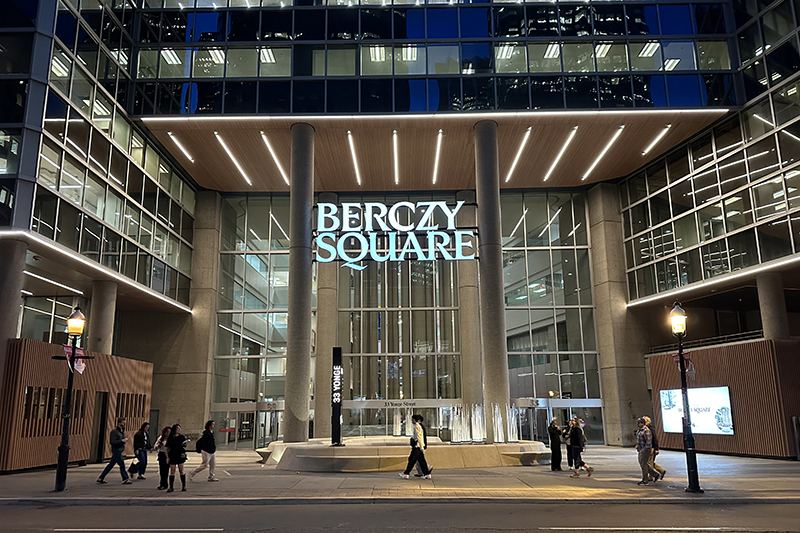
And this fanciful name has spread itself onto businesses as well. A recently established restaurant just a bit farther east on Front Street is called the Berczy Tavern; a building just west of the park, long known as the EDS Building and then the Altus Group Building, is now branded Berczy Square.
So William Berczy finally has the recognition he always wanted – at least among those of us who, seeing the name on the park, undertake some dogged digging into fountains of knowledge. Perhaps eventually there will be a plaque about him, or a reproduction of one of his paintings…
Who doesn’t like lavish things? Lavish parties, lavish gifts, lavish spending, lavish praise, a lavish lifestyle – to run through the most common words that come after lavish? Or a lavish spread, a lavish banquet, lavish accommodations, lavish dinners, lavish vacations, even a lavish home? Such ravishing luxury, such a lively lifestyle, so much more than, say, a slavish attention to the bottom line, or a meal made of a single piece of lavash. One simply can’t have too much lavishness, can one?
Can one? Is there a point when such a flood of luxury leaves one just… washed out?
Well. If you ask Lao Tzu – in the translation of the Tao Te Ching by Wing-Tsit Chan – “There is no calamity greater than lavish desires.”
Yes, OK, but what if the lavish is not desired but just given – perhaps by nature itself? To quote Vachel Lindsay,
I would be one with the lavish earth, Eating the bee-stung apples red: Walking where lambs walk on the hills; By oak-grove paths to the pools be led.
Such golden fires, such yellow—lo, how good This spendthrift world, and what a lavish God! This fringe of wood, Blazing with buttercup and goldenrod.
And Michael Field (the pen name of Katherine Harris Bradley and Edith Emma Cooper) voiced a paean to the
Lavish, large, soothing, refluent summer wind.
So how could lavishness itself be wrong? Who would reject a lavish?
Perhaps the people who would not reject “a lavish.” Because, ah, yes, lavish was a noun before it was an adjective (or, after that, a verb) – and while this noun fell out of usage around the time of Shakespeare, while it was at large it meant, to quote the Oxford English Dictionary, “profusion, excessive abundance, extravagant outpouring or expenditure.” And they say that like it’s a bad thing! A synonym would be prodigality, which, again, we know is supposed to be bad, but it is nice from time to time to be on the receiving end… when some storied host “makes it rain,” as the saying goes, and you are indeed awash in good things.
A wash? A downpour, perhaps? Consider this definition of a word (which I will name shortly) from Littré: “Pluie subite et impétueuse” (Sudden and impetuous rain). That sense of the word is “peu usité” (little used), but there is a second sense: “Vin, bouillon, sauce, tisane où l’on a mis trop d’eau” (Wine, bouillon, sauce, herbal tea where one has put in too much water). The example sentence for that uses the word defined: “Cette soupe ne vaut rien du tout, ce n’est qu’une lavasse” (That soup is worth nothing at all, it’s just a lavasse).
Yes, lavasse – which is the word that lavish traces back to. And lavasse traces, as Littré puts it, to “laver, avec la finale péjorative asse”: the verb laver – meaning ‘wash’ – with the pejorative suffix asse. We don’t quite have an analogous suffix in English – it’s tempting to say “that wash-ass stuff,” though the asse is not related to ass or arse – but we could say “just a washout” or something like that.
Which, ironically perhaps, something is now if it is not lavish enough. Like the infamous Fyre Festival. Which certainly involved lavish desires, and certainly was a great calamity, a total washout – but precisely because it was lavish in desire but not in fulfillment. It was – and its participants were – dishevelled, and dislavished.
Ugh, we were seated in a restaurant last week right next to a table with a family with three kids who were snorking and snotting. One was less than a metre from me. Just what I wanted: to catch a respiratory virus. It also didn’t make for the pleasantest dining experience soundscape.
OK, now, question, though. I like to use “snorking and snotting” to describe a certain thing, and I suppose not everyone uses that turn of phrase, but you know what I mean, right? For snotting one could say “blowing the nose and sniffling,” perhaps – the idea, anyway, is ‘producing a lot of mucus’. But snorking, now: is there another word that conveys that quite as well? If asked to define it, would you come up with a string of words, or would you just demonstrate: “sssnnoorrrrkkkkkk!”
Because it’s not simply sniffing or sniffling, is it. It’s inhaling loudly through the nasal passages for the purpose of swallowing loose mucus. It’s a common enough thing for people with head colds to do – especially the youth and any other uncouth. And yet our vocabulary for exactly that act is broadly wanting. Perhaps because it’s disgusting.
But people do snork, and we need to name it from time to time. So it’s odd to me that I rarely see the word snork. It’s not a new word. Aside from being imitative, and having the /sn/ phonaestheme that is so commonly associated with things nasal, it’s been in the language for centuries, though not strictly referring just to that gross ingression of catarrh. It’s attested in the OED from the 1500s meaning ‘snore’ and from the 1800s meaning ‘snort, grunt, breathe noisily’.
That is certainly broader than what I have in mind here. ‘Snort, grunt, breathe noisily’ puts me in mind of the eponymous vagrant in the song “Aqualung” by Jethro Tull, so named because of his noisy breathing (including, as specified in the lyrics, snot). But this is not quite aqualung territory. It’s more like… a snorkel, I guess.*
But, really, what other word could you use that would be equal? I’d be tempted to use sknx but it’s canonically a snore (and, almost unique among English words, strictly requires an ingressive airstream). Snorking (in the sense I mean) and snoring are produced by almost exactly the same means, though. Only, ironically, while a snore is somnolent, it is the snork that is more phlegmatic. Which is, for all the subtle gradations, a gross distinction.
*By the way, snorkel comes from German Schnorchel, which first named an exhaust pipe for diesel-powered submarines; it is formed from the same root – with the same meaning – as snore, which is also the most likely etymon of snork.
The point of compunctions, more often than not, is that one pointedly does not have them. Now and then is there a momentary compunction, a slight compunction, perhaps a single compunction, but the majority of times compunctions are spoken of, it is their absence that is remarked: a person has no compunctions about something – not even the least compunction.
Which means what, by the way? What are compunctions? Emotional complications? Moral conditions? Points of punctiliousness? Punctures in your composition? Or, simply put, qualms?
Wait… what is the difference between compunctions and qualms? When you inquire into qualms, you find that they, too, are most often remarked by their absence: nary a qualm, without a qualm, no qualms about doing it, no qualm with what someone has said or done, not even the least qualm… Occasionally someone may have a sudden qualm, or a slight qualm, or perhaps even a few qualms, but qualms, like compunctions, seem in short supply, at least when spoken of.
And a qualm is what? A quaver? A break in the calm? A mild queasiness or quaking? I could look to Wiktionary and see that it can be “a prick of the conscience; a moral scruple, a pang of guilt.” That brings to mind “a pricking of conscience or a feeling of regret, especially one which is slight or fleeting”… which is the definition of compunction. But a qualm can also be “a feeling of apprehension, doubt, fear etc.” or “a sudden sickly feeling; queasiness,” which goes beyond what one might think of for a compunction, which seems more a mere point of order or politeness.
Which allows me to get to the point – or points. The punct in compunction, you see, is indeed the same as in puncture, punctual, punctiliousness, and so on: a point, a needle, a prick – in this case, as said, a pricking of conscience. But compunction was not at first a slight needling; the com- made it more commanding and complicated. It was a bed of nails for the moral sensibility. It was the sting of remorse. It is only over the centuries (in particular between the 1300s and the 1700s) that the sense became less intense, as the usage slipped into the negative. Now a compunction – if you have one at all – might make you come to a stop, but it won’t kill you.
Unlike, perhaps, a qualm. We’re not quite sure, mind you, where qualm came from; there are a couple of theories, and not enough evidence to solidify either. But one theory connects it to quell, which, originally, meant ‘kill’. Indeed, in Old English – and up to the mid-1500s – qualm (or an earlier spelling such as cwealm) meant, to quote the Oxford English Dictionary, “Death, esp. of a violent nature; (also) an instance of this.”
So the moral quake of a qualm could be a little murder of the soul, no? Well, aside from the last known instance of that qualm being from 1532, and the first known instance of our modern qualm being from 1531, there isn’t much other than the coincidence of form to connect the two. Our first known use of the latter sense is from William Tyndale: “When Jonas had bene in te fishes bely a space … the qualmes & panges of desperacion which went ouer hys hert halfe ouercome.” I just don’t think “qualms and pangs of desperation” works with the ‘death’ sense, ya know? It is true that the older qualm could also mean ‘torment’ or ‘pain’ or ‘injury’, but, as the OED says, “evidence for a direct connection of the two words is lacking, and on chronological grounds it is unlikely that there is continuity between the two words.”
Which is why there is the thought that our compunctious qualm might be connected to modern German Qualm and Dutch kwalm ‘smoke, mist (especially noxious)’, perhaps from a root meaning ‘gush forth, well up’ or connecting through a sense of ‘dizziness, stupefaction’ – you know, that little queasy feeling.
Either way, you probably don’t have any, nor compunctions either. But how do you decide which of them in particular you don’t have? The sound and associations certainly help: compunction is longer and more technical, qualm short and visceral. Perhaps you could combine the two, to connote a sickening pricking of the conscience – a sort of food poisoning of the soul: qualmpunctions. It looks and sounds pretty bad. But, of course, you have none.
You hardly even notice it happening to you, if they’re good at it. They cozy up to you, almost like a brother, or at least a cousin, and they get you into what feels like a shared simpatico space – a kind of co-zen co-zone. But eventually, you realize you have been separated from your money or your moral principles, or at the very least a pretender has gained entry into your inner circle. You have been cozened.
It doesn’t sound very likely? Oh, my friend, it happens by the dozen. They catch you dozing, or simply with your guard down, and you’ll gladly supply in your own mind the story of why they belong where they are.
And this “they” includes words. Such as cozen. It’s a kind of Jay Gatsby of a word, except that by the end of The Great Gatsby we know where Gatsby really came from. We’re still not sure where cozen came from. There are a couple of good, interesting-looking, often-accepted possibilities – but they both present, as the Oxford English Dictionary says, “difficulties, which the extant evidence is not sufficient to remove.”
One account has cozen coming from Italian cozzonare ‘cheat, play the knave’, from a term for a horse-breaker. The problem with this is that it’s not clear how it got from Italian to English, or why English spelled it with an s in the middle at first and only later gradually changed to z, and never used a double z. For an Italian relation, it sure seems English, or perhaps French.
The other account is a literal relationship to cousin: a cozener, or cousoner, as spelled in 1561, was reported to be someone who travels around and pretends to people to be a kinsman so as to be a parasite on them. You know, a knock on the door, and it’s some travelling person who introduces himself as your distant cousin Fred, who’s been travelling and is passing through town, and could you happen to spare a bed, et cetera. You take them in and are taken in by them. Of course, this kind of thing was much easier to pull off in 1561, not just because these days it’s easier to check (though scammers still do impersonate family members, usually by text message now) but because in our culture today we are more likely to direct some purported unkown relative to a hotel.
The problem with that etymological account, however, is that the historical spellings of this word have generally been with -on or -en, whereas cousin has long been spelled with -in. So, again, it looks good but not quite right and something doesn’t altogether add up and the connection can’t be attested all the way.
Cozen has to have come from somewhere, of course. But its disguise is good enough, and its origins murky enough, that we may never know for sure. And, frankly, we’re kept off balance from the very start by the relation between its spelling and pronunciation, which – while not without precedent – is nonstandard, and by the presence of that uncommon and eye-catching z. There’s something fascinating about it. How can you not see yourself taking it in… or vice versa?
“It really was bizarre,” Maury said. “She just went berserk.”
“Biting her shield, like?” I said. “Immune to flame and blade?”
“What?” Maury said. And then he remembered that those were reputed characteristics of the berserkers, the Norse wild-man warriors from the age of the sagas who would go into frenzies, biting their shields, fighting almost demonically, undaunted by fire and swords. They were highly effective – but vulnerable to blunt instruments. “Oh,” he said, “no, sorry to be a buzzkill. She did not mount a bazooka to her shoulder or some other absurd thing. She is Norse, yes, but a Norse of a different colour.”
“So what happened?”
“As I said, we had been for ‘beerskis’ and brisket at the local brasserie, and then, while dancing a mazurka to the sound of a bouzouki played by a busker, I made myself so brazen as to suggest she invite me over for dessert.”
“How brash of you.”
“But she was not brusque in response. She led me to her flat, where I observed that she is a busy baker and had some lovely butterfly-shaped palmiers at the ready.”
“So much better to bite into than a shield,” I said.
“And no need for a knife,” Maury added. “But I feel I may have ruined the mood by being a bit blunt.”
“Well, you were probably a little hammered,” I said. “What did you say?”
“I was just wandering around the room, like a berk, and I picked up a picture from the buffet and said, ‘Who’s this babe?’”
“Was it a picture of her?”
“Well, I thought it was. It was a bare-skinned baby lying face-down on a bearskin rug.”
“That certainly seems appropriate for a berserker,” I said. I knew that Maury knew that the word berserk comes from Old Norse for either ‘bare skin’ – as in they fought while unclad – or ‘bear skin’ – as in they were clad in bearskins.
“And it would have been,” Maury said, “had it been of her. But she snatched it from my hand and went into a cleaning frenzy the likes of which I have seldom seen.” (Well, I thought, that’s appropriate: berserkers got things done briskly.) “Every loose piece of paper,” he continued, “odd book, what have you, she gathered up and stuffed them in a drawer that, I glimpsed, was also loaded with brassieres and other such business.”
“Did she explain?”
“No – rather, she attacked me. But in a good way, I guess. She grabbed me and started smooching me. Perhaps to take my attention away from anything she had missed ablating.”
“So did you find out who was in the picture, and why she went berserk?”
“I got an idea,” Maury said, “when I heard the door buzzer. She rushed over and pressed the intercom and a voice said, ‘Bazinga!’”
I looked at him quizzically.
“It seems,” he said, “she has a boyfriend. Who had arrived on a surprise visit.”
“Ah, well,” I said. “Them’s the breaks. And how did he react to your presence?”
“No idea,” Maury said. “I escaped via a window. But perhaps she will tell me on Wednesday – we have another date.”
I gave him a steady look. “You’re a real wild man.”
I’m sure it’s not everyone, but there’s a lot of it going around: you’re overwhelmed by what’s going on in the world, overwhelmed at work, maybe even overwhelmed in your personal life, and then, when you get some leisure time and take in the available entertainments (or, after an overwhelming travel experience, get to an affordable destination, if any such exists), you find the enjoyment level… underwhelming.
Welp.
I reckon we need some whelmness coaching. So we can get our level of whelm just right.
OK, OK, word cranks. Yes, whelmness is not in your dictionary. So what. There was a time when underwhelmed wasn’t in any dictionary, but it took root nonetheless.
And OK, yes, word nerds, whelm actually means the same as overwhelm, according to any dictionary you look in. But try using it that way, my friends. “I was completely whelmed by work.” “Oh, so you were suitably gruntled? Reasonably combobulated? You’re acceptably shevelled?” “No, no, I was whelmed. Which means ‘overwhelmed.’” “Well, why didn’t you just say ‘overwhelmed’ like a normal person, then? Are you trying to overwhelm us with your dictionary study? Because I’m a bit… uh… underwhelmed here.”
Yes, this is how it is: whelm meant, originally, ‘overturn’ or ‘capsize’; a thing that was whelmed was either a boat or other thing inverted with concavity down, or someone or something covered by such a concavity. It seems to have come from a root referring to arches or vaults, as in vaulted ceilings – in other words, if you whelmed your boat, you turned its hull into a ceiling. And from that, whelm then came to mean ‘sink, submerge, drown’. And from that, it came to mean ‘engulf, bury’ – if an avalanche covers you, you are in that sense whelmed.
These senses of whelm showed up in English in the 1300s and 1400s, but also by the 1400s we had overwhelm, meaning ‘overturn’ or ‘overrun’. Why bother with the over? Well, why bother with the by in bypass? Why say both hence (‘from here’) and forth (‘forward’) in henceforth? Why say linchpin when linch means ‘pin’?
The answer is that sometimes it’s for clarity, and sometimes it’s for emphasis, and sometimes it just sounds more impressive – and sometimes it’s two or all three of those reasons, which is probably the case with overwhelm.
And, quickly, from ‘drowned’ or ‘buried’, overwhelm came to a broader figurative sense of ‘defeat utterly’ – so that if you (figuratively) lose in (or by) a landslide, you are (figuratively in the same sense) overwhelmed. And thus we have overwhelming odds, overwhelming victory, and, you know, overwhelming stench and overwhelmed by emotion and, with only a little bit of weakening of the sense, overwhelmed by work.
And since we had this word overwhelm, so vivid and forceful and long, there was no call for the weaker whelm, and at length we did not learn what the books say it means. And thus of course it’s easy for people to make a guess as to what the whelm means and, seriously or perhaps a bit jocularly (just as with recombobulate), come up with underwhelmed. Which first showed up in the 1950s. And absolutely sealed the fate of whelm, which was, we may say, overwhelmed by the trend of usage.
And thus, in the same jocular vein, with a play on wellness, it seems perfectly obvious to talk about whelmness. I’m not the first person to confect that, either. It’s sitting right there. When you see whelmness, you can recognize what it means: something on the order of ‘level of challenge from life circumstances’. And you may smile ruefully and check your own internal whelmometer.
Ha. Sure, the days are going to be longer than the nights now, but if you’re from any northern climate zone, you know that it’s more light than heat. And you can expect the slow thaw to be shot through with bursts of cold. Don’t put away your winter clothes yet – it’s a trap. Spring? More like springe. Don’t be a woodcock!
For those not at home with Hamlet, I’ll explain the reference. In act I, scene iii, Ophelia is telling her father, Polonius, about the vows Hamlet has made to her, and Polonius snorts, “Ay, springes to catch woodcocks.” As it happens, this turn of phrase didn’t originate with Shakespeare’s 1603 play; the Oxford English Dictionary has earlier quotations, including one from 1579: “Cupide sets vpp a Springe for Woodcockes, which are entangled ere they discrie the line.” You can see it means a trap for fools or the unsuspecting.
Specifically, a springe is a snare trap using a bent branch and a noose, and when it’s tripped the noose catches the creature – in this case a woodcock – and hoists it. If springe looks like spring, there’s a reason for that: it’s really a variant of the same word (and, by the way, spring meaning bouncy or tensioned thing, spring meaning the season after winter, and spring meaning water source are all the same word, just set to different specific aspects of ‘leaping forth’). But don’t get caught out: springe does indeed rhyme with hinge.
And a woodcock? Well, leaving aside any double entendre, it is a bird – specifically a kind of sandpiper of the genus Scolopax, and closely related to the snipe – and, like the sandpiper, finds its food by stabbing the sand. Etymologically, woodcock really does just mean ‘forest rooster’. But the relevant point here is that the woodcock is, by reputation, rather stupid or foolish, such that woodcock was by Elizabethan times a term for a fool, dupe, sucker, simpleton, what have you. Also, the literal woodcock is, by reputation, good eatin’ – a fine little game bird. Which is why you would want to set springes to catch them in the first place.
That’s not the only way to catch them, though. Hunters would gladly go a-hunting for them and their near kin. They would employ dogs to flush them out of the shrubbery – specifically cocker spaniels; that’s why they’re called cocker spaniels, because they’re for flushing out woodcocks (which they may do with a little help from their friends, but they’re not Joe Cocker spaniels). Were you thinking that perhaps they would use springer spaniels for that? Indeed, springer spaniels were also meant for springing – flushing out – game birds, but mainly larger ones, which is why springer spaniels are larger. And note that this springer and springing are like spring, not like springe.
Incidentally, once the birds are sprung, they still must be shot. Keep your rifle cocked. I can’t tell you just how difficult it is to hit a woodcock, but I can tell you that their cousins the snipes famously require skilled shooters to hit. That is why we have the term sniper: originally a word for someone who could hit a snipe; then a term more generally for a sharpshooter; now a term specifically for someone who shoots with care and precision at people – with the verb snipe backformed from it.
I swear, I’m not pulling a fast one on you here! I am not springeing you like a woodcock, nor am I taking you on a snipe hunt (which, by the way, as you may know, is not a hunt for actual snipes but is a prank played on summer campers, scouts, and similar young woodcocks, who are sent out on a wild chase looking for something called a snipe that is certainly not a wading bird). The word snipe truly is an Old English word from an Old Norse word for the bird, and might have originated in a reference to its snout – that is, its needle beak, suitable for stabbing the sand in search of worms to hoist, sort of like how frost stabs its way into spring to springe you like woodcock as you set out underclad. No need to get heated; I am just trying to shed some light on the subject.
Oh, by the way. Polonius says a little more than what I quoted as he warns Ophelia against Hamlet’s affections. Ah, a little more? Polonius is famously prolix: his brief advice to her stretches 21 lines. Here are his opening few lines:
Ay, springes to catch woodcocks. I do know, When the blood burns, how prodigal the soul Lends the tongue vows. These blazes, daughter, Giving more light than heat, extinct in both Even in their promise as it is a-making, You must not take for fire.
Oh, say – are you more used to the phrase being “more heat than light,” typically used to mean “generating more emotion than understanding”? That’s a credulous reversal of the original, which, as you can see, means “giving a lot of show but not much real value.” Or, I guess, as Hamlet said, “words, words, words.”
…Huh, would you look at the time. We’re halfway between the winter of our discontent and glorious summer. I should take my leave now…