alcatras, pelican

The pelican does not have an overwhelmingly noble image in the modern world. Comics have undoubtedly had an influence on this: the bird is portrayed as a large, ungainly thing with a great big pouch in its bill that it uses for stowing whole fish. As Dixon Merritt wrote:

A wonderful bird is the pelican,
His bill will hold more than his belican,
He can take in his beak
Food enough for a week,
But I’m damned if I see how the helican.

It matters little or not at all that the word pelican is in its way delicate, with tastes of skin (pellicule) and peels and angel hair pasta (cappellini) and possibly even singing (a capella). The focus is now on the big garbage can of a bill.

Nor would it be served so well now by its alternate name, taken from the Spanish: alcatras. The taste of the prison, named (in archaic Spanish) for the island it was on, named for the birds that flocked there, is hard to get past, even though the word has a certain delicacy that could go either way – hints of scar and sacral but also alcohol and star and perhaps class… Both words have two voiceless stops and that liquid /l/ plus one other consonant, and both have three syllables with a dactylic rhythm. Neither has an easy phonological or orthographical resemblance to the big bird with the big bill. But we still no doubt view it better than we would if it were named, say, grackle.

I say alcatras comes from Spanish because that is its immediate source, but this word, like some others that begin with al, comes originally from Arabic, where al is a definite article. And like most of those others (including alcohol and algebra), it means something a little different from the original – in this case, the source, al gattas, referred to a kind of sea eagle. But an even greater shift shows up in albatross, which also comes from al gattas but with the Spanish influence of alba “white”.

But talking of shifts: this is the bird that is the national bird of Romania (and of the fictional Syldavia in the the Tintin books) and three Caribbean countries, and the state bird of Louisiana; this is the symbol of institutions such as the Irish Blood Transfusion service; this is the bird featured on the coats of arms of Corpus Christi Colleges at Oxford and Cambridge, and used in heraldry as a symbol of selfless sacrifice, vulning, because of its use in Christian iconography to represent Jesus – the sacrifice of a parent for children. And to advert to the eucharist, the consumption of bread and wine as the body and blood of Jesus.

What? Well, the pelican (alcatras, if you prefer) was long thought to wound itself in the breast to feed its young its blood when food was scarce. You see, pelicans have a habit of pressing their beaks against their chests to empty their pouches, and this can look like wounding itself in the chest. Some kinds of pelicans also have red on their bills at certain times, which can look like blood. It is thought that these things, observed, were interpreted as the selfless act.

And thus we have, for instance, this verse from a hymn by St. Thomas Aquinas:

Pie Pelicane, Jesu Domine,
Me immundum munda tuo sanguine:
Cujus una stilla salvum facere
Totum mundum quit ab omni scelere.

Which translates (I’ll use Wikipedia’s version) as:

Lord Jesus, Good Pelican,
wash me clean with your blood,
One drop of which can free
the entire world of all its sins.

That’s a far cry from “I’ll be damned if I know how the helican.” And it’s also a bit of a trip from national symbols to a prison island… But redemption may come again. After all, Alcatraz is now a very popular attraction with beautiful flowers and plenty of birds surrounding its grim buildings.
vuln

Does this word seem somehow wounded? Truncated, perhaps, or otherwise cut? An eviscerated vulcan? Or a vulnerability that has been exploited? Or, if not wounded, then at least tightly wound?

Oops. Did you see what I did there? Tsk. How is a person supposed to know which wound I’m using when I do that? It would be like if we had the same letter to represent both a consonant and a vowel. OK, well, yes, we do, y. But what if we used the same letter for v and u? What if we spelled this word vvln or uuln?

As in fact we used to. After all, v and u have only been treated as different letters for a couple of centuries. They both come from Latin v, which, classically, had a [w] sound as a consonant and an [u] or [ʊ] sound as a vowel (as in “boo” and “book” respectively). Over the centuries, as letters developed cursive forms, there came to be an alternative u shape for v, but the sounds also pulled apart and its consonantal value moved to [v]. So some bright sparks recommended that, rather than having two interchangeable forms of a letter that stood for two different sounds, one form should go with one sound and the other with the other. (This happened with i and j too.) So back in the 1500s, this word could be seen written as vvln, uuln, vuln, or even uvln, though probably not so much that last one.

Fair enough, for three reasons. The second reason is that in some people’s handwriting – mine, for instance – the letter n looks pretty much like the letter u. The third reason is that the standard English pronunciation of this word is represented in the International Phonetic Alphabet as /vʌln/, yet another case of flipping shapes. The first reason – a longer, more important reason, which is why it’s the first but why I’m getting to it last – is that the word comes from Latin vulnus, i.e., vvlnvs (or uulnus), “wound”, as in the noun for what you receive from a sword. It’s also the root of vulnerable, the first syllable of which is identical to today’s word in pronunciation as well as spelling.

So why would we need another word for “wound” when we already have wound, aside from that it can be confused with the past form of the verb wind (which has a similar issue in the present)? It’s not as though we have a special need for another word with a swallowed /l/ in the middle. And actually it seems we wouldn’t need another word; vuln is pretty much not used nowadays. With one little exception. There is one preserve of pretty little archaic and rare Latinate words that is a natural resting place for this word, this vulnerable little fallen angle (that’s not a typo): heraldry.

Heraldic shields, after all, often feature animals. Sometimes those animals are wounded. Well, no, in heraldry they’re vulned – often stuck through with a spear as vuln is stuck through with the l. (I can see this catching on with the role-playing game crowd: “I seriously vulned him with my Ethereum phase-spear.”)

But there is also one bird that is said to be vulning. A vulture? A falcon? No, it’s a bird that is known for constantly picking at its chest, an act that is referred to (in heraldry) as vulning, on the idea that the bird is wounding itself. It’s a bird that happens to have given its name to a famous and forbidding prison. Which bird? The pelican.

What, you’ve never heard of a famous jail named after pelicans? Of course you have, and it even had a “bird man”… I’ll tell you about it tomorrow.

futalognkosaurus

I was going along by foot up from Museum Station towards the entrance of the Royal Ontario Museum when I noticed something afoot – specifically, stick-on dinosaur footprints on the sidewalk, leading along underfoot towards the entrance. Almost entrancing. Each had the name of a dinosaur on it. But my head really turned when I saw a name literally sesquipedalian – a foot and a half long – spanning one. It was a name with which I was unfamiliar and it had a spelling that seemed all gunked up, like an orthographic logjam: futalognkosaurus.

Well. I knew that was something to look up. As it turns out, it’s also something to look up at: a futalognkosaurus is much, much more than a foot long. The skeleton that has been assembled from three specimens is 70% intact, which allows us to see quite surely that this enormous herbivore was about 33 metres long, and its head can be seen more than two storeys above your feet. (See “Futalognkosaurus was one big-ass sauropod.”)

So the word is quite fitting in magnitude, with its six syllables, fourteen phonemes, sixteen letters. But, oh, yes, how does one say it? Attempts to sort it out this funky chaos might seem futile or even fatal without some guidance. Who, after all, is at fault for this gnarly knot, gnk?

Well, when you’re digging up remains of very old critters that haven’t been identified before, you have to get a name from somewhere. Sources vary. Krister Smith, for instance, named a little lizard Suzanniwana patriciana after two colleagues of his. In this case, Jorge Calvo and his team named the lizard – well, the dinosaur, but the saurus part comes from Greek for “lizard” – with a compound word taken from an indigenous language local to where the bones were dug up: Mapudungun, language of the Mapuche people of the Argentinian province of Neuquén. Futa means “giant” and lognko means “chief”. This is thus, in its linguistic miscegenation, a name for a giant chief lizard. (But a vegetarian one!)

Oh, and lognko is pronounced as it would be were it spelled longko. As in fact it sometimes also is. The Mapudungun language has various competing orthographies. All of them are efforts to fit the language into the Latin alphabet, which is not perfectly matched to it. Does gn seem an odd way to spell that sound, /ŋ/? Well, so is ng – there’s no /g/ in the sound, after all – and so are pretty much all two-letter representations of single sounds: sh, ch, th in English, for instance.

Anyway, this massive critter from the Cretaceous is such an odd transposition into the present, such a startling juxtaposition, and all made of bones, why should its name be a simple no-bones-about-it spelling? Better to have something that stops us in our tracks. Or in its tracks, on flagstones along underfoot.

rebozo

Frida Kahlo with rebozo.

This is what the placard next to the painting says. Not Frida Kahlo with her bozo. Not Frida Kahlo with boozer. There is no one else in the picture. It’s Frida Kahlo with rebozo. And what you see is Frida Kahlo, the same face at the same angle as dozens of other Frida Kahlo pictures of Frida Kahlo, with no sort of painting or architecture around, just some clothing on her. What is a rebozo again? It sure sounds like some part of a gothic cathedral or its altarpiece or…

No, it’s that scarf, that shawl. That red wrap. You see it again and again; in the photos of her she’s wearing it very often. Sometimes she has it wrapping over and around her head and framing her face, as is traditional. But often she has it wrapped just around her shoulders and bust.

It says she’s Mexican.

Rebozos are most popular in Mexico. They were likely born there. The name is Spanish, with a proper Latinate pedigree. The immediate source is rebozar, verb, “muffle”; that draws from re plus bozo “cheek, mouth”, which comes from Latin bucca. The word shows up first in the 1500s, right around the time the Spanish colony of Mexico was coming into being, wrapping itself over the existing cultures, the Europeans smashing in like a cultural Chicxulub. But the cultures did not disappear; they contributed, or were taken from. There is likely indigenous influence in the design and fabric of rebozos, which can be solid-coloured or can have designs, either in small bands or as a pattern.

Frida Kahlo felt strong attachment to her Mexican heritage – from her mother’s side. Her father was a German photographer. Her name has nothing to do with Kahlúa, nor with Friday. She was a mix of imported and indigenous, exotic and domestic. She was a communist and wanted to identify with the salt of the earth of Mexico. A rebozo certainly wrapped her in that.

You know, since it’s Spanish, that the z in rebozo is, in the original, pronounced like /s/ (it would be different in Spain than in Latin America, but this is not a garment from Spain). But in English, we say it as /z/ because that’s how it’s spelled. It gives it a buzz. We are paying more attention to the externals as they seem to us rather than to where the word really came from. We’re very inconsistent about such things in English.

But this word, it looks somehow rakish or comic or otherwise exotic to us. The z is not an indigenous character for English; we didn’t treat /z/ as a different sound from /s/ until somewhere in the Middle English period, under French influence. Then we had to borrow the letter. Positioned between the o’s, ozo, it gives us an arrangement with rotational symmetry, a hint of ozone, a pair of eyes that call forth ojo (Spanish for “eye”), a z with two zeros flanking it, and something like a pattern to go on a robe or rebozo.

Romance languages are much more used to z. It shows up all the time in them. Words that end in o are also quite common in Spanish. This word may startle our eyes like Frida’s unibrow and moustache, but such things are not equally startling or exotic to everyone.

If you search rebozo on Google, you find quite a lot of references to its use for pregnant ladies to support their bellies, during labour as well, and then as a sling to carry an infant in. (I’m sure it’s a coincidence that Richard Nixon had a confidant, Charles Rebozo, nicknamed “Bebe.”)

Frida Kahlo had several miscarriages. Her rebozo is not filled with belly or baby. She wears it just around her upper body. It may be native Mexican, but hers has no Mexican nativity. It is just her, over and over again, sometimes with her husband, Diego Rivera. A piece of the past, not carrying the future. Just framing a gaze.

e’en

’Tis Hallowe’en. Darkness falls o’er the land. Ah, if e’er there were a night for ghoulies and the deil, ’twere e’en this one. A night when all is dark poetry… and a gremlin goes about stealing v’s.

No, that’s not quite it, but one does wonder. Hallowe’en, from Hallow even (as in evening); deil, a Scottish version of devil; and then there’s e’er and o’er and e’en… But of course those are not confined to Hallowe’en. Rather, they are hallmarks of heightened, poetic diction to most modern English eyes.

Well, there’s a reason for that: the place we typically see them is in archaic verse, where even and ever and over have been condensed into single syllables to fit the meter. We see e’en in Shakespeare, to be sure, and not always in the verse – it shows up in some of the more casual speeches too, demonstrating that it was also used in ordinary speech. Hamlet uses this contraction e’en five times (and other characters in the play another half dozen); it shows up nearly two dozen other times throughout the Bard’s plays. (On the other hand, e’er shows up 85 times, but only once in Hamlet, while o’er is used 211 times, including 14 in Hamlet.)

But who would say it thus? Does it not seem forced? We’re used to contracting vowels, but less so consonants. In modern English, where we do drop or greatly reduce consonants, they tend more often to be at the tip of the tongue – /t/, /d/, even /n/, sometimes /z/, innit? We are not so much in the habit of leaving out /v/ these days. So this hollow e’en truly does seem like a creature from Hallowe’en. It may intend to be even, but, frankly, it’s rather odd. It looks like a claw has come down and plucked the v out.

What it really is is a sign of shifting phonotactics. Different languages, even different accents, have different possible versions of a given sound. In the kind of English I speak, /t/ can be reduced to a stop or left out entirely next to a nasal or some other consonants, but not usually between vowels; in some versions of English, it can be replaced with a glottal stop between vowels; in others, it has to have the tongue touch the palate everywhere. In some kinds of English, [h] is lost at the beginning of a word, and [r] after a vowel becomes a lengthening of the vowel. In other kinds, no. In Spanish, [b] and [v] are two versions of the same phoneme, but not [p] and [f], and [d] and [ð] are versions of the same phoneme, but not [t] and [θ]; in Dutch, you can drop the [n] in an en ending; in French, many consonants are only pronounced at the end of a word if there’s a vowel starting the next word, and in past times it became so standard to drop s (said [s] or [z]) before certain consonants in certain words that it was just replaced with a circumflex over the previous vowel; and so on.

Differences between dialects, differences between languages… also differences within a language over time. Or should that be o’er time? You see, it was at one time the case in English that lazy lips could let the [v] sink and slip, and accommodating listeners would fill in the blank – just as “’sup” can be understood as “What’s up”… Nome sane? (Nome sane? Ima let you figure that one out.)

Yes, yes, it was lazy speech, of course, just as contractions ever are: economy of effort. But accepted enough in its time and place, just as ’tis. Now, of course, ’tis is considered formal or, if in dialect, cute, while it’s is just casual. And e’en? Words are known by the company they keep, and e’en, like o’er and e’er – and of course ne’er – is only ever seen in hymns, Shakespeare, and lofty poetry. It’s moved up in the world.

Funny, innit, how current syncopations can be so casual and archaic ones so formal. It’s as though the ghosts of working-class toughs gained tuxedos. When I was writing Songs of Love and Grammar, my friend and colleague Carolyn Bishop (who, by the way, has lately come out with a book of wordplay called Meaningless Platter Dudes) suggested a novel punctuation mark especially for these elevated revenants (and all the nonce contractions made by lazy poets to cram words into the line). Here is what I made of it:

The gravitastrophe

for Carolyn Bishop

Had I it in my pow’r
e’en for a wond’rous hour
to let words solemn hark’d
in print be plainly mark’d,
the mark I’d use would be
the gravitastrophe!

Momentous situations
oft call for syncopations;
howe’er, a plain contraction
is plebeian detraction.
To keep solemnity,
use gravitastrophe!

Take ink plash’d from a fount
on ’Lympus’ heavn’ly mount;
’scribe it with quill-pen gain’d
from phoenix wing detain’d;
’gainst alabaster be
writ gravitastrophe!

Like cherub’s down, the curl
shall clockwise-turn’d unfurl
’til, widdershins returning
(profan’d convention spurning),
with circlet tipp’d shall be
the gravitastrophe!

This stroke shall through the ages
be ’grav’d on scepter’d pages
so humbl’d reader knows
that whilom mundane prose
is rebirth’d poesy
with gravitastrophe!

bupkes

Four years I’ve been working on this blog. Four years! One thousand two hundred seventy-six posts! And what have I earned from it? Bupkes!

Or bubkes!

Or bobkes!

Or bubkiss!

Or bupkiss!

Or… OK, you get the picture. Words, they’re their own reward. Fine. As we say in show business (I used to be a theatre person, you know), “Don’t clap, just throw money.” Ah, money shmoney. I’m doing it for the fame. With a beautiful sweet wife like mine, how much luckier or richer should I expect to be? Still, I wouldn’t object to a few people buying my book.

But enough about me. Back to this word. You can guess what it means from context, even if you’re not familiar with it. And the context you’ll hear it in might lead you to guess soon enough what language English got it from. That object-subject-verb syntax for emphasis, the shm echoes, the bantering style, the rhetorical questions – all are characteristic of Yiddish humour.

And I have to tell you, English would be that much poorer without Yiddish humour. Many of the funniest people in 20th-century America had Yiddish backgrounds (including some you may not have realized, like Rodney Dangerfield, born Jacob Cohen), and the Yiddish music-hall shows in the early 1900s in New York made very important cultural contributions that may not often be acknowledged but show through in many places.

Yiddish vocabulary shows up in more places than you might even notice, and sometimes creeps into everyday usage almost unremarked. (I think of myself in 1990s Edmonton playing a Spanish soldier invading the Americas in Peter Shaffer’s Royal Hunt of the Sun, improvising a little bit about stealing some gold – other actor: “It’s just a trinket.” Me: “Trinket shminket!” Did I mention that my ethnic background is WASP and, growing up in 1980s Alberta, I knew very few Jewish people?) When you read “40 Yiddish words you should know” from Daily Writing Tips, you will surely find that you do know several of them, and may not have thought of all of them as Yiddish.

By the way: Do you know what Yiddish is? Yes, it’s the language commonly spoken for a long time (but not so much anymore) by Ashkenazi Jews in Germany and nearby places (and America). You may not have known that it’s basically a kind of Low German (“Low” because from areas closer to the sea; “High” is from areas higher in elevation) with a fair amount of influence from Hebrew, and typically written using the Hebrew alphabet.

Which is why there are so many spellings of this word. You’d think someone could settle on one! But what do I know? When I first heard this word (and for a while thereafter) I thought it was buttkiss. You know, “What did I get? Buttkiss! (As in I might as well kiss their butts!)” But there are so many different transliterations of Yiddish words, depending on who’s doing the transliteration. The spelling of this word that I’m most used to is bupkes, but that’s more of a phonetic transliteration than a phonemic one. The original is באָבקעס, bobkes, which means “big beans”, but voicing assimilation causes the /b/ to become [p]. But actually that’s not really the original original. The original original is thought to have been a longer word, קאָזעבאָפּקעס, kozebopkes, which means “goat droppings”.

So there it is. It’s a good word for it, with that opening bop, like a hand flipped up abruptly (in colloquial Italian there’s a word boh that’s said like a bop, with maybe a shrug, to mean “dunno” or something of that order), and the backing echo of guess… Actually, what it really is is more the sound of something inflated (your expectations maybe) being punctured (bup!) and all the air hissing out (kiss…). All this and what do I get? Beans! Goat droppings! Bupkes! I’d be better with a bunch of latkes…

Funny, by the way, how “nothing” has such power to it (sort of like words for sex or drunkenness or other socially outré things) that we have come up with a variety of colloquial ways to express it – as though the strong emotion it calls forth demands some sort of trope or linguistic excursion. There’s buggerall, diddly-squat, SFA, zilch…

Say, how many synonyms for “nothing” do you suppose I can collect? A whole lot more than bupkes… I’ll be watching the comments.

per se

A crowd-sourced reference such as Urban Dictionary is not altogether reliable per se, but it certainly can give you bits of insight that you won’t get in more authoritative references. Look, for instance, at some bits of its several definitions of per se:

A Pretentious term, often used both out of context and too often by people who would like to sound more intelligent than they actually are.

Frequently used improperly by persons who think it makes them sound educated.

a phrase that allows some flexibility in the topic at hand, so you can talk about something without being very specific

“as such” or “by” but really it seems to be used as a pause in a sentence. It is an overused phrase by Neanderthal wannabes incapable of speaking or writing clearly.

Trenchant thoughts about its pragmatic place in communication. But its meaning? Here are some versions you’ll get from Urban Dictionary:

on the face of it
generally speaking
on average
inherently

Synonym for “exactly” or “quite.”

Hmm, what? That’s not quite it per se… But you see how those might come to be seen as definitions. It is, as the best definition at Urban Dictionary says,

typically used with a negative to indicate that a term being used is understood to be imprecise or off-the-mark (i.e., not accurate ‘per se’) in a case where the term is nevertheless useful to an explanation. Usually followed by an explanation or justification for the use of the term indicated.

So what is per se, per se? In itself? “In itself”. That’s the Latin: per se is Latin for “in itself” (or “by itself”, “of itself”, or “for itself”, or “intrinsically”). When you say, for instance, “He’s not attractive per se,” you can follow it up with, say, “but his bank account does draw attention.”

It thus allows you to be a bit catty: a subtle undermining, a Parthian shot. There’s a little purr in what you say. Or it can simply allow you to be circumspect: first you thoughtfully purse your lips, then you say… for instance, “It’s not well written per se, but it makes some very important points.”

But, oh, watch out! Don’t get purr say or purse say stuck in your head. Many people write this phrase as per say. Why? Well, that’s not so hard to guess: they aren’t used to seeing it written down, they don’t know Latin, and that’s what it sounds like – two English words, per and say. Even if the sense of the phrase doesn’t match the combined sense of the two words per se, that’s not a big issue; English is loaded with idioms that have scant surviving relation to the senses of their parts.

Still, better to think of something that will help the proper spelling stick. I’m put in mind, for instance, of Perseus – the Greek hero who slew Medusa and saved Andromeda from a sea monster, among other things. How did he slay Medusa when the sight of her would turn anyone to stone? He had to look at her, right? Well, not per se. But did he then slay her without seeing where she was? Well, not per se. He used his shield to see her reflection. (A mirror may be a visual prosthesis, but it’s an imperfect one – perhaps the gorgonizing properties were carried only by wavelengths not reflected by his shield.) So he’s per-se-us… sorta. Or not.

You could also think of perse, which is a very deep shade of purple or bluish-black. It’s pronounced like “purse,” so be careful, but you could always say it’s not black per se… It’s more the colour of smoke on the water. Really deep purple. (It seems to come from an alteration of the Latin word for “Persian”.)

By the way, there is another usage of per se, one that is more common in the positive: as a legal term meaning, well, yes, “in itself”, but more strictly “by law” – as in “Exceeding the speed limit is an infraction per se.”

It’s really not a difficult term per se; it’s just loosely used and a bit confusing for some people. I’d have to say it beats the Aristotelian Greek phrase it was pressed into use to translate: kath’auto, which looks like a woman’s car and sounds a bit like catheter.

shotglass

There are 26 ounces in a standard bottle of liquor. There are 26 letters in the alphabet. I’ll drink to that.

In fact, I decided to make it easier for everyone to drink to that. I set up a little store in CafePress.ca where you can buy shotglasses, one for each letter of the alphabet, each one with a word, so you can also use them as teaching aids (yeah, right): A is for apocolocyntosis, B is for bahuvrihi, C is for cataskeuastic, D is for deliquium, E is for esoterogeny, F is for floccinaucinihilipilification, G is for glossolalia, H is for haruspex, I is for isogloss, J is for jildi, K is for kjerulfine, L is for littérateur, M is for monoubiquitination, N is for nudibranch, O is for onychophagia, P is for polyphloisboian, Q is for quux, R is for rocococity, S is for splanchnic, T is for tergiversation, U is for unununium, V is for vellicate, W is for whippletree, X is for xylyl, Y is for ytterbium, and Z is for zurrukutuna. Alas, the cafepress.ca prices are not quite as cheap as souvenir store prices, so I doubt anyone will collect the whole set. But, then, people don’t often drink a whole bottle of liquor in successive shots in one event, either. If you did, you would probably very soon find yourself face down in bed, proofing your sheets.

Shotglasses do make nice little souvenirs. Not too expensive, quite easy to fit in your luggage, and capable of displaying to whoever might see it that you (or someone you know) visited the location or event thereon named. They are also handy in bars for measuring liquor (in those places where, by law, liquor has to be precisely measured) and selling shooters – which are an excellent profit centre for bars. And of course they’re good for selling shots of liquor. Hence the name.

The full course of coming into being of the word shotglass is disputed, and there are a variety of inane invented etymologies, which I will do you the favour of not sticking into your mind. But we do know that a short measure of liquor was being called a shot before the name shotglass (or shot-glass or shot glass) was ever known to have been used. And when did shotglass come about as a name? By 1940, but likely in the 1930s.

That’s right. Those “old west” images you have of cowboys or prospectors slapping down a nugget or a bullet (or several – whiskey wasn’t that cheap) and getting a modern-looking shotglass of whiskey in exchange are in need of correction. The saloons likely didn’t bother carrying special glassware for the small quantities, and if they did, the glassware – called a pony or jigger at the time (and still) – was slightly different in shape. The tapered, thick-bottomed glass we see now is really a post-Prohibition thing.

This word, shotglass, seems almost too long for its object, which is quite a short glass. Shotglass has two syllables! Nine letters! The measure in a shotglass (an ounce or an ounce and a half) can be downed in the time it takes to say either syllable of it – the time it takes someone else to say either syllable, of course. You shouldn’t try to speak while you’re tossing back a shot.

But it is a nice word nonetheless. It slides in and slides out on voiceless fricatives, and it has a sharp joint in the middle that seems rather like an act of swallowing – you could think of it as like the liquor pouring into the mouth (sho), being swallowed (tgl), and pouring down your throat (ass). That swallowing also swallows the /t/. Just try saying the word clearly, with a properly said [t]. Because of the /gl/ after it, it’s just a lot easier to reduce the /t/ to a simple glottal stop – which, right before a [g], becomes an equivalent of a [k], really.* Shotglass is said just the same as shockglass would be.

And why not. What you swallow from a shotglass is probably a shock to the system. Oh, it might not be liquor; it could be espresso. That’s a nice, strong little dose, too. We know that whatever’s being served that way will have some punch to it, some amount of aggression in the image. To drink larger amounts of alcoholic beverage rapidly, you might shotgun it. If you have a shot of hot chocolate, it’s a thick, dark, spicy brew. You can think of having a shot of tea – if you picture slugging back some very strong black tea. A shot of chamomile tea just seems very incongruous to me.

There is another thing called a shot glass, by the way. In weaving, one passage of a shuttle across the web is called a shot. And if you use a magnifier to count the shot – to count how many threads there are in some fabric – that magnifier can be called a shot glass, though it’s more often called a linen proofer.

For me, the usual pattern of usage does not involve proofing linen through a shot glass. It involves drinking 80-proof from a shotglass (not 26 ounces in one session), and then hitting the linen later. Which is actually an inspiring idea for me right now.

*What’s the difference between /t/ and [t]? The slashes mean a phonemic transcription – the sound we think we’re saying. The brackets mean a phonetic transcription – the sound we’re actually saying, which may or may not be the same.

vignette, vignetting

There are a lot of photographs to look at these days. Since sharing them digitally online has become easy, the number of photos by non-professionals (especially personal acquaintances) that you see in an average week has increased exponentially. At every turn, you are being exposed to another exposure, a little highlight of someone’s life.

And there’s really a lot of eye-catching stuff out there. Photos are being shared around that have special qualities that you just don’t see with your own eyes. “Art” filters have become very popular – digital cameras are generally expected to include at least a few of them. And people with cell phones can take pictures right, left, and centre, and make them look somehow classic or hip or retro or you pick your style, thanks to the Instagram effect. It’s like dressing up boring salad greens with some sassy vinaigrette. The “lomography” movement already making its way through the grapevine of film phtography more than a decade ago – a movement that makes use of previously deprecated features of “bad” equipment – is now bearing digital fruit. Now, instead of a simple snapshot, you can have something that really seems like a glimpse of some significant, timeless moment, a frozen vignette.

And one of those bits of special sauce is vignetting. Do you like the look of this word, vignetting, with its sort of symmetry as though bright in the middle and shadowy at the sides? In photography, that is what vignetting is: fading away to shadows towards the edges, usually in a circular pattern.

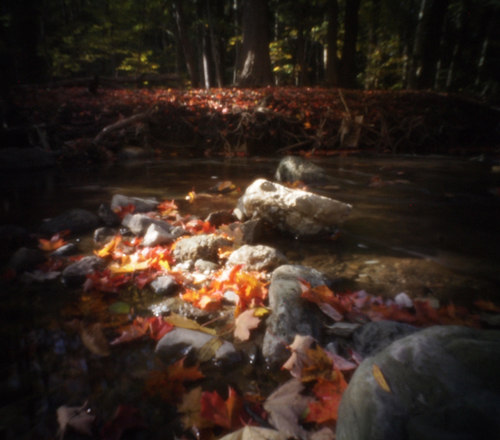
It’s a natural property of light to be weaker as it is farther from its source (because the same amount of light gets spread over a larger area) – just think of a candle on a table in a dark room: the light spreads in a circle around it and gets dimmer over distance. When you have a lens focusing light onto a flat surface – a negative or a digital sensor – the sides and especially corners of the surface will be farther away from the centre of the lens, and the light getting to them will, if not corrected, thus get dimmer. This is easy to see in pinhole photographs. Lenses are designed with multiple elements to correct for that effect – and others.

Another thing to know about lenses, by the way, is that the image they project onto the film or sensor has its limits. You couldn’t put them in front of a much larger area of film or sensor and get a much larger picture. You would get a picture that had a circular border (probably fairly abrupt, thanks to the corrections for the vignetting as I just mentioned), and outside that it would be black. This is also a problem with lenses that are not well made or are mismatched to the format of the camera. This, too, is called vignetting. And you may also cause vignetting if you have a lens hood that cuts into the corners of the lens’s field of view.

But at the same time, you know what a vignette is, do you not? In my Word Tasting Note Index, when I refer to my little stories that I use for some word tastings, I call them fictional vignettes. Little glimpses of some focused bit of time, a stretch of activity surrounding some word that fades in abruptly and fades out abruptly. And you likely also think of a picture when you think of a vignette: a little cameo-type thing, just a little picture in a book that fades away at the edges into the black of ink or the white of the page. This is the connection: this fading away at the edge gives a focus, a centre of attention and a selective forgetting at the edges. The circle of attention is narrowed to one subject, one topic, one moment. It’s a little like looking at it through a lorgnette. It has a highlighting effect similar to that of chiaroscuro. It is a candle-in-the-darkness effect. A piece of literature that is small and focused is similar and so is called a vignette.

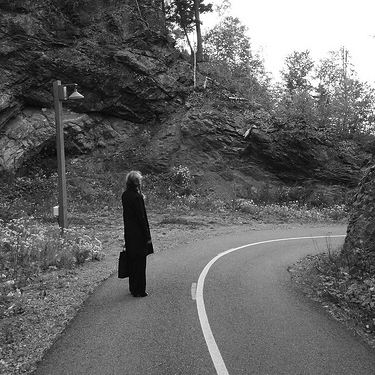
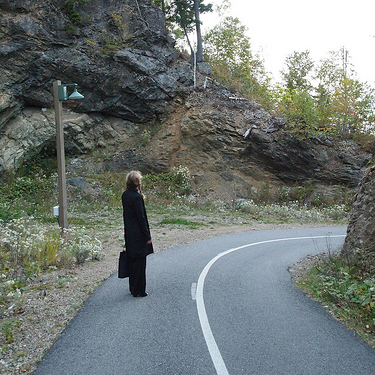
Let’s look at this effect in a photograph for a moment, shall we? Here is a photograph of my lovely wife standing on the road up to the golf course from Le Manoir Richelieu in Charlevoix.

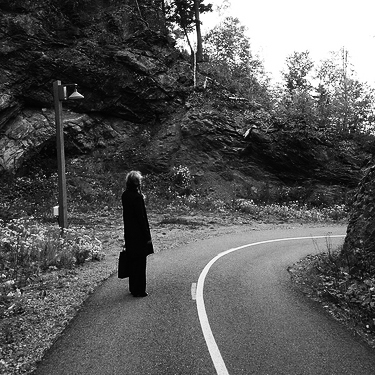
First, cut it down to essentials: black and white. Just one scale to go on.

Now heighten the contrast. Everything sharper, crisper, grabbier: darks darker, lights lighter.

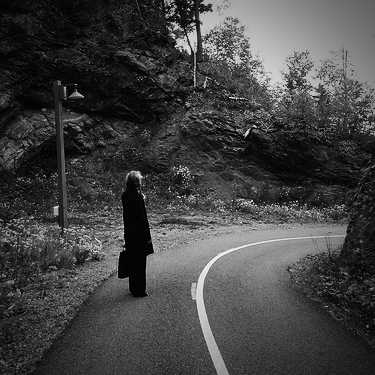
Now add vignetting. Not strong, strong, strong; just enough to shade the corners and edges off, to make it clear that they’re less important, less focal.

There. You see? Scroll up and look at what we started with. Now look at this. The first photo was a moment. This one is a vignette. (But does it seem overdone or trite? It might.)

Try it with a scenic shot, like this one from the Eglinton Valley in New Zealand. Here it is in original colour:

Here it is with the same processes applied:

Contrasty clouds are especially popular in photos I’ve seen lately.

But why this word vignette? We do not normally choose words because of their shape; nor is it truly pertinent that this word has, as its central consonant, a palatalized nasal, that /nj/ spelled gn, like an ordinary /n/ with vignetting around it so that it shades into the vowels with an intermediate glide. This word is often associated now with things “vintage” – old books, old photos, old cameras… What is its vintage?

Its vintage is the wine that helps us to forget the things at the edges, to focus our view more on what matters in the middle – as Ambroise Thomas’s Hamlet puts it in the eponymous opera, to pour intoxication and forgetting into our hearts (verse l’ivresse et l’oubli dans nos cœurslisten to the aria on YouTube). I’m not being cute here: wine and vine are cognate, and vignette is not a cousin but a child of the vine. Latin vinum “wine” became vinea “vine, vineyard”, which became French vigne, and the diminutive of that is vignette. Little vine? Little drawings of vines to fill space ornamentally in books, and little pictures with vine borders. Then vignette transferred from the borders to the pictures, and when the vines fell away and the pictures simply shaded into the page, the name vignette stayed.

But you don’t remember all that history when you see a vignette, or when you see vignetting. You remember only the intoxication of the image, with that sauce poured on it, that tunnel vision. What is in the heart of it is given, and you are getting it; the rest is not for getting, so you are forgetting it and it is taken away when the picture is taken.

kwikluk

Word country is not one place; it’s wherever you find it. Words have their carefully cultivated ground, places where they are grown to be bottled and shipped and ship-in-bottled, but they spring up in the wild on the banks of everywhere. Where there are people, there are words. You may have a set of roots sprouting into syntax trees in your own backyard and not notice it. You doubt? Take a kwikluk.

What is a kwikluk? It seems to be a very common thing: people will often say, when they are uncertain of something but have – or hope to have – ready access to usable information or verification, “I’ll take a kwikluk.” If someone wants your instant opinion on something – or wants your approval without too much argumentation – they may ask you to take a kwikluk. And if you want to comment briefly on something, then too you may take a kwikluk. It’s always one, and you almost always take it – sometimes you have it.

Oh, you think I’m being cute. But this word grows in the wild. Take a kwikluk in your atlas. Where? Well, what kind of word does this sound like? I’ve always thought it sounded like Inuktitut, something from Aklavik, Inuvik, Iqaluit. Either that or perhaps Kwakiutl (a language and people from Vancouver Island). And in fact where you find a kwikluk is on the west coast of Alaska, in Yup’ik soil. Yup’ik is related to Inuktitut and Aleut. So there it is.

But I should not really say you find it in the soil there. You find it running through the soil, between banks of soil. This word may seem hard, with its three /k/s, but it has a liquid /l/ and a glide /w/ too; it could as easily be the sound of a trickling brook or of rocks clicking together in their liquid creekbed. You see, a river runs through it – but look quickly; the river changes course constantly. It is a stream on a flat alluvial plain, and it meanders. This word may seem the same, may sound the same, but it wanders far and wide, diverging into soil that had been dry the day before. Such is language change, such is the stream of language. Take the long view and you see not a neat fast canal but a lazy delta. And mathematicians know delta means change. So do potamologists.

And anyone who watches television knows that change also goes with channel. Do you want to take just a kwikluk at what else is on? Change the channel. But with the kwikluk, the channel will change unbidden. Kwikluk, you see, is a channel, a meander in a delta: the Yukon-Kuskokwim Delta, one of the largest deltas in the world. The name Kwikluk comes from Yup’ik kwikli, which means “river” – this river may meander, but it always flows kwikli.

How quickly can it change? Like this: in 1898 the name of the river, this 137 km meander, was written down as Kwikluk, on the basis of the Yup’ik name for it. By 1915 it had become Kwethluk, which is what you will usually find it under today. How we write what we hear can change, not just because language changes but because when we hear it first we don’t always get it right, and sometimes when we hear it second we don’t either. Different languages have different sounds. This is why we have ketchup and catsup, for example. So if you take a kwikluk you may need to change your view later.

This channel, flowing through an alluvial plain of a northern word country, has meandered as an unsuspected current in our language. We may think we are merely speaking of a quick look, but when you look again you find that you are standing in arctic waters that were not there a moment ago. The word has meandered into your mind and will move much soil in its sedimental journey. Now you know: when you take a kwikluk, you are taking a piece of a river, an ever-changing flow, just a cup out of water that will have moved on when you turn back – from a channel that itself writhes constantly in its landscape, ever changing course by inches, never going straight. You are taking a quick sip of the river of language.