biannual

To the eyes, this word brings a repeated duality expressed in multiple ways: there are two each of two letters; it is bookended by two vertical lines coming from two different characters; the u is a rotation of the n before it; and the one letter not part of any other duality is made of two detached parts: i, with its stroke and its dot – a point and an extent.

In saying the word, you make four syllables; the middle two are attached to their preceders with a high front glide, while the first and last start with the lips – as a stop or as releasing from rounding. The vowels are low and forward first, but then in the back half of the word move to high back and then to a neutral step into a held “dark” /l/ with the tongue high at back. The word starts towards the front of the mouth but ends pulled back.

The central consonant is written with two letters but is at most a quick touch with an off-glide, and for many speakers in many instances is really just a nasalization of the glide it releases – the tongue may or may not fully touch. And yet it is heard as the same sound whether it is made with the tip of the tongue curling up and touching or with the blade of the tongue simply pressing up and forward while the tip stays down.

That curvy, contorting /bajænjuwəl/ pronunciation has come about because of how English vowels have shifted over the centuries and how we’ve come to pronounce Latin words generally. Were the word said the Latin way, it would be /biannual/ – just as it’s spelled, but to English ears more like “be on new wall.”

Except that the Latin word wouldn’t be biannual at all. This word may be made from Latin parts, but it wasn’t assembled from them until the later 1800s. The Latin word for a period of two years was (is) biennium, which lends to the word biennial, “every two years”. One might imagine that something that happens every half a year is semiennial (and every year and a half sesquiennial), but those words aren’t to be found.

The sense of this word is, as we all know too well, also dual. Its use to mean “every two years” dates from 1884 or earlier. Its used to mean “half-yearly” (every six months) dates from 1870 or earlier. Dictionaries list the two senses next to each other. So which is the correct meaning? It seems that there is no reliable verdict, and the court of common usage is divided. It’s just the same with other words, such as bimonthly and the perhaps even more bothersome biweeklyall these bi- usages appear to have come forth in the latter half of the 1800s. I recommend avoiding using these words, preferring clearer phrases such as every two years and every six months – unless you want to be ambiguous.

*ckle

A slick trick for quick locution:

Will a quick phonetic tickle make you chuckle, quickly cackle,
or electrify your hackles so you heckle like a grackle?
Is your prickle frankly fickle – first you truckle, slackly buckle,
then in instant trick you stickle and commence to crack your knuckle?
We expect you not to suckle at a freckle on the deckle,
but we’d like to lightly tickle you till you elect to keckle,
so we’ll tackle you and rackle you and fix your cracks with spackle
so you’d crick your neck to ruckle with a sickle at your shackle,
then we’ll peckle like a puckle, first a trickle, next it’s mickle,
knocking like some ickle cockle: click and crackle, crickle, rickle.
And just when the focal vocal’s quackled you until you huckle,
we project you will effect a yucking racket like a yuckle.

These -ckle words don’t all have a common morpheme. Many of them have the -le frequentative suffix, but others share the ending just by coincidence. There is no -ckle morpheme. Some of the words may be less familiar, so here are some quick definitions: a grackle is an annoying noisy bird; to truckle is to submit; a deckle edge is a rough edge to a page (a deckle is actually a frame for making paper); to keckle is to chuckle; a rackle is a chain; to ruckle is to rattle; to peckle is to make a lot of little pecks; a puckle is a bogeyman; ickle is a play-childish way to say “little”; to crickle is to make a series of thin, sharp sounds, and to rickle is to make a rattling sound; to quackle is to choke; to huckle is to bend the body; a yuckle is a kind of woodpecker.

sphagnum

This word has the flash of a phosphorus charge and the soft, deep, resonant rumble of a mine blast in a cavern far below, shaking the foundations as it flares the windows. But its sense is something so much softer. Step aside from the world of Magnum guns and gum; let it go in a soft fog, leave riddles for the Sphinx and the slow figuring of the ages, and fall back on the sphere, the surface of the ground, on a bed of soft moss, where all hard things dissolve and all soft things persist, and watch as the numbers on the sphygmomanometer go down.

Sphagnum moss. Such a deep and soft thing to say. And wet. It can hold up to two dozen times its weight in water, this moss. Even on a rock, it is like the softest, lushest fur you can imagine, green pelt of the planet. In some places it is deep, deep, many metres deep, growing new on decay, a history of millennia. Bury a person most places on earth and what remains will be nothing but the bones, the hard bits, the structure, none of the skin and tissue that made what we knew of them, what they felt, their weaknesses and loves and vanities. Bury them in sphagnum moss, deep, decaying sphagnum moss, a peat bog, and the opposite happens: the acidity of the moss dissolves the bones but the skin and tissue are preserved. When we find people from past eras in bogs we put them under glass in museums, squished, distorted, leathery, but still all there as though they had just slipped out to the bog and gotten lost – and only the bones cannot be picked.

Sphagnum sequesters water and carbon. Dry out its decayed bits and you have peat that can be burned. Lose too much of the moss cover and you damage the planet, give it mange, take away its soft, absorbent places. The moors of the English heart are losing their memory – but projects are underway to regenerate them. Much of Europe and North America, and parts of the southern hemisphere, was once covered by this intricate beauty, microscopic forests that still exist here and there in the soft places between the asphalt and concrete borders of us bony kind with our explosions.

Greece has sphagnum, of course. The home of our older honoured Western classics had a word σϕάγνος sphagnos which was converted in modern times (a mere quarter of a millennium ago) to the Latinate sphagnum. What did we call it before? Moss, certainly; specifically, peat moss. When it has petered out and gone the way of all decay, it is simply peated out as peat. It, and what it preserves, is repeated.

That does sound like the name of a drummer for some ’60s group, doesn’t it? Pete Moss. Or perhaps a football (soccer) player.

Sphagnum has some lovely properties. It makes a good surgical dressing: it can absorb much more than cotton can, and it has antiseptic properties. Microbes simply don’t thrive in it – another reason the bog bodies are there to be found. It can preserve food too, for very long times. It insulates well. It helps other plants to grow – the peat from its decay especially does. And babies can rest in it and it will absorb their messes. First Nations people of North America, the Sami of northern Scandinavia, and who knows who else in times past, have used moss for this. When I was a baby, we lived with the Nakoda (Stoney) people in Alberta, and my parents sensibly followed their lead: they put me in a moss-lined leather bag. Comfortable. Absorbent. Antiseptic. Lie in the moss and stop worrying.

A word like sphagnum is, to my ears, an invitation to artistry. There are fewer artworks than I would have expected involving this word, at least that I can find. But there are two contrasting bits of music.

One is “The Sphagnum Bog” by Eustachian, a group clearly enticed by savorous words; the genre is listed as experimental grindcore, though it sounds long on the experimental (in a late-20th-century electronic approach) and not so long on the grindcore.

The other is a soft, ethereal, reflective song, “Sphagnum Esplande” by The Shins. This is a song I was destined to find, I who lay as a baby in sphagnum and lie as an adult in my bed on The Esplanade. As you listen to the song (you will listen to it, I hope), you may want to refer to the lyrics, which include these things to think of as you lie in the moss:

We’ll make a new ship
Christen it for the trip
With a toddler at the helm this time

and

You’re not expected to know why
in such a short time

Don’t suffocate, asphyxiate, choke on a Sphinx in your esophageal sphincter. The answers will come. When the hard parts have dissolved, the soft parts will endure. Go figure? Go sphagnum.

foliage

What word goes with foliage?

There are a few that it’s seen near. You’ll often see references to flowers and foliage or foliage and flowers. You will also see references to green foliage, dense green foliage, lush green foliage, dark green foliage, and so on, and to dense foliage too. But especially around this time of year, and especially in eastern North America, the collocation to go with is fall foliage.

I grew up in Alberta. In the fall there, the leaves turn yellow and then fall off. That’s pretty much it. It’s a sort of interesting little change from the green, but it’s really just a step towards the enveloping buff and brown. When I moved to Massachusetts for grad school, my parents kept asking me, in our weekly phone calls, “Have the leaves changed colour yet?” I could not for the life of me understand this overweening interest they had in the deciduous decadence of forest foliage. And then the leaves started changing colour.

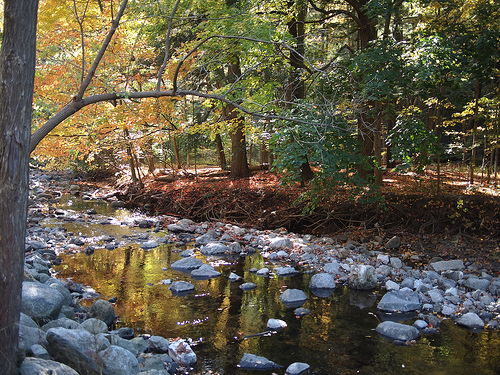
Where I work in Toronto I have a view of the Don Valley. Lots of lush greenery – that turns to reddery and yellowery in stages this time of year. It’s a glorious sight. People always love a chance to see the eastern fall foliage in full follies. Hotels in Vermont are very expensive this time of year. If you go for a stroll on a weekend day in the Don Valley parks in Toronto you’ll see an incredible quantity and variety of cameras. The paths are full of photographers filling their portfolios.

Yes, the folio in portfolio is related to foliage. So, incidentally, is foil as in aluminum foil. It all has to do with leaves. Do you feel that’s it’s a failure to say “foilage” instead of “foliage”? Well, here’s a fun bit of history for you: Latin folium “leaf” became French feuille (earlier foille), from which was derived feuillage (earlier foillage); this came into English as foillage. Then, in the 1600s, when we were rediscovering the classical roots of some of our words, this word was “corrected” to foliage to match the Latin. It turned over an old leaf, as it were.

Is foliage a suitable word for its sense, phonaesthetically? Do you find the soft /f/ and floppy /l/, and the shapes of their letters, to be leaf-like enough? Is it somehow a bushier word than leaves? And what else – does it taste of agile redistribution of letters? Do you see it going with golf or declaring I age? How close it is to fragile? Does a leaf, reflecting, see in it the green days a whole life ago – before it turns a glorious colour and leaves us?

uisce

Words are a strange crop to grow, and an even stranger one to study. Oh, they have some common DNA, as it were, although there’s quite a lot of variation. Their soil is the human mind and the human vocal tract, and while there is a lot of flexibility and many options, there appear to be a few general parameters you can usually count on… usually. But where they can really fool you is when they go onto paper.

If you drink whisky or wine or brandy, you know that they don’t usually taste all that much like what they’re made from. Whisky doesn’t really give you a flavour of grains, not exactly; it’s been fermented and distilled. And it certainly doesn’t taste like water, its majority ingredient. Wine seldom tastes like grapes (there are exceptions) and brandy never does (a bit like raisins sometimes, but never like grapes). But at the same time, the grains and grapes can be cultivated for how they will taste after fermentation and, as the case may be, distillation.

Think of the written form of language as like the whisky, wine, brandy. This is not an exact analogy, but it has its uses. The written form does not always correspond reliably to the spoken form. Indeed, in a language such as English, what you get when you write a given sound can be very inconsistent from word to word. And once you compare writing from one language with writing from another, all bets are off. But sometimes the way we say the word – and the way we think of it – is shaped by how it’s spelled. And sometimes there are very interesting feedbacks even crossing from one language to another and back.

And that’s not even saying anything about the interplay of meanings. It can all get very intoxicating. There’s a certain magic in language… Watch as it turns water into whisky.

We start with uisce. This is not an English word; it’s not even in the Oxford English Dictionary. It’s a Gaelic word. You will find it in both Irish and Scots Gaelic, in the same form or as uisge (the two kinds of Gaelic are reasonably closely related, but there are certainly differences). Does it leave you wondering how to pronounce it? If you know the rules of Irish or Scots Gaelic pronunciation, it’s actually quite clear, just like what it refers to: depending on dialect, something like “ishkih” or “wishkey.” And it means “water”. If you say “Tabhair dhom gloine uisce,” which in Irish sounds sorta like “trrum glinna ishkey” to Anglophones, it means “Give me a glass of water.”

But there’s water and there’s water. In Slavic languages, add a diminutive ending to the word for “water” and you get vodka or wódka or similar, and you know what that is. In France, say “water of life” – eau-de-vie – and you are referring to a distilled spirit, such as brandy (the word brandy, not a French word, comes from Dutch brandewijn, “burnt wine”). The Irish and Scots follow the French in this – a diminutive added would just make uiscín, “a little water” (if you would even say it), but you’re talking about whisky when you say uisce beatha or uisge beatha, which means “water of life” and sounds like “wishkey bah” or “ishkibeh” or something on that order depending on dialect. When they started distilling their fermented grains, that’s the name they gave the result.

That name clearly was not going to transfer to English unaltered. Some words come over to English with spelling intact and sound changed, some with sound intact and spelling changed, some with both changed, only a few with everything intact. In this case, the sound was adapted moderately to suit English tongues, and the spelling was based on the English pronunciation. Actually, there were two different English versions at first: usquebaugh and whiskybae.

And we know that what has prevailed and made it down as the normal word in modern times is a cut version of the latter: whisky. It is also spelled whiskey. The two are pronounced the same, but it is very, very, very, VERY! important to some people that you get the spelling right (you know how some people are about these things – if they were concerned with fashion rather than words, they would be the ones tearing strips off you for wearing white after Labour Day). If you are drinking Scotch, it is whisky, no e. If you are drinking Bourbon, it is whiskey, with an e.

But the story does not end there. Let’s turn back to our Gaelic dictionary. The one I have ready to hand is Irish, because that’s the kind I’ve studied. You will find in it the word fuiscí, pronounced (to English ears) like “fishkey” with perhaps a hint of “w” after the “f”. I should say that the /hw/ that English sometimes (more formerly than now) has where we write wh is not a sound one makes per se in Irish. So that English sound was rendered in Gaelic as /f/ – and they spelled the word accordingly. They may not export their whisk(e)y to England and reimport it before drinking it, but they did export the word and reimport it. Sort of like if the French exported wine to another country to be made into brandy and then reimported it for drinking as such.

These are crazy crops, these words. You may want to tread with a light foot around them. Perhaps a Gordon Lightfoot – he sang “Whiskey and wine help me pass the time / I don’t leave no evidence.” Well, these words, with their Zugunruhe, do show evidence of their travels. They come back aged and transformed. And then we sit and sip them.

Tá tart mór orm anois. Cá bhfuil an fuiscí?*

Thanks to Roberto De Vido for suggesting uisce.

*I’m very thirsty now. Where’s the whisky? Pronounced sort of like “taw tart moor orum anish, caw will a fishkey?”

kex

Look at this stylish little word. It has lines vertical, horizontal, and diagonal, plus an almost-circle. It’s almost architectural. And it has such a snappy crisp sound. It looks like it could be a brand name – shoes, maybe? (That’s Keds.) Some kind of stock exchange symbol? (KEX is the NYSE ticker symbol for Kirby Corporation, and it also stands for the Kansai Commodities Exchange in Japan.) Perhaps a sci-fi character? (Actually yes, Kex is a Mandalorian in the “extended Star Wars universe.”) Does it mean complain? (That’s yex.) Annoy? (Vex.) Curse? (Which is hex.)

Could it be a slang word? (In northern England and southern Scotland, it means “trousers” or “underpants” – also spelled kecks.) Is it perhaps something from Greek? (Well, it is part of the sound the frogs make in Aristophanes’ Frogs: brekekekex koax koax.) Maybe Icelandic? (Indeed: in Iceland kex means cookie or cracker.)

I’ll tell you what kex makes me think of, or what makes me think of kex. You know when your throat feels like one of those hollow dry plant stems, and you just have to cough, and the cough catches and leaves your throat feeling even more like that hollow stem, perhaps ready to snap? That sound makes me think of kex, or kex makes me think of that sound, or both. (Aina and I are currently coughing back and forth at each other. It’s like a battle of the kexes.)

Any dry, hollow stem of that sort can also make me think of kex. Plants that have them – cow parsnip, wild chervil, marsh angelica, poison hemlock, and other large umbelliferous plants – are called kexes. They get the name from their stems, which bore the name kex first (by the 1300s), though the OED tells me that the usage to refer specifically to the stems is obsolete except for dialectal. No one seems to know where the word comes from; I doubt that it is any more than coincidence that a kex, when broken, might make a sound like “kex.” (So do many other things, such as a finger snap.)

Oh, was there a word back there that might have been unfamiliar? Not everyone knows what umbelliferous means, so I should say it means “having an umbel”. And what’s an umbel? Here’s the OED’s definition: “A mass of inflorescence borne upon pedicels of nearly equal length springing from a common centre.” Isn’t that nice and clear and helpful and easy? Here’s a plainer picture: it’s a plant that has as its head a whole bunch of little flowers spoking out from the main stem like the ribs of a blown umbrella. As it happens, another word for umbel is umbella. And it is unrelated to umbrella. Aren’t words fun?

Sure, kex kex, lots of fun, kex kex kex. Could I just get to sleep now? Where’s that hemlock? That oughta fix it. Oh, no, no, no… Relax and delectate the lexis. Go have a snack. Perhaps an Icelandic cookie. Or some cake mix.

whippersnapper

Look at this word: it looks like a long bridge, with two piers – perhaps two double piers. It has a nice visual rhythm to match the rhythm of saying it. It starts with the lips out, then they bounce together, then you go to the tongue tip, then the lips again; the vowels match, with a higher forward /ɪ/ to go with the forward /w/, and a lower /æ/ to go with the pulled-back /sn/, and in the off syllables bouncing from /p/ you have that syllabic /ɹ/ with the tongue bunched up in the middle. If you say the wh as /hw/ then you have a voiceless consonant at the start of every syllable, giving it an appealing contrast and crispness – but even without that touch, it still cracks.

Cracks like a whip? Perhaps, or should we say snaps like one. After all, that’s where this word seems to come from: whip-snapper, extended for the echo and rhythm in a similar way to fixer-upper and quicker picker upper. But what has this to do with what the word refers to? Its object might seem to be more like a wimpy little whippoorwill of a person, or at most an impertinent pipsqueak. Look at what the word most often goes with: young whippersnapper (and you can hear a creaky old man’s voice saying it, can’t you?). Sometimes it’s little whippersnapper. You wouldn’t expect such a snippet to snap a whip at anyone.

But that’s just the point: this insignificant personage is attempting to order around his (or her) superiors, or, by extension, to behave towards them as though they were inferiors. (It is possible, however, that the word was first a word for a ruffian of whatever age and size, and that it subsequently narrowed to refer to rambunctious youth, and shifted to indicate impertinence rather than violence.)

Whippersnappers have of course been around from the dawn of time: impertinence is a characteristic of youth, and resentment of the impertinence of youth is common for some types of older people. Interactions that would give occasion to use the word whippersnapper can be found in comedies throughout the ages. The word whippersnapper, however, dates only from the later 1600s.

What did they call them before that? Hm. The options are plenty. I immediately hear John Gielgud’s voice: “You little shit.”

Thanks to Margaret Gibbs for suggesting whippersnapper.

prior

You’ve seen this word before. Many times. You have prior knowledge of it prior to seeing it here. You may even have seen it a few too many times – it sits like a brier in laboured formalese, all those documents by assorted office staff who issue stiff directives and think before is too informal somehow. How could a good old English word be as good as this Latin one? Formalese hews, as though driven by an anxiety disorder, to prepositional phrases rather than the nice, direct verb phrases: Please remove shoes prior to entering rather than Please take off your shoes before you come in. It sallies forth with a breastplate – nay, an escutcheon – of nouns and Latin-derived words, not to mention telegraphic omission of articles.

Not that prior to is the only place you’ll see prior. It shows up in a variety of collocations: prior knowledge, prior research, prior experience, prior approval… These do make nice, compact phrasings. They also have the arched tone of authority, the sound of police-speak – prior convictions – or the starchy formalism of someone writing for people he or she wishes to speak authoritatively to. Prior is inescapable superior. It has the loftiness of prayer, but with the beginnings of rotation of an eye orbit.

A prior, noun, is a superior officer of a religious order. This is from the same origin: Latin prior, meaning (as the OED has it) “in front, previous, former, earlier, elder, superior, more important”. It is related to the prefix pre and comes from the same root, way back in Indo-European, as English fore – as in foreman and before. So our synonyms have not only prior acquaintance but prior identity.

But it is from the noun prior that I get my favourite prior: Maddy Prior, the folk singer. (I’m OK with Richard Pryor, too; there are various other Priors and Pryors that I’m less well acquainted with.) If you have no prior acquaintance with her music (as a soloist, with June Tabor, and with Steeleye Span), here are a few songs to take your mind off monkish formalese:

Zugunruhe

There is a season in word country when things rise and fall: some things fall in place, and others rise to go. All is changing, colour, temperature, movement. After springing forth, after flourishing and strengthening in the constant rounds of the estival festival, a direction is found, and that direction is either down or away. There is a hunger. All seems under the gun. There is an electricity, a summer’s buildup of static ready to discharge.

It happens in many places and with many things, this energy. Runners who have trained all summer now taper for their fall target race, skittish, antsy, almost overcome with an urge to run. Students’ long lazy summers end in a pile of unread, unwritten, uncounted work lurking on the thither side of a bell. Birds gotta fly: they’re skittish, they don’t sleep the same, they just want to go south like so many Canadian retirees at the first sign of frost.

Languages, too, grow into these seasons, these moods. Something that has always been with you but that you have never needed a word for, something that could easily have had a name from local rootstock, instead seeks abroad for its label. Somehow it feels better. The soil it grew up in is too plain, too ordinary, too expected and habituated. The familiar thing, to be seen apart from its surroundings, must go to another language for its word, returning in its new form after the winter of discontent.

These urges and these flight paths may at first seem incoherent. Perhaps you cannot make out the sense of the form: Zugunruhe. Is this Tibetan, Mongolian, Turkish? As your eyes focus you see it may be German. That ruhe, that’s something German, no? “Peace”? And zu, “to” – so is this, um, peace to the gun? But wait, what is gun in German? No, that’s not it. Your eyes zig-zag through the gauze, picking out hunger, urge, run, rotating shapes (three cups u u u and two caps n h and that electric bolt Z and…). This strange bird that we have brought back from our migrations, it has to do with…

Zug. What’s that? One of German’s more basic all-purpose words: “train, trend, way, move, push, pull, migration” und so weiter. Said like “tsook” to English minds. Plus unruhe, “restlessness”, said vaguely like “oon rooa.” Together, “migration restlessness”. Our restless need to go abroad has led to our bringing back a word for a restless need to go abroad – or, more exactly, to migrate: it’s a word for the birds.

Birds fly away, then come back, and they seem much the same. People often grow or change, though not always. The language, in its excursions, returns like a merchant ship laden with treasures. But as the exotic becomes familiar we must again seek to make the familiar exotic. Old words, fallen out of use, coat the ground and enrich the soil; new words will come to take root and add new forms and colours to the landscape.

And the time has come around again.

Thanks to Doug Linzey for suggesting Zugunruhe.

Are you deranged?

As people who read Sesquiotica know, I’m not in the business of coming up with inflexible rules for people to slave under. But I am in the business of making observations and occasional suggestions. And sometimes asking questions.

Well, today I have a question for you: Are you deranged?

Actually, that would be better put as Is your prose deranged?

Here’s what I’m getting at. How do you normally express a range in English? You know, from 1 to 20 or from ultraviolet to infrared?

The way I just did, naturally: from…to.

And when people write ad or marketing or expository copy wanting to talk about all the options available in this or that place or from this or that person or business, they very often like to use this form to give a sense of a full range. In fact, two items often don’t suffice to express the ambit of offerings: you’ll get

from Iqaluit to Toronto and from Victoria to St. John’s

or you’ll get

from drama and dance to engineering and physics

and sometimes you’ll even get a string of to‘s.

But what you much too often will not get is an actual range. The from…to construction is grabbed as a convenient way to convey the idea of a a diverse offering, like a sweep of the arms. But too often it lacks clarity, it lacks sharpness, it lacks punch, because it doesn’t express a real range. It’s de-ranged.

Consider a sentence such as

From its beautiful waterfront to its exciting dining options to its lively theatre scene to its lush parks, Toronto has a lot to offer.

Diagram that out if you can. Does that really express a contrast between endpoints or extremes? It’s four different things, but it’s not like

from Bonavista to Vancouver Island, from the Arctic Circle to the great lake waters

It’s more like

from your elbow to a poodle to your nose to pineapples

As I’ve discussed elsewhere (“Sharpening and vowel shifts” and “chiaroscuro“), contrasts appeal. Make a strong statement. Give it some flavour if you can. Go for something like

From Napoleons to beef Wellington, if it has pastry, we make it.

If you don’t have a sharp contrast, don’t pretend you do. But you can probably find one if you look – rather than just being lazy and relying on a usage that seems to suggest contrast. You’ll get more contrast from

Treat yourself to our one-inch micro-whoopie pie. Or to our twenty-inch monster cake. Or maybe just a nice warm muffin.

than you will from

From cookies to cakes to muffins, we have the full complement of baked goods.

This isn’t a rule; this is advice: don’t be de-ranged. Don’t be lazy or sloppy. Don’t rely on clichéd syntax. Stop for a moment and think about the truly vivid images available. You’ll produce much better results if you do.

