gecko, get-go

Montgomery Starling-Byrd was back in town on yet another global word-tasting expedition. A few of us joined him for dinner and drinks. He happened to be seated next to Elisa Lively, and I canted an ear to their conversation. Which did not disappoint.

“Well, we ran into trouble right from the get-go,” Elisa was saying.

“From the gecko?” Montgomery said.

“No, from the dog. It kept taking the food.”

“From the gecko,” Montgomery said, seeking clarification.

“Yes, right from the get-go. It liked lizard food right away.”

“As long as it didn’t like lizard for food.”

“Oh,” Elisa said, “that’s a whole other tale.”

“Another tail from the gecko?”

“No, that came later.”

“Where was the tail from?”

“From the gecko, but later. Not from the get-go.”

“I’m afraid I’ve lost the thread of the tale here,” Montgomery said.

“Well, the gecko’s tail was threatened. Actually the dog pulled on it and wouldn’t let go, and the gecko dropped it.”

“Autotomy,” Montgomery observed (that’s the word for when a lizard drops its tail).

“It wanted its autonomy, yes. So that was the end of the tail.”

“And there was no more.”

“No,” Elisa said, “it grew another one. Geckos do that.”

“Indeed they do. It’s a kind of insurance.”

I just about choked on my wine stifling a giggle at the thought of the Geico gecko and its accent, which is not quite as plummy as Montgomery’s.

“That happened more than once,” Elisa said. “But the worst was the noise.”

“From the gecko?”

“Yes, from the very start. Especially from the dog.”

“Why?”

“It didn’t like the noise the gecko made.”

“Ah, yes: ‘Gecko!’ That’s how they got their name. It’s from Malay.”

“The poet?”

“What?”

“‘I burn the candle at both ends…’ She named the gecko?”

“The… Oh, no, the Malay language. In Malaysia. Not Edna St. Vincent Millay.”

“Oh. Well,” Elisa giggled, “that gecko burned at both ends. It made a noise the dog hated. And so the dog barked like crazy. And the gecko made more noise.”

“A sort of gecko echo.”

“Yeah! And at the other end there was that tale.”

“The end of the tale.”

“Repeatedly.”

“From the gecko.”

“No, not from the get-go.”

“From the dog?” Montgomery furrowed his brow.

“No, from the gecko.”

“Are you insane, or am I?” Montgomery said, staring abruptly into his wine glass.

I intervened. “Montgomery! Do you mean to say you are unfamiliar with the Americanism – and Canadianism – from the get-go?” I pronounced it slowly and clearly.

“From the… get? go?” Montgomery said. “Oh yes, I see. Voice and place assimilation with reduction: the /t/ devoices the /g/ after it, but also moves to the back and simply pre-stops the stop. Well, this is a very hockey-sounding term. Or perhaps NASCAR. So I take it that it comes from get going, which has been shortened and treated as a noun.”

“Truncated and mutated,” I said.

“Like my gecko,” Elisa said.

“I don’t think I would,” Montgomery said. “I would as soon have a grackle.”

“I guess your kind of bird is the starling.” Elisa giggled.

“Rather. I prefer a murmuration to the noise of a gecko.”

“So would Lawrence,” Elisa said.

“Who is Lawrence?”

“My dog.”

“Oh,” Montgomery said. “And what, dare I ask, was the gecko’s name?”

Elisa held her hands wide, palms up, as if to say it was obvious. “Gordon, of course!”
Ohthere

Today, through a passing reference in Melville’s Moby-Dick, I became aware of a Norse explorer from the 9th century AD. This was a chap who had mainly commercial interests – killing whales and walruses – but who decided to go see what he could see.

Not that he sailed around the world or anything. You have to remember the time and its limitations. The boats they had were not large. One normally sailed following a coastline, and anchored (or even camped ashore) at night.

But this chap lived in Hålogaland, pretty far north on the Scandinavian coast – so far north that, as he told King Alfred of England, no one lived any farther north, except for occasional Finns; it was all wasteland. Well, one day he decided to see just how far north the land went. So he sailed up along the coast for six days – in three days he was as far as the whale-hunters went, and in another three the land turned eastward. After that he followed it down again and into the White Sea as far as where Arkhangelsk now is. Then, seeing that there were people there (Sámi, as it happens), he turned around and went back home.

So I wonder if, when he passed the northernmost point, he said, “Oh, there!”

If he had, one is tempted to say he could have named it after himself.

This is not actually true. It is true that we call him Ohthere (not pronounced like “oh, there”; stress is on second syllable, there are three syllables, and the th is voiceless), but he spoke Old Norse, in which the expression would have been different, and in which his name was Ottar (which probably means something along the line of “fearsome”). But it sounds nice, doesn’t it?

You could also come up with some other version of his name. Melville actually calls him Other, in fact. Imagine if he had named the northernmost point after himself, and his wife asked him where he was going, and he said, “Oh, somewhere or Other…”

But that’s just silliness. Still, his name pleaseth. I don’t mean Ottar; that’s like Otto and otter and Ottokar and attar and all that, a little brittle. Better the soft cloth of the Alfredian version – it’s a touch more, oh, therapeutic. But note that in the Old English original text, that th is actually written th – not with the thorn (þ) or eth (ð) used to signify dental fricatives. One may surmise that it was thus actually a stop, perhaps with aspiration after it (and – as the preceding h will tell you – even before it, as is the practice in modern Icelandic with double voiceless stops).

Oh, there we go again. Take it as it comes. And take him as he comes. He came to England at some point; after all, he told King Alfred about his voyage north (his recounting was recounted by another; Ohthere was not the author), and about another one south to the bottom of the Jutland peninsula. Where? The south end of Denmark. Oh, there. Yes, there.

Well, he may not quite have been Franklin, reaching for the Northwest Passage, but on the other hand he came back. The gesture of saying his name reminds me of that – it starts at the back of the mouth, with that back vowel /o/, but the lips rounding, as looking forward; and then the tongue darts forward, touches the tip at the teeth, and then at last pulls back into the middle again. There and back again.

If you would like to read the account of Ohthere’s voyages found (as an addition) in Alfred’s version of Orosius, stop by www.oldenglishaerobics.net/ohthere.html. If you would like to read it in Modern English, I recommend dl1.yukoncollege.yk.ca/agraham/ohthere. It won’t take you long.

dweeb

We were milling around before the official start of the monthly Words, Wines, and Whatever tasting at the Domus Logogustationis, warming up our palates with start-up glasses of wine and some conversation. Arlene was talking about a recent conference she had been to.

“So there was this word challenge thing,” Arlene said, “and one of the challenges was that there are only three words in the English language that start with dw, and all of them are common words.”

I cocked my head slightly and raised an eyebrow. “Three?”

Daryl pulled out his iPad. Arlene darted a hand to block it. “No cheating.”

“There must be more than three,” I said. “Let’s see…”

“No,” Arlene said, “let iPad Boy here see if he can cough them up straight out of his cortex without an index.”

Darryl pulled a little face. “Um. Dwell. Uh, personal names should count – Dwight, Dwayne… Oh, dwindle. And dwarf. Which is actually a noun and a verb, so you can count that twice. We’re already over three that way. And dwelling! The noun means something not exactly the same as the gerund of the verb. I think that’s a pretty comprehensive confutation of the contention.” He smiled.

“Dweeb,” Arlene said.

“I don’t think you’re being fair,” Daryl said. “Geek, sure, nerd, maybe, but I’m not a dweeb.”

“You’re not exhaustive, either,” Arlene said. “You missed dweeb.”

Daryl facepalmed.

Arlene smiled. “I got them all and then I tweeted it.” She took a sip of her wine. “Sweet.”

“No need to gloat,” Daryl said, and turned his attention to his own glass.

“No, this wine is sweet,” Arlene said.

“Kabinett,” I said. “Riesling.” I mused aloud: “Sweet – tweet – dweeb…

“It doesn’t really have that much in common with the other dw words, does it?” Arlene said. “More with some other words that have that vowel.”

Daryl had his iPad in action now. “First OED cite is 1982. Which sounds rightish to me. …Probaby comes from feeb, for feeble, with that dw added at the beginning. Maybe from dwarf.”

“I bet there are some phonaesthetics at work there,” I said. “We know that those high front vowels tend to be associated with lighter, smaller, less substantial things. Compare dweeb with what it would be if it were, say, dwab.”

“Sounds like twat,” Daryl said. “And a twat is more obnoxious and less ineffectual than a dweeb.”

“I think the rounded glide into it adds contrast,” I added. “Compare deeb. Think about how we talk about a tweet rather than a teet.”

“Will you stop with the female body parts,” Arlene said.

“No, not – oh, never mind,” I said. “Anyway, what other words do we get a taste of in dweeb?”

“Well, twee,” Arlene said. “And wee.”

“And maybe queen and queer,” Daryl said.

Oui,” I affirmed. “It’s a little farther afield to squeal, but then there are those toys, Weebles. And weenie.”

Arlene wagged her finger: “Body parts!” I rolled my eyes.

Weed,” Daryl said. “And Guido.”

“Ooh! Guido!” Arlene said. “Is a Guido a dweeb? They’re kind of different, aren’t they?”

“A dweeb is like a nerd or a geek,” Daryl said, “but with excessive self-estimation, combined with a neediness and overearnestness.”

“Overweening,” I said. “Sort of like a twerp. Which is also a very similar word.”

“Ah, yes,” said Arlene. “I’ll have to tell my tweeps.”

“But, by the way,” Daryl said, scrolling on his iPad, “there are some other dw words that aren’t so common: dwale, ‘deadly nightshade’; dwalm, ‘swoon’; dwang, ‘a short piece of reinforcing timber’; dwerg, a pseudo-archaic form of ‘dwarf’; dwile, ‘floor-cloth’; dwine, ‘waste away’; and a bunch of obsolete ones.”

“And dwapp,” Arlene said.

Dwapp?” said Daryl. “That’s not in the OED.”

“As in Tony Orloongoo and Dwapp, a fake African music duo from a Don Martin comic strip in MAD Magazine?” I said.

“As in dwapp!” Arlene said, backhanding Daryl lightly on the side of the head. She turned to me and backhanded me as well. “Dwapp!”

“I think I shall dwalm,” Daryl said. “And dwine.”

“And whine quite a lot,” Arlene said. Then, with a smirk, she said, “Don’t dwell on it… dweeb.” She tossed back her glass, turned, and went to refill it.

epicene

This really is a word that could go two ways.

On the one hand, its form suggests something fun or exotic or, well, epic – it starts with epic, after all, and French speakers will know that épice means “spice” and piscine means “pool” (the latter two syllables of epicene in English sound like piscine in French). It has overtones of prehistoricity – the Pleistocene epoch, perhaps. It is close to epicentre. It even sounds a little like obscene (and the sounds of it can be rearranged – an anaphone, if you will – to say “a penis”). Those three e’s look eager and ready to my eyes, and the pi pokes down and up like something trying to fight out of a sack. The word stays right up at the front of the mouth – lips, tongue tip, front vowels – which could, if you want, be taken as being as though the word is at the point of jumping out.

But the source of the word is Greek ἐπί epi “on, at, around” and κοινός koinos “common”, which makes it pretty much about normal, and it refers to things that are neutral – specifically gender-neutral. They can go either way. It referred first to words in Greek that could denote either sex without changing grammatical gender – for instance παρθένος parthenos “virgin”, which can refer to a male or female virgin – just as can the equally epicene English word virgin. From that it has come to refer to similar words in other languages (a notable current use is epicene pronoun, referring to a gender-neutral pronoun – especially use of they for third-person singular), and it has also been used to refer to unisex things (e.g., clothing), as well as persons of things stripped of perceptible sex (masculinity or femininity).

But it has also come to be used on occasion to refer to androgyny of the sort that, rather than lacking male or female characteristics (like Pat – the name and the character from Saturday Night Live), has notable qualities of both (think Victor/Victoria). Even in its way of referring to something that can go two ways, there are two ways it can do it. The word may yet have some spice in it.

obelisk, obelus

I have, from time to time in these notes, mentioned my fondness in my youth (and still) for Asterix comics. The heroes of this series are a small, clever Gaul named Asterix and his enormous sidekick, Obelix.

Their names, like all the names in the series, are obvious plays on words. All the Gaulish male names end in ix by analogy with Vercingetorix, the great Gaulish chieftain defeated by Caesar. All the Roman male names end un us. Gaulish and Roman female names end in a. Other nationalities get similar treatment; Goths end in ic (after Aleric), for instance, and there is an Egyptian named (in English) Ptenisnet (represented in hieroglyphics as a tennis net). One of my favourites is the Gaulo-Roman chief and pugilist named Cassius Ceramix. (I’ll explain that one at the end if you don’t get it.)

So anyway, Asterix and Obelix. Asterisk and Obelisk. One is small, the other large, and they both end in isk, easily changed to ix for wordplay. It never occurred to me that asterisks and obelisks might have more of a connection than that, because I only ever thought of an obelisk as a large stone thing (similar to the menhirs that Obelisk was forever quarrying and toting around).

But do you know what obelisk comes from? It comes from Greek ὀβελίσκος obeliskos “small spit” (as in for roasting). That’s a diminutive of ὀβελός obelos.

It may seem interesting enough that this term for a not-too-large pointed metal thing came (by analogy of shape with one, or with a nail, also called obeliskos) to refer to a quite large standing pointed stone thing (and I do not find the word obelisk to seem all that pointy, except for the /sk/ at the end, perhaps, and maybe the fact that the word progresses backwards in the mouth as you say it, from a blunt start to a sharp end; obelisk is, however, suitable for a large obstructive object). But you may not know that asterisk and obelisk are actually two of a type.

Two of typography, to be exact. You see, there is another kind of thing called an obelisk, and there is a related thing called an obelus (the terms are sometimes used interchangeably, in fact). They are marks on a page, and they came from the same place as the asterisk. The blog Professor Carmichael’s Cabinet of Curiosities has a nice exposition on the origin of the obelisk, but I will give you the short version: the asterisk and the obelisk were invented by Homeric scholars in Ancient Greece and Alexandria. They used them to mark passages: the asterisk for a word (or words) that should have been there but wasn’t; the obelus for any text that was deemed suspicious, dodgy, probably spurious.

The asterisk, that little star, hasn’t really changed much over the ages. The obelus, however, started out as a simple line — and then gained a dot below, a dot above, or both: ÷ . This “should be gotten rid of” mark came in math to indicate subtraction; in the 1600s, the ÷ version came to be used to indicate division. But there was another version of the mark, or rather another mark: †, the one we also call the dagger. The classical name for this is in fact obelisk.

Not such a bad name for it, really, this mark that is as baleful as a basilisk. After all, even still it marks obsolescence and obscurity and objection (and not oblation but ablation); before a person’s name, it indicates that they are dead (unnecessary in an obituary, of course), and before a word in a place such as the Oxford English Dictionary, it indicates that it is obsolete – no one uses it anymore, except perhaps in Scrabble and spelling bees and blogs. Contrast this with the shining little light of the star, *, which usually has something more positive to say – in etymology, it has been used to indicate reconstructed but unattested words (words that should have been there, you may say), though the related use of it to indicate words or phrases that are unattested because nobody ever says them (“this is ‘bad’,” the dialectological asterisk says) is, true, a bit more like an obelisk.

So: obelus, obelisk. There you have it, holus-bolus, in an Augenblick. You can look down on a page and see, sharing a name with an enormous hieroglyphic stone needle, a little dagger. And usually it plays second fiddle to an asterisk. You’re not so likely, after all, to be reading critical works on ancient texts. The sublime and erudite, in latter days, may be reduced to footmen, and the sometime-mighty asterisk and obelisk are now most often pressed into service for footnotes, asterisk first, then obelisk… then diesis. Diesis? Double dagger: ‡. Dieses irae indeed – dagger meets dagger. So it progresses: first the bright star, then the dark dagger, and then it really goes to hell. Well, you knew when you started down that road that it was your asterisk.

(Oh, by the way, to explain Cassius Ceramix: the boxer better known as Muhammad Ali was born and started his career as Cassius Clay.)

guava

Christina Vasilevski finds this word really odd. It even makes her giggle. I wonder who else it has that effect on.

Not me. It pleases me. It has a nice tropical sort of flavour to it for me, partly from the echoes of such words as guacamole, Guam, Guadalcanal, and lava, but more importantly from where I first encountered it. When I was 13, my family went to Hawai‘i, and there, at breakfast, I encountered for the first time the word guava and the beverage guava juice. I loved it instantly, and had it every morning for the rest of the trip. And then it was quite some time before I had it again, because back in the early 1980s it was not widely available in Alberta.

My next salient recollection involving guava comes from the later 1990s, when I bought some guava paste at a Chinese grocery for use in cooking. It’s a passable thickener and a heckuva sweetener, but it doesn’t quite have the full flavour and tang I had come to know and love.

And now there is a third thing I think of right away when I think of guava: Sauvignon Blanc from Hawke’s Bay in New Zealand. Oh, we all know NZ Sauv Blanc, right? (Or anyway the wine geeks among us do.) Gooseberry and so on. But the stereotypical NZ Sauv Blanc is from Marlborough, on the north end of the South Island. Hawke’s Bay is in the middle of the east side of the North Island – different conditions. And I found, in tasting several from wineries such as Craggy Range, Trinity Hill, and Sileni, that the Sauvignon Blancs from around there have, riding along with what you would expect, a solid line of guava right up the middle. I encourage you to try some for yourself and see.

Does the word guava have a solid line of guava passing through it? Well, first, do you know what guava tastes like? If not, go find some guava juice and drink it. I’m not going to make a fool of myself trying to describe it for you. Do you think you could describe the taste of, say, a banana or an apricot to someone who had never had one? But assuming you know the taste of guava, well, it’s up to you to taste guava and decide for yourself; taste is individual.

For me, I think the word does fit reasonably well. The /gw/ onset is reminiscent of drinking, and guava juice is one of those things that are great when you’re thirsty (or when you’re not) but seem to make you want to drink even more. The rounded u and pointed v – two letters that (in general, not in this word) were originally the same letter, back in Latin and older English – are like the sweet and round but slightly tart and sharp flavour of the guava. And the a letters stand for a sound (or two sounds in most English pronunciation, since the latter one is reduced) that is associated with the open mouth, ready to receive, and also with the sound of satisfaction one makes having received something good. The repeated a’s – and if we still used one letter for both u and v, we would have a repeated pair, vava or uaua – are reminiscent of the repetition that is a common feature in Polynesian languages. And what’s more tropically blissful than the image most of us get (rightly or wrongly) when thinking of Polynesia?

Not that the guava is originally a Polynesian fruit. Nor is the word guava from a Polynesian language. Nope, it’s from Arawak, as best we can tell – a South American language. The guava is a fruit originally from the tropical Americas, though it’s grown all over the tropical and subtropical world now (because it’s so yummy – and, I suspect, so easily grown). The original Arawak word is guayabo, and it comes to us by way of the Spanish guayaba. Which, it occurs to me, sounds a bit like “go have a” – as in go have a glass of guava juice.

Which I would if I could, but I have none in the fridge. Dang it, now I’m all thirsty.

camisole

When I was a boy, I was a boy.

Not a girl. Which means I didn’t really know all the intricate insanities of women’s clothing. Adolescent boys know about bras and panties. That’s all. Oh, and wet T-shirts, and the usual outerwear. I was well into my adulthood before I knew, for instance, the difference between pumps and mules. And what the heck camisoles were.

I mean, really, what does the word camisole sound like? A canvas insole, some kind of camouflage, maybe something made of camel hair or, heck, for all I knew, some kind of sail a girl could unfurl so the wind could carry her away from the unwanted advances of a spotty-faced weakling… like me. What it did not sound like was any sort of soft, lacy thing that might be worn close to those chests I had spent so many cumulative hours inspecting sidelong.

I suppose, knowing what it refers to, you could hear the soft silk in the /s/, see and hear the mammaries in the m, get a whisper from the aspiration on the opening /k/ (and there are surely many aspirations that are mediated by camisoles), and end with that liquid /l/ that is like a touch of light fabric on skin. Sure, but that’s all post facto. It sounded more like military equipment to my young ears. Further evidence that girls are strange (if delightful and yet cruel) creatures deserving more of padded cells than padded undergarments.

But, then, the very idea was flummoxing. Why would anyone need another layer? Wot, there’s a bra, then a camisole, then a shirt, then a jacket, then… Well, now, of course, a married man, I know that some women may wear a half dozen layers at times (although my wife does not actually own any camisoles). “Warm” for dudes is the same as “freezing” for dudettes.

Still and all, if you have the idea that showing one’s underwear is rather outré, and a glimpse of a bit of lace is something you’re only supposed to get on the sly, the more recent trend towards having the tops of camisoles peeking out from behind outerwear tops can be a bit discomfiting. Is that proper lady in this formal situation really displaying her undergarment?

Well, is a camisole underwear or not?

Originally, the answer was easy: not. Originally, camisoles were actually jackets. Or, rather, originally camisole referred to a sleeved jacket or jersey worn by men – that was how it came to be in English in the earlier 1800s, from French, which took it from Provençal camisola, which in turn derived from Late Latin camisa “shirt” (from which, I am sure you have already guessed, we also get chemise).

Then it came to be “a loose jacket worn by women when dressed in negligée,” to quote the Oxford English Dictionary. By the latter 1800s, the name had transferred to an underbodice – worn, as the Random House Dictionary puts it, “to conceal the underwear.”

Um, so it’s not underwear then? But it’s worn under…

And worn over, yes. And, honestly, some things now sold as camisoles look just like spaghetti-strap tops or even tank tops (do a Google image search on camisole to see the variety available, or if you just want some pretext to look at models in their underwear – or their not-underwear). I’ve seen some young women go by with three sets of thin straps over their shoulders, one for the spaghetti-strap top, one for the camisole, one for the bra. So, now, would they wear just the camisole with nothing on top of it? Or is this some special kind of garment where part of it isn’t underwear and part of it is?

Well, fine. I’m not going to try to delve deeply into the intricacies of women’s clothing. That way madness lies.

Which reminds me: there is another use of camisole. It also means – often but not always in the fuller phrase camisole de force – a straitjacket.

cicisbeo

I first encountered this word when watching some spelling bee or other on TV. It struck me as a rather pretentious word, the sort of word that doesn’t really seem to make any sense or have any place in the modern world other than as a word you don’t know, and in particular one you don’t know how to spell. Even to one literate in Latin roots it is a closed boudoir door, the inaudible whisper in a lady’s ear of her companion standing behind her.

It has no obvious roots; its morphology is rather opaque. Indeed, etymological sources are reduced to weak speculation: perhaps it’s from bel cece “beautiful chickpea” (or the French chiche beau); perhaps it’s from onomatopoeia for whispering or chattering. In the end, it is just there, and what are you going to do about it?

And what, pray tell, is a cicisbeo? Someone you don’t see these days, to start with. He’s more a creature of the 18th century, in Italy and France, among the nobility. A synonym is cavalier servente. He was the recognized gallant of a married lady.

This first puts me in mind of Paul Varjak, the charming young man in Breakfast at Tiffany’s, played so well by George Peppard in the movie. But he’s no cicisbeo: he’s the kept lover of a married woman, but he goes nowhere with her outside the apartment she has set up for him, and her husband doesn’t know about him. A cicisbeo went everywhere with his lady; he stood behind her chair and whispered in her ear; they would go to assorted entertainments together; they might also go behind closed doors in the boudoir together.

The intimate nature of the arrangement undoubtedly varied, as some cicisbei were not actually sexually attracted to women – but made excellent companions. Whatever the arrangement, it was socially acceptable; indeed, the husband would open himself to ridicule if he objected. The cicisbeo was there, and what could he do about it? But he was likely too busy with his mistress to object.

Given that sense, can you make the form of the word go together with it somehow? Is the /tʃitʃi/ like a sound of summoning, or whispering, or tongues clicking in interest, approbation, or condemnation? How about the buzz of the /zb/ – is that the buzz of a honey bee courting the flower? Can you see the act of saying /bɛo/ as like a kiss, a bacio (or baiser)? The word as a whole makes me think of a character from Happy Days: Chachi, played by Scott Baio.

And the lines, dots, and curls of the written word, sitting there like ruffled chest hair? You may see in the cici two ears and two i’s in service of the lady; perhaps you spot cis, which as a prefix would mean “to this side” (the converse of trans, “to the other side”), or in reverse sic (transit Gloria? how’s Monday for you?). Hopefully the beo doesn’t bring too much B.O. – better to call forth a wulf.

Stan Backs, who suggested this word, observes that “According to [Canadian finance minister] Jim Flaherty, there is no bad job.” Many guys would be inclined to say that cicisbeo sounds like nice work if you can get it. But we ought to remember that they could always be replaced, these cicisbei; cicisbeism may have been an institution, but the individual pretty boys could fall out of fashion, at which time – unless they found another lady to favour them – they would be spiantati: penniless cast-offs.

risotto

This word has a certain exotic, erotic flavour for me because of its sounds and echoes. It’s Italian, of course; even if you’d never seen it before you’d probably guess that on the spot. It makes me think of the various words of the same ending: grotto, blotto, biscotto, motto, Giotto (a painter whose name stays with me because I successfully BSed my way to half points on a high-school exam question on him in spite of having no idea who he was – I know now; I’ve been to Florence), fagotto (Italian for “bassoon”), lotto, stracotto, panzerotto, and a few other otto loans not so commonly seen in English – plus all those etto words (libretto, ristretto, vaporetto, et cetera) and assorted other tto words such as prosciutto.

And of course it brings to mind riso, Italian for “rice”, on which it is formed; also, adventitiously, sotto, for “below”, and ri, a prefix meaning “again” – under again? under where? – as well as sorriso, “smile”. It also brings to mind a couple of excellent meals in New Zealand, and a rather yummy one I just made and ate this evening.

The risotti in New Zealand were a smokey fungus tomato one at the restaurant at Elephant Hill winery on Hawke’s Bay and a nice blue cheese one at a brew pub in Wellington. As to this evening’s, I found myself needing to use some sweet peppers, which I don’t generally go gaga over, but have enjoyed roasted. So I decided to stuff them and roast them. Stuff them with what? After consulting a few recipes and my own perverse and pertinacious proclivities, I decided to make a risotto – specifically a bobotie risotto. Why not just make something up, I thought with a smile. So I assembled the onion, ground beef, ground pork, arborio rice, blatjang, coconut milk, salt, curry powder, and water; I found I did not have raisins and so had to do without.

Of course it’s an odd culinary catachresis, a bit of syncretic intercultural gastronomy, this marriage of Italian and South African cuisines, Canadian-style. But risotto is a word of such flavours and overtones; it can sustain it. It is true that it stays on the tip of the tongue, though it does end with a rounded back vowel. But the stories its many mild echoes may have – zero, raise, rosette, otter, rot, risen, utter, exotic, erotic; roll it on your tongue and find more – can keep your palate entertained for some time, while your eyes enjoy the joining of the curving and popping ris with the symmetrical otto, a set of noughts and crosses: 0++0… or perhaps two round grains of arborio rice, or two bowls of it, and two, hm, forks? Or pairs of chopsticks? Say, perhaps add something Chinese to it next time…

Sonoma

This is a simple-seeming word, but a deep, rich, sonorous one with numerous flavours and overtones, from the numinous to the ominous; it may seem as cold as a snowman or as hot and dry as the Sonoran desert, as gleaming as shiny cookware or a moon’s shimmering, broken-up reflection or as dark as some unearthly anonymous moans, as soft as its simple /s/ and two pillowy nasals and as round as grapes or as hard and angular as some broken up masonry. ¡O, no mas!

The word could be a mantra (an “om,” son). It carries flavours, flavours of the American far west and its Spanish and Native history, flavours of fine wine, flavours of expensive cookware. But what are the secrets of its onomastics? It seems to come from the language of the Miwok people who lived in the Sonoma valley; it is said to mean “valley of the moon”, though it could mean “many moons” (as in the paired o’s). I’d like to say it means “a moon’s valley” if only for the anagram.

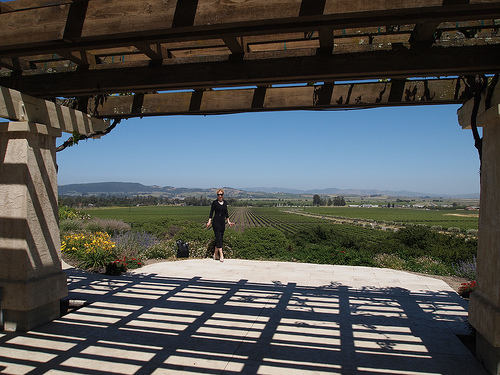
Is this the moon that the cow jumped over? It is more likely the moon that oversees somnolence and snoring, which may follow on consumption of too much wine (perhaps followed by an evening in a spa – there are natural spa waters there, and Aina and I partook of them on our recent sojourn). And there is much wine to be had in Sonoma now – the county has followed on the heels of its neighbour, Napa, in the California wine sweepstakes, from the lovely sparklers of Gloria Ferrer south of the town of Sonoma to the exquisitely crafted Pinot Noirs and Chardonnays of Marimar Torres an hour’s drive further to the northwest, with many wineries in between covering an amazing range of styles, some even remarkably European in approach. Wine lovers can truly be over the moon there (and even perhaps have a brief second – or third, or twelfth – honeymoon).

Meanwhile, seleniosaltorial cows notwithstanding, the dish probably has run away with the spoon – to your local high-end mall. A guy named Chuck Williams opened a store in the cute, charming centre of the City of Sonoma (ten thousand souls and a small-town feel) selling high-end cookware, and now if you feel that fifty dollars is not enough to pay for a corkscrew, for another twenty Williams-Sonoma can help you get into your bottle of Anaba Chardonnay (the winery is named for anabatic winds, which are the reverse of katabatic winds).

That cute, charming town centre, with the largest town plaza in California, was also the site of the first revolt against Mexican rule; Sonoma was briefly the capital of the Republic of California, until it was all assimilated to the USA (sort of). I would not now say that Sonoma is revolting – although there are things about driving a car in Sonoma that I need like a carcinoma: the tendency for a numbered route to make a hard right turn off a main road, or suddenly exit onto or off of a freeway, for instance. Apparently they are still a little wary of invading troops. Or maybe it’s just a way of getting people to conclude that they’ve had enough wine tasting for one day and should go eat somewhere, such as The Girl and The Fig.

But as you do, savour the word further, and ask yourself: are you tasting the history through the modernity, or vice-versa?