In a language as verbally efflorescent as English, the inevitable excrescent lexical vegetation can be a cause of vexation. But would you respond with vetation? Is any deviation from strict verbal elegance unallowable in your books, and is invitation to exuberant expansions and neoclassical confections met with anathema?
Or perhaps lexical recreation is acceptable only in estivation and vacation. Well, far be it from me… unless you’re vacationing in my town, that is. But if you are, I’ll allow it. Which is to say, it will not be met with my vetation, even if the power of such should be vested in me.
Lest you have not guessed, vetation is, as the Oxford English Dictionary says, “a refusal to allow something.” It comes from Latin vetare, which means ‘forbid, prohibit, refuse to allow, oppose’. If you have been to Italy, you have seen its modern reflex: vietare, or more likely its past participle vietato, which shows up in signs that avail themselves of an emblematically Italian syntactic formation: vietato fumare, ‘forbidden to smoke’, meaning “no smoking,” and vietato l’ingresso, ‘forbidden the entry’, meaning “no entrance.”
But while vetation is well formed as a derivation from its Latin root into English, we have generally preferred to do a bad, bad thing, at least from the view of some sticklers: we have given our imprimatur to a conjugated form of the verb and made it into a noun. It’s the same kind of thing we did with imprimatur, which means ‘let it be printed’ (not as in ‘allow it to be printed’ but rather as in the third-person infinitive imperative that Latin uses a subjunctive for and that we have no really good way of expressing directly in English), and which we now use as a noun, as I just did. But in the case of vetare, we’re using the first-person singular present indicative, which is veto.
Yes, veto is Latin for ‘I forbid’ or ‘I advise not to’ or ‘I oppose’. We’ve taken a verb and we’ve nouned it. This is, depending in your particular bent, either elegant or inelegant. But the alternative, vetation, is longer and fussier and, depending on your bent, either more or less elegant.
Well, never mind. The decision has already been rendered in the legislature of popular opinion. The reason you’ve almost certainly never seen vetation before is that no one uses it. Even when it was used – in the 1600s through the 1800s – it wasn’t really used; as the OED puts it, it’s “apparently only attested in dictionaries or glossaries.” It is an inkhorn word, and we have, passively, tacitly, vetated it.
My latest pronunciation tip is about 10 German words that I rather like and occasionally find the chance to use in English contexts: gemütlich, Sitzfleisch, Korinthenkacker, Sehnsucht, Weltschmerz, Kummerspeck, Schnapsidee, verschlimmbessern, fremdschämen, and Backpfeifengesicht. It includes a bit of background information too!
Heh. This is a word that sounds like it sounds like it means, or anyway sounds like it means what it sounds like. If you know what I mean.
One fun thing about this word is that its advent is not the usual. Each of us may well know where we first saw or heard a word, but we probably don’t have any way of knowing just when it first saw the light of day on this planet. Usually a word creeps out from under a rock or comes whiffling through the woods; we have some record of when it first started getting around, and we may have a trail of uses, forms, and other lexical spoor that leads us to infer where it came from, but there is no proper birth certificate. Chortle is quite unlike that.
You may or may not remember when you first saw or heard chortle, but I have no idea where I did. I am sure it was not in its original context – the place it first knew the earth and the earth knew it – and I know that when I subsequently saw it in its original context I didn’t realize it was in its birthplace. It wasn’t until a bit later that I realized that, like the numerous opaque words peppered around it, chortle was invented by Lewis Carroll (in real life, Charles Lutwidge Dodgson) and first published in Through the Looking-Glass in the poem “Jabberwocky.” Here is the stanza in which it blazes into glory:
“And hast thou slain the Jabberwock? Come to my arms, my beamish boy! O frabjous day! Callooh! Callay!” He chortled in his joy.
And, unlike some of the other words Carroll introduced in the poem, it caught on and took off. You don’t see uffish used much at all, nor manxome; although vorpal has a certain something, you will rarely hear it outside of the realms of role-playing gamers; but within mere years, chortle was being used as if it had been around for centuries, like whiffling (also used in the poem) had.
So what did Lewis Carroll confect this word from? The Oxford English Dictionary’s full etymology is just “Quite unconnected with churtlev.” (And what does churtle mean? “Chirp,” apparently.) But Carroll himself was good enough to give some indication. The origins of chortle, as it happens, are chuckle (which in turn first appeared around 1600 as chuck – meaning not ‘toss’ but ‘cluck’, imitative of sound – with a frequentative -le suffix) and snort (another imitative word, with us since the 1300s). So this is a portmanteau word, but not in the usual fashion, with a first half of one part and a second half of another. Rather, it has a graft from snort right in the middle of chuckle. Why is it not snuckle? Well, that’s a different sound, isn’t it? More like snickering than snorting. And of course it couldn’t be something like chuckort – we need that -le.
Most importantly, because it was made from two imitative words and is itself audibly imitative, it conveys its sense quite engagingly. And we even know its parentage and have its literary birth certificate: Through the Looking-Glass, and What Alice Found There, the sequel to Alice’s Adventures in Wonderland, was published on December 27, 1871. O frabjous day! (Frabjous, by the way, comes from fair, fabulous, and joyous. It has not really caught on.)
English pronunciation is a balancing act, a tightrope between sound and spelling where even a mild crosswind can lead to a fall. And we can often be a bit myopic in our reading of words. Even if the way a word is put together is right there before our eyes, we might still be misled by an analogy with another word and say it wrong. You may have heard a coworker say charcuterie in a funny way at one time or another, or heard a journalist mispronounce integral – or you may be among the many who have snagged on misled or coworker, for that matter. So it’s not so surprising that I, in my youth, reading about Karl Wallenda, saw the word biopic and assumed – as many people do on seeing it – that it rhymes with myopic.
Well, why not? There’s also biopsy and -optic words like panoptic, not to mention other words ending in -ic like robotic. And sure, you might see bio and even understand that biopic refers to a biographical movie, but is it so hard to imagine that it’s like somehow putting the biography under a microscope or something? Most of us do not carry classical morphological dictionaries around in our heads.
And, frankly, even if we did, it wouldn’t help here. You see, biopic is made from bio – yes, as in biography, and in this case actually shortened from that rather than formed directly from the Greek root bio- – and pic, shortened from picture, which, yes, comes from Latin pictura, but if someone asks you for “a pic,” do you send them a movie? Sure, movies are “moving pictures,” but the use of pic for a movie is a bit dated. (There’s also that mixing of Greek and Latin, but we do that a fair bit, because most of us don’t know otherwise.) And, for that matter, putting stress on pic in the last syllable just seems odd. You sure it shouldn’t be pick then?
Of course not – this is the language where microphone is abbreviated mic and no one wants to have to spell out the present or past participle because of the perversity of c before i and e (look, we used to spell it mike and miking and miked; don’t blame me for all those hip kids changing it). So why shouldn’t we expect biopic to be bio plus pic, as in fact it is, and to be said exactly like “bio pic”?
Just because, in general, we don’t. Those of us who know better know better, and the rest don’t. And that includes some journalists I’ve heard on TV, plus people I know personally, including younger me. Now you know better, if you didn’t before – yes, I am recommending you say biopic as “bio pic,” not only because that’s what it’s meant to be (and Merriam-Webster and the OED insist too) but also because that way you won’t cause anyone to pop a vein in their heads about it, as people occasionally do about “wrong” pronunciations. But there still stands one question: Why not call it something else?
I mean, it’s too late, I suppose. But why don’t we call it, uh, biofilm? That makes sense, right? As long as that word doesn’t mean anything else… [checks earpiece] It what? It does? Oh. Folks, apparently biofilm has an established meaning: to quote the Oxford English Dictionary, “A thin but robust layer of mucilage adhering to a solid surface, containing the community of bacteria and other microorganisms that generated it.”
Ew.
OK, biopic, as in “bio pic,” as it has been since at least the 1940s. Back on the pronunciation tightrope…
Just like Karl Wallenda, the famous funambulist (tightrope walker). And why did I see biopic associated with Karl Wallenda? Well, it’s just that he was apparently filming a movie about his life when he did a tightrope walk between two 10-storey buildings in San Juan, Puerto Rico. On the day of filming, there was an inadvisable crosswind, but, you know, shooting schedules… and, uh, well, anyway, he made a misstep and consequently concluded his life. And the biopic.
It’s opening the door to meet a stranger and realizing you know the person already. It’s sitting down to do a thing for the first time and finding that somehow you know how to do it. It’s trying long and hard to figure something out and at last realizing that you always knew the answer, but just didn’t know you knew. Sometimes it’s because you didn’t have the chance to see that you had been seeing it; sometimes it’s because you had chosen not to see it sooner.
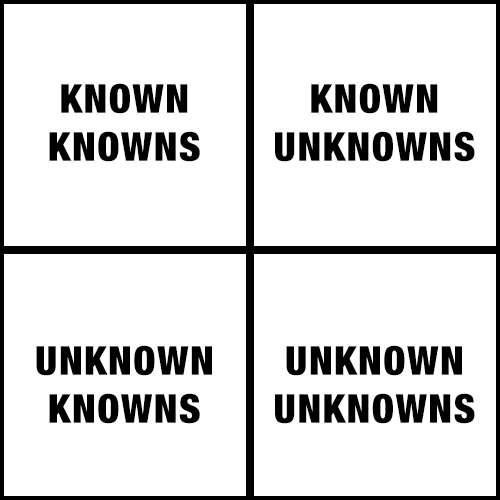
What am I going on about? Let’s look at what can be called a Rumsfeld square or Rumsfeld matrix. It’s named after Donald Rumsfeld, who famously said, “there are known knowns; there are things we know we know. We also know there are known unknowns; that is to say we know there are some things we do not know. But there are also unknown unknowns—the ones we don’t know we don’t know.” (Some people have characterized this as incomprehensible, but I have no idea what they’re talking about.) If we diagram it out in Greimas style, we see there’s a fourth square he doesn’t mention:
The existence of known knowns, known unknowns, and unknown unknowns implies the existence of unknown knowns. It’s right there. Yet people don’t seem to talk about them* – perhaps that’s why they’re unknown.
But the fact we have a space for them in the matrix doesn’t mean that they actually exist. Putting things into tidy diagrams and taxonomies can be rewarding, but it doesn’t necessarily add information any more than organizing your bookshelf adds information about what’s in the books. Mainly, it tells you about how your mind – and the structures it has learned – views and organizes things. But inasmuch as it describes aspects of reality, it may also be a heuristic for discovering things we aren’t aware of yet, or at least for knowing where to look for them – or, as the case may be, for becoming consciously aware of them.
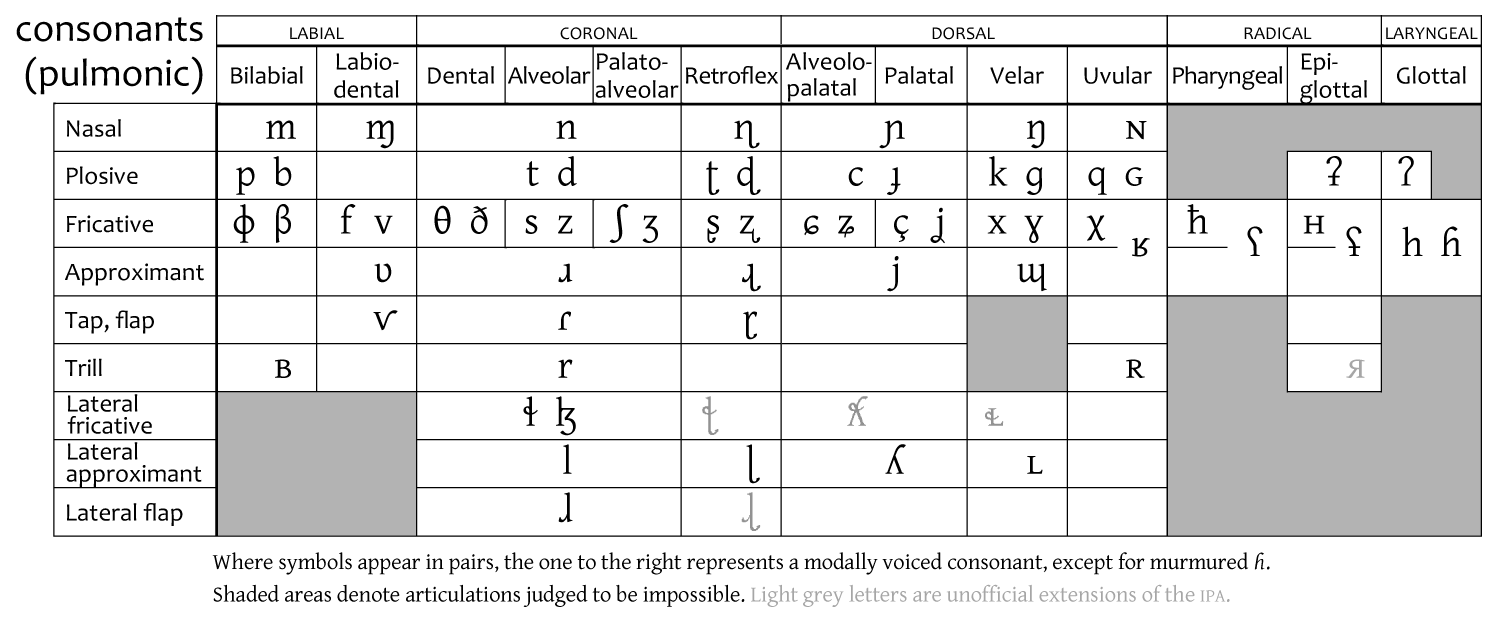
Linguistics is a great place to look for this kind of example, and I mean that in several ways. Here’s a table of the International Phonetic Alphabet symbols for consonants (thanks to Kwamikagami on Wikimedia Commons):
I won’t explain all the terminology because we don’t have all night. But you’ll see that this chart has grey areas: those are sounds that are considered impossible. A pharyngeal lateral fricative, for instance, would require having your something like the tip of your tongue stuck back deep in your throat – which, even if it were physically possible, would stimulate your gag reflex. So the grey areas help us confirm aspects of reality. They also force us to clearly define what we mean by our terms. For instance, “lateral” it means going around the side(s) of the tongue, like the sound [l]; a labiodental lateral fricative is impossible because it would require going around the sides of your tongue without using your tongue, because “labiodental” means using a lip and the teeth (and not the tongue). If “lateral” could mean the side of something other than the tongue, such as air going out the sides of the mouth while biting your lip, the labiodental lateral fricative box would not be grey.
But it still might be empty, like the labiodental trill, which is considered possible (I think it would take practice!) but no known language uses it as a speech sound. But look right above that empty box, and you’ll see the symbol ⱱ, which represents a labiodental flap: a sound you make by flipping your lower lip out brushing it past your upper teeth. That box was empty until fairly recently, when the people who agree on the chart were made aware of an African language that uses the sound as a distinct speech sound.
In a way, an empty box is a challenge to fill it – just as a grey area is a challenge to prove it wrong, or to scrutinize the definitions. So these taxonomies help turn unknown unknowns into known unknowns, and sometimes eventually to known knowns, and they also help us understand how we know – but they don’t produce the data themselves; you still have to go find speakers of real languages for that.
But our choice of what to include in the grid – what questions to ask – can still leave unknown unknowns unknown and unknown, and it can also divert attention away from known knowns. For example, there is no column for linguolabials (tongue and lip), which is altogether possible (you could do it right now: touch your tongue to your upper lip). In this case, it’s not because they’re judged impossible, nonexistent, or unimportant; it’s just that they’re treated as variants on bilabials and coronals, and so are represented with a mark under a letter: [n̼] and [l̼], for instance. They’re known knowns but more easily overlooked because they’re not given equal weight in the taxonomy – which effectively makes them lesser-known knowns.
But there’s one more thing that linguistics tells us about all of this. Every linguistics student comes in feeling sure they know all about the sounds we make in our mouths and how we make them, and every linguistics student comes to realize they were doing things they weren’t aware that they were doing. For instance, before I encountered phonetics, I knew how to say “pot” and “spot” like a usual English speaker, but I didn’t realize that, like a usual English speaker, I was making a puff of air after the p in “pot” but not so much after the sp in “spot.” Every introductory linguistics course has one class where the students are all holding their hands, or pieces of paper, in front of their mouths and discovering that they’re doing something that they know to do but don’t know they’re doing. This is was what is often called tacit knowledge.
In fact, most of language is tacit knowledge for most speakers. We know how to put together a sentence, but we aren’t really aware of how we do it or why some things sound right and others sound wrong. And we learn rules in school and think that anything that doesn’t follow those rules doesn’t follow any rules, when in fact “nonstandard” varieties of languages have grammars that are every bit as developed and constraining as “standard” varieties.
Some of the things we learn don’t just block knowledge, they put in false belief in place of accurate knowledge. If you say “doin’” instead of “doing,” for instance, we typically say you’re “dropping the g,” but there is no g. The difference between those two consonant sounds – [n] versus [ŋ] – is only a matter of where they’re said in the mouth; it just happens that we don’t have a separate letter for [ŋ] so we write it as ng, which also sometimes stands for [ŋg].
That’s not just an unknown known; it adds a whole new dimension to the Rumsfeld square. As the popular saying goes (seen in many versions, and often inaccurately attributed to Mark Twain), “It ain’t so much the things that people don’t know that makes trouble in this world, as it is the things that people know that ain’t so.” But I’m not going to redraw the diagram with veracity versus delusion as another dimension right here and now, because that would be a very mentally taxing digression.
Beyond linguistics, and beyond tacit knowledge and knowledge blocked by falsehood, there are also other unknown knowns in life. I think of the time more than 20 years ago when I was looking for a job and a friend said a friend of his needed someone to do some proofing corrections on HTML. So I phoned the friend-of-a-friend and we chatted a bit and he told me to come in. When I walked in the door to the office, this person I had chatted with already on the phone looked at me, and I looked at him, and we both said, “I know you!” We had had a great long conversation at our mutual friend’s place at a party some months earlier, but had not learned each other’s full name, so when we were talking on the phone we didn’t know we knew each other. The knowledge wasn’t tacit, and it wasn’t blocked; it was transiently and accidentally obscured. (He remains one of my closest friends.)
And then there’s the Karate Kid kind of moment. In the first Karate Kid movie, the hero wants to learn karate, so he apprentices himself to an old Japanese man who makes him do menial tasks such as washing and waxing the car according to very specific instructions and painting the fence with exact strokes. When at length the hero complains that he hasn’t learned anything and is just being used for free labour, the master throws some punches at him, which by reflex he blocks using the muscle moves he had internalized through doing the scut work. He knew how to do it, but he didn’t know he knew. This, too, is tacit knowledge, but not one that had already been demonstrated, like speech knowledge; it was first manifest at the point of awareness.
That’s also how I learned how to do structural editing. I picked it up through researching and writing essays and through evaluating and grading very large numbers of student essays as a grad student and instructor. I wasn’t fully conscious of the sense of flow and structure and the intuitions I was developing, but when I first sat down to actually edit articles and books, I realized that I knew how to do something I hadn’t known I knew. Of course, once it’s a known known, it can be further developed – but I have to watch out that I don’t start misleading myself into “knowing” things that aren’t so!
And then there’s the ultimate unknown known: the “enlightenment” (satori, kensho) of Zen practice. If my sense of it from accounts I have read is accurate, it involves seeing the world and realizing that you always knew its true nature, but you just didn’t know you knew… because you were too busy putting it into boxes and matrices and categories and words. Which reminds us again that while logical deductions and categorizations can lead us to discoveries, they can also lead us away from them.
Unknown knowns are some of life’s greatest pleasures, its greatest serendipities. There are also, yes, great discoveries of unknown things you either suspected might exist (as a known unknown) or had no idea would be there like that (unknown unknown). But as T.S. Eliot wrote in “Little Gidding,”
We shall not cease from exploration And the end of all our exploring Will be to arrive where we started And know the place for the first time.
In an important way, our lives are a course of coming to know ourselves and our worlds – of coming to know the things we had always known but had not been aware we knew. The unknown knowns.
* Well, Slavoj Žižek has – he has used the term for “the disavowed beliefs, suppositions and obscene practices we pretend not to know about, even though they form the background of our public values.” These are not so much unknown as “unknown” – we agree to pretend not to know them so as to avoid cognitive dissonance. He was responding to Rumsfeld’s use of the idea of unknown unknowns to justify attacking Iraq.
Let us first flush out any misconceptions about what this word comes from or what it might mean. Cistern is not a seabird (tern) that has stayed on the same side (cis) of the road, the pond, or whatever (why would it do that anyway, instead of crossing? I guess because there’s a fellow tern there, and one good tern deserves another). Cistern is not, though it sounds like it could be, a converse to brethren (in fact that’s sistren). And it is not a medieval stringed musical instrument (that’s a cittern). Any proposal that it is related to those is thus tanked.
I presume you know what a cistern is: it’s a reservoir for water – not a cup, not a jug, a proper fixed container of substantial size. It may be a tank for catching and holding rainwater; it may be the large reservoir at the top of your (and my) building that holds the drinking water supply (why up there? water pressure depends on the height of the vertical column – that’s why so many towns have water towers rather than just ground-level reservoirs); it may be the vessel surrounding the condenser on a steam engine; it may be the tank on your toilet – well, if you’re in England, anyway. I’ve never heard it used as such in North America, and was first made aware of the cultural difference in a bit of Marxist graffiti from England (in a book, collected by Nigel Rees) where someone had written on a water closet (WC), “Man is born free but everywhere is in chains. Smash the cistern.” (I didn’t get the pun at first either.)
So where did this word come from? English got it from Old French cisterne; Old French got it from Latin cisterna; that was formed from Latin cista (‘trunk, chest, casket’); that in turn came from Greek κίστη kístē (‘box, chest, casket’). And κίστη also, at length (and via Proto-West-Germanic), transformed into English chest.
But we are in general oblivious to the deeper histories of the words we use. No one is likely to see cistern and think of a box or chest that doesn’t hold water. And similarly, though words can have echoes of other words (which can also be useful in puns from time to time), you won’t hear tern or stern and think of a tank (though if you hear sternum you might think of a tank top – “tanks for the mammaries” so to speak). Ultimately, cistern is now, in the main, just a fancier, perhaps thirstier-sounding word for tank.
Not for just any tank, of course; only the kind that is filled from rain or a well. Tanks are also military vehicles, so named because they looked at first like large rolling cisterns. I am reminded of Sam Peckinpah’s 1977 war movie Cross of Iron, in which a soldier, seeing such vehicles approaching, screams “Tanks! Tanks!” In the French version, the translator did not render this as “Chars d’assaut! Chars d’assaut!” (the standard French term) nor as “Citernes! Citernes!” (the direct translation of the word). No, it came out as “Merci, merci!”
One of the comic strips I liked in my childhood was a quirky one set in the “old west” and starring an eponymous cowpoke, viz., Tumbleweeds. You would not think that a comic set in a frontier town called Grimy Gulch would be the sort of strip from which one might learn recondite vocabulary (unlike Calvin and Hobbes), but Tom K. Ryan, who drew it, clearly had a literary sensibility. For example, the lawyer in town was named Larsen E. Pettifogger, from which I learned the word pettifogger. But that is not today’s word. Today’s word is not in fact a word but a condensation thereof, viz., an abbreviation.
Abbreviations are not often encountered in comic strips, except on signs – certainly not in dialogue, for who speaks abbreviations? But one character in Tumbleweeds, named Lotsa Luck, did not speak but rather wrote small notes on a small notepad and peeled them off and handed them to his addressees. The notes were in a pointedly erudite style, and one of them – at least one; I don’t have the source material to hand anymore – used an abbreviation that has stuck with me, namely viz.
I didn’t know at the time that it was an abbreviation. I figured out from context that it meant something like ‘to wit’ or ‘namely’ (as indeed it does), and, not knowing any better, went with what my eyes told me and assumed that it was to be pronounced “viz,” rhymes with “wiz.” I also reckoned from context that it was about as stilted as, say, ye olde. I believe the first time I was confronted with its being an abbreviation was when I tried to play it in Scrabble. It would be a very useful word to play in Scrabble, but you may not play it in Scrabble any more than you may play etc. At length I learned that it stood for videlicet. Which left me with three questions: first, what exactly does that mean; second, how do you say videlicet; and third, how do you say viz.? Oh, and a fourth question: where the heck does that z come from?
Let’s answer the fourth question first, because it relates to ye olde as well. You may know (as I have mentioned it occasionally in the past) that the y in ye olde is not actually a y but a rendering – within the limitations of type bought from the Netherlands – of the character þ, which stood for what we now write as th. It’s similar to how the z in names like Kenzie and Menzies is a representation of an old character ȝ, which stood for what we might now write as gh – except we don’t use that sound anymore. The names Menzies and Mingus were originally the same. So does that mean that viz was originally viȝ? No – it’s a different abbreviation, something more abstruse and wicked.
OK, you may not agree that medieval scribal abbreviations for Latin are wicked. After all, these scribes had to copy out countless pages of text and had good reason to make their work a bit lighter, even if it made life troublesome for scholars of later centuries. So, just as we might use Ltd. in place of Limited and Dr. in place of Doctor, they would regularly reduce common Latin suffixes to standard abbreviations – -um (or often any other thing involving m or n) might be converted to a simple ~ or just ¯ above the letter before, for example, and -et was sometimes represented by ꝛ. And occasionally the abbreviation might grab a few more letters under its umbrella. So videlicet could be viꝛ. Which, if you’re trying to set it in type and you have only the letters produced in Dutch foundries, or you’re just going with what your eyes tell you, might – in fact, would – come out as viz.
What does videlicet mean? Well, first off, the et is not the et that means ‘and’ (though ꝛ was also used to stand for that et). Videlicet is itself a contraction, of videre licet, which is videre ‘to see’ and licet ‘it is permitted’. But in Latin it would be said as videlicet, not as videre licet, and that would be with the stress on the first e – which is the only long vowel – and if you’re going with classical pronunciation, the v is like “w” and the c is “k,” but if you’re going with ecclesiastical pronunciation the v is “v” and the c is like “ch.” But in English pronunciation, the word is said “videliset.”
So is that how you also say viz., just as you say etc. as “et cetera”? You could… but that’s not the usual way, at least according to the Oxford English Dictionary. So does one say it as “viz”? One does not. No, apparently, “in reading aloud [it is] usually rendered by ‘namely’.” So, for instance, Please send $3K of Au to my residence, viz. 27 St. James St. would be read “Please send three thousand dollars of gold to my residence, namely twenty-seven Saint James Street.”
I’ll have to take their word for it. I am not aware of ever having heard it read aloud. In fact, I have rarely seen it even in print – though I did just encounter it this week in an academic book I’m editing. I seldom see it even in academic books, but the author of this one is not American; he’s from the same country that supplied early English printers with their type sets, viz., the Netherlands.
“It’s seven courses,” Arlene said, leaning forward, her eyes widening.
“Not including the little extras,” Jess added. “You know, little hors d’œuvres. Who knows what it might be. But the official first thing is the fish of the day.”
Arlene looked up, raised her palms to the ceiling. “Could be anything!”
“Who knows what they’re catching,” Jess said. “It’s the Spanish coast.” She leaned back on her chair and had a swallow from her class of cava.
“San Sebastian?” I asked.
“Yeah,” Arlene said. “And then – what was it? Naked shrimp?” She turned to Jess.
Jess held up a finger (one moment!), set down her glass, and flicked to an image on her phone. “Unclothed prawn.”
“Well, the clothing is hard to digest,” I offered.
“In two firings, with slight heat stroke and fried head,” she read off her screen.
“What,” I said. I leaned in to look at the image of a printed menu she was holding up.
Just then Maury entered. His gaze settled on the little scene before him. “A feast for the eyes?”
“We’re pregaling James with our trip,” Arlene said, beaming like a flashlight. She held up her glass of cava in a toasting gesture.
“Pregaling,” Maury said.
“Well, sure,” Jess said. “If we had already been there, we’d be regaling him with it. But we haven’t been yet, so it’s in anticipation.”
“Pre,” Arlene added, suppressing a little smile.
“Who’s Gail?” Maury asked drily.
“Who’s that gal…” Jess crooned.
“Why is it regale?” I mused aloud.
“A royal treat?” Arlene said.
“I suppose it might be related to Spanish and Italian regalo, ‘gift’,” I said.
“Yup,” said Jess. She was operating her phone again. It looked like Wiktionary on her screen. “Seems like it all comes ultimately from French régal…”
“Regal – royal!” Arlene exclaimed.
“Mais non, Manon!” Jess replied. “That would be royal or réal. Somehow it’s from régal ‘treat’ but that’s from Old French galer, ‘to enjoy oneself’.”
“As in gala,” Maury said from the sideboard, to which he had sidled. “At one of which I am due in half an hour.” He poured himself a glass of cava.
“Well, you can regale them with our pregaling you with our dinner at Arzak,” Arlene said. She took the phone from Jess’s hand and flipped back to the menu photo. “Look, after the Mandarin pigeon there’s something called ‘Enigma.’”
I leaned in, flipped my glasses onto my forehead, and read. “Yuzu and cherry cream with mint crisp.”
“You’ve solved it!” Arlene said. “Now solve how it got from gifts and galas to storytelling.”
“That’s easy enough,” Jess said. “It’s all pleasing entertainments. You can still regale someone with food and drink. You can regale yourself, too.”
“Dinner and a bedtime story for one!” Arlene said. “Netflix and chill by yourself. But first… pregale.”
“Oh, the things we will do. Let me tell you about them.” Jess raised her glass.
I turned to Maury, who was still at the sideboard, already refilling his glass. “You’re going to a gala?”
“Yes,” he said, “but it’s likely to be a dry evening.”
“Dull company?” Jess said.
“And an expensive cash bar,” Maury said.
“So let me guess,” Arlene said. “You’re…
Maury nodded and finished the sentence with her: “…pregaming.” He raised his glass in a toast.
This is the time of year you can get to be like a cat when it comes to heading outside. You spend too much time inside where it’s warm but you’re feeling cooped up, so when you have a chance to step out, you hotfoot it… until you get out that door, and suddenly you have cold feet. Literally. You might even nope right back into the house.
It’s fun how we have this pair, isn’t it? And also how they only kind of go together? After all, people rarely if ever talk of having hot feet, and no one is going to say they coldfooted it back inside. Plus, hotfoot refers to haste, with a possible implication of eagerness, whereas cold feet refers not to slowness but to hesitation or outright refusal on the basis of pusillanimity. If they were bookends, a person inclined to tidiness would take one look and say “Can’t you make them match better?”
To which the answer could readily be “They weren’t made together.” Because they almost certainly weren’t, nor do we have any evidence that one was made on the basis of the other. They’re just like decorative items on the same theme that were bought in different places at different times – like the decorative leather-bound-book-styled cushion and decorative leather-bound-book-looking rolling cabinet that my wife and I have, or our lamp and bottle holder both styled after the Eiffel Tower but not in exactly the same way.
Which word is older? As it happens, the verb hotfoot and the verb phrase get cold feet are both first attested in print in English in the 1890s… but hotfoot the verb comes from hotfoot the adjective and adverb (as in “he was coming hotfoot from the village”), and hotfoot has been in English as adverb and adjective since the 1300s. Yes, it was much more eager to appear, though it was (may we say ironically) hesitant to be a verb.
And where did English get hotfoot from? French. Old French has chaut pas (modern French would make it chaud pas), meaning literally ‘hot step’ and figuratively ‘immediately’, and that’s where we seem to have gotten hotfoot by translation and adaptation.
OK, so where did we get cold feet from? That one’s a bit less forthcoming. The first known published use of it in the current sense is in Stephen Crane’s novel Maggie: Girl on the Streets, where someone says “They got cold feet” and the reader understands that the people referred to were overcome with reticence. It seems reasonable that the phrase was already current in colloquial use for it to be used that way in that book, and in the following decades its use spread – people who refused to fight in World War I were called cold-footers, for example. But where did the phrase come from?
There are idioms referring to cold feet in other languages. The most reasonable suspect is German kalte Füße bekommen, literally ‘get cold feet’, which refers particularly to gambling: if you are on a losing streak, you may get cold feet – perhaps because you’ve lost your shoes – and back out, and if you’re even just afraid of losing what you’ve won, you could also be said to have cold feet. And in 1878, an English translation of a German novel, Seed-Time and Harvest by Fritz Reuter, had a character saying “haven’t I as good a right to cold feet as you? Don’t you always get cold feet, at our club, when you have had good luck?” The sense of hesitancy to join in gambling could be applied more broadly, to such things as social engagements (up to and including engagements to be married). But I have no idea whether that novel was popular among the set of people who would make the turn of phrase popular, or whether the same idiom might have spread another way, say in actual casinos.
But there is an earlier appearance in English of an idiom about cold feet – it’s in Ben Jonson’s play Volpone, from 1605. He makes reference to a Lombard turn of phrase, which is avegh minga frecc I pee (Italian aver freddo ai piedi, ‘have cold in the feet’), but then, as now, it doesn’t mean ‘hesitant’; it means ‘broke’. As in you have holes in your shoes – or no shoes at all.
Which could, after all, dispose a person to hotfoot it to work, I suppose. But not to something that would cost them money. Which may be a pity – as we learn from Vimes Boot Theory, propounded by Terry Pratchett in Men at Arms:
The reason that the rich were so rich, Vimes reasoned, was because they managed to spend less money. Take boots, for example. He earned thirty-eight dollars a month plus allowances. A really good pair of leather boots cost fifty dollars. But an affordable pair of boots, which were sort of OK for a season or two and then leaked like hell when the cardboard gave out, cost about ten dollars. Those were the kind of boots Vimes always bought, and wore until the soles were so thin that he could tell where he was in Ankh-Morpork on a foggy night by the feel of the cobbles. But the thing was that good boots lasted for years and years. A man who could afford fifty dollars had a pair of boots that’d still be keeping his feet dry in ten years’ time, while a poor man who could only afford cheap boots would have spent a hundred dollars on boots in the same time and would still have wet feet. This was the Captain Samuel Vimes “Boots” theory of socioeconomic unfairness.
Meaning, if we extrapolate from wet feet to cold ones, that the people who are best disposed to hotfoot it are not the ones most likely to get cold feet, and vice versa. And all the best occasions boot little if you have little boot – and cold conditions to boot.
He pounced on a piece of text and fairly bounced with outrage. “Words don’t get meaning from sounding like other words!” he pronounced, and, having thus denounced, flounced out of the room.
And fair enough: in general, words don’t get their meaning by sounding like other words. If they did, puns would be rather duller, and all those caterers with fare and thyme in their names – and all those hairstylists with mane – would just seem like they were making spelling errors. But there are always exceptions. We do sometimes shift the sense of a word towards what we think it sounds like it’s supposed to mean – outrage, for instance, has nothing in its origins to do with rage, and yet…
Of course, that’s an etymological conjecture. But conjectures on the basis of similarity are always conjectures of relatedness; we need to remember that most speakers of a language don’t actually know which words are cognate and which are not, and so if cognate sounds related to cognition they will think of them as having a similarity of sense. (The two words are, in fact, unrelated.)
And anyway, it goes the other way too: we will take bits from words and put them together to make other words. Of course we will! And we’ll do it in a way that just feels like it makes sense. So we get chocoholic, from choco-, trimmed from chocolate (it is not a word made from a root and a suffix), plus -holic, trimmed from alcohol, which is a one-piece word in English but traces back to Arabic al-kuhl.
So, now. Flounce. You know that it has something in common with bounce, jounce, pounce, and perhaps trounce, but not with ounce or any of the Latin-derived words containing -nounce (pronounce, announce, denounce, etc.). If you were to define flounce, what would you say? Would ‘bounce in a floppy or flailing way’ work? But then can we say that that fl- is adding an element of sense, if not in the origins then at least in the way we think of the word?
Well, fl- isn’t a morpheme – it doesn’t automatically carry meaning. Sure, there are flail, flap, flutter, flounder, and a few others like that; but there are also flat, flake, flank, floor, and a few others that seem to have to do with two-dimensional surfaces; and there are fly, flower, floss, fleer, flaw, and assorted others that relate to neither. In fact, of all the etymologically unrelated words in English that start with fl, about one in seven have something to do with loose motion and about one in six have something to do with surfaces. That’s arguably more than chance, but it’s far from a sure thing. And yet if you’re casting around in your mind looking for words with a similar sense, perhaps to use as a basis for a portmanteau, it could be a quorum.
But that’s not where flounce comes from, is it? Well… we’re not completely sure. There is a verb flunsa that in Norwegian means ‘hurry’ or ‘work briskly’ and in Swedish means ‘fall with a splash’; it seems like it could be related to flounce, but there’s no actual trail of evidence to connect the two; also, the Scandinavian words are first attested from the 1700s, and flounce is first seen in texts from the 1500s, whereas the development of sound and form would require the two to have split apart from their common source at least a few centuries earlier.
And on the other hand, words – especially expressive words – do have something of a history of being formed imitatively in English: sometimes imitating the sound (e.g., splash), but sometimes just imitating other expressive words. And yes, there is the possibility that flounce was formed by analogy with bounce and pounce plus that fl at the start, which might flap or flutter or might just soften the overall effect. After all, we did just that kind of thing with plounce, a (now rare) word that showed up in the 1600s and means ‘plunge into water’ or ‘flounder in water’.
And then, on the other hand, given that people are often more prone to flouncing (either literally, moving in an exaggerated fashion, or more figuratively, making an ostentatious departure, say) when they have had a bit to drink, could a connection to fluid ounce be worth a shot? …No, it could not.
Incidentally, however ostentatious both may seem, the flounce that names a decorative fringe or ruffle is not related to the verb flounce; it comes from the Middle English verb frouncen ‘curl’.






 Sesquiotica