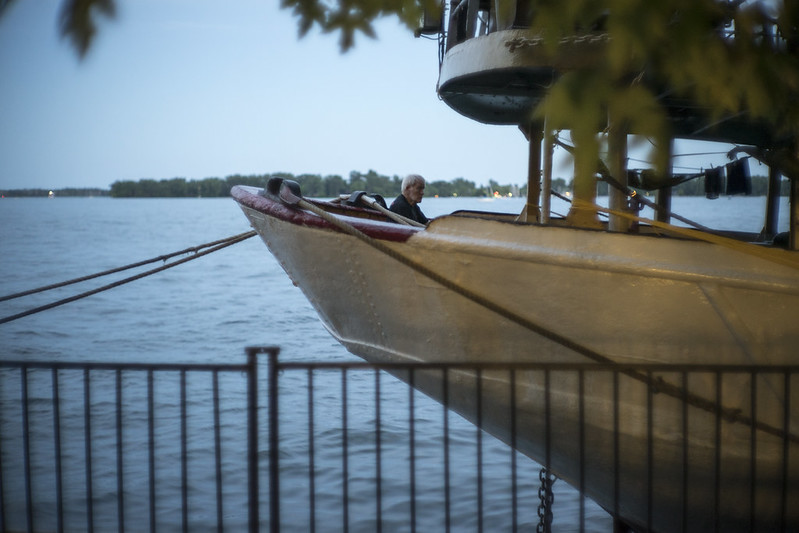
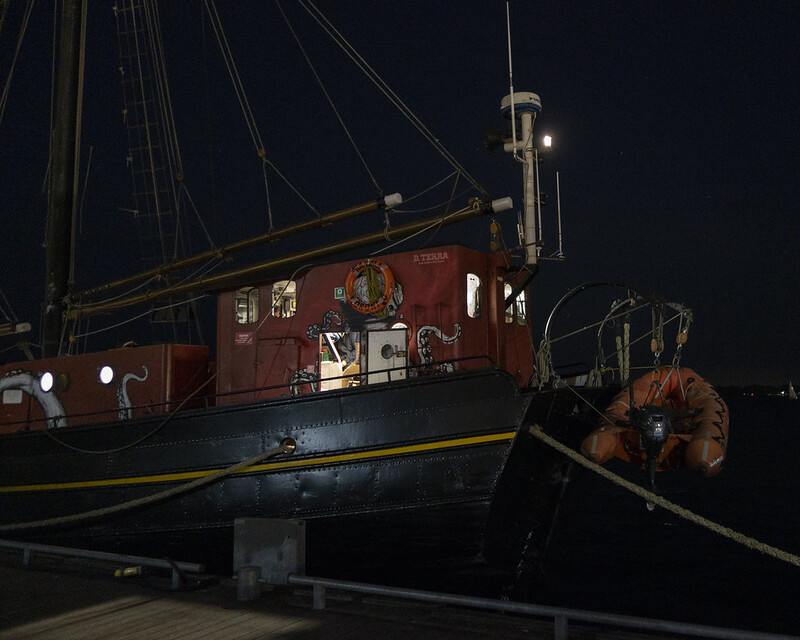
I’ve learned that if you take pictures of people in the backs of boats, you get some stern looks.
OK, ha ha. Look, at least I’m not doing that other grand old word for the back end of a boat. There’s a lot of play to be had with “back end” and poop, and you should thank me for not stepping into it. (By the way, poop for ‘back end of a boat’ traces back to Latin puppis meaning the same thing, and has no actual etymological relation to that other poop – which appears to come from an onomatopoeic word for breaking wind.)
I’m also sure that the phrase from prow to poop isn’t as popular as the synonymous from stem to stern for reasons of relative ridiculousness. Anyone who deals with children knows that the moment “poop” enters the conversation, anything stern is doomed.
But how is it that there is stern meaning ‘back of the boat’ and stern meaning ‘severe, humourless’? Let’s start with the latter one. It’s from an old Germanic root meaning ‘rigid’; it came into modern Scots as stern meaning ‘resolute, courageous’, but into modern English with a rather less inspiring sense of ‘grim’ or ‘severe’. It’s been in English for as long as there’s been an English for it to be in, first in forms like sturne and styrne and later shifting to steerne and sterne.
It could seem reasonable for the back of a ship to be strong and resolute, right? After all, it’s the place the boat is guided from. And that’s right: it is guided from there. It’s also right in that the nautical stern is directly related to starboard, as in ‘right side’. But neither has anything to do with sternness. Rather, they have to do with steering – in fact, etymologically, with steering. Stern comes via Old Norse from the same root that gives us steer; it showed up in English around the year 1400 (thanks to Norse invaders who occupied a large part of England around then), in forms like steerne and sterne. Steer had already been in the language, long enough in fact that by about 1500 steereboard – so called for the side of a smaller boat that a right-handed helmsman would steer from – was becoming starboard, inevitable subject of folk etymologies.
But of course the bigger boats were being steered from the back end. Hence the name stern, because it’s where you steer the boat – where the rudder and the wheel are. Rudder obvious once it’s pointed out, isn’t it?
Why wouldn’t the catamaran race with the other boats?
It was two prowed.
OK, OK, take a bow. You might as well; there’s two of them.
No, I’m not going to get into bow here; there are only so many hours in my day. I’ll just mention that bow as in the prow of a ship is related to bough as in a tree branch but is not related to bow as in bend from the waist or to bow as in tied ribbon. But mainly I’m here to tell you that prow is related to proud.
Oh, no, sorry, I don’t mean the prow that’s the front of a ship. That prow is related (way back, passing through Latin prora, which meant the same thing, and Greek πρῷρα, ditto, to Proto-Indo-European *pró) to pro as in professional and in every other word with the prefix pro-, as well as to premium and every other word with the prefix pre-. But it’s not related to proud.
So there’s another prow? There is, not only noun but verb and adjective as well. The noun means ‘advantage’ or ‘benefit’; you could speak of “the common prow” or of “doing someone prow.” The verb means ‘be of advantage’ and typically took (no one uses it anymore) an indirect object: “It would prow him.” The adjective means ‘worthy’ or ‘valiant’ and has in particular been seen several times in literature (from Spenser’s Faerie Queene through Tennyson and Hardy) in the phrase “the prowest knights.”
And is proud thus originally prowed? It is not. The derivation happened much earlier; in fact, like prow, proud comes from Latin prodesse, ‘be of value’; it kept the d in point of pride, whereas this prow did not. And then its vowel changed to derive pride from it, in a way similar to how we got fill from full and length from long. (This is called umlaut, a word most of us know as a metonymic term for the diacritic used to indicate it in some other languages.)
So the next question is… is this prow related to prowess? And yes, it is. Prowess is derived from prow (though the derivation happened in French, which English got it from; prou became prow and prouesse became prowess). Originally prowess referred to a valiant act, or to valour in general; over time it extended in sense to mean any particular skill… though it does still have some overtone of valour or at least of force, doesn’t it? Perhaps like a prow slicing proudly through the waves.
Which takes us back to the first prow, which also came to us from French (proue), which got it from Latin. You will recall I said that traces all the way back to the same Proto-Indo-European as gave us pro. You may also remember that I said that proud and prowess and so on come from Latin prodesse (‘do good, be of benefit’). Well, now I must note that that is the infinitive of the Latin verb prosum, which may look like a command in Excel but is from pro- (as in ‘before’ etc.) plus sum (‘I am’). So…
…yeah, I was untruthful. Proud is closely related to prowess and the prow you probably didn’t know about before, but it’s also distantly related to the prow of a boat.
So I misled you. I’m not proud of it. But please don’t be stern.
I’m thinking of Cockaigne today because on Twitter there’s been some discussion of what restaurants people thought were a real treat when they were young – someone had said mean things about Red Lobster and the Olive Garden, and while we didn’t have either of those when I was a kid, we sure looked forward to steaks at Ponderosa – and also because Michelin has announced its new Canada guides, including mention of restaurants in Toronto, some of which I’ve even eaten at. And, yes, the food at a Michelin-starred restaurant is quite the indulgence, but on the other hand, there’s a lot to be said for a bit of good old comfort food, y’know? Sometimes you want quality, other times quantity; sometimes you want delicacies, other times… indelicacy.
But what what would your Cockaigne feature? If you could drink one thing all day long, would it be champagne or Coke? If you could eat whatever you want, would it include cake, or coq au vin, or some other kind of cooking? If you were at leisure with unlimited resources, would you spend your time relaxing at a grand beach resort or skiing at a little tucked-away place? If you could indulge in any sensual pleasures you wanted, what would be the relative balance of wanton sexual adventures versus reading books in a bubble bath?
If you’re not familiar with Cockaigne, or have seen the word but aren’t sure of its reference, allow me to introduce you. It’s a mythical land of indulgence, first concocted in the medieval era. The origin of the word is uncertain, but probably has something to do with cakes. It has versions in various languages, such as French Cocaigne (the source of our English word), Italian Cuccagna, and Spanish Cucaña; some other languages have different names for the same place, such as Dutch Luilekkerland, German Schlaraffenland, and Swedish Lubberland. It’s not etymologically related to Cockney, although an association has occasionally been made and Edward Elgar played on it in his concert overture “Cockaigne (In London Town).” And it is not at all related to cocaine, a word it pre-dates by more than half a millennium (cocaine is just from coca plus -ine), even though cocaine is probably the sort of thing that some people might want in their Cockaigne.
I’ve looked at this general topic before, a dozen years ago, when I tasted thelemite; I noted that Rabelais’s vision of a “do what thou wilt” place required maid service, meaning there were some people who were apparently not so free (unless they wanted nothing more than to be fancy maids, I guess), and I considered the 1920s hobo song “Big Rock Candy Mountain,” which to me sounds like a land full of indolent people with tooth decay and desolated livers, although I suppose if we’re doing fantasy anyway, we might as well fantasize that you can eat and drink all the crap you want and suffer no ill effects. I mean, it’s hardly paradise if you wake up with a flensing headache, right?
Anyway, fantasy is fantasy. It exists precisely because our lives are frankly insufficiently gratifying. But our fantasies often reflect our priorities in ways that reveal the chains we still gladly wear (and also the chains we’d like other people to wear, as Rabelais showed). Some people’s fantasy cities, for instance, have freeways you can drive through them at high speed, unobstructed (a staple of mid-20th-century urban visions); others’ fantasy cities entirely obviate driving: step out your door and everything you want in any normal week is steps away, and you can take a fast train or even an easy bike ride to get to other things and places when you want. Introduced to a Cockaigne, would we be like Little Orphan Annie who, when asked what she’d like to do first in the mansion of Daddy Warbucks, said “The windows, then the floors”?
Even if we can cast off all chains and just talk about things people enjoy, it’s plain not everyone agrees. Many people could spend their whole lives lolling on a beach and never once be cold, but there’s a reason that the only resort I know of called Cockaigne is a cute little ski area in New York State (I’ve skied there; it ain’t Whistler, but it’s gemütlich). And while I first saw the word Cockaigne in the name of a recipe (I can’t remember what it was for; I’m nowhere near my mom’s cookbooks right now), if you search for recipes with Cockaigne in the name, you’ll get quite a variety, everything from brownies to chicken breasts. Both of those, in fact, are from The Joy of Cooking; my mother didn’t have that book, but it seems to have been a vector for use of the term—the authors explain in their foreword to the 1967 edition, “in response to many requests from users of ‘The Joy’ who ask ‘What are your favorites?,’ we have added to some of our recipes the word ‘Cockaigne,’ which signified in medieval times ‘a mythical land of peace and plenty,’ and also happens to be the name of our country home.”
Well, ha, mythical land of peace and plenty, sure. I mean, that’s true, but I don’t imagine the Rombauers and Beckers had in mind the plenty of social inversion and plenty of wild shagging that the author of the medieval poem “The Land of Cokaygne” described. They might have been OK with the skies raining cheese, I suppose, but only depending on their lawn furniture. And they most certainly would not have envisioned the kind of company or consequences described in “Ego sum abbas Cucaniensis,” “I am the Abbot of Cockaigne”:
Ego sum abbas Cucaniensis et consilium meum est cum bibulis, et in secta Decii voluntas mea est, et qui mane me quaesierit in taberna post vesperam nudus egredietur, et sic denudatus veste clamabit: Wafna, wafna! quid fecisti, Sors turpissima? nostrae vitae gaudia abstulisti omnia!
I am the Abbot of Cockaigne and I keep counsel with drunkards and prefer the company of gamblers and who seeks me in the morning in the tavern will leave naked after vespers, and stripped naked he will cry: Oh no! Oh no! What have you done, most filthy luck? All the joys in life you have snatched away!
Just gets a bit too… real, doesn’t it? No need to go all medieval on people, so to speak. A scenic spa with coquilles St. Jacques and champagne—and nothing to risk losing—seems like a nicer starter pack.
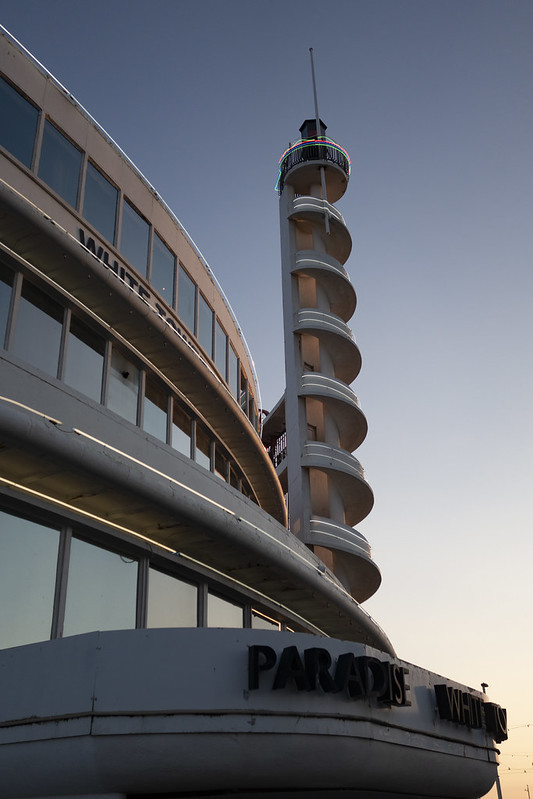
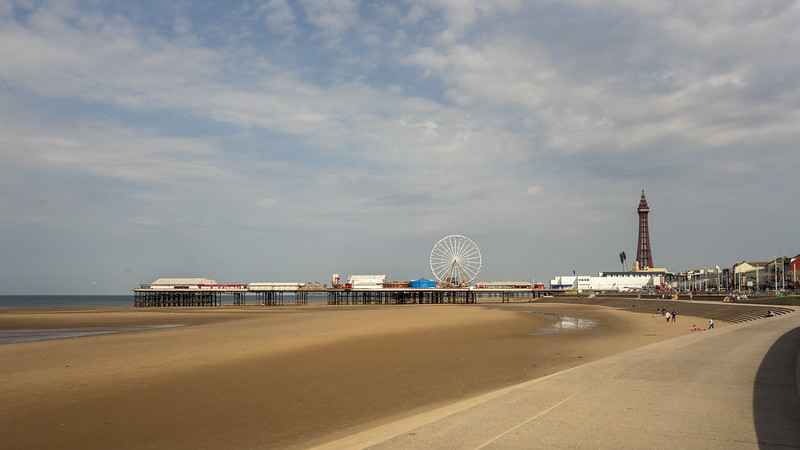
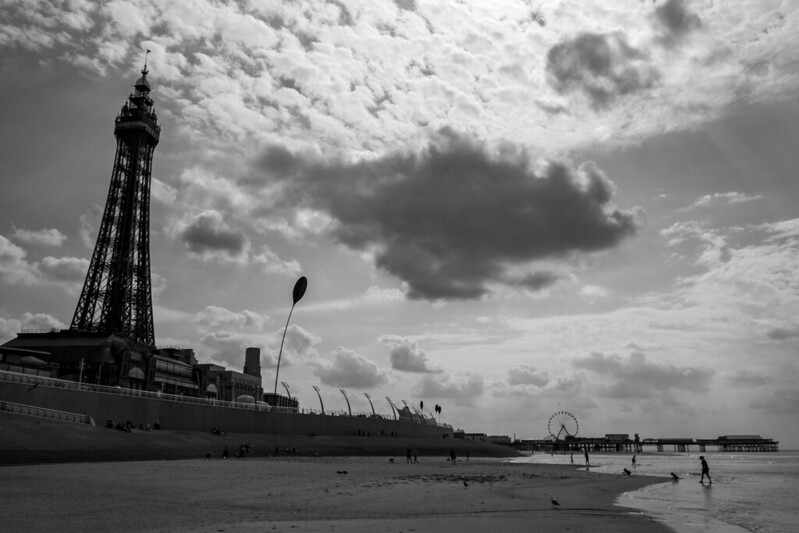
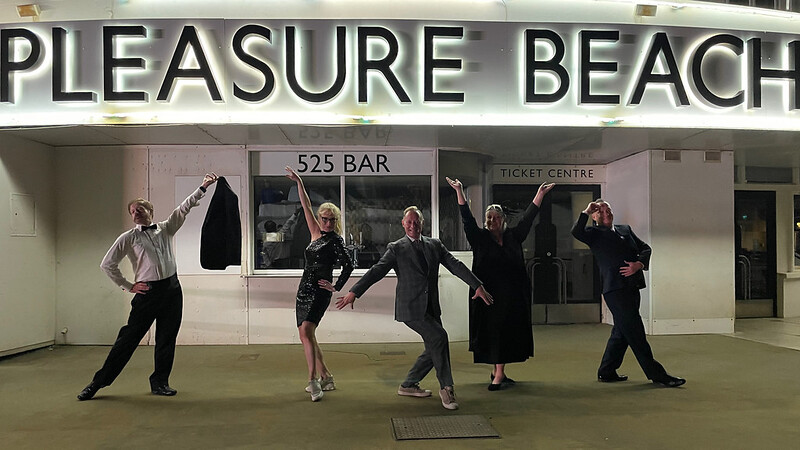
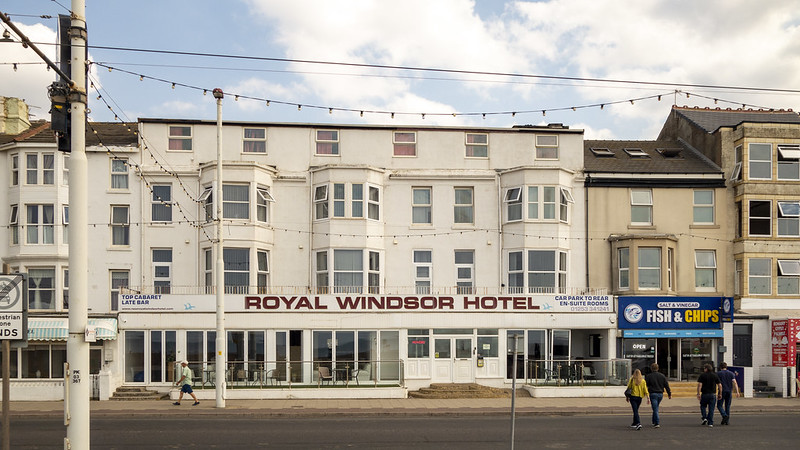
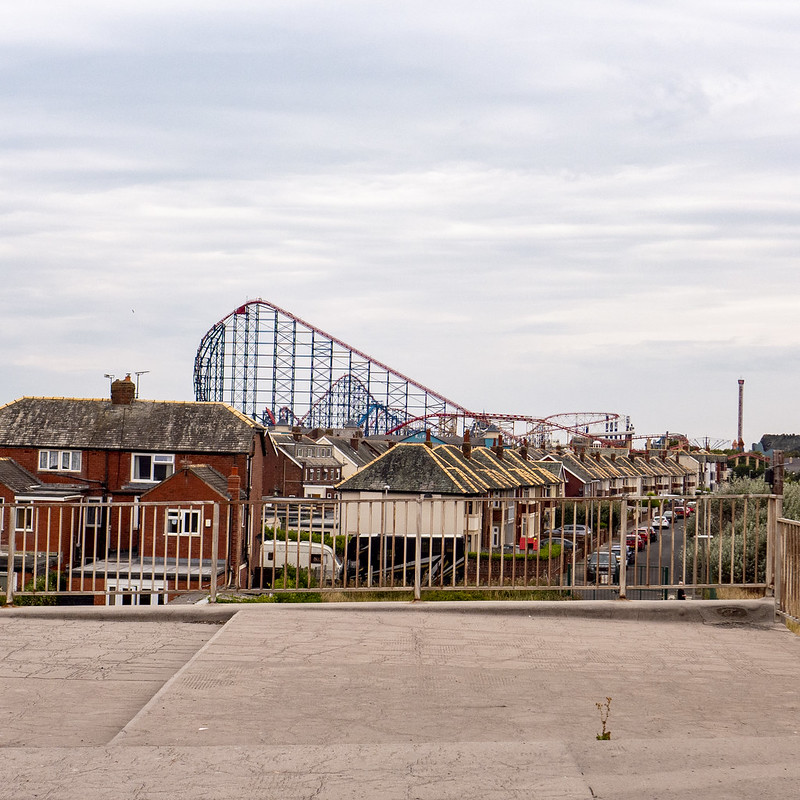
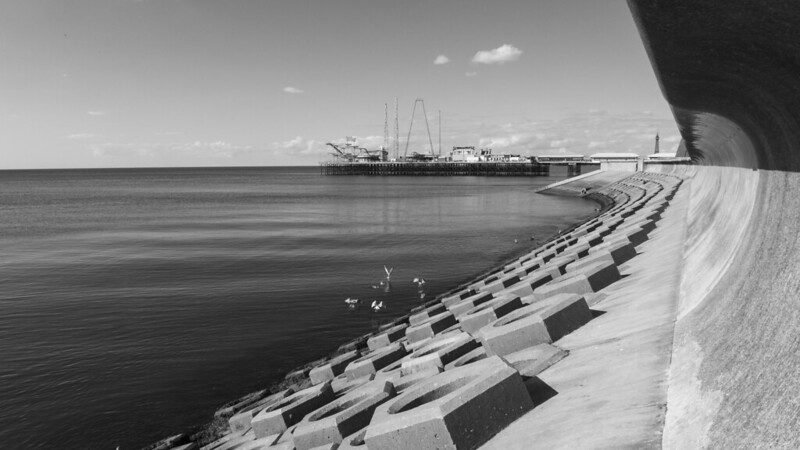
I was recently in a town that has famously been called “a famous seaside place.” In its heyday, it saw up to 17 million visitors a year. It has a lovely sandy beach seven miles long. It has a famous festival of lights, a famous amusement park called Pleasure Beach, famous entertainments…
I’d often heard of Blackpool, but this was my first time visiting.
What, you were expecting Boca Raton? Well, at least Blackpool’s name doesn’t mean ‘rat mouth’. (Things can sound so much less uncharming when not in one’s home language. Translate ‘Blackpool’ to Irish and you get Dublin – or, technically, its etymon, Dubh Linn, though the Irish name of that city is Baile Átha Cliath.) It’s named as it is because one of the local streams poured a black effluent into the sea from a peat bog it passed through. (No sign of that when we were there, but we did get told that there had been a “pollution incident” at one of the piers and we should probably not be in the water.)
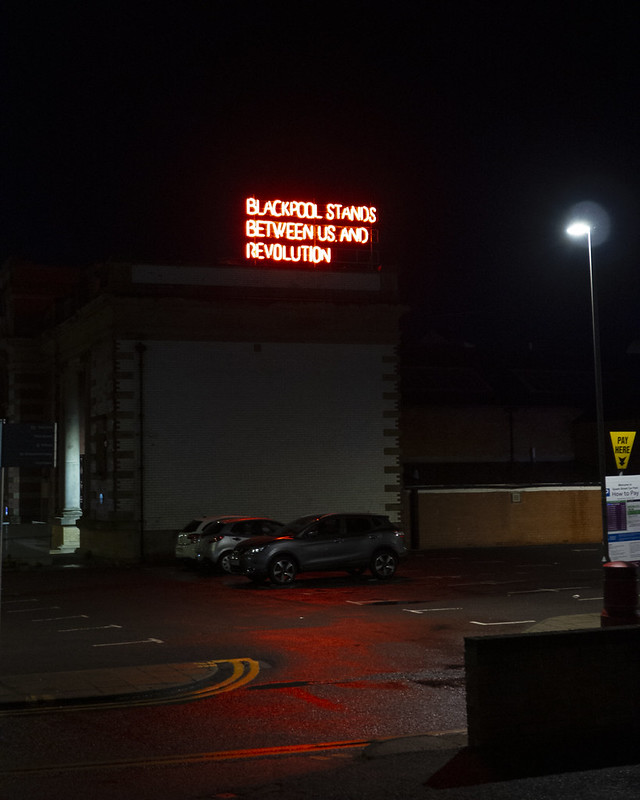
Admittedly, “Blackpool” doesn’t sound as bright as “Brighton,” but that doesn’t seem to have bothered Britons. It was the most popular holiday resort in England in the late 1800s through the middle 1900s. For factory workers in the north of England, who for a long time all got a week off every summer – each factory would close for a week, but they didn’t all close on the same week – Blackpool was a lovely place you could easily get to by train and wouldn’t blow your bank account on. The Romans had panem et circenses; the English – especially the northern English – had Blackpool, with its beach and entertainments. No wonder an anonymous businessman is quoted as having said, in the 1920s, “Blackpool stands between us and revolution.”
Blackpool was the first city in the world to have electric street lights. It has the oldest still-operating tramway in England. It’s the only town in the United Kingdom with three piers. It has what was, when it was built, the tallest structure in the British Empire. Its opera house, when opened, was the largest in Britain outside of London. And it is home to the oldest purpose-built ice theatre in the world.
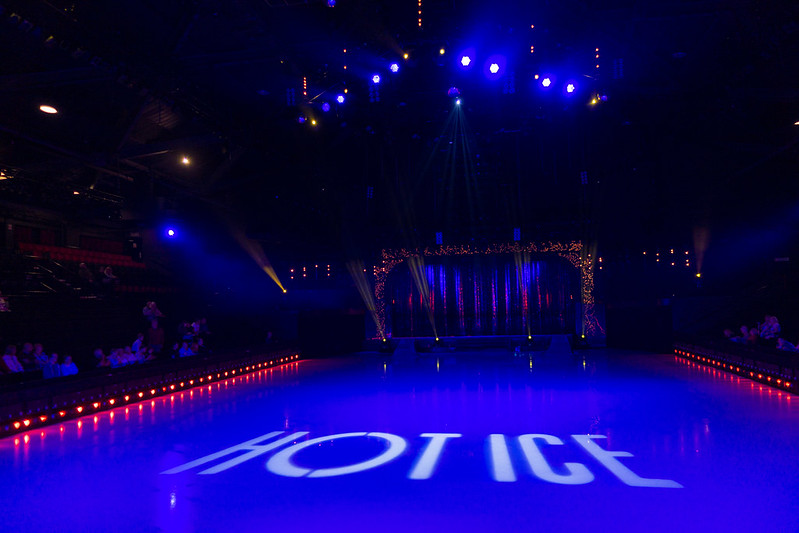
Which, by the way, is why we were there: my wife, as you may know, is a former professional figure skater, and there was a reunion there for people who skated in Holiday On Ice.
Ice shows have, like Blackpool, outlived their peak days, and most of the people in attendance were somewhat older than us (and we’re over 50 these days too), but Blackpool still has an ice show, Hot Ice, that runs every summer with extremely skilled young skaters, and it was a highlight of the reunion. And I have to tell you, it was one of the most impressive ice shows I’ve ever seen. The calibre of the talent is stunning. But aside from the hundred or so there for the reunion, there didn’t seem to be more than a couple dozen people in the audience. Perhaps they were all at the beach or riding the roller coasters.
In truth, many a modern beachgoer might think Blackpool better suited to ice rinks than to summer holidays. It’s true that its average daily low never dips below freezing (though its record low is –15.7˚C), but its average daily high never gets above 20˚C for any month of the year, and it averages fewer than five days a year over 25˚C. But you take what you can get.
Everyone I talked to who knew Blackpool from the later 20th century agreed that Blackpool used to be very nice. They also all agreed that it has… gone downhill a bit.
The Blackpool economy still relies very heavily on tourism, but tourists in recent decades have been able to take quick and cheap flights to the Costa del Sol. A British co-worker of mine in Toronto was gobsmacked when she discovered how much our equivalent, a trip to the Dominican Republic, would cost. I should have suggested she try Wasaga Beach on Georgian Bay. It’s warmer on average in the summer than Blackpool (though not than the Caribbean); it’s the world’s longest freshwater beach, longer than the beach at Blackpool; and it’s only as far from Toronto as Blackpool is from Sheffield… but there’s no train from here to there anymore.
At least you can still get to Blackpool by train, as we did. The train helped make Blackpool; of that there is no doubt. And cheap airfare has helped unmake it. But other factors have also played a part: the decline of the factories, for instance, which were such an important source of annual visitors. They would go to Blackpool to feel good about life. With them gone, Blackpool itself doesn’t feel quite as good as it used to. Indicators of social well-being (such as health conditions, divorce rates, and employment) are in a bit of a… dark pool. This is not to say that the town can’t rebound. But it’s not the only place in England lately that’s seen better days. So… if Blackpool stood between businessmen and revolution, who’s standing between Blackpool and revolution?
Originally published on The Editors’ Weekly, the national blog of Editors Canada
What’s missing from this sample text?
A set of subjects, n = 180, were surveyed using a predetermined questionnaire. Statistical analysis of the responses revealed a statistically significant pattern of association of low-frequency polysyllabic lexemes with greater intellectual value.
It’s not short on words, nor on syllables per word, nor on grammatical complexity. It’s an imposing and impressive display. But who chose and surveyed the subjects? Who predetermined the questions? Who conducted the statistical analysis?
It’s like the Great and Powerful Oz. You’re supposed to pay no attention to whoever’s behind the curtain, making it happen.
What you’re seeing is the effect of a language ideology, the ideology of objectivity – an underlying belief in the association between detachment and authority. It’s a belief that humans are messy, subjective bags of feelings, and that to achieve real, authoritative, reliable, unquestionable truth, you remove people: these facts were not worked out by fallible humans; they were just… revealed. It’s one reason so much academic writing is so hard to read.
It’s not the only reason, of course. There are other ideologies at play too. The effects of one of them are described in the example text above (not quoted from a real study, however): the ideology of mental effort. We know that complex ideas take extra mental effort, and so we assume that greater mental effort is an indicator of greater intellectual value.
Complex syntax is equated with complex thought, and, as the example says, long and uncommon words are associated with rare and rarefied ideas. If something is easy to read, how impressive can it be, really? And, more to the point, if you make the reader sweat to figure out what you’re saying, they might not notice that what you’re saying is really fairly trivial. Once again, watch the Great and Powerful Oz, and don’t look behind the curtain!
This is not to say that everyone who writes that way is consciously trying to be the Great and Powerful Oz. Most authors, academic or otherwise, write in a way that’s considered appropriate for the type of text, and questioning why it’s “appropriate” might itself seem inappropriate – isn’t it obvious that in a research paper you don’t say “really fun,” you say “highly enjoyable”? We seldom stop to look at what’s driving our assumptions about the intellectual value of the way we phrase things. The real “man behind the curtain” is language ideology itself.
But there is no language use without language ideology: we believe that certain qualities go with certain kinds of language. It’s part of how we understand language in its context of usage. And our ideas about language are always ideas about the people we envision using that language. We don’t all agree all the time; there can be competing ideologies, for instance, about whether colloquial speech is a mark of unintelligence or of honesty. But we never come to language without baseline assumptions about what it says about the people who use it – even if it’s language that pretends they’re not there at all.
And from time to time, we can all benefit from pulling back the curtain.
What, do you dislike diversity? Then the English lexicon is not for you. Many a word, over the course of the years, gets diverted one way and another, until it has some number of forms manifesting some variety of sense. We see person and parson, victuals and vittles, vermin and varmint, and carmine and crimson. We even see it in to and too (yes, that’s right, they started out as the same word). So why wouldn’t we have divers and diverse?
We do have them, anyway, both coming from Old French divers, from Latin diversus, originally from roots meaning ‘turned different ways’ – the same as also gave us divert. But does there seem something particularly pervers, I mean perverse, about this doublet?
Well, yes, there’s the issue that divers is also the plural of diver (and is pronounced the same way as this divers). There’s also the fact that if you know French, you know that the word divers is not pronounced at all the same as how we in English say divers or diverse. (On the other hand, it is said the same as French d’hiver, ‘of winter’. I’m sure that signifies something.) But mainly, it’s hard to say why we would need two forms of this word. It seems like diversity for its own sake. Is it just that, contrary to a current popular usage, we may reasonably hold that one thing (or person) cannot be diverse? So we just have to have at least two?
I’d say there are two main reasons for having both (leaving aside the basic reason that we just do because historically it just happened that way – this is true, but nothing forces us to use both if we don’t want to). The first is that – for those who have become acquainted with divers in the wild – it has a quaint and old-fashioned air to it, the sort of word you see in texts that also have the old “long s”: ſeen in ſundry ſeaſons and divers manners (note that since the only s in divers is at the end of the word, it is not a long one – perhaps ironically).
The second reason is that whereas diverse carries an implication of considerable difference between the sundry parts, divers can mean simply ‘different’ or ‘various’ without implication of how different (the Oxford English Dictionary quotes Richard Chenevix Trench’s book The Fitness of Holy Scripture for Unfolding the Spiritual Life of Men: “We have the divers statements of St. Paul and St. James—divers, but not diverse”). It can also simply mean ‘several’ or ‘sundry’ or ‘a number of’ – so when I say there were divers people in the water, I can just mean that there were a fair few splashing about, with no particular comment on how different they were one from another.
You might object that most people don’t really know or appreciate this subtlety, and that’s true. But we don’t always write for most people. People are diverse, and certain subsets have exceptional inclinations and predilections. It’s OK, from time to time, to know your audience and know that they might find divers lexical charms on the necklace of prose to be welcome diversions.
L’empire empire. The empire gets worse. It’s an empirical fact. Every imperialistic imperative ends in pyres and impertinence. You may think that the empire state is building, but all empires are stricken back in the sequel.
You may object that this is all wordplay, but if you object to wordplay, why are you here reading this? Anyway, many a truth may be expressed more engagingly with a bit of verbal titillation or scintillation. It’s not that lexical coincidences reveal truth; they just give the opportunity to make truth spicier.
And one truth that is lurking in all of this is that empire, like any empire, has claimed by association some things that do not pertain to it at all. Empirical, for instance, which always strikes me as referring to things seen in the empire of the world, comes from Greek ἐμπειρία (empeiría, ‘experience’), which is from ἐν (en, ‘in’) plus πεῖρα (peira, ‘trial, experiment, attempt’). It has no relation to empire, which comes from Latin in (‘in’ or ‘on’ or an intensifier) plus parare (‘make ready’ or ‘order’ – you see it in prepare as well, among other words). How do you get from ordering to an empire? Through an imperator: an emperor, a person who delivers imperatives (yes, also related).
And then there is French empirer, which means ‘make worse’ or ‘become worse’, from en (‘in’ or related prepositions) plus pire (‘worse’, from Latin peior, which shows up in English in pejorative). Although its first- and third-person singular present indicative conjugation is empire, it also is not related to the noun empire (which is spelled the same in French as in English). And yet.
We see empire in various places, some dating to when empires were seen as good things, others dating to when they were… not so much. The Empire State Building, in New York City, which in my heedless youth I processed as [Empire] + [State Building] rather than [Empire State] + [Building], is named after the State of New York, which is nicknamed the Empire State. Why is it nicknamed that? We’re… not entirely sure; there are ideas about who first called it that and why, and how the name caught on, but there’s nothing solid. We just know that it started somewhere and expanded somehow and by the mid-1800s it had taken over. And we know that people did not view empires badly at the time. It was, after all, the height of the imperial age: the British Empire, the Spanish Empire, the French Empire, and on and on, each one a rapacious metastasis of commercial and military might – or, if you asked people at the time, a manifestation of the glorious spread of civilization.
As though civilizations were only the victors. International law of the time followed a principle that, if held to in small local matters, would mean that mugging was not only good but right and just, because clearly the person who is able to rob you of your wallet is smarter and better prepared and thus more deserving. But eventually what goes around comes around, and the colonial enterprises sclerose into bureaucratic enterprises as the active rapacity of the invader turns into the passive rapacity of the collector of unearned wealth. And by the late 1900s (that means 1980 or so – sorry), The Empire Strikes Back could be counted on to have a tinge of villainy in the very name. It’s not that we hate all things empire now; but, like an empire waist on a dress, empires seem old-fashioned, high-handed, and heading for a bust. Somehow in empire we are more likely to hear vampire than umpire now (neither of those words is related, by the way) – and perhaps also pirate (also not related, but it is related to empirical).
And yet. Humans being humans, there will always be someone somewhere wanting more and finding a way to get it. There will always be an empire building somewhere, in some state. But empirical observation of history tells us that, like the Roman Empire, they rise and fall.
J.M. Coetzee, in Waiting for the Barbarians, wrote this:
Empire has created the time of history. Empire has located its existence not in the smooth recurrent spinning time of the cycle of the seasons but in the jagged time of rise and fall, of beginning and end, of catastrophe. Empire dooms itself to live in history and plot against history. One thought alone preoccupies the submerged mind of Empire: how not to end, how not to die, how to prolong its era.
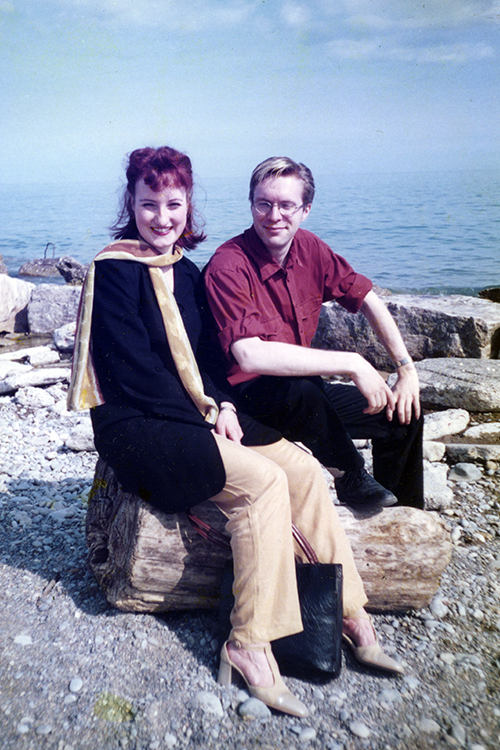
It wasn’t quite a meet-cute. Well, maybe it was. You be the judge. It went like this.
I was new to town and, to make some connections and see some performing art, I volunteered to usher at a dance festival. I knew no one. I went to the opening night party and did what I could to impersonate an extravert. This mainly meant conversing briefly with anyone who took it upon themself to converse with me. I managed to initiate a few brief conversations, but I spent the rest of the time just looking around. There was one person who caught my attention, a striking young woman with red hair who was sitting alone in the middle of the action talking to no one. I thought about going up to her and introducing myself. But she was beautiful, she wasn’t smiling, and it seemed quite possible she would chew me up and spit me out. I was a scrawny dorky guy. My nerves failed me altogether.
But wait. Two days later, I showed up for my first shift ushering. The doors weren’t open yet; we were getting things ready. I was told to go help stuff programs (put inserts into the booklets). The front of the theatre, when it wasn’t being the front of a theatre, was (and still is) a cabaret bar called Tallulah’s, and so I walked up to what was normally a bar counter by a window to join the other usher who was already there stuffing programs.
Guess who the other usher was.
Yes. The heart-stopping red-headed woman.
I was in a situation where conversation was expected, so I immediately made some kind of joke. I can’t remember what it was (the smart money says it was a play on words), but she seemed to think it was funny. She was very sweet and not at all carnivorous. We started talking. For some reason we got onto the subject of music and I mentioned my love for Arvo Pärt. She was very impressed, as she was also fond of his music, and she – like Pärt – was Estonian (on her father’s side).
Anyway, we got along well. Or at least I had the sense that we did. We chatted as occasion permitted all shift long (not during the performances, of course). I found out a few things about her; she found out a few things about me. And, naturally, at the end of the shift, I had a complete failure of nerve and did not ask her to meet me for coffee or anything of the sort. We went our separate ways and all I knew was her name.
And this was before social media. In fact, it was August 18, 1997.
Which was also before such things as online sign-up for dance festival ushering. So the next day I went back to see about signing up for some more shifts. Anything to increase the chance of another meeting. And as the volunteer coordinator looked at his big open schedule book, I looked at it from the other side and was grateful that I could read upside-down, because I saw an open slot on the same shift as Aina Arro. I volunteered for that day. And you can easily guess that I didn’t mess it up that time.
And that, to put it as cutely as possible, is the story of how I met my wife in a gay bar. (Technically that’s true: Tallulah’s is a gay cabaret bar.)
But was it a meet-cute?
You know what a meet-cute is, right? The noun meet-cute, which dates to the 1950s, is formed from the verb phrase meet cute, which dates to the 1940s (if not earlier). The Oxford English Dictionary defines that as “(of two characters in a film, novel, etc.) to have an amusing or charming accidental meeting which leads to, or is followed by, romantic involvement.” It illustrates it with a quote from the play Will Success Spoil Rock Hunter? by George Axelrod: “Dear boy, the beginning of a movie is childishly simple. The boy and girl meet. The only important thing to remember is that—in a movie—the boy and the girl must meet in some cute way. They cannot … meet like normal people at, perhaps, a cocktail party or some other social function. No. It is terribly important that they meet cute.”
So… was my meeting Aina cute enough? It was for us, to use the OED’s definition of the noun, “an amusing or charming first encounter between two people that leads to the development of a romantic relationship between them,” but was it amusing or charming enough for movie audiences? We didn’t bump into each other on a streetcorner, each weighed down with armloads of paper or pastries. We didn’t mistakenly take each other’s bags in an airport or train station. I didn’t go to serve her in a restaurant and accidentally pour wine or sauce all over her dress. I just saw her once, then saw her again, and it was in a thrown-together circumstance only inasmuch as we were both volunteering for a dance festival.
But what is cute, anyway? In Ireland, the word can be used to mean ‘clever, crafty, deceitful’, and in fact, cute is originally ’cute – that is to say, it was to acute as ’nuff is to enough: what is technically termed an aphetic form. So its first meaning was ‘clever’ or ‘smart’. And just as smart has gained senses relating to good appearance, cute has gained a sense of ‘attractive’ or ‘charming’ – or, increasingly, ‘pretty, in a childlike way’. Kittens are cute. But there are many people who are very good looking who you would probably not call cute.
And likewise, there are many charming circumstances that might also not be called cute. Seeing someone interesting, not having the nerve to talk to her, and then two days later being put to work right next to her? Well, mmmaybe.
But I have the older definition of cute to fall back on. After all, reading the sign-up book upside down and picking out the next open spot with the person I wanted to “coincidentally” be put together with again was at least a little clever. Right?
It was smart, that’s for sure. We met 25 years ago, and we’ve been married for more than 20 years now. Ain’t we a cute couple?
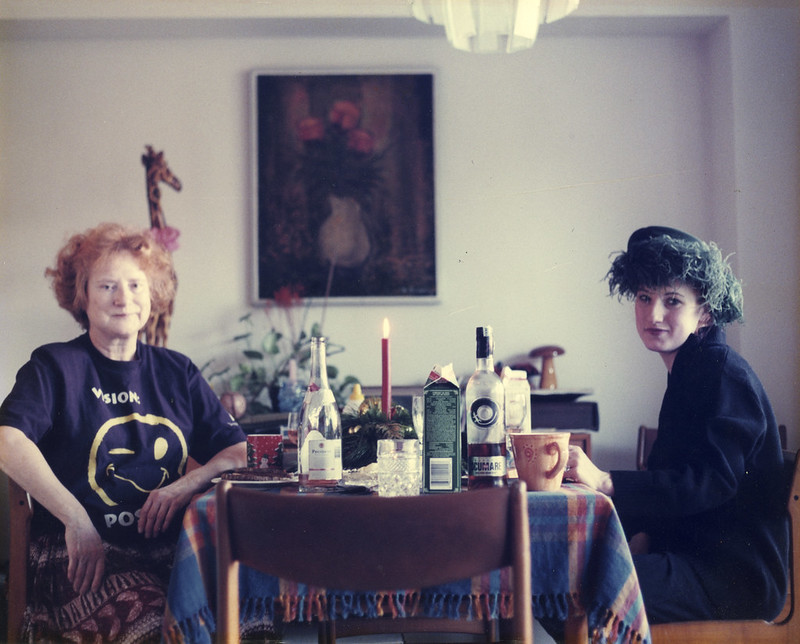
More than 80 years ago, in Riga, Latvia, a girl was born. Her mother wanted to call her Larissa. But her father thought too many girls had that name. So – perhaps influenced by the fact that their family name started with A – they called her Arisa. (The stress in Latvian is on the first syllable, and the name sounded the same with single or double s, so Arisa really was Larissa minus L. But in English-speaking context, Arisa is always said as you would expect, with the accent on the second syllable.)
A small digression here. You may not know where the name Larissa comes from; if you don’t, you’re in good company. In fact, you’re in a group that includes pretty much everyone. It’s a name that has been popular in some parts of Europe (especially eastern ones) for some time, since there is a Saint Larissa, who was part of a group of martyrs in a place that is now on the eastern side of Turkey. The name is Greek, and we’re not sure, but it was probably taken from the Greek city in Thessaly named Λάρισα (Lárisa, but usually rendered as Larissa). The name of that city is also of uncertain origin, but likely comes from λαρός (larós, ‘sweet, delicious, pleasing). This would all have been history unknown to the parents of little Arisa.
If you’ve done the math, you know that a war was breaking out just around when Arisa was born. That war and its sequelae led many people in the Baltic states to leave for another country. Arisa and her parents and younger sister escaped to Sweden. And then, after a few years, when Arisa was 10, they took a ship to Canada.
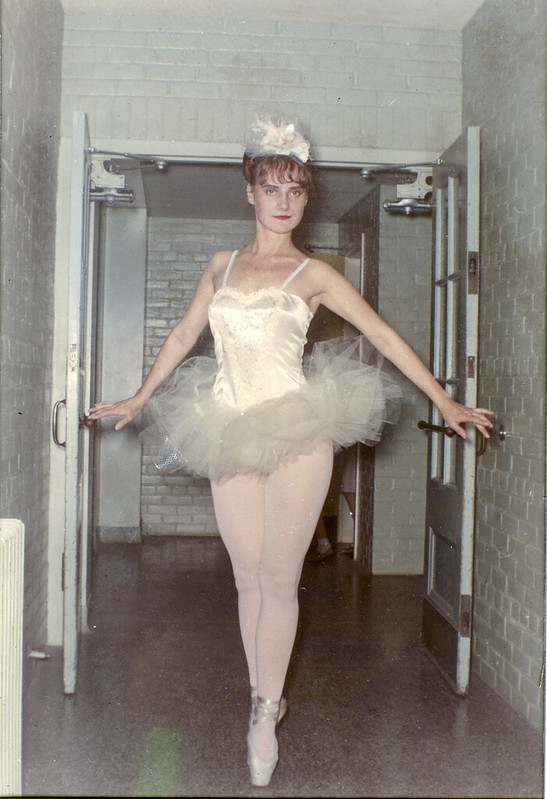
Arisa and her sister grew up in Toronto and environs. Arisa enjoyed the arts. She was excellent at drawing and painting. She loved ballet.
She danced avidly for as long as she could, even for years after she was married and had two daughters. And when she no longer could dance, she moved on, but she didn’t leave the arts behind. She designed and sewed clothing for herself and her daughters. When her older daughter became a figure skater, she made her costumes for her programs. She helped both daughters with their school art assignments. She shared her encyclopedic knowledge of dance, especially with her older daughter, who, along with becoming a professional figure skater, earned two degrees in dance studies.
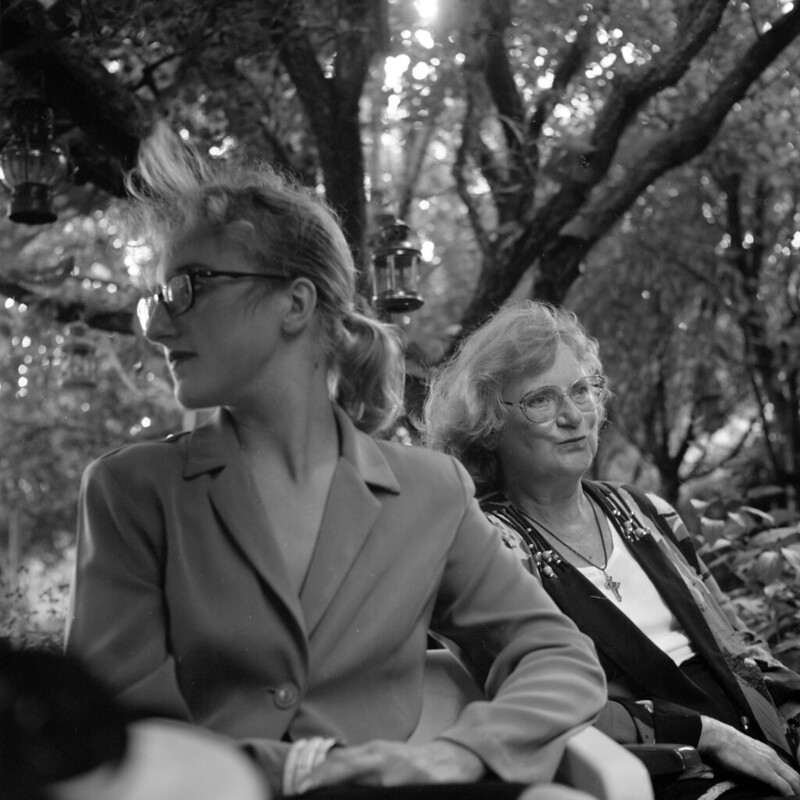
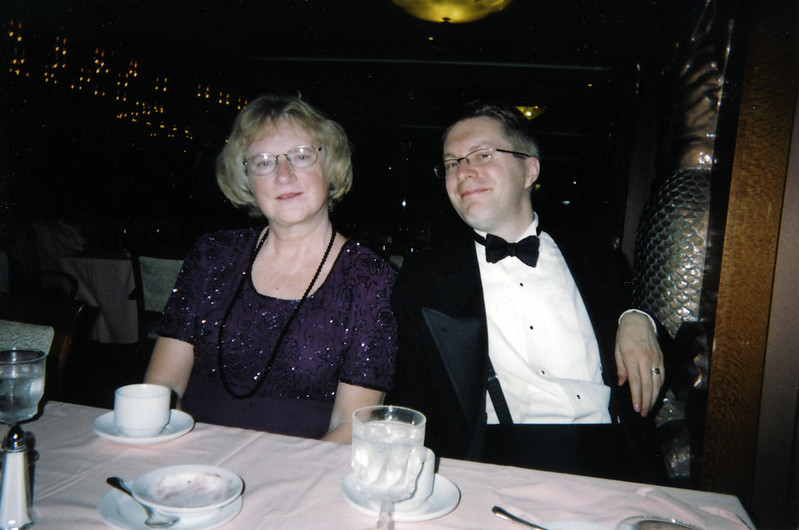
And then that older daughter – Aina – met me, volunteer ushering at a dance festival. In 2000, Arisa became my mother-in-law. And with me as with everyone, she was unfailingly kind, conscientious, and giving.
She never stopped being interested and involved in the arts. She volunteered for arts festivals (including literary and film festivals). She joined us to theatre and dance. If you met her in her later years, you might not expect she had ever been a dancer, and she would never tell you she had, and yet she loved the arts avidly… just as you would never expect that her name was altered from the name of a saint named after a Greek town, and yet it preserved the euphony that had undoubtedly helped make it so popular (a euphony that has led to the name being created in other cultures quite independently).
And you could never miss noticing that she had a certain flair.
She joined Aina and me to several theatre festival performances this year, complete with picnic lunches. We were looking forward to more with her. But, on short notice, she – and we – discovered that her season was ended. But at least we had what she had given us, which was so much. Like her name, she was always sweet… and more – and other – than you might expect.
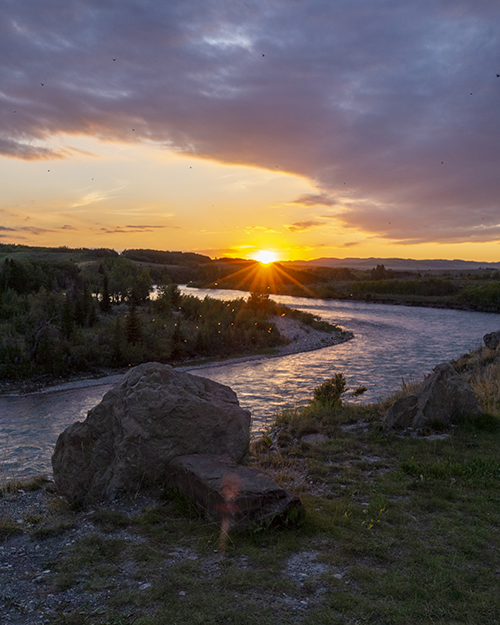
As the sun sets on Toronto one day in early August, it’s rising on what remains of the Aral Sea and, in another minute or three, on the whole west coast of India. As it sets on Calgary, it has just lately risen on the African coast of the Red Sea. For every sunset and sunrise, there is a whole set of places in the world that are crossing the terminator line of the sun’s shadow at that moment, turning away from or towards the sun. They are bound and set so to do, as long as the earth is moving as it is.
Poets write about sunsets, from time to time. But that’s like singing a song about a painting. There is no conversion rate between images and words; the words carry sounds and ideas the images never could, but the images bring things words have no hope of tattooing in black on white with their abstract little lines.
We like the sunset because we are there for it (how much less often are most of us awake to see the sunrise!), and because it is there for us, at eye level, the sun’s rays passing at a flat angle through the atmosphere, skimming across clouds. At the last, as it is cut by the horizon, you can look at it for more than a moment. And you want to look at it, because it has contrast and colour: all the things that your eye seeks as a treat but that are too harsh during the day are there on a dessert tray at sunset, completed by the contrast between the daylight before and the nightdark after. During the day we take the sun for granted, we seek the shade, we don’t look straight at it, but when we have turned far enough away from it we pause and appreciate it just before we can’t see it, and then it is gone.
But of course it’s still there. It’s all just our perspective, on our spinning ride. Every second of every day, from the beginning of the earth through now to the very end of our planet, there is a shadow line, a set of sunrise and sunset. When it is our time at the line, we can enjoy it if we want. When I visit my parents in Alberta I like to go for walks and see the sun go down. Back in Toronto, though that’s where my favourite song about watching the sunset was written, I much less often see it – there are buildings in the way. So be it.
You know the word sunset, of course, and you can see its parts. Sun is a grand old Germanic word, not related to son though it sounds the same in English now. Set is not so much one word as a set of words, or rather two sets. One of those sets is related to sect and refers to groups and such things. The other is related to sit and refers to going down, putting down, being in place. You can easily enough tell in which set to set sunset. (There is a third Set, the Egyptian god of war, chaos, and storms. Sometimes that Set unsettles the sunset. But we can set him aside.)
It is tempting to use sunset as a metaphor. But if you must, remember this, set this down: on the earth it is always sunset and always sunrise and always neither, and what we experience at any time just depends on where we are… and we will come around to each again and again.

















 Sesquiotica