ipsedixitistic

You’ve all heard of supercalifragilisticexpialidocious, of course. But what about ipsedixitistic? Try this to that famous tune:

Supercilious mumpsimuses, ipsedixitistic,
Prone to captious pickiness, so priggish and sadistic,
Just-so stories not so apodictic as just mystic…
Supercilious mumpsimuses, ipsedixitistic!

What, you can’t sing it straight through at high speed on first try? Then you’re not trying hard enough. It’s so simple, 87% of four-year-olds can do it.

Where did I get that figure? Everybody knows it. It’s obvious. I read it somewhere, anyway.

Well, what. Didn’t you know that 78% of statistics are made up on the spot?

If you haven’t met this word ipsedixitistic before, you will likely come to love it soon. Of course it’s a bit of a party trick to say – or even to read – but once you see how it’s put together it’ll be a bit easier. It comes from Latin ipse dixit, literally ‘he himself said it’, a thing that followers of Pythagoras and, later, other thinkers were prone to saying (though I imagine at least some of them said it in Greek at the time, not Latin). It was a flat appeal to authority: something must be true because their vaunted teacher said it (not that he even did in every case). A modern parallel would be “My English teacher always taught me…”

From this comes ipsedixitism, whence also ipsedixitist (one who utters ipsedixitisms) and ipsedixitistic (characterized by ipsedixitism). Ipsedixitism (or, countably, an ipsedixitism) is something that appeals flatly and dogmatically to an authority (citations typically not forthcoming), but it can also appeal to the speaker’s own authority: an ipsedixitism can be just a flat, dogmatic statement. Most variants on “That’s not good English” are ipsedixitisms. You’re expected to accept that the thing speaks for itself.

Which would be res ipsa loquitur, by the way. (Implied is the authority of the speaker, who has the discernment to point out things that lesser intellects ought simply to accept.) But in ipsedixitisms, res does not actually loqui ipsa. They may insist that it’s omnibus notum (known by everyone), scilicet (obviously), but the very fact that they feel obliged to point it out gives the lie to that – res ipsa loquitur (or, as logicians like to say, QED)! In fact, though ipsedixitisms are presented as apodictic (speaking the incontrovertible truth), they’re typically mumpsimuses: mistaken beliefs held to dogmatically.

There are many kinds of ipsedixitistic utterances. Grammatical prescriptions (and other statements about language, such as “English is the most expressive language”) are common, but so are statements about society (such as “there’s no such thing as society”), economics, and, of course, cooking (ideas about aluminum foil, lifting the lids on pots, and the proper handling of a Bialetti come to mind). The most tiresome ones, though, are the ones where someone, encountering a statement well supported by extensive research, calls it an ipsedixitism. My own quick survey of social media instances suggests that these make up a substantial minority of uses of the word ipsedixitism, but I won’t say that’s reliably true everywhere – you might as well check it out for yourself.

Thanks to Ellen Jovin and Stan Carey for talking about this on Twitter today, inspiring me to write about it.

sud

I pulled the plug, and the sink, a seething mess of soap suds, slowly swirled south until all was down the drain save a single last sud.

Wait, can I do that? A sud?

Not everyone would say I could. Some would seethe with resentment. Others would tell me to sod off. I don’t think I’d get sued, though.

But if I did get sued, I’d win. Because yes, though one seldom sees singular sud today, it is, it would seem, the base of suds.

This sud is of not entirely certain origin, but some things are known and others are conjectured. We know that it has long been used predominantly in the plural, and no surprise; one seldom sees a single sud. We also know that before it named soap bubbles, it named scum – wet muck. And as such it seems related to sodden. (However, sod referring to turf is not related, and of course neither is the British crudity as in sod off.)

Sodden in its turn is the past participle of seethe (see the connection?). We know seethe now as a word for anger, and perhaps we imagine seeping steam, but it was originally the usual word for ‘boil’ (the word boil came from French and gradually took over, as many French terms did in the kitchen; the French word came from Latin bullire, ‘boil’, ‘bubble’). Boiling is bubbling, of course!

I would like to say that this is why there is a restaurant near me called Sud Forno. But I’ll have to burst that bubble: that sud is the Italian word for ‘south’ (and forno is ‘oven’). It doesn’t come from Latin, though; Italian took it from French, and French took it from Old English suþ, source of our modern south. That suþ in turn traces back through Proto-Germanic to Proto-Indo-European to a root meaning ‘sun’ that also produced Latin sol and Greek ἥλιος, helios. So somehow the sun floated north like a solitary sud and then flowed back south to become ‘south’. But at least the restaurant isn’t called Sud for no good reason.

So anyway, there is some basis for saying a single sud. But is it common? No. In fact, you won’t easily find instances of its use anywhere, now or over the course of history. Any attempt to deploy it might land with a thud… or perhaps even get the reader into a lather.

fonds

Do you know what it is like to use a fonds? Have you ever dug deep into a fonds? Do you agree with respect des fonds?

Do you know what a fonds is? 

Are you wondering why I keep using the singular article a with an evidently plural word, fonds?

Fields often have concepts and terms of which they are particularly fond. Often these are things that within the field are treated as “everybody knows” things – assimilated as part of the base collective understanding, and referred to without explanation – while to outsiders they are unknown, and the terms may even seem jarring or self-regardingly counterintuitive. 

Such a one, for archivists, is a fonds.

A fonds, in brief, is a collection of documents having the same source (person or organization). The principle of respect des fonds is that you keep a fonds together, in the order the originator put them in. So, for instance, if you have a child, and your child draws pictures and writes things and so on, and gives them to you or puts them in scrapbooks or whatever, when you collect them all without re-ordering them, taking any out, or adding anything from any other source to them, you have a fonds. And as long as that child keeps drawing and writing and so on, you can keep adding to it.

This also means that if you have two people who write letters to each other, a collection of all the letters of both is not a fonds, and a collection of all the letters and papers in possession of one or the other is not a fonds (it is, rather, to use the archival term, a collection – oh, wait, I already called it that). A fonds for each person would include the letters by that person… and not the letters in response.

In truth, a fonds is a more effective approach for a public entity that principally emits documents, such as a government department. If you have every single damn missive uttered forth by the Ontario Department of Widget Frobulation, for instance – every white paper, every manual, every ad, every sticker, every abusive letter from the assistant director, every annual supplier holiday party invitation – that is a fonds, but it must not contain so much as one single unattached complaint letter from a concerned taxpayer, nor even a copy of that seven-part investigative exposé in the Globe and Mail. And if you’re doing your job according to Circular no. 14, you’ll keep all those documents in the order in which they were organized by the Department, even when it went through that bad period where the two chief administrators hated each other and had starkly different ideas of proper organization.

Circular no. 14? Oh, yes. The principle of respect des fonds does not (as many people think) come from the TV series Happy Days; it is typically attributed to a document issued by Natalis de Wailly, head of the Administrative Section of the Archives nationales de France, in 1814. It seems M. de Wailly was sick and tired of dealing with many and varied and frankly capricious systems of organizations of papers. He said, “Right, that’s it, we’re keeping stuff from the same source together, in the same order the source organized it. Respect the Fonz fonds!” Now, he may not truly have been the first person to have that idea and insist on it (really, it would be surprising if he had been). But he was the prime vector, and Circular no. 14 was the Love Potion no. 9 of archives (but more long-lasting).

OK, fine, all of that, but I know what you really want to know: the same thing I wanted to know. “Whaddya mean, a fonds?”

Like, why use that plural, right? Is there some kind of hidden agenda?

Well, that would be appropriate, at least, since agenda is plural in Latin (it means ‘things to do’) but we use it as a singular in English. But no. It’s a bit more like those names that look plural but are actually singular. You know, Jeeves, Giles, James… but in fact it’s most like a name such as Ivars Taurins or Arturs Ozolins. That’s not to say it’s a Latvian term (it’s not), but the s isn’t there by accident. It’s left over from when it had a specific basis.

Basis? Foundation. Fundament. Or, in Latin, fundus. Which passed into French as fond, alternately spelled fonds; the two spellings were in free variation for a long time. As Littré says: “L’s de ce mot n’est pas autre chose que l’s du nominatif dans l’ancien français, qui est restée au mot comme dans fils. La distinction qu’on a essayé d’établir entre fond et fonds à l’aide de cette s accidentelle est tout à fait ignorée des auteurs un peu anciens.” Translation: “The s of this word is nothing other than the s of the nominative in Old French, which has stayed on the word as on fils [‘son’, from filius]. The distinction that has been imposed between fond and fonds with the help of this accidental s is entirely ignored by earlier authors.”

But since about the 1600s, fond has been the word for ‘base’, ‘bottom’, ‘foundation’, ‘depths’, et cetera, while fonds, singular, has been the word for ‘capital’, ‘resources’, ‘fund’, and so on. (Littré gives these nice examples for the figurative use: “Un grand fonds de savoir. Un fonds de malice. Il a pour vous un grand fonds d’estime.” In translation: “A great fund of knowledge. A fund of malice. He has for you a great fund of esteem.”)

So, in truth, since fond (the French word, not the English one, which is an old English word originally meaning ‘foolish’ or ‘naïve’) and fonds come from the same source, they should be, on principle, kept together. And, in the opinion of Littré, “Le mieux serait de supprimer l’s de fonds, et de ne faire qu’un seul mot de ce qui n’en est réellement qu’un”: “The best thing to do would be to get rid of the s on fonds and make a single word of what really is only one word.”

But would that truly be respect des fonds?

nucivorous

Nuts to that doctor. Really. …Actually, no nuts to him. I’ll have the nuts. See if he stops me.

The doctor in question is one I talked with a few years ago, one who helped me to an important realization: that some medical specializations tend to filter out people who have a normal sense of enjoyment of life. This doctor, who seemed affable enough and demonstrably had a sense of humour, nonetheless was telling me that I should make eating a spoonful of psyllium my “special time” of the day. And that I should avoid Thai food, because everything in it was bad for digestion. And nuts? “I don’t even understand why anyone eats nuts.”

By that time I was beginning to feel a little… squirrelly.

Well, at least in that squirrels are nucivorous.

Isn’t that a delicious word, a munchable word, a word you can get your teeth into? You can see the -ivorous, which you’ll recognize from carnivorous and herbivorous and omnivorous and so on. And the nuc(i)-? Well, you may (just perhaps) recall the term nuciform sac, a fictitious organ (invented by G.B. Shaw, I think); that literally means ‘nut-shaped sack’, not to be confused with the common term that is exactly like that definition but without the -shaped part, and names something not fictitious at all.

So, yes, nuc(i)- means ‘nut’. It’s the combining form of the Latin nux. Which, I must say, is about as perfect a word for a nut as any I have ever seen. Especially if you can crack the nut with your knuckles. It’s a bit of a pity that it changes form when used in combination; nuxivorous would be even better. But Latin declension is a tough nut to crack, and I think I will decline.

The word nucivorous doesn’t get a lot of use, but there are some critters that eat mainly nuts. Squirrels are the emblematic case, but I can tell you from personal observation that they eat quite a few other things too. There’s a bird called a nucifrage that is noted for nut-eating; its Latinate name translates directly to its much more common English name, nutcracker. What it eats, though, are often actually seeds, as for instance from pine cones. (Do those count? Nuts if they do.)

And most people are, in the non-restrictive sense, also nucivorous. We’re all-sorts-of-things-ivorous, really; most of us are omni-voracious. But sometimes some nutcase of a gut doctor tries to redirect our diets.

Well. I’ve eaten a heck of a lot of Thai food since I last talked to him. With peanuts in it. And I’ve consumed countless almonds and even countlesser pistachios (or, as I call them, vegan clams). I remain nucivorous. And if the doctor says no nuts are good nuts, I’ll have his.

elucubrate

Here I am, elucubrating again. If you want to set the world on fire, sometimes you have to burn the midnight oil.

Allow me to elucidate. It is late, and I am creating. By the glow of lamps – OK, of electric lights and also of my laptop screen – I am researching and writing yet another work of lit literature. (And, as brevity is the soul of wit, and the hour is not getting any earlier, I intend to make this one more soulful and witty than most, although this parenthesis is not helping the cause.)

You may be familiar with the verb lucubrate or its noun form lucubration. It is often used to refer to strenuous learnedness, overdone erudition, the output of late-night sweating over inkhorn terms by the glow of a lamp. Well, elucubrate is about the same kind of thing – working late by lamp light – but perhaps with less implied derision. It has escaped the accumulated sootiness of snootiness through the simple expedient of not being used. Both lucubrate and elucubrate appeared in the early 1600s, but lucubrate has stayed in occasional use – mainly as a pointedly learnèd word (used to scorn pointed learnedness) – while elucubrate has generally not. But oh well. Here it is, come to light once more.

The source of both words is Latin lucubro, which means ‘I work by lamplight (or candlelight)’ and traces back to lux ‘light’ and luceo ‘I am light; I illuminate’. It was clearly a common enough activity in ancient Rome that they had a word for it. In fact, they had more than one, because they also had elucubro. The distinction between the two words is in the e-, which adds the sense of expenditure (it means, basically, ‘out’). So it’s not just that you work by light; it’s that you use up the light – or its fuel. Or your own fuel, until you burn yourself out. You burn the midnight oil, so to speak. In fact, ‘burn the midnight oil’ shows up in the definition of elucubrate.

Of course, we mostly don’t literally burn oil in our houses now for light. But that doesn’t mean we don’t burn it at all – the electricity powering your lights and your laptop may be coming from combustion of coal or even oil. And while, as Edna St. Vincent Millay knew, a candle that burns at both ends (so to speak) “gives a lovely light,” in the long run of elucubration we may not be able to sleep even when we want to, if we’ve set the world on fire…

swath, swathe

You sway as you swing your scythe: swoop, swish, slash. And again and again. Each sweep makes a swath: a track of cut stalks as wide as your blade and as broad as your swing.

And then, oops, you slip! Your scythe cuts your skin. You stop and grab a bandage, a big piece of cloth, and wind the swathe around the wound until it is swathed.

Most of the time, swath – also spelled swathe at times, mainly in England – and swathe are used figuratively. We know “cuts a wide swath,” for instance. We think of a swath as a sweeping span of terrain, typically lately cleared by action. The sw- plays well with other words suggesting curving motion; they make a nice set, even though they’re not all related. But then there’s this other swathe just to confuse things: the one that is not an exposed patch but a wrapping or cloth for one. You could lay down a swathe on a swath, even.

Is that how we got here? That you make a swath and then you ease it with e, laying that last letter on so you can lay a swathe on top?

Nah. The words are not originally related. It’s like cleave and cleave. Except that the cleave words were at least distinct in Old English. The swath(e) ones were already both written as swæþ by the time of Beowulf. But, on the other hand, they sound different. The scything one, which rhymes with moth, comes from a root to do with swinging – it may or may not be related to swing – while the wrapping one, which rhymes with lathe or with the first part of rather, comes from a root to do with bandages – and is also the root of swaddle.

So how do you remember which is which? I tend to think of the one without e as bare, and the one with e as dressed. But remember that readers in general are likely to be less familiar with the swaddling one. And while you’re at it, remember that the bare-patch or open-tract one shows up most often in tired clichés. Consider cutting it.

cynanthropy

Woof. Ruff. Grruffff! Wrrf wrf woof wuf grf grruff grf gruh rruh rurf ruh wuurh ruwww! WRUFF! Huhh huhh huhh huhh huhh huhh huhh huhh

Oh, sorry. Just mistook myself for a dog there for moment. Much canine. Very dog. Such bark. Wow.

Oops, sorry, did it again. Different kind of dog this time.

I don’t really think I’m a dog much. (A cat, sure, all the time, though.) But some people do seem to imagine themselves as such, or at least to embody themselves as dogs in fantasy (advance notice: this video has rude language):

I’m not sure whether anthropomorphizing dogs, as in the famous poker-playing-pooches pictures, counts, but there is a word for cynanthropizing humans.

Which I kinda gave away there, didn’t I? Yes, it’s cynanthropy.

You may be familiar with lycanthropy: a human becoming a wolf, or at least believing it’s happened. The English word for one such is werewolf (the were is from an old Germanic word meaning ‘man’; it’s not the past tense of was). Well, the English word for a cynanthrope is weredog. Though, really, if you want to go with the Old English roots, it should be werehound—the word dog is an interloper from we’re not sure where.

But speaking of roots, you may have been expecting cananthropy. After all, the classical root for ‘dog’ is can-, right? As in canine, cave canem, et cetera? Well, yes, that’s the Latin root, but anthrop- is from Greek, and the classical Greek root for ‘dog’ is κυν-, which passed through Latin as cyn-, and is seen most often in modern English in cynical (there’s a story behind that, but it’s not today’s word).

So you see what a bit of dogged research can dig up. But is cynanthropy relevant? Yes, it seems it is.

Not that there are packs of weredogs roving around. But in the face of the cynicism of the age, some people are attracted to the ingenuous eagerness of pooches. I don’t mean that they’re dressing up as dogs – though, yes, that too, sometimes, for various reasons –

– but they’re pretending to be dogs on social media. There are, for example, Twitter accounts presenting as dogs, and expressing all the simple wonder and emotional dependency that tend to be projected on dogs. 

And, hey, why not? On the Internet, nobody knows you’re not a dog

conference

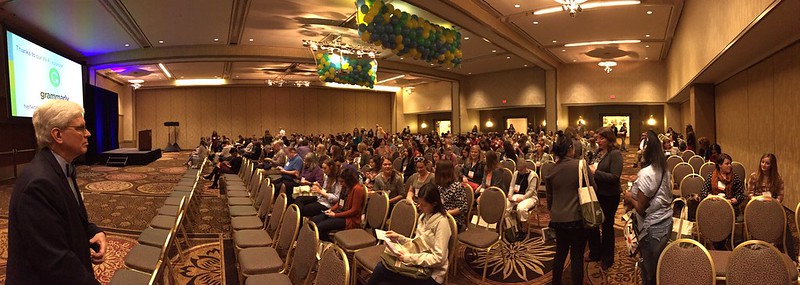
This weekend I’m attending the Editors Canada conference. And this year it has been… different.

Every year, I attend two conferences for editors, one in Canada, one in the US. In 2020, for reasons of global plague, both were cancelled; in 2021, both have moved online, at least for this year.

Before I became an editor, conferences I attended were academic ones – specifically theatre studies and performance studies. But the model was the same. Conferences are organized around speeches and presentations, some to smaller groups, some to bigger ones. You get to learn about all sorts of interesting and relevant ideas.

And then there’s what they’re really about.

Conference is a word that is used for more things than this sort of gathering, as we know; it can be a small meeting (between a lawyer and a client, for instance), or a grouping for the purposes of sports (the Eastern Conference of the NBA, for instance) or religion (e.g., certain sets of Methodists), or any of several other assemblies of people. Conference is the noun form of confer, which comes from Latin confero, from con- ‘together’ plus fero ‘I bear, I carry, I bring’.

And conferences are about bringing people together.

They’re about not just listening to information, but listening to it sitting next to someone interesting you just met. They’re about not just laughing at a witticism, but laughing about it in a room full of people. They’re about sneaking into a session late, sneaking out of a session early, standing listening at the back because the room is too full, live-tweeting, asking a question in person, sharing in the silent group indignation when someone goes on a rambling more-a-comment-than-a-question.

They’re about big rooms full of hundreds of people with a common interest, and smaller rooms with fewer people focusing on a niche subject.

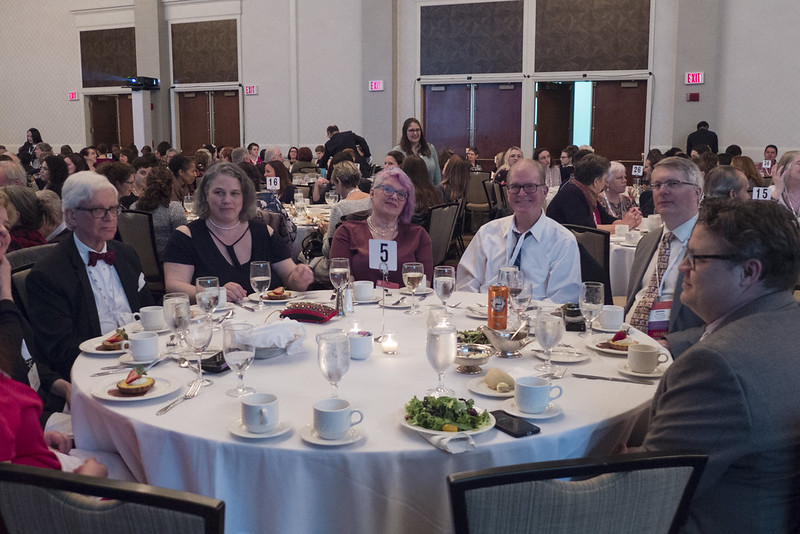
They’re about banquets, with their curious mix of pro forma, exciting, starchy, and awkward presentations, plus the infinite logistical vagaries of mass food.

They’re about standing in front of a room full of people, talking to them as a group, seeing their faces, hearing them respond, and then getting to chat with some of them afterwards.

They’re about sitting at a picnic table with people from several continents, having lunch and talking about whatever really interests you.

They’re about bumping into people at receptions. They’re about banquet table strategy. They’re about going out touring the town and seeing other people from the conference doing the same.

They’re about sitting in a lobby bar, or a local pub, or someone’s hotel room, until rather late in the evening, with people you get to see in person for three days each year, talking about what’s happened with you and what you’ve seen and how business is going and…

They’re about getting to meet people in person whom you’ve long admired from a distance – or, these days, long interacted with online (more or less mutually).

They’re about group outings, and silent auctions, and events such as dance-offs and spelling bees (yes, really), and playing cards or Scrabble (or both) in the lobby.

They’re about all sorts of human interaction and observation. (And they’re about the best occasion you could ever want for taking pictures of people.)

But when you can’t get together in person, they’re still about coming together. Webinars are justly reviled – from the audience perspective, they’re not very engaging, and from the presenter perspective, they’re talking into the void, disorienting, unnerving, panic-inducing – but they do let you slip in late and slip out early without being noticed, and they do make question-and-answer less susceptible to domination by the most aggressive. And the small-group meet-ups – I took part in two of them today – still let you talk to other people and see their smiling faces, not to mention whatever part of their residence is behind them. And they let people from many places come together with minimal expense or inconvenience.

But online conferences still bring only about ten percent of what I go to a conference for. They don’t bring the same togetherness.

So I look forward to seeing people in person again… next time!

winx

If you were to see this word, perhaps on some packaging or in an ad, what would you think it meant?

It’s a hard one, isn’t it, to take a go at without making an ass of oneself. Let’s see…

It could be some version of Windows, I suppose. Actually, that’s Win XP, right?

It could be like Spanx, only for, uh, your eyes? Like somehow to keep them less baggy, in place of cosmetic surgery? Or maybe just wicked fake eyelashes. Sure, that could be it.

It could be a breakfast cereal. If Trix are for kids, Winx could be for adults. Rather than the unpleasant Trix rabbit, its mascot could be a pleasant donkey – in other words, a nice ass, if you know what I mean, nudge nudge, winx winx…

It could be a Dutch name. You know, like Schillebeeckx, Hendrix, Six (yes, that’s really a family name)…

It could be an animated series on Nickelodeon. Actually, it is – well, Winx Club is – but that’s not what I have in mind here. Because this winx is actually a common word – a verb, in fact.

So could it be a combination of wink and wince? That’s a thing for sure. I’ve seen people do it. Also some people who have really pronounced dry-contact-lens blinks do similar. But that’s not what the Oxford English Dictionarysays winx is.

According to the OEDwinx is a now-obsolete verb meaning “to bray as an ass.” Its formation is apparently analogous to whinnock (meaning ‘whinny’) and whink (meaning ‘yelp, bark’).

But can you even picture a donkey’s bray sounding like “winx”? I mean, I guess if you give it some latitude… or maybe asses sounded different in the 1400s, when this word was attested.

But just imagine if this word had stuck around and caught on. That great TV variety show Hee Haw could have been called Winx. And then it could have had its own line of cereal and fake eyelashes and…

arteclination

Arteclination: ‘lying in art, lying on art, or leaning on art’.

If you are inclined to recline on or in an artwork, should you decline? We rely on art, but may we lean on it? In art is truth, but may you also lie in art – I mean lie down in an artwork?

The answer is not simple. Some art is made for leaning on or lying in, sometimes even for sleeping in (I’ve stayed in hotels that had that feel); some… less so. 

In the Aidekman Arts Center at Tufts University, where I got my PhD, there is a sculpture court that features several large, sturdy, metal abstract sculptures. Receptions for various things to do with the fine arts are often held there. On one occasion I was on a clear liquid diet (for a medical procedure the next day) but that didn’t stop me from attending an reception for something there; wine, after all, is a clear liquid. However, wine goes to one’s head quickly after a day on clear liquids. I reached out to one of the sculptures to steady myself. Immediately an art student materialized and asked me not to do that. Arteclination prohibited!

On the other hand, in Toronto, where I live now, there is a lovely and popular park south of the Art Gallery of Ontario, and on one side of it is a large metal Henry Moore sculpture. Like many Moore pieces, it is holey. But it is not sacred. There are no guards or art students shooing people away from it. Children play on it. People lean on it (as I have – recently, too). And, sometimes, people recline in it.

Imagine lying in art: the delight of arteclination. It’s almost beyond articulation. To put yourself at the centre of the holy, to be incumbent in the transcendence of form. The exaltation of relaxation. The artificial divide between aesthetic and everyday is unmoored. You become a transient part of art.

And yet sculpture is nothing other than the exaltation of aspects of everyday life. Figural art imitates those ordinary forms and beings that so many people think are too mundane to touch it; abstract art presents the forms and relations, the colours and textures, taken from the skin of the earth and its denizens. Art relies on life: life is what it rests on. And we rely on art to take parts of life, set them apart, and present them back to us for our own abstracted emotional and aesthetic responses, our own – often restful – exaltation. 

We want art in our lives, and we want our lives to touch it. And when we want to relax, where better to support our inclination than an ostentatiously aesthetic object? Or even some piece of everyday life that we have decided to see as art, and to rest ourselves in it or on it as part of it?

Hence arteclination. The arte- is clear enough, and you recognize it from artefact. The -clination shows up in inclination, but its root -cline is also in recline, and many other words; it means ‘lie’ or ‘lean’.

Yes, it’s true, you won’t find any historical uses of this word. It’s a new old word. But it’s for real.