prepone, postpare

“Sorry,” Jess said just after her window appeared in our Zoom chat. “My meeting was preponed and so I was busy postparing.”

“You what was what and you what now?” Daryl said.

Behind him, Margot said “Her meeting was postponed and she was busy preparing.”

“No…” Jess said, with that you-did-not-get-that-right dip in intonation. “My meeting was preponed. You know, moved earlier.”

“Oh, yes,” I said, “that’s apparently a common term in India.”

“It is,” Jess said, “but they’re not the only people who have meetings moved earlier on them.”

“We usually just say moved up,” Daryl said.

“And you tell me whether that means moved earlier or later,” Jess said.

“It’s simple,” Margot said.

“Deceptively simple,” Jess said.

“What do you mean by that?” Daryl said, apparently speaking to Jess but turning to look back at Margot as he did.

“Exactly,” Jess said.

“So your meeting was preponed,” I said, to get the conversation back on the rails. “A perfectly reasonable word. Postponed is ‘put later’; preponed is ‘put earlier’.”

Daryl was looking up data as we spoke. “Been in the language more than a century,” he said, “and not just in India. In the US and England too.”

“Because it’s obvious,” Jess said. “And, obviously, if you were supposed to prepare for a meeting, but as you were about to start preparing you got a message that the meeting was moved to, say, five minutes from that very moment, you won’t be able to prepare.”

Prepare from præ- and parare,” I said, trying to contribute, “‘make ready before’.”

“So you make ready after,” Jess said. “You postpare. Obviously you have to BS your way through the meeting, but if it has deliverables or required background knowledge, there are things you’ll still need to do.”

Arlene appeared behind Jess. “Sort of like doing the readings after the lecture,” she said. Arlene was more recently graduated from university than some of the rest of us.

“Exactly right,” Jess said. “You pretend you know what they’re talking about, and you fill in the blanks later.” Arlene wandered off screen again.

Catching up, you mean,” Margot said as she passed behind Daryl.

Postpare is a perfectly cromulent word,” Jess said, with a little smile. Needling Margot was one of her favourite sports.

Daryl was tapping on his device with the same look on his face as Thomas Dolby had at the Grammys when his keyboard was producing no noise. “It’s not in there,” he said.

Postpare?” Jess said.

“Not in Oxford or even Wiktionary.”

“Try Urban Dictionary,” I said. I knew – because I had just looked – that it had an entry for postpare from 2010.

“Urban Dictionary is not authoritative,” Margot said, busying herself with something or other.

“I guess they’ll just have to catch up,” I said.

“Well, we’ll have to catch up with you later,” Margot said. She turned to Daryl. “Dinner’s on.” She continued bustling back and forth in the background.

I checked the time. “I haven’t even started cooking,” I said. “I should, though.”

Jess looked off screen. “Hey, Lene. Everyone’s having dinner. Where’s ours?”

Arlene reappeared. “Just put it in the oven.”

“You knew when I was going to be done the meeting.”

“Did I, though?” Arlene smiled angelically. “Sometimes these things run long. I didn’t want it to be overpared.”

Jess looked back at the camera. “I think I’m overmatched.”

“I think I’d better preheat the oven,” I said. I knew this would nettle Margot, who considers the pre in preheat to be unnecessary. 

I was not disappointed. She stopped in her tracks and glared towards the camera. “Why don’t you just postheat it? Eat your food first, cook it later.” And then she resumed her bustling.

“Oh, you’ve worked for my company, have you?” Jess said. She turned back to Arlene, who was just off screen. “What are we having?”

Arlene leaned in. “Corn pones with pears.”

Daryl stood up from his chair. “Sounds pre-post-erous. See you later!” He waved and disconnected.

“See you sooner!” Jess said, and then she, too, waved and blinked out.
nychthemeron

How long is a day?

Did you say 24 hours? How about if someone says to come for a day – do you need more context before you know whether they mean until some afternoon or evening point or to stay the night? And how about if someone says you’ll get something by the end of the day?

Or did you say how long a day is depends on what time of the year and what latitude, because the sun is up for variable amounts of time? But does that mean that “three days” is longer in summer than in winter?

Of course we can be more precise when the context isn’t clear. But so often we want to be able to say “day” and just mean a contiguous span of 24 hours – either any span of 24 hours (say, starting right now and ending at the same clock time tomorrow) or one night plus one day, beginning at either sunset or sunrise (allowing, of course, the slight shift in sunrise and sunset times from day to day). In those cases, the problem may just be that day is not long enough.

Not the day. The word day. What you really want is a nice, luxuriantly long word, one that has, say, a letter for each hour – well, OK, a letter for each two hours, we’ll say, since there are hours of the day and hours of the night, and anyway 24 letters would be an awfully long word. How about a word that morphologically maps to the circadian cycle? And how about if, as an added bonus, it’s really hard to spell and confusing to pronounce?

Oh. Lost you on that last bit, did I? Well, so it goes. That’s what we have. The word, my friends, is nychthemeron, also spelled nycthemeron. It comes directly from Greek νυχθήμερον, which in turn formed it from νυκτ- (nukt-) ‘night’ and ἡμέρα (hemera) ‘day’. You may notice that the t in the one root and the h in the other have come together to make th, which is not pronounced like “t” and then “h” (or just like “t”) but is in fact θ, said like “th” as in “thin”; the collision of the two words in Greek made a sort of twilight zone where the “k” (κ) also became “kh” (χ), though we say it “k” now in English. Oh, and the stress is on the them, which can be said with the e as in “them” or, if you want to Anglicize further, can be said like “theme.”

And there it is. Night and day, you are the one… It’s a bit of a pity that this word is so unwieldly, because it could be quite useful in some contexts (such as hotels, where night means ‘nychthemeron’ but they always start at 3 or 4 pm and the last one – or the only one if you’re only there for one night – is a few hours short). And while “See you in twenty-four hours” is accurate but sounds cold and dorky, “See you in a nychthemeron” sounds poetic – though perhaps a bit frightening.

luxurinate

The other day, I was listening to the radio and I thought I heard the person speaking say “luxurinate” rather than “luxuriate.” And if that’s what they said, they said it straight-facedly, not as a joke. 

Now, I’m sure it was a slip of the tongue (or a mishearing on my part), but I think this is a word at least some of us could use.

It’s a pretty self-evident construction – in fact, it shines out like a shaft of gold when all around is dark: a blend of luxuriate (or just luxury) and urinate. So what could that mean?

Well, it could mean go wee-wee on a golden toilet, sure, but how often do you get to do that?

It could mean get to use a really nice washroom facility rather than having to use a port-a-potty or shrubbery – something anyone who’s returning from a camping trip will appreciate. I recently watched a movie, Man in the Field, about Jim Denevan, a chef and artist who runs a program called Outstanding in the Field of fine dining in farmers’ fields, and for the 20th year of the program, he announced with considerable excitement that they would have proper (frankly luxurious, to look at them) toilet facilities in a trailer. I think that could qualify.

It could mean, as Riffat Yusuf (@ryusufedit) suggested, “not having toddlers banging on the bathroom door.” (We really are getting a sense of how luxury is relative, aren’t we!)

Or, I suppose, rather than following urinate disposition, it could have a less literal use – not taking a piss at leisure but taking the piss at leisure. Taking the piss is a mainly (but not exclusively) British term that has a rough equivalent in some parts of America of taking the mickey or pulling [someone’s] leg. It means ‘making a mockery’ or similar things – it can be flagrantly roasting someone, or wink-nudge playing along with something, or deliberately overdoing something, or trying to get away with the bare minimum, or slipping in a naughty word-play… And if you’re taking the piss and having a right old time doing it, well, then, why not luxurinating?

I remember, as a kid, looking at a book listing great historical scientific discoveries, and seeing a picture of some guy gazing with ecstasy on a test tube of yellow liquid, which the caption informed me was the discovery of urea. You can bet that I thought at first that they were, um, pulling my leg, and doing so at some expense. And since an emblematic feature of luxury is its wanton expense, I think that if they had in fact been taking the piss rather than just talking about piss, it would be the marquee instance of luxurinating. (It turns out, however, that Friedrich Wöhler’s synthesis of urea in 1828 was the first production of organic compounds from inorganic materials without the intervention of a living organism, which put paid to the theory of vitalism, and so it really was important – and my classic example goes down the drain.)

Alas, the way popular usage goes, if this word catches on, it probably won’t be in the ‘taking the piss’ sense; that’s just a bit too clever. Perhaps it will be for those sweet restroom trailers Jim Denevan got. Or maybe it will be for some extremely fancy high-tech high-quality urinal, featured in the home of the latest tech whiz kid. But if the responses I’ve gotten on Twitter are any indication, it may be best used for just closing the bathroom door for a bit and getting a little, uh, piss and quiet.

solitude

Laurie Anderson said,

Paradise
Is exactly like
Where you are right now
Only much much
Better.

I have a similar thought about solitude: Solitude is exactly like loneliness, only much much better.

To put it another way, the difference between loneliness and solitude is that you hate the one and want the other.

I spent many years in corrosive loneliness, single, unattached, walking miles by myself hoping to find someone else but unable or unwilling or afraid to reach out. Now, I happily go for long walks or runs by myself, because I know there is someone there for me when I get back. I can be by myself because I know I have friends who will spend time with me. Being apart from others is no longer a subtraction; it is an addition.

Solitude, etymologically, means exactly the same thing as loneliness: sol- as in sole, solo, solivagant, plus -itude; lonely plus -ness, where lonely is lone plus -ly and lone in its turn is shortened from alone, which is from all one. (The difference between only and lonely, etymologically, is just that the latter has the last remnant of all.) Why have they gained different tones? I don’t know for certain, but I have a guess: poetry. Solitude comes from French, which took it (altered) from Latin, and poets for a long time, especially in the educated and courtly traditions, preferred the classically derived words. Lonely comes from base old English, the language of the commoners when, after the Norman conquest, the rich spoke French. Rich, well-educated people can afford solitude; poor peasants are stuck with being lonely.

There’s no shortage of poetry on solitude; just search “solitude” at poetryfoundation.org and see. You will also find enough entries for solitude in Bartlett’s Familiar Quotations. Some of it is very much the kind of mood I like, when I like that kind of mood:

That inward eye
Which is the bliss of solitude

—William Wordsworth

I never found the companion that was so companionable as solitude.

—Henry David Thoreau

She would not exchange her solitude for anything. Never again to be forced to move to the rhythms of others.

—Tillie Olsen

For those of us who have been too much isolated, solitude is not available, only loneliness. But for those of us who are well supported and have as much social contact as we need – or perhaps even more – solitude can be a sweet gift, a refreshing time away.

And it doesn’t need to be in the far countryside. It can be in the middle of a city. If you can be alone in a crowd, you can have solitude in the heart of a city.

I wish you as much solitude as you desire, and as little loneliness as you want.

subsidence

The first time I remember hearing the word subsidence – though I’m sure I must have heard it before – was in the movie Schindler’s List. The scene is a Nazi camp in winter; a barrack is being built. A young Jewish engineer, Diana Reiter (played by Elina Löwensohn), strides up to Kommandant Amon Goeth (played by Ralph Fiennes) and tells him, “the entire foundation has to be torn down and repoured. If not, there will be at least a subsidence at the southern end of the barracks. Subsidence, and then collapse.”

If you’ve seen the movie, you know what Goeth does about this: he turns to a subordinate, Oberscharführer Hujar (played by Norbert Weisser), and tells him to shoot her. She protests that she’s only doing her job, but Goeth insists that she be shot right then and there. Hujar pushes her onto her knees on the snow and pulls out his gun. “It will take more than that,” she says. “I’m sure you’re right,” Goeth says as Hujar fires into her skull. As Goeth walks away, he says, “Take it down, repour it, rebuild it, like she said.”

What is a subsidence? It’s not a fault in the materials or the structural design in and of itself. It’s that the ground beneath the structure will fail to support it. However solidly made your foundation is, if the ground it’s on gives way, the building will tilt and may eventually collapse. 

In a way, Schindler’s List documents a subsidence: the German war effort relied on massive industrial production, but that production needed people and materials; when willing people were less available and available people were less willing, the base started to give way. Oskar Schindler, factory owner, contracted to supply the German army with munitions, but he – and those who worked for him – undermined it by making the materials just slightly substandard, so guns jammed. Historians of World War II will tell you that numerous such subsidences of willing participants and suitable supplies were important factors in the collapse of Hitler’s plans.

I’m going to suggest that we’re facing a kind of subsidence in our own times too. I’ll get to that in a moment.

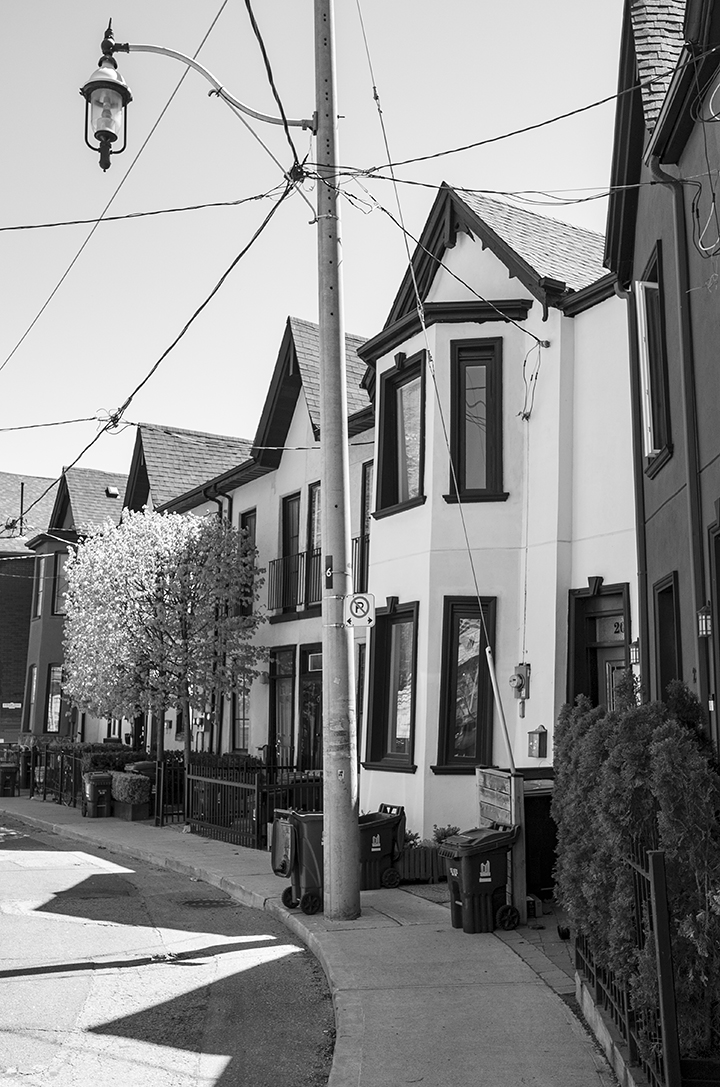
Most subsidences are more plain and literal, if often insidious. I can go for a walk on Bright Street, not too far from where I live in Toronto, and see houses leaning back from the street, as the soil has compressed unevenly beneath them. They’re still standing, but it does make things a little iffier (and harder to furnish) for the residents. Visitors to Pisa have the subsidence of an alluvial (sedimental) soil to thank for the special picturesqueness of its famous tower, but they have the assiduous (and subsidized) efforts of more recent engineers to thank for arresting the tilt so that the tower is still leaning and not now strewn across the ground.

Subsidence comes, of course, from subside; that in turn comes from Latin – the verb subsido, which is sub ‘under’ plus sido ‘I sit’ (or ‘I sink’). Related words are many, including sediment, insidious, assiduous, subsidize, and resident. The causes of subsidence are many, too: natural ones, such as earthquake, dissolution of limestone, or thawing of permafrost (the causes of which may not be quite so natural); less natural ones, such as buildings compressing a soft soil, literal undermining – mines being dug under areas, or, more recently, fracking – or depletion of groundwater: draining of the aquifer for various human purposes, resulting in a desiccation and depression of the ground. Sometimes sinkholes appear spontaneously; other times, the ground seems normal until you try to put a house on it.

More figurative subsidences can also occur in many ways and places. Any time something such as noise or desire or hunger subsides, you could, I suppose, call it a subsidence, but the term does carry an image of the subsidence of underlying ground through compression, undermining, or depletion.

So consider, for a detailed example, the economic trends of the past four decades. We have had a recession or two; we suppose we have avoided a depression, though we have had something specially catastrophic in the pandemic. But overall the usual measures of economies have been trending upward, and the people who have the gold and make the rules have been gaining more gold and making more rules for others and fewer for themselves. The economic structures seem sound. But their foundation may be having a subsidence. 

I’ll explain. In inflation-adjusted dollars, the top 10 percent have seen about a 40% increase in income since 1980; the bottom 10 percent have had about a 6.3% increase in income, and those at the median about a 9% increase. Different demographic groups have done differently well – women have seen a larger increase, mainly reflecting the fact that they used to be horrifyingly underpaid (just over 60% of what men made) and are now only indecently underpaid (just over 80% of what men make), but men at the median and in the bottom 10% have actually seen a decrease in income (by 3% and almost 8%, respectively). And the minimum wage, adjusted for inflation, is just over 75% of what it was 40 years ago.

All of that may or may not look like a subsidence. But what about if you try to put a house on it? In 1980, the median house price was about 2.7 times the median annual income; in 2020, it was almost 4.5 times. And that’s a nationwide figure for the US – specific markets (in the US and in other countries such as Canada and the UK) have seen much greater increases in house price. In Toronto, for instance, prices of houses – and condominiums – have approximately doubled in the past 10 years and quadrupled in the past 20. (Those leaning townhouses on Bright Street, which were worth about $250,000 each in 2000, are now going for well over a million dollars – when someone wants to sell one.) Incomes in these markets have not kept pace, unless you’re among the very few. So the pressure of the cost of a house on an income is more likely to be too much to bear.

Some other things have also pulled away from median incomes. University and college tuitions have increased at about twice the rate of incomes – which means that if in 1980 you could pay for a year of university by working all summer, you’d need to work at least two summers for it now.

Does this all amount to a subsidence? Consider one more bit of the metaphor: often a subsidence is due to the groundwater being piped up out of the ground. Now consider that housing prices are higher due in no small part to the activities of those higher up on the income scale (buying to rent out, or sometimes just to park money); tuition prices are higher largely due to government support drying up, since governments have less tax income thanks largely to decreasing tax rates on the top earners and corporations; and low and median wages are stagnant because those higher up have found ways to keep more for themselves while paying relatively less to most employees. Not trickle-down but pipe-up. 

And consider that people at low and medium income levels are what the economy is built on, as they produce goods and services and generate profits, pay tuitions, pay rents, and eventually (it is hoped) buy houses. But they just can’t support that like they used to. They need something: not a subsidy, you understand, but a return of what has been drained away.

So we may not be in a Great Depression or a Great Recession, but the numbers suggest we’re well into the Great Subsidence. And a subsidence won’t go away if you ignore it. And it won’t help to shoot the messenger, so to speak.

Now, if you’re making comfortable money, you may feel that you’re safe as houses. But how safe are houses, really, if what they’re relying on is less and less up to supporting them?

truncate

What do you call a tree that’s had its top cut off?

Trunk-ated!

Ha ha ha ha. But… actually… have you ever paused to wonder where the word truncated comes from?

Since you’re here and I’m here, I know you know I’m about to tell you. Our verb truncate comes from Latin truncatus, the past participle of the verb trunco, which means ‘I truncate’ (reasonably enough) or ‘I cut off pieces or extensions’ (of a thing or a person). Trunco comes from truncus, which means… ‘trunk’. As in a human torso or the main body of a tree. (And yes, truncus is the source of trunk.)

So just as we might, in English, call lopping off the top and branches of a tree trunking it (and in fact trunk was in use as a verb to mean ‘cut a tree down to its trunk’ from the 1400s to the 1800s, and perhaps some people still use it that way), in Latin, they did the same thing, just changing truncus to trunco (truncas, truncat, truncamus, truncatis, truncant).

But wait! There’s more! Not a whole lot more, but there is. Do you want to know where truncus comes from? We’re not completely sure, but it may have come from a Proto-Indo-European root (yes, yes, trunks come from roots) meaning ‘carve, cut off, trim’ (meaning that the trunk of a tree or of a human is conceived of as what’s left when you’ve cut the limbs off, ouch). And that root has been reconstructed as *twerḱ-. Which is apparently not related to the English word twerk, though certainly your trunk is involved in twerking.

And that’s all I have to tell you. I could go on about the ramifications, but I think I’ll cut it short.

kyriolexy

“Well,” Bruce said, “if Jack was going to be the devil’s advocate, I decided to give him a taste of his own medicine. But I didn’t want to stir up a hornet’s nest, so I got cold feet, and then I ended up in hot water.”

It was an open house Zoom meeting for the Order of Logogustation, and Bruce, a prospective member and evident raconteur, was holding forth on some misadventure. Anthony, another prospective member, cut in. “I’m sorry, I really do prefer to hold to literal usages. Metaphors, especially overused ones, tire me. You mean to say that if he was going to take a contrary position for the sake of argument, you were going to do the same, but you were afraid of causing trouble, so you changed your mind, and then you found yourself in conflict anyway.”

You’re not going to like it here, I thought. Also, half the words you just used came from metaphors. Including metaphor.

Jess piped up: “Oh, you’re an advocate of kyriolexy!”

“Yes, that’s right!” Anthony said. “I’m so glad someone knows the term for the use of literal expressions.”

I prefer more curious lexis, myself – you may have noticed many cuter curios in my lexicon – but kyriolexy is perfectly snappy word, from Greek κύριος ‘authoritative, proper’ (also used to mean ‘lord, master’ as in kyriarchy, and you may know Kyrie eleison, ‘Lord have mercy’) and -λεξια ‘speaking’. And yes, it means ‘using words literally’ or ‘using literal expressions’.

“Oh, but I did mean it literally,” Bruce said. “Jack is a lawyer, and he had decided to take a position as the legal counsel for the Church of Satan. But he’s also an… amateur pharmacologist, and I thought perhaps I could help him reconsider by sharing some of the finer drugs he had sold me. But when I got to his house, there was a hornet’s nest right at his front door, so I went around the back to avoid disturbing it. The problem was that I was wearing sandals and it wasn’t very warm, and his lawn was wet. So when I got around back I dunked my feet in his hot tub.”

“I—” Anthony said.

“Are you pulling his leg?” Jess said.

“No!” Bruce said. “We’re not even in the same room.”

“So,” Arlene said, “what happened then?”

“Well, someone let the cat out of the bag,” Bruce said.

“Someone alerted him to your presence,” Anthony said.

“He has a pet bobcat,” Bruce said, “and it likes to sleep in a burlap sack. But someone in the house woke it up and it came out.”

“Good grief,” Arlene said.

“Grief is seldom good,” Anthony said.

“It turned into a wild goose chase,” Bruce said. “I tried to be on the ball, but Jack had to let me off the hook.”

“It became a wild cat chase, I think you mean,” Anthony said, “and you attempted to keep up with it, but Jack had to relieve you.”

“Naw, man,” Bruce said. “There was a wild goose out by the pool, and that’s what the bobcat was going after. I tried to get out of the way by standing on a large exercise ball, but I fell backwards and my shirt caught on a coathook. Jack had to help me off it.”

Arlene and Jess were both dissolved in laughter. (Not literally dissolved.)

“Why was there a goose by the pool?” I said.

“I may have brought it,” Bruce said.

“You’re not sure,” Anthony said.

“I may have had a taste of my own medicine before arriving, so to speak,” Bruce said.

“So…” Arlene said, as best she could, “how did it all end up?”

“Oh, my goose was cooked,” Bruce said.

“Literally, I suppose?” Anthony said, wearily.

“Yes, stuffed and roasted,” Bruce said.

“I guess you bit off more than you could chew,” Jess said, giggling madly.

“Yes!” Bruce said. “How did you know? The goose was very good, but I gobbled it a bit too hungrily and Jack had to do the Heimlich maneuver on me.”

“That was really the icing on the cake!” I said.

Bruce looked at me (well, as best he could on a Zoom call) for a moment. “No, it was the goose. We didn’t have cake.”

“And were things been OK between you and Jack after that?” Arlene said.

“Well…” Bruce said. “He’s given me the cold shoulder.”

“Oh, leftover goose?” Arlene said.

“Nah! Geese don’t have shoulders. I just mean he hasn’t wanted to talk to me. I guess I might have opened up a can of worms.”

We all just looked at each other and no one said anything for a few moments. Finally Jess broke the silence. “So… kyriolexy. Nice word.” We all agreed that it had a certain something.

skeevy

We have a whole set of colloquial words for distasteful, disreputable, insalubrious things that you would generally shy away from or eschew outright: scuzzy, sleazy, sketchy, skeezy, skanky, scurvy, skeevy

You can notice some commonalities, and you would not be off base to suspect some cross-influence. Usage of words can be influenced by the senses of other words they sound like, and if we make up a new word – especially one meant to be particularly vivid – we tend to draw on established sound patterns from other words of similar sense (I covered this in my master’s thesis, if you’d like some substantiation for it).

But of course there are some words that established the pattern and others that followed it. We can feel confident that scurvy, for instance, was an early entrant in this group; it showed up in its present form in the 1500s, and it traces (by way of scurf) back to Old English. Sleazy has been with us since the 1600s, though its origins are sketchy (while sketchy is more recent, but its origins aren’t sleazy).

And how about skeevy? That seems like a portmanteau, doesn’t it, or at least a phonaesthematic confection? It’s not. It showed up in English quite recently, apparently the 1970s, but its origins are, in their way, ancient and clear: it comes from an Italian word, schifo, ‘loathing’ or ‘crap’ (and its related verb, schifare, ‘loathe’). For those who don’t know, sch in Italian is pronounced like “sk.” And while the f is “f” in standard Italian, it can be voiced to “v” in regional varieties – such as the variety spoken in South Philadelphia, where skeevy appears to have entered English (this is the kind of Italian where prosciutto is said like “brazhoot” and capicola like “gabagool”).

And where does schifo come from? Not from Latin! Rather, Italian seems to have gotten it via Old French from Frankish, which in turn took it from Proto-Germanic *skeuhaz… which is also the source of English shy and eschew.

So skeevy just happened to sound appropriate when it was imported (in modified form) into English. But of course it might not have been imported if it had not sounded suitable! Now, if you’re looking for a word made up on the basis of just sounding right, try skeezy, which showed up in the early 1990s, evidently on the model of skeevy, sleazy, and the rest.

And what are the subtle shades of meaning between all these words? You know, that would probably make a good journal article… if not a whole dissertation. But if you have a sense of differences in how you would use them, don’t be shy, tell me; I love good usage data points.

lachanopolist

I stopped by my neighbourhood lachanopolist – or so I thought – to acquire some basil. The emporium in question is Urban Fresh Produce in St. Lawrence Market, a couple of blocks from my front door, and I am on friendly terms with its proprietors.

As I came up to its frontage, I first encountered Anthony, co-owner, a fit fellow somewhere in his thirties with assorted tattoos. “How is my friendly neighbourhood lachanopolist?” I said.

“Your what?” he said.

“Lachanopolist,” I said. “Herb-seller.”

“That’s a word?” he said.

“I’ve been told,” I said.

“I’ll sell you herbs,” he said. “Whaddyou want? We got some fresh basil in.”

“Perfect,” I said.

His phone went off. “Sorry,” he said, “I gotta take care of this. You can find it, right?” And he detached.

I went in through the entry between the berries and the cash register. The universally beloved Fiona, busy at cash, waved hi. I headed towards where the herbs usually were. Lou, the other co-owner, about the same age and description as Anthony but a bit taller, was in that aisle.

“I’ve come to my friendly neighbourhood lachanopolist,” I said.

“Your what?” Lou said.

“Lachanopolist,” I said. “Herb-seller.”

“Do you get paid to know that?” he said.

“I’m not sure,” I said. “You got herbs, though…” I said.

“Yeah, whaddyou need? It’s all right here.”

I started looking through the various vegetation: rosemarysagethyme

Lou started walking away to take care of some stocking. “Don’t leave without having an espresso,” he said.

I gave him a thumbs-up. Then I looked back to the shelf.

Huh. Where’s the basil.

Fiona, who had detached from the cash, came by. “Hellooooo. What you looking for?”

“I came to my local lachanopolist to buy some basil.”

“Your what?” Fiona said.

“Lachanopolist,” I said. “Herb-seller.”

“You want some herb?” Fiona said. “Will you sell me some herb?” She made a smoking gesture, then laughed.

“I’m not in the business!” I said. “But you are.”

“We don’t sell that kind,” she said. “Maybe try Front Street!” And she laughed again.

“I’m actually here for basil,” I said.

“Ohhhhh,” Fiona said. “Basil out front. That way. Past the berries.” She pointed to the far corner of the establishment (admittedly not a great distance). Then she headed back to the cash register to ring through a customer who had walked up.

I walked back over towards the front corner. Sure enough, there was fresh basil in large bunches. There was also Bianca, sister of Anthony. 

“Hello!” Bianca said.

“Hey,” I said. “I came to my friendly neighbourhood lachanopolist for some fresh basil.”

She made a bit of a face. “Your friendly neighbourhood what?”

“Lachanopolist,” I said. “Herb-seller. I swear I read it in a dictionary.” I pulled out my phone.

“If you were selling words, you could charge a lot for them, you know,” she said.

“I charge enough to be able to afford your stuff,” I said. I opened the Oxford English Dictionary, still displaying the entry for lachanopolist. “See?” I said, handing the phone to her. “A seller of herbs and vegetables.” I didn’t bother boring her with the etymology, from Greek λάχανον ‘vegetable’ and -πώλης ‘dealer’.

She looked at the phone. Her eyes are younger than mine and she saw some smaller text below the definition. “Apparently only in dictionaries,” she read, and handed it back to me.

I took the phone and pulled my glasses off my face (I’m nearsighted, so this is what I do to read small things) and looked closely. Yes, right under the definition, as I had read it, was the caveat, as she had read it.

“I don’t think I’m selling herbs in a dictionary,” she said. “I’m selling them in a market!”

“Well, that’s one for the books,” I said. “I have no idea who sells herbs in dictionaries, but I guess they sell them by the leaf.” Bianca made another wry face. “Anyway,” I said, “you’re not lackin’ basil.” I held up the bunch.

“Glad you found what you need,” she said. “You want an espresso?”

Disclaimer: The people named here are all real people, and very nice ones too, but this particular interaction never actually happened.

stellification, stelligerate

You have, perhaps, heard of “an exaltation of larks.” But what of exaltation for a lark? Of exalting words for wanton gratification? What of the stellification of the lexis: the consecration of words into a constellation, amplifying the merely empirical into the empyrean – a dark purple vault of prose into the universe? The ecstasy of explication? The apotheosis of apothegms and epigraphs and epochal epopees? Dammit, why have all these words unless we can shout them to the heavens, lift them to the dark skies, turn the ink traces on the white pages into so many mythical figures pinpricked in the nightly dome? Let language be stelligerate when it may!

Look, read this, from Cold Modernism: Literature, Fashion, Art by Jessica Burstein:

Her lexicographical prowess made her eerily fast on the cryptonymous counterpunch; she could feint to the distaff, drop to her knees, and make like to pray. A swift consult with Messieurs Furnivall, Murray, Onions, and Trench, and she’d be back bobbing and weaving before they knew what hit them. Diagnosing modern verse as supine, moschiferous, and polysarcous, Loy infused her poetry with illicit shards; the result was a disturbing mongrel, with bark no less stelligerate than bite. Taxonomers then entrenched her as the preeminent litterateur of traumatropism, having grown some peculiar poetry from the bed of a wound.

Burstein’s whole book isn’t as stelligerate (or belligerent) as that, of course; Burstein is plainly aiming to make the passage an icon – in the manner of a constellation more than a painting, perhaps – of the stylings of Mina Loy, whom it is describing. And, given the opportunity to let off some fireworks, why should one not take it?

I won’t define or etymologize all of the words in the passage for you; Google works fine, and I know you have an internet connection. But I am here for stelligerate – and for stellification while I’m at it. 

Stelligerate is a word seldom used now (one might declare it obsolete, but clearly it’s used more than never); it means, as best the Oxford English Dictionary can conjecture, ‘exalted to the heavens’. It comes right from Latin stelliger, ‘star-bearing’, from stella ‘star’ and the suffix -ger ‘bearing’ (as in verbigerate, but otherwise not much seen in English).

Stellification, as you may well have guessed from the stell- and the -ification, means ‘making a star’ or, perhaps more precisely, ‘placing among the stars’ – in other words, making something (or someone) into a constellation. Its related verb is stellify

Of course there’s an important difference between making something into stars and making something into a constellation: when you identify a figure as a constellation, you use stars that are already there. They have been burning in their separate distant places in the universe for eons, and from the terrestrial perspective you have decided that their perceptual alignment represents the figure. It’s all in your head; the stars exist independent of, and unmoved by, your fancy.

And so, too, we might say, when we use such stelligerate verbal stylings: the words were there from ages past, and we merely draw on them to exalt what we describe. But it’s not quite the same. A word exists only because of human minds and only as humans use it. You do not keep a star alive by using it in a constellation, but when you exalt a word, you fuel it. As it shines the light you want, it burns not the hydrogen of distant galaxies but the oxygen of your lungs – and the electricity of your mind and our millions of glowing screens. What a lark of exaltation.