conference

This weekend I’m attending the Editors Canada conference. And this year it has been… different.

Every year, I attend two conferences for editors, one in Canada, one in the US. In 2020, for reasons of global plague, both were cancelled; in 2021, both have moved online, at least for this year.

Before I became an editor, conferences I attended were academic ones – specifically theatre studies and performance studies. But the model was the same. Conferences are organized around speeches and presentations, some to smaller groups, some to bigger ones. You get to learn about all sorts of interesting and relevant ideas.

And then there’s what they’re really about.

Conference is a word that is used for more things than this sort of gathering, as we know; it can be a small meeting (between a lawyer and a client, for instance), or a grouping for the purposes of sports (the Eastern Conference of the NBA, for instance) or religion (e.g., certain sets of Methodists), or any of several other assemblies of people. Conference is the noun form of confer, which comes from Latin confero, from con- ‘together’ plus fero ‘I bear, I carry, I bring’.

And conferences are about bringing people together.

They’re about not just listening to information, but listening to it sitting next to someone interesting you just met. They’re about not just laughing at a witticism, but laughing about it in a room full of people. They’re about sneaking into a session late, sneaking out of a session early, standing listening at the back because the room is too full, live-tweeting, asking a question in person, sharing in the silent group indignation when someone goes on a rambling more-a-comment-than-a-question.

They’re about big rooms full of hundreds of people with a common interest, and smaller rooms with fewer people focusing on a niche subject.

They’re about banquets, with their curious mix of pro forma, exciting, starchy, and awkward presentations, plus the infinite logistical vagaries of mass food.

They’re about standing in front of a room full of people, talking to them as a group, seeing their faces, hearing them respond, and then getting to chat with some of them afterwards.

They’re about sitting at a picnic table with people from several continents, having lunch and talking about whatever really interests you.

They’re about bumping into people at receptions. They’re about banquet table strategy. They’re about going out touring the town and seeing other people from the conference doing the same.

They’re about sitting in a lobby bar, or a local pub, or someone’s hotel room, until rather late in the evening, with people you get to see in person for three days each year, talking about what’s happened with you and what you’ve seen and how business is going and…

They’re about getting to meet people in person whom you’ve long admired from a distance – or, these days, long interacted with online (more or less mutually).

They’re about group outings, and silent auctions, and events such as dance-offs and spelling bees (yes, really), and playing cards or Scrabble (or both) in the lobby.

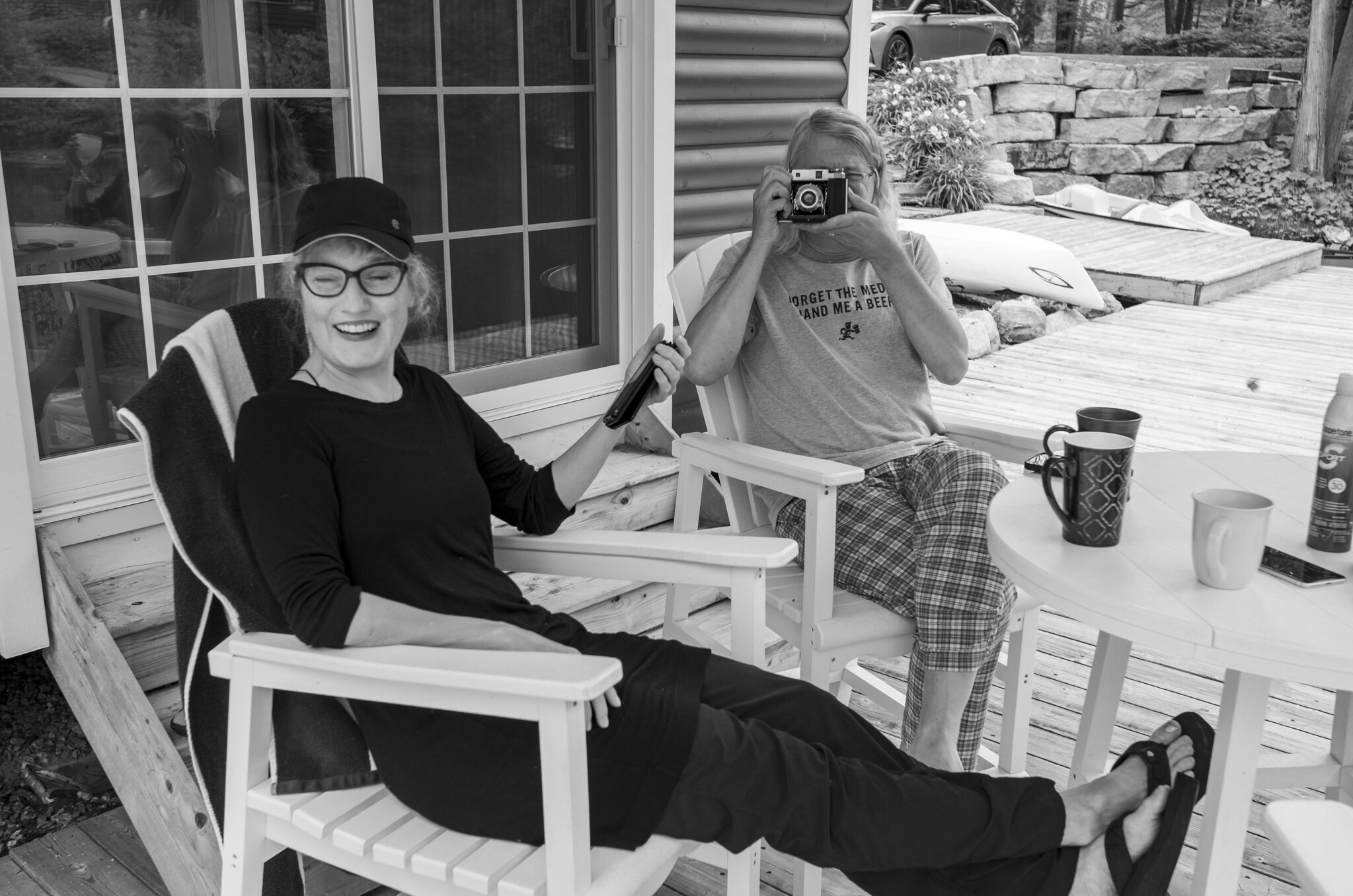
They’re about all sorts of human interaction and observation. (And they’re about the best occasion you could ever want for taking pictures of people.)

But when you can’t get together in person, they’re still about coming together. Webinars are justly reviled – from the audience perspective, they’re not very engaging, and from the presenter perspective, they’re talking into the void, disorienting, unnerving, panic-inducing – but they do let you slip in late and slip out early without being noticed, and they do make question-and-answer less susceptible to domination by the most aggressive. And the small-group meet-ups – I took part in two of them today – still let you talk to other people and see their smiling faces, not to mention whatever part of their residence is behind them. And they let people from many places come together with minimal expense or inconvenience.

But online conferences still bring only about ten percent of what I go to a conference for. They don’t bring the same togetherness.

So I look forward to seeing people in person again… next time!

winx

If you were to see this word, perhaps on some packaging or in an ad, what would you think it meant?

It’s a hard one, isn’t it, to take a go at without making an ass of oneself. Let’s see…

It could be some version of Windows, I suppose. Actually, that’s Win XP, right?

It could be like Spanx, only for, uh, your eyes? Like somehow to keep them less baggy, in place of cosmetic surgery? Or maybe just wicked fake eyelashes. Sure, that could be it.

It could be a breakfast cereal. If Trix are for kids, Winx could be for adults. Rather than the unpleasant Trix rabbit, its mascot could be a pleasant donkey – in other words, a nice ass, if you know what I mean, nudge nudge, winx winx…

It could be a Dutch name. You know, like Schillebeeckx, Hendrix, Six (yes, that’s really a family name)…

It could be an animated series on Nickelodeon. Actually, it is – well, Winx Club is – but that’s not what I have in mind here. Because this winx is actually a common word – a verb, in fact.

So could it be a combination of wink and wince? That’s a thing for sure. I’ve seen people do it. Also some people who have really pronounced dry-contact-lens blinks do similar. But that’s not what the Oxford English Dictionarysays winx is.

According to the OEDwinx is a now-obsolete verb meaning “to bray as an ass.” Its formation is apparently analogous to whinnock (meaning ‘whinny’) and whink (meaning ‘yelp, bark’).

But can you even picture a donkey’s bray sounding like “winx”? I mean, I guess if you give it some latitude… or maybe asses sounded different in the 1400s, when this word was attested.

But just imagine if this word had stuck around and caught on. That great TV variety show Hee Haw could have been called Winx. And then it could have had its own line of cereal and fake eyelashes and…

arteclination

Arteclination: ‘lying in art, lying on art, or leaning on art’.

If you are inclined to recline on or in an artwork, should you decline? We rely on art, but may we lean on it? In art is truth, but may you also lie in art – I mean lie down in an artwork?

The answer is not simple. Some art is made for leaning on or lying in, sometimes even for sleeping in (I’ve stayed in hotels that had that feel); some… less so. 

In the Aidekman Arts Center at Tufts University, where I got my PhD, there is a sculpture court that features several large, sturdy, metal abstract sculptures. Receptions for various things to do with the fine arts are often held there. On one occasion I was on a clear liquid diet (for a medical procedure the next day) but that didn’t stop me from attending an reception for something there; wine, after all, is a clear liquid. However, wine goes to one’s head quickly after a day on clear liquids. I reached out to one of the sculptures to steady myself. Immediately an art student materialized and asked me not to do that. Arteclination prohibited!

On the other hand, in Toronto, where I live now, there is a lovely and popular park south of the Art Gallery of Ontario, and on one side of it is a large metal Henry Moore sculpture. Like many Moore pieces, it is holey. But it is not sacred. There are no guards or art students shooing people away from it. Children play on it. People lean on it (as I have – recently, too). And, sometimes, people recline in it.

Imagine lying in art: the delight of arteclination. It’s almost beyond articulation. To put yourself at the centre of the holy, to be incumbent in the transcendence of form. The exaltation of relaxation. The artificial divide between aesthetic and everyday is unmoored. You become a transient part of art.

And yet sculpture is nothing other than the exaltation of aspects of everyday life. Figural art imitates those ordinary forms and beings that so many people think are too mundane to touch it; abstract art presents the forms and relations, the colours and textures, taken from the skin of the earth and its denizens. Art relies on life: life is what it rests on. And we rely on art to take parts of life, set them apart, and present them back to us for our own abstracted emotional and aesthetic responses, our own – often restful – exaltation. 

We want art in our lives, and we want our lives to touch it. And when we want to relax, where better to support our inclination than an ostentatiously aesthetic object? Or even some piece of everyday life that we have decided to see as art, and to rest ourselves in it or on it as part of it?

Hence arteclination. The arte- is clear enough, and you recognize it from artefact. The -clination shows up in inclination, but its root -cline is also in recline, and many other words; it means ‘lie’ or ‘lean’.

Yes, it’s true, you won’t find any historical uses of this word. It’s a new old word. But it’s for real.

Global English?

This article originally appeared on the blog of ACES: The Society for Editing.

English is not one language and never has been. Even Old English had different dialects. Global English is a family of varieties, mostly mutually comprehensible but loaded with traps and surprises. And even when you can easily understand English from another part of the world, you will most likely recognize that it’s from somewhere you aren’t… and you’ll eventually get confused by something.

All of that shouldn’t be a surprise to anyone, but some people seem to think it’s possible to produce a neutral, non-regional, truly global English. I will grant that it’s possible to produce an English that seems at least slightly foreign to anyone anywhere – the famous “mid-Atlantic” English you hear in some movies is a spoken version – but it is not possible to produce a variety of English that is taken as unremarkably local by every English speaker everywhere. There are several reasons for this.

Pronunciation

The most obvious difference is in pronunciation. Get someone from Kalgoorlie, Western Australia, someone from Tuscaloosa, Alabama, and someone from Newcastle upon Tyne, England, to have a pleasant chat and see if they can understand each other at all. 

Pronunciation is less of an issue when dealing with the written word – you probably won’t have a person from Buffalo writing “hot” and a person from Toronto thinking it’s “hat,” as you may when it’s spoken. But text is, in fundamental ways, a representation of the spoken word, and it often relies on reference to the spoken word. 

Not just jokes but advertisements and catchphrases rely on rhymes and wordplays that are particular to just some varieties of English – “caught” and “court” sounding the same, or “quarter” and “border” rhyming for instance. These differences also help ensure the impossibility of English spelling reform: you can’t make a phonetic spelling of one variety of English that won’t be incomprehensible to users of many other varieties.

Spelling

Not that English spelling is the same everywhere of course. Canadians are used to American-style spellings but can be very patriotic about colour and centre in some contexts; if a Canadian book expects a largely American audience, however, you can count on those Canadian spellings to alienate them. And on the other hand, if you just go with British-style spellings in Canada, you’ll soon realise it doesn’t always suit. And there are more striking differences, such as gaol versus jail, oestrogen versus estrogen, and arse versus ass – though that last case is arguably a difference of which word is used, not just which spelling.

Same thing, different word

There are many, many things that have different names in different countries. It’s well known that British cars have boots and bonnets instead of trunks and hoods and that a British lorry is an American truck (of a specific kind); it’s generally famous that what Americans call a barbecue Australians call a barbie. Fewer people will know that South Africans call the same thing a braai, or that instead of saying bro or buddy they say boet (which sounds like “boot”) – while in India, they say yaar.

For that matter, there are regional differences even in America, some of them quite celebrated. Is a Pepsi a pop, a soda, or a Coke (used in defiance of trademarks)? Do children on playgrounds ride see-saws or teeter-totters? Such regional differences – which don’t always divide on the same lines – are what linguists call isoglosses, and maps showing the isoglosses are some of linguists’ favorite things.

Same word, different thing

Americans occasionally run up against the fact that pants and fanny mean less publicly acceptable things in British English, and Americans are likely to know that in England and Australia mate refers to a friend rather than a romantic partner.

They’re less likely to know that hotel can mean a restaurant in India; that South Africans call a traffic light a robot; that in India you don’t graduate, you pass out; that tea can be a full meal in England; that a torchlight in Nigeria is a torch in England and a flashlight in the US; that I understand you in the US is I hear you in Nigeria; or that South Africans say shame when they are shown a cute baby or told of happy news such as an engagement.

Americans may not even know what someone from a different part of the US means by boulevard (a grassy strip between sidewalk and street or a wide avenue with a green strip in the middle?).

Turns of phrase

The lexical differences also extend to idiomatic turns of phrase. Where an American might write Main Street on Friday is different from a suburb on the weekend, a Brit would have The High Street on Friday is different to a suburb at the weekend.

A person from England might say I’ll knock you up to mean I’ll drop by and might tell you to keep your chin up by saying Keep your pecker up, but if the hearer is from North America, the results could be… awkward.

Some differences are points of pride: New Yorkers make waiting on line rather than waiting in line a kind of local shibboleth, and for New Zealanders, a phrase like Kiwi as (as in This food is Kiwi as) is, well, as Kiwi as… as what? They expect you to fill in the blank.

Grammatical niceties

There is also the matter of things that are correct usage in one variety but terrible errors in another. I dreamed I dove into a lake may be fine in the US, but I dreamt I dived into a lake is necessary in England. I casted my vote yesterday is terrible in some countries but absolutely correct in Nigeria. I’ll call you when I reach is normal in India rather than I’ll call you when I arrive.

Cultural references

Words and grammar aren’t the only things that vary from place to place though. English-speaking culture is obviously far from uniform, and some baseline assumptions just don’t work the moment you cross a border. Food is different, and passing references can quickly be opaque: not everywhere has food trucks or pretzel carts or chaiwallahs; not everyone can order poutine or grinders or bangers.

And while any Canadian will know what another Canadian means by toque and parka, most other people in the world won’t.

Americanizing and Canadianizing texts is a large and expensive business, and the spellings are the least of the issue. I remember one time a Canadian colleague working on a converted document discovered a number of instances of underprovinciald in a document; it turned out that someone had done a replace-all from state to provincial without checking. But when a guide to a health care topic starts talking about insurance, no amount of word replacement will fix the disparity between the US and Canada – or, really, between the US and anywhere else.

Houses and other buildings can be different, including what’s called the first floor (ground floor in the US and Canada, the floor above ground in most of the rest of the world).

There are also regional differences. In Canada, for instance, if you talk about a condo in Ontario, you probably mean a high-rise apartment; in Alberta, a condo is more likely to mean a townhouse, possibly a vacation property. What you mean by the word bungalow can vary quite a bit depending on where you are in the US. And in some cities, a duplex is typically side-by-side residences with one common wall, while in others, it’s a house with one residence on the upper level and the other on the lower – meaning that a reference to the people in the other half banging on the wall may be confusing.

Global varieties

How many kinds of English are there? Hmm, get a book of paint colors from a hardware store and tell me how many kinds of white, or blue, or black there are. Get another book and count again. English has national standard varieties, regional varieties within countries, local variants, socially divided varieties (often people from the same social group in different cities will sound more like each other than like people from other social groups in their respective cities). 

And don’t forget that the status of English is not the same in every country where it’s spoken – it’s the historical main language in some, the language of a colonizing class in others, and a lingua franca in still others. 

But in every country where texts are published in English, someone needs to make sure that that English doesn’t seem strange. And that someone may be you. The one thing you can be sure of is that while one variety of English may be comprehensible to speakers of another, it may alienate them – and may give rise to significant misunderstandings.

No exceptions?

Do I see a hand in the back? …Yes? …Labels on boxes? And short warnings and things like that? Yes, it’s true that you can produce some short passages that look local to anyone anywhere. But that’s not a global variety of English; it’s a snippet, and many other similar snippets will not seem so universal. 

It’s like going up to a rail ticket office in a European country and knowing enough of the local language to buy a ticket without their noticing that you’re not a native speaker: it doesn’t mean you’re fluent. You couldn’t carry on a conversation without being smoked out. You sure couldn’t write an article – let alone a book – that would be smoothly idiomatic. 

The same is true with using English from one part of the world in another part of the world. Oh, they’ll understand you, probably. But they’ll know you’re not from there, and there will be extra friction and effort in the communication and comprehension. You may not realise it, but the little differences to what you’re expecting colour your reception. And editing means understanding, appreciating, and working with these subtleties.

In effect, localizing English is like translating from one language into another, just subtler. You should only localize into a variety you have native fluency in – if you try to adapt a text into the English of a country you’re not from, you will eventually make an embarrassing mistake. But you also need to know the variety you’re converting from well enough to understand the local points of usage and cultural assumptions, so you don’t think a Canadian’s toque is a chef’s hat, don’t believe that a South African at a robot is watching an android, or don’t get what the big deal is about jumping out a first-floor window.

Which, in my view, seems like an excellent excuse to do some international traveling… when you can.

disjune

You wake up. It’s 8:30 am, May 31. Your beloved is standing nearby. “Disjune?” you say.

“May,” your beloved replies. “Tomorrow.”

“Tomorrow?” you say. “Why may we not today?”

“May not what?”

“Disjune!”

“No,” your beloved says. “Dismay!”

“I am dismayed!” you say. “Not only that, I’m hungry!”

“Well, let’s eat, then,” your beloved says.

“You said we may not,” you say, slowly attaining the vertical.

“No, I said we June not. It’s May.”

“If we june not, then let us disjune.”

“I don’t want to diss it,” your beloved says. “It’s not even here yet.”

“What?”

“June!”

“Disjune!”

“Look,” your beloved says, “I can’t deal with this on an empty stomach. Let’s have breakfast.”

That’s what I was saying,” you say.

At this point you’re awake enough to sort out that perhaps your beloved does not know the word disjune, and you are about to explain it. However, your beloved has already escaped the room and is headed for the kitchen.

You (dear reader) may not know disjune either. But you may know the French word déjeuner, which these days usually means ‘lunch’, and petit déjeuner, which is ‘breakfast’. Well, déjeuner is just the modern French of the same word that has come to us (and especially to Scots, apparently) as disjune. It is formed on the French jeun, as in à jeun ‘on an empty stomach’ and jeûne ‘fasting’, which comes from Latin jejunus, ‘fasting’. (No connection to jeun/jeune meaning ‘young’.) So to disjune is to un-fast, de-fast, or, um, break fast. (Disjune is mainly used as a noun, but has been verbed, though not often.)

Yes, disjune literally means the same as breakfast, etymologically.

It has nothing to do with the month June, though. The month is named after the Roman goddess Juno. Now, it happens that jejunus traces back to a Proto-Indo-European root referring to sacrifice and worship (well, fasting has its religious uses), but Juno does not – it probably comes from roots meaning either ‘heaven authority’ or ‘lifetime authority’.

But that’s all good news, d’you know? It means you can still have breakfast between May 31 and July 1 without any disjunction.

escal

So… we have some food. Heh. “Food.” “Snack food.” 

Well, it’s escal.

Escal? Isn’t that just a scale you stepped on too hard and the end spun around to the beginning? Nope, it’s a word for ‘fit to be eaten’ or ‘pertaining to food’. In other words, it’s pretty close to edible. But… edible has taken on a new sense lately. At least in my neighbourhood, where there are various cannabis emporiums springing up like, uh, weeds. And after you’ve had an edible or two, what do you call the kind of thing you may want some of?

Just to be clear, by the way, I have not been eating edibles. I mean, I have, but not of the tetrahydrocannabinol kind, just… food. Escal things. We had some leftover barbecue ribs with beans for supper. And after a little bit we each had a Werther’s. And I finished the cheese-and-caramel popcorn. And then I felt like opening the taco chips. And… it kind of escalated. Ya know? It was escal and I ated.

That is not where escal comes from, though. Nor from escalier, the (related) French word for stairs, which are 27 storeys from the street to our apartment and yes, I have taken them, yes, recently (our building’s elevators are not always reliable and we have no escalators), and yes, it does build up an appetite. But no, escal comes from esca.

Now, I don’t know about you, but Esca looks to me like a name. Maybe the name of a Roman nobleman – like Casca – or maybe a Celtic deity – like Ecne – or maybe a soft drink – like Fresca. (One of those three is wise and hasn’t killed anyone. Hint: the Irish one.) But esca is really just a Latin word for ‘food’.

It isn’t the only Latin word for ‘food’. There’s also cibus (modern Italian for ‘food’ is cibo), victus (as in victual but not as in invictus or victim), and alimentum (alimentary, dear Watson). But esca has its own related words: esculent is a fine word, and the related Latin verb edo gives us edacious, a good adjective for a caterpillar or any other incessantly esurient entity. Oh, and come to think of it, edible also comes from edo.

Ya know what else comes from Edo? Sukiyaki, teriyaki, tempura… oh, um, Edo is the name of a chain of Japanese restaurants, no relation. But they excel in the escal, the kind of thing you might want if you’re peckish. Still, I’m not going out to get food, not at this hour, and not when we have all this stuff in bags. Well, look. It was on sale, see?

esbatement

This word is presented here just for your diversion; you won’t get to use it in earnest – it hasn’t been current in English since before Shakespeare’s time. But what is fun if a bit of ultimately otiose intellectual exercise isn’t? Those of us who go running for fun and exercise aren’t trying to get anywhere, and there are various other ways of killing time that amuse without direct issue.

Esbatement may look like basement, but it’s not, though some people may find self-abasement to be an esbatement. It also looks like abatement, and to that it is related, though we need to beat back the semantic connections. Both esbatement and abatement trace to the same Latin verb, battuere, but with different prefixes: ab- versus ex-. The route to esbatement is especially diverting, however.

Let’s start with battuere, also known by its first-person singular indicative form, battuo: ‘I beat’ or ‘I fight’ or, as Wiktionary puts it, “I bang (have sex with)” (Latin is not the only language in which a word for bonking is a word for boinking). That combines with ex- ‘out’ to give exbattere. This has passed into modern Italian as sbattere with an assortment of uses: ‘beat’, ‘bump’, ‘shake’, ‘whip’, ‘whisk’, ‘chuck’, ‘force’, ‘wear out’, and – again – ‘boink’ (i.e., ‘bang’). But that’s not where our esbatement came from.

No, we got it from French, Old French in specific. The Old French verb was esbattre, and the noun derived from that was esbattement, or esbatement. It has come to be spelled ébattre and ébattement in modern French. Littré gives some nice historical examples of its use. Here’s from the 1300s: “En certains esbattemens comme luittes ou courses pour soy eschauffer et exerciter” – that can be translated as “In certain esbatements such as wrestling or races to get energized and exercised.” Here’s from the 1500s: “Les dames se trouvoient aux esbatemens publiques et assistoient à veoir les jeux” – “The ladies found themselves at public esbatements and attended to see the games.”

So it means fights, competitions, matches? Well, sure, but it has come to have a broader meaning: ‘amusement’, ‘diversion’, ‘recreation’. The word came over into English by the 1400s with that trend of sense, and Oxford has some nice historical quotations. Here’s one from 1531: “If he haue pleasure in wrestling … where shall he se any more plesant esbatementes, than that.” 

Apparently wrestling and other things involving beating were considered excellent sport at the time. We often incline to less physical, more verbal entertainments in our time. But words are not only recently a good sport – here’s William Caxton, who brought the printing press to England, in 1484: “These wordes are but sport and esbatement of lordes.”

So… we have verbally mastered esbatement for our own diversion, as it has been diverted from thrashing or even tongue-lashing to just a lush luxury of linguistics. Doesn’t that beat all!

prepone, postpare

“Sorry,” Jess said just after her window appeared in our Zoom chat. “My meeting was preponed and so I was busy postparing.”

“You what was what and you what now?” Daryl said.

Behind him, Margot said “Her meeting was postponed and she was busy preparing.”

“No…” Jess said, with that you-did-not-get-that-right dip in intonation. “My meeting was preponed. You know, moved earlier.”

“Oh, yes,” I said, “that’s apparently a common term in India.”

“It is,” Jess said, “but they’re not the only people who have meetings moved earlier on them.”

“We usually just say moved up,” Daryl said.

“And you tell me whether that means moved earlier or later,” Jess said.

“It’s simple,” Margot said.

“Deceptively simple,” Jess said.

“What do you mean by that?” Daryl said, apparently speaking to Jess but turning to look back at Margot as he did.

“Exactly,” Jess said.

“So your meeting was preponed,” I said, to get the conversation back on the rails. “A perfectly reasonable word. Postponed is ‘put later’; preponed is ‘put earlier’.”

Daryl was looking up data as we spoke. “Been in the language more than a century,” he said, “and not just in India. In the US and England too.”

“Because it’s obvious,” Jess said. “And, obviously, if you were supposed to prepare for a meeting, but as you were about to start preparing you got a message that the meeting was moved to, say, five minutes from that very moment, you won’t be able to prepare.”

Prepare from præ- and parare,” I said, trying to contribute, “‘make ready before’.”

“So you make ready after,” Jess said. “You postpare. Obviously you have to BS your way through the meeting, but if it has deliverables or required background knowledge, there are things you’ll still need to do.”

Arlene appeared behind Jess. “Sort of like doing the readings after the lecture,” she said. Arlene was more recently graduated from university than some of the rest of us.

“Exactly right,” Jess said. “You pretend you know what they’re talking about, and you fill in the blanks later.” Arlene wandered off screen again.

Catching up, you mean,” Margot said as she passed behind Daryl.

Postpare is a perfectly cromulent word,” Jess said, with a little smile. Needling Margot was one of her favourite sports.

Daryl was tapping on his device with the same look on his face as Thomas Dolby had at the Grammys when his keyboard was producing no noise. “It’s not in there,” he said.

Postpare?” Jess said.

“Not in Oxford or even Wiktionary.”

“Try Urban Dictionary,” I said. I knew – because I had just looked – that it had an entry for postpare from 2010.

“Urban Dictionary is not authoritative,” Margot said, busying herself with something or other.

“I guess they’ll just have to catch up,” I said.

“Well, we’ll have to catch up with you later,” Margot said. She turned to Daryl. “Dinner’s on.” She continued bustling back and forth in the background.

I checked the time. “I haven’t even started cooking,” I said. “I should, though.”

Jess looked off screen. “Hey, Lene. Everyone’s having dinner. Where’s ours?”

Arlene reappeared. “Just put it in the oven.”

“You knew when I was going to be done the meeting.”

“Did I, though?” Arlene smiled angelically. “Sometimes these things run long. I didn’t want it to be overpared.”

Jess looked back at the camera. “I think I’m overmatched.”

“I think I’d better preheat the oven,” I said. I knew this would nettle Margot, who considers the pre in preheat to be unnecessary. 

I was not disappointed. She stopped in her tracks and glared towards the camera. “Why don’t you just postheat it? Eat your food first, cook it later.” And then she resumed her bustling.

“Oh, you’ve worked for my company, have you?” Jess said. She turned back to Arlene, who was just off screen. “What are we having?”

Arlene leaned in. “Corn pones with pears.”

Daryl stood up from his chair. “Sounds pre-post-erous. See you later!” He waved and disconnected.

“See you sooner!” Jess said, and then she, too, waved and blinked out.

nychthemeron

How long is a day?

Did you say 24 hours? How about if someone says to come for a day – do you need more context before you know whether they mean until some afternoon or evening point or to stay the night? And how about if someone says you’ll get something by the end of the day?

Or did you say how long a day is depends on what time of the year and what latitude, because the sun is up for variable amounts of time? But does that mean that “three days” is longer in summer than in winter?

Of course we can be more precise when the context isn’t clear. But so often we want to be able to say “day” and just mean a contiguous span of 24 hours – either any span of 24 hours (say, starting right now and ending at the same clock time tomorrow) or one night plus one day, beginning at either sunset or sunrise (allowing, of course, the slight shift in sunrise and sunset times from day to day). In those cases, the problem may just be that day is not long enough.

Not the day. The word day. What you really want is a nice, luxuriantly long word, one that has, say, a letter for each hour – well, OK, a letter for each two hours, we’ll say, since there are hours of the day and hours of the night, and anyway 24 letters would be an awfully long word. How about a word that morphologically maps to the circadian cycle? And how about if, as an added bonus, it’s really hard to spell and confusing to pronounce?

Oh. Lost you on that last bit, did I? Well, so it goes. That’s what we have. The word, my friends, is nychthemeron, also spelled nycthemeron. It comes directly from Greek νυχθήμερον, which in turn formed it from νυκτ- (nukt-) ‘night’ and ἡμέρα (hemera) ‘day’. You may notice that the t in the one root and the h in the other have come together to make th, which is not pronounced like “t” and then “h” (or just like “t”) but is in fact θ, said like “th” as in “thin”; the collision of the two words in Greek made a sort of twilight zone where the “k” (κ) also became “kh” (χ), though we say it “k” now in English. Oh, and the stress is on the them, which can be said with the e as in “them” or, if you want to Anglicize further, can be said like “theme.”

And there it is. Night and day, you are the one… It’s a bit of a pity that this word is so unwieldly, because it could be quite useful in some contexts (such as hotels, where night means ‘nychthemeron’ but they always start at 3 or 4 pm and the last one – or the only one if you’re only there for one night – is a few hours short). And while “See you in twenty-four hours” is accurate but sounds cold and dorky, “See you in a nychthemeron” sounds poetic – though perhaps a bit frightening.

luxurinate

The other day, I was listening to the radio and I thought I heard the person speaking say “luxurinate” rather than “luxuriate.” And if that’s what they said, they said it straight-facedly, not as a joke. 

Now, I’m sure it was a slip of the tongue (or a mishearing on my part), but I think this is a word at least some of us could use.

It’s a pretty self-evident construction – in fact, it shines out like a shaft of gold when all around is dark: a blend of luxuriate (or just luxury) and urinate. So what could that mean?

Well, it could mean go wee-wee on a golden toilet, sure, but how often do you get to do that?

It could mean get to use a really nice washroom facility rather than having to use a port-a-potty or shrubbery – something anyone who’s returning from a camping trip will appreciate. I recently watched a movie, Man in the Field, about Jim Denevan, a chef and artist who runs a program called Outstanding in the Field of fine dining in farmers’ fields, and for the 20th year of the program, he announced with considerable excitement that they would have proper (frankly luxurious, to look at them) toilet facilities in a trailer. I think that could qualify.

It could mean, as Riffat Yusuf (@ryusufedit) suggested, “not having toddlers banging on the bathroom door.” (We really are getting a sense of how luxury is relative, aren’t we!)

Or, I suppose, rather than following urinate disposition, it could have a less literal use – not taking a piss at leisure but taking the piss at leisure. Taking the piss is a mainly (but not exclusively) British term that has a rough equivalent in some parts of America of taking the mickey or pulling [someone’s] leg. It means ‘making a mockery’ or similar things – it can be flagrantly roasting someone, or wink-nudge playing along with something, or deliberately overdoing something, or trying to get away with the bare minimum, or slipping in a naughty word-play… And if you’re taking the piss and having a right old time doing it, well, then, why not luxurinating?

I remember, as a kid, looking at a book listing great historical scientific discoveries, and seeing a picture of some guy gazing with ecstasy on a test tube of yellow liquid, which the caption informed me was the discovery of urea. You can bet that I thought at first that they were, um, pulling my leg, and doing so at some expense. And since an emblematic feature of luxury is its wanton expense, I think that if they had in fact been taking the piss rather than just talking about piss, it would be the marquee instance of luxurinating. (It turns out, however, that Friedrich Wöhler’s synthesis of urea in 1828 was the first production of organic compounds from inorganic materials without the intervention of a living organism, which put paid to the theory of vitalism, and so it really was important – and my classic example goes down the drain.)

Alas, the way popular usage goes, if this word catches on, it probably won’t be in the ‘taking the piss’ sense; that’s just a bit too clever. Perhaps it will be for those sweet restroom trailers Jim Denevan got. Or maybe it will be for some extremely fancy high-tech high-quality urinal, featured in the home of the latest tech whiz kid. But if the responses I’ve gotten on Twitter are any indication, it may be best used for just closing the bathroom door for a bit and getting a little, uh, piss and quiet.