nulleporte

I came then at last, after much walking and climbing, to the door. It was set at the top step, without so much as a landing; and it was beautifully fashioned, and its handle was ornate. The lock was a master piece: cleverly crafted, designed as much for admission of its maker to the highest level of the guild as for admission of key-holders to what lay on the other side. I had carried the key for it these many miles, an intricate and nearly cylindrical item with the aspect of a forest of metal. I carefully inserted it into the lock, and with some manipulation at last caused it to work. The bolt slid with surprising ease. I turned the handle and opened the portal. It swung and revealed… nothing. And everything.

The door at the climax of my travels was a nulleporte.

—Alexis de Saint-Morissette, La Couronne des hommes (Corona virorum), translated by Alana Leroy

The translator can be forgiven for not translating nulleporte: there is no single word in English for it. Oh, yes, we have an expression, door to nowhere, and it serves well enough, I suppose (and, at least for me, immediately cues up “Road to Nowhere” by the Talking Heads). But it’s so much tidier and cuter as nulleporte: French for ‘nowhere’ is nulle part, and French for ‘door’ is porte.

We expect doors to go to places. They are limens, literally; they are transition points, places to stop and reflect for a fleeting instant as you move from one state of body and mind to another. Gaston Bachelard asks in The Poetics of Space (translated by Maria Jolas, and my apologies for the default to masculine), “is he who opens a door and he who closes it the same being?” My answer is that we are not ever the same from moment to moment, but doors give a particularly clear and prescribed instant of change. The state you are in as you approach them is known; the state on the other side is expected or at least guessed at. A door is a conjunction in the grammar of spaces.

A nulleporte is a door that you open and.

A door is a passage through a boundary. A nulleporte has a boundary but no passage, or a passage but no boundary. It is a solecism in the grammar of spaces.

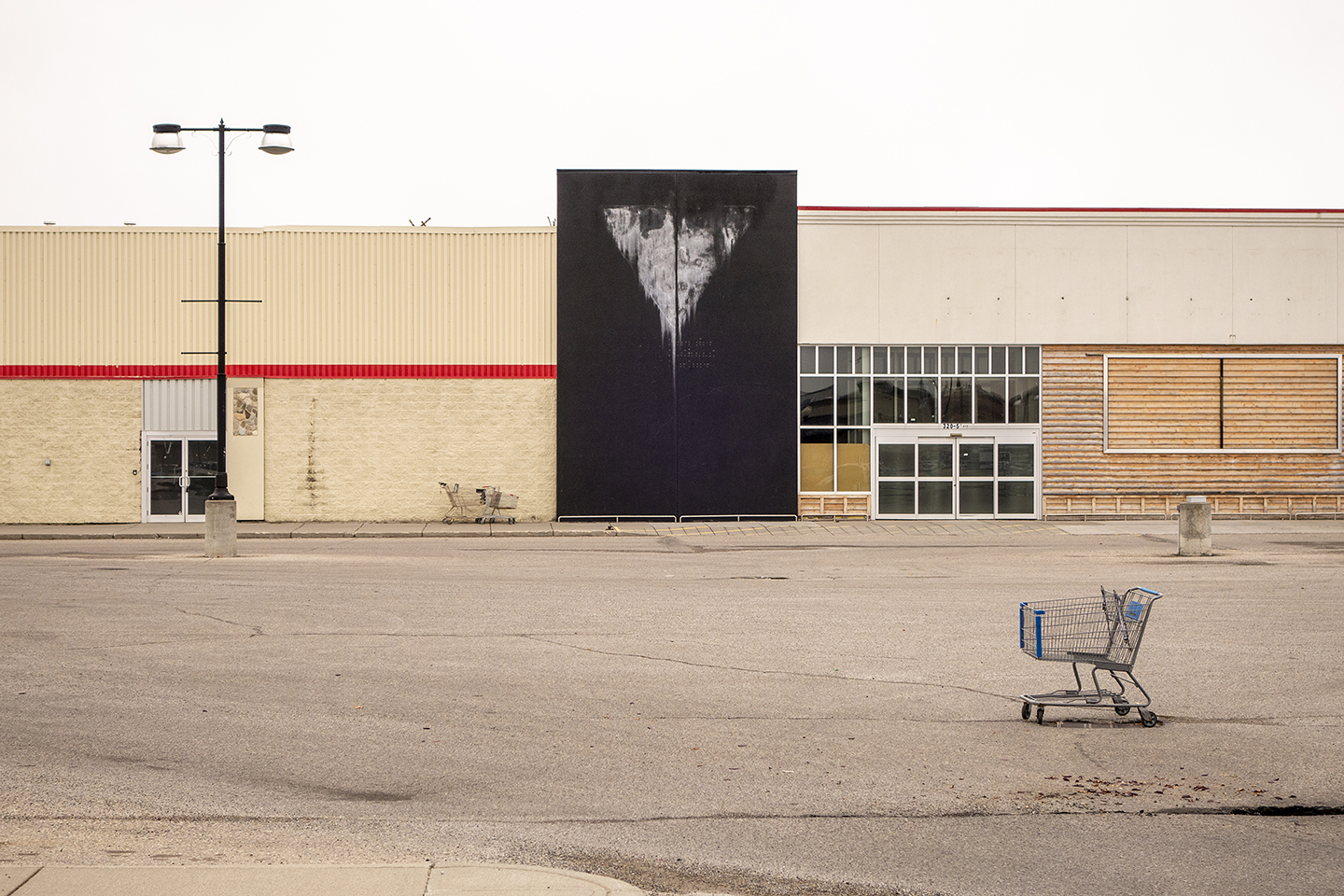
Of course a door, even a nulleporte, always has not-nothing on the other side. It may defeat your expectation of a room, or a hallway, or the enterable outdoors, and at least something to step forward onto. But even if you pull it open only to find a wall, or open air and a drop-off, there is still not nothing. And if, as is the case with some nulleportes, it’s just a door to more of the same space (there are doors standing in the middle of the countryside, inviting you to pass through though you could always just go around), there is no less potential than there was – you just have the added experience of a gratuitous transition. But in all cases, a nulleporte is not a door you can use as you expected to. The expected potential has not been realized, so the options are undefined.

One thing has been prescribed: you have to do something other than what you thought you would. If the door is in the middle of a field or standing free in a gallery, you can pass through and continue, and your mind will tell you both that something has changed and that nothing significant has changed, and you have a decision to make about what you tell yourself. If it opens to wall or to sky, you can turn around and go back where you came, perhaps; that’s usually an option with doors (though certain doors in places such as airports – remember those? – have a requirement of not reversing course). But you came with a plan to go forward, no? Is there, after all, turning back?

When a door is a literal nulleporte, the realistic decision can be clear-cut and unavoidable: few people will step into open air with a long drop down, and fewer still will walk into (or through) a wall, and let us not condemn those who choose to keep living unbruised. When it is not clear-cut, it is likely inconsequential: some will step through a door that leads to the same space, and some will go around it, and the result is, physically, functionally indistinguishable.

But when in the course of our lives we reach a figurative nulleporte – a transition point anticipated but not providing the expected outcome – we still must do something. We can walk into a wall and somehow pass through it (or at least hope to). We can step off into air and manage to fly before we become a Wile E. Coyote canyon-floor dust cloud. We can pass through into the same space as we were in and truly see it and be in it differently. Nothing… and everything: a transition because you decide it is one.

Or not, of course. We can also come up to a nulleporte in our lives and find no sensible way to go through, and go back and choose another route. That’s better than hitting a wall or becoming a dust cloud on the canyon floor, or pretending things have changed when they haven’t. Sometimes a nulleporte opens a door only to recognizing our own assumptions, expectations, and plans. It makes a difference, of course, whether no door was expected and you came to one only to find it not what it looks like, or whether you’ve been waiting for this moment for all your life only to find it’s all been a pack of lies.

Now here’s a question: if we have a meaning for something, and a phrase to signify that meaning, does it make a difference if we have a single word? We know what door to nowhere is; it’s a collocation, well established, and clear enough for most people. The idea of a word is that it unlocks new meanings, but nulleporte means nothing more than ‘door to nowhere’; it just says it in one word, and more cleverly, and plainly borrowed from French (which is classy or something). It gives it a new air and a new thingness, but is that just imagination? Is nulleporte a nulleporte? Are you exactly where you were before you had it? Or has it led to a state change? Is there something not just liminal but numinous about doors, and about the linguistic doors that words are? Per Bachelard, “Why not sense that, incarnated in the door, there is a little threshold god?”

And have you, by the way, stopped to think about who goes and puts nulleportes in places? It seems like such a frank (and perhaps passive-aggressive) bit of spatial communication. Or perhaps it’s a gift, meant to give a new perspective. Or it’s just fun or diversion or fantasy. Bachelard: “And what of all the doors of mere curiosity, that have tempted being for nothing, for emptiness, for an unknown that is not even imagined?” What of them? In fact, life is full of them, incessantly, and we don’t even notice most of them.

I can’t speak for everyone, of course. But I can speak for the person who created the word nulleporte, because I am that person. It’s a new old word. (I created the quoted passage at the start as well, but the Bachelard quotes are all real.) And I suggest using this nulleporte for the best reason for using a nulleporte: because why not.

wabbit

Notwithstanding – or even perhaps because of – the season, I think many of us are getting to be a little wabbit.

No, I don’t mean Elmer Fudd–style, although, well, come on, here, you may need this:

But, regardless of the wiles of Bugs Bunny, if you are wabbit (not a wabbit), you are more likely to be wiped out than to prevail. Not that it has anything to do with being hunted or being a rabbit. No, wabbit means ‘exhausted’, ‘dog tired’, ‘not feeling at all up to it’, et cetera, and it’s from Scots.

I don’t mean Scotch – though that may help you if you’re wabbit (or, on the other hand, it may help you to end up wabbit if you have too much). Scots is a sister language to English spoken in Scotland (as distinct from Scots Gaelic, which is a Celtic language and sister to Irish). And in Scots, the past participle suffix (which in English is -ed) is -it. As in that little rhyme by Robert Burns I first learned as a child and was instantly irritated by, because I didn’t see why they had to use all these weird versions of words and that forced rhyme:

Some hae meat and canna eat,
And some wad eat that want it,
But we hae meat and we can eat,
And sae the Lord be thankit.

So if thankit equals thanked, wabbit equals… uh…

Well, Scots is a different language, you know, and it doesn’t always have one-to-one word correspondences with English. And its etymological record is less replete too, due to its having fewer speakers, fewer books, and less investment in its teaching and research. So anyway, exhaustive search has turned up only possibilities. It might be a past participle of the verb wap, which has a good reason for looking like English whap: it means ‘throw quickly or with violence” (per the OED). (No explanation is given for the shift from p to b.) Or it might be somehow from woubit, which is a “woolly bear” kind of caterpillar or, figuratively, a contemptible person. Or it might be from neither. Ah, who knows?

Wabbit has been borrowed into English, anyway, so you can use it without having to try to emulate Rabbie Burns. But if you’d like to see it in context, here’s a poem by William Stewart, from his 1895 book Lilts and Larks frae Larkie (look for our word halfway through the second stanza):

Adversity Sweetens Success

Here, within my cot in Machan,
I’ve got landed richt and ticht,
Face aglow, an’ lungs apechan’,
Wi’ the fury o’ the nicht.
Hech, but I’d a michty battle
Comin’ ’tween the toon an’ manse,
Hail, like jaury-bools, play’d rattle
’Gainst my nose an’ garr’d me dance.

Doon it pelted, helter skelter,
Like as gif my banes ’twould pyke,
Deil the bit whaur I could shelter
Till I got to Crichton’s dyke.
Braithless, blinded, a’ but wabbit,
On I sprauchled, heid agee.
Till against the wa’ I labbit,
Frae the bitin’ halestones free.

Noo I’m plantit by the ingle,
King or prince can never ken
Hoo wi’ joy my heart strings tingle,
Noo my trauchel’s at an en’.
Wife an’ bairnies a’ sae cheery,
Pipe aluntin’, hearth aflame,
Mak’s me bless the ootside fury,
For it hichtens joys o’ hame.

Would ye ken sweet plenty’s pleesure?
First ken poortith’s bitin’ sting;
Would ye ken true comfort’s leisure?
First ken labour’s constant hing.
Would ye ken the joys o’ simmer?
First ken winter’s bitin’ blast,
Hope’s bit stamy’s faintest glimmer
Beems a bleeze whem storms are past.

Are you wabbit now? That poem might have been a bit much exercise for some readers. But so is quite a lot of life these days. Well, noo yer trauchel’s at an en’, at least for the time being. Go get some rest if you can. It may be all the sweeter if you been befuddled.

kallipyg

I’ve been biking quite a bit this summer, and running too, and while this is unlikely to make a kallipyg of me, one can but hope. My wife, like pretty much all lifelong high-level figure skaters, is a noteworthy kallipyg. One need not be athletic to be a kallipyg, but it seldom hurts.

It is not always easy to judge whether a person is a kallipyg. It depends on the clothing they’re wearing, but more particularly it depends on the angle you see them from. If you can see their face, for instance, you are probably not in a position to judge whether they are a kallipyg.

Does this word look like somehow it’s been cut off? It has not. Does it make you think of a pygmy? It has nothing to do with pygmies (except for inasmuch as any among them may be kallipygs, which some probably are, but not because they are pygmies). Perhaps a calliope? No, though a kallipyg may be music to the eyes of some. And the connection between kalli and calli is well made: they both come from Ancient Greek κάλλος kallos, ‘beauty’.

Some of you will see the meaning of this word coming by now. But all of you have seen it going. The pyg, you see, is from Greek πυγή pugé, ‘buttocks’. I think many of you know the word callipygian, which means ‘having beautiful buttocks’. It comes from an epithet for Aphrodite: καλλίπυγος, an adjective meaning ‘callipygian’ which, as a substantive used as an epithet, could be rendered as “sweetcheeks” or “the one with the nice bum.” (“You know, Aphrodite, the one with the buns.”)

Well, kallipyg is a rather less common word, but it comes from the same source, and it’s a noun for a callipygian person. If you want to say it out loud, the stress is on the beginning – although we could say the weight is on the end.

scopulous

There’s a link between rocks, looking, and Dutch cookies. I expect you’ll be skeptical, but it’s not just speculation: the path from one to another is scopulous, but the view in the end is spectacular.

Let’s start with the cookies. You may know speculaas; they are those spicy brown cinnamon ginger cookies, also called “windmill cookies,” that are typically shaped like animals or edifices, especially windmills. The Belgian version are called speculoos, and so are the crumbs made from them that are used for various purposes, sort of like delicious food gravel.

There are arguments about exactly why the cookies are named speculaas, but it is known that the spec is the same as in Latin speculum and speculator, which trace farther back to specula, Latin for ‘watchtower’ or ‘lookout’, which comes from the same root as scopulus, ‘crag’ or ‘rock’. Which is the origin of scopulous, meaning ‘rocky’. Promontories and crags are rocky, you see. It’s true that a pebble in your shoe can impede you from getting to the point of one, but if you can scamper up the escarpment you will find that much larger rocks can give much bolder outlooks. One way or another, it’s scopulous all the way.

Is it mere coincidence, or perhaps merging, that brings the spec of looking and the scop also of looking together with this scop as in rock? Nope, it really is that the rock, the headland, gets its name from the eyes in the head, or anyway from what they’re doing. The Latin scopulus came from Greek σκόπελος skopelos, ‘watchtower’ or ‘rock’ or ‘promontory’ or ‘crag’, which most likely came from σκοπέω skopeo, ‘I look’, ‘I contemplate’, ‘I consider’. It comes from the Indo-European *sḱep- root, which is a metathesis of the *speḱ- root. Apparently neither the Proto-Indo-Europeans nor the Ancient Greeks could mind their p’s and k’s. Anyway, an amazing number of words in many languages, including quite a few in English, trace back to these roots, all coming by one path or another from looking: spectrum, spectacle, species, specimen, expect, skeptic, scopophilia, telescope, and so many others.

And if you follow the crumbs to climb the scopulous path to the spectacular promontory from which you can trace your trail back with a telescope, do you get a cookie? I expect you may, if you bring one, but you’ll have to look out for yourself.

gup

Marry gup! This is fishy indeed.

What, sir, what is fishy? What say you, ha?

This… hodge-podge of hucksters and mountebanks, this hippo-crate of hypocrites, this convention of worms and weeds and watersnakes, this whited seppuku, this monstrous erection of eructations and vice versa, this pond of piranhas, this immoral morass of morays… Gup! ’Tis an ill thing indeed.

But “gup,” sir? Is this like “welp,” sir? or “gulp”? Or is it of a guppy?

Like “welp”? Or a little fish named in 1866 after one R.J. Lechmere Guppy and not to be gulped by bumptious youths? Mary and gup, you whelp! “Gup” is a word one says to express surprise, dismay, derision – or to chide a recalcitrant horse. It comes from “go up”; it has on occasion arrived by some oblique process to be said or written “quep”; it is frequently prefaced with “marry,” which is to say “Mary,” which is to say an invocation of the mother of Our Lord.

Ah, I see. So “gup” is more readily pronounced than if the g were replaced with w, the u with t, and the with f? And otherwise is used to much the same effect?

Indeed, just as “marry” is better said than “Mary,” which is better said than the name of her Son.

And people still say this, do they? Today, in our times?

I’ faith they do, so long as ’tis understood that “our times” are mainly before the year 1700, when many a fine author (such as Messrs. Heywood, Middleton, and Fletcher) had recourse to it. Later than that… not so much. But I find that what goeth around cometh around. And a brief but not censorable exclamation is often needed in many a time.

…Yup.

derf

Because yet again an article talking about different generations skipped straight from the Baby Boomers to the Millennials as if Generation X didn’t even exist, I decided to read, at last, Douglas Coupland’s Generation X. I picked up a copy of the 25th Anniversary Edition, because kill me now, how was my youth a quarter century ago. And on page 25 I saw a word that really caught my attention.

Derf.

Actually, I saw a derived form of derf, but I’ll get to that.

Don’t mistake derf for derp. The word derp (suggesting stupidity) is much more recent – really only current since after the turn of the millennium. Derf has nothing to do with it. It also has nothing to do with dearth (which is from dear+th like width is from wide+th and sloth is from slow+th) or deaf.

Derf is not much used anymore as such, but it shows up in Oxford in two basic versions, with several derivative forms.

Derf the noun is (per Oxford) “trouble, tribulation, hurt.” It comes from deorfan “labour.”

Derf the adjective and adverb is either “bold, daring, courageous, brave” or “in a bad sense: bold, audacious, daringly wicked.” It can also mean “strong, sturdy, stout” or “vigorous, forcible, violent” or “painful, grievous; terrible, dreadful; cruel” or “troublesome, hard, difficult” or “grievously, terribly.” It apparently comes from Old Norse djarfr “bold, daring, audacious, impudent.”

So. Imagine the sound a superhero or supervillain makes when punching through a superobstacle or hitting the turf: DERF! That should make it stick in the mind. To put it another way, why say “This is tough” when you can really be forceful and say “This is derf!”

From derf and derf we get a few other words, and they are too good not to include.

There’s derfful, which looks wonderful but is quite the opposite – “troublous, hurtful” (yes, Oxford uses “troublous” in the derfinition).

There’s derfly, which Word insists should be deerfly though I think it’s more like the end of alderfly. It comes in adjective and adverb flavours. The adjective means “grievous, terrible, dreadful” and the adverb means “boldly; fiercely” or “forcibly, violently” or “quickly, promptly” or “grievously, terribly.” In other words, derfly is used in all the places we used wicked when I was in high school.

There’s derfness, which is not as in “Your Derfness” and also has nothing to do with deafness; it means “trouble, hardship” and “boldness, audacity.”

There’s derfship, which means “audacity.”

And there’s also a verb derve, derived not from derf but from the same deorfian that gave us the noun derf; it means “labour” or “trouble, grieve, hurt, afflict, molest.” (But who has deserved to be derved?)

There are also other derivatives not listed in Oxford that we can form, of course. For instance, just as I can say I’m hatted or jacketed or even re-beered, or for that matter puced or happied, without implying the existence of hat, jacket, beer, puce, or happy as verbs because -ed can be used to form adjectives from nouns and other adjectives, I can be derfed. Which means I can be endowed or afflicted with boldness, force, courage, audacity, trouble, or any of those other qualities that the adjective or noun derf implies. Or I can be described as having those, just as I might be puced if someone says “Whoa, dude, you look puce.” I could also be said to be bepuced, I suppose, and if no one has said I look puce, then I am un-puced.

Of course, since no one (except Gen Xers and Douglas Coupland, who is actually a late Boomer) talks about Generation X practically at all, and when they ever have it’s always about how we’re the “meh” generation (because that’s our reaction to the self-derfed Boomers) and “slackers” (because we don’t want to be the red shirts in their Enterprise expeditions), we are chronically un-derfed.

Which is the word I saw in Generation X.

The quote from Generation X is (ironically?) from a description of a Boomer character: “like an underfed Chihuahua baring its teeny fangs and waiting to have its face kicked in.”

What.

What.

You think it’s under-fed?

Well.

This book is the song of my generation and I will be so derf as to read it however I want.

chthononosology

Imagine if someone were to show you a map of diseases. Every disease, splayed out across the globe, signified by colour and shaded for concentration. All the ways of getting sick, and the ways and places they’re spreading. You look at it and you react, trying to grasp it: “Ch—… Th—… O no no… so…”

All the ways to zero in on sickness. All the repeats, and the confusion, and the things you’re not sure you can say. The down-and-dirty, down in the dirt and spread out over the earth. Here’s your chance to geek out… or Greek out. Every map of a pandemic, an epidemic, or an academic exercise in the glory of sickness transiting the monde, it’s all chthononosology.

Just look at those letters: c g h h l n n o o o o o s t y. So many o’s (five of them, like the number of zeros in ten myriads). Doubled h, then (with the chimneys cut off) doubled n. And ending, logically, with the logy of words and science.

It’s all from Greek, of course: χθών khthón ‘earth’ (as in the surface of the planet, or the dirt that makes it) and νόσος nosos ‘disease’ and λόγος logos ‘word, discourse’. Talking about the diseases of the surface of the earth, which means all over the world. We know these roots: every -logy, logically; a few nos- words such as nosocomial (which refers to diseases that have been acquired in a hospital – the kind that make hospitals bright hot spots on disease maps); and chthonic, having to do with the ground, the earth, the dirt, the surface of the planet or something burrowed beneath it… perhaps something deep and dark and dirty and evil…

This word was put together as such by someone probably in England in the later 1800s. It shows up in the New Sydenham Society’s Lexicon of Medicine and the Allied Sciences of 1881. Honestly, it probably could have been geonosology or nosogeography, but it wasn’t and that’s just the way it is. And fair enough: disease calls for something more deep, dark, dirty, and hard to say; even a map of diseases looks like the tracings of an ancient earth spirit, and experiencing an actual affliction may lead to an unusual increase in utterances of “ch” (the hard kind) and “th” and especially “ooooo.” And now, when someone shows you yet another map of worldly unwellness, you have a word to characterize it.

theriodic

It is an event as yet periodic, though not infrequent, that the weather turns… theriodic. There is a tempest to suit the temperature of the times and tides. It may be Hobbesian – nasty, brutish, and short – and it may be scenic, but it is vicious while it lasts.

This afternoon, for example, I was seated working at a table under an expansive overhang, several metres from the edge, and when the foretold rain began I was not disturbed. And then there was a bit of breeze from behind, causing a minor mist onto my screen, so I closed the computer and put it away in my backpack for the time being and resolved to wait out the weather. And then, within a span of seconds, the patio became a scene from a sea storm: the wind increased to a gale force, hosing down the environs, blowing folding metal chairs and signs and nearly tipping heavy tables, and chasing me and my backpack inside, where I watched with moistened amusement. Ten minutes later it abated, but there was no dry place left to sit. It was as though a herd of water buffalo – by which I mean buffalo made of water – had stampeded through.

Meanwhile, in Death Valley, temperatures hit a record high. But at least it was dry. Nonetheless, that weather too is, in its way, theriodic.

Theriodic is not a word exclusively or even mainly for weather, though it certainly serves the turn. It’s more often medical in use when it’s used at all, and in that context it means ‘malignant’ or, I suppose, ‘fulminating’. The root gives you the clue: theriodic is taken from Greek θηριωδία theriodia, which means ‘brutality’ or ‘savagery’ and in turn comes from θηρίον therion ‘wild beast’ (though it has nothing to do with the lion nor, on the other hand, with Charlize Theron). That same ther- shows up here and there, like in theriomorph and anoplothere.

So, in other words, what is theriodic is like a wild animal – whether it be one that stalks you and abruptly craunches and devours you or one that by mischance has gotten trapped in a minivan and tears the interior to ribbons and bits – and when faced with theriodic weather or other affliction, it is best not to dither, lest the next threnody be for you (or your electronic devices).

barge

Look at the large barge, sarge! Who’s in charge of the large barge? And what’s that sparged on its marge? Is that parge? Is it going to Canada Cement Lafarge?

Barges get a bad rep, but flat-bottomed boats make the world go ’round. Or anyway they make stuff go ’round the world. It’s known that to succeed in logistics you have to be a bit anal-retentive, but for many times and places (and sometimes still) you also have had to be canal-retentive. Many things are moved more smoothly over water than over land, especially because you can fit much bigger loads on a floating vessel than on anything that has to navigate road or rail. Take as example the construction materials and equipment I see cruising into the eastern entrance to Toronto Harbour nearly every early evening.

DSC07816_640

Should I say “barging into”? Well, it is a barge, being pushed by a… hmm, it’s not tugging, so it’s not a tugboat… well, a pusher boat, OK? But it’s where it’s supposed to be. Not like some personal sport watercraft ripping into the picture.

Does that seem fair? That if I’m taking a picture of a barge that I fully expected to be at that place at that time, and a Sea-Doo or whatever tears across in front of it, the interloper is said to be “barging in” while the barge is being all polite and invited? Why does a barjaun “barge on,” anyway?

Well, before there was barging in there was barging around and barging along and barging through, and barging into or barging against someone or something, and the sense was of bumping, of being big and heavy and inertious and unbrakeable just like a fully laden barge. Perhaps the kind of cad or bounder that a less bumptious person wouldn’t want to touch with a bargepole… which, by the way, is literally a pole used for keeping smaller canal barges from touching other barges or the shore or whatever (and occasionally for propelling barges, though really human musclepower is mostly not up to the task).

Where did this word barge come from? French, of course, like the other words ending in -arge, and French got all of them from Latin. But this ­-arge has a lot of cargo of many sorts from various origins: while large comes from Latin larga, and marge (as in margin) from margo, charge comes from carricare (cargo is descended from that too, but charge didn’t come by way of cargo), and sarge is short for sergeant, which French made from Latin servientem – that g just kinda… pushed its way in (it’s not the only time a “w” sound has been changed to or from a “g” sound). And while sparge comes from spargo, parge comes from French porjeter, from Latin porro plus jactare. There’s also litharge, via Latin lithargyrus from for ‘silver stone’, and targe from Latin targa, from a Germanic word – look them up if you’re curious. The name Marge takes us back to Latin Margarita, which in turn came from farther east. As for Lafarge, the name of a large cement company that does have a small facility in Toronto’s docklands, well, that’s a variant of La Forge, and forge traces to fabrica, because, well, why the heck not.

As to barge, it came by way of barga from late Latin barca (also the source of barque but not of bark), from earlier Latin baris, ultimately by way of Greek and Coptic from Egyptian (you can see the hieroglyphics on Wiktionary). All the way back, it’s all words for boats of various kinds. And there are still various kinds of vessels called barge, including ones that can be wind- or self-propelled, even big glamour boats for royalty rowed by peons. But mainly, these days, a barge is a big floating cargo platform. And regardless of where it comes from, when it’s loaded up, it goes where it’s going and will not be quickly diverted.

bedog

To bedog or not to bedog? Or to be a bedog?

Not to be doggèd about it, but this is a word that seems to shift to suit – you or it, we’re not sure. It’s sort of like a big dog that you can lie on – or that can lie on you. Or that can follow you, or you can follow it. Or maybe you are the dog, and the dog is you.

Here’s what this is all about. The first time I can think of seeing the word bedog, it was in a sense that (I now know) is not at all the dictionary sense, and I can tell you it did not lie easy on me, or I on it. It was in Frank Herbert’s sci-fi novel The Dosadi Experiment, wherein a bedog is a bed that’s a dog, or a dog that’s a bed. It’s a big furry critter than you can sleep on and that is docile and very happy with the arrangement:

McKie stretched his arms high over his head, twisted his blocky torso. The bedog rippled with pleasure at his movements. He whistled softly and suffered the kindling of morning light as the apartment’s window controls responded. A yawn stretched his mouth. He slid from the bedog and padded across to the window.

Later,

Jedrik moved softly with her own preparations, straightened the bedog and caressed its resilient surface.

Of course, this means that this bedog is pronounced like “bed dog” but with only one “d,” and I am not comfortable with that. Even if you degeminate the [dd] you should, in English orthography, write it as dd (which we would usually say as just “d” anyway) because otherwise the e becomes “long.”

Which, in the real-world version, it is. Because bedog is really the verb dog (formed from the noun dog, of course) plus the prefix be, as in befall, bemoan, benight, bewitch, bedaub, become, believe, behave (yes, of course behave is beplus have; it’s just travelled a long way since the joining), and many others. But that be can be many things, as it happens, as is evidenced by the different definitions of bedog. The Oxford English Dictionary gives the options as “To call ‘dog’” (so “I bedogged him” means ‘I called him a dog’) and “To follow about like a dog, to dog” (which also means that to bedog can be to be doggèd) with the addition of bedogged meaning “Become like a dog.” Wiktionary, for its parts, gives us “to refer to or treat like a dog; (by extension) to follow like a dog, harass, torment; bully” and “to become or behave as a dog.” And Webster’s Third New International Dictionary is succinct but in line with Oxford: “to call (a person) a dog” (meaning you can’t bedog a dog, because that dog do be a dog and if you do be dog you do not be bedogged) and “dog vt” (i.e., the transitive verb dog, as opposed to “dog, VT,” which is a dog in Vermont).

So. To debog this:  You can bedog someone else by calling them a dog or by dogging them (which means acting like a dog in their direction, generally), or, supposedly, you can bedog and just, you know, be a dog. (However, the quotations in Wiktionary in support of that latter sense do not support it: “That envy, malice, and hatred bedogged his steps” is clearly the first sense, and “So they went to sleep like a pair of chain gangers, and bedogged if during the night Rose didn’t get up and start for the bathroom, and down she went” is equally clearly using bedogged like doggone or any less canine and less polite turn of speech involving g with b and/or d.)

And can you be bedogged by a dog? Seems redundant, dunnit. But can you be bedogged by a dog star? Hmm, is that serious? Ha, it’s Sirius. We are in the dog days, and the heat is both canine and incandescent. So if you don’t want to be bedogged, beware of updog.