
Tag Archives: English grammar

What’s logical about English?

A common complaint about English – by those who are inclined to complain about English – is that it’s not logical enough. Whatever that means. Words aren’t premises and sentences aren’t syllogisms, after all.

If you inspect the targets of their opprobrium, you find soon enough that what they mean is that English isn’t tidy enough for them. It’s inconsistent. Lacking in symmetry. Their experience has led them to believe that for every up there should be a down, for every in an out; when they see an over, they think “therefore under,” and if there is no under, they are… underwhelmed.

They’ve condemned themselves to a lifetime of disappointment. English does not satisfy their need for an overarching tidiness. It is not a Zen garden; it is a forested mountain, every tree grown unplanned in its place and conditions, every rock where the ineluctable complexities of physics left it. It is not an edifice of modernist design with proportions based on the golden mean; it is a Winchester House of a language, a veritable Heathrow Airport of accretions (for those who have not been to Heathrow, let me just say I suspect that J.K. Rowling based Hogwarts on it). Like any natural language, English has been built up by habit, need, association, and analogy. It does have structure – in fact, it has some inflexible syntactic requirements. We have slots to fill, and fill them we do. We just sometimes grab whatever’s ready to hand to fill them.

Let’s consider a few examples. One case where a desire for logic has actually prevailed is “double negatives.” Anyone who has studied logic will tell you that in “not not” the second not undoes the first one. “There will not be cake” is disappointing; “There will not not be cake” is affirming. Thus, the reasoning goes, “I do have nothing” and “I don’t have nothing” are opposite. But anyone who has learned a Romance language ought to know ça ne vaut rien, no vale nada – that ain’t worth nothing.

Nothing, you see, is not not. It’s a noun, not an operator. And one thing languages like is agreement. Concord. Adjectives tend to take the same gender as the nouns they modify, for instance. In English, we use concord with tenses in some contexts: “Should we expect them tomorrow?” “They said they weren’t coming.” Notice how we use weren’t even though we’re talking about the future? We even let negative concord pass unremarked in some contexts: “They won’t be coming, I don’t think.” This doesn’t mean I don’t think they won’t be coming; it just retains the negative aspect.

But since it’s possible, with shifting emphasis, to make “There ain’t no one here” and “There ain’t no one here” mean opposite things, an argument can be made for disallowing negative concord for the sake of unambiguity. So the proscription stuck, defended by pleas for logic – although “if negative noun, then negative verb” is perfectly reasonable if that’s the rule in the language.

Syntax has its requirements – as linguists would say, there are principles and parameters that specify how it functions in a given language. Negative concord is one parameter we have managed to turn off. Others are not so easily disabled. It’s necessary to have an explicit subject (except in imperatives), for instance; I can’t write “Is necessary to have an explicit subject,” so I stuff in an it that has no meaning. It may not seem logical to have a pronoun with no referent, but consider that, from the view of our syntax, “if it has a sentence then it has a subject” is solid. Sometimes we grab and stuff on the fly – we may jam a word in the place where a word like it normally goes, even if in this case it’s a whole nother thing and what even were we thinking? This, too, comes from a simple if-then – just a little simpler than it might have been.

Another plea for logic comes when a word is pressed into service in a way that seems untidy. One I saw recently was an objection to using disconnect as a noun, as in “There is a real disconnect between the labourers and the management.” We don’t say “There is a connect between them,” we say connection, so it’s illogical not to say disconnection. Indeed, this is untidy, in the same way as it’s untidy that when my wife is at home I heat two servings of food and pour two glasses of wine, but when she’s not at home I heat one serving and open a beer (or go out for sushi). But our little untidinesses have reasons: my wife doesn’t drink much beer and doesn’t like sushi. And disconnect is an allusive use borrowed from electronics and telephony.

A line of communication is expected to remain connected, so there is no instance where we would say that it has experienced a connect. We grabbed a bit and stuck it where it fit, and in so doing made a metaphorical connection. There’s no need to construct a symmetrical positive use any more than there is a need for a 33-storey building to have 33 levels of basement. And there’s no need to disallow allusions just for the sake of tidiness – we don’t forbid lights on Christmas trees just because there are none on the house plants. If you want to make a connection, you make it; if you don’t, you don’t. That’s logical, no?

Some people also like to laugh at how “illogical” English words are. “Why do our noses run and our feet smell? Why do we park in a driveway and drive in a parkway? Why do we say a bandage was wound around a wound? How come you can object to an object?” OK, now tell me why these are illogical.

Every one of them comes from a well-motivated historical development founded on consistent principles: metaphor, ergativity, historical sense developments and standard compounding rules, phonological shifts, stress-based differentiation of nouns from verbs. In every case there was an if-then judgement based on analogy. It just happened not to be exactly analogous to some other if-then judgements, and it produced results that seem inconsistent when juxtaposed. I think that’s fine – why not have funny things? But more than that, it’s not even illogical. In every case, we got to it from “if A → A´, then B → B´.” They just happened to be local judgements made in the context of a big, multifarious, inconsistent world.

But it would be illogical to treat a multifarious, inconsistent world as though it were elegant and pervasively consistent, wouldn’t it? It certainly wouldn’t be well adapted. It would be like laying down a strict grid street plan for a very hilly city (and San Francisco knows how well that worked out). It wouldn’t be as much fun, either. And it might do real harm.

Look! It’s a noun! It’s an adjective! It’s a number! No, it’s…

My latest piece for The Week is an introduction to that double-agent class of words, there in the numbers but not of the numbers: quantifiers.

Singular or plural? It’s complicated.

That old bad rule-seeking behaviour

Linguistics is great for making you aware of things you were already doing consistently but weren’t consciously aware of. In fact, that’s the basic point of several subfields of linguistics. There are a few particularly memorable examples that one learns in the course of an education in linguistics. One of these is the order of adjectives: we have a standard order for adjectives when there are several before a noun. We may not be analytically aware of it, but if someone says “a red big balloon” it will sound wrong.

If you’re a linguistics student, you take that as more data, and the point of such data is to use it to help you figure out why we tend to do that, and to do that you have to see what exceptions there are and sort out what the various inputs and influences are. It’s explanation-seeking behaviour.

If, on the other hand, you’re not a linguist but an ordinary English speaker, you may approach English with an eye to finding out what is right and what is wrong. We learn that good grammar is the great sorter, and we treat errors as evidence of flawed character and intellect. And so when you encounter a new fact about the language, you may well be inclined to turn that fact into a rule. It’s rule-seeking behaviour.

So when, recently, a book came out pointing out (in passing) the standard order of adjectives to the lay masses, many people were all “mind=blown” about it. The author, Mark Forsyth, stated confidently that the order absolutely has to be opinion-size-age-shape-colour-origin-material-purpose-noun, and “if you mess with that word order in the slightest you’ll sound like a maniac.”

Linguists, of course, quickly critiqued this overstatement; read Language Log for some responses. But non-linguists didn’t just say “Wow, I didn’t know I was doing that”; many of them were writing down that order and determining that any deviation from it must be wrong. I didn’t see any instances of people telling other people “You didn’t put it in this order, so you’re wrong,” but I did see instances of “What’s the correct order? I don’t want to get this wrong!” English speakers, you see, are in general convinced that they’re always making mistakes and doing things wrong, and they want to know the right way to do them for those instances where they’re going to be judged. (Ironically, many of them think one of those instances is when they’re talking to a linguist. Listen, honey, whatever you say or don’t say is great with us; it’s all data.)

So I feel I need to say this: There is no official correct order of adjectives you must adhere to. If something sounds wrong, then adjust it, but if it doesn’t sound wrong, it’s not wrong.

In fact, we vary the order depending on context, priority, and sets of words that we’re used to having together in a certain order. Consider a nice big old round red Spanish silk riding hood. Try moving any of the words and it may sound wrong (but not like a maniac!), although big old nice Spanish red round silk riding hood doesn’t sound awful to me. You might also get away with Spanish red silk. Some orders are more weighted than others. But change nice in the original phrase to good. Suddenly it doesn’t work as well: not good big old but good old big will sound better because of collocation – good old travels together. Also, any compound noun will defeat the word order. You have a tawny giant tortoise, for instance, because giant tortoise is a thing. And it will be different in what it can convey than giant tawny tortoise. We can even vary the order to adjust the sense: a little dumb ass is different from a dumb little ass because dumb ass is a common collocation.

So if you come up with a string of adjectives and it doesn’t sound right, just change the order so it sounds right. Make things that go together go together. Do not start overthinking it: don’t say “this one must go before that one because that is more common or more essential,” as is a common explanation for the ordering. Go with what sounds right. Afterwards, you can use that as interesting data to tell you what you see as more essential, but do not arrange the order by asking yourself which is more essential, because you could be wrong. For instance, we would all say big red building and not red big building, even though the building can be repainted more easily than it can have its size changed. And yet even that order can be changed in some circumstances: for instance, we use little closer to the noun to express an attitude towards it: I’m not gonna drive that purple little car of yours all over town communicates something not altogether the same as I’m not gonna drive that little purple car of yours all over town.

The number one thing we should learn from this, then, is that in general people aren’t fully aware of how their language works and yet they make it work, and when people start trying to analyze it and come up with prescriptions they very often miss things and get things wrong. The most poplar grammatical cudgels are based on thick-headed simple-minded misunderstandings of how and why we do things, and on grotesque overapplication of rules. That’s why they’re used as cudgels: not everyone follows them because they aren’t real rules, they’re made up.

Mistrust imposed rules, especially inflexible ones. You’ve been using English your whole life. If someone tells you that something that sounds right to you is wrong, and that something that sounds odd to you is right, they’re probably just wrong. And if your analysis tells you that a sentence that sounds awkward to you is right while one that sounds good is wrong, question your analysis. If you love the language and want to understand how it works and use it effectively, engage in explanation-seeking behaviour, not rule-seeking behaviour.

About this sentence that you’re reading

Originally published in Active Voice, the magazine of the Editors’ Association of Canada

About this sentence that you’re reading…

Should that be “About this sentence, which you’re reading”? After all, you’re not reading any other sentence, are you? So it’s not restrictive, so it must be non-restrictive, meaning it should have a comma and use which. Right?

I was talking to my wife Aina and a friend about this the other day…

What?

What do you mean, how many wives do I have? Look, if I set it off in commas, it would be “I was talking to my wife, Aina, and a friend about this the other day,” and you would be saying “So that’s three people? Who’s your wife if not Aina?”

Since you’re an editor, you’ve heard of restrictive and nonrestrictive clauses. A nonrestrictive clause is like a little Santa Claus in the sentence: it gives the reader a gift, with a comma or two as tiny ribbons.

The cakes are served warm.

The cakes, which are kept in the refrigerator but carried under the waiters’ arms, are served warm.

The sentence would be coherent without it, but it’s there as a special bonus of information. It’s also called a nonrestrictive relative, which works because it’s not really Santa Claus giving you gifts, it’s your relatives. (The rules apply similarly to non-clause modifiers as well, such as the name of my wife, Aina.)

A restrictive clause or relative (or modifier) is like your aunt who says “I’m giving you anything you want as long as it’s this sweater!” It no sooner gives than it starts to take away.

The tea is served cold.

The tea that is carried by Pat is served cold; the tea that is carried by Alex is served warm.

But where there is a Claus, there may be a Grinch. What is a restrictive Grinch? It’s one of those people who carp at things that are perfectly clear to reasonable people. Consider:

He went to a famous school called Eton.

The restrictive Grinch might say “Oh, so there are multiple famous schools called Eton?” In fact, the sentence does not necessarily imply that there are multiple famous schools called Eton (although it does imply that there are multiple famous schools), and ambiguity is not automatically a grammatical error – although it can be worth avoiding… when a reasonable person might reasonably misread it, or when too many people might deliberately (and unreasonably) misread it for their own entertainment.

Reasonableness is important. Communication normally (outside of contracts and courts of law) depends on people being reasonable. We make inferences on the basis of what’s reasonable, given our knowledge of the world. If we have some new data, such as a sentence,* and we choose among different interpretations on the basis of what we already know to be the case, we’re using a loose form of Bayesian inference.

Let’s take a Bayesian look at “my wife Aina and a friend” versus “my wife, Aina, and a friend.” In the version with commas, if we don’t know my wife’s name, we need to conjecture or determine whether I use the serial comma; if I don’t, it’s clearly two people, but if I do, it may be three. In the version without commas, the possibilities are (1) that I have more than one wife or (2) that I am disregarding the usual rule about setting off nonrestrictives with commas. Why would I disregard it? To avoid interrupting the flow or causing ambiguity with the extra commas. Given that bigamy is illegal in our society, option 2 is far more likely. Indeed, only a restrictive Grinch would raise the objection that the comma-free version must mean option 1.

There are, of course, many cases where proper use of commas is necessary to set off nonrestrictive clauses for clarity or legal defensibility. But there are also cases where the commas make no difference to the meaning but may make a difference to the flow or tone. The moon, which orbits the earth, is also the moon that orbits the earth (since there are many moons but there is one we call the moon); the sun, which we orbit, is also the sun that we orbit (for the same reason). This sentence that you’re reading is this sentence, which you’re reading, and the different possible uses of this make both defensible, but flow and tone may make one a better choice than the other.

So, when we are faced with a modifier such as a relative clause and we’re not confident about whether it’s restrictive or unrestrictive, we should ask the following questions:

  1. Will the commas help or hurt the flow?
  2. How likely is it to be misread accidentally?
  3. How likely is it to be misread deliberately?
    1. By which readers?
      1. And do they really matter?


*Or some new data such as a sentence – equally true.

scenicest

“It’s not the scenicest day,” I said to Aina, looking out the train window at a cloudy sky as we headed to Niagara for some wine and walking.*

Or perhaps I should spell that scenic-est, so you know I wasn’t saying it like “see nicest,” even though what is scenicest is nicest to see.

“Is that a word?” you may be thinking – or perhaps typing in an email to me. Well, I used it and you understood it, so yes. But is it a well attested word? No. You can find a couple hundred hits for it on Google, but it’s a safe bet most of them are – as I was – self-consciously using it as an awkward construction rather as Lewis Carroll used curiouser.

Why wouldn’t I just say most scenic? Because I like playing with words. Now it’s your turn: Tell me why scenicest shouldn’t be allowed. It’s a two-syllable word, after all, and it’s quite common to append –er and –est to one- and two-syllable words. The selection of those for which more and most are reserved is almost random-seeming. At the very least, the distinction is not black and white. For some words, it is a matter of personal taste which to use: beautifuller and beautifullest were formerly common enough, but now it seems we see the two-word version as the more beautiful.

I do think that what we see is part of the problem here. For assorted historical reasons (mostly to do with palatalization before front vowels in Latin and Romance languages), c “softens” before e and i. But the sound /k/ does not have an actual allophonic alternation with /s/ in modern English. We just retain the rule about c because of our borrowings from French and Latin. This makes a problem when we have something that sounds fine but runs into a spelling issue. Take chic. Lovely word, stylish, smart. Borrowed from French. By borrowed I mean adopted – actually I mean stolen. Anyway, it’s treated like an English word: it’s one syllable, so instead of saying most chic we often just add the –est and make it chicest.

Which looks horrible on the page. And chic-est looks at least as bad. And you can’t add or swap in a k because chikest would look completely wrong and incomprehensible and would conduce to yet another inaccurate pronunciation, and chickest is chick plus est. Somehow the chicest word to say is one of the unchicest (let’s say least chic) words to write.

Well, what do we expect? It should be supercalifragilisticexpialidocious?

Am I the only one who feels certain that supercalifragilisticexpialidocious should be two words? Normally, morphologically, we can add only other suffixes after a suffix, not a whole new root, let alone a prefix plus a root plus a suffix. And yet that’s what appears to come after the the ic in supercalifragilistic. Another bit of evidence to marshal for its being two words is that the spelling would seem to require a pronunciation like “–listi sexpi–,” which is clearly wrong.

Which takes us back to our problem of the orthographic scenery. Now, –ic words often used to be spelled with a k, as in musick and magick. So could we borrow on that and make it scenickest? Hmm. It looks a bit of a snickerfest. It may also tempt a person to shift the accent onto the second syllable because of the “heavy” consonant ck.

Or we could just keep using it and writing it and people will get used to seeing it and saying it. That’s how a lot of things in English have come to be as they are.

We ought not to be distracted by looks, anyway. A cloudy day may be warm and lovely. Indeed, when the sun is out and it looks most scenic, you are at greater risk of getting burned.


*It was not a reference to the fact that we would not be taking in a play at the Shaw Festival, even though scenic referred to the stage a century before it referred to the natural environment – it comes from a Greek word for a stage.

Kicking ass and taking names is useful sometimes

A colleague was wondering about a construction on the order of “Multiplying the number by 9 and adding the digits together give you a multiple of 9.” Does that sound odd to you? It did to her – she wanted it to be gives, not give. And yet the subject is two things: multiplying … and adding … So shouldn’t it take a plural conjugation, give?

It shouldn’t because it’s one action, multiplying and adding – a compound noun phrase that is nonetheless a single entity because it is a single complex action rather than two separate actions. If it’s two different possible actions – i.e., you can multiply or you can add with equal effect – then it’s plural. Parallel examples:

Kicking ass and taking names is my favourite Saturday evening pastime.

Kissing ass and taking bribes are both ways of getting ahead in business.

It’s similar to how we can say “The hop, step, and jump is the silliest track event,” not “are.”

When in doubt, though, or concerned that some readers may prefer singular while others prefer plural, you can always avoid the issue by using an auxiliary (or, as possible, a past tense), which conjugates the same either way:

Multiplying the number by 9 and adding the digits together will give you a multiple of 9.

In case you’re wondering, it’s a callow mistake

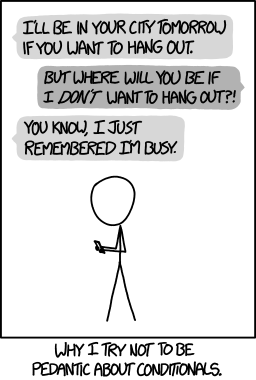
A recent cartoon from Randall Munroe’s xkcd, which is the most intelligent cartoon in existence, has been brought to my attention. You can see it at http://xkcd.com/1652/ but, since Munroe gives permission, I’ll reproduce it here for ease of reference:

This interpretation is not just pedantry and not just a turn-off. It’s a callow mistake.

It’s callow because it transgresses standard expectations of interpersonal decency in conversation – if the other person is using a common turn of phrase and you understand what they mean, don’t be a dick about it (or, as I put it in a haiku for the ACES Grammar Day haiku contest, Which do you prefer: / keeping your friends’ grammar right / or keeping your friends?). But it’s also callow because it imposes an inappropriate misreading, the sort of simple-minded overbroad application of a rule that is characteristic of an immature understanding of grammar. The clause in question, you see, only looks like a conditional.

I’m put in mind of an anecdote I recall from the actor Simon Callow. When he was first trying to make it in theatre, he worked in the box office of a theatre. Later on, when he was becoming established as an actor, he was in the cast of a play that happened to be performing in the same theatre. One evening before a performance, one of the box office staff saw him and, thinking he still worked in the box office, asked him to come help with some box office function.

Thinking this if you want to hang out is a conditional is like thinking Simon Callow still works at the box office. It’s the same clause, but it’s been elevated. It’s a sentence adverbial.

In case the term isn’t familiar, a sentence adverbial is a word or phrase that, within the ambit of a verb phrase, could serve to modify the action of the verb, but that is instead applied to the entire sentence to frame it within a discursive context such as the attitude of the speaker or writer towards the utterance. “Frankly, Scarlett, I don’t give a damn” uses Frankly to mean ‘I speak to you frankly and say…’; “Among other things, this book explores the concept of silliness” uses Among other things to position the following statement within a larger possible set of observations (‘There are various things this book does; one of them is that…’); “Going forward, we’ll do it this way” uses Going forward to mean ‘I am making a prescription that applies to future instances when I say…’. They do not mean, respectively, that Rhett doesn’t give a damn frankly but he may give one covertly; that the book only explores silliness when the book is among other things; or that we will do it this way only when we are progressing ahead. And In case the term isn’t familiar doesn’t mean the preceding applies only in the case where the term is unfamiliar. It means I’m saying it in anticipation of the possibility of unfamiliarity.

Because sentence adverbials use words and phrases that can be used to different effect at lower levels, they are like candy to immature minds who are eager to pounce on other people’s “errors” to show their superior knowledge. But, as with so many rigid “rules” propounded by people who claim to care about grammar but really care mainly about demonstrating superiority, the “pedantic” interpretation is founded on a simple-minded misunderstanding. We have no difficulty understanding the sentences as they are intended – the pedants don’t even have the excuse that the box-office employee (who evidently didn’t read the programmes) had. The most they can argue is that the sentences are ambiguous. That can be something worth fixing, but it’s not a grammatical error. And they’re not always ambiguous, either. We usually understand them with no risk of confusion.

To add another analogy: When I was in New Zealand, I rented two different cars on separate occasions. In New Zealand they drive on the left, and so some of the driver’s controls are also the reverse of what I’m used to. With the first car, I managed to get used to the turn signal being on the opposite side from what I expected. Then when I rented the next car it was a model with the turn signal on the North American side. So I had to get used to it again and not keep turning on the wipers when I wanted to turn left or right. But in all of that, I did not say that the controls were wrong and I was right and stick to my preferred sides. I did not insist on turning on the wipers when I wanted to turn off the highway – or on signaling a turn when I wanted to wipe the windshield – because those were the correct sides for the controls to be on. I did what worked. When my expectations did not correspond with the results, I corrected my perspective. Which is what those who care about understanding language must do if they do not wish to be wrong.

So this pedantry is both a turn-off and a callow error.

Which, of course, Randall Munroe knows. He also knows that linguistics isn’t his area of expertise, and I’m not going to hold it against him for missing the analysis. He’s not the only one.

Because language

First published on BoldFace, the official blog of EAC’s Toronto branch. Copyedited by Valerie Borden.

We have a beautiful opportunity to watch language change in action: English is gaining a new preposition.

Really?

Yes. Because change. Because language!

Do you find that jarring? Folks, this is how your language is made. Because may be gaining a new syntactic role, but this is not the first time it has done so.

Because has been a word in the English language for about 700 years. Before that, it was two words: by (at that time typically spelled bi) and cause. Preposition and noun. By cause of became because of; we also had because that—no longer in use—and because why, which has actually been around the whole time. Once the two words merged, the new single word naturally had a single syntactic role. In fact, even before the two words were written as one, they were already used to introduce a clause without further conjunction. See Chaucer’s prologue to the Franklin’s Tale: “by cause I am a burel man…”

So a multiple-word expression became a single modular unit. This happens in language—indeed, our prefixes and suffixes nearly all started out in the distant mists of history as separate words. Set as such, because sailed on for seven centuries, losing the that but otherwise holding steady. But we love to play with language like kids with erector sets, and, every so often, someone picks up a bit and sees if it can be screwed in somewhere else—just because.

Take a sentence. Any sentence. Even something that is used as a sentence but has no verb. Hey! There were some right there! Yes, we can and do use expressions such as “No” and “Hey, free candy!” and “The higher, the fewer” and “CAR!” in place of complete sentences. Since we can normally turn a complete sentence into a subordinate or coordinate clause, we should be able to use those other expressions the same way, right? Well, let’s just stick them in and see what happens: “I thought I could do it, but no.” “I’m dieting today, except hey, free candy!” “I climbed and discovered that the higher, the fewer.” “We scampered off the street because CAR!”

Do some of those seem more jarring than others? They well may. But for that very reason, they are more humorously effective. Consider this bit from a 1987 Saturday Night Live episode: “If you ever fall off the Sears Tower, just go real limp, because maybe you’ll look like a dummy and people will try to catch you because, hey, free dummy.” That appears to have been one of the seeds of the because [expression] trend that is increasingly popular because jarringly humorous: “I was wired last night because mmm sugar.” “They want to bomb it to the Stone Age because FREEDOM!”

This is not the same as the literary usage seen in “increasingly popular because jarring”—that’s an established predicative usage with an implied “it is”—but that may have had a slight influence. Rather, the current use seems to take the whole expression and plop it in as a substitute for a structured clause, and to do so as a deliberate syntactic mirroring of the leap of logic that it presents. It does not actually turn because into a preposition; the noun is what is converted. We see similar structures with other conjunctions—“We are hungry, therefore PIZZA!” and a favourite of mine from more than a decade ago, “You make good points but have failed to consider that bite me.”

What does turn because into a preposition is the reanalysis of this construction by newer, naïve users. This is, in fact, how syntactic change tends to happen: for fun or convenience, speakers of a language modify a structure or turn of phrase; then a subsequent generation reinterprets that usage as a different, easier-to-assimilate structure. You will probably agree that because as a preposition is easier to assimilate into a standard grammar of English than a noun as a complete subordinate clause. So now we can see children using because where their parents would have used because of: “I liked it because the ponies.” And this usage does not seem to draw on the substitute-for-reasoning effect.

You may not like this new usage; it’s not what you’re used to. But it’s language change, and you’re seeing it in action. It will be a while before it is accepted in formal usage, though. Expect sticklers to be routinely purple in the face about it by, say, AD 2050.

There’s much more to be said and read on this topic. I direct your attention to the following fine articles:

When intransitives go transitive

This article was originally published on BoldFace, the official blog of the Toronto branch of the Editors’ Association of Canada.

We’ve all learned that there are two kinds of verbs: transitive and intransitive. Transitives take a direct object—“I fry an egg”—and intransitives don’t—“My stomach aches.” But that’s not the whole story. In fact, it’s not actually quite right.

For one thing, there are also impersonal verbs (“It seems to me,” “It rained”), which don’t even have proper subjects, just empty pro forma its.

For another thing, there are different kinds of intransitive verbs. Linguists divide them into unergative, where the subject really is the one doing the thing, and unaccusative, where the subject is treated as being on the receiving end of the action and can be modified by the past participle. We see from the guests are departed and the departed guests that depart is unaccusative; run, on the other hand, is unergative—you can’t say the run horse.

There are also verbs that change from intransitive to transitive or vice versa—several kinds of them. We don’t always think about them. In fact, some details of them are still being argued about by linguists.

I think it’s time for a quick field guide to these changeable verbs, complete with their overstuffed technical names.

Agentive ambitransitives

Some verbs can name the object of the action or not, but they always say who or what is doing the action (i.e., what is the agent). Read is one of these: “What are you doing?” “I’m reading.” “Reading what?” “I’m reading this article on grammar.” These are the nice, simple ones, and we don’t need to worry about them. But worry, now… yes, that verb can worry us a bit more, or we can worry it.

Ergatives

With worry, the object when it’s transitive—“That worries me”—is the subject when it’s intransitive—“I worry about that.” Another one of these is break: “I broke the window,” but “The window broke” and “The window is broken.” And if “I fry an egg,” then “The egg is frying.” Do those look like the unaccusatives I just mentioned? Some say that’s what these are. But some linguists argue that these aren’t true unaccusatives, precisely because they have transitive variants. True unaccusatives, like come and arrive, can’t be used this way. So what do we call these ones? Ergatives (from a Greek root for work). Well, some of us call them that, anyway.

Some people call some of these middle voice. Take for example shave: “The barber shaved me” or “I shaved myself”; “I shaved” means “I shaved myself” and “The barber shaved” means “The barber shaved himself.” Why middle voice? Because it’s not exactly active and it’s not exactly passive—or, we could say, it’s both at the same time.

Preterite causatives

Our real favourites, though (if by “favourites” we mean “favourites to get exercised about”) are a set of verbs that express transitive causation by using the past tense of the intransitive form. We don’t make new preterite causatives anymore, but we have some lying around… not laying around.

Yes, lay is one of these. “I lie down today,” “I lay down yesterday”; “Now I lay me down to sleep” (reflexive), and “I lay down the law of grammar” (transitive). We wanted something to express “cause another thing to lie down,” and we just used our past tense of the intransitive for the present of the transitive (and then made a new double past from that: lay gets a d to be laid). I’m sure many of you wish we hadn’t.

Another one like this is fell. This isn’t an ergative—if it were, you could have “I am felling the tree; the tree is felling.” Nope. “The tree falls,” “The tree fell”; “I fell the tree today,” and “I felled the tree yesterday.”

Cognate object constructions

There’s one more especially fun case: verbs that are intransitive—and in some cases always and everywhere intransitive and never taking an object—except when the object is a nominalization of the verb. You die, and you don’t die something, but you can die a death. You can die the death of a hero; you can die a happy death or a sad death. Likewise, you can smile, and you can’t smile me and I can’t smile you and neither of us can smile our faces (not in standard English, anyway), but we can smile a smile. I can smile an aimless smile that hovers in the air and vanishes along the level of the roofs (to steal from T.S. Eliot). And then perhaps you can smile that same smile.

What do we call these? What we probably should call them is a term Iva Cheung made up for them: self-transitives. But in case you haven’t noticed, linguists sometimes like ugly terms a bit too much, and so it turns out that the technical term for this sort of thing is cognate object construction, because the object has to be cognate (coming from the same source) with the verb. I wouldn’t blame you for preferring Iva’s term, though.

An article title, “An article title ‘An article title needs commas’ needs commas,” needs commas

A little while back, a fellow editor asked me about commas and appositives, particularly with an eye to mentioning titles of books and such like. Consider the following:

A 2011 report, “Fun Things to Do in Ottawa,” makes no mention of the weather in January.

The question was whether the commas should be there. It’s a restrictive, isn’t it? You’re specifying which report, right?

Actually, structurally, no. It’s kind of counterintuitive. In fact, with just a noun phrase there, you can’t make it restrictive. Compare:

A passenger, a young lady, sat next to me.

*A passenger a young lady sat next to me.

A passenger, who was a young lady, sat next to me.

A passenger who was a young lady sat next to me.

When it’s just a noun phrase, it’s effectively an alternate subject (or object, in a case such as “I sat next to another passenger, a young lady”) – you need to make a full relative clause to make a restrictive.

Now, if you use the, you can go with or without commas when it’s a name or title:

The report, “Fun Things to Do in Ottawa,” came out in July.

The report “Fun Things to Do in Ottawa” came out in July.

Note that the second is restrictive, while the first assumes that the report has already been established in a previous sentence and we are here just naming it. With “a” rather than “the” you of course can’t have established it before, but you are on the spot establishing it, and you would need a relative clause to restrict it further:

A report, “Fun Things to Do in Ottawa,” came out in July.

*A report “Fun Things to Do in Ottawa” came out in July.

A report called “Fun Things to Do in Ottawa” came out in July.

A report, called “Fun Things to Do in Ottawa,” came out in July.

In some nonstandard versions of English we can use a simple noun phrase as a restrictive: “I met a man Bojangles and he danced for me”; we see survivals of this in something like “He is her man Friday.” But it’s not a real option in standard modern English.

And how about an instance like the following – should there be a comma after “report”?

In the 2011 report “Fun Things to Do in Ottawa,” the authors pretend it’s not brass monkey weather in January.

In fact, it’s fine as it is as long as the report is not previously established in the text. If we said “In a 2011 report,” we would need to use commas, but with “In the 2011 report” we can’t use the comma (the comma after is fine because it’s the end of the propositional phrase that’s modifying the main clause). If the report is previously established – “…there were annual reports on Ottawa tourism from 2009 to 2014” – then your sentence would be “In the 2011 report, ‘Fun Things’” etc.

Here are the three possible combinations of articles and commas, with comments:

  • In the 2011 report “Fun Things to Do in Ottawa” – specifies which book you’re talking about that you are newly introducing
  • In the 2011 report, “Fun Things to Do in Ottawa” – the book has been previously named, so you’re not at this point establishing its identity, you’re just clarifying it
  • In a 2011 report, “Fun Things to Do in Ottawa” – “a 2011 report” posits some report, tout court, without greater specificity possible; you can’t narrow down on a because then it’s not a report, it’s the report, this report – so if you add the title it has to be non-restrictive because a can’t be restricted further

There was one more question, based on a reading of a dictum from the Chicago Manual of Style: If you use something like called before the title, shouldn’t it have a comma? Like this:

A 2011 report called, “Fun Things to Do in Ottawa,” etc.

The answer is no, it shouldn’t. It’s an error I see on occasion, I think because of confusion with sentences such as “John said, ‘Come in,’” and “Suzie called, ‘It’s time for dinner!’” In the use here, call is a verb that takes three arguments (in the syntactic/semantic sense of argument: an entity or actor or complement): a subject and two objects. The first object is what (or who) is being called, and the second is what that person or thing is being called (i.e., the name). “I shall call him John.” When used as an adjective, the subject is removed (same as in the passive voice) but there still need to be both objects. “A boy1 called John2 came to see you” – not “A boy called, John, came to see you.” (You can write “A boy, called John, came to see you,” making it non-restrictive, because “called John” is a relative clause, though a nonfinite one. But that’s a separate matter.)

The rule is the same for entitled: “A report entitled ‘How to Freeze Your Ass Off in Ottawa’ just came out” – not “A report entitled, ‘How to Freeze Your Ass Off in Ottawa,’ just came out.” It has the same argument structure.

Always remember: approach authoritative grammar guides such as the Chicago Manual of Style with the Buddha’s dictum (a variant thereof) in mind: if something you read in it conflicts with your sense of what is usable English, follow your sense… and figure out what the reason is for the discrepancy. If following a rule makes something sound weird to you, the odds are good that the rule doesn’t apply in that way in that instance.

