
Tag Archives: syntax

In case you’re wondering, it’s a callow mistake

A recent cartoon from Randall Munroe’s xkcd, which is the most intelligent cartoon in existence, has been brought to my attention. You can see it at http://xkcd.com/1652/ but, since Munroe gives permission, I’ll reproduce it here for ease of reference:
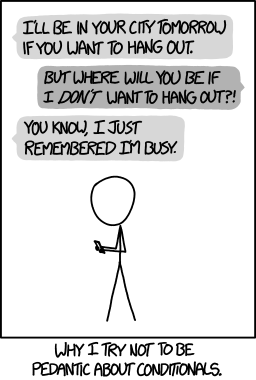
This interpretation is not just pedantry and not just a turn-off. It’s a callow mistake.

It’s callow because it transgresses standard expectations of interpersonal decency in conversation – if the other person is using a common turn of phrase and you understand what they mean, don’t be a dick about it (or, as I put it in a haiku for the ACES Grammar Day haiku contest, Which do you prefer: / keeping your friends’ grammar right / or keeping your friends?). But it’s also callow because it imposes an inappropriate misreading, the sort of simple-minded overbroad application of a rule that is characteristic of an immature understanding of grammar. The clause in question, you see, only looks like a conditional.

I’m put in mind of an anecdote I recall from the actor Simon Callow. When he was first trying to make it in theatre, he worked in the box office of a theatre. Later on, when he was becoming established as an actor, he was in the cast of a play that happened to be performing in the same theatre. One evening before a performance, one of the box office staff saw him and, thinking he still worked in the box office, asked him to come help with some box office function.

Thinking this if you want to hang out is a conditional is like thinking Simon Callow still works at the box office. It’s the same clause, but it’s been elevated. It’s a sentence adverbial.

In case the term isn’t familiar, a sentence adverbial is a word or phrase that, within the ambit of a verb phrase, could serve to modify the action of the verb, but that is instead applied to the entire sentence to frame it within a discursive context such as the attitude of the speaker or writer towards the utterance. “Frankly, Scarlett, I don’t give a damn” uses Frankly to mean ‘I speak to you frankly and say…’; “Among other things, this book explores the concept of silliness” uses Among other things to position the following statement within a larger possible set of observations (‘There are various things this book does; one of them is that…’); “Going forward, we’ll do it this way” uses Going forward to mean ‘I am making a prescription that applies to future instances when I say…’. They do not mean, respectively, that Rhett doesn’t give a damn frankly but he may give one covertly; that the book only explores silliness when the book is among other things; or that we will do it this way only when we are progressing ahead. And In case the term isn’t familiar doesn’t mean the preceding applies only in the case where the term is unfamiliar. It means I’m saying it in anticipation of the possibility of unfamiliarity.

Because sentence adverbials use words and phrases that can be used to different effect at lower levels, they are like candy to immature minds who are eager to pounce on other people’s “errors” to show their superior knowledge. But, as with so many rigid “rules” propounded by people who claim to care about grammar but really care mainly about demonstrating superiority, the “pedantic” interpretation is founded on a simple-minded misunderstanding. We have no difficulty understanding the sentences as they are intended – the pedants don’t even have the excuse that the box-office employee (who evidently didn’t read the programmes) had. The most they can argue is that the sentences are ambiguous. That can be something worth fixing, but it’s not a grammatical error. And they’re not always ambiguous, either. We usually understand them with no risk of confusion.

To add another analogy: When I was in New Zealand, I rented two different cars on separate occasions. In New Zealand they drive on the left, and so some of the driver’s controls are also the reverse of what I’m used to. With the first car, I managed to get used to the turn signal being on the opposite side from what I expected. Then when I rented the next car it was a model with the turn signal on the North American side. So I had to get used to it again and not keep turning on the wipers when I wanted to turn left or right. But in all of that, I did not say that the controls were wrong and I was right and stick to my preferred sides. I did not insist on turning on the wipers when I wanted to turn off the highway – or on signaling a turn when I wanted to wipe the windshield – because those were the correct sides for the controls to be on. I did what worked. When my expectations did not correspond with the results, I corrected my perspective. Which is what those who care about understanding language must do if they do not wish to be wrong.

So this pedantry is both a turn-off and a callow error.

Which, of course, Randall Munroe knows. He also knows that linguistics isn’t his area of expertise, and I’m not going to hold it against him for missing the analysis. He’s not the only one.


Sentence fragments? If you like.

As I sometimes do, I guested into a friend’s online copyediting course as a grammar expert for a week recently. One of the questions I answered was about whether “If you like” is acceptable on its own in any context. The questioner felt that in a conversational context it was acceptable (“Shall we leave at noon?” “If you like.”). Another student said that it doesn’t work because there’s an if but not a then. I said the following:

There are a few important things to remember.

First is that there are many kinds of English, suited for many different situations. To insist on standard formal English in all contexts is like wearing formal wear every day all the time. To use formal English in colloquial contexts doesn’t bespeak class and elegance; it bespeaks tone-deafness and rigidity. Rules are made to serve communication, not vice versa. Get to know the kind of English that is expected and used in each context you’re writing for. The point of editing is to make sure that the text produces the desired effect on the readers. Your job as an editor is to minimize the impedance in the circuit between author and audience. This often involves fixing infractions of rules, but not always. Indeed, sometimes the way to signal the tone of the text is to break a formal rule.

Second is that even in formal standard English, there are many things that are matters of preference, not rules.

Third is that not everything you do with language is a matter of grammar. Spelling mistakes, for instance, are not grammar errors. Neither are malapropisms. They’re errors, but they’re different kinds of errors (and in fact are the kind you can make sure to fix everywhere regardless of the tone and audience).

So, for instance, if as in “I want to know if you’re in town” is not a bad habit you need to cure yourself of for once and for all. The colloquial use of it where whether is the formal standard is very well established, and for some texts using if in place of whether will be the sort of little adjustment you can make to make it seem more relaxed. Bear in mind that “If you’re in town, I want to know” is acceptable even formally (the then can be and often is left out), which means that in the same sense, “I want to know if you’re in town” is also formally acceptable to mean “Let me know in the case that you are in town.” This, I believe, is why it has come to be used in the other sense, “Let me know whether you are in town or not.”

A very common mistake made by people who are eager to be right about grammar is to infer an absolute rule from one case, or to take a rule as learned overtly and apply it too broadly, declaring many common usages to be wrong because they don’t fit it. This is like pulling out a field guide to birds, looking at the picture of a magpie, deciding that all magpies must exactly resemble the exact specific colouring of that picture, and declaring any that don’t not to be magpies (and perhaps repainting or just killing them).

The effective approach is to read widely, see what kind of usages are common in what kind of contexts, and figure out the real rules on that basis. Often the real rule is not so simple and clean-cut; some things that are perfectly standard formal English still provoke arguments among linguists as to their actual grammatical structure.

To address a specific question: “If you like” by itself is a “sentence fragment” because it uses a subordinating conjunction (“If”) without a main clause to be subordinate to. But that doesn’t mean it can’t be used; we use sentence fragments all the time (I won’t say “The more, the merrier,” but if I did, it wouldn’t have a verb!). Only in the starchiest of contexts is it necessary to avoid starting sentences with conjunctions such as But and And, and in those cases only because some people in the past decided to repaint the magpies. In conversation, it is quite normal to leave out established material, especially in responses: “Shall I join you?” “[You can join me] If you like.” In more formal texts, where it is a monologue, not a dialogue, and is expected to convey clearly the logical connection, you would just use a single full sentence: “You can join me if you like.” (I’m not going to wander into the can/may argument here, but here is a full article on things many people think are errors that aren’t: sesquiotic.wordpress.com/2008/12/04/when-an-error-isnt/)

An important step on the way to being an expert user of the language is to read authors you respect in as many different genres as possible. Learning cut-and-dried rules and trying to apply them as broadly as possible won’t make you an expert user; in fact, you risk destroying your ear for the language. You need to be able to hear and read it as your readers will. You won’t be in a position to give them lessons in how to hear it the way you’ve learned to.

None of it is true, and none of them are right

One of the more popular grammar superstitions is that none must always only be singular. This belief has less basis and produces more awkward results than the idea that you should never step on cracks in the sidewalk, but it persists, even though if you Google none is none are you will get a full page of authoritative sites, none of which supports it.

None of which support it. Not one of which supports it.

Ah, and there’s the thing: those who spread this bit of syntactic spit-over-the-shoulder support it with the contention that none is short for not one or no one. Since you would say no one agrees or not one of them agrees, you should – they counsel – say none agrees and none of them agrees.

Even if the supposed derivation were true, it wouldn’t matter: etymology is not a guide to current usage. Even words that have their current form due to a historical mistake still aren’t guided by the pre-mistake usage – although peas was a reanalysis of pease, which was singular, we can’t now say The peas is ready. (Well, not in standard English, anyway.) But none isn’t a contraction of no one or not one.

OK, to be fair, back in the mists of time it came from a root meaning ‘not’ and a root meaning ‘one’ or ‘any’. But by the time there was an English, it was already one word, nan or non, and it was already being used with plural as well as singular referents.

And there’s the important thing: you can use it with the singular. Of course you can. It’s the less common usage – when we want the singular we are more likely to say no one or not one – but it’s entirely available. You can even use the conjugation to make a subtle differentiation: “We expected deer, but none have arrived”; “We expected deer, but none has arrived.” (The former sentence might be spoken in a park, the latter perhaps in a restaurant.)

Given that every authoritative, learned source you can find will tell you that none can be singular or plural – and given that anyone well read in English knows it by reflex – how is it that so many people insist on this mumpsimus? Most likely just because it was enshrined in one book that remains popular, even though it is inconsistent, self-contradictory, and prone to declaring many of the most revered authors in the language to be wrong.

The book in question is The Elements of Style by Strunk and White. If you want to know why people who know English syntax well tend not to be so fond of it, read Geoffrey Pullum’s “50 Years of Stupid Grammar Advice.” Pullum notes that on the matter of plural none, Strunk and White place themselves above Oscar Wilde, Bram Stoker, and Lucy Maude Montgomery.

They also place themselves above John Dryden (himself no wild descriptivist), Henry Fielding, Oliver Goldsmith, and Somerset Maugham – and that’s just in the short list of citations in the Oxford English Dictionary. I particularly like these two illustrative quotations presented by the OED:

None are more ignorant of them than those learned Pedants…
Tom Jones, Henry Fielding

There are none so deaf as those who will not hear the truth.
The Times, March 4, 1963

So trust your ear, and ignore those who self-deafen with this superstitious hypercorrection. None of them is right.

Time to learn about copulation

Some people really screw up their grammar. They do it by trying too hard and by misanalysing what’s going on – they’ve learned a few simple rules and don’t know the fuller facts of language, because no one told them about copulation… or resultatives or substantives.

Well, time to find out. Here’s my latest article for The Week:

What we talk about when we talk about (word) copulation


Whom do you believe?

Originally published on The Editors’ Weekly, blog.editors.ca

First of all: If you can avoid using whom, you should. Any but the most formal texts are better off without it; it’s a foreign word for most users, as evidenced by the general inability of even many language professionals to use it quite correctly all the time.

Sometimes, however, you have to use it. The text demands it. When you do, you may be faced with a choice between two voices in your head – the one who says what you would say without thinking too hard about, and the one who says what you would say if you did think too hard about it. Whom do you believe? More to the point, who do you believe is right?

As a general rule, believe the first one. That’s the one that won’t tell you to use “Whom do you believe is right?”

Is that whom wrong? You bet it is. It’s also an error many people make. Here’s what’s wrong and how to avoid it – and similar misadventures.

The key is this: Always look for a subject for every conjugated verb.

We know (I hope) that whom is for the object and who is for the subject (and, if you don’t use whom, who is for the object too). We also know that when we ask a question or make a relative clause, the subject or object of the verb is at the start of the clause:

She is right.

Who is right?

She tickled him.

Whom did she tickle?

A woman knows her grammar.

She’s a woman who knows her grammar.

She tickles him.

He’s a man whom she tickles.

In each of the above sentences, all subjects are in small caps, all conjugated verbs are underlined, and all objects are in bold. Not all verbs have objects, but they all have subjects. In some sentence a single subject has two verbs – “He baked a cake and iced it nicely.” But unless the verb is an imperative, there has to be an explicit subject. And if that subject is the interrogative or relative pronoun, it has to be who, not whom. So:

Who do you believe is right?

Who is the subject of is. And you is the subject of do (which is the auxiliary for the infinitive believe). If you make who into whom, you don’t have a subject for is.

This throws people off because they see “do you believe” and think, well, it has to have an object. “Whom do you believe” is correct, after all.

But when it’s “…believe is right,” it’s not the same. You say “I believe him” but not “I believe him is right” because the clause “he is right” is the object of believe, and within it he is the subject of is. We get tripped up because the subject and object raise to the same position (I’ve added brackets to separate the clauses):

I believe [she tickled him].

[Who] do I believe [tickled him]?

[Whom] do I believe [she tickled]?

The key, as I said, is to make sure you have a subject for every verb. Or avoid using whom altogether. And when you are faced with those voices, ask yourself: Whom do you believe? And [who] do you believe [is right]?

A podcast we made, yes

My recent article on the syntax of Yoda-speak has been made into a podcast. If you’d like to hear me do a half-assed impression of Yoda, and/or if you would like to hear movie sound clips to illustrate the points, give it a listen:

Why so strangely Yoda speaks

Infixes? Absofreakinglutely… not.

The tools of linguistics are like a fancy set of lock-picking tools, different ones suited to different locks. Some locks are hard to pick and linguists try a few different tools, proclaiming varying amounts of success in the effort. Sometimes you may want to conclude that a new tool is needed. One case that’s given a lot of fun in the attempt is the case of words such as abso-freaking-lutely. What, exactly, is taking place, morphosyntactically? Or is morphosyntax even the right way to look at it?

Well, here’s what I think, in my latest article for The Week:

Why linguists freak out about ‘absofreakinglutely’

They don’t even really know what to call it

Strong with the fronting Master Yoda is

One of the great classic topics in linguistics is… the syntax of Yoda’s speech. What’s up with the way he talks? What are the characteristics of his syntax? It’s not universally agreed on… or even galactically. But there’s something interesting you might want to know about the language he speaks. I tell you in my latest article for TheWeek.com:

Why so strangely Yoda speaks

For the interested, here are some more linguistic looks at Yoda-speak:


Are you a fan of its?

Sometimes editors (and others) wonder what the difference is between, say, “He’s not a fan of Cher” and “He’s not a fan of Cher’s.” Is there a distinction? Is it equally important in all instances?

There is a distinction: it’s between possession and association. In some cases it’s the same thing; in others, quite different. “A picture of Mr. Goldfine” is not a picture belonging to Mr. Goldfine but a picture depicting him; “A picture of Mr. Goldfine’s” is a picture belonging to him. (“Mr. Goldfine’s picture” can mean either because we use the “possessive” for both possession and association.)

When you talk about fandom, there is again the possible distinction between association and possession, but in that case it really refers to the same thing, just from a slightly different angle. “A fan of Cher’s” is the same as “a fan of Cher” but in the “Cher’s” case it gives a sense of there being a collection of fans belong to Cher, as opposed to it being simply an attitude on the part of the fan.

It also follows that because running in the rain is a kind of action, not an entity that can possess, “A fan of running in the rain’s” is odd.

English pronouns are more archaic than the rest of English; they preserve case distinctions that have been lost everywhere else, mainly because they’re so entrenched and we used them automatically by habit and without analysis. In cases such as this, a distinction can be made with them when there is a real distinction to be made: “A picture of him”; “A picture of his.” In instances where the distinction is not a significant one, we may hew to the older construction, which in this case uses the genitive because that was the case governed by this construction: “A fan of his” may seem more natural than “A fan of him” (though this will vary from speaker to speaker). (Languages that have full and productive cases systems for nouns tend to use different cases after different prepositions and depending on context; German and Latin are two languages that do this. Old English was another.) Note, however, that the association/possession distinction still matters: “I am not a fan of it” is fine; “I am not a fan of its” is probably not.

Seriously, what’s the problem with sentence adverbs?

Originally published on The Editors’ Weekly

The English language is a very complex and powerful thing, capable of many nuances and quite resistant to simplistic attempts at tidying it up. Sadly, not everyone realizes that. Worse still, many people take very narrow and inconsistent views, focusing on pet peeves while letting parallel instances of usage pass unnoticed. It’s as though a self-trained self-appointed “master chef” opened a cooking school and taught, among other things, that salt and anything containing sodium can only be used in savoury dishes, never in desserts. The cakes may all be horrible and heavy and the puddings insipid, but goshdarn it, they’re culinarily correct!

Adverbs give us a good example of this. “An adverb modifies a verb,” some people say, “so it must always directly modify the main verb of the sentence. If someone says ‘Hopefully, they will be here tomorrow,’ it can only mean that their presence here will be hopeful.” And yet the same people will not be seen declaring that “Seriously, it will be very amusing” must mean that it will be amusing in a serious manner, or that “Frankly, you’re being evasive” must mean that your evasiveness is frank, or that “Clearly, someone has muddied the water” must mean that the water has been muddied in a clear manner.

If the “hopefully” peevers were to take note of how these other sentence adverbs function – using the adverb to give an attitude or setting for the entire sentence – they would be forced to allow the same role for hopefully… or perhaps they would decide that all those uses must be wrong, well established though they are (some date from the 1600s). But let’s say they allowed them. The next thing the forced-tidying mind might do – like the robot maid tossing out both the cat and the master of the house – is decide that only single-word adverbs can fill this role. Never mind that one may modify the action of a verb with prepositional phrases and participles; they’re not adverbs, so (the reasoning might go) they can’t be used as sentence adverbs. Sure, you can say “Hypothetically, he could resolve it with a clear statement of fact,” but you must not say “Speaking hypothetically, he could resolve it with a clear statement of fact”…!

Now, of course, there’s a perfectly good reason not to use the latter sentence – it has an ambiguity that could make the reader snicker (I like to say such sentences have a high SQ, or snicker quotient) – but ambiguity (and high SQ) is not the same thing as grammatical error. There are many instances of prepositional phrases, participles, and infinitives being used to set the scene for a sentence: “To give an example, he is disinclined to use illustrations”; “Going forward, all cars on the ferry must have their parking brakes on”; “Among other things, it is located on an empty treeless plain”; and so on. These do not generally raise the ire of the particular – although some can be awkward – and they are not ungrammatical.

Hopefully, as editors, we have eyes more finely tuned to such structures and can discern the many places and cases of their use. Going forward, I would like to suggest that we all keep our eyes open for every instance where an adverbial construction of any sort is used to give a setting for the entire action of a sentence rather than to modify the main verb directly – and, if we dislike it, ask ourselves whether it is truly ungrammatical or simply ambiguous. You may find yourself having to come to some surprising and possibly discomfiting conclusions.
