Tag Archives: word tasting notes

nephelibate

“What does nephelibate mean?”

Aina was reading Mario Vargas Llosa’s In Praise of the Stepmother, translated by Helen Lane. On page 95 of that festival of sensual words she found this: “And he remembered José María Eguren, the slender nephelibate poet who, regarding the Spanish word nariz as being phonetically vulgar, gallicized it and called it nez in his poems.”

I had to admit I didn’t know what nephelibate meant. In fact, I didn’t think I’d even ever seen or heard the word before.

As it happens, nephelibate isn’t on dictionary.com either, or m-w.com, or even in the Oxford English Dictionary. But I turned to the great cloud mind of Google and found a page in French that gave a definition. The word also exists in Spanish and Portuguese, spelling differing as appropriate. A bit of an infraction, don’t you think, for a translator to use word that’s a direct borrowing from another language and doesn’t have a dictionary entry in the language you’re translating into?

But of course this is English. That’s a thing we do.

But what did this word mean? Did it have to do with nephews, or kidneys (that root is nephr as in nephritis), or a nefarious Nefertiti, with some kind of philia, with celibate or libation, with phlebotomy or something flabby, infallible, or inflatable? Given the title of the book, could it be some converse to novercal (‘of or relating to a stepmother’)? It starts soft with the /n/ and becomes softer with the /f/ (puffed with a classical breath by the ph spelling) but then hardens with /b/ and comes to a point at /t/. It’s like a down pillow with a hard cube in the middle. Or a cloud that will send down ice.

The obliging web page I found that first gave me the definition in French was on the blog Le Lorgnon mélancolique, and here is a translation of what it says (you will find this same definition also in wiktionary in Portuguese for nefelibata): “Nephelibate: who lives in the clouds; said of an excessively idealistic person, who flees reality, also of a writer who doesn’t follow literary rules. From Greek nephelê (‘cloud’) and batein (‘walk’), the term seems to have been invented by Rabelais in the fourth book of Pantagruel.”

Ah, François Rabelais, the 16th-century French author who gave us gargantuan, agelast, and thelemite, among others. He used the word Nephelibate just to name a particular fictitious nation. But its roots made it handy and it persisted. A cloud-liver! Sky-walker! Someone whose head is in cloudcuckooland, who simply can’t be brought down to earth! A fantastic rule-breaking poet or prose writer! Perhaps someone who invents new words, or borrows words whole-cloth from other languages without so much as explaining them. Or, of course, someone who insists on using a French word because he does not like the word available in his own language.

The image that comes to me is of The Beatles’ fool on the hill: “Well on the way, head in a cloud, the man of a thousand voices talking perfectly loud, but nobody ever hears him or the sound he appears to make, and he never seems to notice, but the fool on the hill sees the sun going down, and the eyes in his head see the world spinning ’round.” Oddly, that also seems to describe life in a high-rise apartment such as the one I’m sitting in right now…

cancan

I wore my Toulouse-Lautrec tie today, with its picture of La Goulue doing the cancan. Why? Because I can. And my wife asked me to.

I am going to tie that together with this:

Several years ago, on a web forum, a commenter responded to a posted picture with “What is this I don’t even.” It represented tidily the complete failure of words in the face of something so…

Anyway, it became a common phrase in comments on things; sometimes you would see strings of several of them in response to each other (the obvious spoor of adolescent males). Over time it morphed to “I can’t even.”

But wait, there’s more. One thing that many on teh interwebz glory in is breaking English. Why not have fun with language by committing grammatical infractions? Bending syntax the wrong way, disfiguring morphology? The categorical requirements of verbs just beg to be tweaked on the nose. Because fun! Very amuse. And one of those sets of rules that have long been waiting to be given a wedgie is the one that applies to modal auxiliaries. You know, can, may, shall, and so on. They attach to an infinitive verb without using to and you can’t use them as main verbs, infinitives, or participles. There is no “I want to may” or “I shall English” or “I have canned it” (well, that last one will be taken to refer to putting something in a cylindrical metal container).

So. “I can’t even”? How about “I have lost all ability to can even”? Hee hee. An article that covers this rather nicely is “Your Ability to Can Even: A Defense of Internet Linguistics.”

So if I am able to be able, can I say “I can can”? Ah! To some people that desecration of grammar would be scandalous! Like exposing its undergarments publicly! They would get very exercised about it. Even though it’s really a canard.

A canard? Quack quack – canard is French for ‘duck’. And a word that seems to have been derived from that is the childish reduplication cancan, a French word for a scandal. A fast and energetic quadrille with leaps and leg kicks and whirls came to get this name, because it was shocking and really not proper. It’s not that people were exposing their undergarments – not at first, anyway; indeed, it was sometimes done by individual males. But it was quite improper.

Which meant if you got women to do it, and do it so that they were exposing their many layers of frilly underwear, you could get men to pay to watch it. You could could. They would dance it to such pieces as the galope infernal from Offenbach’s Orpheus in the Underwear. I mean Underworld. It became popular at places such as the Moulin Rouge, danced by chorus lines and by star performers such as La Goulue, who would flip up her skirt and show an embroidered heart on her can.

Of course, the prudes of the era couldn’t even. They were fit to be tied. It was too loose, Lautrec! But the dancers wouldwould and diddid, and even today, you maymay go to the Moulin Rouge and they willwill. Because they cancan.

cilantro

As I mentioned yesterday, I like coriander, and the word coriander, and the word cilantro, but cilantro itself not as much.

And yes, I know that coriander and cilantro are the same plant. Here in North America among Anglophones, it is usual for cilantro to refer to the leaves and coriander to the seeds.

So you would think that, coming from the same plant, they would taste about the same, right? Well. You would think that, coming from the same Latin (and Greek) root, coriander and cilantro would be about the same word, wouldn’t you, but they’re as different as the things they name: there’s a resemblance, but there are obvious differences.

The origin of these two words is Greek κορίαννον koriannon, which became Latin coriandrum. But then, just as one part of a plant becomes a leaf and another a seed, the word became two words – because of dissimilation: since there’s another /r/ later in the word, the first /r/ became (for some speakers) /l/. So we got a variant word, coliandrum. And that changed a bit more when taken into Spanish: the /um/ into /o/, which is the standard development from Latin into Spanish and Italian, and the /d/ into /t/, the /o/ into /u/, and the /i/ dropped – probably for ease of articulation. Thus culantro. And that further changed, through processes unclear to me, into cilantro.

So you have on the one hand coriander, with a hard /k/ at the start and hollow /ɔ/ and /ri/ rolling in the middle, and a /dr/ on the end (because French converted drum into dre and we got it from them and changed it a little), and on the other hand cilantro, with soft /s/ and narrow /ɪ/ (or narrower /i/ in Spanish) and liquid /l/ and final /tro/. The /æn/ at the heart stays the same. So cilantro is soft at the start like a leaf, but crisper and rolling at the end, while coriander is harder at the start and then rolls all through like a seed on the tongue. And cilantro gives us resonances of silly and cilia and supercilious and slant and Elantra and entropy and el centro. It’s a more Spanish sound.

Is it a more Spanish taste? Certainly fresh cilantro is a central salsa savoury. And I don’t mind it so much in that context as long as it’s not overdone. But cook it into a soup and it becomes soapy. I do like a nice bowl of pho, that Vietnamese specialty, but when I hit a soggy limp cilantro leaf in it, well, that’s never the high point. But different people have different tastes.

Anyway, unlike coriander, cilantro does not open a door in the hall of memories for me. And nothing gives a word flavour like your own personal memories.

coriander

I like coriander, and I like the word coriander. I’m fine with the word cilantro too, although I’m not too keen on cilantro.

Yes, I know that coriander and cilantro are the same plant. Here in North America among Anglophones, it is usual for cilantro to refer to the leaves and coriander to the seeds. And it is the seeds that I generally fancy more. The flavour is nice enough, and it brings back memories.

Coriander was the name of a natural food store in the Sundance Mall in Banff – on the upper floor, which you had to take an elevator or an unprepossessing staircase to get to. It smelled like a natural food store. Like all natural food stores smell: an impossibly complex olfactory mud of hundreds of spices and whole grains and sprouted grains and nuts and beans and seeds and leaves and things you only eat because they’re good for you and some things you’d eat anyway. You could get a peanut butter and banana sandwich at Coriander made with thick-cut whole-grain bread, chunks of banana, and dense peanut butter that had been made right there and was no so much spread on the bread as impressed upon it a centimetre or two thick. You could also buy any of quite a few Celestial Seasonings teas – that was where I first met the brand (I still have at least one bag of something of theirs most days of the week, although it has been years since I had any of their famous Sleepytime tea, their big breakthrough blend). You could also have soup and all those other things that natural food places make. To be perfectly honest, I am not at all sure that I ever had anything there that had coriander in it. But coriander was undoubtedly one of the myriad components of that smell that wrapped the premises.

That store is the first place and thing I associate with coriander. I may well have encountered the spice by name before, though. I certainly used it in cooking every so often once I was cooking every so often. It was one of the ingredients I used in the nasi goreng I used to like to make. I still have a jar of it on my spice rack, but I must confess I don’t use as much of it as I used to.

The other thing that coriander makes me think of is Calvin and Hobbes, which to my mind is the best comic strip ever, and I’m generally not a person who chooses single bests or favourites. The connection is that Calvin’s favourite book was Hamster Huey and the Gooey Kablooie, and its sequel was Commander Coriander Salamander and ’er Singlehander Bellylander.

Coriander has some interesting flavours as a word: all those words starting with cori or similar such as coryphaeus, coryza, and anyone you know named Corey; there’s also a core of cor words, though chorus, corpus, and court are as faint as the hint of carob in the smell at Coriander; there are also ander words such as Alexander, salamander, philander, commander, and so on; and I find a variable echo of words that hinge on ri such as variant, orient, euphoria, aerial, teriyaki, and so on. It’s all there, but you may not pick out invidual subtle smells behind a few dominant ones.

I think coriander is a good word for the spice. The spice seems suited to the air of the natural food store, and the natural food store seemed suited to the word, with its late-blooming flower child sensibility and its whole-spice and grainy or seedlike image. Of course the word is much older than flower children. It comes from Latin coriandrum, from Greek κορίαννον koriannon (where Greek got it from is a conundrum). English has had the word since the 1300s at least.

The word cilantro also comes from the same root, as of course does what it names. But I’ll leave that for tomorrow.

mischievous

I’d like you all to meet Miss Chievous.
She’s got a lot of fun to give us.
With eyes so wiley and mouth so devious,
She’ll trick you to thinking she’s Miss Chievious
(She isn’t now, though you should know
She had that name centuries ago).
She’s a little imp, a sylph, a sprite,
A naughty mistress of delight;
When it comes to fun that could end in grief,
She’s the boss-girl – she’s Miss Chief.
It’s Friday evening and you’re bored stiff?
Just wave a little handkerchief,
Put on your tail coat and your waistcoat –
Or kevlar vest, and grab your mess kit –
Her boat to fun’s docked at the quay.
She’ll teach you to be wild and free!
She’ll have you dangling on a gunwale
Quaffing Cognac with a funnel,
Held inverted by a boatswain
Mostly naked till half frozen;
Sneaking peaks and stealing victuals –
Blancmanges and peanut brittles,
Caesars spiked with sauce from Worcester –
Then she’ll say, “Come meet my sister.”
If your tongue is free from injury,
Just wait till she comes out in… lingerie!
For that’s how she breeds fascination:
She ever foils your expectation.
If you make your chief Miss Chief,
You’ll end up hanging from a cliff
And see Miss Chievous just above it…
But mark my words, boy, you will love it.

I encourage you to read this through for yourself first. But you may thereafter watch this video of me reading it, if you wish:

macramé

Sound is a thread, a string, a cord, pulling you along or pulling time out of you. The individual vowels and consonants are knots. Tie them together in this pattern and that and soon you have a recognizable word, a set of words, a pattern of thought expressed, a meaning. Perhaps a memory.

A memory, say, of a house full of plants, and forest-pattern wallpaper, and brown ceramics and bubbling orange and white glass. And hemp, plenty of hemp. Ropes, cords, strings, knotted, hanging, decorated with wooden beads. Plants hanging in pots made of knots. Wall decorations in brown rope and green wooden beads. Perhaps a purse or other bag made of naught but knotted knots in abstract patterns. Maybe a belt or two. A hammock? Perhaps not. Not thin strings knotted, not tatting or knitting, nothing micro; this is macro: macramé.

Yes, it was a thing of its time, macramé. Not that it was a never-before-seen craze in the 1970s and early ’80s. Indeed, it had been big in Victorian times, and has been around much longer than that, on the fringes. But the cord of my memory does not pull nearly so far back. For me, this knotty pattern of four consonants and three vowels speaks clearly of my early adolescence.

And it is a word with a certain mouthfeel. Twice soft on the lips, and in between textured by the /kr/, and afterwards simply gliding away. Somehow it tastes of granola, although at that age I ate Mini-Wheats. Is it macrobiotic? It sounds like macaroon or macaroni, but with that French-like é on the end. I do not get a real Scottish flavour in spite of the mac. Indeed, I sooner taste caramel. Or perhaps a blend of tumeric and cumin?

If this somehow seems Arabic, you have gotten to the spool of this cord. The source is migramah, ‘striped cloth’; it was borrowed to Turkish makrama ‘towel, napkin’. It happens that woven cloths would often have the loose strings knotted into tasselled fringes, and in Italian this knotted fringe came to be called macramè. The knotting craft itself came to be what we called macramé in English, reversing the direction of the written accent to follow our more accustomed practice.

We also called it macramé lace more fully. Sailors did this handicraft, making belts and hammocks, and – through a rearrangement of the knots of this word – sometimes called it McNamara’s lace.

Yes, rough and hardy sailors, so different from my sweet, crafting mother. I’m sure the taste of this word would be different for me if I knew it first from the navy. But that is not where these knots are tied for me. The plant of this memory is suspended from the ceiling of my mind in the macramé planter holder of this word, and the plant is a house, a time, a place, a feel, a mother, and a lot of brown cord, tied and, once tied, not undone.

kwashiorkor

She was a pretty blonde with dreadlocks and a strict vegan diet. He was a cherubic guy guy who had always liked a double cheeseburger… until she came to work for us. All of a sudden he was ordering the vegan entrées when we went out for lunch, and we all knew why.

And I thought, “Dude. Watch out for kwashiorkor.”

No, kwashiorkor isn’t a sexually transmitted disease. It’s also not some nasty protector demon that keeps vegans safe from poseurs. And it wasn’t the name of her boyfriend.

To be fair, it also wasn’t a real risk for him, even if he went whole hog – I mean whole soy. Because, after all, there are proteinaceous vegan foods, and kwashiorkor is a disease of severe protein deficiency. Vitamin deficiencies and anemia are a much greater risk for vegans, and they generally address them with supplements.

But kwashiorkor is such a nasty-sounding thing, how could I resist thinking of it? It’s nasty-looking and nasty-feeling too. It sort of sounds like “squash your core,” but while this disease of protein deprivation emaciates parts of the body, it causes swelling of the hands, feet, and belly. Yes, this is “famine baby” disease. You’ve seen children affected with it in various appeal commercials for African famine relief, although it can affect children deprived of protein anywhere.

Given the association with Africa, though, it’s unsurprising that this is a word borrowed from Africa. It comes from the Ga language of Ghana. The word refers to the condition of a baby when a newer baby comes – no more breast milk.

The way we in North America say this word makes it sound like something truly dark, like the distorted whisperings of swirling spirits. But actually the word in Ga is kwašiɔkɔ – those open o’s are the vowel we say before the /r/ in or… and the entire sound that someone with an r-less British accent makes for or. So if you say kwashiorkor with a British accent you’ve got it pretty much right. And in that pronunciation it sounds not so much dark as hollow.

Hollow like the prospects of my co-worker. I don’t know if he really could have swapped meat for her permanently. But he didn’t get the chance. What came in the way? Not a vegan protector demon. Just her boyfriend.

gruelling

As I ground around the curve into the industrial corner of downtown, just me and dozens of my closest strangers, the gas in my tank started to burble and burp down to fumes, and my legs began to grow little crystals in them that within the half hour would harden into pain diamonds and grow branches. Ten kilometres to go, thirty-two gone. The air going in and out of my lungs started to acquire a weight. Three hours running, three hours ten, three hours twenty. My legs contracted were forgetting how to expand, expanded were forgetting how to contract. Hit the wall? What wall? There was no wall, just a tall-grass glade growing knives and glass. The elevated freeway was above me, and I was carrying it on my shoulders. I turned the corner and I knew. I knew I was in so much pain a sensible person would stop and hail a passing ambulance. And therefore the only thing I could do was run. I had been running three and a half hours, and had run through fresh cool air down into an uncertain valley and now was in a dense cloud forest of stings and burns. I could not not finish. My legs wept, begged, pleaded to walk, to stop, to be folded up and stuffed into the nearest garbage bin. I could not walk. If I walked I would never run again. I needed this to be over. As soon as possible. And the only way to do that was to run. Run up that slow hill for twenty minutes more, run while the crowds cheered, run while other runners streamed past me, run while everything that moved trailed smearing lines of blood and mud and coloured smoke, run up and around the park, run down into that funneling gate and at last, delirious, soaked in the endorphins that come to make war with pain, stop, stumble stop, walk like a rusted robot. Lean the head and receive the finisher’s medal. Delirious, eat a banana. Five minutes after swearing I had never suffered so much, work out when I might do it again.

Gruelling? Yes, that’s a good word for the last ten kilometres of your first marathon.

Gruelling because cruel. Gruelling because gruesome. Gruelling because lingering. Gruelling because grinding. Gruelling because reducing reality to a thin strained gruel. Gruelling because hard like a rule. Gruelling because punishing.

Gruelling. The word grips, grabs, grasps, grunts. The lips purse into a moue: “oo.” The tongue licks and retreats to the velum.

And yet gruelling is glorifying. Glorifying suffering, punishment, overwork: a gruelling schedule or a gruelling workout is something to be admired, to be aspired to. To endure something gruelling is a true test of character. To last a marathon. To endure through the muggy hot night of my first 30-kilometre race a month and a half earlier, stumbling dehydrated along a path, mouthing “help” in desperation, then knowing that help could be had only two kilometres further on at the finish, and making it there so soaked in sweat that I could have been dunked in the Dead Sea, and absorbing two litres of water and sports beverage just to return to normal. And the next year going back, Jack, and doing it again. Gruelling is doing sprint intervals until your body rings the same alarms you feel when you’ve held your breath for two minutes. Gruelling is doing hill repeats until your lungs burn like a furnace for firing ceramics. Gruelling is pain endured at length. Does pain make you a better person? I don’t know, but coming through it makes you feel like a better one.

Watch the Olympics. There are many amazing feats of strength, skill, and danger. Every second of it earns respect. All of those people have endured gruelling training, torture designed with scientific precision, far more than I have ever endured. But do you know what I like watching the best? The finish lines of the long-distance cross-country ski races. Three metres past the red line, the skiers simply fall into the snow and lie there panting, spent like a twenty at a Saturday sale, letting the cool of the snow soothe the salamander flames of their muscles. Gruelling.

What has such punishing exertion to do with gruel? Gruel (from Old French, from medieval Latin grutellum, from a Germanic root for fine flour) was a light liquid food fed to invalids. From that, the phrase get your gruel came to mean ‘receive punishment’ or ‘be killed’. And so the verb gruel came to mean ‘punish’ or ‘exhaust’ or ‘disable’, and from that came gruelling, also spelled grueling. It is not related to gruesome, which comes from grue ‘shudder in horror, shrink away in terror, tremble’. Well, it is not etymologically related. The sound similarity may or may not have a phonaesthetic basis. I feel quite sure that our modern usage of gruelling is conditioned by what it sounds and feels like.

Not everyone likes a gruelling workout. I can come up with only one explanation for this: those who do not like it have not discovered the thrill and mastery of inflicting pain. On themselves.

library

Every word is a library. It speaks volumes of ideas, experiences, and desires. We each furnish our own library for a word – standard references for all, but the novels, the histories, the philosophies, the biographies, will be different from person to person. The architecture too.

Library. That’s a word to illustrate this. For many people, library conjures images of institutional edifices, cold and stone or tiled and metal, quiet places – perhaps too quiet – with rules and shushes and librarians who may be stern or hot, and any enjoyment to be had is from hanky-panky between the shelves.

Not for me. For me, library evokes a place of comfort, a warm building lined with thousands of doors to other worlds, a place in whose liberating embrace I may lie buried in literature, ideas, images, explorations. The very feel of the word warms me, the [r] and [r] rolling on the tongue like pages leafing past – a favoured form of R and R for me. The liquid [l] is soothing like a babbling brook or enveloping book. The [b] is hard but not hard hard, just hard like a hard cover on a book. The first vowel sound, [aɪ], is like a sigh or the eye that reads. The word ends in the sound of airy, and for me a library is a more infinite space than the open air. It is not a cocoon; cocoons are made to be burst out of and left behind. A library is a mind, a mind of paper that records all its explorations for re-experiencing. It is an interior that as as large as all outside and beyond.

Let me tell you a little of some libraries I have known.

One of my favourite childhood places was the Banff public library. At the time, it was housed in the same building as the Whyte Gallery; it occupied the upper floor, the gallery the lower. The building is still there – now entirely gallery and museum, with the new library next door. It is a heavy stone and timber building in the best Canadian mountain national park style. I recall a large room, wide and long with a high beamed ceiling, shelves to adult waist height at the walls and in standing ranks above eye level, and wooden tables in the middle. In one corner near the circulation desk was the children’s section, supplied with a complete collection of Berenstain Bears books plus an orange shag rug in kidney shape that had some thickness and seemed to be filled with gel or water, perfect for literary pronation. We would be greeted at the building door by a pleasant older lady at the desk; my favourite was Mrs. Shandruck, whose husband would pick her up in a Studebaker. In my Sunday afternoon visits I would peruse books of house plans (I fancied becoming an architect), theses on music (one book asserted that if you entered a room in the middle of a note you couldn’t identify the note), gnostic gospels, alternative orthographies, and picture-full books on history and flying and skiing. In the reference room I conceived a desire, fulfilled many years later, to ski at Stowe. In the lower level, tea could be had on Sunday afternoons, and art seen in many styles and forms; my favourite show was an amusing ensemble piece about an imagined nook of the Rockies: Beyond Exceptional Pass. It came with a thin floppy book, bought by my father and, two decades later, permanently borrowed away by me.

Another library I remember spread along a wall facing a fireplace and, past a glass door, climbed up a nook next to the fireplace as well. It had some two thousand books; I counted them once. It opened doors to me on linguistics and Tolkien and Zen Buddhism. It had as well, on a separate shelf, an Encyclopedia Britannica and an older World Book set, my favourite thing to read – an art gallery of the mind and the world. There was also a stereo with a library of vinyl, including a multi-disk collection of Gregorian chants and a two-disk concert of Ravi Shankar and Ali Akbar Khan, great music for reading and thinking. To reach this library I simply descended a spiral staircase from our family room. It was not a public place – there were none of those overheard whispered conversations by strangers, sounds that to this day stroke my skin and soothe me like petting a cat. I had no people to ignore, other than my brother and parents, who could be importunate and were too familiar to be decoration. But it was a likable retreat no less.

There were school libraries, shelves full of books new and old, books that opened to me the 1920s and PG Wodehouse and jackdaws, medical diagnosis and handwriting analysis and Frank Herbert. There were university libraries: The twelve-storey tower at the University of Calgary, which I first visited with my parents in my younger years and learned about how to mislead with statistics and what John Cage’s scores looked like and what photocopiers smelled like and how to read microfiches on transit projects. The Wessell Library at Tufts, expanded and renamed Tisch during my time there, with its study rooms and its rows of stacks that I got to know so well I remembered books by location, including one twine-tied seventeenth-century book with a slip in it on which each person who peeked into it wrote the last time it had been opened; I retreated to that library after dinner every night during my first year of grad school and the sight of bookshelves gained a Pavlovian stimulus association with the functions of digestion. The music library at Tufts, a basement room with a collection of CDs that I listened to while studying, music from every corner of the world. The Robarts library at the University of Toronto, a massive triangular brutalist block which Marcel Danesi has told me was the inspiration for the library in Umberto Eco’s Name of the Rose (Eco was a visiting scholar while writing it). The tiny imperfect modernist Frost Library at Glendon College. The bookshops I have worked in.

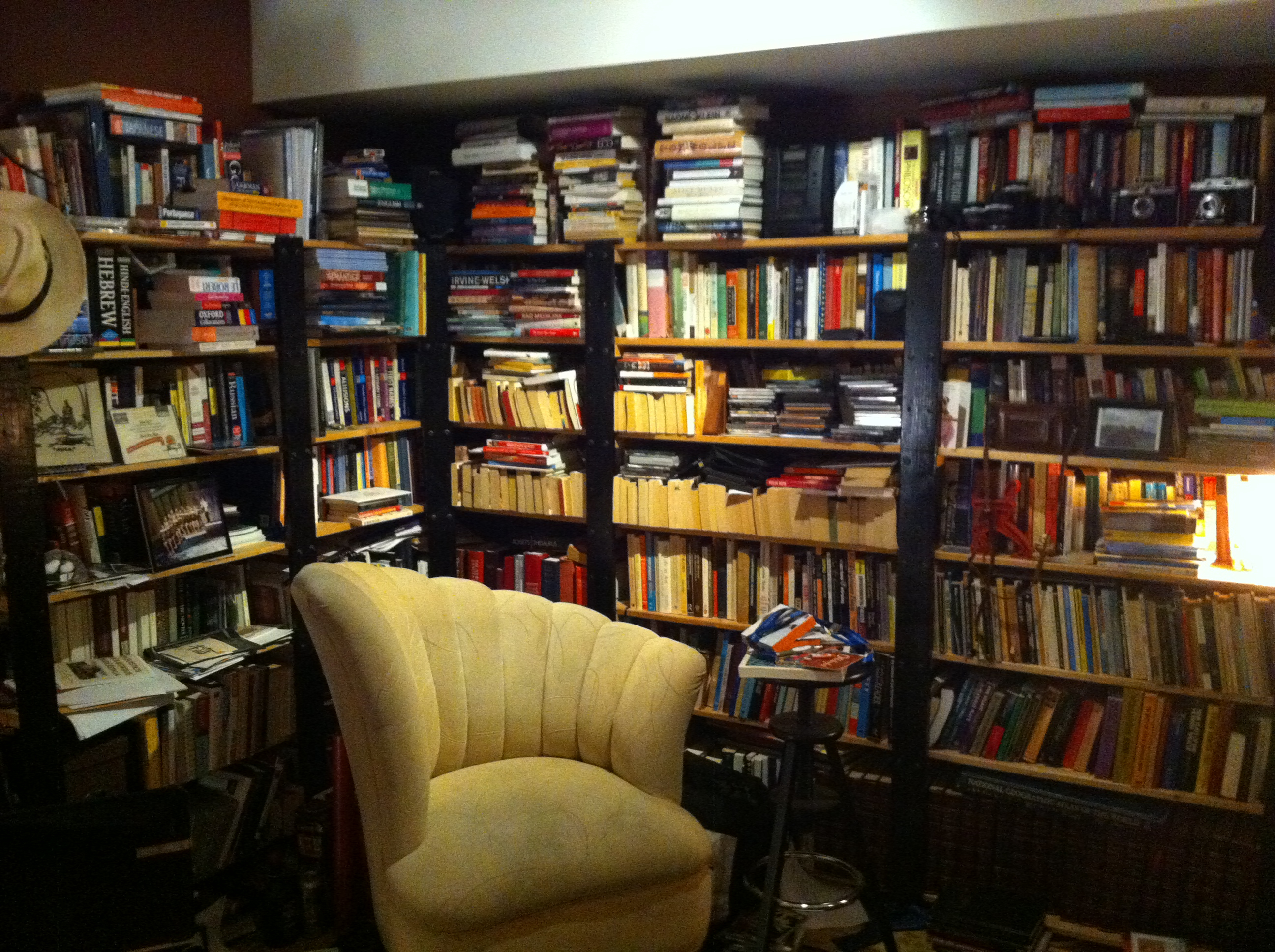
And my living room. Two walls floor-to-ceiling with books ranked two deep on black-and-blonde wood shelving, sections for dictionaries and reference and plays and novels and books on religion and travel and my grandmother’s old Britannicas and large volumes of collected Doonesbury and Calvin and Hobbes, with a small shelf including a linear foot of my own bound publications; snug into the angle a welcoming chair reminiscent of a baseball glove; a stereo on the top shelf and a tall rack on the side holding fifty score compact discs. How can a home be complete without a library? We also have piles of books here and there – our collection has outgrown our shelving. But to me it is not clutter, it is just a lush garden of the mind that has grown and grown and spread seeds and creepers. It is a comforting bed and blanket of books. Not a cocoon. A thousand and more doors to other worlds. A library.

frippery

Time to put on the glad rags: fillips and frills dripping with pretty things, fitted out like a flapper or preppy, fit for tripping the light fantastic or frittering time away. The tedious togs of daily wear are basic like milk; this is a frappé. This is frippery.

But frippery is not just finery. We are not talking about the simple solid core of handsome apparel. Frippery flips and flaps and flops on the periphery. You can hear it in the word: the front of it is the fricative-liquid [frɪ] of frills, fringe, fricassee, frisky, frisson, fritter, frizzy, and frivolous, with a French flavour; it bounces off the pp in the middle, skipping, tripping, hopping happily like a peppy puppy; it ends with [əri] as in luxury, hosiery, millinery, periphery, and many others less related. The sound rebounds off the lips from liquid to liquid, flapping like a bit of lace or a nice tie.

Frippery is not always finery of the first rate; indeed, it can have a tawdry air, something meretricious. Consider how Robert Burns used it:

Dame Life, tho’ fiction out may trick her,
And in paste gems and frippery deck her

And Walter Scott:

I was born in the land of talisman and spell, and my childhood lulled by tales which you can only enjoy through the gauzy frippery of a French translation.

And Oliver Goldsmith, in She Stoops to Conquer:

By living a year or two in town, she is as fond of gauze and French frippery as the best of them.

Do we detect a pattern? There is something flippant here, perhaps a fillip to the top of the head. When we talk about frippery, we can never completely divest it of a derisive or deprecatory air. Frippery is like finery said with heavy lids, a raised eyebrow, a little uptick of the chin, a curl of a corner of the mouth. Which is only fair – its origin is Old French frepe ‘rag’, and that has carried through.

So glad rags indeed. Which is why I like frippery better than finery. What’s better than looking sharp? Looking sharp with a knowing smirk.