
Tag Archives: word tasting notes

perimath

When I worked in a bookstore with a replete Penguin section, I came to know a whole lot about a whole lot of books. I knew who classic authors were, I knew what books they had written, I knew what the books were about.

I had not actually read all the books. 

Who has that much time? I read their back covers. In matters of classic literature, I was not a polymath; I was a perimath.

You know what a polymath is, I reckon: someone who knows a lot of things. That’s from πολυ- polu- (normally rendered as poly-) ‘many, much’ plus μάθη mathē ‘learning’ (and yes, that’s related to the math in mathematics). I imagine you’re also familiar with peri-, as in perimeter, periscope, periphrastic, and peripatetic. That’s from περί peri ‘about, around’. So, yes, perimath means someone who knows about things – you could say they know details peripheral to the things. (And a person who knows about a lot of things could be called a polyperimath.)

That might not sound like a good kind of thing to be. But believe me, there’s a lot to be said for knowing about things – knowing that information exists, and knowing where and how to get that information. Very few people will remember everything exactly as they read or learned it, and the amount of information available will be forever greater than any one person’s capacity for learning it all. But if you see some reference to a fact, and you can remember where and how to find out the details – if your mind is not an encyclopedia but a catalogue or search engine for a whole library – you can be very intellectually effective indeed. And, I must add, people who are sure they don’t need to look things up tend to get things wrong enough of the time to vitiate their effectiveness.

Let me give a little example. When I was in grad school, I taught test prep for the GRE, GMAT, and LSAT, which are standardized tests for admission to graduate school, management school, and law school, respectively. They have a “reading comprehension” section, wherein you read a passage and then answer multiple-choice questions about it. A good way to do badly on it is to read the passage once and then answer the questions on the basis of what you’re sure you remember. The way to do well on it is to look back at the passage and confirm the exact answer to every question. (Remember: these tests are multiple-choice, so you are given the correct answer for each question, along with three answers that are incorrect in ways that people who rely on memory may miss.) But it’s a timed test, so you need to be able to find the information without rereading the whole passage every time. You need to have an idea where and how to look (numbers and capitalized words make great landmarks, for instance) – and then you need to pay attention to what it definitely does and does not say.

Real life isn’t like standardized tests, of course, but it does present unlimited opportunities to make dumb mistakes on the basis of what you’re sure you remember. The ability to find and check facts is very useful – and the inclination to do so is a mark not of insecurity or ignorance but of diligence and careful thinking. It should also go without saying that it’s better to know that a piece of information exists than not to.

So sure, it’s good to be a polymath. No one could say otherwise. But it’s also good to be a perimath. And, if we’re being honest, a lot of people we think of as polymaths are really mainly perimaths – or polyperimaths, if you want to insist. One of my favourite quotes about high intelligence (or producing the impression of high intelligence, anyway) is from a guy named Rick Rosner, who characterized it as “doggedness and reference skills.”

Which also characterizes essential traits for getting a graduate degree – and for several professions, such as librarian and editor. So here’s to the perimaths.

By the way: you won’t find this word in wide use… yet. I assembled it from existing parts, and its sense follows quite reasonably, but I have no prior attestations for its use. I do hope it catches on, though!
gelid

It’s the gelid time, the time when the cold is legit, when you glide on the sidewalk even in your clonky boots. When you get together with the larger family for larger family meals, with jellied cranberries or jellied salad or jellied eels depending on what your clan is like. When from your urban shoebox dwelling, perhaps, you make a trek to a cold country home, decorated as in Maya Angelou’s vision:

Flush on inner cottage walls
Antiquitous faces,
Used to the gelid breath
Of old manors, glare disdainfully
Over breached time.

Oh, those gilded gelid days, when the warm family embrace was from the fingers of Jack Frost. It is in the deep mid-winter (which somehow is proximate to the very first day of official winter, though the denizens of the true north strong and freezing know it hit us a month or more ago); frosty wind makes moan; earth stands hard as iron, water like a stone. Thank divine providence and clever humanity for central heating, if you have it.

Yes, gelid is ‘cold’, basically. It’s like frigid, but it’s freezing. It’s the same -id, but frigid starts with Latin frigus, ‘cold, coldness’, whereas gelid starts from Latin gelu, ‘frost’. So if you are gelid, you are as cold as ice. You may be as pretty as the fancy ferns of frost on an Alberta foothill windowpane, but you are no less frozen. You are as welcoming as that jellied salad, at the very most, but no warmer than a Jell-O popsicle, and in this weather it will be you who is licked; it is not the August dog days. It is the moon of wintertime, when all the birds have flown. You may hope for Santa Claus and his Missus, but what you get is Jack Frost and his wife, Gellian.

Unless, of course, like some people I know, you are where it is still quite warm know. In which case, count your blessings and treat yourself to a gelid beverage.

snew

As the day grew bright on Saturday, I knew it was going to be wintry. The wind blew, and it snew abundantly.

What? 

The past tense of grow is grew. The past tense of know is knew. The past tense of blow is blew. Who can object to the past tense of snow being snew?

Sure, I admit, it might be a little uncomfortably like spew (which is not the past tense of spow). But it matches the pattern. Not only that, there was a time in English when snew truly was normal for the past tense of snow.

Mind you, that time was 500 years ago. And you know what they say: Où sont les neiges d’antan? (Where are the snows of yesteryear?) They all blew away or flew with the dew.

But also, while snew was common a half a millennium ago, it wasn’t the original past tense of the verb. No, that was snewed.

I’m not kidding! The original present-tense verb in English was snew. Yes, it’s derived from snow by ablaut, the same process that gave us those “strong” past tenses such as grew and knew. But that process could also be used to derive a verb from a noun. Not from the noun snow, though; the ablaut happened much farther back. Even in Proto-Germanic there was a distinction between the verb *snīwaną and the noun *snaiwaz.

But, you know, even though snowflakes are all at least slightly different, they all drift together into one big mass. And likewise, although English started out having the verb snew (with its regular past tense snewed) and noun snow, by the 1400s a conversion of the noun supplanted the verb, making it snow… in the present tense. Because of course snew looked like a past tense, and a past tense it became. Until even that melted away, and it all just became regular snow and snowed.

Ah ! comme la neige a neigé !
Ma vitre est un jardin de givre.
Ah ! comme la neige a neigé !
Qu’est-ce que le spasme de vivre
À tout l’ennui que j’ai, que j’ai !…
—Émile Nelligan

Or did it? Where are the snows of yesteryear? Recycled as the snows of this year, that’s where. They melted, went back into the streams and lakes, and that went back into the clouds, and now here again is snow. And if you want to say snew, well, no one can object that it’s new.

loggerhead

When times are festive, sometimes spirits run a bit high: someone says something flip, and things get heated and end up at loggerheads.

Have you ever wondered where that phrase, at loggerheads, came from?

We know, more or less, what it means: an intractable conflict between two dug-in parties. Blockheads butting heads. Perhaps a barstool argument over grammar or etymology getting out of hand as the beer gets out of mug. (Say, should it be at lagerheads? No, it should not; there’s no evidence for that as an origin.)

So OK. What are loggerheads? Once this question was raised by my longtime friend (and reader of these blitherings) Margaret Gibbs, I knew where I wanted to look first: Michael Quinion’s site World Wide Words. And I was not disappointed.

It’s not that he had the exact perfect answer. Actually, no one knows for sure precisely where and in reference to precisely what the phrase was first confected. But the list of suspects is greatly narrowed.

Loggerhead, as the Oxford English Dictionary confirms, is confected from just what you see: logger plus head. In this case, logger appears to be in reference to a block of wood or similar lump, rather than (as we use it now) someone who cuts down trees and moves them to market. A loggerhead has thus, since the late 1500s, been one of two things: a thick-headed person (a blockhead, etc.), or a thing or person with a head out of proportion with the rest – could be a tadpole or similar critter, or could be an instrument made of, for example, a pole with a bulbous end. And, it seems, there is an intractable dispute about which of these the phrase came from. (Well, unresolved, anyway.)

If at loggerheads comes from the first sense, the derivation is straightforward enough: it’s two people being blockheads – pigheaded, in fact. Butting heads.

But if it comes from the second sense, it may well refer to the item that, since the late 1600s, has more often been called a loggerhead: an iron rod with a bulbous head, heated in a fire and used to heat up liquids such as pitch or tar.

Did people get into fights with these? Well, I don’t know. I wasn’t there (so glad about that). But it is true that a loggerhead may even today be involved with a flip utterance. 

You see, there is a beverage called flip; it is made of warmed ale, eggs, sugar, nutmeg and/or ginger, and rum or brandy. The ale is warmed in advance, but when the flip is to be served, it is heated again – by plunging a hot iron implement into it. And, from what I have read, the implement first used for this was a loggerhead.

Which doesn’t really explain how at loggerheads would come from that. Frankly, I prefer the idea it came from the first sense: two people being blockheaded. But I am sure that on many occasions when servings of flip heated by loggerheads were involved (and perhaps still are, in those places where historical reenactment buffs gather), flip utterances led to parties at loggerheads.

gaudy

Advent – the four weeks leading up to Christmas – is, in general, a gaudy time: lots of bright lights and colourful decorations. But originally it was a penitential season. Except for one Sunday. The third Sunday of Advent. Which was today. That Sunday is, by definition, gaudy.

OK, well, it’s Gaude. Or, in the plural (since gaude is the singular imperative), Gaudete Sunday. Or, as many Anglicans and Roman Catholics call it, pink candle Sunday.

An Advent wreath has four candles in a ring. Three of those candles are purple (technically violet or blue), but one of them – the third one to be lit – is pink (technically rose-coloured). That signifies that you can take a break from your solemn penitence (everyone’s being solemn and penitent, right? right?) and rejoice! Gaudete! You in particular, gaude! Be both godly and gaudy!

And yes, that’s no coincidence The Latin verb gaudere means ‘rejoice’ or ‘make merry’, and its noun form gaudium means ‘joy’, and it has given English its noun gaud meaning ‘trick, prank’ or ‘plaything’ or ‘ornament’ as well as its adjective gaudy, meaning, of course, ‘flashy, showy, brightly coloured, happy’ – but pronounced after the English fashion, rhyming with bawdy rather than, to match the Latin, rowdy.

Of course what is gaudy can be bawdy or rowdy, but it would be unseemly to be either in the context of holy rejoicing. You can have the gaudy, bawdy, rowdy flash and trash of the shopping mall as the holiday shopping season ramps up, but if you feel like something a little less lucrative and ludicrous, a little more to the gaudete, you can always pause in a peaceful place to light a pink candle and listen to (or sing) a bit of happy music. For those who want, here’s a nice song (a bit early, by the lyrics, but so what, it’s Latin):

jeepers

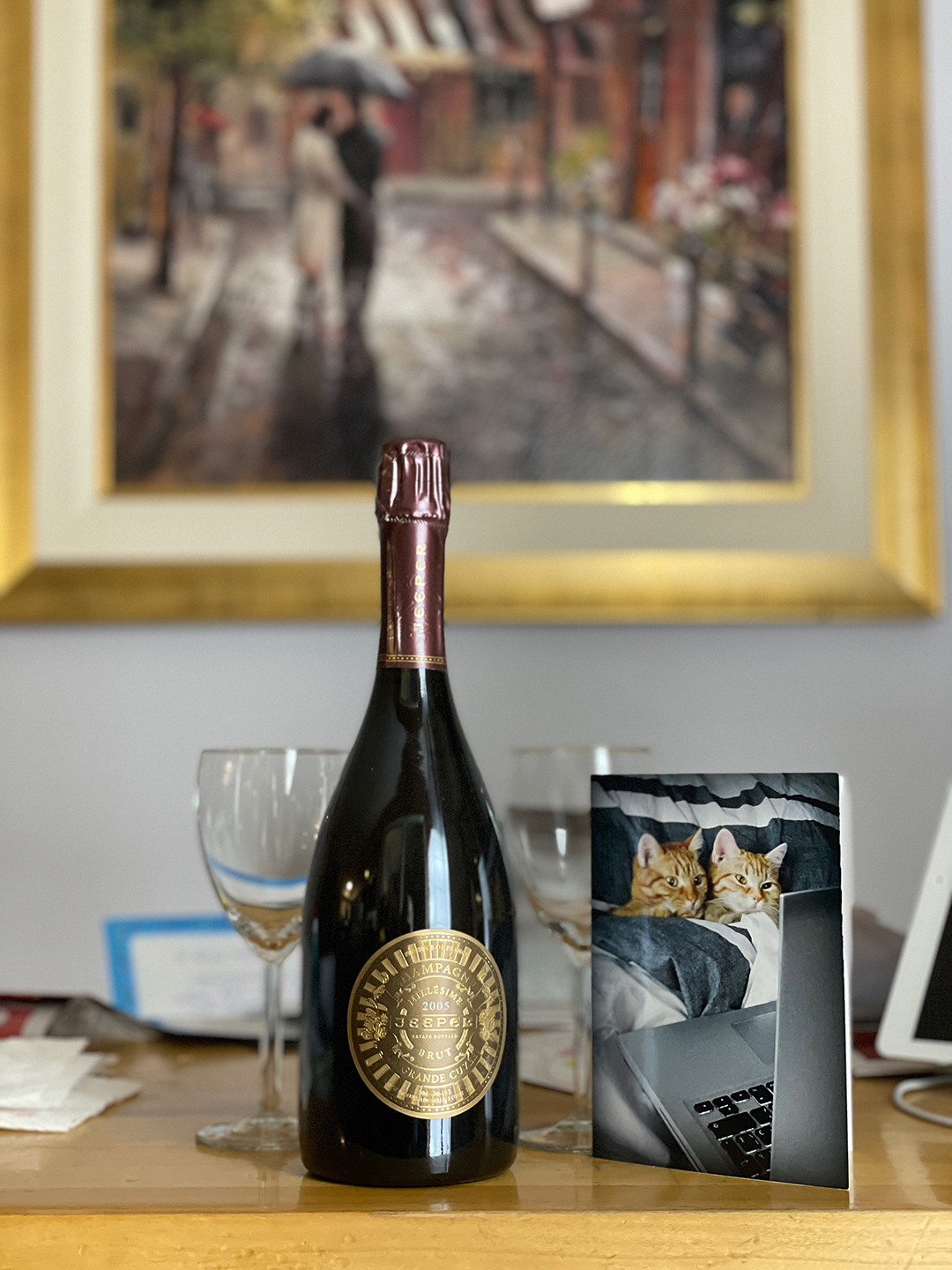
Jeepers! I’ve been married to a sweet, beautiful, talented, charming woman for 21 years! So to celebrate, we opened some champers. (The photo is obviously from before we opened it. Once it was open I was too occupied with serving dinner to take another picture.)

You know the term jeepers, I suppose. It’s rather old fashioned now, about on level with gadzooks. It probably brings a particular song to mind:

(It might also bring to mind a much more recent horror movie franchise of the same name, but I’m not posting any video clips from that.)

That song first came out in 1938; Ethel Waters did the first studio recording of it, but Louis Armstrong boosted its fame the same year by singing it in the movie Going Places – only in the movie he sings it to a horse. (A horse? Well, he was black, and it was 1938 in the USA, so there was no question of his singing it to a woman in a movie. In the script they named the horse Jeepers Creepers and he sang the song to it. Now, horses can have nice eyes, but come on, hmm?)

So is that where jeepers comes from? Nope. Johnny Mercer – the guy who wrote the lyrics to the song – explained in an interview that he had some music by Harry Warren that he needed words for, and then he saw Henry Fonda in a movie where he played a farm boy, and Fonda said “Jeepers creepers!” And that was exactly what Mercer needed for the song.

So it was something that Fonda said in a movie? Yeah: in The Farmer Takes a Wife (1935) – but Fonda didn’t exactly improvise it. It’s in the script, and the scriptwriter got it from the novel the movie is based on, Rome Haul (1929), by Walter D. Edmonds. Did Edmonds make it up? It doesn’t look like it; you can find several earlier uses of it in short stories published in magazines in the 1920s in Google Books. A few of them are proper names, but the rest are exactly this exclamation.

So, OK, whoever said it first had to make it up on some basis, right? 

…Yes… It’s an exclamation, of the euphemistic kind. 

What could a person being substituting “Jeepers creepers” for? Well, hmm. What thing might some people exclaim that involves two words starting with “jee” and “cr,” do you think?

Mm-hmm. It’s a minced oath for “Jesus Christ.” Kind of casts a new complexion on the song, I suppose – but, then, complexion is also why Louis sang it to a horse.

But then why am I exclaiming it about the happy occasion of my marriage attaining an age such that, if it were a person, it could drink in any province or state? I guess I just thought of it because of the champers we were drinking. (Champers as a cute version of Champagne dates to a couple of decades later than jeepers, by the way; the OED’s first citation for it is 1955.)

Did you notice the label on the bottle? It’s Jeeper La Grande Cuvée Millésime Brut 2005. It came well recommended, so, as Aina and I both love our fizzy-o-therapy, I bought a bottle four months ago and hung onto it for an occasion. Now, the names of Champagne houses are often a bit on the unexpected side – Krug hardly sounds French; Moët and Perrier-Jouët fool people who don’t know you’re supposed to say the t on the end of each, and Perrier-Jouët also sounds like it might be high-priced water; Taittinger is an evidently German name but an obviously French producer, so however you pronounce it is going to sound wrong to someone – but Jeeper struck me as next-level. Is it a Dutch name that ended up in France (like Citroën)? Is it some regional quirky French thing? Is it an English family that set up shop?

None of the above. It’s apparently because the original owner of the Champagne house, back in 1949 (yes, it’s not as old as some), had a Jeep he bought from the departing American army after World War II. He used it to drive around the vineyards. I guess he was fond of it, and proud of being a Jeeper. And that original Jeep owes nothing to jeepers (nor vice versa; Jeep dates to the 1940s), though it’s not unreasonable to imagine the brand Jeeper might have some influence from it. (I’d hope that’s the only influence the owner was driving under, but…)

So there you go. That’s quite the journey, eh? But not as long as 21 years. Jeepers!

cruft

Merry cruftmas!

Just admit it: December is the most cruft-full time of the year. It’s not just that almost everything you get or give comes with a box (or perhaps two or three), packing and padding material, twist-ties, peel-off sticky items, and possibly a pretty bag you brought it all home in. It’s that you end up with all sorts of stuff you don’t need and won’t use more than three times, and so does everyone else. In our society, a sign of a long life fully lived is closets and shelves and cabinets and even whole basements and garages full of cruft. 

But… no, don’t Konmari my cruft! The mere possession of hundreds of books, scores of electronic devices, and collected toys such as my two dozen cameras and three dozen lenses brings a spark of joy. Well, to some of us, anyway.

And hey, my cameras aren’t cruft – I still use all of them, each one at least once a year. Anything that actually gets used doesn’t count. Cruft is accumulated detritus. Schmutz. Leftover crap that you just haven’t been motivated to clean out. Computer programmers use the term for obsolete and otiose lines of code left over in a program from earlier versions. People working in labs and offices might consider cruft to be all the old equipment that has been disused and is stacked off to the side – in some cases, in windows where people can see it. 

I think most of us have walked past a nice-looking building and seen a window that is filled with basic piled-up cruft. It’s possible that that’s even where the word cruft comes from: at Harvard University, there is a Cruft Laboratory, which for a long time had assorted detritus piled in its windows and visible from the street; it’s not impossible that it was seen by students from nearby MIT, where the word cruft is first known to have emerged in 1959 (specifically at the MIT Tech Model Railroad Club, which was also an early wellspring of computer programmers and hackers – in fact, hack and hacker in the computer sense are also among the words the club has given us).

It’s not impossible, but it’s certainly not certain. Cruft Laboratory isn’t an exceptionally prominent building among the accumulation of red brick that is Harvard’s core campus. And MIT is a mile and a half farther east, in its own distinct neighbourhood. Other theories of its origin have it as a fanciful formation on the basis of crud, fluff, and crust. My favourite theory – not any more supported than any of the others, but not really less likely, in my opinion – is one I read somewhere (I can’t remember where!) that it is a deliberate play on the effect of a bit of orthographical cruft: the long s.

The long s? You know, when you read old books and, for lower-case s in nearly all positions except final, they use ſ(which, not italicized, is ſ). As in buſineſs (buſineſs) rather than business. So when you see the word crust in such an old book, it’s cruſt. And certainly nerds and geeks do look at old books on occasion, and see things that amuse them, and repurpose them for ſhits and giggles, just as they may do with many another bit of cruft, as suits them. I do fancy the idea that the word might bear the trace of orthographic cruft, especially since English has so very much of the stuff (silent letters, obsolete but retained spellings, redundancies…). But I cannot say it’s true.

One way or another, the word has a certain something to its sound, crunchy but soft, sort of like the sound of sorting through or sweeping up dusty papers and other crap. It does have other overtones too, though. Notably, Crufts is the name of a famous dog show. It was founded by Charles Cruft, one of many people who have had that as a family name – another being Harriet Otis Cruft, of Boston, who donated Cruft Laboratory to Harvard in memory of her four brothers, all Harvard graduates. (Meanwhile, a mile and a half north of that, there is a whole university named after Charles Tufts, a university I happen to have two degrees from, but Tufts is not Cruft; whether my degrees are cruft is not for me to judge.)

Cruft remains a strong hacker-toned word, a word seldom heard outside of nerd and geek culture. But that ought to change. Cruft is a pervasive, even ubiquitous fact of life, and even from the earliest ages, before we have programmed our first line of code, we are taking part in arts and crufts. Go into any kindergarten and ſee for yourſelf.

BIBBO

Back in high school in Banff, in the early 1980s, I had a math and computer science teacher named John P. Stutz. He was quite the character (still is; between then and now, he has been mayor of Banff, and now he performs weddings for a living). One of his lessons I remember best is the classic computer science axiom: GIGO – garbage in, garbage out. In other words, no matter how good a program is, if you feed it garbage data, you will get garbage results. The fact that it’s a well-designed program on a good computer doesn’t automatically transmute rubbish into gold.

Back then, machine learning and artificial intelligence were still in early days. The sophistication I now get from my iPhone – or Google, for that matter – would have blown my head clean off back then. Stutz’s too, probably. But these days, you can seriously propose and produce things that would have been pie in the sky at the time: say, having a computer read job applications and automatically filter candidates, or getting writing advice from a computer application that had learned from a large number of published articles, or having software use security cameras to scan faces and flag people whose appearance matched faces with a higher-than-average likelihood of interaction with police. And when you train that kind of thing, GIGO matters. But something else matters even more: BIBBO.

BIBBO? That stands for bias in, bigger bias out.

Why not just BIBO? Well, here’s the thing. Garbage is garbage, but bias is scalable, and repeated bias compounds. When computers learn biased things from biased data and then put those biased things in the real world, that has real-world effects that feed back and increases the bias in the model. And also, if bias is going in, it’s because that bias can be found in the real world, and the machine’s biased output will confirm and strengthen that real-world bias. Not just the machine but the people who use the machine will have bigger bias.

Consider the job application filtering program I mentioned. The machine learning will look and see that certain kinds of applicants have been more likely to get hired, and will filter those kinds of applicants in and other applicants out. Seems fine? Not if the hiring choices in the original set were influenced by factors such as race, gender, religion, prestige address, prestige school etc. For most jobs, none of these factors have a direct bearing on ability to do the job. But the machine will see a certain kind of name and address and so on and downgrade the applicant on the basis of other similar people not getting hired previously. And then as such applicants are hired less and less, the machine’s bias is reinforced – as is the bias of those doing the hiring.

Consider the writing advice idea. An application that has looked at thousands of academic journal articles will have identified various stylistic features of academic writing. What it won’t know is that many of those features are actually functionally bad: they obscure key details and bury essential points in circumlocution and uncommon terms. Many editors are trying to work to undo these practices, but it’s an uphill struggle, as academic authors often think that if text sounds too clear it’s not erudite enough, and if it takes into account the author’s specific role and position it’s not objective. Throw in software that reinforces these habits and you get academic authors having these prejudices reinforced and being told to do more of what the editors want them to do less of.

And consider the security cameras. If the data from the cameras is used to advise police on who to do a stop-and-check with, and each stop-and-check is counted as an interaction with the police, then obviously it produces a feedback effect. If in one month people with red hair happen to have interactions with police at twice the rate of people with brown hair – statistical anomalies do happen – and that data is fed back into the system, in the next month people with red hair may be more likely to be stopped and checked, which will increase their interaction statistics. And even if the system only counts actual arrests, not interactions, anything that increases the likelihood of someone being stopped by police also increases the likelihood of their being arrested, assuming they have the same likelihood as anyone else of happening to be doing or possessing something illegal, and the same likelihood of not responding well to being stopped by police for no obvious reason. And then the system becomes more biased, and so may the police officers – and perhaps society in general.

These aren’t made-up examples, either. They’re taken from the real world, from products and applications promoted by software companies. I’m not naming names just because it’s tiring (and occasionally expensive) to deal with angry techbros.

There are ways to correct for these biases, of course. You can work on evening out the training data; you can correct for biases in the data and the output. Above all, though, you need to know what to watch out for, and how to deal with it. You need to know BIBBO. Because if there’s bias in the system, bias is the system.

It will naturally help if you yourself, as a designer of the machine learning, do not also have uninspected and uncorrected biases. A problem we face today with many of these applications is the idea that if it’s large amounts of real-world data processed by sophisticated programs, then it is objective and not subject to human biases. This is false, of course – it’s programmed by humans and the data is taken from humans in a society with its own biases – but there are people in the field who do not seem to see that it is false, because they have an ideology that science (including math and computer science) is hard and strong and intelligent and objective, while things that study humans – sociology, philosophy, etc. – are soft and weak and wishy-washy and tendentious. They come through education with this bias, and they use it to filter the information they get, and they design computer applications with that bias. And so you get these things that reinforce bias. All because they thought they could avoid bias by avoiding inspecting bias. But BIBBO.

widthy

You need not be lengthy if you can be widthy.

Have you seen this word widthy before? You probably have not. Have you considered why that might be?

Widthy seems, plainly, to be a natural counterpart to lengthy. Spatial dimensions include both length and width, after all. And yet.

Is it that the counterpart to lengthy is in fact breadthy? After all, broad – though not as commonly used here and now by us as such – is the true old direct counterpart to long; look at modern German: for ‘long’ it has lang, but for ‘wide’ it has breit, which is related to broad. And broad, via umlaut, is the source of breadth just as long is the source of length.

But breadthy is not in use either. And, like widthy, it really never has been. Until now, that is.

So, first of all, why lengthy? Why not just long

For the sake of mild euphemism, it seems. Length is, after all, not always so good. Consider some of the Oxford English Dictionary’s earliest citations for it. John Adams, 1759: “I grow too minute and lengthy.” Benjamin Franklin, 1773: “An unwillingness to read any thing about them if it appears a little lengthy.” Thomas Paine, 1795: “In the mean time the lengthy and drowsy writer of the pieces signed Camillus held himself in reserve to vindicate every thing.”

Did you notice another thing? Yes, all three authors I’ve quoted were prominent figures in the American Revolution. The word lengthy first appeared in America in their time, and was for a long time (and still to some extent is) considered an Americanism. And all three seem to have prized brevity in speech and writing, or at least to have allowed that cogency is valuable. But when apologizing or deprecating, rather than use the blunt long, they use the, uh, lengthier (and thus slightly more cushioned) lengthy.

It’s not that lengthy is always negative, especially lately. But consider whether you’d use it in place of long for things that are undoubtedly better for being longer. “A lengthy baguette”? Well, that sounds silly because we more often associate lengthy with less physical characteristics, perhaps (nothwithstanding “a lengthy journey,” which could be referring to long time as much as distance). But “a lengthy slow dance with my darling”? Ouch… sounds like you’re impatient to move on from dancing.

So is this why we don’t (or didn’t) have widthy and breadthy? I suspect that has something to do with it. Width and breadth are not so often apologized for. One can have a great breadth of knowledge and education, for instance, or of perspective. A store or a library may have a breadthy selection. Breadthiness could be intoxicating; it could leave a person breathy – or breathless.

And why, by the way, do we have width when we have breadth? In truth, as I’ve pointed out, breadth is the more natural original counterpart to length; width referred originally – and still does, in some contexts – to expanse or extent in any and all directions. You travel far and wide, for instance, over the whole wide world. If your eyes are open wide, they are open top to bottom as much as side to side. Certainly wide has always had an available sense referring specifically to side-to-side dimension, and that has increasingly come to dominate, but it still has a, uh, widthier range.

And anyway, when you see widthy, you know what it means, don’t you? If you look at breadthy, you might misread it as breathy, or perhaps you might get stuck on the bread part. So I like widthy. It seems that we didn’t get the word 250 years ago because no American statesman ever felt the need to apologize for going too wide (hmm, perhaps if they had instead been sportsball players…). 

And it’s true: don’t apologize for being widthy. Just do.

ain’t

Ain’t ain’t a word.”

Obviously, that’s functionally false, and the speaker knows it: if ain’t really weren’t an understandable lexical unit, the sentence would make no more sense than “Zcvny zcvny a word.” But what some of us miss – but the people who declare the unwordness of ain’t (and other words) know at least implicitly – is that they don’t mean “not usable as a word.” They mean that it’s not a word in roughly the same way as someone in, say, 1850 might say that an obvious human adult was “not a person.” 

It’s not that the human couldn’t speak, eat, run, or do other things that any human could do. It’s not even that the human wasn’t, in the broader and more common sense, a person. It’s that the human was not legally a person: she or he couldn’t vote. The human was not of the right sort. The human did not belong in certain places, and could not fill certain functions, that were open only to those who were duly enfranchised.

This question of what humans are legally persons has not been so contentious since all adult human citizens regardless of gender or race (though not necessarily regardless of certain other statuses, such as criminal or mental) have been eligible to vote. But the question of what words are words has not gone away, not least because it’s not a question for courts decide, nor for dictionaries, and especially not for linguists (if you assigned the task to linguists, they would refuse it, run away and hide, or arm up and fight you).

It ain’t for dictionaries to decide? Nope. And I say that not just because dictionaries are field guides, not legislation (you don’t say something that just flew past is “not a bird” just because it’s not in your pocket guide); I say that because even the people who appeal to the authority of dictionaries reject that authority when they don’t like what they find. Such as “ain’t contraction 1 : am not : are not : is not 2 : have not : has not.”

Ain’t is not legally disenfranchised, no (though I suspect its ingenuous use in legal documents would be frowned on). But it is pointedly socially “not our sort, dear.” It is a word that “the better people” want it to be understood they would not consort with. It would not be invited to society weddings. But it would work in the kitchen with the caterers.

And as it worked there, those in the wedding party would studiously avoid seeing or acknowledging it, just as they would any fallen poor relation. “Do not say that Uncle Frederick is working in the kitchen. I won’t have it! That man is just Freddy, a local ne’er-do-well to whom we try to give a bit of charity work from time to time. And he should be kept away from the guests.” Never mind that Freddy, the erstwhile cadet of the family, is doing quite well and in fact the wedding is entirely relying on his skill as a saucier.

Erstwhile cadet? By that I mean younger brother of the heir. But younger brothers, as louche as they may be, are still normally permitted entrance to society, and so was ain’t, at first.

You might think that ain’t was illegitimate, since it doesn’t match anything clearly: not am not, not are not, not is not, not have not, not has not. But if you spend a little more time with the matter, I think you won’t be of that mind for too long. Contractions can change form. Am not became a’n’t for some people for some time, as did are not, and have not and has not became ha’n’t and even ’a’n’t (with varying numbers of apostrophes). And then, with shifts in vowel, that lengthy a came to be a “long a” – the sound that is represented by the ai in ain’t. We also know that respected writers and assorted rich persons were using it in the late 1600s and into the 1700s. The debate has not been concluded as to which sense of it came first, or exactly how it came to cover so many different senses; it may have arisen independently for multiple forms and merged. But its ejection from polite society came as a result of several transgressions to the rigid and fragile roles and rules of privilege.

For one thing, it simply wouldn’t stay in its place, or even know its place. It covered too many senses. This was a problem for reasons of ambiguity, perhaps, though in truth only rarely, since its use for hasn’t and haven’t is only for the auxiliary: “I ain’t a dog” can’t mean “I haven’t a dog.” It was a bigger problem for reasons of flagrant promiscuity, which is frowned on. And – to put it plainly – it was too easy. Which is a terrible sin in English. All of the worst mistakes, my darling, come from trying to make a spelling or inflection too easy. “I goed”? Wretchedly childish. “I been?” Sloppy and lazy. And simplified spelling? Beyond disgusting. It also ran up against an increasing prejudice against contractions, which – starting not too far into the 1700s – were increasingly seen as too informal and lazy, making one syllable where our illustrious forebears had seen fit to make the effort of saying two.

And then it started being associated with the wrong sort of people, which is absolutely death, darling, death. It was heard on the tongues of those rural sorts from the farther reaches of the countryside, and those lower-class sorts from the poorer neighbourhoods of the city – those unpleasant people who sold fish and made deliveries and took away rubbish and cleaned gutters and, in short, did all the essential work without which all the fashionable people would be wallowing starving in the muck – and then it was done. No decent person could be heard to use it.

Except when slumming, of course. Your school teacher, socially vulnerable, might studiously avoid association with the lowlifes, but the assorted lords and barons could afford to consort slyly on the side with the riff-raff if they were the fun or useful sort of riff-raff. And ain’t has become the classic slumming word. With this one word, you can shift the tone and attitude of a whole sentence – “Sir Peter? He ain’t here, darling, so off with you” – or even set the tone for a song in the title – “Ain’t Misbehaving,” “It Ain’t Necessarily So.” It is, in short, an expert saucier. With its fall from grace came an ability to season a sentence as quickly and effectively as any pepper or aged cheese.

And that is a role it is happy to fill. In fact, it has far more effect and power than any of its more respectable siblings and cousins. It’s not just that it can instantly set the tone as casual, folksy, and thus (thanks to our ideologies around class and language) more honest; it’s that it does not shrink from respectable companions, but they can be frightened by it – one incursion of ain’t into the wrong place could be like a fly in the pudding: “In submitting this update, we acknowledge that we ain’t achieved our goals yet, but we hope that with further funding we will be able to provide conclusive results.” In short, ain’t is misbehaving, and that’s the point.

So I am not making an impassioned plea for the acceptance of ain’t into formal discourse. That would take away its power. It would be telling the best saucier in town that he must rejoin his starchy family and spend the afternoons discussing bank drafts and society weddings and never cook again. But I am saying to stop saying that it’s not a word. A word that is casual is still a word, and it does not demean or degrade anyone to use casual language when the situation calls for it. Our language is capable of almost infinite variety and nuance in tone; let’s make use of it unashamedly. And wave hi to Uncle Freddy in the kitchen.

