I wanted to do something lapidary for tonight’s tasting note. I make no claims to writing gems – I am not much of one for self-spruiking – but at least I am not prone to alalia (speechlessness). So I have found this elegantly euphonious name of a mineral. It may even have something of the animal in it: specifically, a wing – ala – and a light one at that. So I’ll alight on it.
Its initial ala is especially to my liking because those are the initials of someone lovely and likeable (and light) to whom I was wed 15 years ago; today has been our anniversary. But it also has a little alliteration internally with those two licks of the tongue, and to the eyes it seems a specially strong seal of approval, A1 A1. I also like the little light in the middle right, the candle of the i.
But what light of the alalite through yonder window breaks? What colour is this rock? It is, it seems, a light – or not-so-light – green, that loveliest of colours, shade of the forest and of the best eyes. But alalite is a sort of diopside, or perhaps it is just another name for diopside – the sources are conflicting and uncertain on this – and diopside, though mainly various shades of green, can also be blue, brown, white, grey, or colourless. It can also be clear or cloudy. Very helpful, isn’t that? Anyway, it’s MgCaSi2O6. Magnesium, calcium, silicon, oxygen. Four things you are sure to have in your kitchen, but not in purified form, just in foods, supplements, or implements – or atmosphere. And not in this combination.
And where does this name come from? The Ala valley in Piedmont, Italy, where this variety of diopside was first identified. So it is a green stone of a mountain valley, and its name sounds like echoing yodeling. I like it – I delight in it. I do not have the stone, but I have the name, and it is illuminating (even elating) enough.
My latest article for The Week looks at emoji and emoticons – little icons of facial expressions and gestures and objects – and asks two important linguistic questions: Are they words? And if so, what kind of words are they?
My late teens were charged with yearning and self-fulfilling prophecies of failure, an arc of desire and disappointment that was accomplished before it began. I felt that I wanted to be someone whose lost potential others would mourn, who had loved better than others and yet to whom others would say “I loved you better.” I was in search of a new version of reality, an altered state, one in which simple truth of feeling would be enough.
In other words, as I have since realized, I was pretty typical in many ways. Except that I was even less able than most to act on my desires, paralyzed from within, so afraid of rejection that I pre-rejected.
I was introduced by a drama teacher to the music of Laurie Anderson. I loved her work instantly. One piece stirred me more than others – and in fact still stirs me, and now I understand a little better what she had in mind. It’s “Gravity’s Angel.” Play it while you read this.
Send it up. Watch it rise. See it fall. Gravity’s rainbow.
Send it up. Watch it rise. See it fall. Gravity’s angel.
It’s a reference to Thomas Pynchon’s novel Gravity’s Rainbow. The song doesn’t follow the plot; you may know the song ever so well and still be entirely in the dark about the book. But there is a thematic resonance.
I was curious. A friend had the book. I borrowed it. I found it was very well written – vivid – but also a bit hard to follow, which actually I sort of liked (hey, I had already read Finnegans Wake). But it was too vivid, and it described some things that were hard to swallow. I put it down a third of the way through.
A few years ago, I decided I wanted to try it again. I bought a copy.
It’s a darkly (darkly!) comic novel, hallucinatory almost, an alternate reality, full of sex and destruction and desires, version and inversions and perversions and conversions and reversions and other diversions. It’s set during the Second World War. Its opening and focal point is the Blitz in London.
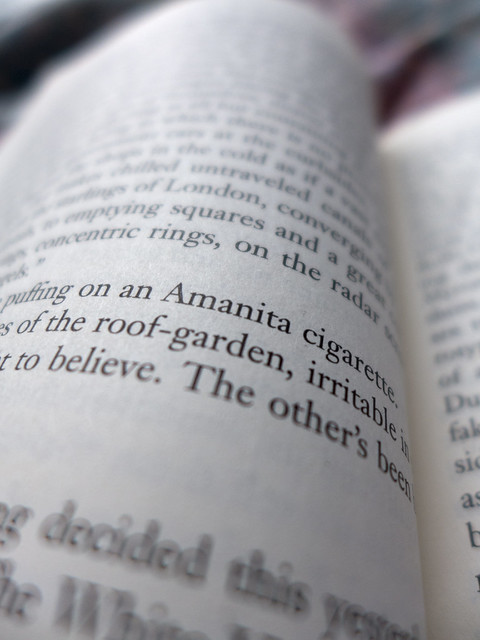
I’ve been wanting for some time now to take this one from the bookshelf and taste a word from it. But what word? Today I finally just grabbed it and opened it and flipped to a page. Nope, not that page. Another. Hmm. A third.
Yes.
There. There is the word I want from this book. A word of hallucination, a word of escape, a key to a Lewis Carroll world of inversions, but a word of a destroying angel, an angel rising above a bombed city, an angel falling in a bomb on a city, an angel eating you from within like unsatisfied desire.
Amanita.
Amanita is a kind of mushroom. In fact, one kind of amanita is the classic toadstool, bright red with white dots: Amanita muscaria, commonly known as fly agaric (the musca in muscaria refers to flies), because it was used dried in bowls of milk to kill flies. But it is also a well known hallucinogen, eaten (and, it seems, smoked) recreationally. It has surely led to the undoing of many flies of more than one kind.
But then – beyond the undone flies – lurks Amanita phalloides, known as the death cap. And different species known as destroying angel: Amanita bisporigera, Amanita exitialis, Amanita ocreata, Amanita virosa. They will be your undoing if you eat them. Not right away – it takes a few days – but by the time you realize something’s wrong, your only hope to live is likely a new liver. Such appealing-looking phallic fungi, not so different in appearance from many table mushrooms, tempting too to those who wish to experience a new reality. Oh, and they will.
It’s a pretty word, isn’t it? Amanita. Like a cross between Amanda and Anita. Perhaps they are cousins of Alice – we should go ask her. It apparently comes from Amanon, a mountain in what is now Turkey. It makes me think of our first microwave oven, an Amana: a very well made machine, a miracle of technology, cooking with radio waves. Amanita could just be a small Amana, a little thing in your hand capable of leaving you fully cooked.
Pynchon’s book is a rainbow of sex and death, an arc with all the visible colours and more, extending into radio waves. It has its destroying angel and it has its angelic young man in an arc of destruction, annihilating at final contact; it has its louche antihero and its picaresque adventures, its half-circle of the demimonde; it has its escape, its hallucination, its alteration. It has its cheap tricks that make you say “Amanita few minutes to absorb this.”
And perhaps you will not fully appreciate what you have let yourself into, what you have let into you, the gravity of the circumstance, until too late. You have swallowed it and it has eaten you from within.
A colleague raised a common issue: she had chosen to use Canadian Press style for a website with health information, and it left her with stuff such as “at ages six to nine, you will use 10–20% more.” What to do about those mixed and inconsistent numbers when they show up together like that?
I’ll tell you what: Don’t follow Canadian Press style. Or any other style like it, when it comes to numbers.
In many ways, CP style is appropriate only for newspapers. For instance, usages such as “$9-million” are not standard English but have a justification in the narrow columns of a newspaper. CP style rules for spelling out numbers, however, are not appropriate for newspapers. Nor for most other nonfiction, in fact.
Long ago, when teaching test prep for the GRE, GMAT, LSAT, and SAT, I realized that numerals communicate more directly, immediately, and effectively to the reader, stay better in the mind, and leap off the page much more readily. In any work that is being referred to for facts, numerals are more effective for all magnitudes, not just for 10 and higher. And in a context that is as space-sensitive as a newspaper, the only reasons for preferring spelled-out numbers are prissiness and dogged traditionalism. That’s it. Adhering to their rules produces not only the example above but even worse things, rubbish such as “He is facing an eight- to 20-year sentence” and “seven in 10 people.” There is nothing about this is that is helpful to the reader; it is distracting and impedes comprehension and retention.
And how about starting sentences with numerals? The standard argument is that the reader somehow won’t know you’re starting a sentence. Why? Numerals stand out as much as capital letters. There’s a space after the period – a suitably large one in a modern proportional font, too – so no one will mistake it for a decimal.
Look, do you really prefer this:
Nineteen-eighty-four was a bad year. Eight out of 10 members of the club faced jail time ranging from six to 20 years.
to this:
1984 was a bad year. 7 out of 10 members of the club faced jail time ranging from 5 to 20 years.
Really. Which leaps off the page and into your brain more readily? Which sticks in your mind better? Quick, tell me (try it without looking first, then just at a glance): How many out of 10 members in the second example? And in the first? And what was the jail time range in the first? And in the second?
If you’re communicating factual information where the numbers matter, use numerals. Don’t worry, people will still remember how to spell them even if you don’t spell them out. You are not contributing to the decline of literacy. You are facilitating the communication of information.
Will some readers complain if you don’t spell out the low numbers? Yes – the kind of reader who is more interested in making sure that everyone follows their personal set of rules than in the actual communication being effected. These are not readers to take any account of; almost nobody even likes them. Most readers just want the facts.
The only numeral that is problematic, in fact, is 1, and that’s because it looks like l and I, especially in some type faces. For my own house style at the company where I work, I have set the rule to be that we use numerals for all numbers in all contexts except where 1 appears by itself, in which case we spell it out for clarity. We make occasional exceptions with idiomatic phrases, where the numeral would look odd (no need to be at 6s and 7s about that). Otherwise, it’s all numerals, and that makes it much more effective and usable.
You will note I said “most other nonfiction.” For works that are more narrative in style, such as many biographies and most fiction, numerals may stick out quite a bit in the flow, since – as noted – they leap off the page and communicate much more quickly. In a story they can be like sudden spurts of water in a steady stream (or like your tap after the water’s been off and air has gotten into the line). So I don’t take issue with the literary habit of spelling out up to ninety-nine and, in dialogue, even higher. But in informational material – such as health data – I strongly advocate all numerals all the time.
And the Canadian Press ought to smarten up and do so as well. Until they do, though, effective editors will do better to ignore their prescriptions. After all, the name of the game is effective communication, not “Who’s following the holy writ?”
“It’s… JEN-TACULAR!” You drop your fork on your bacon and eggs and look up at the TV. There, good enough to eat, are Aniston, Lawrence, Lopez, and Garner. Well! This is a good way to start the day. Breakfast TV indeed! Positively jentacular.
Of course, such a scene might be most openly desirable to that sort of gent who is attracted to copious quantities of bacon and eggs. Well, yeah, and the Jennifers, too. But come on. We’re talking about breakfast here.
You didn’t know? Jentacular means ‘of, or relating to, breakfast’. It’s from Latin jentaculum ‘breakfast’, which in turn is derived from jentare, ‘eat breakfast’ (or, for the old-schoolers, ‘break fast’, since breakfast is from break fast, i.e., end the overnight fasting – that thing where you don’t eat because you’re asleep). Of course, in classical Latin, it’s IENTARE; in modern writing, we distinguish consonant i from vowel i by using the extended version of the letter, j, for the former, just as we distinguish the vowel form of v from the consonant form of v by writing the cursive form, u, for the former. We’ve made them official different letters, and they sound much more different in English. But in Latin jentare (or ientare, or IENTARE since half-uncials didn’t exist way back then) was pronounced “yen-ta-reh.”
Quite a difference between a yenta and a Jen, though, isn’t there? As much of a difference as there is between breakfast and breakfast. In some places, breakfast may be fish and soup; in others, it may be sugary processed grains soaked in low-fat milk (because somehow lots of sugar and little fat is better than little sugar and lots of fat?); in others (looking at you, England – please invite me over), it may be bacon, eggs, beans, and fried tomatoes – not gentle, but gentile. Breakfast changes over place and time.
And so does Jen, or rather Jenny. We know that Jenny is not new as a nickname in English; we see it in various usages even in the time of Shakespeare. But somehow in The Doctor’s Dilemma, written by George Bernard Shaw in 1906, there is this:
MRS. DUBEDAT. My name is Jennifer.
RIDGEON. A strange name.
MRS. DUBEDAT. Not in Cornwall. I am Cornish. It’s only what you call Guinevere.
How do we reconcile this? Is Dr. Ridgeon oddly onomastically naïve? No. In the time of Shakespeare and for centuries after, Jenny was short for Janet or, occasionally, Jane. If you’re wondering how Janet came to be Jenny, you may as well move on to how Richard became Dick, Edward became Ned and Ted, Robert became Bob, John became Jack, and Margaret became Peg. After those, Jenny seems quite obvious for Janet, doesn’t it?
But more obvious for Jennifer. Which is indeed from the same root at Guinevere, which means, roughly, ‘fair and soft’. OK, fair enough, once Jennifer is popular it naturally claims Jenny and Jen. How did Jennifer become such a popular name that Jen is practically the default name for North American females now? I guess a lot of people liked it… starting with those who saw The Doctor’s Dilemma, which – in spite of being one of those preachy, wordy Shavian thinkdramas (which are nonetheless great to act in) – was quite popular. I’m sure the scripted extreme attractiveness of Jennifer Dubedat (and thus of the actresses who played her, starting with Lillah McCarthy) didn’t hurt.
But. That’s a lot to digest before breakfast. I should go more gentle on the gut in what is, for many of my readers who open this first thing in the morning, still an antejentacular hour. I suggest something to settle the stomach. Sparkling wine, perhaps? Ah, that would be jentacular.
Do you wish you could have an easier time with non-English sound distinctions? Do you have a sense there are sounds that sound the same to you but are heard as different in other languages? Give this a listen – it’s the podcast version of my article on subtle sounds English speakers have a hard time telling apart.
Doesn’t this look like the name of some Egyptian pharaoh or Babylonian king? Or perhaps some writing left on a wall by a disembodied hand that was a bit too drunk? (If that doesn’t make sense, look up mene mene tekel upharsin.) Or maybe what Neneh Cherry and Pharrell Williams would be called if they got together?
Or it could just be a nice soft word with white shoulders clothed in light linen. It seems pleasing enough. Even French in its way. To me it does, at least, because the first time I noticed it, it was spelled nénuphar. It was on a bottle of liquid hand soap. The French part. (Hey, we’re in Canada here.)
Twice a year, we go to the One-of-a-Kind Craft Show, and we have some favourite booths we stop at (out of the something like 1000 that are there). I like Peppermaster, for instance – I always taste their latest and hottest sauces. I get my cufflinks etc. from BBJ (Barbie’s Basement Jewellery). Aina buys dresses from if and Dinh Bá. And we buy our hand soap (and hand cream) from Lovefresh. It’s not as cheap as the mass-market stuff, but it’s more responsibly made and it sure is nice.
One of their kinds of hand soap is Nénuphar. Well, that’s what it is in French. In English, it’s Water Lily.
Yes, nenuphar – which is also an English word once you lose the accent on the e – means ‘water lily’. It’s not the kind of soap we buy the most of (grapefruit and lavender and lemon grass are more to our taste) but it’s nice for our smaller bathroom that guests go into. It has that super flowery smell. I mean, lilies, right? It makes me think of that perfume, White Shoulders. Also funerals. Especially if you open the bottle and sniff the great clear mass of it directly, full on. It’s like you’re lying on a bed of flowers. No, not on. Under.
So this word must be Greek, right, with the ph? Unless it’s something like Hindi or Thai? Hmm. Here’s the funny thing: It came to us (via French) from Latin nenufar. Latin got it from Arabic naynufar. The OED says that was probably a “transmission error” from Persian nilufar. Which in turn comes from Sanskrit nilotpala, from nila ‘dark blue’ and utpala ‘lotus’ or ‘water lily’.
Do you notice where the ph comes in? Right at the end. French also had it originally as nénufar. Apparently f just didn’t seem classical enough. Latin has f, but words that are loans into Latin must get ph because Greek, amirite? Maybe the f is just too, um, basic, so they have to adjust the ph balance.
So. From nilotpala to nenuphar – which, in English, according to the OED, is pronounced “nen you far” or “nen ya fer,” thanks to the phonological muscle-wrenching of the English vowel shift.
Well, whatever. It all comes out in the wash. Actually, no, it doesn’t – your hands smell like it for a while.
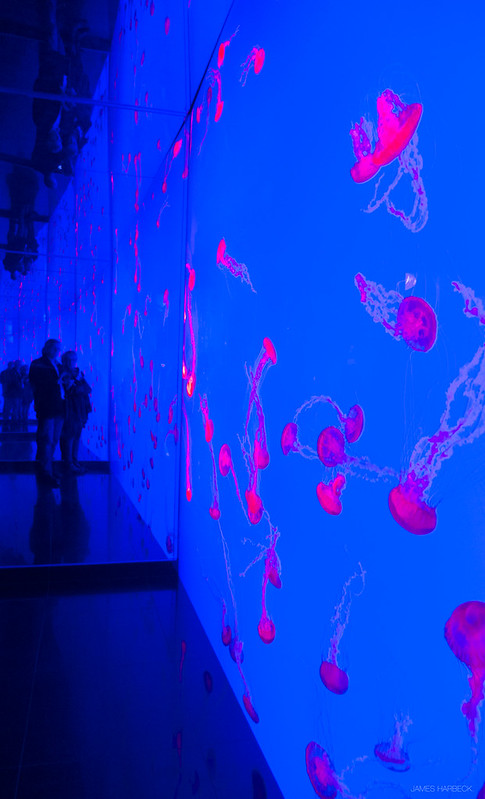
Look at that pretty thing. It has a rounded cap on it followed by a mess of attachments trailing off, pointing in various directions.
Frozen here but fluid in reality, never quite the same from one instant to the next, and, as you see it, in an engagingly backlit form, though with the contrast a bit stinging. So too the marine life form it names. There are differences, of course. For one, the critter has its sting in its tail and the meat of the subject in the cap, whereas the sting of Cnidaria is in the cap: How, exactly, do you say Cn?
The answer, for most Anglophones, is that you skip the C. You just swallow it. As to the rest, the aria is pronounced like area, and the nid can have either a “short” or a “long” i. The standard American pronunciation is like “I dare ya” with “n” before it, and if you really want to say the C, you’ll probably say Cnidaria exactly as you would say “Can I dare ya.”
Dare ya to do what, now? Hmmm… how about swallow one?
Swallow one what? Cnidarian, of course. Cnidaria is the phylum name, and cnidarian is what we call an individual member of the phylum. More commonly we call them jellyfish, but really they’re not fish – fish are vertebrates. Cnidaria is a whole separate separate set – we don’t just file ’em in another folder or another drawer; we phylum in a whole different cabinet. The Cnidaria also include sea anemones and corals: all critters with squishy bodies and stinging tentacles; some attach to things and some float freely, and some do both at different life stages.
The stinging tentacles are what give them their name. Cnidaria comes by way of Latin from Greek κνίδη knidé ‘nettle’. Nettles are hard and jellies are soft, but if you swallow jellyfish tentacles you’ll wish you had swallowed nettles. I recall reading of a marine biologist who was keeping some jellyfish tentacles in water in a bottle in the fridge, and one of his office mates came in thirsty and grabbed the first bottle of water he saw and took a big gulp. He recognized his error instantly, but too late. He was hospitalized – it was, shall we say, unpleasant. (Life lesson: Don’t drink from other people’s water bottles.)
Between this and the appearance, we get a common name for the floaty things such as we see in aquaria: medusa. I have recently learned from my Finnish word-of-the-day email that the Finnish word for jellyfish is meduusa (double u because it’s a long vowel – but the stress is on the first syllable because it’s Finnish). I’m not sure why that would be a word you would need to learn early on in Finnish, but there it is (where? not in the Baltic Sea, that’s for sure). It’s obviously borrowed into Finnish. Finnish belongs to a different language phylum – it’s Finno-Ugaric, no more related to English than Navajo, Nahuatl, or Na’uruan is – but languages can borrow words. The only way you’re going to integrate a critter from another phylum into the Cnidaria is for a cnidarian to eat it.
Or we could eat the cnidarian. No, no, not the stingy tentacles. The cap. Cooked and chopped up and seasoned, it’s not so different in texture from squid, though the flavour is different and less pronounced. I had some with lunch just the other day. I quite enjoyed it. You may prefer a jelly sandwich, but I don’t mind the odd bit of jellyfish. Can I dare ya to try some?
My bookshelf is a tree. It doesn’t look like a tree, no, but it’s made from trees – the wood of the shelves, the pulp that made the paper in the books – and it has many branches. Branches of knowledge, that is. There’s quite a lot on languages and linguistics, of course. There are also numerous other reference books, many of which acquired at the Oxford University Press sale that used to happen annually. It is a rich tree with many leaves (of paper) on each branch. Some branches are deceptive: on the upper right you see a novel by Irvine Welsh, not a lexicon of Welsh. Some parts of this tree are in the light, some are in the shadows…
…like that book hiding back there. Visual Encyclopedia. What is that, now?
A thick book on glossy paper, richly illustrated and labelled. Its size makes it easy to hold but not so easy to hold open.
You can see that in this book are many branches. This shadowy part of my library tree is quite dense. It is in some ways a microcosm of the shelves around it with their 1200-some books (more than two for each page of this one). Let’s look at the branch of it that has branches.
Plants! Trees and so on. They have branches. There turn out to be quite a few kinds of plants. Let’s go to the gymnosperms.
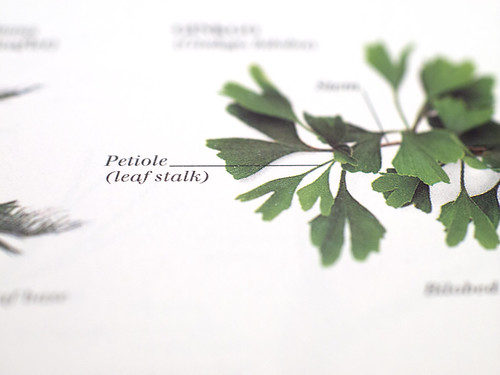
You see some seeds, of course (that’s what the gymnosperms get their name from: naked seeds). You also see some branches. Let us look at this one from the ginkgo tree, a tree that is supposedly good for the brain. (Does it make knowledge stick to your brain? I’m not sure, but if you live near one, it makes its seeds stick to your feet for a few weeks each year.)
Is that a branch or a twig? When does a branch become too small to be a branch? A branch can have branches, but at some point those little branches are not quite big enough to be branches.
Well, we can draw a definite line when the material changes, anyway. A petiole is not a branch; don’t be misled by its branching. It connects a branch and a leaf – indeed, it’s the thing that connects the leaf and the stem.
The book helpfully tells us that petiole means ‘leaf stalk’. Fine, we know leafs talk: this leaf of paper is talking to us right now.
Oh, yes, right, that’s leaves. Even though leaves talk can also mean ‘walks out on speech’. But this is not walk, it is stalk. I think we have taken a wrong branch. Well, anyway: How, in fact, do you put petiole in speech? The British style has the first syllable as like “pet”; the American style has it more like “pede” (as in centipede). But the French, who gave us the word, say the beginning like our “pate” (rhymes with spate – I don’t mean pâté) and spell the word pétiole.
It may make you think of petal. After all, it is a small branching-off part of a plant; it connects to leaves, which are similar to petals in various ways. But that is another misleading branch (though perhaps there is some cross-influence in the form). The Latin source of petiole, petiolus, most likely derives from the ped and pes root meaning ‘foot’ plus a diminutive suffix, meaning it’s related to pedal. Petal, on the other hand (or foot), comes from an unrelated Greek root for ‘spreading out’.
So. There is your knowledge: branch, twig, stem, petiole, leaf. It is true that petiole seems more erudite, perhaps more polite, or perhaps more specific – a cross between a petunia and an oriole? – but the tree doesn’t care; it’s just there. As is this sub-sub-sub-branch of knowledge we have leafed our way to today. Now we will leave it, but at least you may be relieved that, should you see petiole in future, you will twig what it is.
The turkey, as you may know, does not come from Turkey. It also does not come from France, India, Rome, or Peru. And yet its names in different languages around the world attribute it to those places. So… why? Find out in my latest article for The Week:












 Sesquiotica