Monthly Archives: September 2026

invent

What is, and what is not, invention?

If you discern a mathematical relationship that no one has noticed before, and you produce an equation characterizing it, you didn’t invent it, did you? You just applied existing methods to a new discovery.

If you come up with a wordplay, you don’t invent a pun – it is not so much an act of creation as just one of noticing, right? 

What about if you write poetry? That may be a matter of thinking something out, but is it sensible to speak of inventing a poem? 

Paul Quarrington thought so; in his play The Invention of Poetry, it is not the idea or paradigm or practice of poetry that is spoken of as being invented, but rather the wordstuff of a particular poem. That’s how Shakespeare and Dryden used invent, synonymously with create. But it seems unidiomatic now.

So what, then, do we mean when we say invent? If I invent a vent, what developments and differentiations must I devise so that it’s not merely an advance or variation? I don’t need to invent the concept or practice of venting; I need only invent a new way to vent – something clever, something that shows a spark of inspiration, the divine afflatus or at least an insight of the moment. Perhaps something that lets me vent steam from my stove without installing a duct or merely recirculating. (Don’t ask me what. I didn’t say I had invented it.)

But say I do invent a vent, or some other advent of invention eventuates. Is it the exertion of my own genius, or is it just something that somehow comes to me, or that I somehow come upon?

Different people have different opinions, to be sure. In particular, the ancient Anglo-Saxons saw it one way, and the Romans another. The Anglo-Saxon word for ‘invent’ was āþenċan, literally ‘think out’ – make a thought and excrete it into the world. But that was supplanted by a word taken from French inventer, which in its turn came from Latin inventus, past participle of invenio, which is from in ‘in’ and venio ‘I come’ (different from the source of vent, ventus, which is from a root meaning ‘blow’ and is cognate with wind).

This means not so much that the invention comes into you – blown into your head, as it were – as that you come into, or upon, the invention. If in Latin I want to speak of someone or something being found or discovered, I can use inventus. This seems odd to the English eye, as though a detective might invent a corpse (obviously more the work of the murderer, at least in Dryden’s sense of invent, which can include simple making from raw materials). But there it is.

We came into the word invent, anyway, and at first we used it like discover – which means ‘remove the cover from’, remember – or discern – which comes from roots meaning ‘separate, divide, sieve’. Then we came to use it like devise, which is historically a doublet of divide; our current sense descends from a use with wills, where the dividing of possessions was converted into instructions, and then from giving instructions the sense moved on to figuring out.

Today, we conceive of the mental act invent as synonymous with create, from Latin creo, related to a root meaning ‘grow’, and with conceive, which comes from con ‘with’ plus capio ‘I seize, I grasp’. You may sow or you may reap and yet you invent.

But in the material production, we use invent as a sort of synonym for contrive… with which we find that what went around has come around. It’s from con ‘with’ and Old French trovar ‘find’, from Latin tropare, which meant ‘find’, and before that ‘invent’, and before that specifically ‘create poetry’, from tropus ‘figurative use of a word’ (you may recognize the source of English trope in it). It’s almost poetic justice. Or at least the intrinsic inadvertent inventiveness of verbal evolution.

souse

Sometimes you get into the sauce and things go south: you sluice whatever’s in the house into your mouth, you start to get salty, your brain turns to brine, and you’re pickled. In short, you’re soused. Or, to say it another way, you’re a souse.

Now, tell me, those of you on speaking terms with souse: while we all agree that soused means ‘heavily inebriated’, do you use souse to mean ‘a person who is currently heavily inebriated’ or do you use it to mean ‘a person who is habitually inebriated’? In other words, in your usage, is the relation between soused and a souse the same as between drunk and a drunk?

Hmm, well, how about the relation between pickled and a pickle? If something is a pickle, it has been pickled, but, more to the point, it is presented as intrinsically and permanently pickled. It will never be unpickled at any future time you may pick. Pickle is its nature. So calling someone a souse is like calling them a pickle, right?

Hmm, yes and no. First let’s get the order of derivations straight: the noun pickle came before the verb. It’s called pickling because it involves using a pickle. But – trick! trickle! – the original sense of pickle is the brine. The cucumber (or other vegetable) has gotten the name pickle by transference. 

But back to souse: It is a similar situation to pickle in that soused, the participle, derives from souse, the verb, which in turn comes from souse, the noun. So a souse is not so called from being soused, but rather the converse.

It is also a similar situation because soused means, literally, pickled, and a souse is something that has been steeped in brine. Not necessarily a pickled cucumber per se, though – more likely something that’s a sow’s. Or a hog’s. You know, pickled pig’s feet, pickled pig’s ears, that manner of thing. And specifically it’s pickled in a salty brine: souse, you see, comes via French from Proto-Germanic (yes, Proto-Germanic – French has lots of Frankish bits) *sultijō ‘saltwater, brine’, which is derived from a Proto-Indo-European root *sḗh₂l ‘salt’. 

It’s interesting to see that the /s–l/ and then /s–lt/ was preserved for such a long time, only to have the /l/ softened up to /ʊ/ and the /t/ to /s/ to make /saʊs/, sounding as though someone truly sauced were trying to say “salt.” But on the other hand, in the figurative transference, the key component, salt – something that makes you thirsty – has been replaced by a completely different agent, one often used (with variable efficacy) to address thirst: alcohol.

Ontario

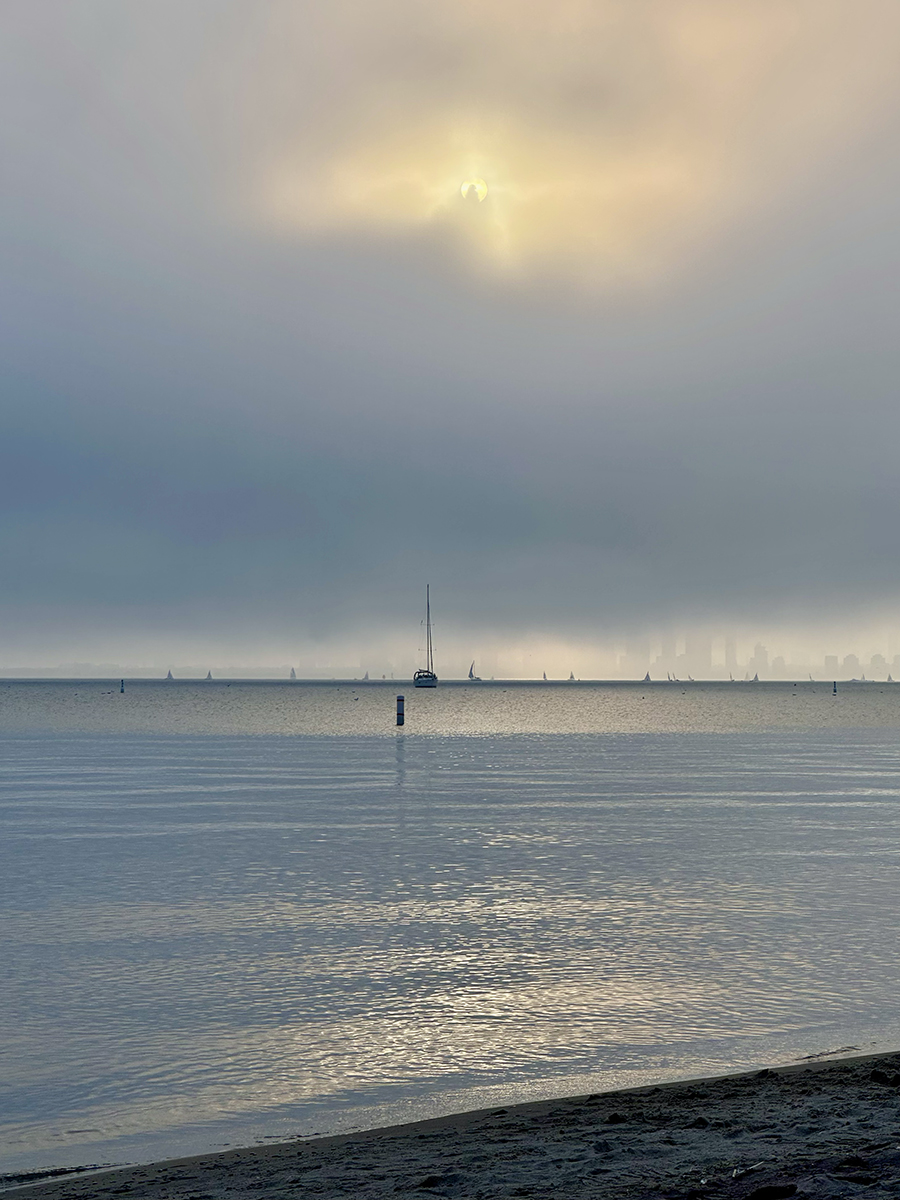
I’ve lived in Ontario for nearly 30 years. I’ve woken up every morning with a view of Lake Ontario for 18 years. But somehow I’ve neglected to taste the word Ontario until now.

Ontario is a musical word, suited if not for an oratorio then at least for an aria on the radio – or for an airy jingle, as the provincial government showed every Canadian starting in 1967: their promotional song branded all our brains with “A place to stand, a place to grow, Ontari-ari-ario” (music by Dolores Claman, more famous for the Hockey Night in Canada theme): https://www.youtube.com/watch?v=zPgZFzO0XZ0

It’s a pretty efficient word, too: four syllables from seven letters, with “airy” in its heart, and using the same vowel at the start and the end – traits that it shares with, among others, America. But I’m not in America (I’m in North America, but not in the country commonly called America), and though my view is elevated, I can’t quite see America across Lake Ontario, because the lake is, after all, a great big one.

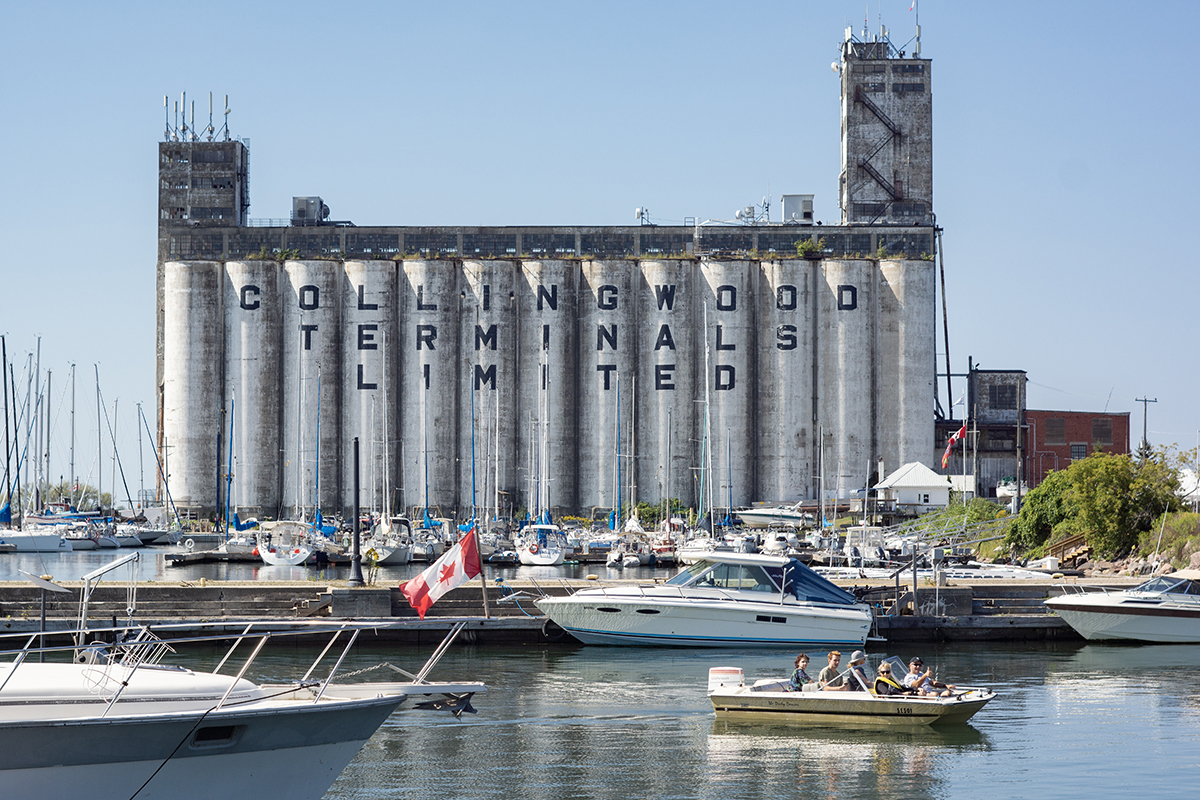
Ontario names several places. In Canada, it’s two big ones: the province of Ontario, the most populous and second largest of Canada’s provinces (two territories are larger, but territories are not provinces), and Lake Ontario, the smallest of the great lakes by area (but second smallest by volume). It’s also smaller places, such as Ontario Street, which is on the east side of downtown Toronto (and probably other places in other towns too), and Hurontario Street, which was laid to run from Lake Huron (Georgian Bay) in Collingwood to Lake Ontario in Mississauga (more than 130 km, but it has some gaps).

There are also eight towns and cities in the USA called Ontario (including, notably, a suburb of Los Angeles, where you will find Ontario Airport, which I have to think has confused some people), and they all seem to be named after the lake or the province. But just to get an Ont-ological question out of the way right away: The province of Ontario is named after the lake, and not vice versa (before Canada became an independent country in 1867, Ontario was called Upper Canada, a name you’ll see reflected in various places and things). 

The lake has been called Ontario for a long, long time. And for much of that time, it wasn’t Lake Ontario, it was just Ontario – or another similar word that’s the source of Ontario. This could possibly be skanadario, an Iroquioian word meaning ‘beautiful water’ or ‘sparkling water’, but it’s probably Ontarí:io, a Huron-Wendat word meaning – wait for it – ‘great lake’.

Yes, that’s right. The smallest of the great lakes is the one named Great Lake. But also, that means Lake Ontario is a redundancy, just like Sahara Desert (in Arabic, ṣaḥārā means ‘deserts’). But it’s been called Lake Ontario since before 1794, when it was named in the Treaty of Canandaigua, signed by President George Washington (and still in effect). So we can live with the name, and more easily than, say, salsa sauce or ATM machine.

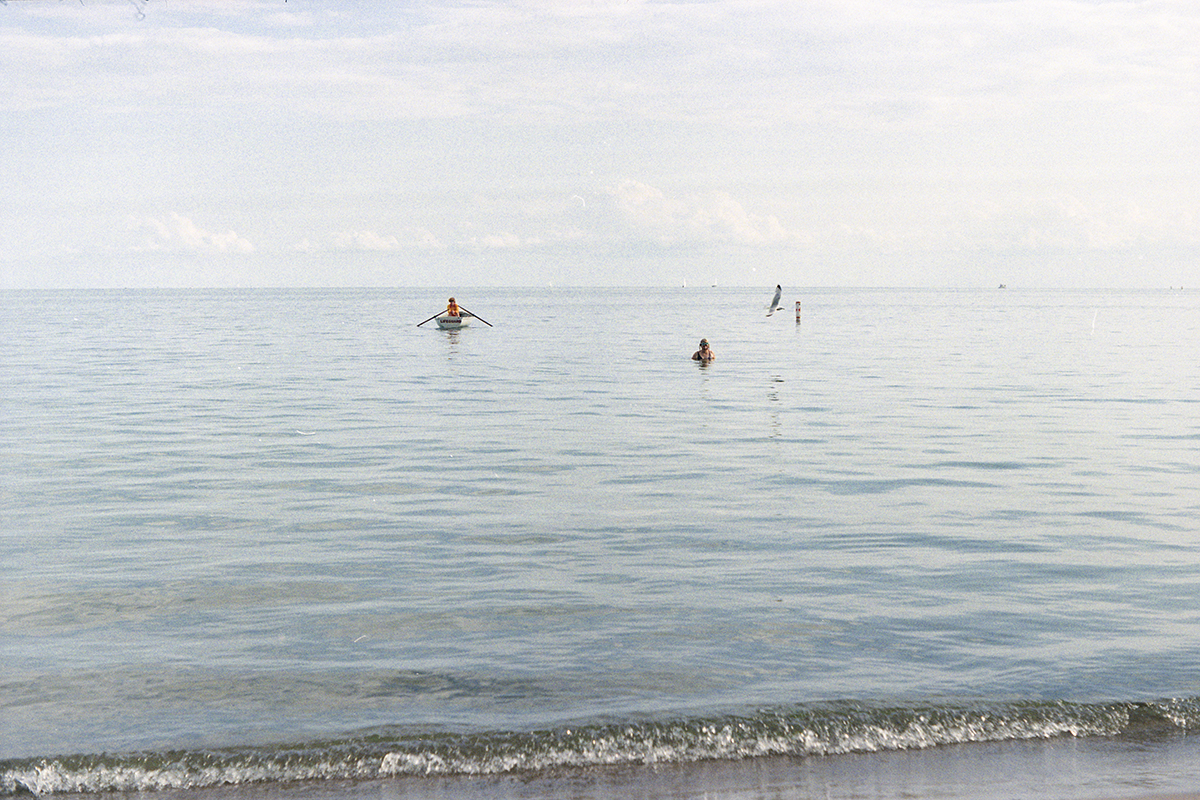
Anyway, it’s a pretty lake, and it has some very nice beaches too – including several on Toronto Island, where my wife and I go at least once a week all summer long. The water isn’t tropically warm, true, but on the other hand it’s not salty either. And you can go to Ward’s Island beach and feel like you’re way out in the country, even though it’s less than 20 minutes from downtown, most of which is spent on a ferry across the harbour.

Most of the water in Lake Ontario was, of course, previously in the other Great Lakes, since they’re a chain like sausage links, more or less: Lake Superior empties through the St. Marys River into Lake Huron; Lake Huron empties through Lake St. Clair and the Detroit River into Lake Erie; Lake Erie empties into the Niagara River, which – after an abrupt change in elevation – empties into Lake Ontario. A fun bit of trivia is that Lake Erie is shallow enough, and Niagara Falls high enough, that the bottom of Lake Erie is higher in elevation than the surface of Lake Ontario – but Lake Superior is so deep, its bottom is lower in elevation even than the bottom of Lake Ontario.

And although the province of Ontario is named after Lake Ontario, the province touches all of the great lakes I just named. In fact, since hydrologically Lake Huron and Lake Michigan are one lake – because they have the same surface elevation – you could say that Ontario touches all of the great lakes. But we have to admit that most people don’t see it that way, because the only thing connecting Huron and Michigan is the Straits of Mackinac. Anyway, Ontario is the only province that touches any of the great lakes. And all ships that want to get from any great lake to the ocean, or vice versa, have to pass through Ontario – not just in the middle of a lake, but by way of the Welland Canal, which cuts across the Niagara Peninsula, allowing ships to avoid a rather difficult passage over the falls.

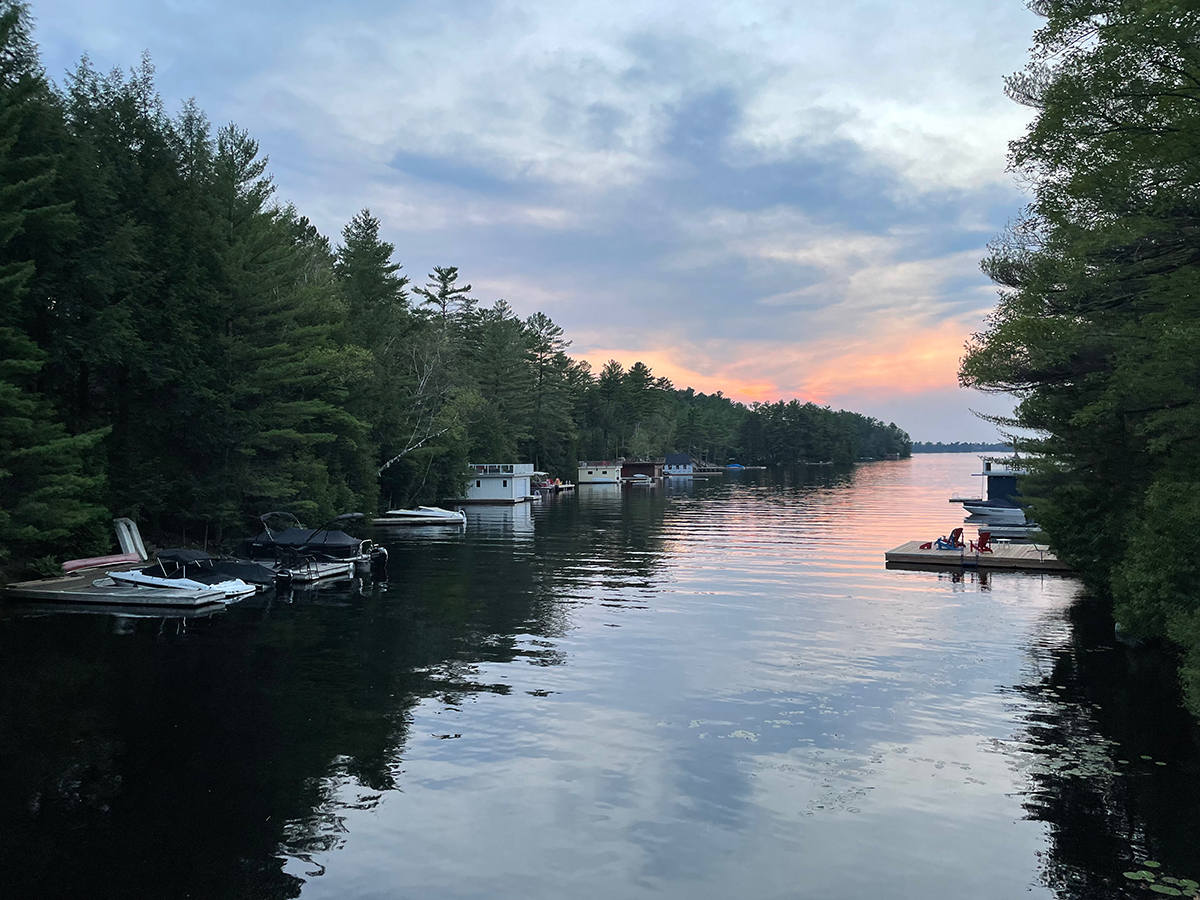
But the great lakes are not the only justification for Ontario’s having such an aqueous name. Ontario also has a shore on the Arctic Ocean – specifically the Hudson Bay and James Bay extensions of it – and within its interior it has another quarter of a million lakes. Yes, that’s right, over 250,000 lakes of various sizes. Fully one seventh of Ontario’s area is water. Most of Ontario is impossible to cross without crossing water quite often, and passing by water even more often. Ontarians seem OK with this – going to lakes is a popular pastime.

And, for that matter, Ontario is nearly impossible to enter from the USA without crossing water; of the more than 2700 km of border between Ontario and the US, only about one kilometre is land, and that’s all up in the wilds at the northern edge of Minnesota. To get between Ontario and the US in a motor vehicle, you have to cross one of 14 bridges – or one tunnel.

But, all that Ontari-eau notwithstanding, Ontario has quite a diverse geography; just watch any tourism video, from the famous “Yours to Discover” of 1980 (https://www.youtube.com/watch?v=0Iv7QHcOED0) to more recent ones (e.g., https://www.youtube.com/watch?v=SHy0BeOLzaE). In southwestern Ontario – the spear’s head bounded by Lakes Ontario, Erie, and Huron (including Georgian Bay) – there’s a huge amount of agriculture, including the most farms of any province (more than even Alberta), as well as 150 wineries, several of which are excellent and widely respected, and an ever-changing large number of craft breweries as well. 

Ontario has cities, and lots of them, including Toronto, North America’s fourth-most-populous city and seventh-most-populous metropolitan area, and Ottawa, the capital of Canada. Most of the people in Ontario live in the southern part – Ontario has nearly 40% of Canada’s population, and almost 95% of those live in southern Ontario, which, however, is only about 10% of the total area of the province.

All of southern Ontario is well south of the 49th parallel, and the southernmost part of Ontario is farther south than the northern border of California. Toronto is on the same latitude as Marseille, France; Florence, Italy; Sarajevo, Bosnia and Herzegovina; Sochi, Russia; and Sapporo, Japan. But of course it’s still part of the “true North, strong and free.”

And anyway, Ontario has plenty of northern On-territory in its massive Ont-area. Ontario is about 60% larger than Texas and almost three-quarters the size of Alaska, and most of that turf is rocks, trees, peatland, and, yes, all those lakes – and not so many people. If you drive from Windsor to Kenora by highways 401, 400, and the Trans-Canada, it’s more than 2000 kilometres and almost 24 hours of pure driving – and I’ve driven it all (though not all in one trip). 

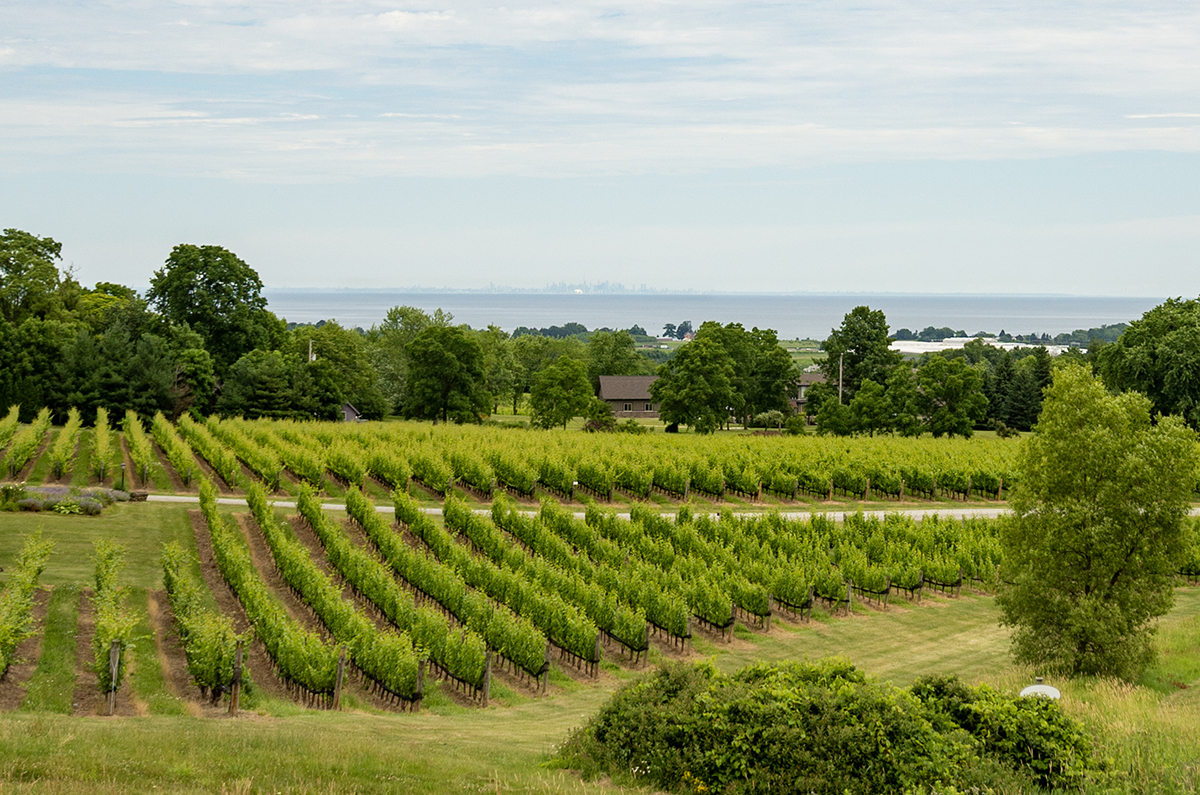
But I rarely see most of it, except when flying over. I live in downtown Toronto. But there’s still so much to see and do within an easy day trip – for instance, I can take a train down to the Niagara wine region, where I can have a lovely glass of Cabernet Franc by a lovely vineyard, and I can look north across Lake Ontario at my home in the distance, full circle O–o, still in Ontario.