Category Archives: word tasting notes

prig

As I said in my last word tasting, smugness smothers like an overstuffed overpriced cushion, but priggishness pricks like a cactus. A prig is someone who is unassailably conceited on a point of correctness, self-righteous with the primness of certainty of moral as well as factual correctness. And it is not enough for a prig to be right; there must also be someone who is correspondingly wrong. Indeed, I think that prigs choose their opinions precisely on the basis of being able to flatly “correct” others on occasion. As George Eliot put it in Middlemarch, “A prig is a fellow who is always making you a present of his opinions.”

There is, I should say, no sure etymological connection between prig and prick (though a person who is called the former might well also be called the latter). There is also no known connection between prig and any other word such as sprig or brig or rig, because, to be plain, its origin is unknown. Its earlier senses included ‘thief’ and ‘dandy, fop’, and the latter shaded into the present usage, but before about the time of Shakespeare we have been unable to get a grip on prig, source-wise. Sound-wise, it may well gain from the “pr” we hear on prick and prim and proper and a few other words of similar tone, and perhaps from the stiffness or restriction of sprig, brig, and rig. But there’s no way to know that for sure. Not that priggishness requires any support – it is entirely self-assured – but linguistics sure does. Which is one reason linguistics is a natural enemy of priggishness.

I’ve wanted to write on prig for some time, but each time I’ve had the thought to do so, I’ve determined to wait for a bit so that I won’t seem to be focusing on some specific person I’ve had an interaction with online. The problem is just that by the time the smoke from one such interaction has wafted away, either I’ve forgotten about the topic or – at least as likely – another prig has come along. 

You see, when it comes to grammar and usage, well-informed, open-minded views draw prigs like a fruit basket draws flies. As soon as I use linguistic fact and understanding to contradict some reactionary mumpsimus (remember, “unalterable tradition” is what any given change-hater recalls learning in their childhood, even if it was new at the time and even if they have not accurately remembered it), I can count on someone showing up to flatly contradict me. They don’t present any counter-argument; they simply say I’m wrong, and that’s that, as though they had such authority that I ought to accept it and sit down and be quiet.*

I’m not the only language person to encounter this – not by a country mile. Others with higher profiles than I encounter it even more. My fellow editor and friend John McIntyre recently posted a column on letting go of long-held usage rules, and in it he quoted one person on Twitter who took exception to letting go of one particular “rule”: “actually, right is right and wrong is wrong, and as the ink-on-paper world dies it should do so with some fidelity to the language. also, ‘they’ and ‘their’ as references to an individual are always grammatically wrong. precision exists for a reason.” (This statement is wrong in every detail, incidentally, not just analytically in the present but in terms of historical fact too; I’ve written and presented on the topic in detail already.) As John said in a tweet about the column, “Apologies to anyone from whom I may be taking away things that make them a prig.”

But of course one of the things about prigs is that they refuse to have those things taken away. A prig is someone who clings to the last floating matchstick of a sunken ship and declares themself captain of it. Often that sunken ship is some idea of intrinsic superiority that is actually the ghost of class (well, “ghost” in the same was as a person may leave a “ghost” in an elevator after a lunch of beans and cabbage, and the next people into the elevator will not see a spectre of them but will certainly know something ghastly has passed). A most famous prig – indeed, the one person whose name comes up repeatedly if you search “prig” today – is Jacob Rees-Mogg, an English politician who has resolutely determined to mistake class signifiers for infallible marks of intelligence one hundred percent of the time. 

Another political figure I have seen called priggish is John Bolton, erstwhile US “diplomat” (technically yes, but astoundingly undiplomatic) and national security adviser, whose signature move is lecturing other people and being unable to conceive of any occasion in which he could possibly be even slightly in the wrong. Both Rees-Mogg and Bolton are blue-ribbon members of the “geez, you must be fun at parties” set, and this is an essential quality of prigs: above all, they do not, they may not, have fun. Fun is childish, and they are fully invested in being superior, which means absolutely not childish. You may on occasion see the phrase “joyless prig”; in truth, it’s pleonastic, but use it anyway if it pleases you. As one Reverend Alexander Carlyle wrote in his 1860 autobiography, among the clergy, “The prigs are truly not to be endured, for they are but half learned, are ignorant of the world, narrow-minded, pedantic, and overbearing.”

Which says, in its way and with more words, about what George Eliot said. The motion of the prig is upbraiding. Pigs might fly, but prigs will not – but they will sit on their dilapidated rooftops trying to shoot down anyone who does.

*Which, if you know me, is pretty funny. I have many weaknesses and undesirable traits, and I can certainly be provoked, but if you try to bully me on matters of understanding of language or general perspicacity it is not going to go as you appear to have envisioned it. I may have been bullied many ways as a kid, but, if I’m being honest, when it came to matters intellectual, I was the bully, so much so I didn’t even notice or admit it. And was I priggish? Yeah, probably, but mainly when I was wrong. Priggishness is rigid and rigidity is the best way to be wrong.

smug

Today I saw two unrelated but in one way coincidental tweets adjacent in my Twitter. The first, from @PamelaLeibfried, in response to a tweet by @mollypriddy that “we gave morning people way too much power,” read “And they are so damned smug.” The second, from @BCDreyer, said “I know that some people are anti-blocking because blocking allegedly gives the blockee some sense of smug satisfaction, but that’s nothing compared to my smug satisfaction at being rid of the asshole.”

That’s the thing about smugness: it’s insufferable, but we all allow ourselves a little from time to time, as a treat. A person who is smug is a schmuck, but there are some people we will be quietly pleased to imagine thinking of us as schmucks.

The Oxford English Dictionary defines this common sense of smug as “having a self-satisfied, conceited, or consciously respectable air,” and I have to say, as much as I love the OED, that definition doesn’t fully capture the particular kind of irritating smugness can be. It could almost equally define priggish, and while there could seem to be some overlap between smugness and priggishness, in truth it’s a narrow borderland; priggishness pricks like a cactus, while smugness smothers like an overstuffed overpriced cushion. 

So, after gently setting aside the plate I received when I was given the Karen Virag Award by Editors Canada, I reached behind my little Eiffel Tower filled with bottles of champagne and other sparkling wines and hefted up my ponderous copy of Webster’s Third New International Dictionary – which some years ago I portered home from the ACES conference after winning it in a spelling bee – and flipped casually to page 2153, whereat I read what I think is a more satisfying definition: “marked by or suggestive of belief in one’s own superiority, virtue, and respectability usu. accompanied by contented resistance to change, provincial lack of vision, or deprecation of others.”

I may be coming at it just from my own perspective, but I do think the “belief in one’s own superiority” is a particularly signal characteristic of smug as it’s used today, as is “resistance to change” or “lack of vision.” When I think of smug people I have encountered, top of the list is political insiders: that subset of people who have worked in some government office or otherwise had some particular “in” in politics (such as working for a candidate or giving lots of money to a candidate) who are prone to chuckling lightly, rolling their eyes, waving their hands, or whatnot, any time someone in earshot suggests that something better than what we have now might be possible.

Not that they are the only smug people out there, of course. I’m sure we can all think of instances where someone who had a certain seemingly unassailable advantage – money, height, insider status, or some other apparently unalienable boon – treated our concerns or questions as so much lint to be blown off. (The comedy duo Garfunkel and Oates conveyed the sense rather trenchantly a decade ago in their song “Pregnant Women Are Smug.”)

And as repellant as it is on the receiving end, smugness has an undeniable appeal on the giving end. It’s just so… snug. You get to be calm and happy and yet somehow smuggle in just a little bit of emotional murder. 

And so you might think that smug is related to snug, and perhaps to smuggle. Well, yes, I suppose you might think that, since you haven’t been reading up on it. Oh, now, that’s fine, I’ll tell you; you had no reason to know better, really. In truth, snug has an uncertain origin but is likely related to Proto-Germanic words meaning ‘tight’ or ‘handsome’, and has no evidence of relation to smug, and although snuggle is quite obviously derived from snug with the -le suffix we see from time to time, there’s simply no evidence to tie smug to smuggle – in fact, smuggle came into English from a Proto-Germanic root meaning ‘creep’ or ‘sneak’ or ‘slip’.

No, no, smug is a little mysterious – oh, when we’re smug, aren’t we always playing at being mysterious? – but before it had our current sense it started up in English as meaning ‘well-groomed, neat, smart’ and seems to have come from Low German smuk ‘delicate, neat, trim’ – though it’s hard to account for just how that k became a g because, though I wouldn’t expect you to know this, it’s not a usual change in that environment between those two languages. But anyway, that Low German smuk is, yes, related to German schmuck ‘pretty’ and Schmuck ‘jewelry, ornament’.

And does that mean therefore that smug and schmuck (in the English sense of ‘jerk’, taken from Yiddish for ‘penis’ or ‘foreskin’ or ‘fool’) are, back in the mists of time, the same word? Well… we’re not sure. There were, it seems, several kinds of schmuck and related words in the Germanic sphere at the time, and they may or may not all have come from the same source. 

But we know, don’t we.

offing

This word tasting has been in the offing for a while – if by offing I may mean my notepad on my phone. It’s not that it’s been perceptible to anyone else. But, hey, it’s my offing. Lay off. -ing.

Most of us know this word only in the phrase in the offing, and meaning something that’s a-comin’ like a slow train across the prairies. Occasionally you may even see it reconstrued as in the offering, because, really, what the heck is an offing? We know what an inning is, and we know what an outing is (by the caprices of English the two are not antonyms), and we know what a siding is and a topping (probably not a bottoming, though), and we can talk about upping the price and downing a drink, but there’s no such thing as an onning and it’s not clear to most of us why the offing is the offing.

Well, what it is, is if you’re on shore and looking out to sea, out there, off shore, off past all the coastal hazards, off in the stretch of sea before you get to the horizon, if you see a ship there, it’s in the offing. Because the offing is that stretch of the sea that’s far off, but not so far off that you can’t see it. And it’s called the offing because, well, it’s off in the distance. 

Really, that’s it. The word’s been with us at least since Shakespeare was alive and writing (though the Bard himself never used it in his plays), and the figurative use has been around at least since the late 1700s. Now, a ship that is in the offing is not necessarily heading towards you; it could be just crossing from one side to the other, parallel to the shore at a distance, or it could even be going away from you. But when people were keeping watch on the offing, it wasn’t principally to make sure that a ship was good and gone; it was to see if there was one coming, looming in the offing, to use a turn of phrase that Theodore Dreiser and Walter Scott were both comfortable with.

The offing is not a strictly established distance or span of distance. The inshore hazards and anchorages extend a varying and imprecise distance, beyond which the offing starts, and the distance of the horizon – the farther limit of the offing – will depend on your elevation. Just for example, when I stand on the shore of Lake Ontario, on Toronto Island, the far shore is beyond the horizon, but when I look from the south window of my apartment on the 27th floor, I can see the far shore, nearly 50 km away. 

This can certainly inform the metaphor too: not just that if you take a more elevated perspective you will be able to see more in the offing, but also that sometimes the offing ends before the horizon – there is a far shore, and who knows but the ship you see in the offing may be heading for it. And you’re on the far side of the offing for people on the far shore. Perhaps that puts you in the onning.

distraught

On September 23, George Wallace, @MrGeorgeWallace, tweeted “How come you only hear about folks being distraught? No one’s ever like, ‘I’m good, Bro. I’m traught as hell.’”

The answer to this might leave you variously whelmed or gruntled, but I wouldn’t be surprised if you felt a little straught. At the very least, though, you might be distracted.

The thing is, distraught is… a bit of a historical misanalysis. Like parsnip, or belfry, or cockroach, or penthouse, or female. The best you could even say is that it’s a deliberate blend, like chillax.

Oh, are you a bit distracted by that list of examples? Maybe even disgustipated? Are they vomitrocious? Sorry, I’ll give you the quick low-down and then we can move on to the main event. Parsnip looks like a blend of parsley and turnip but it actually came from Old French pasnaie (from Latin pastinum, probably), reanalyzed to pasnepe under the influence of nep (‘turnip’), and then that was reanalyzed to parsnip because parsley somehow (they don’t have a lot in common). Belfry comes from berfrey, related to German Bergfried, referring to a tall defensive tower – but, hey, bells! Cockroach, as you may know, is from Spanish cucaracha, no relation to cocks or roaches (a roach is a kind of fish, and I don’t mean a silverfish), but if you see one crawling from under your pineapple, you’re only reaching for your Merriam-Webster for the sake of violence. Penthouse is from pentice, ultimately from the same Latin root as append. And female is originally from femelle, from Latin femella, diminutive of femina, no relation to male.

OK, but distraught? Well, it started as distract (meaning, as I’m sure you don’t need to be told, distracted), ultimately from Latin distractus, but, in a Reese’s Peanut Butter Cup way, it also started as straught, a strong past-tense form of stretch (in other words, straught is to stretched as taught is to teached, except that the strong form won in the latter but not in the former). We could say that distract was just misanalyzed by analogy, but we could also say that it was at least partly deliberate, a blending like disgustipated or vomitrocious or chillax, because being distraught is not just being distracted (even as in “driven to distraction”) but feeling stretched in various directions (as, for instance, by several divergent horses).

The funny thing about that, mind you, is that that’s what distractus meant too: dis- ‘apart, away’ plus tractus, from trahere ‘pull, drag’ – you might recognize the relation to traction, tractor, and even attraction (something that draws you in). If you’re distracted, your attention is pulled in different directions. 

And if tractus had passed through the same Germanic machinery as Proto-Germanic *strakkaz (which became stretch and, at one time, straught), it could have become George Wallace’s traught. It still would have meant ‘pulled’, but only one way, not several at the same time. Which, I guess, is more attractive.

proteronymous

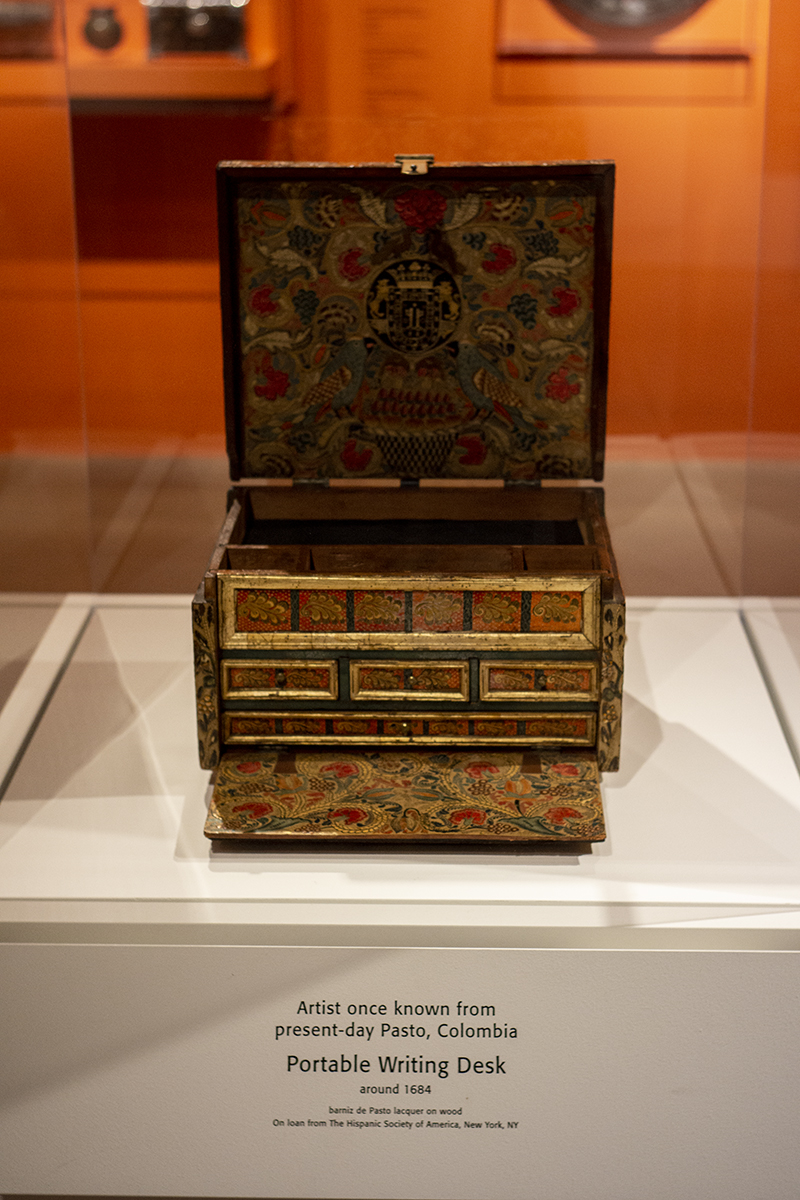
I was at the Art Gallery of Ontario today, and I stopped one more time by the exhibition Faith and Fortune: Art Across the Global Spanish Empire. Along with the many artworks and historical insights, I especially took note of something I saw on several placards describing artworks:

“Artist once known.”

Think of how many times you’ve been in a gallery or a museum for an exhibition of artifacts from other times and places and seen a placard detailing a work by someone whose identity is not known. Do you remember what it said?

“Anonymous.”

“Artist unknown.”

Or nothing at all, just the place and date.

We all know, but I’ll say it to make sure it’s acknowledged: Everything that has been made has been made by someone. 

And while things made in factories are made by people following the designs of other people and they generally have no expectation of recognition, every singular handmade work of art or craft has been made by someone who has done it in a way no one else would have done quite the same, and most of them were done by people who were certainly known at the time the artwork was completed, even if not for long after. And we can’t assume they didn’t care whether their name was remembered.

We often call works by unknown artists “anonymous.” This is so common in music from earlier times that the different composers known as Anonymous are numbered for identification (because we know all these pieces are by one person, and all these by another, but we don’t know their names). One prolific medieval composer even has an eponymous quartet: Anonymous 4. But those of us who work on bibliographies often make the distinction that Anonymous means that the person deliberately did not want their name to be known (like an anonymous donor to some art institution, say), whereas a person whose name is unknown just by happenstance is Unknown. (Or is just not named: depending on your house style, you may cite articles by unknown authors just by the title.)

The thing about unknown, though, is that it has a timeless air to it: the question is not raised of whether it had ever been known. The name is treated as if it had never been known. (To say nothing of giving only a title or description and not even a substitute for a name.) And, on a moment’s reflection, we know that that is not true. At least one person knew – and probably more than just one. It’s only unknown to us.

Which is why I really like “Artist once known.” It’s accurate, and it also reminds us of the person, and of the erasures and erosions in the river of history. Not only that, you could say it leaves the door of possible knowledge ajar: if once, why not future? Who is to say we might not find out, at some future time, the name and other details about the person who made it? It’s not very likely, but such things happen once in a while.

Now, once known is a perfectly suitable and clear term. There is no need for a classically derived term. But there is also no need for all sorts of fun things that nonetheless do no harm and that some of us still want. Museums are known to have a few. And I enjoy words (did I need to say this?). So… what word could we use in counterpoise to anonymous?

There isn’t an established word for ‘once known’ to match up with anonymous. So I decided to do a little messing around with the Lego kit of Classical Greek. Why Greek? Just because anonymous is from Classical Greek, from ᾰ̓νώνῠμος, meaning ‘no name’. So in place of ‘no’ we want… what?

I looked at a number of possibilities. I had uneasily settled on potonymous or poteonymous, using ποτέ, pote, meaning ‘once, at one time’. But there’s not so much likelihood of that being remembered, used, and for that matter pronounced suitably by English speakers. 

So I am suggesting proteronymous, from πρότερος ‘before, earlier’ plus the same -onymous root (from ὄνῠμᾰ, Aeolian and Doric version of Attic ὄνομᾰ). Easier to deal with for Anglophones. I acknowledge that ‘once, at one time’ is semantically slightly better than ‘before, earlier’, but usability is a thing, you know? And anyway, it’s only for people for whom once known isn’t quite fancy enough… and those of us who fancy another word just because.

And if it passes into general use and no one remembers that I was the one who first glued those two bits together… it’s OK. I don’t mind. It’s not an artwork I toiled many hours on. Unlike paper money, a word is only truly verbal currency when it has no one’s signature on it.

trice

If you know this word, I am willing to bet that it brings a line of poetry to mind instantly. Not necessarily the same line for everyone, but my guess is that for a great many of us (Canadians especially) it’s from “The Cremation of Sam McGee” by Robert Service:

It was jammed in the ice, but I saw in a trice it was called the “Alice May.”

How about I give the whole stanza for context:

Till I came to the marge of Lake Lebarge, and a derelict there lay;
It was jammed in the ice, but I saw in a trice it was called the “Alice May.”
And I looked at it, and I thought a bit, and I looked at my frozen chum;
Then “Here,” said I, with a sudden cry, “is my cre-ma-tor-eum.”

(If you haven’t ever read the poem, read it. If you have, you know what’s going on.) I am also sure that I learned the word marge (in that sense) there, and possibly derelict too (I was young).

There are other places you might know it from, too. “Dolores (Notre-Dame des Sept Douleurs)” by Algernon Charles Swinburne:

Could you hurt me, sweet lips, though I hurt you?
Men touch them, and change in a trice
The lilies and languors of virtue
For the raptures and roses of vice

To the Chief Musician upon Nabla: A Tyndallic Ode” by James Clerk Maxwell:

I come from fields of fractured ice,
Whose wounds are cured by squeezing,
Melting they cool, but in a trice,
Get warm again by freezing.

Rabbi Ben Ezra” by Robert Browning:

Not on the vulgar mass
Called “work,” must sentence pass,
Things done, that took the eye and had the price;
O’er which, from level stand,
The low world laid its hand,
Found straightway to its mind, could value in a trice

(Not the most memorable line, but a beloved poem – or at least its first two lines: “Grow old along with me! The best is yet to be.”)

Perhaps you know it from Shakespeare – King Lear, maybe:

This is most strange,
That she, who even but now was your best object,
The argument of your praise, balm of your age,
The best, the dearest, should in this trice of time
Commit a thing so monstrous, to dismantle
So many folds of favour.

Or Twelfth-Night:

I am gone, sir,
And anon, sir,
I’ll be with you again,
In a trice,
Like to the old Vice,
Your need to sustain

Or The Tempest:

On a trice, so please you,
Even in a dream, were we divided from them,
And were brought moping hither.

Or maybe you think of the song “Violets for Your Furs,” by Matt Dennis and Tom Adair, first sung by Frank Sinatra (and later by many others):

It was winter in Manhattan, falling snow flakes filled the air
The streets were covered with a film of ice
But a little simple magic that I heard about somewhere
Changed the weather all around, just within a trice

Or perhaps you think not of poetry but of Jane Eyre by Charlotte Brontë, in which at one key moment Rochester says (though not to Jane) “I’ll make you decent in a trice.”

Or maybe you like rap music and are familiar with Obie Trice (which, atypically for rap artists, is his real name, no gimmicks), or maybe you know (or know of) someone else with the family name Trice. But that won’t tell you what trice means.

Or just maaayyybe you were in the US Navy and regularly heard the shipboard reveille announcement, which includes “all hands heave out and trice up.” But if that’s where you know it from, you might have a different sense of its meaning.

If you learned the word from poetry (or fiction), then you will almost certainly have gotten from context that a trice is a very short period of time, a moment, an instant; a thing that happens in a trice or on a trice or within a trice happens lickety-split. It also, thanks to rhyme, has an above-average likelihood of involving ice, or perhaps vice, or some price (or something nice?). 

But where does the word come from? It looks like twice and thrice, but it’s not twice and certainly not thrice, it’s once and immediately. Does it relate to truce? But how could it? A truce is an indefinite suspension of hostile activity, something that is expected to last far longer than a mere moment. Perhaps trace? But a trace is a scintilla of evidence, not a scintillation of a star or spark. Um… tryst? Oh, come on. (And if you know the Spanish phrase en un tris, literally ‘in a crack’ – tris means ‘crack’ – and having very much the same sense, I regret to say that English in a trice is too old to have come from that. But hmm.)

In fact, the navy reveille gives the clue, though the trail might be hard to follow at first. The origin is a Dutch word, noun trijs, ‘pulley, hoist’, and verb trijsen, ‘hoist’, from which a less specific sense ‘pull suddenly’ or ‘snatch’. And so a trice came to be a term for the amount of time it takes to do a single pull on a hoist – about a half a second, if the timing in the shanty “Haul Away Joe” is any guide.

Funny, though. The word trice hardly seems heavy enough to bring to mind such a muscular action – more like tripping lightly across the ice. Ah well, what it signifies no longer requires the pull of the original; if you wish to think of it simply as a thin slice of time, or some similar choice, you may. After all, we all (or nearly all) know it from poetry, and light verse in particular. And if you happen to drop it into conversation – “I’ll be there in a trice” – it’s more likely to have the tone of “I’ll be with you in the squeezing of a lemon” than of “I’ll arrive in the jerk of a hoist.” Provided your hearers know the word at all, that is.

stern

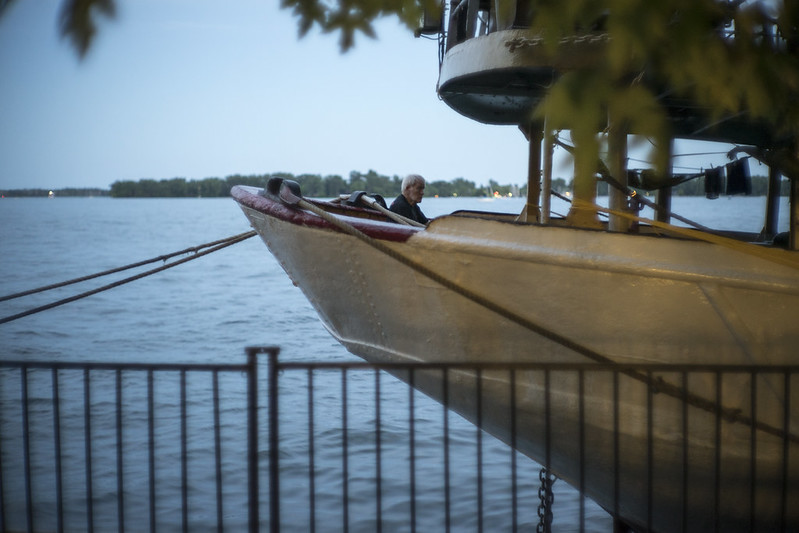
I’ve learned that if you take pictures of people in the backs of boats, you get some stern looks.

OK, ha ha. Look, at least I’m not doing that other grand old word for the back end of a boat. There’s a lot of play to be had with “back end” and poop, and you should thank me for not stepping into it. (By the way, poop for ‘back end of a boat’ traces back to Latin puppis meaning the same thing, and has no actual etymological relation to that other poop – which appears to come from an onomatopoeic word for breaking wind.)

I’m also sure that the phrase from prow to poop isn’t as popular as the synonymous from stem to stern for reasons of relative ridiculousness. Anyone who deals with children knows that the moment “poop” enters the conversation, anything stern is doomed.

But how is it that there is stern meaning ‘back of the boat’ and stern meaning ‘severe, humourless’? Let’s start with the latter one. It’s from an old Germanic root meaning ‘rigid’; it came into modern Scots as stern meaning ‘resolute, courageous’, but into modern English with a rather less inspiring sense of ‘grim’ or ‘severe’. It’s been in English for as long as there’s been an English for it to be in, first in forms like sturne and styrne and later shifting to steerne and sterne.

It could seem reasonable for the back of a ship to be strong and resolute, right? After all, it’s the place the boat is guided from. And that’s right: it is guided from there. It’s also right in that the nautical stern is directly related to starboard, as in ‘right side’. But neither has anything to do with sternness. Rather, they have to do with steering – in fact, etymologically, with steering. Stern comes via Old Norse from the same root that gives us steer; it showed up in English around the year 1400 (thanks to Norse invaders who occupied a large part of England around then), in forms like steerne and sterne. Steer had already been in the language, long enough in fact that by about 1500 steereboard – so called for the side of a smaller boat that a right-handed helmsman would steer from – was becoming starboard, inevitable subject of folk etymologies.

But of course the bigger boats were being steered from the back end. Hence the name stern, because it’s where you steer the boat – where the rudder and the wheel are. Rudder obvious once it’s pointed out, isn’t it?

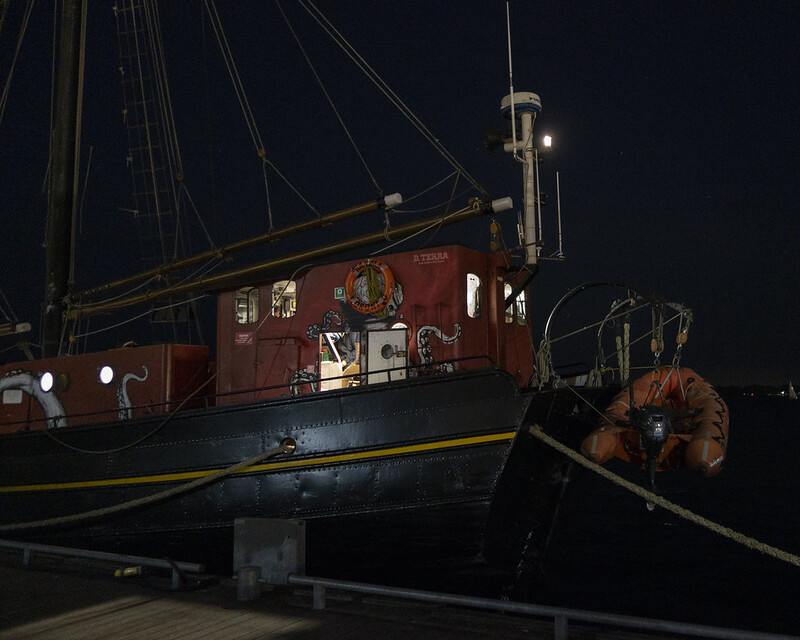
prow

Why wouldn’t the catamaran race with the other boats?

It was two prowed.

OK, OK, take a bow. You might as well; there’s two of them.

No, I’m not going to get into bow here; there are only so many hours in my day. I’ll just mention that bow as in the prow of a ship is related to bough as in a tree branch but is not related to bow as in bend from the waist or to bow as in tied ribbon. But mainly I’m here to tell you that prow is related to proud.

Oh, no, sorry, I don’t mean the prow that’s the front of a ship. That prow is related (way back, passing through Latin prora, which meant the same thing, and Greek πρῷρα, ditto, to Proto-Indo-European *pró) to pro as in professional and in every other word with the prefix pro-, as well as to premium and every other word with the prefix pre-. But it’s not related to proud.

So there’s another prow? There is, not only noun but verb and adjective as well. The noun means ‘advantage’ or ‘benefit’; you could speak of “the common prow” or of “doing someone prow.” The verb means ‘be of advantage’ and typically took (no one uses it anymore) an indirect object: “It would prow him.” The adjective means ‘worthy’ or ‘valiant’ and has in particular been seen several times in literature (from Spenser’s Faerie Queene through Tennyson and Hardy) in the phrase “the prowest knights.”

And is proud thus originally prowed? It is not. The derivation happened much earlier; in fact, like prow, proud comes from Latin prodesse, ‘be of value’; it kept the d in point of pride, whereas this prow did not. And then its vowel changed to derive pride from it, in a way similar to how we got fill from full and length from long. (This is called umlaut, a word most of us know as a metonymic term for the diacritic used to indicate it in some other languages.)

So the next question is… is this prow related to prowess? And yes, it is. Prowess is derived from prow (though the derivation happened in French, which English got it from; prou became prow and prouesse became prowess). Originally prowess referred to a valiant act, or to valour in general; over time it extended in sense to mean any particular skill… though it does still have some overtone of valour or at least of force, doesn’t it? Perhaps like a prow slicing proudly through the waves.

Which takes us back to the first prow, which also came to us from French (proue), which got it from Latin. You will recall I said that traces all the way back to the same Proto-Indo-European as gave us pro. You may also remember that I said that proud and prowess and so on come from Latin prodesse (‘do good, be of benefit’). Well, now I must note that that is the infinitive of the Latin verb prosum, which may look like a command in Excel but is from pro- (as in ‘before’ etc.) plus sum (‘I am’). So…

…yeah, I was untruthful. Proud is closely related to prowess and the prow you probably didn’t know about before, but it’s also distantly related to the prow of a boat. 

So I misled you. I’m not proud of it. But please don’t be stern.

Cockaigne

I’m thinking of Cockaigne today because on Twitter there’s been some discussion of what restaurants people thought were a real treat when they were young – someone had said mean things about Red Lobster and the Olive Garden, and while we didn’t have either of those when I was a kid, we sure looked forward to steaks at Ponderosa – and also because Michelin has announced its new Canada guides, including mention of restaurants in Toronto, some of which I’ve even eaten at. And, yes, the food at a Michelin-starred restaurant is quite the indulgence, but on the other hand, there’s a lot to be said for a bit of good old comfort food, y’know? Sometimes you want quality, other times quantity; sometimes you want delicacies, other times… indelicacy.

But what what would your Cockaigne feature? If you could drink one thing all day long, would it be champagne or Coke? If you could eat whatever you want, would it include cake, or coq au vin, or some other kind of cooking? If you were at leisure with unlimited resources, would you spend your time relaxing at a grand beach resort or skiing at a little tucked-away place? If you could indulge in any sensual pleasures you wanted, what would be the relative balance of wanton sexual adventures versus reading books in a bubble bath?

If you’re not familiar with Cockaigne, or have seen the word but aren’t sure of its reference, allow me to introduce you. It’s a mythical land of indulgence, first concocted in the medieval era. The origin of the word is uncertain, but probably has something to do with cakes. It has versions in various languages, such as French Cocaigne (the source of our English word), Italian Cuccagna, and Spanish Cucaña; some other languages have different names for the same place, such as Dutch Luilekkerland, German Schlaraffenland, and Swedish Lubberland. It’s not etymologically related to Cockney, although an association has occasionally been made and Edward Elgar played on it in his concert overture “Cockaigne (In London Town).” And it is not at all related to cocaine, a word it pre-dates by more than half a millennium (cocaine is just from coca plus -ine), even though cocaine is probably the sort of thing that some people might want in their Cockaigne.

I’ve looked at this general topic before, a dozen years ago, when I tasted thelemite; I noted that Rabelais’s vision of a “do what thou wilt” place required maid service, meaning there were some people who were apparently not so free (unless they wanted nothing more than to be fancy maids, I guess), and I considered the 1920s hobo song “Big Rock Candy Mountain,” which to me sounds like a land full of indolent people with tooth decay and desolated livers, although I suppose if we’re doing fantasy anyway, we might as well fantasize that you can eat and drink all the crap you want and suffer no ill effects. I mean, it’s hardly paradise if you wake up with a flensing headache, right?

Anyway, fantasy is fantasy. It exists precisely because our lives are frankly insufficiently gratifying. But our fantasies often reflect our priorities in ways that reveal the chains we still gladly wear (and also the chains we’d like other people to wear, as Rabelais showed). Some people’s fantasy cities, for instance, have freeways you can drive through them at high speed, unobstructed (a staple of mid-20th-century urban visions); others’ fantasy cities entirely obviate driving: step out your door and everything you want in any normal week is steps away, and you can take a fast train or even an easy bike ride to get to other things and places when you want. Introduced to a Cockaigne, would we be like Little Orphan Annie who, when asked what she’d like to do first in the mansion of Daddy Warbucks, said “The windows, then the floors”?

Even if we can cast off all chains and just talk about things people enjoy, it’s plain not everyone agrees. Many people could spend their whole lives lolling on a beach and never once be cold, but there’s a reason that the only resort I know of called Cockaigne is a cute little ski area in New York State (I’ve skied there; it ain’t Whistler, but it’s gemütlich). And while I first saw the word Cockaigne in the name of a recipe (I can’t remember what it was for; I’m nowhere near my mom’s cookbooks right now), if you search for recipes with Cockaigne in the name, you’ll get quite a variety, everything from brownies to chicken breasts. Both of those, in fact, are from The Joy of Cooking; my mother didn’t have that book, but it seems to have been a vector for use of the term—the authors explain in their foreword to the 1967 edition, “in response to many requests from users of ‘The Joy’ who ask ‘What are your favorites?,’ we have added to some of our recipes the word ‘Cockaigne,’ which signified in medieval times ‘a mythical land of peace and plenty,’ and also happens to be the name of our country home.”

Well, ha, mythical land of peace and plenty, sure. I mean, that’s true, but I don’t imagine the Rombauers and Beckers had in mind the plenty of social inversion and plenty of wild shagging that the author of the medieval poem “The Land of Cokaygne” described. They might have been OK with the skies raining cheese, I suppose, but only depending on their lawn furniture. And they most certainly would not have envisioned the kind of company or consequences described in “Ego sum abbas Cucaniensis,” “I am the Abbot of Cockaigne”:

Ego sum abbas Cucaniensis
et consilium meum est cum bibulis,
et in secta Decii voluntas mea est,
et qui mane me quaesierit in taberna
post vesperam nudus egredietur,
et sic denudatus veste clamabit:
Wafna, wafna! quid fecisti, Sors turpissima?
nostrae vitae gaudia
abstulisti omnia!

I am the Abbot of Cockaigne
and I keep counsel with drunkards
and prefer the company of gamblers
and who seeks me in the morning in the tavern
will leave naked after vespers,
and stripped naked he will cry:
Oh no! Oh no! What have you done, most filthy luck?
All the joys in life
you have snatched away!

Just gets a bit too… real, doesn’t it? No need to go all medieval on people, so to speak. A scenic spa with coquilles St. Jacques and champagne—and nothing to risk losing—seems like a nicer starter pack.

Blackpool

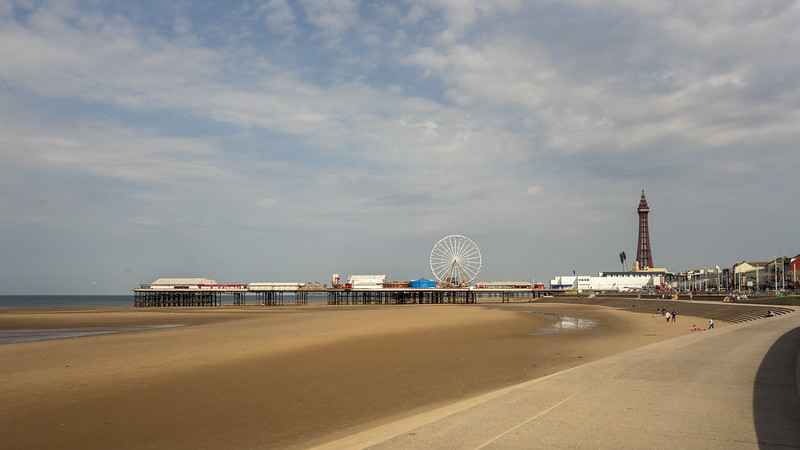
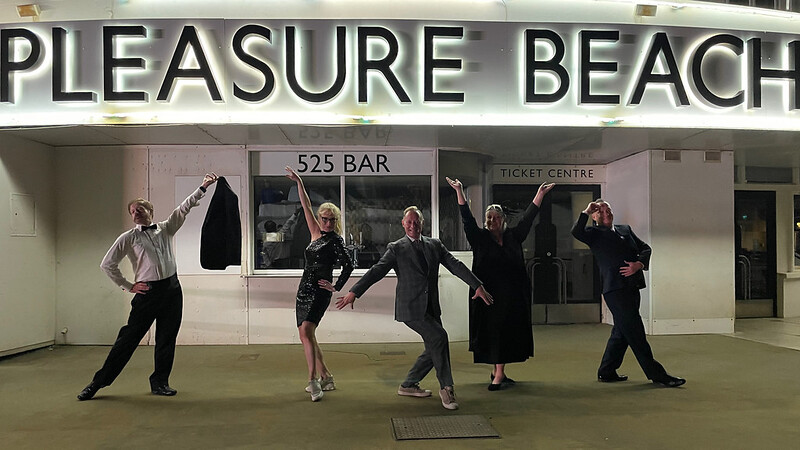
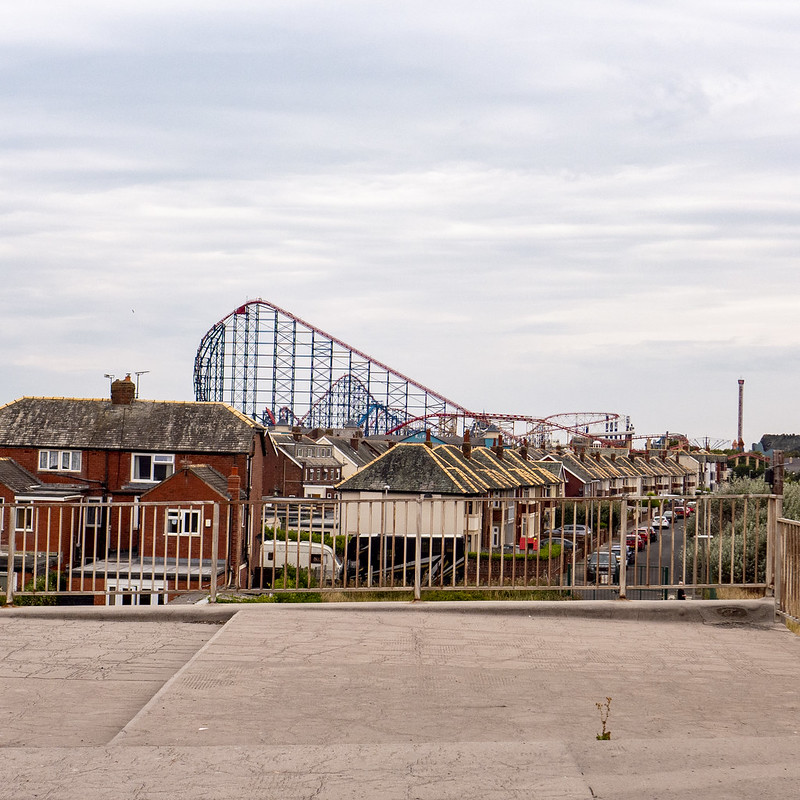
I was recently in a town that has famously been called “a famous seaside place.” In its heyday, it saw up to 17 million visitors a year. It has a lovely sandy beach seven miles long. It has a famous festival of lights, a famous amusement park called Pleasure Beach, famous entertainments…

I’d often heard of Blackpool, but this was my first time visiting.

What, you were expecting Boca Raton? Well, at least Blackpool’s name doesn’t mean ‘rat mouth’. (Things can sound so much less uncharming when not in one’s home language. Translate ‘Blackpool’ to Irish and you get Dublin – or, technically, its etymon, Dubh Linn, though the Irish name of that city is Baile Átha Cliath.) It’s named as it is because one of the local streams poured a black effluent into the sea from a peat bog it passed through. (No sign of that when we were there, but we did get told that there had been a “pollution incident” at one of the piers and we should probably not be in the water.)

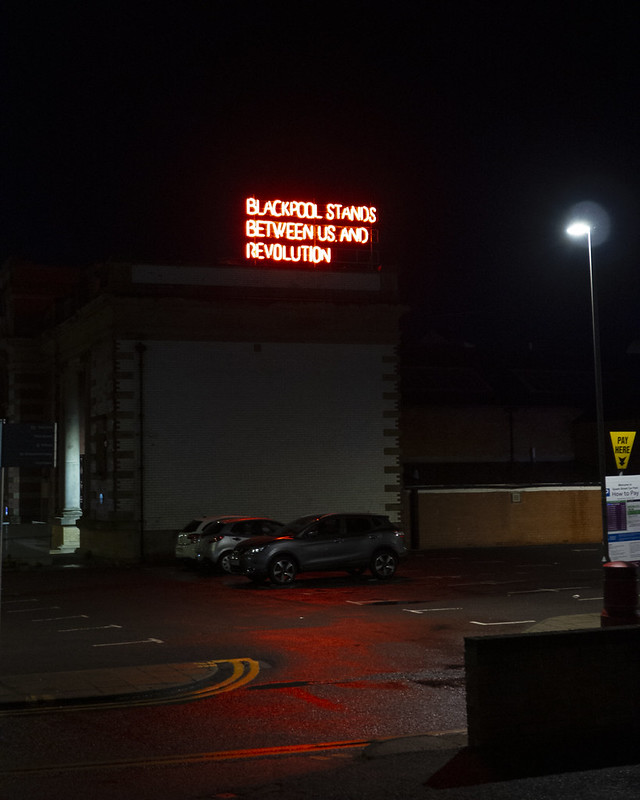
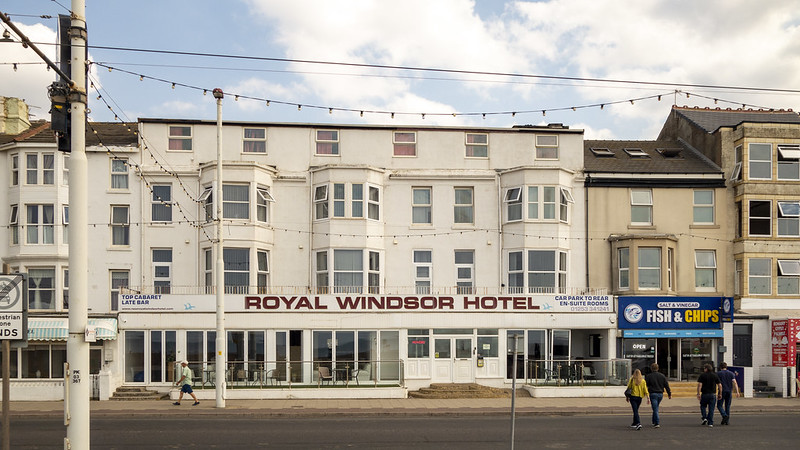
Admittedly, “Blackpool” doesn’t sound as bright as “Brighton,” but that doesn’t seem to have bothered Britons. It was the most popular holiday resort in England in the late 1800s through the middle 1900s. For factory workers in the north of England, who for a long time all got a week off every summer – each factory would close for a week, but they didn’t all close on the same week – Blackpool was a lovely place you could easily get to by train and wouldn’t blow your bank account on. The Romans had panem et circenses; the English – especially the northern English – had Blackpool, with its beach and entertainments. No wonder an anonymous businessman is quoted as having said, in the 1920s, “Blackpool stands between us and revolution.”

(That quote is currently featured in a prominent public artwork by Tom Ireland.)

Blackpool was the first city in the world to have electric street lights. It has the oldest still-operating tramway in England. It’s the only town in the United Kingdom with three piers. It has what was, when it was built, the tallest structure in the British Empire. Its opera house, when opened, was the largest in Britain outside of London. And it is home to the oldest purpose-built ice theatre in the world.

Which, by the way, is why we were there: my wife, as you may know, is a former professional figure skater, and there was a reunion there for people who skated in Holiday On Ice. 

Ice shows have, like Blackpool, outlived their peak days, and most of the people in attendance were somewhat older than us (and we’re over 50 these days too), but Blackpool still has an ice show, Hot Ice, that runs every summer with extremely skilled young skaters, and it was a highlight of the reunion. And I have to tell you, it was one of the most impressive ice shows I’ve ever seen. The calibre of the talent is stunning. But aside from the hundred or so there for the reunion, there didn’t seem to be more than a couple dozen people in the audience. Perhaps they were all at the beach or riding the roller coasters.

In truth, many a modern beachgoer might think Blackpool better suited to ice rinks than to summer holidays. It’s true that its average daily low never dips below freezing (though its record low is –15.7˚C), but its average daily high never gets above 20˚C for any month of the year, and it averages fewer than five days a year over 25˚C. But you take what you can get.

Everyone I talked to who knew Blackpool from the later 20th century agreed that Blackpool used to be very nice. They also all agreed that it has… gone downhill a bit. 

The Blackpool economy still relies very heavily on tourism, but tourists in recent decades have been able to take quick and cheap flights to the Costa del Sol. A British co-worker of mine in Toronto was gobsmacked when she discovered how much our equivalent, a trip to the Dominican Republic, would cost. I should have suggested she try Wasaga Beach on Georgian Bay. It’s warmer on average in the summer than Blackpool (though not than the Caribbean); it’s the world’s longest freshwater beach, longer than the beach at Blackpool; and it’s only as far from Toronto as Blackpool is from Sheffield… but there’s no train from here to there anymore.

At least you can still get to Blackpool by train, as we did. The train helped make Blackpool; of that there is no doubt. And cheap airfare has helped unmake it. But other factors have also played a part: the decline of the factories, for instance, which were such an important source of annual visitors. They would go to Blackpool to feel good about life. With them gone, Blackpool itself doesn’t feel quite as good as it used to. Indicators of social well-being (such as health conditions, divorce rates, and employment) are in a bit of a… dark pool. This is not to say that the town can’t rebound. But it’s not the only place in England lately that’s seen better days. So… if Blackpool stood between businessmen and revolution, who’s standing between Blackpool and revolution?