Category Archives: word tasting notes

encave

What is it about us that we think we are immune if immured? The world is big and full of variety, and help comes from others, but so does danger, and many of us, faced with the temptation of an overbuilt cocoon, cave in and encave in an enclave, urban (and suburban) troglodytes warming ourselves at the blue flicker of giant flat screens – the new silhouettes in our Platonic caves. It is so craven to cave in so, to crave encavement. In the yard perhaps is a sign signifying cave canem (‘beware of the dog’), the pooch positioned to protect us – forgetting as we do that in Goethe’s Faust the devil appears as a poodle – but our motto may as well be cave diem (‘beware the day’).

Do I overstate the case? Go into the newest neighbourhoods and see: vestigial yards fronting overinflated balloons of boards, bricks, and vinyl siding, a mere metre gap between one and the next, as if on compact archival shelving for house models. No life outdoors; even when you evacuate you encave: hop in your moving imperial shell to get to shopping or work, joining others to make a metal-and-glass bubble-wrap unrolled along the “free”way.

So we are encaved. It is a simple enough word: en ‘in’ and cave ‘cave’ (obviously) from Latin cavus ‘hollow’ as in concave and cavity. But look in two dictionaries and see two slightly different senses. In Webster’s Third New International Dictionary, it is, succinctly, “to hide in or as if in a cave.” In the Oxford English Dictionary, it is “To enclose or shut up in, or as in, a cave.” Both are shown as transitive: you do not encave, you encave yourself or someone else. Both allow an “as (if) in,” so I can say we are encaved and not add figuratively. But there is the difference between “hide” and “enclose or shut up.” You may be enclosed or shut up but not hidden (a glass cave?) and hidden but not enclosed or shut up (duck behind a rock?). The difference is in perspective and who is restrained. Is it that others are kept from seeing us, and we are free from their gaze? Or is it that we are kept from leaving, and others are free from our presence?

And can we easily tell which is which? And when one becomes the other?

keck, kecks, keckish, kex

There are times when you feel… keckish. Your throat feels like one of those hard hollow plant stalks, or a pants leg dipped in saltwater and dried out, rigid, astringent. It is as if someone has stuck a popsicle stick too far back in your gullet. You can’t kick it; you keck, keck, keck!

Keck, verb, means ‘gag’ as in ‘try not to vomit but not have an easy time of it’. It can be used figuratively (with at) to refer to expression of disgust: “Ugh. I keck at that jackass’s expectorations.”

Keckish means ‘inclined to keck’; it’s disused but useful, and has a synonym kecklish.

Kecks plural can refer to pants: in Scotland and northern England, your kecks are your trousers, and if you’re caught with your kecks down, you’re in an embarrassing spot. That usage comes from kicks, as far as we can tell.

Kecks seems not to have to do with kex, also seen as keck, which like pants legs is tubular but is harder and smaller – it’s a hard hollow stalk of an umbelliferous plant such as cow parsnip, wild chervil, or marsh angelica (as Oxford tells me). The x may lead you to expect a Greek origin, but no, not as far as we can see. On the other hand, we don’t quite know just what lexical marsh it did sprout out of.

What a keck-collection! It’s nothing to cough or scoff at; it kexceeds kexpectation (but not kexpectoration).

So. If the sight or sense of a strawlike stem in his dungarees makes a fellow gag, that means he kecks at kex in his kecks… just for kexample.

sheel

To sheel is to shell, meaning to de-shell.

And when you peel away the shell, how does it feel?

Clams and mussels are shell without and flesh within, which means that without the without they are soft. Turtles, de-shelled, are soft but have bones farther in. Humans have the hard deep within and are soft without – so we cannot be without something hard to go around us: buildings, and cars, and the assorted armour of culture. The world is our oyster because we are cultured oysters in our world: we build our shells and then take what irritates us and build shells around it so we have pearls. Of wisdom? Of great price? Of art? Sheel us and find out.

One sheeler I think of is Charles Sheeler. He was a photographer of things industrial, and a painter of them too. Factories, buildings, chimneys, bridges, iron scales, slate roofs, the hard diagonals and sharp angles of steel and stone: the bones and shells of our culture and means, all rendered with exquisite precision. Do have a look at some.

I first met Sheeler’s work in the Museum of Fine Art in Boston; I went there often to swim in the paintings. Take the red subway and the green streetcar (E) and walk a block until you are almost in a lush little fen-way park, and there is the flat stone face. Go in and you will know that museum smell. Upstairs, go left, then right, halfway to the other end, turn right, and there in the centre of it all is a gallery of moderns. The Sheeler is on a half-wall in the middle, facing left. Or at least it was two decades ago. Shale-grey steel carrying steam, an image of what we have made to produce things to protect us and convey us. This hardness we’ve produced, now flaked off in a flat pinacothèque rectangle for us to admire and see ourselves reflected in its sheen. Other painters show people; Sheeler’s pearls were our shells: he sheeled them for us. Does that seem inside-out? Remember that a pearl is just shell grown in the other direction. The outside is deep inside, a universe locked in a grain of sand; the inside is all there is to see, and it shines at the infinite within without.

Where does sheel come from? It is related to shell, of course, but also (and perhaps more closely) to shale. Shale was first a word for a husk, a covering; from that (we think) we got the name of the rock. And all this is also related to scale. As we scale the sheer heights in our buildings, so we scale the heights of our art, and we weigh our lives in the scales and the scales fall from our eyes. But we never stop making our shells within and without, even as we ever look to the sheeling.

frontline

Who is at the frontline of language change?

Sorry, should that be front line? I think it should. If you are at the foremost front, you are at the forefront, not the fore front, but the line that forms the front of a battle – or, more figuratively, any other advance (especially in conflict situations) – is the front line, according to, well, every dictionary you look in.

But a lot of those dictionaries have frontline too. Not as a noun, though: as an adjective. Staff who are dealing directly with customers are front-line staff or frontline staff. If they were written as front line staff, there could be confusion over whether they were line staff at the front rather than staff at the front line. So we hyphenate. And, over time, as with this adjective, we may merge.

Or we may not. Mergers happen sometimes and not other times. You can be a healthcare professional working in health care – or working in healthcare, because that noun has a closed-up version now too. And you’re reading this on a website – or, to be old-fashioned, a web site. But you can have an ice cream float or an ice-cream float, but if you had an icecream float you risk having some pedant with a marker draw a couple of lines to indicate that there should be a space there, implying that you need grammatical trainingwheels.

The front lines, in language change as in war, are very uneven, meandering up and down and in and out, and the main thing that keeps them from moving is just if they get really entrenched (yes, when you think about it, front line and entrenched both call to mind the ghastly battles of World War I – both predate it by centuries, but both have military origins).

So… could frontline become the noun form too? Some people want it to be – a colleague mentioned to me that one of the people he works with is pushing for that change in their published text. Mind you, his coworker isn’t saying “I know that front line is standard, but I think we are making a good move forward to close up this compound. We may be in the, erm, vanguard, but we can take the fire.” No, his coworker is saying “I looked in the dictionary and it has frontline as a form so I’m going to use it everywhere.” His coworker is heedless of the noun-adjective distinction.

Which is how language change so often happens: reanalysis, or what members of preceding generations tend to call mistake. The English language isn’t really an ongoing battle – if there is an enemy, they are us. It’s more like a complex game that gets passed on from one family to another, and it doesn’t have a rulebook, and each new group of players pick up a few things from the previous players but mostly figure things out for themselves, resulting in some shift of the rules over time. We hear our parents talk, and we work things out for ourselves, and they don’t correct all of our reconstruals.

So, yeah, you could say that the front line in language change is the battle between the older generation, wanting to preserve what it knows, and the younger generation, wanting to do what suits them best. But from another perspective, the battle is as much like explorers having to put up with previous people – who didn’t get as far – shouting at them “No, you fools! You’ll fall off the edge of the planet!”

Fine, fine. The question remains: is frontline taking over from front line as a noun? Is it heading the way of healthcare and forefront? Will we soon see not only the frontline but the frontlines just as we see the headlines? Or is it like icecream and trainingwheels? Let’s have a look at a Google Ngram:
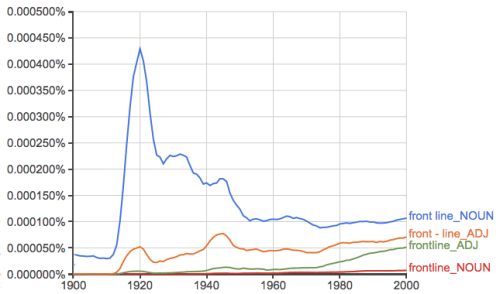
frontline_NOUN is way below front line_NOUN and both adjective forms, and not gaining very much

Hmm. Nope. Anyone who uses frontline as a noun is going to be awfully far in front of everyone else, exposed and prone to being shot at… from behind. And the general usage may not ever come close to catching up. It looks pretty well entrenched.

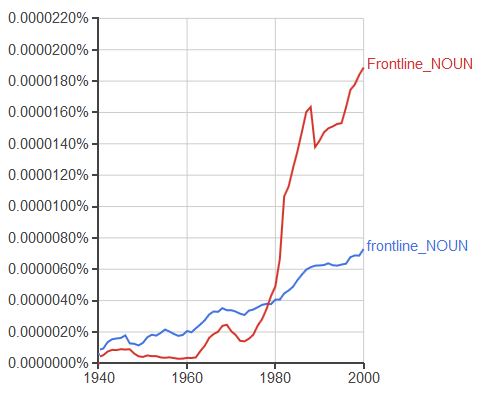
Addendum: I neglected to consider one important vector for change in this. Google ngrams are case-sensitive, and I only surveyed lower-case. But take a look at this:
Frontline-1

So Frontline is increasing in usage much more than frontline. Why is that? I’ll tell you one reason. Since 1983, PBS has had a documentary series called Frontline. TV shows are important vectors for language change.

But that doesn’t mean the branding of the show is spreading the one-word noun throughout the language rapidly. A brand is a brand and may stay as such. Let’s put this in perspective:

Frontline-2

After all, it’s on PBS, not NBC, ABC, or CBS. Public broadcasting is at the front line of knowledge, but most people don’t actually like to get too close to the front line. At least not intentionally.

winsome

You win some, you lose some. But if you’re winsome, how can you lose?

Winsome doesn’t mean you tend to win things. Well, OK, hearts, agreement, devotion, prizes for the best smile, those sorts of winning ways, sure. But it’s not quite like meddlesome or quarrelsome. The win that it’s for is not the win of competition – from an old Germanic verb meaning ‘labour, exert, contend, fight, gain’ – but the otherwise-disused win of joy and delight, from Old English wyn (or wynn), related to wish and more distantly to wine (but if you’re winsome and you wish for wine, you will surely win some). So winsome means ‘delightful, agreeable’ and refers most often to manners, mannerisms, or appearance.

I’m sure we all know someone who is exceptionally sweet without seeming fake – someone you like as soon as you meet them, and keep on liking thereafter. In the world of figure skating, I’m told Jason Brown (a current leading men’s single skater from the US) is such a person, and he certainly has a winsome smile. In the world of words, Carol Fisher Saller (of the Chicago Manual of Style and Subversive Copy Editor) may as well have her picture next to winsome in the dictionary. But in my own world, my wife (Aina) is the winner, and then some. Herewith I present evidence:

Obviously all you see from that is her smile when in a state of bliss, as for example when she is holding a bowl of sauerkraut in a Hofbräuhaus. But I can assure you that she has delightfully winning ways. The set of all the people who like both me and her is the set of all the people who like me (there may be a few, I’m not sure) and have even so much as met her. She gets me invited to social occasions just because I come with the set. (Ironically, she is more introverted than I am, and often has to be dragged to events.)

It’s unsurprising that smile is the word most often described by winsome. But other things can be winsome too. A person can have a winsome manner, for instance, or a winsome laugh. The term is sometimes used just to mean ‘good looking in an unthreatening way’. Which describes quite a lot of the editors I recently finished conferencing with in St. Petersburg, Florida. Relaxed, happy, cheery, non-threatening – I mean, yeah, that’s pretty usual for people at a collegial conference in a warm place. But these ones have the edge of both being winsome and knowing it. Not knowing that they’re winsome – knowing the word winsome and how to use it.

flabbergast

Flabbergast. F-L-A-B-B-E-R-G-A-S-T. Flabbergast.

This would make a good spelling bee word, wouldn’t it? Other than its being reasonably well known and predictable. It sounds long and floppy and loosely jointed, garrulous as a flibbertigibbet, frenetic as a flutterbudget, verbally flabby and flatulent (gaseous) and ultimately aghast.

Well, especially aghast. The word may be fluttering and rubbery but its meaning is slackjawed: “to overwhelm with shock, surprise, or wonder,” to quote Merriam-Webster (m-w.com). The Oxford English Dictionary shows us a nice quotation well suited to our times: “Now we are flabbergasted and bored from morning to night.” That does seem the incessant go-round of digitally mediated modernity, no? But this observation was made in 1773, in the Annual Register for 1772, in a jeremiad on faddish new words, signed “Observator,” and the author was inveighing not on the state of life but just on the words used to speak of it.

So flabbergasted (and flabbergast) was new in 1772. Where did it come from? There has been speculation and there have been observations – related forms in Suffolk and Perthshire – but no one knows (yet). It is likely a collision of flabby and aghast and who knows what else, formed on the basis of sound symbolism and phonaesthetics on the nonce by some fashionable lark in London society and passed about as a bit of the latest lexical frippery.

And it has lasted, especially among those who love lively syllables. I had occasion to use it myself lately when I described a haul of prizes from a spelling bee. You see, the ACES (American Copy Editors’ Society) conference, in St. Petersburg, FL(abbergast), which I was attending, had a spelling bee sponsored by Lingofy, with officials from Merriam-Webster and Scripps, to raise money for the ACES Education Fund scholarship program. There were 15 entrants and a goodly audience. It went to 7 rounds, I think. And the last person standing, successfully spelling agelast, A-G-E-L-A-S-T, was… me. For which I won a nice little lucite trophy. And a Bananagrams game. And a copy of Webster’s Third New International Dictionary, Unabridged, which weighs 18 pounds. And an iPad Pro. And a messenger bag to carry it all in (which I did, and was nearly Grendelized, disarticulated at the shoulder by the weight). Flabbergasting indeed.

breth, brath, broth

There are some people whose every breath is wrath. They don’t merely stew; they are a seething broth of ire, ever at the boiling point. They are a bucket of gasoline looking for their perfect match. They are not just brash, they are brath, broth, full of breth.

These are old and disused words, breth and brath and this sense of broth. They all come from the same Old Norse: bráðr, ‘hasty, sudden, rash, passionate’. One might say ‘impetuous’. ‘Quick to anger’. All up in your Face-book. A-Twitter with rage. Except that no one has really used them for a bit over 500 years now.

That’s not that surprising. Breth, a noun meaning ‘fury’ or ‘rage’, sounds exactly like breath and while it can make neat wordplays – such as this line from a play written in 1500: “While I am in this breth, let me put him to death” – it is likely to cause confusion. True, a beautiful sight can take your breth away, but “fresh breth” may be misleading. Still, there could be some value in calling the raging trolls of the interwebs the breth-ren.

Broth, for its part, is of course going to land you in the soup. The broth we know is derived from brew just as sloth is from slow and death is from die. This other broth, an adjective meaning ‘impetuous, violent, wrathful’, has no origin in common with its doppelganger. And while it’s true that in some kitchens every day is a broth day, some may find it a bother to have to deal with both. But again, how could we not want to call a member of the breth-ren a broth-er? Aside from the fact that exactly no one would get the wordplay, that is. I won’t even try to anagram it productively into throb.

But brath! Well, now, that’s a word of its own. It’s even two words – the Scottish variant is braith. Brath is the northern English version, broth the southern, of the same word. In the south it’s a bubbling broth, in the north more of a hot bath, one that rhymes with wrath (or, in Scotland, wraith). And it has such a nice taste of brash. It gets that br in there, as in bratty and brusque and brutal and broken, and rhymes with psychopath and aftermath. And we could still make a wordplay with brathren and brather – which would remind us of their steam-powered blather.

threap

As you “SO?!” so shall you threap.

To threap is to make a threap, but not to make a threat – you are not talking of action, you are taking action, and the action is disagreement. You may threap a person, in which case you are rebuking or scolding the person; you may simply threap, in which case you are arguing, bickering, or wrangling about terms; or you may threap that something is so, in which case you are maintaining your position in the face of contradiction or doubt.

Let us imagine a case, let’s say a spokesperson, whom – to spice things up – we may call the Grim Threaper. He is representing some enthroned mammothrept who has not thruppence worth of thrift, but the Grim Threaper has heard that you have said as much, and he calls you out from the throng. He threaps you: you are a very naughty person for threatening the mammothrept’s reputation for thrift. You clear your throat and throw in some facts. He threaps: that is a manner of speaking, and besides the mammothrept did not mean what he said or say what he meant, and in any case he did not say what he said. Your temples start to throb but you thrust forth your evidence. He threaps that it is not so: the mammothrept is the chieftain of thrift. And so the Grim Threaper makes a threepeat, three threaps… but he may threap-eat yet when all is laid on the table (and why not – threptic has to do with eating and nutrition), so he ought to have put more honey on his tongue.

There are more ways you can use threap, too. You can threap someone out of something – wear them down with incessant argumentation. You can threap something upon someone – press it on them, urge that they accept it. You can threap someone down – prevail in discourse through threaping (“A man will say of a clamorous talker, he did not convince me, but he threaped me down” —Richard Winter Hamilton, Nugæ Literature, 1841; thanks to the OED for that and much of the rest of this information).

In short, threaping is badgering, bullying, talking a blue streak, and thereby prevailing or at least attempting to prevail. The word does not have the same bludgeoning bluntness as words that begin with b, and perhaps that is a weakness for modern use: thr can have driving force – thrusting, throwing, thrilling – but the vowel is too high (the same as in “three”) and thereby weak-seeming.

At any rate, you seldom see it. Well, I think it is nonetheless a useful word, one that can come in quite handy in our times. Allow me to insist and to persuade you…

distaff

This isn’t a word you see as often as you once would, but some writers seem to like it for some purposes. Here are a couple of recent hits from The New York Times:

Her apple-cheeked robustness seemingly hollowed out by the final curtain, Ms. Piper vaulted in a single performance to the top ranks of distaff talent in a town where women across the spectrum of age and experience reigned supreme in 2016. —Matt Wolf, “In a Year of Surprises on the London Stage, Women Held Pride of Place,” January 3, 2017

Trump is surrounded by a bitchy sewing circle of overweight men who are overwrought at the prospect of a distaff Clinton presidency. —Maureen Dowd, “Girl Talk at Trump Tower,” October 1, 2016

Another recent NYT hit refers to Batwoman as “a distaff crimefighter.”

Distaff is an old-fashioned or newspaperese word for ‘woman’ or ‘female’ or that sort of thing. Sometimes you’ll see references to “the distaff side.” Those who use it likely see it as a handy synonym to enlist in that texturbation they like to think of as “elegant variation” (also known as tawny-gourd-ism; see pontiff and temblor). It seems to be lacking in negative connotations or connections. I mean, what, exactly, is this word distaff anyway? What does it mean? Where does it come from? I’m here to ’splain it for you.

First off, the staff in distaff is the staff in staff, as in shepherd’s staff and flagstaff.

Next, although it is pronounced with a “short” i as in dis (so not “Di staff”), the di is not short for dis- or de-. Which means that distaff does not mean ‘without a staff’. No, it’s from Old English dise (also spelled dis), which is an old Germanic word referring to a bunch of flax for spinning. “Here, spin dis!” A distaff is a staff about 3 feet long that was used for holding flax or wool for spinning into thread. The spinner held the staff under the left arm and drew the flax or wool through the left fingers, and twisted it into thread with the right thumb and forefinger as it was wound onto a spindle.

Oops! Did I say spinner? Sorry, the word is spinster.

Does that sound familiar? Like, hmm, a word for an “old maid”? Yeah. Spinning, you see, was woman’s work – or, anyway, work for women who didn’t have a husband to take care of. Starting in the 1600s, spinster was even the official legal designation in England for a woman who was still unmarried. That was how her name was to be written: “Elizabeth Harris, of London, Spinster.” And of course every spinster had a distaff – after spinning wheels were brought in, the distaff was mounted on the spinning wheel rather than being held under the arm.

Have a look at the shirt you’re wearing. Presumably it’s made of fabric that is composed of threads woven together. Imagine every one of those threads being spun by hand (and then woven together with a loom, and the resulting fabric cut and sewn together by hand). Until the Industrial Revolution, that’s how it was done. It required a lot of very dull work. Badly paid dull work, if clothing was to be at all affordable. Work for women who had nothing better to do – because they weren’t allowed to do anything better. Like, you know, work on rockets.

That’s an anachronistic ha-ha, but the irony is that they did have rockets back when distaffs were used. Remember that spindle that thread was wound onto from the distaff? It was called a rocket. The space projectiles that came later were so named because of the resemblance of shape. (The distaff was also called a rock – different origin than rock as in rock climber or rock as in rock the cradle.)

Well, now women can work on the newer kind of rocket on the staff of NASA. Or, if they want, they can work on the older kind of rocket and rock. Or whatever else. I’m sure a few women – and maybe some men – spin because they like the craft of it. I’m also sure far more now go to “spinning classes” involving stationary bikes. Women have infinitely more things they can do than carry the distaff’s burden and be known as spinsters.

fog

The fog was where I wanted to be. Halfway down the path you can’t see this house. You’d never know it was here. Or any of the other places down the avenue. I couldn’t see but a few feet ahead. I didn’t meet a soul. Everything looked and sounded unreal. Nothing was what it is. That’s what I wanted – to be alone with myself in another world where truth is untrue and life can hide from itself. Out beyond the harbor, where the road runs along the beach, I even lost the feeling of being on land. The fog and the sea seemed part of each other. It was like walking on the bottom of the sea. As if I had drowned long ago. As if I was the ghost belonging to the fog, and the fog was the ghost of the sea. It felt damned peaceful to be nothing more than a ghost within a ghost.
—Edmund, in Long Day’s Journey into Night, by Eugene O’Neill

When I was a young aspiring actor, that was one of my favourite audition monologues. Edmund is a young man whose life in no way resembled what mine was or is – his family life was dreadful, and he was dying of tuberculosis. But I could understand the desire to be alone, out in the fog, where all is peaceful, colours are soft, sights fade in and fade out, and you can only see so much at once. Such a soft aloneness, a world that coalesces and evanesces like anticipations and memories. And the smell, the rich cool humidity. For a boy who grew up in dry Alberta, humid air is a treat. For a person who has a low noise limit – sonic, visual, social – the fog is where I want to be, when it’s there. To be at the glowing light as trees and shadows loom in the mist, where a tapestry of light and shadow is woven by a loom of mystery. So little there, and none of it sharp, just like this ancient northern word, fog, bequeathed to us by Scandinavians.

And yet. Fog is not your friend either. When you are out where you can’t see what’s land and what’s sea, the fog will make a ghost of you. When you are driving in fog… well, don’t drive in fog. Not being able to see is peaceful if you have nowhere you need to go and nothing you need to avoid. If plans and memories are of no great matter, you can dissolve them in fog-get-fulness. But you will not find meaning in fog. Fog gives the impression of light spreading in the dark – such a glow – but all you see is the glow, not what the light would otherwise show.

The Fog Index is a simple measure of how much a text is obnubilated by obfuscatory sesquipedalian paraloquies. Long words and long sentences may have their beauty when well handled, but the clear sense is hard to hear in them. Too many pulses of sound dissipate the energy. This is why foghorns are low: the low notes push through. Make a lower note with the same energy input and there is more energy per sound wave, just as that two-hundred-pound panther looming just out of view in the fog will hit you so much harder than twenty ten-pound house cats, which will hit harder than two hundred one-pound kittens.

But two hundred one-pound kittens would be delightful. All those small padded feet with their innocuous claws.

The fog comes
on little cat feet.
It sits looking
over harbor and city
on silent haunches
and then moves on.
—Carl Sandburg

This is what the fog is, and more: a near-infinity of tiny feline water nymphs, lightly brushing you, delighting and de-lighting. Every droplet deflects the light so you see it rather than seeing through it. The means of vision hides life from vision. But it purrs coolly as it wraps you. So soft, so glad to forget in, such a welcoming suffocation. A relaxing cocktail, an opiate.

An opiate. That is what Edmund’s mother has turned to. As the one long day in four acts of Long Day’s Journey into Night rolls into its night, she embraces the fog of morphine, and truth becomes lies and she can see neither future nor present; she is lost once more in a mist of the far-back past.

We all have our ways of forgetting and our things we want to forget. The fog makes a lovely invisibility while it lasts. Just us and a phantasy of ghosts of things.

The things will still be there when it lifts. They are still there even in the fog. And we may encounter them if we go wandering.

