reciprocal

There are many roads that have entirely different spatial narratives for me depending on which direction I travel them in. The same buildings, trees, hills, curves, and power lines seem and feel not the opposite but entirely elsewhere when seen from a diametrically opposed perspective. Sometimes I do not even think of the places as the same places, the route as the same route; it takes an act of mental abstraction to unify them if I can at all. But only when a route is walked over both ways can it be fully understood.

This has a parallel, or anyway an analogue, in relations between people. Any two people may see the same things, the same moments, the same interactions, as parts of two quite different schemata, two quite different narratives, two quite different ideas of what is happening and how and why and what its significance is. Each may feel sure that his or her view of the situation is accurate, and yet what is happening for one is not the opposite of what is happening for the other, but not the same. At best, it may be the reciprocal.

What is the reciprocal? Reciprocal has different uses in different places. Between persons it is used to imply mutuality or at least an even balance sheet. In mechanics it (or its related form reciprocating) can refer to something that comes and goes repeatedly, like a piston (the word reciprocal seem to me a natural fit for such an engine, sounding like a cycling cylinder). In math, it is – to quote the Oxford English Dictionary – “A function, expression, etc., so related to another that their product is unity.”

Unity? There are two ways of looking at mathematical reciprocals. One is to see all numbers as fractions, and the reciprocal of each as being the reversal of it – topsy-turvy, upside-down, arse over teakettle. The reciprocal of 3/4 is 4/3; the reciprocal of 2 (which can be written as 2/1) is 1/2.The other way is to see a reciprocal as 1 divided by the number. The reciprocal of 3/4 is 1/(3/4), which is 4/3; the reciprocal of 2 is 1/2.

If you multiply a number by its reciprocal you get 1: for example, 3/4×4/3 = 12/12 = 1 and 2/1×1/2 = 2/2 = 1. This might seem a magical fact the first time you see it if you have thought of a reciprocal as being the flipped version of a number, but if you think of it as 1 divided by the number then you see it is necessarily true. Mutual reciprocals must multiply to unity. The road out and the road back combine to make the whole route.

It is tempting to add that this mutuality leading to unity can only work if both sides keep “I” out of it. You may know that i is a mathematical constant equal to the square root of –1. Thus if you have reciprocals such as 3/4 and 4/3, but you multiply i into each, you have 3i/4 and 4i/3 (which are no longer reciprocal), and if you multiply them together the result is a negative one: 3i/4×4i/3 = 12i2/12 = (12×–1)/12 = –1. But, you know, that’s just convenient, coincidental. You can’t have a perspective without a percipient; you can’t have an eye without an I. And in real life, the result of squaring up an I with another I is not a negative one. Any time you bring two roots or routes together you gain something.

Where does this word reciprocal come from? Apparently from Latin recus ‘backward’ (from re– ‘back’) and procus ‘forward’ (from pro– ‘for’). Something that is reciprocal is complementary, or mutual, or mutually dependent, or back and forth, or alternating, or contrary, or opposing. You see: even the meaning covers a 180-degree arc from sense to countersense.

And yet it still all makes sense. I see you: you see me. We see different things. Perhaps our views are in concord, perhaps in discord; it may be that we don’t even realize that they are as different as they are. But if we are on the same road, or sitting at the same table, the product of our fractions can put us at one.
flumf

“When I get home, I am going to flumf and have a nap.”

That was me this afternoon, after we had swum, steamed, been massaged, and had lunch with sparkling wine. In short, it was a spa day, and there’s nothing I want more after all that than to flumf onto the bed and snooze for a piece of the rest of the afternoon.

Don’t bother looking up flumf in a dictionary. It’s not there. So what. I just used it and don’t pretend you didn’t understand it. Sound symbolism and phonaesthetics are an inexhaustible well, especially in English.

What do words that start with fl tend to signify? OK, many of them don’t have any special meaning in common, or any evident connection between sound and sense (fleet, flint), but those that do often have a sense of loose motion (the flapping and fluttering of a flag, for instance). There is a soft looseness to /fl/, onomatopoeically.

And how about that umf? First we should note that I’m spelling it umf and not umph. We’re more likely to spell that set of sounds umph in English, but I find that a bit too weighty – simultaneously precious (because of the ph, heavily associated with expensive words taken from Greek) and hard (because it manifests a connection to p). I want to make it clear how soft and fluffy this bed is. And flumf has those feathery f’s bedposting it, and is only one letter from fluff. But that one letter is m, and the /ʌmf/ has a dull, dense heaviness to it. Words ending in /ʌmp/ have a solid tendency to be associated with heaviness and bluntness (bump, clump, dump, lump, slump, thump). That /m/ is resonant, and the /ʌ/ is a vowel that tends to be associated with dullness (“uhhhh”). So soften it to /ʌmf/ and you have a heavy but soft landing.

And since this is English, which so freely converts words of one type to another type, thanks to its minimal requirements of derivational and inflectional morphology (i.e., you don’t have to change the form of a word to change what you use it for), I don’t have to say “I’m going to fall with a flumf on the bed” (imitative noun) or “I’m going to fall on the bed flumf” (ideophonic adverb). I can just flumf on the bed. Which in fact I did, and remained there for a halcyon hour.

And now you have had a nice brief lesson in the nature and function of phonaesthetics. Want more? Lots more? I wrote a whole master’s thesis on it. The official conferral of my Master of Arts in linguistics is this Tuesday, June 21. Don’t bother coming (I’ll be at the office). Just read the thesis. Or anyway the abstract. Or the conclusion, which is better. It’s pages 141–144 here: http://www.harbeck.ca/James/Harbeck_James_C_2016_MA.pdf

enthusiasm

I’m prone to enthusiasms.

That might seem funny to my wife, since it’s kind of a joke between her and me that I have two modes of expression, noncommital and vehement. But vehemence can be an expression of enthusiasm, and enthusiasm is really a mode of perception and action, not of expression. I’m often very enthusiastic about a thing without actually saying much about it. I just take an avid interest in it and read a lot about it – and maybe write about it too. And maybe every so often it comes up in conversation and I go on a bit much if the other person seems interested.

I think it’s hereditary. My brother has enthusiasms, too, and our father is strongly prone to enthusiasms. (Our mother is a very patient, good-natured person.) It’s true that enthusiastic people can be a bit tiring at times, but boy, can they get things done. Even if their perspective may seem a little imbalanced to us, we benefit from it. It’s like the man whose wife came to the doctor and said, “My husband thinks he’s a chicken.” “How long has he thought this?” the doctor asked. “A few months now,” the woman said. “A few months!” the doctor said. “Why didn’t you come sooner?” The woman shrugged and said, “We needed the eggs.”

What, really, is enthusiasm? It’s a kind of wind in your sails. It picks you up and you get carried away. Lord Shaftesbury once wrote, “Inspiration is a real feeling of the Divine Presence, and Enthusiasm a false one,” but I think there is something of the divine wind in enthusiasm. And not just because Japanese for ‘divine wind’ is kamikaze. Nor is it just because the “thu” sounds a bit like a gust of wind. No, though inspiration comes from Latin for ‘breathing in’, if you want divinity, you should turn to the Greeks, whose word for ‘god’ was θεος theos, and whose word for ‘possessed by a god’ was ἔνθεος entheos, and from that came ἐνθουσιασμός enthousiasmos, ‘state of being possessed by a god’, whence our enthusiasm.

So. Not just divine wind. Possession! If someone says “What has gotten into you?” you can tell them it’s a divinity. And remember, possession is nine points in the law. (No, not nine-tenths of the law. Look, I’m a bit of an enthusiast for looking things like that up, OK?)

purparty

If I were not allergic to cats, there would be nearly nothing I would like better than a party of purrs: cats and kittens, calico and tortoiseshell, shorthair and shaggy, Siamese and Persian, piled and purring all over me, the very essence of happiness. I would not require all of this ecstasy for myself; I could share it equally with others and receive a purparty of a purr party.

Purparty need not be part and parcel of feline furr and fang. A collection of furniture, purple and arty, would serve as well. Or a pie. Or a proprietorship, or other things with less propriety. Most likely, though, it would be an estate. An estate due equally to several, and severally to equals: coparceners, which is to say co-inheritors. To each their purparty.

The pur is not the one in E pur si muove, ‘And yet it moves’, Galileo’s purported recantation of his recantation. Rather, it is the one in purport and purpose and purloin and purchase: all come from Middle French, which made it from Latin pro ‘for’. And the party is from Latin partita ‘divided’, which is also the source of the parce in coparcener and, of course, part and party. A purparty is a portion or share, especially an equal share in an estate.

And what kind of estate would that be? For me, a country pile. Pile of fur and ferns, that is. If I were living on great green grounds with lawns and trees and flowers, I would be sure to have lots of cats on it. If I had to share it, if I had but a purparty of it, I would make sure to have a room or two inside (OK, three: a library, a kitchen, and a bedroom – I could share the bathroom), and to have the lushest part of the outside – so long as it had cats that I could share part of a bench with.

red-eye

For the second time in three months I’ve flown home on a red-eye flight and gone to work. I do not recommend this. I managed to get possibly even 3 hours of sleep on the way, but that’s rather less than the recommended amount. Notwithstanding this, my eyes are not in fact red. I suppose they’re slightly bloodshot, but not badly (I could take a picture, but if I used flash I’d have another kind of red eye: that reflection off the retina). And they’re not red around the outside from rubbing, crying, or allergies either.

I could have used red-eyes to help myself get to sleep, I suppose. By which I mean a mixture of beer and tomato juice (this is apparently a Western Canadian thing, which is why it seems to me like everyone must know it). But I’d risk needing to get up halfway through the flight, which is not good for my sleep or for that of anyone between me and the aisle. On the other hand, I could use red-eye in the US sense, which is cheap whiskey; that would probably serve the turn a little better, as long as I didn’t overdo it.

I am less sure that I would be helped to sleep by anything else called a red-eye. That includes a kind of cicada, a kind of bird, and several kinds of fish. The bird is a songbird, so that wouldn’t help; the cicada is a cicada, and say no more. Please. The fish would be silent but, out of the tank, they could smell; I can’t say whether eating them (cooked) would aid sleep or not.

Well then. The other way about it is just to have some red-eye gravy afterwards. That’s ham gravy made with coffee. Yes, the bone in a ham can be like a red eye, but I do think it’s the coffee and associated sleep deprivation that gets it the name. The caffeine and protein (from the ham, which you are surely eating) ought to keep you going for a little while, anyway.

I hope I shall not have to muse on such things again soon. I have no love for red-eye flights. Which reminds me that for a long time, I thought Golden Earring’s song “Radar Love” was “Redeye Love.” “We have a thing that is called redeye love…” Well, why not? Love that keeps you up all night? Better that than jet noise, clinking ice cubes, loud conversations, and small children screaming.

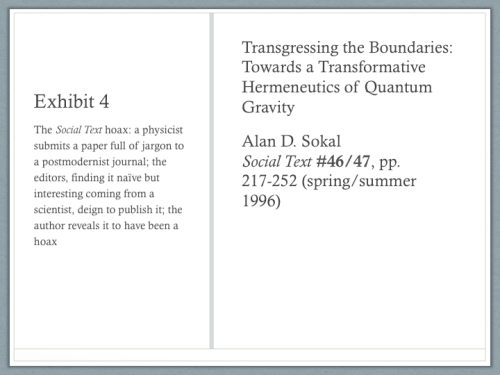
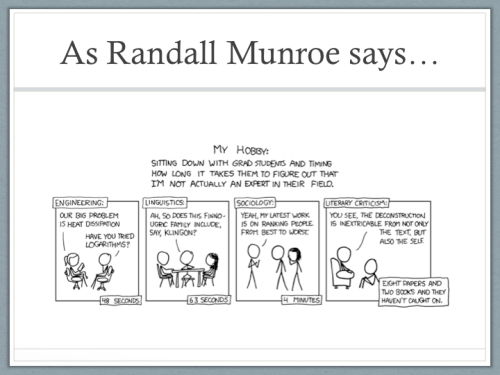
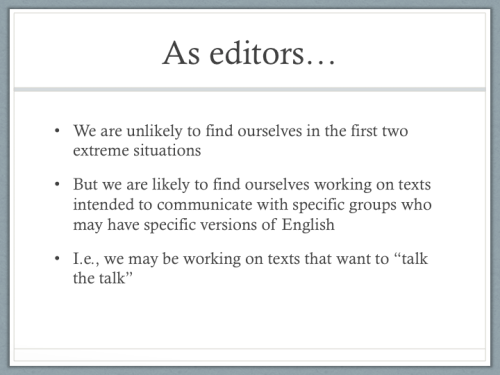
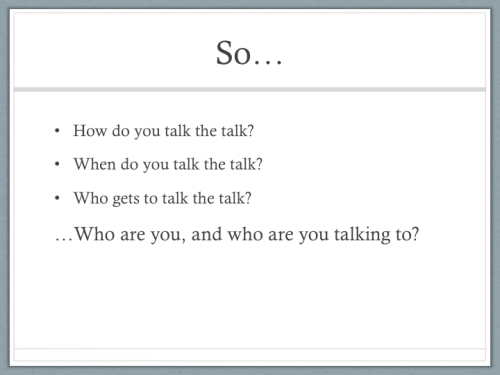
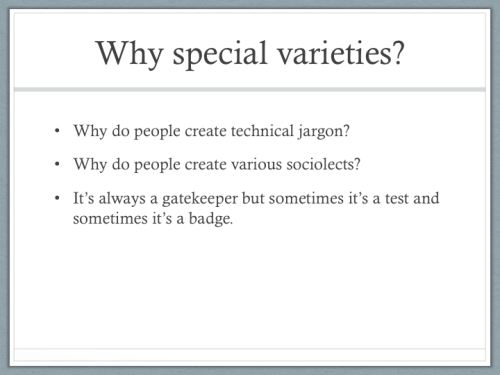
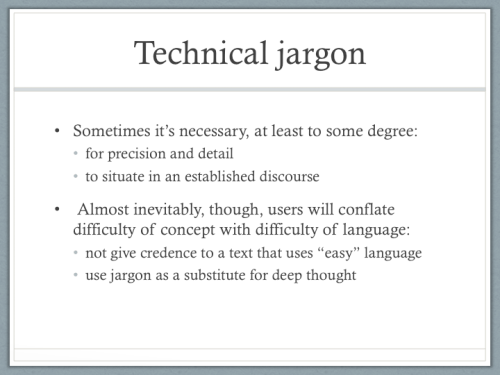
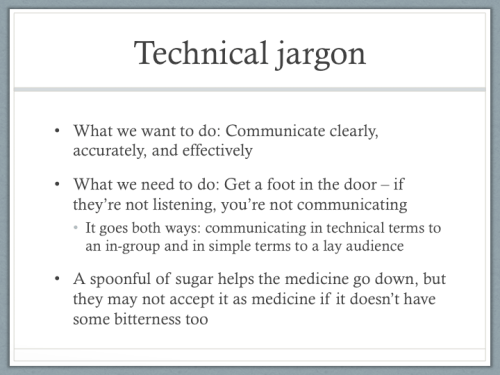
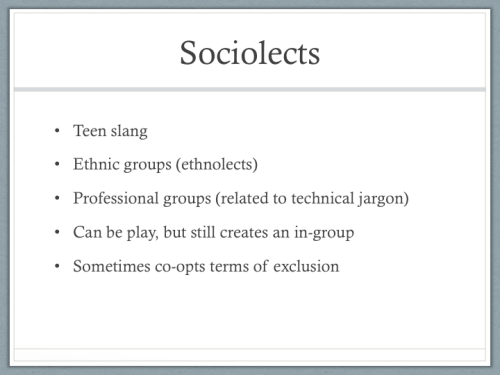
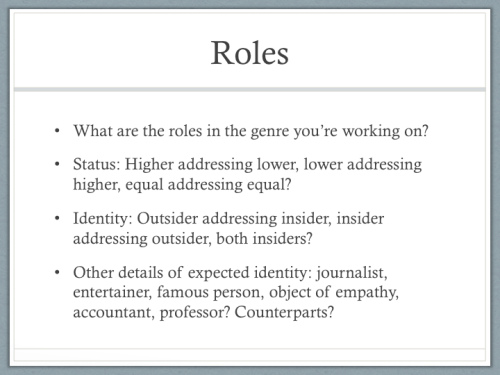
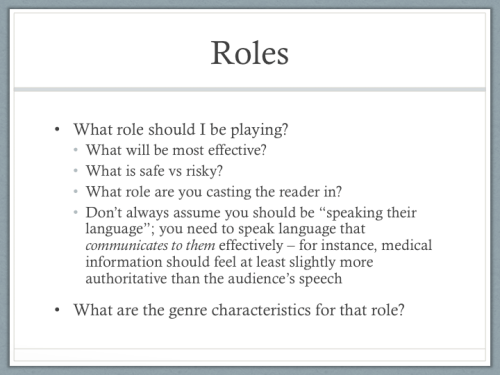
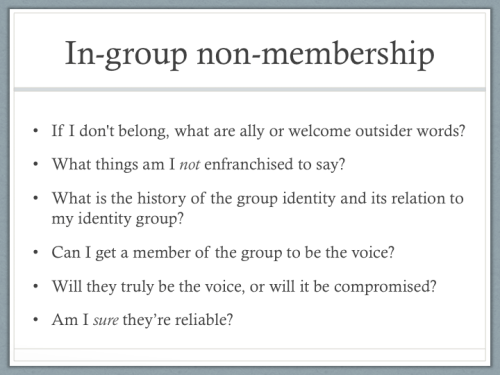
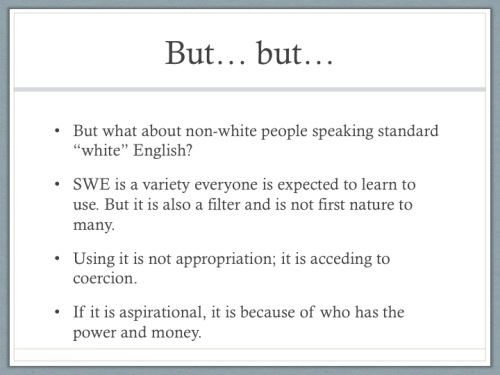
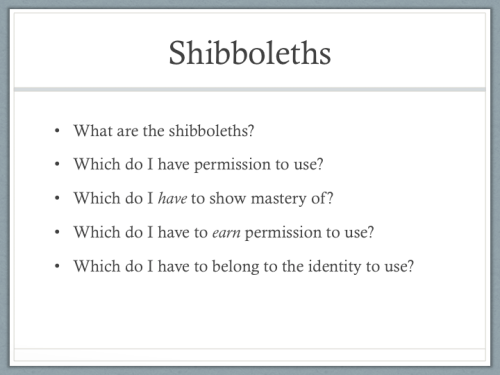
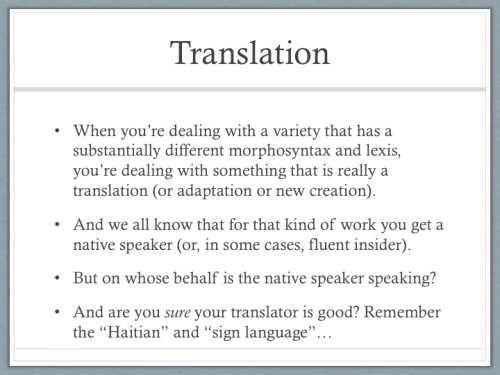
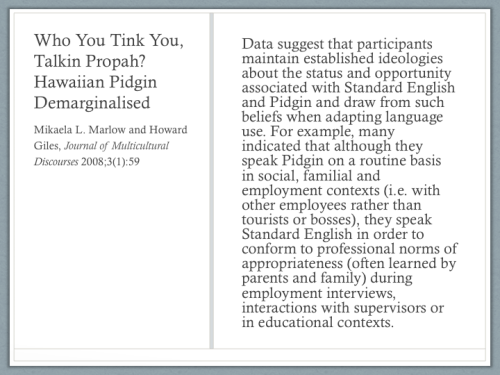
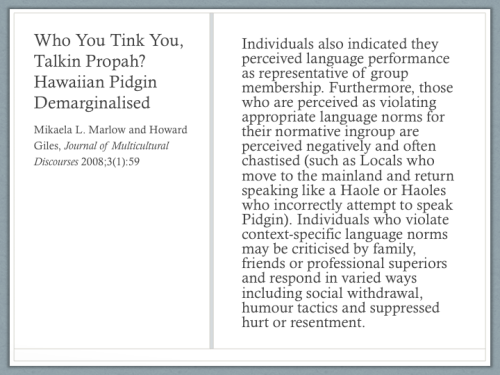
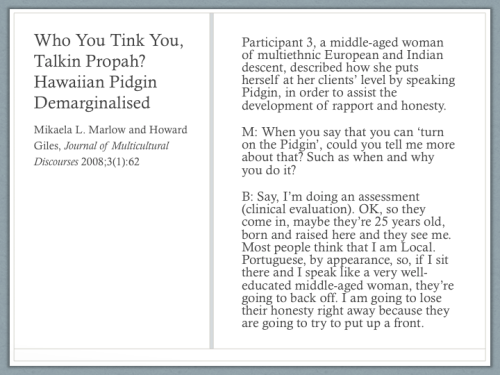
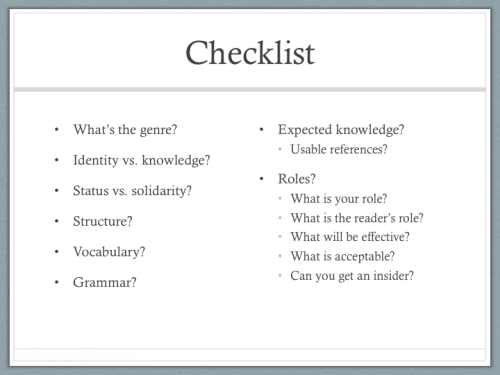
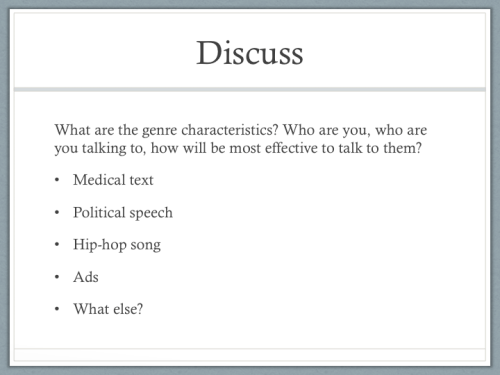
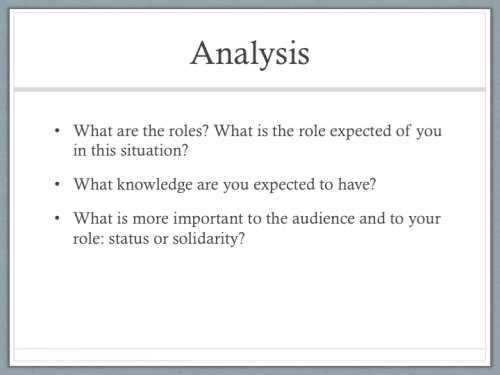
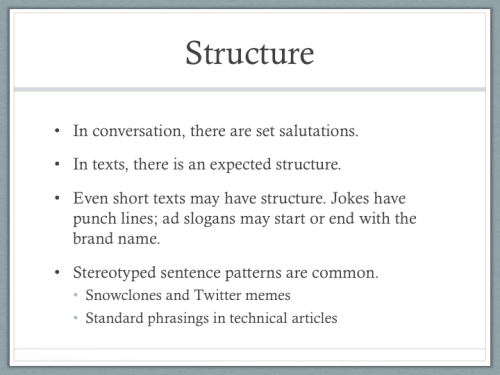
Who are you, and who are you talking to?

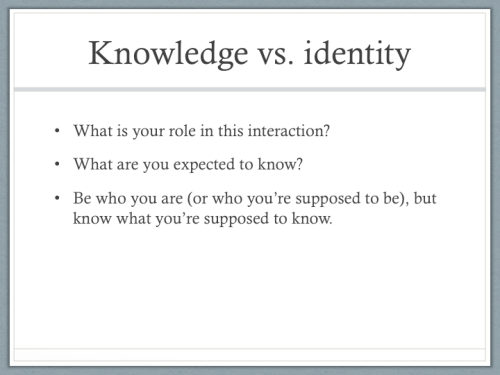
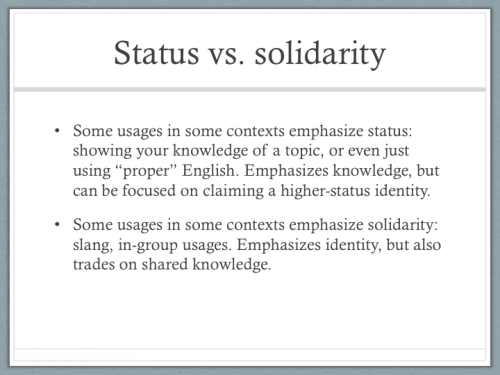
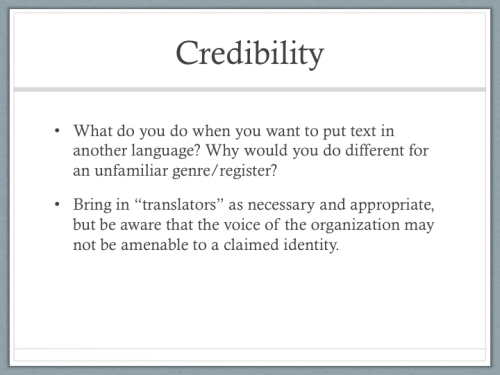
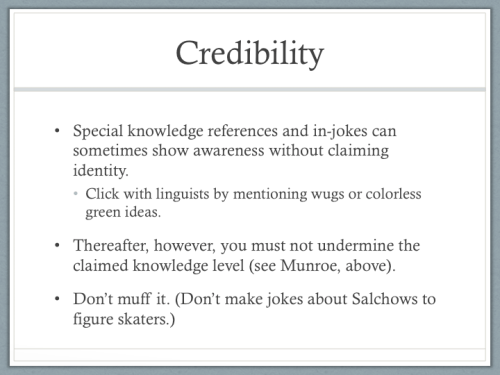
Here are the slides from my presentation at the 2016 Editors Canada conference. I didn’t have a separate script, and I neglected to record myself presenting, so this is what there is to give you, but it covers the points; my speaking was generally expansion on the points.

Here is the whole show, downloadable: harbeck_who_EAC_201606

Here are the slides, one by one.
Slide01

Slide02

Slide03

Slide04

Slide05

Slide06

Slide07

Slide08

Slide09

Slide10

Slide11

Slide12

Slide13

Slide14

Slide15

Slide16

Slide17

Slide18

Slide19

Slide20

Slide21

Slide22

Slide23

Slide24

Slide25

Slide26

Slide27

Slide28

Slide29

Slide30

Slide31

Slide32

Slide33

Slide34

Slide35

Slide36

Slide37

Slide38

Slide39

Slide40

Slide41

Slide42

Slide43

Slide44

Slide45

Slide46

caper

“I didn’t come here for the capers!”

Harry shouts this at Marianne in an alley on Pantelleria. Harry is Ralph Fiennes. Marianne is Tilda Swinton. Pantelleria is an Italian island between Sicily and Tunisia. The movie is A Bigger Splash, which Aina and I saw tonight.

He did come for the capers, though. And I think we all do, really.

True, we don’t all like the little green pickled flower bud, its name bequeathed by the Greeks as κάππαρις, taken to Latin as capparis, thence by English as caperes, which was finally taken as a plural and resingularized as caper. I do like these capers, and I think Harry does in the movie, too. They are a quite singular flavour in any dish, although you never have just one at a time. But Harry didn’t come for them.

And maybe we don’t all like the caper that is cut from capriole, a frolicsome leap as of a young goat – capriola in Italian, from capra ‘goat (feminine)’ – although I can’t see why people wouldn’t at least want to watch a good one, even if they weren’t up to doing any themselves.

But surely we all like the extended sense of that second caper: those caprices that cut us free for a spell from our usual rules. Who doesn’t like a diversion, a frisk, even a little risk? And yes, caprice is also a related word: it comes (via French) from Italian capriccio from capro ‘goat (masculine)’, because it jumps around as a goat does. Harry surely wanted that. Capers are had in the movie.

I won’t go into the plot of A Bigger Splash, in case you want to see it. I will tell you the title makes it seem giddy, when in fact its frolics are delivered in a more meditative pace, with close-ups and careful jumps and small things that season the dish with little bursts. I do regret, in a way, that it was not set on Capri. I won’t say it gets my goat, but it’s worth saying that Capri also probably gets its name from the Latin for ‘goat’. Does Ralph Fiennes play an old goat? He is perhaps more satyr than satire, but if you see the movie you will see him on full display in his prime.

As may we all be, in one way or another, and for as long as possible. When, in this movie, Tilda Swinton at 55 can cut a more striking physique than Dakota Johnson at 26, we must acknowledge that a capering career is likely to keep a person budding for a long time – as long, I suppose, as you don’t alternate between pickled and recuperating.

Isn’t it funny, by the way, that caprice, which often tends to be seen as more feminine, comes from the masculine goat, while caper, surely the more masculine-toned of the pair (schoolboy capers, anyone?), comes from the feminine? Language is capricious that way. It cuts such capers.

And I don’t mean it cuts flowers in the bud. A caper would grow, you know, into a Flinders rose, a floppy white blossom, and bear a berry too. As long as it is allowed to carry on. But they grow on bushes; you can have some of one and some of the other. Which is really the point of capers, isn’t it?

muesli

I don’t always eat cereal for breakfast, but when I do, I prefer muesli.

It was not always thus. I grew up eating sugarsplosions like most North American spawn do. “Healthy” meant corn flakes. But at some point we noticed a cereal our mother had bought called Alpen. It had an explanation on it that it had so much nutrition in it you didn’t need to eat as much. What that really meant was that it wasn’t fluffy flakes; it was rolled oats, nuts, dried fruit, and powdered milk, and it was dense and heavy. We liked it and came to eat it on occasion.

The box also told us it was a kind of thing called muesli. So when I next encountered muesli in other circumstances, I knew what it was. And when was that? When staying in a house of acquaintances in England, wherein the man of the house showed me the breakfast options and referred to their cereal as a “kind of moozly.” I know he knew how to spell it, but the point is that he didn’t say it /mɪwzli/ or /mjuzli/. I have yet to hear anyone else say it like that, but I suspect that’s because I don’t discuss breakfast with starchy Brits too much (they eat their toast cold, for heaven’s sake!).

I have subsequently encountered some version of it on the breakfast buffet in pretty much every European hotel I have ever stayed in (they usually don’t contain powdered milk, but they are served with milk and yogurt). I am sure to have some alongside the cold cuts and cheese. I can also buy quite a few brands of it in the grocery store now. I can also buy granola, but that has lots of extra sugar in it usually. I get enough sugar, thanks. Dried fruit has loads already.

You may look at muesli and think a couple of things: First, that it comes from German and that the ue is ü in the original; second, that it’s Swiss German, as evidenced by the li on the end (many Swiss German words end in i, and li is a suffix). And you’d be right about the second thing. But you’d be off about the first: the original is Müesli. It comes from Mus, ‘stewed fruit’. But its inventor originally just called the thing d’Spys, the Swiss German equivalent of High German die Speise, ‘the dish’.

Its inventor? Maximilian Bircher-Benner, a Swiss physician who believed in dietary treatments. He came up with this cereal around the year 1900, when was was around 33 years old. You may have seen the term Bircher muesli. This comes from Birchermüesli, which is the name it was given to succeed d’Spys – which they didn’t necessarily despise, but it was a bit general.

Bircher-Benner’s version had the oats soaked overnight. If you eat muesli now, you probably don’t soak it in advance. It also contained fresh fruit, as opposed to the dried fruit that fills it now. And he served it at the beginning of every meal, rather than as a breakfast.

But so what. I don’t care so much about when he served it, or how he served it, or what it was made with. I am not part of a Bircher-Benner worship cult. He had his ideas about nutrition and health, and they remain – as scientists put it – controversial. I like what his muesli has become; I eat it for what I get now, not what it was in some time past. Anyway, he didn’t invent it out of thin air; he and his wife were served something like it on a hike one time, so he “discovered” it… and of course took the credit for it from his own version.

Are you now expecting this to be be the part where I point out how much like language muesli is? How it’s made of various heterogeneous bits, not always the same from one to another? How what we have now may not be what it once was, but there’s no real reason to hew to the origins if we prefer what we have now? How even those origins are not the real origins, and the real origins are lost in decayed history? How we can’t even entirely agree what to call it and what the rules are? How we may enjoy it more when we travel?

Nah. I don’t need to say all that. You already figured it out. I was just going to mention that every single time I’ve typed muesli in writing this article, I’ve accidentally typed museli first. Which is because of typing habits, yes, of course. But also, I’d like to think, because language is my muse. Or one of them, anyway.

lanai, liana

Lana is out on the lanai with a nail to align the liana – she’s an anal one about keeping her lianas in line. Liane and Ilana, please enjoin her to be lenient lest she annihilate it!

A liana on a lanai? Such soft, tropical sounds, more vowels than consonants: a liquid l, a nasal n, a pair of a’s, and that mobile i. There is something almost Polynesian about it. Well, not almost: lanai is a word from Hawai‘ian. We use it for what they use it for: an open-sided roofed structure near a house. Somehow it seems more self-conscious than verandah and ever so much more elegant than porch.

Liana also has a warm-weather sound to it, something Italian or Spanish perhaps. In fact, it has been speculated (in the OED among other places) that its form in English may have come from a belief that it was a loan from Spanish. But we got it from French, in which it was (and is) liane, coming from lier ‘bind, tie’. And what is it? A climbing vine, a plant rooted in the soil but not rising on its own strength. Lianas wrap around trees and hang between them; they also climb walls and structures such as trellises, verandahs, and lanais.

Consider the kinds of names that have these sounds or similar ones in them: Lana, Ilana, Alina, Leanne, Elaine, Eileen, Ellen, Lannie, Anil, Anna Lee, Nell, Neal – all but Anil and Neal (also Neil and Niall) are names for women (though Lannie can be a man). We do tend to end women’s names with vowels, but beyond that, it seems the soft combination of /n/ and /l/ with these vowels (low central and high front – none of those dark heavy round back vowels) has something we tend to associate with femininity. We don’t go all in on it, but you can discern a leaning.

Not that lianas and lanais are leaning. A lanai should stand straight, even though it is a dependent structure; a liana depends on other things for structure, but it has different ways of clinging. They do, however, have a different feel from their associated terms verandah and vine. Those v’s are very vibrant, but they’re less loose. (They’re also less valuable: remember that V is 5 and L is 50.) The teeth bite on /v/; the tongue taps lightly on /l/ and /n/, the only difference being in how it lets air in on the sides with /l/ (like a lanai).

We don’t quite say lanai as a rearrangement of liana, but we do spell it that way. You couldn’t readily rearrange lianas to make a lanai, though: they’re not sturdy enough – in fact, unlike trees and shrubs, which have flexible younger parts and more rigid older parts, lianas are more flexible in the older parts. Which seems good to me: getting more flexible as you get older – and, in another way of looking at it, getting more open, like becoming a lanai – is a way to a happier life. It also helps you to recognize that you never truly stand alone.
ajar

When is a door not a door? When it’s a jar. Ahahahahahaha

I presume you, like me, first heard that joke in your childhood. You probably also heard “You make a better door than a window,” meaning you can’t be seen through, so get out of the line of sight. You’re a closed door; open up.

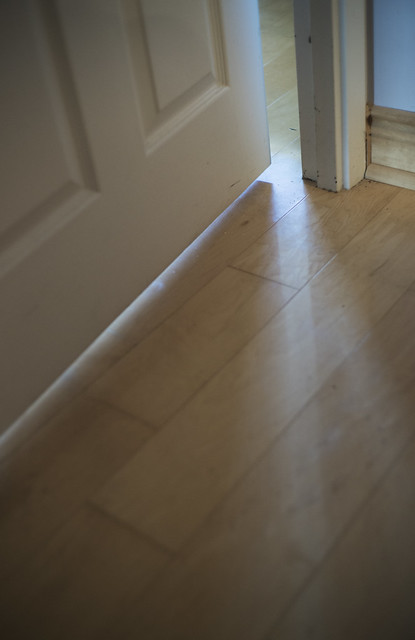
So is a door that’s ajar closed or open?

It’s a jarring question. If a door is ajar, you can’t necessarily just walk right in. But it’s not quite closing you out either. You don’t know if it’s meant to be open, or to be closed, or to be… neither. Just to leave a crack to let the light get through, or to allow a bit of fresh air. This door, this boundary, this limen, is in a liminal condition. It is not sealed, but it is not open enough for a person to pass through. It may or may not be open enough for a cat to pass through. The only way to know for sure is to ask Erwin Schrödinger to lend us his, and then observe.
But wait. Schrödinger’s cat is in a closed box, and its state becomes known when the box is opened. What if the box is ajar?
A jar, as we know, is a round container. Usually jars have lids that screw on. They turn, deturn, return. Is an incompletely screwed-on lid ajar?

Can a sliding door be ajar?

In my world, ajar is not a word for a sliding door. Ajar means the possibility of nudging and turning. Of jarring it open or closed. It is just that disturbance that would resolve it.

Is that what ajar comes from? There is a word ajar which means ‘to be in a jarring state’; it’s roughly synonymous with ‘awry’. But the ajar for doors is not that ajar. Its jar comes not from jar as in discord (“a jarring sound”); rather, it is a turn served on char, an old word which means ‘turning back, returning’. So. Returning to closed or to open?

According to the Oxford English Dictionary, on char is ‘on the turn, in the act of shutting’. Which would seem to answer the question of whether a door that is ajar is slightly open or slightly closed: by origin, it is pushed towards shut but not fully closed. Who, after all, would push a door just slightly open?

Who but a person who wanted to indicate that the door was openable, perhaps. Awaiting an arrival… or a return. Perhaps the person on the other side is listening to Steely Dan on their album Aja singing “Peg”: “It will come back to you…” (Steely Dan also sing “go back, Jack, and do it again,” but that’s on Pretzel Logic, and it seems to me that the logic of ajar is not so much of a pretzel as of a Möbius loop, the one side being in truth the same as the other.)

Or perhaps the person wants to come out but doesn’t want to. Or doesn’t want to but wants to. Or simply hasn’t gotten the momentum. Or wants to be neither in nor out. Or wants you to be neither in nor out.

Or is a cat, of course. In a perpetual state of uncertainty: in theory neither one nor the other; in reality oscillating and vacillating.

Does every door that opens eventually shut, and does every door that shuts eventually open? When you say “ajar,” your tongue swings shut onto the ridge behind your teeth, and then with a slight hesitation swings open again. Returning is the motion of the tao, and it seems to be the motion of the door. But returning to open or to closed? What is the destiny of the door, what is its assigned role? Open, shut, both, neither? Would Arjuna counsel it to be unajar? Is a door that is barely open or barely closed a real door? Or is it the only real door, the only door that, when you come to it, frames the decision as yours?