Zen

On the right side of my bookshelf, around where I keep a lot of my camera stuff, I have a section of books on Buddhism and related topics.
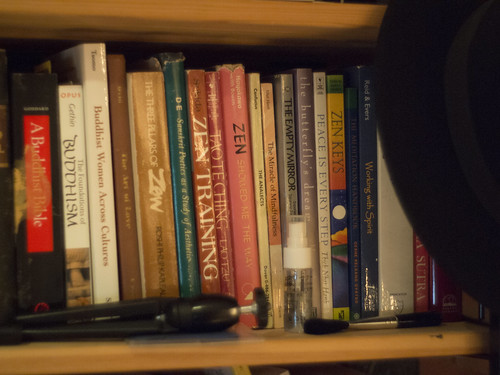
That photo is quite yellow. The shelf is lit by halogen lights and Christmas tree bulbs. It looks normal enough in person (well, a bit dark) because my mind adjusts to the colour. But the camera takes it and then we see the picture in a different context and we see the colour imbalance. So I reset the balance on the camera using a blank white sheet of paper – actually the back of an airline boarding pass that I have sitting around.
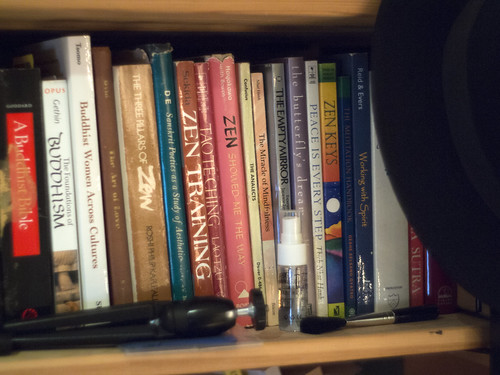
It’s not that that is perfectly neutral white balance. It’s just that it more closely matches our default bias. There is no such thing as unbiased, perfectly balanced colour, any more than there is such a thing as accent-free speech or an unbiased opinion. There is no neutral act of seeing. You just have to know what balance you want, acknowledge it, balance yourself according to it, just as you have to focus on what you focus on and choose what to have in the frame and outside the frame.

There’s one word that shows up a few times on the spines of those books. I could pull out any of them and feature it. I’ll pull this book out because I want to. I found it quite by chance in some used book occasion. It’s a book from 1960, although the first blank page has “January 1965” handwritten in fountain pen diagonally across the lower right corner. The pages are yellowing and smell of the gradual decay of tree-pulp paper and a bit of the basement it must have sat in for many years.

Here is the back cover.

That is the author. Does he look familiar? Here is his dedication.

The author was a motion picture actor. If you recognize him, it’s probably from The Bridge on the River Kwai. He played the Japanese Colonel. His name is Sessue Hayakawa. Actually, Sessue is a name he took when he started acting in movies; his given name – given at his birth in 1889 – was Kintaro.

Here is the front cover.

It’s his autobiography. The title kind of gives away the ending, doesn’t it? But it’s how he gets there that is of interest. He came from a noble Japanese family. He was all set for a career in the navy when, in a reckless diving misadventure, he burst his eardrum and was rendered unfit. He decided that he had dishonoured his family, and he resolved to do the honourable thing.

He in fact did commit seppuku, also known as hara-kiri (not hari-kari!). But he did not die. He didn’t have anyone to cut his head off at the end. So he was hospitalized with very substantial injury to his lower abdomen.

How do you follow up an act like that? With a visit to a Zen Buddhist priest. Followed by a lot of meditation. And then a career as an actor and more meditation and, well, this book.

I have several books on Zen. I have read much about it. Which is like shouting much about silence.

Whatever you think Zen is, it’s not. I can’t tell you just what it is. There are two reasons for this.

The first is that I am not a Zen master. I have meditated various ways at various times, including with Zen Buddhists, although in recent years my only meditation has been running, which doesn’t quite count. But I have no experience of enlightenment in the Zen Buddhist sense. I think I can see the shadow of a corner of it, maybe. I’m probably wrong.

The second is that you can’t explain silence with shouting.

I can tell you what Zen is. It’s a school of Buddhism, best known in its Japanese version although it also exists in China. Zen is the Japanese rendition of the word禅, which in Mandarin Chinese is chan. The full forms are zenna and chánnà. They come from Sanskrit ध्यान (dhyāna). Which means ‘meditation’.

Zen is meditation. In the plainest sense, that is what Zen is. To quote Sylvia Boorstein, “Don’t just do something, sit there.”

In some schools of Zen, that is it. You focus your mind, you watch the thoughts arise and pass by like clouds in the sky, you taste existence. In others, you strive to break your mind free from the ruts it travels in by meditating on paradoxical ideas.

In the end, you learn that you and the things around you are not many, not two. You come to recognize your position, your bias, your perspective, your focus, your frame. You learn that nothing has permanent existence, everything is changing, and what exactly is this “everything” and what exactly is this “changing” and what exactly is this “is” and what exactly is “what exactly” and

As in all Buddhism, the aim is non-attachment. I have some ideas about what is and is not non-attachment, but I’m not, you know, attached to them. Some people interpret non-attachment as meaning eschewing things of the world, but it seems to me that rejection is no more equanimitous than craving. Enjoying while it’s there and letting go when it’s not seem the best options. Fine words, of course, and badly self-incriminating, as witness the two thousand books I can’t bear to get rid of. Fortunately, like all fine words, they will eventually be forgotten.

The simplicity of Zen spills over into an aesthetic associated with it. But Zen gardens are not Zen any more than bedrooms are sleep.

I would like to eschew all marketing and branding that uses the word Zen. Putting Zen on commercial products is like putting vegan on roast prime rib.

I do remember fondly, though, one business in Toronto, no longer there I think – I used to see their sign in an upper window on Spadina: Zen Travel. I liked that. I imagined a place where you go in and they tell you that you are already where you want to be; you just have to realize it. But it’s how you get there that is of interest. In exchange, you pay them all you have, which is nothing.

But perhaps you will get a boarding pass. Which you can use in place of a blank sheet of paper to set your white balance.

chevrotain

“Google image search for ‘chevrotain’ was exactly what I needed,” tweeted (twot? twet?) Iva Cheung today.

Why would that be? What is a chevrotain? Is it some way of entertaining with a Chevrolet? Or is it a kind of goat cheese? A herb, crossed from chervil and milk vetch? Could there be some other kind of overt chain between the name and the thing? What sort of inert havoc is this?

Ah, Google it yourself and you’ll see. A chevrotain is what is commonly called a mouse deer. It should not be mistaken for a mouse, a deer, a mouseketeer, or a deer mouse. The difference between mouse deer and deer mouse tells you how such English compounds are headed: they’re headed to the right. The first word modifies the second. A mouse deer is, nominally, a deer of the mouse type, while a deer mouse is a mouse of the deer type.

In reality, though, a deer mouse is just a mouse that is rather agile. (It is not axiomatically dead. Nor is a dormouse or door mouse. Actually, it’s doornails that are dead.) A mouse deer, on the other hand, is a creature that looks like a deer but is much smaller. And is not a deer, though it is an ungulate, which means it walks on its nails (formed into hooves). But these are not fingernails and not doornails; they are deernails. No, wait, they’re deer-mouse-nails. Um. They’re chevrotain nails. Maybe we should, for the sake of the French that is in chevrotain, call them ongles, which is French for ‘nail’ and comes from the same root as ungulate. (Ungulate has nothing to do with undulate; I’ll just wave that one away.)

The name chevrotain is, as I said, from French, and means (roughly) ‘little goat’ or ‘goatlet’. I must say that chevrotains look more like deer than like goats, but whatever. They don’t have horns or antlers, in spite of chevrotain being an anagram of active horn. You’ll be lucky enough to see a chevrotain anyway. They’re quite shy, because what they really look like to many other animals is lunch. They can be as small as 700 grams (a pound and a half), though some kinds get up to 16 kilograms (35 pounds). So they hide, and they mostly keep to themselves (with a bit of twisting and swapping the ch and a for an rt you can get introvert from chevrotain), which has helped keep them going as a species for about 34 million years. They get together to mate, which seems to be their main social activity; female chevrotains can be almost incessantly pregnant, mating as little as a few hours after giving birth (which has also helped keep them going) – but what the heck, the kids are standing on their own feet after one hour. But they have one at a time.

The other thing they have is fangs. Two at a time.

Yup, all chevrotains have sharp little fangs that stick out of the sides of their mouths. They may seem like micro-vampire-deer. But really they don’t suck your blood, nor do they crave hot sin (hmm, or maybe they do; see above about mating). Or anyway no one’s seen them doing so. We will overlook the fact that their taxonomic family name, Tragulidæ, is a bit reminiscent of Dracula, and that the suborder name, Ruminantia, reminds us of Romania, where Dracula is from. Or that they prefer the dark. There are no chevrotains in Romania; they live mainly in Asia and Africa. And they’re ruminants, which means cud-chewers, which means plant-eaters. But should you happen to be sleeping in a forest in Kerala, say, and you feel four tiny hooves treading on or near you…

Naw, never mind, they’d still be less to worry about than larger things like tigers or, worse, people. Chew that one over.

Wherein I talk to Australians about accent shift

I was interviewed a while ago by Anthony Funnell of the Australian Broadcasting Corporation for his show Future Tense. I was talking about the subject of an article I wrote for The Week: How accents are shifting, and how young women are the best people to look to if you want to know how we will sound in the future. This isn’t ground-breaking research, but it’s something most non-linguists don’t know about. The show that was recorded for has just been broadcast, so you can listen to it now. My segment is at the 10-minute mark, but all three segments are worth a listen:

LANGUAGE, ACCENTS AND WE ARE WHAT WE EAT ON FUTURE TENSE

limen

limen

Follow the left edge of this sidewalk down with your eyes. At what point does it fade into blackness? What is the least light you can see before you can see no light – what is the minimum level of lumens? What is the least sound you can hear, the least touch you can feel? Where is sense no longer sense, feeling not feeling?

At the limen.

This is what psychologists generally mean when they refer to a limen: the line between perception and non-perception, from Latin limen ‘threshold’. It is not necessarily a clear line, a break, a thump. It may be like the moment you fall asleep. Have you ever noticed exactly when you lose awakeness?

But a limen can be another thing.

Look at the woman walking away from the camera. Is she on the flat sidewalk? Or on the faux-brick verge? Or both and neither?

And as you look at her, who is looking at her?

The camera received a share of the light bounced off her, but more a share of the light bounced off around her, so that she is discerned mainly by what she kept the camera from receiving: she is there by not being there; she gives her image by keeping light. The electronic data from my camera’s sensor was stored on my computer, and uploaded to a server, and is now temporarily stored on your computer and represented by an arrangement of light made by your screen. That light strikes your eyes. Your eyes transmit the signal to your brain. Your brain processes it, assembles it, infers a shape from the absences. Your consciousness is aware of this act of seeing. You may not be sure the figure is a woman, not a man, until I tell you so. But who is this you? You know yourself as a stream of thought changing incessantly, aware of the continuity from one moment to the next but leaving behind most of what occupies it. What thoughts passed through your mind over the 5 seconds starting exactly 24 hours ago from now?

We have, then, a string of physical things connecting and connected by processes, like a line passing from L to M to N. What is more real, the things or the processes? If you say the things, what do you make of this process of consciousness that is evaluating this reality? Can the spaces between the letters be more real than the letters? What matters more, the vowels or the consonants? Or the interaction between them? Is the interaction between processes and things the most real thing even as it is no thing at all but threshold between them?

Almost 18 years ago, I finished my doctoral dissertation on Richard Schechner, the founder of performance theory. He produced avant-garde theatre; he brought together insights from anthropology and theatre, and applied them to performance traditions and activities around the world. I am not generally one to focus my efforts on another person’s work, but it was a viable and recommended thesis topic and I enjoyed doing it.

A key concept in Schechner’s work as in the work of those who influenced him is the liminal. Here is a definition from The Ritual Process by Victor Turner: “Liminal entities are neither here nor there, they are betwixt and between positions assigned and arrayed by law, custom, convention, and ceremonial.” A liminal place or, by extension, a liminal entity (inasmuch as the entity serves as a transformational space) may be called a limen. Schechner preferred to stay with the adjective liminal, but I found limen a very handy concept and term of reference. I used the word 76 times in my dissertation. Here are some quotations:

We may visualize the individual, the moment of action, of creation, as the limen between the world of pure potential, unrealized, and the world of physical reality, done deeds, things concretized, set into matter. This point is always transforming potential into actuality just as it is transforming the past into the future. This individual, this act, this moment, this limen, is transformation.

The body is the limen between the inner and the outer.

This both/and is a fundamental characteristic of the limen, the transformational space. It is where there is “not this” and “not not this.” The person, the human individual, is the basic point of transformation, and this transformation requires a transformational space between individuals.

Performance is, thus, a thing that is done and yet also reflected on, held apart from the doer. . . . It is a doing into a subjunctive or suspended realm which nonetheless, by means of its signification—i.e., its effects on the inner reality—may be efficacious. It affects the outer reality by means of the inner reality, and yet affects the inner reality by means of the outer reality. It is ephemeral, and yet in the instant of its being is reified. It is both a being and a nothingness; it is, in short, a limen.

This is what this is: being being. We perform our selves performing ourselves. At every interaction, every threshold, every point of transformation, there is a limen. It is like the layers of an onion. But can you see, at any limen, exactly where the transformation takes place? Where one thing stops and another begins, where they merge and emerge? How do you illuminate it? By what process do you eliminate it?

And who are you to eliminate, who are always a process of elimination and emergence?

alalite

I wanted to do something lapidary for tonight’s tasting note. I make no claims to writing gems – I am not much of one for self-spruiking – but at least I am not prone to alalia (speechlessness). So I have found this elegantly euphonious name of a mineral. It may even have something of the animal in it: specifically, a wing – ala – and a light one at that. So I’ll alight on it.

Its initial ala is especially to my liking because those are the initials of someone lovely and likeable (and light) to whom I was wed 15 years ago; today has been our anniversary. But it also has a little alliteration internally with those two licks of the tongue, and to the eyes it seems a specially strong seal of approval, A1 A1. I also like the little light in the middle right, the candle of the i.

But what light of the alalite through yonder window breaks? What colour is this rock? It is, it seems, a light – or not-so-light – green, that loveliest of colours, shade of the forest and of the best eyes. But alalite is a sort of diopside, or perhaps it is just another name for diopside – the sources are conflicting and uncertain on this – and diopside, though mainly various shades of green, can also be blue, brown, white, grey, or colourless. It can also be clear or cloudy. Very helpful, isn’t that? Anyway, it’s MgCaSi2O6. Magnesium, calcium, silicon, oxygen. Four things you are sure to have in your kitchen, but not in purified form, just in foods, supplements, or implements – or atmosphere. And not in this combination.

And where does this name come from? The Ala valley in Piedmont, Italy, where this variety of diopside was first identified. So it is a green stone of a mountain valley, and its name sounds like echoing yodeling. I like it – I delight in it. I do not have the stone, but I have the name, and it is illuminating (even elating) enough.

Is 😂 a word?

My latest article for The Week looks at emoji and emoticons – little icons of facial expressions and gestures and objects – and asks two important linguistic questions: Are they words? And if so, what kind of words are they?

Is an emoji a word? ¯\_(ツ)_/¯

amanita

My late teens were charged with yearning and self-fulfilling prophecies of failure, an arc of desire and disappointment that was accomplished before it began. I felt that I wanted to be someone whose lost potential others would mourn, who had loved better than others and yet to whom others would say “I loved you better.” I was in search of a new version of reality, an altered state, one in which simple truth of feeling would be enough.

In other words, as I have since realized, I was pretty typical in many ways. Except that I was even less able than most to act on my desires, paralyzed from within, so afraid of rejection that I pre-rejected.

I was introduced by a drama teacher to the music of Laurie Anderson. I loved her work instantly. One piece stirred me more than others – and in fact still stirs me, and now I understand a little better what she had in mind. It’s “Gravity’s Angel.” Play it while you read this.

Send it up. Watch it rise. See it fall. Gravity’s rainbow.

Send it up. Watch it rise. See it fall. Gravity’s angel.

It’s a reference to Thomas Pynchon’s novel Gravity’s Rainbow. The song doesn’t follow the plot; you may know the song ever so well and still be entirely in the dark about the book. But there is a thematic resonance.

I was curious. A friend had the book. I borrowed it. I found it was very well written – vivid – but also a bit hard to follow, which actually I sort of liked (hey, I had already read Finnegans Wake). But it was too vivid, and it described some things that were hard to swallow. I put it down a third of the way through.

A few years ago, I decided I wanted to try it again. I bought a copy.

It’s a darkly (darkly!) comic novel, hallucinatory almost, an alternate reality, full of sex and destruction and desires, version and inversions and perversions and conversions and reversions and other diversions. It’s set during the Second World War. Its opening and focal point is the Blitz in London.

I’ve been wanting for some time now to take this one from the bookshelf and taste a word from it. But what word? Today I finally just grabbed it and opened it and flipped to a page. Nope, not that page. Another. Hmm. A third.

Yes.

There. There is the word I want from this book. A word of hallucination, a word of escape, a key to a Lewis Carroll world of inversions, but a word of a destroying angel, an angel rising above a bombed city, an angel falling in a bomb on a city, an angel eating you from within like unsatisfied desire.

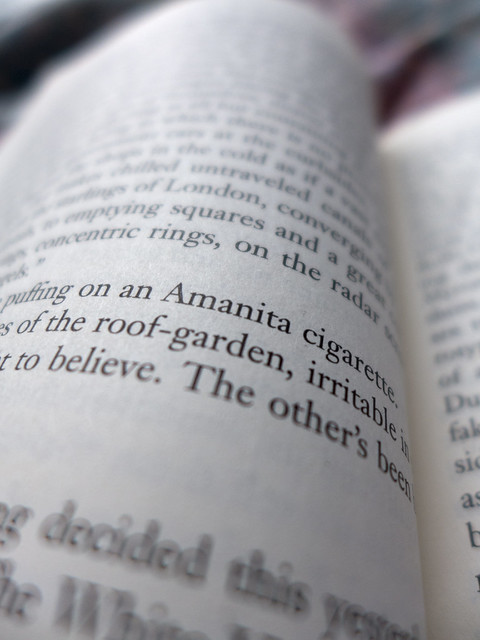
Amanita.

Amanita is a kind of mushroom. In fact, one kind of amanita is the classic toadstool, bright red with white dots: Amanita muscaria, commonly known as fly agaric (the musca in muscaria refers to flies), because it was used dried in bowls of milk to kill flies. But it is also a well known hallucinogen, eaten (and, it seems, smoked) recreationally. It has surely led to the undoing of many flies of more than one kind.

But then – beyond the undone flies – lurks Amanita phalloides, known as the death cap. And different species known as destroying angel: Amanita bisporigera, Amanita exitialis, Amanita ocreata, Amanita virosa. They will be your undoing if you eat them. Not right away – it takes a few days – but by the time you realize something’s wrong, your only hope to live is likely a new liver. Such appealing-looking phallic fungi, not so different in appearance from many table mushrooms, tempting too to those who wish to experience a new reality. Oh, and they will.

It’s a pretty word, isn’t it? Amanita. Like a cross between Amanda and Anita. Perhaps they are cousins of Alice – we should go ask her. It apparently comes from Amanon, a mountain in what is now Turkey. It makes me think of our first microwave oven, an Amana: a very well made machine, a miracle of technology, cooking with radio waves. Amanita could just be a small Amana, a little thing in your hand capable of leaving you fully cooked.

Pynchon’s book is a rainbow of sex and death, an arc with all the visible colours and more, extending into radio waves. It has its destroying angel and it has its angelic young man in an arc of destruction, annihilating at final contact; it has its louche antihero and its picaresque adventures, its half-circle of the demimonde; it has its escape, its hallucination, its alteration. It has its cheap tricks that make you say “Amanita few minutes to absorb this.”

And perhaps you will not fully appreciate what you have let yourself into, what you have let into you, the gravity of the circumstance, until too late. You have swallowed it and it has eaten you from within.

At sixes and sevens about nine and 10

A colleague raised a common issue: she had chosen to use Canadian Press style for a website with health information, and it left her with stuff such as “at ages six to nine, you will use 10–20% more.” What to do about those mixed and inconsistent numbers when they show up together like that?

I’ll tell you what: Don’t follow Canadian Press style. Or any other style like it, when it comes to numbers.

In many ways, CP style is appropriate only for newspapers. For instance, usages such as “$9-million” are not standard English but have a justification in the narrow columns of a newspaper. CP style rules for spelling out numbers, however, are not appropriate for newspapers. Nor for most other nonfiction, in fact.

Long ago, when teaching test prep for the GRE, GMAT, LSAT, and SAT, I realized that numerals communicate more directly, immediately, and effectively to the reader, stay better in the mind, and leap off the page much more readily. In any work that is being referred to for facts, numerals are more effective for all magnitudes, not just for 10 and higher. And in a context that is as space-sensitive as a newspaper, the only reasons for preferring spelled-out numbers are prissiness and dogged traditionalism. That’s it. Adhering to their rules produces not only the example above but even worse things, rubbish such as “He is facing an eight- to 20-year sentence” and “seven in 10 people.” There is nothing about this is that is helpful to the reader; it is distracting and impedes comprehension and retention.

And how about starting sentences with numerals? The standard argument is that the reader somehow won’t know you’re starting a sentence. Why? Numerals stand out as much as capital letters. There’s a space after the period – a suitably large one in a modern proportional font, too – so no one will mistake it for a decimal.

Look, do you really prefer this:

Nineteen-eighty-four was a bad year. Eight out of 10 members of the club faced jail time ranging from six to 20 years.

to this:

1984 was a bad year. 7 out of 10 members of the club faced jail time ranging from 5 to 20 years.

Really. Which leaps off the page and into your brain more readily? Which sticks in your mind better? Quick, tell me (try it without looking first, then just at a glance): How many out of 10 members in the second example? And in the first? And what was the jail time range in the first? And in the second?

If you’re communicating factual information where the numbers matter, use numerals. Don’t worry, people will still remember how to spell them even if you don’t spell them out. You are not contributing to the decline of literacy. You are facilitating the communication of information.

Will some readers complain if you don’t spell out the low numbers? Yes – the kind of reader who is more interested in making sure that everyone follows their personal set of rules than in the actual communication being effected. These are not readers to take any account of; almost nobody even likes them. Most readers just want the facts.

The only numeral that is problematic, in fact, is 1, and that’s because it looks like l and I, especially in some type faces. For my own house style at the company where I work, I have set the rule to be that we use numerals for all numbers in all contexts except where 1 appears by itself, in which case we spell it out for clarity. We make occasional exceptions with idiomatic phrases, where the numeral would look odd (no need to be at 6s and 7s about that). Otherwise, it’s all numerals, and that makes it much more effective and usable.

You will note I said “most other nonfiction.” For works that are more narrative in style, such as many biographies and most fiction, numerals may stick out quite a bit in the flow, since – as noted – they leap off the page and communicate much more quickly. In a story they can be like sudden spurts of water in a steady stream (or like your tap after the water’s been off and air has gotten into the line). So I don’t take issue with the literary habit of spelling out up to ninety-nine and, in dialogue, even higher. But in informational material – such as health data – I strongly advocate all numerals all the time.

And the Canadian Press ought to smarten up and do so as well. Until they do, though, effective editors will do better to ignore their prescriptions. After all, the name of the game is effective communication, not “Who’s following the holy writ?”

jentacular

“It’s… JEN-TACULAR!” You drop your fork on your bacon and eggs and look up at the TV. There, good enough to eat, are Aniston, Lawrence, Lopez, and Garner. Well! This is a good way to start the day. Breakfast TV indeed! Positively jentacular.

Of course, such a scene might be most openly desirable to that sort of gent who is attracted to copious quantities of bacon and eggs. Well, yeah, and the Jennifers, too. But come on. We’re talking about breakfast here.

You didn’t know? Jentacular means ‘of, or relating to, breakfast’. It’s from Latin jentaculum ‘breakfast’, which in turn is derived from jentare, ‘eat breakfast’ (or, for the old-schoolers, ‘break fast’, since breakfast is from break fast, i.e., end the overnight fasting – that thing where you don’t eat because you’re asleep). Of course, in classical Latin, it’s IENTARE; in modern writing, we distinguish consonant i from vowel i by using the extended version of the letter, j, for the former, just as we distinguish the vowel form of v from the consonant form of v by writing the cursive form, u, for the former. We’ve made them official different letters, and they sound much more different in English. But in Latin jentare (or ientare, or IENTARE since half-uncials didn’t exist way back then) was pronounced “yen-ta-reh.”

Quite a difference between a yenta and a Jen, though, isn’t there? As much of a difference as there is between breakfast and breakfast. In some places, breakfast may be fish and soup; in others, it may be sugary processed grains soaked in low-fat milk (because somehow lots of sugar and little fat is better than little sugar and lots of fat?); in others (looking at you, England – please invite me over), it may be bacon, eggs, beans, and fried tomatoes – not gentle, but gentile. Breakfast changes over place and time.

And so does Jen, or rather Jenny. We know that Jenny is not new as a nickname in English; we see it in various usages even in the time of Shakespeare. But somehow in The Doctor’s Dilemma, written by George Bernard Shaw in 1906, there is this:

MRS. DUBEDAT. My name is Jennifer.

RIDGEON. A strange name.

MRS. DUBEDAT. Not in Cornwall. I am Cornish. It’s only what you call Guinevere.

How do we reconcile this? Is Dr. Ridgeon oddly onomastically naïve? No. In the time of Shakespeare and for centuries after, Jenny was short for Janet or, occasionally, Jane. If you’re wondering how Janet came to be Jenny, you may as well move on to how Richard became Dick, Edward became Ned and Ted, Robert became Bob, John became Jack, and Margaret became Peg. After those, Jenny seems quite obvious for Janet, doesn’t it?

But more obvious for Jennifer. Which is indeed from the same root at Guinevere, which means, roughly, ‘fair and soft’. OK, fair enough, once Jennifer is popular it naturally claims Jenny and Jen. How did Jennifer become such a popular name that Jen is practically the default name for North American females now? I guess a lot of people liked it… starting with those who saw The Doctor’s Dilemma, which – in spite of being one of those preachy, wordy Shavian thinkdramas (which are nonetheless great to act in) – was quite popular. I’m sure the scripted extreme attractiveness of Jennifer Dubedat (and thus of the actresses who played her, starting with Lillah McCarthy) didn’t hurt.

But. That’s a lot to digest before breakfast. I should go more gentle on the gut in what is, for many of my readers who open this first thing in the morning, still an antejentacular hour. I suggest something to settle the stomach. Sparkling wine, perhaps? Ah, that would be jentacular.

Phonological aspirations

Do you wish you could have an easier time with non-English sound distinctions? Do you have a sense there are sounds that sound the same to you but are heard as different in other languages? Give this a listen – it’s the podcast version of my article on subtle sounds English speakers have a hard time telling apart.

5 subtle sounds that English speakers have trouble catching