nightfall

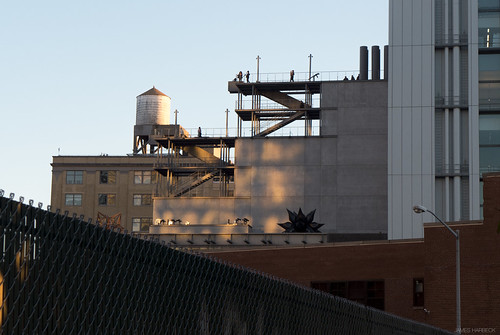
Suddenly it is fall. It has crept up on us. And so much sooner every day it is night. I set out from the office as the golden hour of the sun projects stark fame on the faces of the high-rise apartments, and by the time I am awaiting my bus a kilometre farther south the light comes from the thousand electric fires of street lamps and headlights. The sky aches in iridescent ultramarine and at last surrenders to the… I would say to the stars, but in Toronto they, too, lose to the sodium aura from below. The moon holds its cold throne as duke regent, but all it is able to do is shiver albedo.

Nightfall.

The absolute rule of the sun, the glowing solitary monarch, is suspended. Light comes from this point and that point and the other point. Relativism reigns; the angels of the morning are fled and the opposing angles of evening light fight and play with each other. Shadows are darker. The sun has fallen, and the reign of the day has fallen with it. And with that, the night also falls, like a thick curtain with a frayed fringe.

Night. Fall. Two soft, half-whispering words as old as the language, changed only slightly in form by time, now conjoined. Their first date as a couple is 1611, naming fruit that has fallen from a tree during the night. To mean ‘sunset’, the compound is known from about 1700 in the records of the Oxford English Dictionary. The image is surely older.

But how does night fall? Where does it fall from? As we stand on our planet, if we choose to look away from the setting sun, we see that the darkness is growing on the eastern side. The darkness sweeps up and over the zenith and washes at last down the other side. It is not a fall; it is like a blanket pulled over a dome. Pulled by the fall of a sphere.

Only a blanket has weight, just as things that fall have weight. Darkness may seem dense, but it is really nothing. It is not something that is there; it is the absence of something. It is of no matter; it can be anywhere at any time at any speed. It is not heavy. It is light. The sun is heavy: it sinks.

Light has no weight, of course; if photons had mass they could not move at the speed of light. You can’t be heavy and be light. But you can be heavy and be a source of light; indeed, much light comes from heavy things. Darkness, on the other hand, comes from nothing at all. You may use a heavy thing to stop the light and cast a shadow, but the heavy thing is not sending darkness, it is just stopping light. And then there is nothing: night is naught.

Night hasn’t fallen. It hasn’t risen either. It’s just what’s left when the source of light has fallen. Or been turned away from.

Because of course that’s what nightfall is: earthturn. If you go far enough north, you see it more clearly. In the summer, the sun makes a tilted circle and barely touches the horizon; as the year draws on the circle lowers gradually until it is below the horizon most of the time. In Iceland they don’t say “24 hours a day”; they say alla sólarhringinn, ‘all the sun’s ring’. Sunspin.

We may as well think of the sun as sailing away from us over the horizon. The sun leaves and night is what is left.

The sun is glorious, of course. It fuels life. We would be colder-hearted than Pluto without it. But the sun is a bully, a dictator, a satrap. It gives so much light that other lights can’t compete. The stars don’t come out at night; they’re there all day too, but the sun outshines them… because we are so close to it. On a planet circling a different star, our sun will be just another twitching dot visible in the distance only when the local orb is not. The relativity of night is just what was already there but visually indifferent in the solar onslaught.

Well, what was there plus the lamps we light.

Nightfall is not a falling of darkness but just a revealing of what else was there. But nightfall is a fall. The day is like summer, and the light leaves. Which is to say the light is like leaves, and then like leaves it leaves: it turns yellow and orange and red, and is last seen at ground level. Nightfall is fall. The fruit drops and goes to seed. The night is winter. Dawn is spring. And so we play around the ring.

And once again I await the transit.

ctenophore

One of those mornings. You awaken planked on your bed, your face drained of colour, your tongue sticking to the roof of your mouth. You have clearly consumed too much. When you get up you find that your legs are jelly and you are swimming forward as much by the waving of your hair and flapping of your earlobes as by any limbs. You feel as though your body is almost entirely liquid. One look in the mirror and you know: you’re going to have to carry a comb today. Yes, my friend, you are become a ctenophore.

Ctenophore. From Greek κτενός ktenos ‘comb’ and ϕέρειν ferein ‘bear, carry’. Not that everyone who carries a comb is a ctenophore. No, the word is actually a name for a kind of jellyfish. A small one, plankton-size, measured in millimetres. They move forward by the flapping of lobes and the swaying of cilia (little hairs). Those rows of cilia – eight or more rows – give it the name, since the cilia are short and the rows look like combs. There may be more than a hundred cilia, but note that these are not centophores – actually, cent is from Latin; a proper Greek hundred-bearer would be a hectophore. But these are not that.

Regardless of how opaque their name may seem, ctenophores are transparent and largely colourless. In spite of all that, they are voracious predators. Yes, there are things even smaller than the ctenophores – other little jellyfish, for instance. Read more about them at http://www.ucmp.berkeley.edu/cnidaria/ctenophora.html and http://faculty.washington.edu/cemills/Ctenophores.html .

It may be tempting to think of them as like a c swallowing a t at the start of this word. But surprise! (Or not.) In English, it is the c we don’t say, leaving the word sounding similar to “ten-four”… not quite a hundred, but never mind. But in other languages, the c is said as “ka” or just “k.” Of course they didn’t stick a vowel in there in the original Greek.

We may think we can’t say “kt” at the start of a syllable, but there’s nothing actually keeping most of us from doing so except our beliefs about what sounds we can say where. If you can say “pectin” you can drop the “pe” and just say “ctin,” and if you can say “ctin” you can say “cten.” Never mind that this kind of jelly contains no pectin. Your tongue may feel as though it’s sticking to the roof of your mouth when you say /kt/, but think of this: at least you don’t have any ctenophores in it.

odyssey

What the word odyssey brings first to my mind: the classic Stanley Kubrick–Arthur C. Clarke movie and novel 2001: A Space Odyssey. Starting with the opening bars of Richard Strauss’s Also Sprach Zarathustra. So stirring. So timeless. So cogent.

So brief.

The opening segment is less than 2 minutes long. That’s all most people have ever heard of Strauss’s work. But that’s no odyssey. An odyssey is long and episodic. It is not a single bright sunrise flash. And Strauss’s work is longer, too, over half an hour long. Here, listen to it all:

That is a “tone poem.” It is a poem somewhat as the Odyssey is a poem. A quatrain it is not, nor a sonnet, nor a villanelle, nor a sestina. It is epic. The original Odyssey is a tale of a ten-year journey, a trail of travails with many perilous passages, a detouring tour of possibly more than 8,000 kilometres around the Mediterranean (and to Hades and back) to accomplish a net transit of little over 1000 km by sea (or, now, by road). (I could actually drive from Troy to Ithaca in 3 hours, but that’s the two cities of those names in New York State.)

The Odyssey is the second-oldest extant work of “Western” literature, the oldest being the Iliad. The Iliad tells the story of the Trojan War, ten years of death over one woman. (Helen had “the face that launched a thousand ships”; thus, a Helen is a unit of beauty, that amount of pulchritude sufficient to launch 1000 ships. A millihelen is beauty sufficient to launch one ship. I did not make that up.) The Odyssey tells the story of the return home of one of the surviving Greek “heroes” of the war, Odysseus. His name is of unclear and disputed provenance. It may come from ‘hate’ or ‘struggle’; it may come from ‘wail’ or ‘lament’; it may come from a non-Greek word. It may be a merging of two names and two characters. The Latin version of the name is Ulysses, which derives from the name Οὐλίξης.

In the Odyssey, Odysseus – or Ulysses – makes a dozen stops of various lengths along the way, including enchantment by various women (Circe, Nausicaa, Calypso – with whom he stayed for seven years…), encounters with various monsters, and interference by the usual gods. It ends with his return home to his faithful wife.

It runs more than 12,000 lines of dactylic hexameter, and it begins like this:

ἄνδρα μοι ἔννεπε, μοῦσα, πολύτροπον, ὃς μάλα πολλὰ
πλάγχθη, ἐπεὶ Τροίης ἱερὸν πτολίεθρον ἔπερσεν

Here is the beginning of Robert Fagles’s translation:

Sing to me of the man, Muse, the man of twists and turns…
driven time and again off course, once he had plundered
the hallowed heights of Troy.

Only it doesn’t begin at the beginning. It begins in medias res and makes liberal use of recollections. This is different from how we typically think of an odyssey. Compare a modern odyssey, which begins like this:

Stately, plump Buck Mulligan came from the stairhead, bearing a bowl of lather on which a mirror and a razor lay crossed.

This is the start of James Joyce’s Ulysses, an episodic tracking from start to finish of a single day in the lives of a small set of Dubliners (Stephen Dedalus, Leo Bloom, and at the last Molly Bloom) in a variety of literary styles, a journey of 700 pages in less than 24 hours. It is an epic slog for some readers, although I thoroughly enjoyed it (I had already made it through Finnegans Wake, and Ulysses was a romp after that). It starts at the time of rising in the morning.

And Also Sprach Zarathustra is the start of Kubrick’s and Clarke’s odyssey, which begins with the dawn of humanity. Zarathustra may be the beginning of the odyssey, but it is the end of theodicy. Also sprach Zarathustra means ‘Thus spake Zarathustra,” and while Zarathustra is another name for Zoroaster, the prophet of the ancient dualist religion Zoroastrianism, Strauss’s title is taken from the title of the work by Friedrich Nietzsche, in which Zarathustra is like a photographic negative of the Persian original, dedicated to overturning morality, speaking of the Übermensch, declaring that God is dead. 2001 does not make such a declaration, but rather presents, as bookends in human history, monoliths manifesting an alien intelligence. The eldritch curious liaison is underscored with an even more eldritch Kyrie Eleison by György Ligeti:

Lord have mercy indeed.

An odyssey is a recounting of a long journey, but one that ends with a return home – not a home that is unchanged, but a home nonetheless. The protagonist in 2001 ends on Jupiter, living through stages of life in a sterile isolation in a series of mere moments of flash forward, but finally becomes a star child, a new being, gazing at the Earth. Ulysses ends with Molly Bloom remembering the day she said yes to Leo Bloom. The Odyssey ends with Odysseus returning to his long-faithful wife and slaughtering her impertinent suitors. Other stories follow a similar arc, for instance Ibsen’s Peer Gynt.

But storytelling, so detailed in recounting the past, has its limits with the future. 2001 was released in 1968, 33 years before the time it foretold. That future is now past. If space exploration had continued on the course it was on at the time, we might well have had a moonbase and a large space station and regular service from Earth to them. We had other things instead, things that may or may not have been any better.

When we retell an odyssey, the episodic travels and travails of a hero over a long time, we retell it in retrospect. We have returned home. Those who do not return do not get to recount their odysseys. When you embark on an odyssey, you don’t truly know whither you will go and whether you will return; you do not know if it will finish as an odyssey. You simply set sail… or take your protein pills and put your helmet on.

This is post number 2001 on Sesquiotica. It has been an interesting journey of a bit more than 7 years so far. And yet I’m always just beginning.

albedo

Look at these trees. They exhibit a pleasing play of shadow and light: shadows on the right side, light on the left – a nice moderate light, glowing.

Now look at the buildings behind them. Look at where the light is. Look at the direction the shadows are going in.

The sun is to the right. South-southwest. This is Bryant Park in New York on an October afternoon, and we are facing east-southeast toward the New York Public Library (remember, Manhattan is not truly north-south). The bright side of the trees is the one away from the sun. The direct sunlight is blocked by buildings on the right: just shadows there. The soft glow is thanks to light reflected from buildings on the left.

When I first stopped to think about that fact – how the bright side of the trees was from reflected light – I thought something like “Well, I’ll be…”

I’ll be what? I’ll be doggoned? No. Albedo.

Albedo. Take a moment to reflect on that word. It takes all its time to reflect on you… and on everything else. And from everything. You included.

The sun gives light: as it burns it releases photons. If you stand in the sun, you stand in the path of a small, small wedge of those photons. They don’t make it through you. Some are absorbed; some bounce back off. The number and nature of those photons bounced back depends on the colour of your skin and clothes. If you are wearing a blue shirt, it keeps most of the photons that aren’t blue, and bounces back – gives away – more of the blue ones. This is how we have colour: surfaces keep the colours they don’t show and give away the ones they do show.

Meanwhile, the space behind you, including the back of your head, is not in utter darkness; it is lit by photons reflected off other surfaces – and diffused by bouncing on molecules in the atmosphere.

Albedo is the percentage of light a surface gives away – doesn’t keep. A surface that kept all the light would have an albedo of 0 and would be perfectly black; a surface that reflected it all would have an albedo of 1 (i.e., 100%). The reflection can be directional – as with a mirror – or diffuse – as with paper. Highly reflective but not perfectly flat or even surfaces give a mottled light.

The word comes from Latin albedo ‘whiteness’, from albus ‘white’. You will recognize the root from abumin and albino and Albus Dumbledore (which, in full, means ‘white bumblebee’). Albedo was first applied to the reflectivity of surfaces by Johann Heinrich Lambert in 1790. An important current usage is to refer specifically to the reflectivity of celestial bodies – such as the earth.

It is also important for environmental science. Snow, for instance, has a high albedo, but once it starts melting and the water runs away, more and more dirt and dark matter is left, giving a lower and lower albedo, which means it absorbs more and more solar radiation and melts faster and faster. The glaciers of Greenland are currently demonstrating this, and it is a matter of some concern. It becomes an accelerating self-destructive cycle of selfishness, as it were.

Separate albedo can be calculated for each wavelength. Some people have suggested that since a blue surface keeps the light that is not blue and gives away the light that is blue, its real nature is not blue. I do not agree. As you go through life, you receive love and hurt, joy and anger, comfort and pain; you do not give all of it back to the world, but only those things that you wish others to receive. A person who receives hurt and joy but gives only joy to others is not a person whose nature is hurt. We do what we want to do and what we are able to do. Our character is our able-do; it is our albedo.

And in the darkest moments of our life, when the sun seems blotted out, there is still light: the albedo of others.

Do you do tai chi on Halloween in Hawaii?

My latest article for The Week deals with the tricky question above – and whether it should be “Do you do t’ai chi on Hallowe’en in Hawai‘i?”

The wacky world of apostrophes, explained


Be on the ball with the origins of phrases

Originally published on The Editors’ Weekly, the official blog of Editors Canada

My topic today may seem a bit ribald, but I’m sure you’ll have a ball with it. It’s about monkey business with the origins of phrases, and how to make sure you stay on the ball and don’t hit a wall.

People love stories about the origins of words and phrases, but many of them are rather dodgy. A good general rule is: Look it up — on a reliable site such as worldwidewords.org or snopes.com. But if you don’t have immediate access to the web, or the phrase in question isn’t covered on the trustworthy sites, you can still apply a little real-world knowledge to estimate its trustworthiness.

Let’s start with two examples: cold enough to freeze the balls off a brass monkey and balls to the wall. Those might seem rather off-colour, but popular accounts of their origins proclaim them both to be innocent. Let’s try applying our good sense to them.

For the brass monkey, the story often passed around is that on battleships, cannon balls were piled in pyramids on brass plates called monkeys, and when the weather got really cold, the differential shrinkage between the iron balls and the brass plate would cause the balls to dislodge.

For the wall, the story is that the balls in question are the two balls on a fighter pilot’s control sticks and the wall is the firewall between the pilot and the front of the plane — so balls to the wall means with the accelerator control and the ascend/descend control fully forward, putting you in a high-speed attack dive.

What do you think of the monkey story? It sounds convincing — don’t you remember something on a ship being called a “monkey,” and don’t metals shrink by different amounts with the cold? If you dwell on those, you might not stop to think about how steady the deck of a battleship isn’t. Really, balls piled in pyramids on a vessel where dishes slide off tables and shelves if they’re not held in place? And how much is that shrinkage, by the way? Do you have brass fixtures on your door? Do they shrink enough to pull on the screws or wood?

In fact, cannon balls were held in wooden frames so they wouldn’t roll all over. The “monkeys” on ships were “powder monkeys,” boys who carried charges. And a quick look online will tell you that the shrinkage rates of iron and brass are nearly identical — less than a millimetre per metre. As to the expression, earlier versions included references to freezing the tail off a brass monkey and being hot enough to melt the nose off a brass monkey. So the supposed “innocent” origin doesn’t pass the test — those are real monkey testes.

How about the pilots? What do those joysticks look like? If you recall that, sometimes at least, there’s a ball on each … you’re right. You’d be justified in reserving judgment on this one, because it’s so tidy, but the truth is that it’s correct: it came from fighter pilots in Korea and Vietnam. So that means it isn’t a crude reference? Heh. Please. These are military men. You can feel sure the double entendre was intended.

The army and the navy are often credited with popular turns of phrase. As we have seen, the credit is sometimes due and sometimes not. Another case where it is not due is on the ball. As you may know, at the Royal Observatory in Greenwich there is a red ball that is raised just before 1:00 pm each day and dropped exactly on the hour. It is bruited about that sailors who held fast to this time were said to be on the ball. It may seem reasonable enough; sailors did in fact need to use it to make sure their chronometers were accurate. But the historical record doesn’t support it. The phrase first showed up associated with baseball. Ah, yes, sports: a third field often credited — sometimes rightly — with the origins of phrases.

If that time ball sounds like an old acquaintance not to be forgot, then you are surely thinking of the one used in Times Square at New Year. Time balls for giving the hour to those at a distance were common in the 1800s, but their modern survival is mainly ceremonial, now most often associated with parties. Such as New Year’s balls? Well, yes, but that kind of ball — which we see also in have a ball (and yes, that’s where that phrase comes from) — may have music, but it does not require spheres. It comes from Latin ballare, “dance,” which we see in modern Spanish bailar, among others. A quick look in an etymological dictionary will tell you that.

And so we see you can truly have a ball with etymology — and, with good research, you can have another one, too.

enow

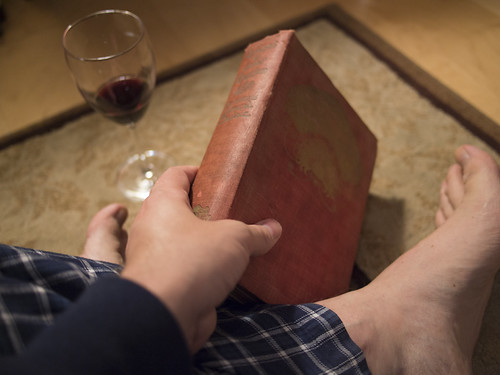
I wasn’t going to do another one from the bookshelf tonight – one a week is enough. But sometimes enough is not enow, and one who floats on the waves of words and images must live in the now. And so, in my jammies, with a glass of wine, on the carpet of my library, I pull from the shelf a book as yellow and foxy in the pages as the library lighting.

The Rubaiyat of Omar Khayyam, in Edward Fitzgerald’s famous English translation, with illustrations by Edmund Dulac.

Look at these lovely pictures, each on its own separate plate complete with onionskin veil to protect it.

The yearning lass looks rather like Meryl Davis, methinks.

I don’t think that’s Charlie White.

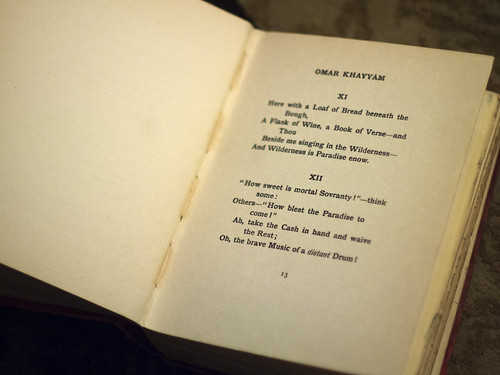
No, these are paintings of Persian love and longing, in a European vision. But their European provenance does not make them un-Persian. The poetry, at least, is part of the Persian dispersion. It is a volume of ruba’iyat, which is the plural of ruba’i. The ruba’i is a Persian quatrain form. The rules are that lines 1, 2, and 4 must rhyme, and that the fourth line must be a high, strong, deep completion of the meaning. There is also expected meter. Fitzgerald has gamely preserved the poetic form in his translation. Number XI is a poem that may seem familiar.

Does it seem familiar yet somehow not right? Let us try that again.

The volume I own, you see, contains editions 1 and 2 of Fitzgerald’s translation. The second edition is different from the first – a whole new essay at the matter, even renumbered. Apparently one was not enough. Are two enow?

Enow.

That is a precious word, isn’t it? Simply a rhyming mutation of enough?

In fact not. Enow, Doctor Johnson explained to us, is the plural of enough.

Does that seem a strange thing to say? In the modern time, it may well, but English words used to have much more thorough sets of inflection. Old English genog became, over time, singular genoh but plural genoge, and those grew to Modern English enough and enow. (It makes more sense if you know that the g’s were fricatives or glides, not stops, and the h was pronounced.)

But in Modern English, once we have learned that one is enough, we take it at its word and stop, and never discover that two are enow.

Remember that, now, the next time someone tells you enough is enough. It may be so, but enow are enow, and two are better than one – especially with that bread, that flask of wine, and that book of verse.

And so there you are. There art thou. There are we. Here we are. Enow. And now?

trice

It’s time for another episode of “from the bookshelf.” But it’s late – I’ve spent the day at a linguistics conference – and I need to be expeditious. So I will quickly pull this volume from the shelf.

I received it for some birthday in my youth, I think. It’s full of Canadian classics, of course. Robert Service was the plucky poet of the Klondike, and there are at least two poems by him that Canadian schoolchildren cannot escape reading (or at least that used to be the case; I can’t say whether it still is). One of them is “The Shooting of Dan McGrew.” The other one is this.

“The Cremation of Sam McGee” is such an essential of the well-read Canadian mind that I once did a quick parody of it on the easy assumption that all of my readers (Canadian editors) would know it in an instance. And I wasn’t wrong.

There is one word I think of in an eyeblink whenever I think of this poem. It’s a word I first saw in this poem, and have read altogether not thrice, not twice, but just that once – or in just that one place, however often returned to. And yet its sense was, by context, immediately grasped.

Trice.

It was jammed in the ice, but I saw in a trice it was called the “Alice May.”

The “it” is a boat, a derelict as Service calls it. Service says he saw in a trice – a slice of the eye in time, a trick, a quick instant, a moment without trace.

Very well. But what is a trice?

Trice was, first of all, a verb, borrowed from a Middle Dutch word meaning ‘haul’. In Middle English it got the sense ‘pull quickly’, ‘pluck’, ‘draw suddenly’. Its first sighting is in Chaucer. Now when it’s used at all as a verb it means ‘pull or haul with a rope’, but don’t count on anyone knowing it.

But that verb came to be converted to a noun, first in the phrase at a trice – as though saying ‘at a hoist’ or ‘at a pluck’ – and thereafter in a trice. It has a long history of use, threading through Shakespeare and Charlotte Brontë. But, at least if you’re Canadian, the telos of all that was its spotlight flash in Robert Service, and all uses since then refer back to that one trace. Now you read it, and in the same second you grasp it; and now it is forever a mirror of that night on the marge of Lake Lebarge.

anthocyanin

This is the time of year when the green leaves.

When the green leaves what? The leaves.

It’s the time of year when the green leaves the leaves, and what is left is – well, that depends on where you are, what the tree looks like, and what the weather has been like. But if it’s the right trees and the right weather and you’re in the right part of the country, you are in for a treat: rather than a wan yellow, the leaves the green has left come to be a bright red. They are dying and dead, of course, but they go in a blaze of glory and finally leave dry piles of browning red on the forest floor and parking lots.

Those red leaves owe their colour to something named for blue flowers: anthocyanin. Unlike the yellow, which is what was there behind the green all the time – the yellows are xanthophylls and beta-carotene, and the green is chlorophyll – the red anthocyanin is added: it’s synthesized once about half the chlorophyll is gone. But anthocyanin is a multi-purpose pigment. Just as the same song may show up as bubblegum pop, grunge, symphonic metal, or new country depending on the production values, instrumental arrangement, and accent of the singer, so the anthocyanin shows up as blue, purple, or red depending on the pH level – the acidity. Indeed, you can use it to tell the acidity of a solution, from red at the most acidic, through pink and purple and blue and then green to yellow at the most basic. But it gets its name from a colour in the middle, and from being used in flowers as well as leaves.

You may or may not recognize the anth, from anthos ἄνθος ‘flower’; it shows up in anthurium (a kind of flower) and, yes, anthology, a collection of flowers of verse (and now prose). It is not related to the anthro in anthropology et cetera; that is to do with humans. The cyan should be familiar. It names a kind of blue colour, and it also shows up in cyanide, which gets its name from cyanogen, which was so named for its presence in Prussian blue. It is a convenient coincidence that cyanides are radicals made up of a C and an N, carbon and nitrogen; the CN is reminiscent of cyan. But the name comes from that Greek blue, kuanos κύανος, run through Latin with cy for the κύ.

Cyanide can leave your lips – or those of any anthropos – blue with death. But anthocyanin, chemically unrelated, leaves leaves red with dying. Such a beautiful passing, and not really a death, anyway, merely an exfoliation: the trees persist and will re-green in the spring. (You can read more about what happens and why on Science Daily.)

vintage

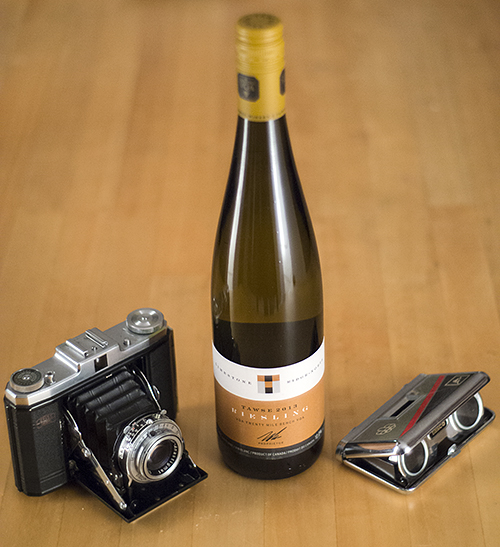
The three items in this photograph have something in common.

Yes, yes, they all have glass and yes, they can all help you to see things from a more interesting vantage. But that’s not what I’m on about.

They’re all vintage.

Granted, one of them is from about 1954, one is from 1976, and one is from 2013. But all three may be called vintage in the right context. In fact, two of them are far more likely to be called vintage more often by more people in more places. The third one actually is made from a vintage.

A vintage is, first of all, a grape harvest. That is what Latin vindemia means, which became French vendange, which became English vendage, which became vintage under the influence of vinter ‘wine merchant’ (from Latin vinatarius, from vinum ‘wine’; it has now with age gained an n to become vintner).

Some wines are made from juice blended from several years of harvest, just to even things out and use some of the better stuff to make the worse stuff more drinkable (because you lose money if you just pour the worse stuff back in the dirt). Other wines are made from the grapes from a single harvest in a single year. It may be all one kind of grape, or it may be several kinds, even from several different vineyards, but if it’s all from the same harvest – the autumn of the same year – it’s one vintage, and you can put that on the bottle so people know which vintage.

The vintage year matters because for any given area (and producer) the wines are better in some years and worse in others. It also matters because different wines age at different rates. Wines are like people in several ways, and one way is that some of them have their glory days early and then get pretty unpleasant after that, while others are not so great for a long time (though a discerning person can usually identify a promise of the future) but then become glorious. Some have longer glorious periods; others, shorter. The sweet ones often last longer but, unless they’re rich, are seldom held in as high esteem as the more demanding ones. Some, of course, are bad at the start and don’t really get any better. And less discerning people will sometimes hang onto one for a long time thinking it will be great, only to discover at length that even its salad days are over and it’s hardly fit for removing paint. The same is true with wines.

But they’re all vintage, every one that was made with grapes from just one year, be they red, white, or pink. However, as we hear in such places as Sinatra’s “A Very Good Year,” fine vintage wines is a common phrase (or, as Sinatra sings it, “vintage wines from fine old kegs”), and because the best vintage wines are made to be consumed many years thence (the best Bordeaux and Burgundy may peak after decades, while most other quality wines peak within ten years), the common line of thought is that vintage connotes ‘old’ and ‘quality’. (Also, because red wines are more typically made for greater aging, we usually think of red when we think vintage.)

And so vintage has come to be used for other things that are old and, one hopes, of quality. Especially things from a specific identifiable year – cars seem to have been the first non-wine things called vintage; there were already “vintage” automobiles in 1928 (!) – but, increasingly, anything old and desirable is open to being called vintage. Or, for that matter, any old thing at all if the person wants you to think of it as desirable, and to pay more for it. It’s like antique: a word for old stuff that you’re supposed to think is worth a lot more for its antiquity.

Actually, it’s kind of overused in that sense, and, frankly, I’m more than bored with it. As much as I like cameras old and new, I could happily go through the rest of my life seeing old cameras called old cameras and not vintage cameras. You can count on my avoiding using it in that sense.

But you can also count on my not telling you that that sense is wrong. It’s well established, understood by everyone, and it takes part in a very common process of semantic broadening through association and figurative usage. You don’t have to like it, and you don’t have to use it, but you don’t get to say it’s wrong. It’s been used for that sense for almost a century. By its own definition, it is a vintage definition.

Well, hey, not everything that is vintage is good. We may like to think we all get better with age, but some old things are not better for it.

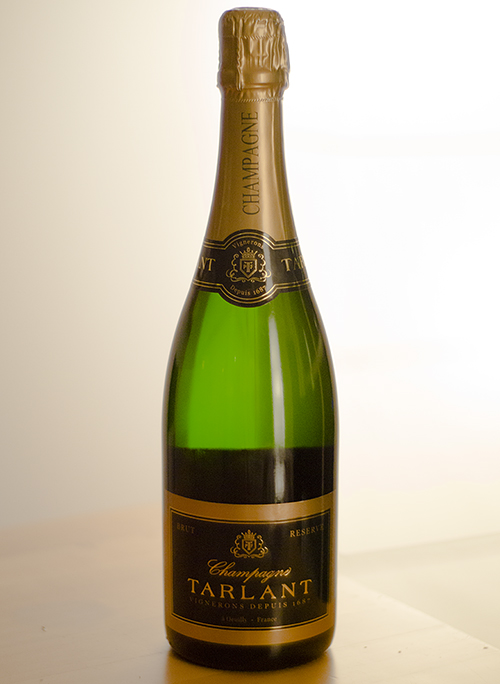
And, on the other hand, not all that is not vintage is bad. Obviously with things such as binoculars and cameras the new is expected to have a measure of functional superiority, even if it lacks charm and “authenticity” (whatever that is) and nostalgia. But even with wine, just because it’s not a vintage wine doesn’t mean it’s undrinkable. OK, yes, with most wines, non-vintage wines fall into that faint-praise-damnation bracket called “easy drinking” (or else they’re “plonk”). But among champagnes and other sparkling wines, non-vintage is standard. Vintage is uncommon. Expensive and highly valued, yes (because they’ll only make it if there’s an exceptional year; otherwise it all goes in the blend), but uncommon and not necessary for quality. I’ll happily have a glass – or a bottle – of “N.V.” champagne any day. Especially a day that merits any sort of celebration (such as celebrating having a bottle of champagne on hand). And hey, best to drink it before it (and you) gets any older.