Here’s the presentation I gave at the 2022 ACES conference in San Antonio, Texas, in which I talk about how nonfiction is driven by feelings, and how to work with them to make the structure as effective as possible.
Álamo is a Spanish name for a tree. The word is related, way back, to elm – you can see the resemblance, can’t you? So, of course, since words are faulty records of history, the tree it names is not an elm but a poplar – specifically, the cottonwood, and in fact several species of cottonwood, but most commonly the eastern cottonwood.
This tree is called cottonwood for a perfectly good reason: something of it looks like cotton – not its wood, but its seeds, or rather the little filaments attached to the seeds that help them be carried by the wind. In early summer the ground around a cottonwood is covered with a white cottony blanket, obscuring all below it. If you want to see the ground again, you will find that this cotton blanket burns rapidly and cleanly, vanishing like morning mist (but be careful – occasionally it ignites other things).
The eastern cottonwood is the state tree of no fewer than three states: Kansas, Wyoming, and Nebraska. But under the name álamo, it is most associated with a state that has as its official tree the pecan: Texas.
Remember the Alamo? Of course you don’t; you weren’t there. And yet, most people in the United States, many in Canada, and quite a few in other parts of the world remember the Alamo, or anyway remember something about the Alamo. It was, uh, a great American battle, like a huge thing with a lot of heroism, and in this big fort (was it a fort?), with great American heroes… Um… wait, was that where both Jim Bowie and Davy Crockett went to glory? Say, was that the battle where one of those guys drew a line in the sand with his sword? And the Americans… won or lost?
If you ever happen to visit San Antonio, Texas, you’ll have a chance to refresh your memory, as it were. A mere block away from the Riverwalk – a sunken riparian loop lined with Margarita-toting tourists perambulating a not-too-wide Disney-feeling stone path between restaurant patios and the shallow river (in which a few each week take accidental swims) – you will find the Alamo, or what’s there of it now. Just walk through the Hyatt lobby, past the Biergarten (“Prost, y’all!”), and along the brutalist sunken stream.
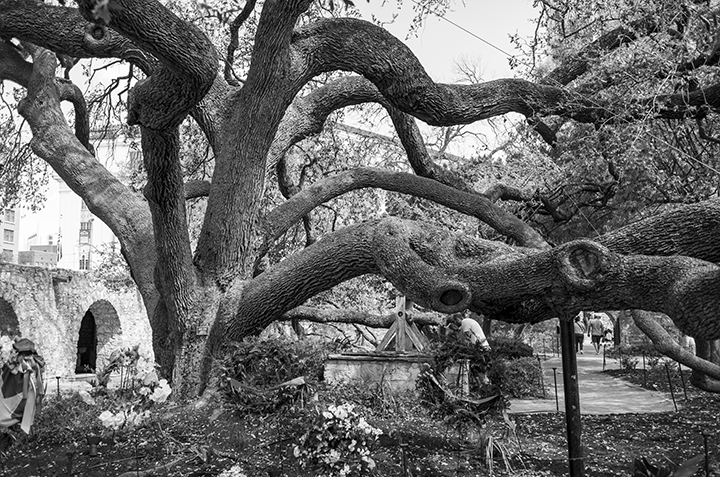
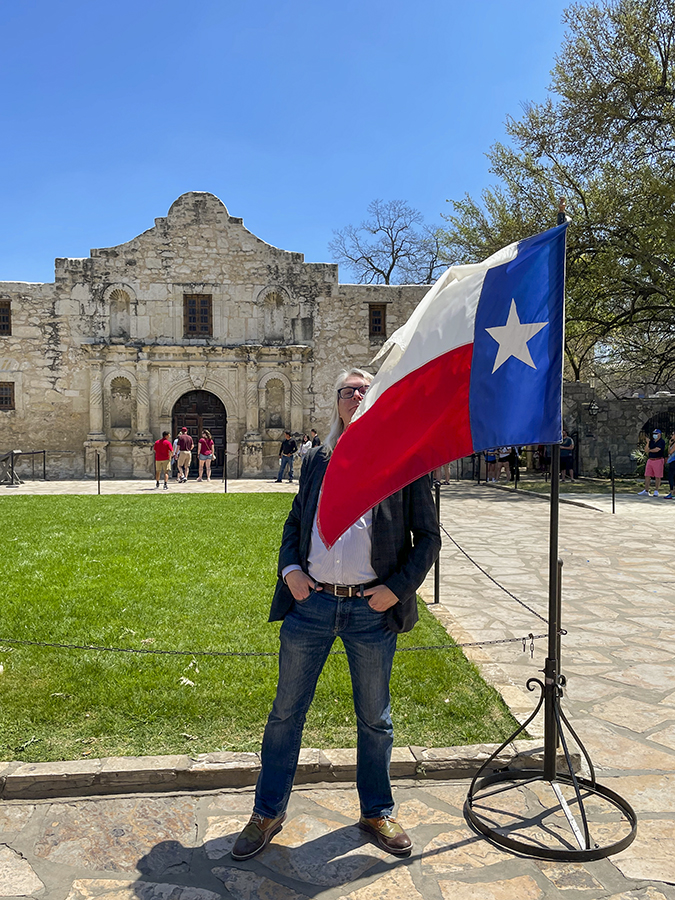
And then, up at street level, heralded by a Texas flag, past much open space and assorted visitors, there is the Alamo. Is it a large cottonwood, or a stand of them? It is not. It is stone buildings and stone walls. One of the buildings, a low, narrow, long one, is the oldest building in Texas, the long barracks. The long barracks doesn’t look like much on the outside, but when you get inside it, it looks like even less. However, it has a video and some historical displays on the wall. But there’s more. There are other buildings, and walled courtyards, and trees. In front of the oldest building in Texas is a large, ancient, gnarly tree. It’s an oak.
It has a well under it. The well is dry and its bottom is covered with coins and small bills. Maintaining memory takes money.
Beyond the big tree, next to the courtyard but not opening onto it, is the chapel.
The Alamo was originally established in the early 1700s as Misión San Antonio de Valero. Various buildings were erected, including a chapel, which was so badly built it collapsed within a few years. They started building a new one, but they never actually finished it. And before the end of the 1700s, the mission had stopped being a mission, for various reasons political and economic. It was abandoned for a while, and then used by various military groups and commercial enterprises. And somewhere in there, it started being called the Alamo, either because there were cottonwoods nearby or because for a time it was occupied by a cavalry detachment colloquially known as the Álamo de Parras Company, so called from the town of San José y Santiago del Álamo, near Parras in Coahuila. Which would mean that the cottonwood tree it was named after was in a village in what is now Mexico. Official memory sometimes carries things away.
The fame of the Alamo comes from the battle that happened there in 1836. Forces fighting for an independent Republic of Texas made a stand against the (also fairly new) Republic of Mexico, from which Texas was seceding. Americans, notably James Bowie and David Crockett, came to help Texas, but there was no official help from the United States of America, as it had treaties with Mexico and did not want to break them and engage in open war. At the time, the Alamo was a walled compound about the size of a city block, mostly open turf, and the chapel – or anyway, the walls and assorted other ruins that remained of it – was at one corner. The chapel was nothing much worth fighting for in itself – walls, no roof, rubble and dirt piled up the middle to make a ramp to the back wall – but it was worth fighting from, if you were going to make a stand at the Alamo.
I won’t recount the whole siege and battle; there are many websites that will tell you, and they mostly agree with one another. The siege lasted a week and a half from when General Antonio López de Santa Anna (yes, with a double n), the president of Mexico, arrived with his troops on February 23 – two days after his 42nd birthday – to when the Mexicans at last overcame the defenders on March 6.
The commander of the Texas forces was a 26-year-old American who had fled financial trouble and joined the Texas Army, Lieutenant Colonel William B. Travis. He wrote letters asking for help; he didn’t get much, but one of them, closing with a cry for “victory or death,” has become famous, and he at least got one thing he asked for (the latter). He is also said to have drawn on a line in the dirt with his sword on March 5, inviting any men who wanted to stay and defend to step across it and join him, and the others could try to escape (and exactly one did the latter). There’s a rather dramatic statue of this moment on the grounds of the Alamo now, over near the washrooms. But it probably didn’t happen that way. We can’t really know for sure; even the guy who escaped died not long after. If it didn’t happen that way, well, it should have. If we’re going to pay to maintain memories, they should be inspiring.
I say that Travis was the commander, but for a time he had to split the command with Jim Bowie. The already famous Bowie, 40 years old and known as a frontiersman, soldier, and skilled knife fighter, arrived in January 1836. In early February, when Travis was given command, Bowie – who outranked Travis – resisted and put it to a vote, and the men chose him. He celebrated by getting roaring drunk and causing havoc in the town, and so, to patch things up, he agreed that Travis would command the regular forces while Bowie took over command of the volunteers. However, partway through the siege, Bowie got so sick (no one says from what) that he was confined to bed, which is where he probably died, armed with pistols and a knife.
The Alamo combatant who is most famous now – though not mainly for the Alamo – was Davy Crockett (“King of the Wild Frontier,” as the Disney show theme song had it). Crockett was already 49 years old and had been a member of the United States House of Representatives; when he lost his seat in the election of 1835, he famously (and perhaps even actually) suggested to the people of his district that “they might go to hell, and I would go to Texas.” When the Texas Revolution started, he went to the Alamo with some men and arrived two weeks before Santa Anna did. No one is sure exactly where, when, and how he died; it might have been in battle, surrounded by Mexican corpses, or it might have been by execution after being captured. There are contradictory accounts. Some people have very strong opinions on this matter, because social memories are battlefields, too.
The actual Battle of the Alamo was shorter than some Zoom meetings, and even more abusively scheduled. For much of the siege, the Mexicans had fired artillery regularly; on March 5, they stopped, and the defenders finally managed to get some sleep… until 5:30 AM on March 6, when the Mexicans woke them up by attacking. The last of the defenders of the Alamo were killed at the upper end of the chapel before 7:00 AM. The whole battle, in which 212 defenders and at least twice as many Mexican soldiers died, could have happened between one time I wake up, look at my clock, and go back to sleep and the next time I do the same.
It is not, by the way, that Santa Anna’s men took no prisoners. They did take a few; then they killed them all. As to the bodies of the defenders, including the famous ones, they burned them in a heap in the middle of the compound, like so much cottonwood seed (but slower).
When the forces of Texas met Santa Anna’s men at San Jacinto on April 21, the brutality of the Mexicans at the Alamo made “Remember the Alamo!” a rallying cry. The battle of San Jacinto, which was won in 18 minutes and made 43-year-old General Sam Houston a hero, resulted in the capture of Santa Anna, who was allowed to return to Mexico after he signed a peace treaty three weeks later. That secured the independence of the Republic of Texas, which lasted until 1845, when Texans voted to join the United States. Many of those who fought for Texas were Americans in the first place, like Taylor, Bowie, and Crockett. The USA as a country wasn’t involved in the Battle of the Alamo, but it benefited from it after the fact, sort of like how the Alamo benefited from someone else’s cottonwood tree.
If you go to the Alamo now, the dirt and rubble are gone. It was in a sad state for some time, at first abandoned and then used for commercial purposes. At length its cause was championed by preservationists and taken up by politicians, and then it graduated from a place where a thing had happened to an official construction of memory. The seeds of events had taken root.
The chapel is the main attraction, the iconic building. The famous bell-shaped top of the façade (once criticized as looking like a headboard) was added in the mid-1800s, about 20 years after the battle. Its roof was added in the later 1800s. When you go inside, you walk on a stone floor that was added about a century ago. There’s not a whole lot in there – some signs, a model of the Alamo in 1836, some plaques, other people in controlled numbers, possibly ghosts but you can see those only in your mind. The chapel is no larger than some people’s houses: about 4,000 square feet, nearly identical in area to the nearby gift shop, which is also in an old stone building – but while the chapel is the empty coop of the flown birds of official memory, the gift shop’s souvenirs are their caked droppings.
You expect the Alamo to be huge, but it’s not. History often happens in places that are smaller than you expect. Memory and history have a magnifying effect. The seeds of memory come with a lot of fluff, but that fluff helps it spread and grow. You never really burn it all off, but sometimes it does take root – and sometimes it ignites other things.
And at the end, what remains, what is carried on the wind, is the words. You can keep saying “remember” long after the memories are vanished.
I have a new attitude, an attitude of nattitude. Not for nothing, I don’t want to be naughty; I have a need to be natty. I’m too used to not being spruce, and the time has come again at last to put on the dog – or at least to get a new leash on looks. I’m known sometimes for nuttiness, but now I want nattiness.
What, by the way, is this word natty? Well, we know: trim like a fancy tree (a spruce, clearly); smart in the sartorial sense – and perhaps not just that. In its earliest known uses it has a clear tone of craftiness and cunning – clever fashion, and perhaps not just well-chosen cuffs but well-picked pockets, too: natty lads was noted as a term in the late 1700s for light-fingered young men.
I am not so young, and no thief either, but my fingers are light in other ways (if you know the type, or the typing), and I have uses to which to put them – to wit: to wit. And I may or may not trip the light fantastic, but I will try to take a fantastic trip, or at least a light one, and have a ball. Because after two years of dressing down or, when cold, dressing in down (or staying in my dressing gown and hoping not to get a dressing-down), I want to dress up, mister.
We don’t really know where natty comes from – OK, it comes from England, the London area in particular, but we aren’t sure of its lexical heritage, other than it may be related to neat – but it has spawned nattily and nattiness. And, yes, now nattitude, which may seem redundant given that we have nattiness, but I’d say nattitude has more of an attitude, dude, and perhaps a greater sense of measurability, like altitude: how high is your fashion?
No, seriously. A hen sits and broods, keeping her eggs warm, and those little chicks grow and hatch so happily, like little fluffy yellow balls of freed sunshine. No wonder brooding is such a happy word – as the Oxford English Dictionary says, it’s a word for something that “cherishes … , hatches, or incubates.”
Um. You look skeptical. …Yes?
Robert Pattinson? What?
Who said Robert De Niro?
Marlon Brando? James Dean? Christian Bale? Ralph Fiennes? Matt Dillon? What’s going on here? Not one of them is a chicken! Total bros, every one!
And yet.
If you see the word brooding in a magazine or on a website, it’s not very likely to be talking about incubating eggs, is it? For that matter, even though it comes from brood, as in ‘family of young animals, especially ones that hatch’, often seen in brood of vipers and similar phrases, there seems to be no direct connection between its usual objects and younglings (except, of course, in that one movie involving Hayden Christensen).
Gonna need to think about this for a few moments here.
Of course, brooding isn’t just applied to the kind of actors who make every other guy on the planet seethingly resentful. It’s also applied to singers. And, more to the point, it’s applied to songs, and paintings, and even architecture. It’s an aesthetic effect: lowering, gloomy, moody, pensive. Like Hamlet (as long as Hamlet is being played by the right actor). But… how did something that started out so warm and fuzzy end up so cool and scratchy?
It’s two things. When a hen broods, she sits above the eggs, overhanging them. And also, more to the point, she sits there and just, you know, thinks. Each egg is like a thought – or perhaps, since they shall be hatched, a plot. Oh, and you’re probably well advised not to bother her; brooding hens are very protective.
So you get brooding skies, with brooding clouds that overhang; and you get the sense of brooding as meaning ‘sitting and thinking’ – or, anyway, ‘thinking seriously for a long time and not doing anything else’. And if you’re brooding, you’re probably brooding over something: your misfortunes, your unhappiness, or, as Gibbon wrote in The Decline and Fall of the Roman Empire, “the dark prospect of approaching poverty.” Definitely more vipers than chicks.
Where, by the way, does this word brooding – or, rather, its root brood – come from? It’s from an old Germanic root, bro-, which has to do with warmth or heat and with breeding.
Which, I guess, is fitting, since all those brooding actor bros are, in the eyes of their fans, pretty hot… and suitable for breeding, too, probably.
Some people are so desperate for a bit of the green, they will do whatever it takes. It doesn’t matter, night or day: they’re looking to be in the clover.
That’s the essence of venality – seeking money, literally being “for sale” (from Latin venum, ‘for sale, sold’) – but that’s not what I’m talking about. I’m talking about vernality. We are back in our salad days.
Which I could mean in the Cleopatra sense: “My salad days, When I was green in judgment: cold in blood.” But while it is both green and cold here right now, what I mean is just that it is the springtime of our lives, yet again, and also everything is becoming springy, verdant, salad-like. Vernal. Exuding vernality. No longer hibernal – which means wintry (from hibernalis), but Hibernian.
Which is, if you don’t know, being of, related to, or about Hibernia, which is Ireland – and we’re surely at the time of year when that’s peaking. Why, the annual St. Patrick’s Day parade was just today itself in Toronto (yes, three days late, but it has to be on a Sunday).
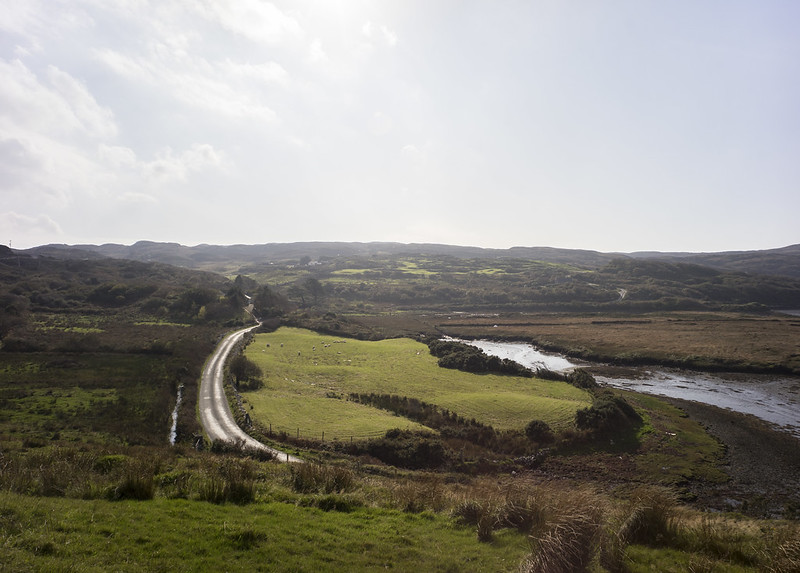
And yes, if you’re wondering, Hibernia does have some connection to hibernal. They’re not related in origin (the Greek Ἰέρνη Iérē, source of the Latin, comes from the same source as Eire and the Ire in Ireland), but hibernal seems to have influenced the appearance of the b in Hibernia. Which is hironic, I mean ironic, given that we associate Ireland with the green of spring (and I am here to tell you that Ireland is indeed a very green country overall; see photo above – which was actually taken in the fall!).
But it’s not the already past 17th I’m on about, it’s today, the vernal equinox – when night and day are equal, and it’s the one time of year things spring forth – and neither hibernal nor Hibernia relates to vernality, in truth; vernality comes from Latin ver, ‘spring’, which somehow is not related to Latin verus ‘true’.
Well. There are a lot of words springing forth from the wellspring of Latin (and its further sources). And the joy of etymology and word tasting is evergreen – which, again ironically, is not particularly vernal, since it’s green all year round. (It’s also not particularly venal, since it doesn’t pay. But it may be venial, since it’s pardonable.)
But it’s never the wrong time to leaf through a dictionary. Don’t be verecund (‘shy’); sure, you never know when you might get lucky.
I was watching a video yesterday about a 32-hour train trip through Argentina, an interesting trip in a new train on old tracks, with a locomotive that is made to go up to 160 km/h pulling a passenger train at an average 36 km/h over old tracks past endless scenery, towns, and stations. As with many YouTube videos about train trips, the narration is in subtitles rather than voice-over. About halfway through, as the narrator took the chance at a station stop to get an outside view of the train and the station, he noted that the railroad was not in its newest condition:
“Take a look at the tracks,” the subtitle reads, with a view from above of two largely overgrown pairs of tracks next to his train… “it’s vestuous for sure.”
Vestuous.
This is not a word I had known before. It seemed to have come from ancient days, not much refreshed by recent use, rather like the tracks it described. But what, exactly, did it mean? Overgrown? Decaying?
I looked in Wiktionary. Wiktionary did not know the word.
I looked in the Oxford English Dictionary. The OED did not know the word.
I knew – only because he had told the viewer so – that the narrator was French. So perhaps the word is an attempt to render a French word directly into English? I did a Google search and found a couple of sites that had been machine translated from French.
The first, from Chateau.com, is a tantalizing description of a champagne. “Vestuous of a magnificent golden colour with light emerald tints, the Cuvée des Princes is crossed by a fine cord of creamy bubbles.”
Hmm. If you click on the language button at the top, you get the French: “Vétu d’une magnifique robe dorée aux légers reflets d’émeraude, la Cuvée des Princes est traversée par un fin cordon de bulles crémeuses.”
OK, so that means ‘robed’ – vétu is a misspelling of vêtu. So the tracks are overgrown?
But then the second, from an Airbnb listing, is in a review of a house in France. The Google results give the following preview: “Nice stay, great pool, the host is available, the house is a bit vestuous but with large room that can accommodate a large family.”
Hmm. However, when I go to the site, I see that sentence as “Pleasant stay, great swimming pool, the host is available, the house is a bit old-fashioned but with large rooms that can accommodate a large family.” So Google’s preview translates vestuste as vestuous but Airbnb’s site translates it as old-fashioned.
But I also see “Some info has been automatically translated. Show original language.” I click on that, and I see this: “Sejour agréable, super piscine, l’hôte est disponible, la maison est un peu vestuste mais avec de grande chambre pouvant accueillir une grande famille.”
Now, if you run that through translate.google.com, you’ll get yet another result: “the house is a bit dingy.” But vestuste is not a word you can find in a French dictionary. That, however, is because it’s a misspelling for vétuste – which means ‘dilapidated’ or ‘antiquated’. It’s from Latin vetustus, from vetus, ‘old’. It has a rarely used English counterpart: vetust.
That works with the YouTuber’s intention. But that’s an interesting trip from the old to the new. To get to vestuousfrom that, you have to conjecture an s where there wasn’t one. At least to get to it from vêtu the s is historically accurate (as usual in French, the ˆ indicates a historical s that stopped being said and then stopped being written) – it’s related to English vest – but of course it’s been misspelled with é on the site. And either way, the -u or -uste has been turned into English -uous, which is not really how it would usually go – an English -uous is more likely matched to French -ueux and -ueuse.
So in both cases there’s been a misspelling, and the machine translation, instead of understanding the intent, has grabbed this apparently suitable English word. Except where did it get the idea that there was an English word vestuous to translate either of these words to?
Well, there’s one more fun thing, one last bit of dressed-up antiquity: there are several other results for vestuous on Google, all in historical English books… all of which have been digitized with OCR (optical character recognition). In many cases, you can see the original. And you find that the OCR has read veſtuous – which it then rendered into modern typography as vestuous – where it saw vertuous. Which is (as context will readily tell you, even if you don’t look it up) an old spelling of virtuous.
An ancient virtue, decayed and misunderstood, brought into the modern times as nothing but a byword for obsoletion and costume. How damned perfect. I think I will start using vestuous for the myriad faux-archaisms often inflicted on us: ſ misread as f, þe olde misread as ye olde, endless excrescent e’s (Crowne, Ranche), and wanton misuse (typically mocking) of -eth and -est. “Ah,” I can say, looking at these new trains travelling labouredly on old tracks, “vestuous for sure.”
Slush has slushed slipperily, and even (or especially) for the fleet of foot the streets are fletiferous; the nimble and awkward alike are likely to become labant.
Labant? Is that something you could transcribe in Labanotation? Well, perhaps, if it’s choreographed. But more likely, on lubricated pavements, you will not be tripping the light fantastic, just tripping – slip-sliding away, slipping into something less comfortable: perhaps an esker of snirt, perhaps just the sidewalk muttering to itself in geological time about how hard it used to rock. You see, when you are labant, you are sliding, or falling down, or at least wavering or tottering.
And where does this word come from? The dictionary, of course. Now, most words can be found in dictionaries, but that doesn’t mean it’s where they’re from any more than the DMV office you happen to be lined up in to get your licence is where you’re from. But there is a special set of words that are conceived in dictionaries and live their whole lives there: born to be defined. Fletiferousis one such, and labant is another, both noted in the Oxford English Dictionary with this caveat: “Obsolete. rare. Apparently only attested in dictionaries or glossaries.”
Well, ya know, when we availed ourselves of the replete pantry of Latin roots, we just couldn’t resist confecting almost anything plausible, just so we would have a fancy word in a scholarly robe for something we previously had to speak of only in brutish Anglo-Saxon. In the case of labant, it’s coined from labare, ‘fall, slide’. But the chips will fall where they may, and for some words, whether they even totter briefly, they land squarely on the otiose side. The lexicographer has laboured in vain.
But all is vanity, and every word is a free coin you can use when speaking to God, yourself, and your cat, even if no one else. If you like labant, keep it. Add it to your slush fund.
We have a paradoxical view of travel and time off in English. As I’ve already noted, we historically associated travel with unpleasantness. And yet we assume that significant time off will be spent away from home. In my latest article for The Week, I look at some of the other lexical paradoxes we have for leisure time: