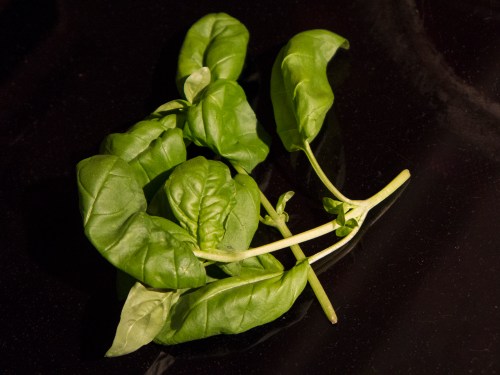
Ocimum basilicum, the herb of kings and king of herbs, an herb so basic as to be only one letter different from basic. But at the same time, as kings are wont to be, a herb that does not blend into the background, a herb that will be different just for the sake of being different, even having pronounced differences with itself.
Pronounced? You don’t believe? Like herb itself, basil has a choice of two ways to say it. Look in a dictionary: while the supervenient pronunciation rhymes with dazzle, an accepted alternate rhymes with hazel.
Weirdly, I first learned neither of those pronunciations. You see, I had a great-uncle Basil whose name was said like “base’ll” – that is, with a “long” a and a voiceless s. So it did not exactly go with hazel. Which is amusing, because his wife’s name was… yes… Hazel. (But his name had always been said that way, even before he met her.)
Anyway, on the basis of my uncle, I assumed that that was the proper pronunciation of basil. When a kid’s TV show I watched had a character named Basil the Beagle, I assumed his name was spelled Bazzle. I mean, wouldn’t you, anyway?
But this herb is not avuncular. I love it, to be sure, and use it in tomato sauces and soups whenever I can (among other things), but I learned an important lesson when I once told my housemate “It’s impossible to use too much basil.” The dude proved me wrong decisively. And allow me to inform you: an excess of basil produces a truly horrible flavour. Just as basil can be (as in Portugal) a token of love or (as in ancient Greece) a symbol of hatred, its effect on your food will vary very much according to the dosage.
This is not to say that basil is tyrannical in a dish. It is not a tyrannos; it is a basileus.
I’ll explain that. Tyrannos, more accurately τύραννος, means ‘king’ and is the term applied to Oedipus in the play Οἰδίπους Τύραννος, most often called Oedipus Rex from the Latin but translated into English as King Oedipus (I’d make that King Piercefoot). But it is also the root of tyrant, which gives you a little sense of what kind of king we mean: an absolute ruler, a dictator, a despot. On the other hand, βασιλεύς, basileus, also means ‘king’ but otherwise means ‘chief, master, patron’, so it’s maybe a little more agreeable. Unless you go too far, take a risk, and it becomes a basilisk: a mythical snake-dragon with a deadly gaze and a name that comes from the same kingly root. So, overall, uh… like a boss.
But basil also has holy overtones. And by that I don’t just mean holy basil, which is a different (but related) herb also called tulsi. I mean assorted saints, especially in the Eastern Orthodox church. You may know that the big church on Red Square in Moscow is Saint Basil’s Cathedral – well, that’s its short, unofficial name. But which Saint Basil is it named after? There were several, about half of them bishops: not quite kings, but men of power and influence. The Saint Basil in honour of whom this magnificent cathedral took its common name (though not until more than a century after its construction) was a holy man who is now buried in it, a man who once rebuked the man who had the cathedral built, Ivan the Terrible (a terrible translation of Иван Грозный – Ivan the Fearsome would better), for not paying attention during church. He is called Василий Блаженный, commonly rendered in English as Basil Fool for Christ. He went around wearing shackles and literally nothing else, destitute by choice, and he had Ivan the Fearsome himself as a pallbearer at his funeral and now is memorialized by a building that epitomizes everything he wasn’t – especially since it’s no longer even a functioning church.
A small further digression must be permitted. Василий is not pronounced “Basil” however you say “Basil”; it is the name normally rendered in English as Vasily or Vassily or Vasiliy or… You know, as in Wassily Kandinsky, whose paintings are as colourful as that cathedral, but with different structure and a different palette. The /b/ of Ancient Greek eased off to a /v/ in modern Russian, and in several other languages – including modern Greek, in which β has also softened to /v/, sort of like how basil’s flavour softens when it has dried.
If you have a kitchen with a standard collection of herbs and spices, you almost certainly have flakes of dried basil. You can shake some into your hand and taste it. Yup! That tastes like basil! As in the stuff you put into spaghetti sauce (along with oregano). It’s vaguely sweet, with reminiscences of chamomile, mint, and anise, and maybe a bit of hay. But do you have access to some of the fresh stuff? Take a leaf and chew it. It’s recognizably the same herb, but the dials have been turned up from 2 to 10, except for the anise dial, which is somewhere between 13 and 20, and there may be a hint or three of your neighbour’s lawn. Its taste suggests that if it were a person, it would be trying to decide whether to kiss you or kill you.
My edition of the Larousse Gastronomique (1960), in translation by Marion Hunter, paints a picture of an erstwhile grand dame: “Basil . . . Plant cultivated in gardens for the sake of its fragrance. . . . Basil was once considered a royal plant; only the sovereign (basileus) could cut it, and even then only with a golden sickle. The plant has now come into common use.”
Oh, but don’t take their word for it (no, seriously, don’t). Throw a naked leaf or three into a sauce. It will beatify the sauce. (Throw in two dozen and it will murder it.) And when you get to the leaf, soft and soggy, it will not resist you like a bay leaf; it will go easily into your mouth, where it will at its last remind you that it was once, and still is, royalty.
And yet it has the common touch, and really always has. Look, here is a recipe, presented to us by Achille Bruni, Professor of the Royal University of Naples, from his Nuova enciclopedia agraria (New agricultural encyclopedia) for “Genoese low-fat lasagne,” which they already had back in 1859 (and if you want to quibble with the spellings, click that link and check it for yourself):
Lasagne di magro alla genovese. — Cuoci in acqua con sale le lasagne, le quali riesciranno più saporite se avrai fatte in casa. Intanto per condirle metti in un mortaio due e tre spicchi d’aglio, foglie di basilico in abbondanzo e alquanta polpa di cacio di Roma, o d’Olanda, o di Sardegna, secondo il gusto, e pesta tutto ben bene; aggiungi dell’olio fino in quantità, e tre o quattro cucchiaiate dell’acqua stessa in cui cuocono le lasagne. Quando queste son cotte, colale e condiscile suolo per suolo col pesto che hai preparato, aggiungendo ancora del formaggio grattato.
Here is a translation (mine, with some help from Google and Wiktionary):
Genoese low-fat lasagna. — Cook the lasagna in water with salt; it will be tastier if you have made it at home. Meanwhile, to season it, put in a mortar two and three cloves of garlic, basil leaves in abundance and some ground cheese from Rome, or Holland, or Sardinia, according to taste, and pound everything well; add fine oil in quantity, and three or four spoonfuls of the water in which the lasagna is cooking. When these are cooked, strain them and season them layer by layer with the pesto you have prepared, adding more grated cheese.
Remember: foglie di basilico in abbondanzo [sic]: basil leaves in abundance. Ma non troppo, sai?