
flitters, flitterjigs

My friend Stan Carey has been so good as to send me a copy of Slanguage: A Dictionary of Irish Slang, by Bernard Share. Naturally, I want to share some of its bounty with you. This evening I flipped it open and found a winner right away – in fact, two winners for the price of one.

The headword is flitters. It means ‘fragments, pieces, tatters’. And it sounds like it should, doesn’t it? Continue reading
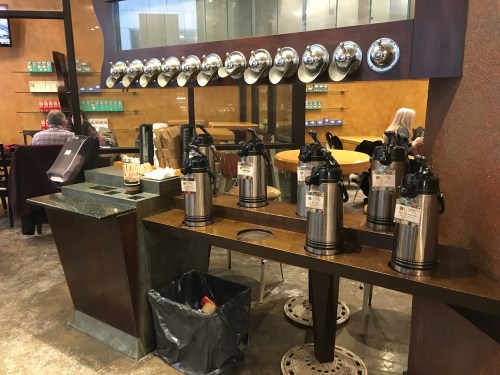
Croissant Express

IMG_9277

Where else can you find this?

Listen to the audio of this – complete with the background fridge hum and radio – on Patreon, for free.

This place is a secret. Don’t tell anyone about it. I don’t want to come here one day and find it packed out with Toronto Life readers or retro-hipsters. This is one place I can come on a winter’s day where there is always room to work and it’s always warm. I’ve been holding off on even mentioning it. Continue reading

galangal, galingale

How do you say galangal?

Why?

I say it with the stress on the first syllable. But that’s because I first saw it written as galingale. If you know nightingale and perhaps farthingale, the stress seems pretty obvious.

But why would anyone spell it galingale? Continue reading

Pronunciation tip: bergamot

Have a nice cup of Earl Grey tea (probably made by Twinings, but your choice). Now tell me: what’s it flavoured with? Yes, bergamot, but do you know how to say bergamot? For that matter, are you sure you know how to say Twinings? (Bonus: How about Evelyn Waugh?) Here’s my latest pronunciation tip video to get you sorted right.

The sound of chont

I make audio versions of all my blog posts and put them on Patreon for all subscribers who pay $2 or more per month. But occasionally I make one free for everyone. Today’s is one of those. As a bonus, it’s the audio version of a subscribers-only blog post: chont, text version, is available only for those who subscribe for at least $1 per month. So you get to hear it for free… but not read it.

What is chont? A satisfying sound. Here is the sound of chont, with lots of chonts.

Tango Palace Coffee Company

IMG_9293

Don’t know where you would tango, but…

Listen to the audio of this on Patreon, as always!

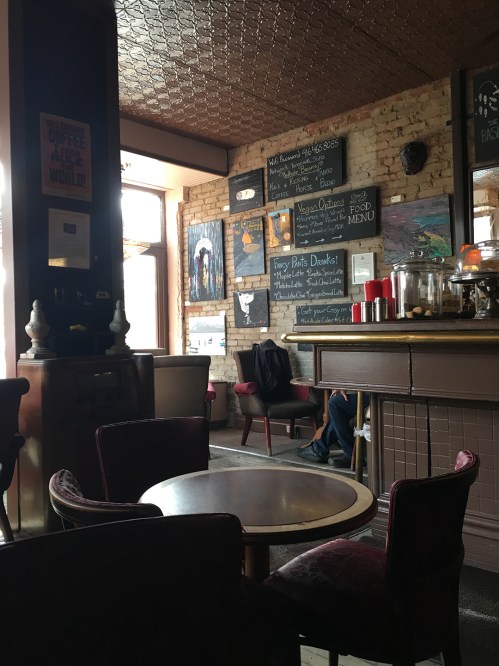
If you’re jonesing for a cute coffice space with a cute name and cute fixtures and everything that comes with that, including a floor that’s years overdue for being refinished (they’re redoing it this summer), a dozen low small round tables flanked by old padded chairs of varying wobbliness, and your choice of illumination from right-in-the-window to deep in the dark back – though of course there are Art Deco lamps throughout (and there’s a garden when the weather’s good enough), dance over to Tango Palace Coffee Company at Queen and Jones. It’s towards the east side of hipsterville, right next to a pretty little park. Continue reading

chont

This word has a very satisfying sound, I think. Like something that fits neatly being slotted in just right, or a nice bit of mechanics tightly machined and working to perfection. A key fitting in a lock. A catch clicking in its notch. A door closing smoothly and tightly. Or perhaps the sound of a block of cheese or soap being cut in a perfect diagonal slice. It starts with the crisp click-slide of “ch” and after a short vowel pushes the cushion of the nasal “n” to the tongue-tip stop “t.” Tidy. Complete. Satisfying. Continue reading

kukumakranka

This word looks like an elephant – or maybe several large birds – tumbling down a flight of stairs. It has no fewer than four k’s and five syllables. It is, as the currently popular term puts it, really extra. Oh, and if you want even more, it can also be spelled koekemakranka.

Or you can call it by its Linnaean name, gethyllis.

Such a pair, gethyllis and kukumakranka. Like some sweet little kid and a rowdy noisy bird from an animated feature. Whatever this thing is should be partly demure and partly dominating.

Which, in fact, it is. Continue reading

seiche

Have you ever been at a party where there’s someone on one side of the room holding forth volubly and vapidly, and the crowd around them gradually rarefies while it gets more and more crowded on the other side of the room? You’ve just seen an important fact in fluid dynamics. Continue reading

pyntrel

So. You know scoundrel and wastrel and custrel (well, maybe you don’t know that one) and kestrel and even doggerel. There’s this –rel suffix that English got from French–ereau and –erelle, and we use it for diminutive derivatives, especially pejorative ones. It sounds sort of like throat-hawking in another room, or a car peeling out on a gravel road nearby, or the faint echo of someone having been thrown in a well.

But pynt? What is that? Well, it’s an old spelling for paint or pint or pained or point. But which is it here?

Yes. Continue reading

