In a theoretical perfect world, there is no depth of field, because in a theoretical perfect world, there is no acceptable circle of confusion.
Let me put that another way: What is sufficiently accurate, or clear, or true is a question of what are able to discern and willing to accept.
I’ll explain. And I’ll say up front that this looks at first like camera geekery, but it’s not. Or anyway not just.
In photography, depth of field means ‘how deep the field of focus is’. This may seem odd, given that a field is a wide, open, flattish place, and depth is how deep something is, which we normally think of as vertical measure. Why not depth of pond instead? But depth has, for as long as we’ve had the word, also referred to distance from front to back, or any distance measured from the perspective of the speaker. And the figurative senses of field are more than you could fit in a field, and, alas, we don’t use pond in all the same ways.
So, anyway, we can rephrase the definition of depth of field as ‘what range of distances from the camera are seen as in focus’. If you have great depth of field, everything from one metre to infinity may be “in focus”; if you have shallow depth of field, it may be only everything from, say, 100 centimetres to 110 centimetres. I’ll illustrate with some pictures below, but first I want to explain very briefly how this works.
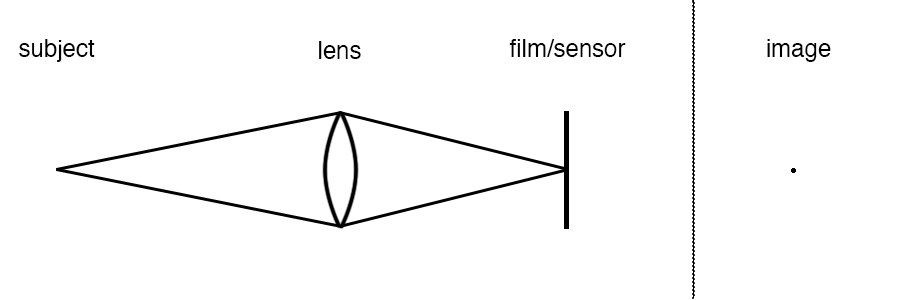
Let’s say your lens is focused on a dot. It takes the light coming off the dot and focuses it on the film or sensor, making an image of the dot:
But let’s say the lens is not focused on the dot. Then instead of a dot, what hits the film or sensor is a circle:
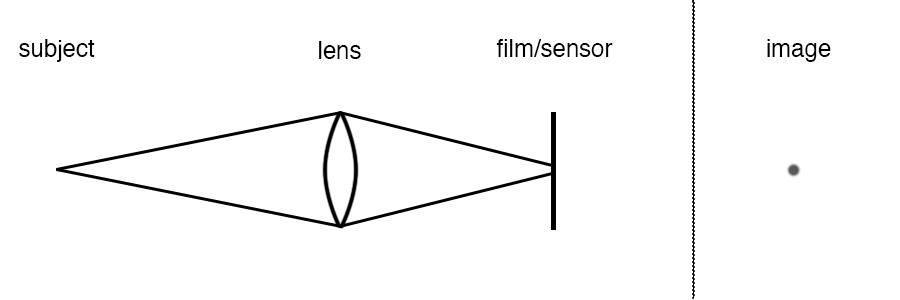
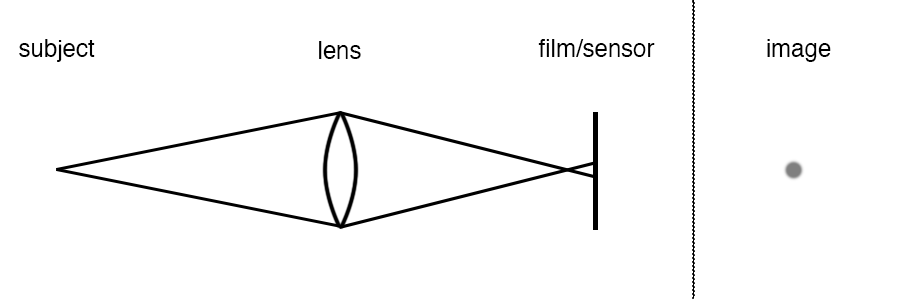
The size of the circle depends on how far from the plane of focus the dot is, the size of the aperture in the lens (we’ll get to that), and the length of the lens (also coming below). This circle is, for optics nerds, called the circle of confusion.
You’ll notice that there’s no field in any of that. There’s just a plane of focus, and whatever’s not on that plane is out of focus. That’s the pure mathematical ideal of it. Which, however, is not part of the world we live in.
In our real world, there is no such thing as a perfectly sharp dot. There are just circles that are so small, they look like dots. And, more to the point, there’s the smallest dot-like circle that can be made by a given lens when it’s in focus, and the smallest dot-like circle that can be recorded by a given bit of film or digital sensor, and the smallest dot-like circle that can be represented by a given printed image or displayed on a given screen at a given size, and the smallest dot-like circle that your eye can distinguish in a given image at a given distance in given lighting conditions. That’s four different things coming into play – but the last one is the final arbiter.
What this boils down to is that everything that’s no less in focus than what your eye can see as “in focus” is in the field of focus. The entire range of planes where the perceived circle of confusion is too small to be distinguishable from exactly in focus is what we call the depth of field.
This has a whole set of implications, and it also opens up a whole bunch of things that people who are so inclined can argue about. But let me just cut to the primary implication of this for photographers (and this is the geekery bit, which you can probably skip if you want to get back to the issues I started with – just scroll down to the wine bottle pictures): You can control the depth of field using the aperture on your lens.
The aperture on a lens is like the iris of your eye (in fact, it’s the same thing, only made of metal, not muscle). When it’s open wider, it lets in more light; when it’s closed down tighter, it lets in less light. So the wider it’s open, the shorter an exposure time you can use (good for capturing motion, avoiding the effect of shaky hands, etc.) and/or the less sensitivity you need for your film or sensor (greater sensitivity leads to more “grain” or visual noise, for reasons we are not going into here). But the wider the aperture is open, the shallower the depth of field, because the quicker the circle of confusion gets bigger than the smallest dot that looks sharp:
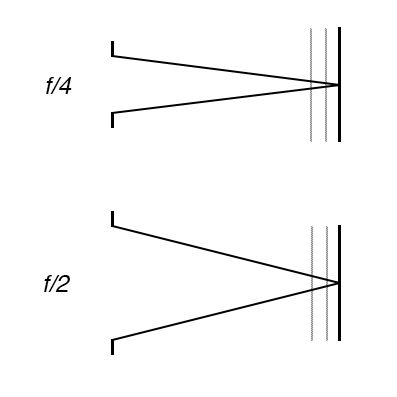
This also relates to the length of the lens, because – to be very simple about it – a longer lens makes a bigger circle of confusion on a sensor or negative of a given size at the same relative aperture. Aperture is expressed as “f-stop,” a fraction of the focal length – for instance, f/4 means the diameter of the aperture is ¼ the focal length of the lens when focused at infinity (lenses get longer as they focus closer, which also means the same f-stop lets in less light at close focus).
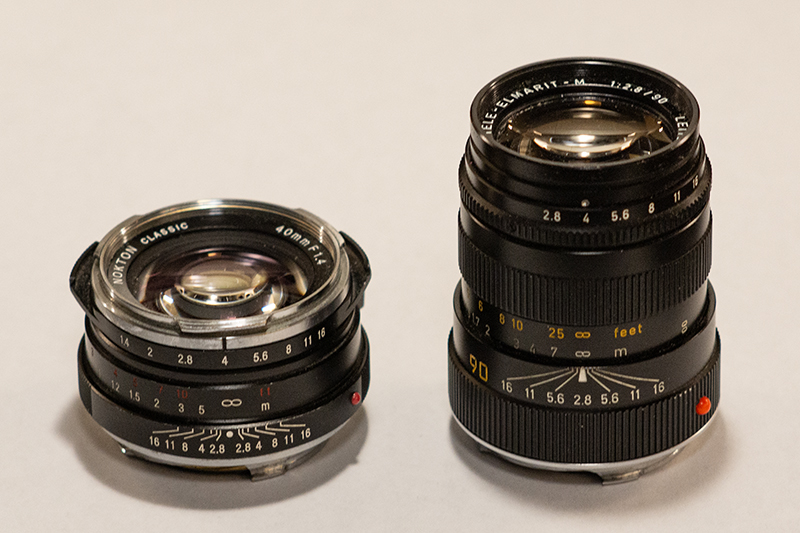
A 40mm lens and a 90mm lens
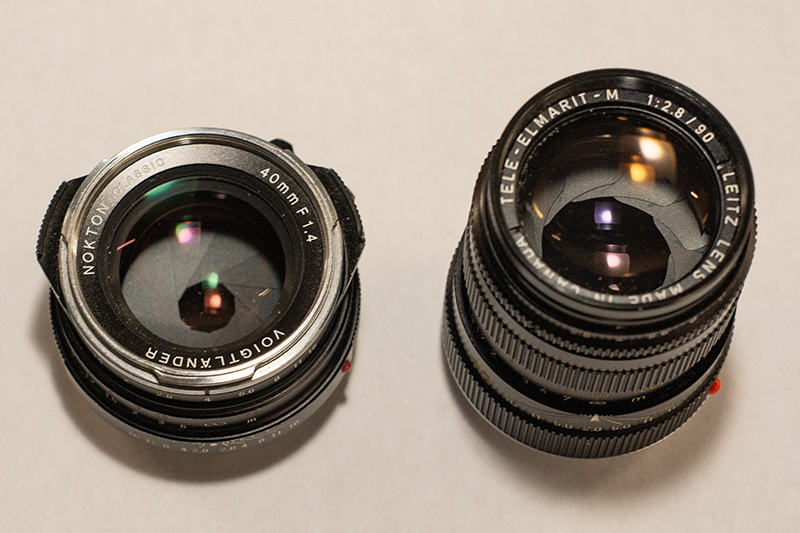
You can see the diaphragm (iris) is more than twice as wide at f/4 on the 90mm
This is because the same f-stop – i.e., ratio of aperture to focal length – lets in the same amount of light, which means the longer the lens, the larger the opening. The geometry of this is straightforward for those who like geometry, and not worth trying to explain here for those who do not.
This also means that for the same amount of light at the same angle of view on two cameras with different-sized sensors, the one with the smaller sensor will use a shorter lens with a smaller aperture, which results in a greater depth of field. (Online camera dorks tend to argue endlessly about the specifics of this. People who love taking photos generally use their eyes and judge what looks good to them, since two lenses of the same focal length and aperture may nonetheless give very different-looking results.)
Here are some wine bottles photographed with a wide aperture:

Here they are with a much smaller aperture:

But remember, this is about what your eye can see as “in focus.” That image is a small representation of a much larger original file – it’s less than one tenth of the pixel dimensions of the original. Let me present closer and closer crops of the same image until I get to the same resolution as the original:



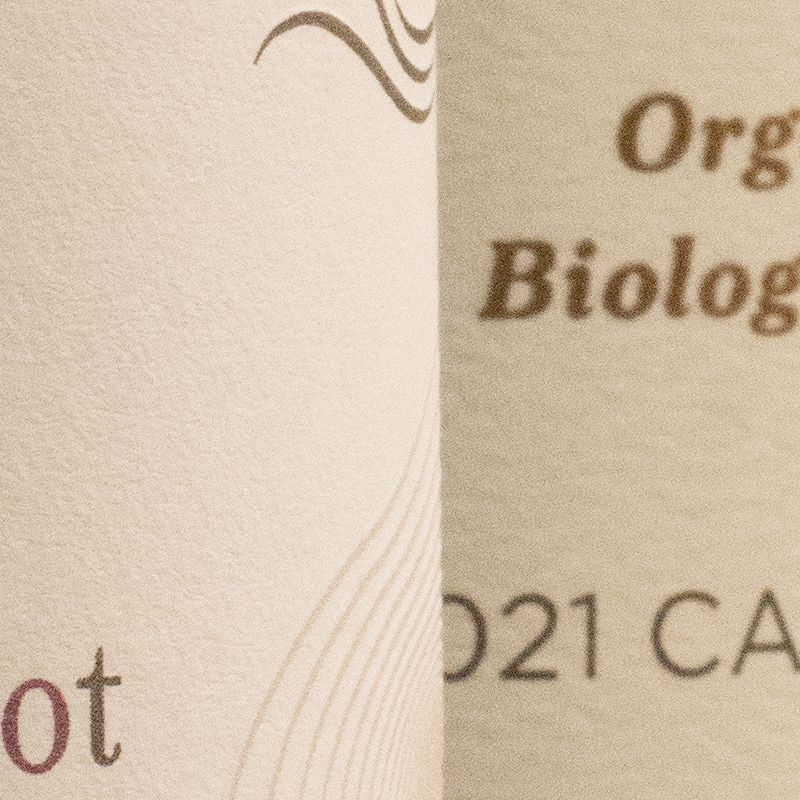
Do you see less and less looking like it’s in sharp focus? If you look at this on your phone, and then go view it on a desktop computer, you’ll see even less that’s in sharp focus.
So. One thing that some people will argue about is what the depth of field is on that photo. Is it really, intrinsically, only what is discernible as sharp at full magnification? Or does it vary according to reproduction, for example greater on a smaller screen? If it does, does that mean that people with sharper eyesight may see less depth of field in the same image than people with poorer vision? (Yes, it does.)
This question makes me think of the classic National Film Board short Cosmic Zoom. Watch it and tell me what the depth of field is at any point… (The second half, when it zooms in closer and closer, is more illustrative than the first half, when it first zooms out.)
So. Let’s step away from the camera. Now say that instead of talking about images, we’re talking about a field of study. You know, linguistics, history, economics, physics, that kind of thing. Remember that “depth of field” is a function of perception – it’s how deep you think your perception of focus is. Now consider how deep you think your perception, i.e., your knowledge, of a given field is.
If your knowledge allows you great detail of perception, and you’re coming at it with eyes wide open, “close enough to right” has to be very close, and the amount you’d say you understand – or the amount that’s accurately captured by a given statement about the field – is not all that much. You don’t tolerate very much fudge factor (circle of confusion).
But if you don’t really know that much, you can’t tell as much difference; you accept more confusion. And if you’re getting a broader view, not as zoomed in on one area, the distinctions are less perceptible. And so you reckon that you understand a fair bit of the field – that your perception of it has considerable depth.
This gives us the classic situation of people who look at a thing and say, “Oh, come on, it’s obvious,” and other people who say “No, this is not the same as that.” The first kind of people may think that they have superior perception – superior depth of understanding.
Which, obviously, seems annoying and bad. But there are also many contexts in which “close enough” has a fair amount of latitude – depth of field – and very fine distinctions are not relevant. When you’re not looking at a matter in great detail, the acceptable circle of confusion may be fairly large, and smaller differences just may not be discernible, or not relevant at the moment.
For example, if you’re learning about something, it’s normal to get to smaller and smaller circles of confusion over time. I’ve often said that in each linguistics course you take, you spend up to half the time learning that what you learned in the previous course was not really accurate. This is true of many fields of learning. The more you know, as they say, the more you know you don’t know.
And of course there’s the old joke about graduate studies: as you move through the master’s and on to your doctoral dissertation, you know more and more about less and less until you know everything about nothing. On one particular point, there is no confusion. But move just a bit away from that point, and there is confusion… which, within certain circles, you will just have to accept.