Tag Archives: from the bookshelf

namárië

I promised to come back to this book. Remember? This bookshelf at my parents’ place?

This book.

I have it on my bookshelf too. Not the same edition. It’s back behind a post. See it?

Look closer.

A box set.

The set also contains The Hobbit, but the volumes of The Lord of the Rings are thick from being read, so I keep The Hobbit next to the box (I read it before I got this box set, so this copy is less read).

Did you know that books get thicker with reading? They absorb some of you each time you go through them. Every book you read, part of you is passed into it through your fingers and the pages are fattened with your spirit and imagination. Return to the book and you will find it there. And add some more. And as you pass through life, that soul you left in the book still feeds into you and sends images to you. You never truly say farewell to a book once you welcome it and it welcomes you.

I swear it’s true.

And I read this copy twice. At least twice, but twice for sure. So it’s thickened.

I like this edition because it has the appendix in the back with the alphabets, runic and Fëanorian.

I cannot tell you how much I fell in love with these alphabets in my childhood and youth. I loved alphabets. I once made a volume of fantasy languages; at that age, I couldn’t be bothered much with the syntax or lexis (let alone the morphology), but I came up with a complete sound system and alphabet for each of them. I’m sure I have that book somewhere. It’s a graph Nothing Book: a hardcover book with empty pages of graph paper. I filled quite a few of them.

I shall have to dig it out. If I have it here it’s under a hundred pounds of other boxes in the closet, probably. Not tonight.

Tolkien is famous for creating languages for his different races. He’s not the only person to create languages, of course; Klingon and Na’vi are two recent examples of thoroughly created “conlangs,” constructed languages (I find the term conlang a bit fanboyish – sci-fi fans have an absolute fetish for syllable acronyms – so don’t count on seeing me use it much). But he was one of the seminal ones to do so, and he did it in a truly thoughtful way, like the philologist he was: complete with history, sound and morphosyntax changes, and more.

Tolkien based his languages on human languages he liked. He like Welsh and he liked Finnish, and he created two elvish languages, one inspired by each. The language of the Grey-elves is Sindarin, inspired by Welsh. It’s the language that elves in The Lord of the Rings generally use in everyday use. But then there is the one based on Finnish: Quenya, the language of the High Elves, the ones who went to the west and for the most part stayed there. Some of them came back to Middle-earth and lived with the Grey-elves and came to speak Sindarin, but kept Quenya – a gradually changed dialect of it – as a formal tongue. The language of their home and heritage, brought out now for formal occasions. And for when they look to the west and their spirits are crying for leaving, remembering Valinor, the western land, and Valimar, its capital.

That might seem familiar to many people in Canada, children of immigrants, who speak English every day but, when they go to church on special occasions or to community gatherings, still have the language of their forebears, wherever they came from. The language that their parents, or their parents’ parents, said farewell to their native home in. The language that is at the same time the connection, the thread, that holds them to their homeland. The language they read the book of their heritage in, and that connects them to the part of themselves they left there.

The longest text Tolkien wrote in Quenya is this poem – a song, actually:

That’s in the single-volume edition my parents have. Here’s in my edition:

He helpfully gives a translation of it below the text.

It’s in the first volume, The Fellowship of the Ring.

It’s sung by Galadriel as the company of the ring leave Lothlórien, the elvish tree-garden-river-home, a green dreamland. In fact, Lothlórien means ‘The Dreamflower’. If you saw the movie, Galadriel is the one played by Cate Blanchett, a rather perfect bit of casting. You can hear it sung in many versions on YouTube. Here’s one by Adele McAllister:

The name of the poem is also the word that comes around in the last stanza:

Namárië.

Four syllables: /na ma: ri ɛ/.

Namárië! Nai hiruvalyë Valimar.
Nai elyë hiruva. Namárië!

Farewell! Maybe thou shalt find Valimar.
Maybe even thou shalt find it. Farewell!

You can glean quite a bit from even just this stanza. Nai means ‘maybe’; hiruva means ‘shalt find’; elyë means ‘thou’ and can be attached to the end of hiruva to make hiruvalyë ‘thou shalt find’ or can stand alone to be emphatic ‘even thou’; namárië means ‘farewell’.

Except there’s more you can’t see from that passage. Namárië comes from á na márië, which means ‘be well’. It is used not only for farewell but for greeting and welcome.

Be well. Go well. Fare well. But in English we say farewell only as a parting. We may say hail as a greeting, and that comes from a wish of good health. But we have lost the literal sense of both in our common use anyway. We may say Good day as a greeting and as a parting, but we only perfunctorily wish a good day if we think of it at all. I cannot say how sincere Tolkien’s elves were in their salutations; remember, this is a word in what had become for them a ceremonial language. It is as though we in English said Latin Salve in greeting and parting. Or, perhaps, Namaste.

But wellness is good, coming, staying, or going. And the road goes ever on. You travel through space and time, taking yourself with you and yet leaving yourself everywhere, and taking everywhere with yourself. There is some of you where you came from, some where you are, perhaps some already where you are going. And every meeting and well-wishing is also an acknowledgement of the unbridgeable distance between two persons, and the transience of our passage through that moment.

We are always everywhere we have been, and yet we are never completely anywhere: we carry our absences like wishing wells in our shirt pockets; we yearn for places we no longer are, places we’ve lost, places we have not yet been. We fatten the pages of the book of life, pages made from the trees of our lost and future homelands. We wish each other well. Namárië.

stardust

Back behind the big plush chair in the corner, down on the bottom shelf at floor level, next to the large-format comic anthologies, stuffed in and rarely touched these days, are my books of sheet music.

I’m going to pull out two of them by the same artist. I don’t own much rock sheet music but I own these. I bought one in Calgary in a long-gone music store in Brentwood Mall, near the university, if my memory doesn’t betray me. I know exactly when and where I got the other one: in the summer of 1984 in a music shop in Montreux (on the Lake Geneva shoreline – the shop was a few blocks uphill, though). It was one of my biggest splurges in a summer spent at a conference centre up the mountain in Caux.

It’s the left-hand one.

Really, who else did you think I would be talking about today?

Yes, of course I’ve been a fan of David Bowie for a long time. From the time a high-school classmate drew my attention to him, I latched on and never really let go. Not that I always listened to his stuff all the time; I still don’t own all his albums. But Bowie had talent, and he had presence. Animal grace. Screwed-up eyes and screwed-down hairdo. Those canine teeth. Eyes of two different colours that could stare for a thousand years. And that voice. Not the voice of a great singer. The voice of a great presence.

At an age when one wants idols, I easily devoted myself to Bowie. I even prevailed on my brother to go with me to a rerun of the Ziggy Stardust concert movie when it was showing in Calgary. I am quite sure my brother did not enjoy it as much as I did, so it was very sporting and brotherly of him. Bowie did not represent to him someone he would want to be like. To me Bowie was a doorway, a gateway, a stargate. I was under no illusions; I knew he had weaknesses, imperfections, an eggshell of humanity, his presence a performance that even he didn’t fully buy into. But that’s why I liked him. He was a star, a starman, come from the stars, fallen to earth.

Just like the rest of us. But he knew it.

Look at this book. I haven’t opened some of these pages in decades now. As I flip through I have to peel them apart here and there. It was in some damp place somewhere for some time, I guess: it has these dark patches. Age has grown into it.

I’m listening to “Suffragette City” as I write this. It’s one of the best high-school dance songs ever. It was played at every single dance at Banff Community High School when I was there. If you want to see the adolescent equivalent of the jump to hyperspace, watch the dance floor at “Awwwww, wham bam thank you ma’am!” – an interjection not found in the sheet music. Oh, sheet music: it just lies there, dry inklings in sprinklings of ink on paper. Without breath and bone and blood and muscle it is nothing. It needs that stardust.

What else? Ziggy Stardust. David Bowie was stardust, and to stardust he… no, has not returned; he always was and always will be. As are we all. But he knew it.

Bowie didn’t invent the word stardust, of course. In 1844 one astronomer first used the term star dust to describe the innumerable stars he saw, too small to be discerned individually. In 1879 a geologist used star-dust to name that dust that constantly falls from outer space on the surface of the planet. By 1933 it was a by-word for illusory, insubstantial things. Hoagy Carmichael had already in 1927 written his song “Star Dust,” now usually called “Stardust,” and in 1929 Mitchell Parish added the words: “…Love is now the stardust of yesterday / The music of the years gone by” … “But that was long ago / Now my consolation / Is in the stardust of a song.” In 1970 in her song “Woodstock” Joni Mitchell sang “We are stardust / We are golden / And we’ve got to get ourselves / Back to the garden.” In 1972 Bowie became Stardust.

But he was already stardust, as are we all. 40,000 tons of stardust fall on earth each year – read this. It becomes us, bit by bit, through our skin and lungs and food, but we are already it. What other matter could we have been made from than the same celestial powder that powers and spins the galaxies? What burns above us burns within us and rests beneath our feet. The earth is not a separate thing; we are all dust in the universe, coming and going, forming and reforming, zigging and zagging. Whoever we were, whoever we will be, moving in this world, is only always and already stardust, an oddity in space, held together by gravity and chemistry and forces of attraction and imagination. We take in and give out and are never the same from year to year, day to day, moment to moment. No matter how you hang onto yourself, you are no more permanent than a daydream, never truly here, so never truly gone, like Ziggy Stardust. Perform it but do not truly believe the performance, just enjoy it. Let’s dance.

To David Bowie.

eunuch

I’m at my parents’ house for the holidays. I grew up in a house full of books. I once counted them as best I could; there were more than 2000. This house is not that house – the house in which I counted the books was much larger and out in the country, at the foot of Mount Yamnuska. Were I to give you directions to it, you would find only a flat area of gravel; it burned down years ago, but years after we had moved out of it. My parents now live in a standard-issue western Canadian suburban house (I have been in dozens of the same design) in Cochrane, near Calgary. Their books are now shelved in their offices in the basement.

Many of the books I was surrounded by are also not to be found any more. They did not all make it all the way here. Some of them my dad sold to a used bookstore, which subsequently lost them to water damage caused by putting out a fire in a unit upstairs from it. Some went to other people and places. Some are on my shelf in Toronto. But there are still some I recognize on my parents’ shelves.

Here is a shelf in my mother’s office area of the basement. Her office, where after she stopped being a full-time teacher she tutored students who needed extra help, is now full of assorted acquisitions, papers, books; it’s no longer much used as an office, my mother being generally retired from all but cooking and cleaning and social obligations.

It’s quite the collection of books from various eras. Some of the authors are old favourites of my mother’s – Erma Bombeck, Neil Bissoondath. Some are less familiar to me. There is the one-volume edition of The Lord of the Rings, and I will come back to that another day soon. But what leaps out at me is a book I first noticed on my mother’s bookshelf back in the 1980s, in that large house. The title is somewhat noteworthy, but the cover is particularly striking.

In all these years, I have never read it. Pulled it out, yes, and looked at that cover, and wondered. But it was my mother’s book and it looked like the sort of book I wasn’t suppose to be looking at, so I always put it back.

I have also, once or twice, seen Germaine Greer interviewed on television. One time she was interviewed on The Journal, a newsmagazine show that followed The National, the nightly national news program on CBC. I can’t remember who interviewed her – probably Barbara Frum, a doyenne of Canadian journalism, long since lost to cancer. (Another host on that show was a lean guy with a smirk who liked to get people of opposing views arguing and then announce that they had run out of time. Only recently did I realize that I was seeing the same fellow again on TV, in a slightly different capacity, and remember that his name was Keith Morrison.) I remember that interview with Greer, partly because she said some obnoxious things such as that men never wash their pants (this based on the smell of her father’s pants, and she probably didn’t know that dry-cleaning also makes pants smell) and that in her family they always said straight A’s are a sign of a dull mind (would you like to make some whine from those sour grapes?). But also in particular because she used a vulgarity once – something like “Why is it that what men fuck they have to destroy?” – and, the CBC being the CBC, and having the justification that it was a news interview, not only did not censor or bleep it but used that clip in particular in the previews for the interview, which they broadcast multiple times in advance.

So we have established that Germaine Greer is forthright, outspoken, and likes saying things that catch attention and stir the pot. But that doesn’t tell me so much about the contents of the book. Why female eunuch?

I’m not entirely sure that I even knew what a eunuch was the first time I saw the book. I feel confident that if I didn’t, I went straightway to find out. I think it safe to assume that everyone who is reading this now knows what a eunuch is. But let us pause and look at this word for just a moment. It is one of those words that are sure to stymie anyone still learning English, thanks to its spelling, which comes to us from Greek by way of Latin. Find me another such word – one that ends in uch but rhymes with “suck.” You won’t find much; I think you won’t find any, though I won’t vouch for it with absolute certainty. (Here is one: cleruch, an Athenian who had land in another country but retained citizen’s rights. Here is another, perhaps, though it might sooner rhyme with “took”: trebuch, another name for a trebuchet, which is a war machine that can hurl large projectiles a considerable distance. We may wonder if Germaine Greer named her typewriter trebuch.)

It is a fun-looking word, eunuch, with the two curls (e and c), two cups (u and u), and two caps (n and the one with a chimney, h). You might say it is unique; at least you will say it quite like “unique.” We know that it refers to a castrated male. In particular, it refers to one in a service capacity – as an attendant for a lady (no threat to the master of the house) or in an attendant government role (no threat to the emperor). Capable of intercourse, but not of impregnation. The Greek source, εὐνοῦχος eunoukhos, comes from εὐνή euné ‘bed’ and ἔχειν ekhein ‘keeper’. So a eunuch is, in origin, someone who keeps the bed. Master of the bedchamber. But not of his own sexuality.

And this takes us back to Greer. She has helpfully written an initial chapter summarizing the book, and I have read it (I will read the rest later). Here are three passages from it that give you an idea of her position:

In essence, Greer views the traditional possessive marriage, both the domination by the man and the desire of the woman to retain her man in iron bonds of commitment, as neutering the woman. She wants women to be true masters of their sexuality and self-determination, and not in a passive role, the traditional construction of feminine sexuality, but in a truly liberated, self-determining role. There are a number of very interesting quotations assembled on Goodreads, and rather than selectively reproduce them here, I suggest that you go to www.goodreads.com/work/quotes/94985-the-female-eunuch and have a look. Note that there are two pages. Some of the best quotes are on the second page. Go read them now. I’ll wait here until you get back.

I have put my mother on notice that I intend to borrow this book. She says just that she wants to put her name in it, as she likes to do with all her books that she lends out. She bought it more than 30 years ago, because it seemed like a book worth having for interest, but she’s never put her name in it because she’s never needed to.

There’s the bookmark from the Banff Book and Art Den, in its time a truly excellent bookstore, the place where I discovered Vonnegut and Milligan and so much more. I can now go to the Banff Avenue Brewing Company pub and point out where the shelves of books used to be. There was where I found Teach Yourself German, which is still on my shelf today; there was where I first read about the Dead Kennedys and Jello Biafra, knowledge which impressed the punk-loving ski racers at school; there was where the smut section was. That was what the sign above the section actually said: SMUT. Greer wouldn’t have been in that section (Xaviera Hollander was, though), but I have to assume she would have had a lot to say about it – endorsement of some books, condemnation of others.

That bookmark is exactly where the cashier put it when my mother bought the book back in the early 1980s.

When I read this copy of this book, I will be the first. It is still virgin, so to speak (please do not overdose on the irony). I wonder what intercourse it will have with my mind.

Zen

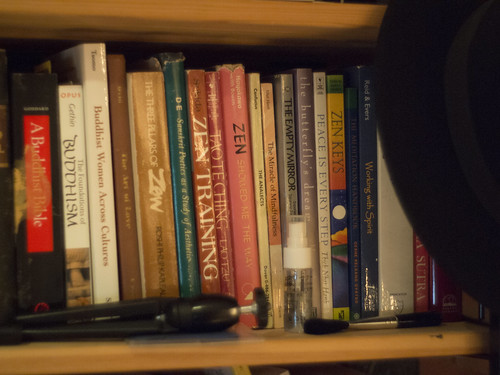
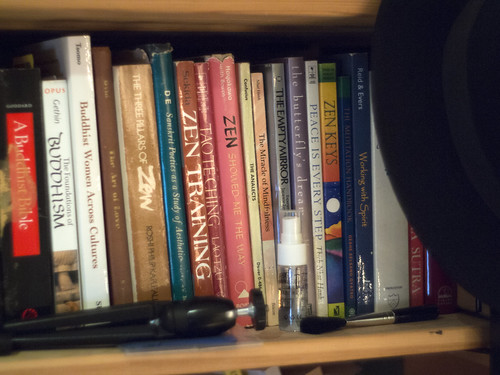
On the right side of my bookshelf, around where I keep a lot of my camera stuff, I have a section of books on Buddhism and related topics.

That photo is quite yellow. The shelf is lit by halogen lights and Christmas tree bulbs. It looks normal enough in person (well, a bit dark) because my mind adjusts to the colour. But the camera takes it and then we see the picture in a different context and we see the colour imbalance. So I reset the balance on the camera using a blank white sheet of paper – actually the back of an airline boarding pass that I have sitting around.

It’s not that that is perfectly neutral white balance. It’s just that it more closely matches our default bias. There is no such thing as unbiased, perfectly balanced colour, any more than there is such a thing as accent-free speech or an unbiased opinion. There is no neutral act of seeing. You just have to know what balance you want, acknowledge it, balance yourself according to it, just as you have to focus on what you focus on and choose what to have in the frame and outside the frame.

There’s one word that shows up a few times on the spines of those books. I could pull out any of them and feature it. I’ll pull this book out because I want to. I found it quite by chance in some used book occasion. It’s a book from 1960, although the first blank page has “January 1965” handwritten in fountain pen diagonally across the lower right corner. The pages are yellowing and smell of the gradual decay of tree-pulp paper and a bit of the basement it must have sat in for many years.

Here is the back cover.

That is the author. Does he look familiar? Here is his dedication.

The author was a motion picture actor. If you recognize him, it’s probably from The Bridge on the River Kwai. He played the Japanese Colonel. His name is Sessue Hayakawa. Actually, Sessue is a name he took when he started acting in movies; his given name – given at his birth in 1889 – was Kintaro.

Here is the front cover.

It’s his autobiography. The title kind of gives away the ending, doesn’t it? But it’s how he gets there that is of interest. He came from a noble Japanese family. He was all set for a career in the navy when, in a reckless diving misadventure, he burst his eardrum and was rendered unfit. He decided that he had dishonoured his family, and he resolved to do the honourable thing.

He in fact did commit seppuku, also known as hara-kiri (not hari-kari!). But he did not die. He didn’t have anyone to cut his head off at the end. So he was hospitalized with very substantial injury to his lower abdomen.

How do you follow up an act like that? With a visit to a Zen Buddhist priest. Followed by a lot of meditation. And then a career as an actor and more meditation and, well, this book.

I have several books on Zen. I have read much about it. Which is like shouting much about silence.

Whatever you think Zen is, it’s not. I can’t tell you just what it is. There are two reasons for this.

The first is that I am not a Zen master. I have meditated various ways at various times, including with Zen Buddhists, although in recent years my only meditation has been running, which doesn’t quite count. But I have no experience of enlightenment in the Zen Buddhist sense. I think I can see the shadow of a corner of it, maybe. I’m probably wrong.

The second is that you can’t explain silence with shouting.

I can tell you what Zen is. It’s a school of Buddhism, best known in its Japanese version although it also exists in China. Zen is the Japanese rendition of the word禅, which in Mandarin Chinese is chan. The full forms are zenna and chánnà. They come from Sanskrit ध्यान (dhyāna). Which means ‘meditation’.

Zen is meditation. In the plainest sense, that is what Zen is. To quote Sylvia Boorstein, “Don’t just do something, sit there.”

In some schools of Zen, that is it. You focus your mind, you watch the thoughts arise and pass by like clouds in the sky, you taste existence. In others, you strive to break your mind free from the ruts it travels in by meditating on paradoxical ideas.

In the end, you learn that you and the things around you are not many, not two. You come to recognize your position, your bias, your perspective, your focus, your frame. You learn that nothing has permanent existence, everything is changing, and what exactly is this “everything” and what exactly is this “changing” and what exactly is this “is” and what exactly is “what exactly” and

As in all Buddhism, the aim is non-attachment. I have some ideas about what is and is not non-attachment, but I’m not, you know, attached to them. Some people interpret non-attachment as meaning eschewing things of the world, but it seems to me that rejection is no more equanimitous than craving. Enjoying while it’s there and letting go when it’s not seem the best options. Fine words, of course, and badly self-incriminating, as witness the two thousand books I can’t bear to get rid of. Fortunately, like all fine words, they will eventually be forgotten.

The simplicity of Zen spills over into an aesthetic associated with it. But Zen gardens are not Zen any more than bedrooms are sleep.

I would like to eschew all marketing and branding that uses the word Zen. Putting Zen on commercial products is like putting vegan on roast prime rib.

I do remember fondly, though, one business in Toronto, no longer there I think – I used to see their sign in an upper window on Spadina: Zen Travel. I liked that. I imagined a place where you go in and they tell you that you are already where you want to be; you just have to realize it. But it’s how you get there that is of interest. In exchange, you pay them all you have, which is nothing.

But perhaps you will get a boarding pass. Which you can use in place of a blank sheet of paper to set your white balance.

amanita

My late teens were charged with yearning and self-fulfilling prophecies of failure, an arc of desire and disappointment that was accomplished before it began. I felt that I wanted to be someone whose lost potential others would mourn, who had loved better than others and yet to whom others would say “I loved you better.” I was in search of a new version of reality, an altered state, one in which simple truth of feeling would be enough.

In other words, as I have since realized, I was pretty typical in many ways. Except that I was even less able than most to act on my desires, paralyzed from within, so afraid of rejection that I pre-rejected.

I was introduced by a drama teacher to the music of Laurie Anderson. I loved her work instantly. One piece stirred me more than others – and in fact still stirs me, and now I understand a little better what she had in mind. It’s “Gravity’s Angel.” Play it while you read this.

Send it up. Watch it rise. See it fall. Gravity’s rainbow.

Send it up. Watch it rise. See it fall. Gravity’s angel.

It’s a reference to Thomas Pynchon’s novel Gravity’s Rainbow. The song doesn’t follow the plot; you may know the song ever so well and still be entirely in the dark about the book. But there is a thematic resonance.

I was curious. A friend had the book. I borrowed it. I found it was very well written – vivid – but also a bit hard to follow, which actually I sort of liked (hey, I had already read Finnegans Wake). But it was too vivid, and it described some things that were hard to swallow. I put it down a third of the way through.

A few years ago, I decided I wanted to try it again. I bought a copy.

It’s a darkly (darkly!) comic novel, hallucinatory almost, an alternate reality, full of sex and destruction and desires, version and inversions and perversions and conversions and reversions and other diversions. It’s set during the Second World War. Its opening and focal point is the Blitz in London.

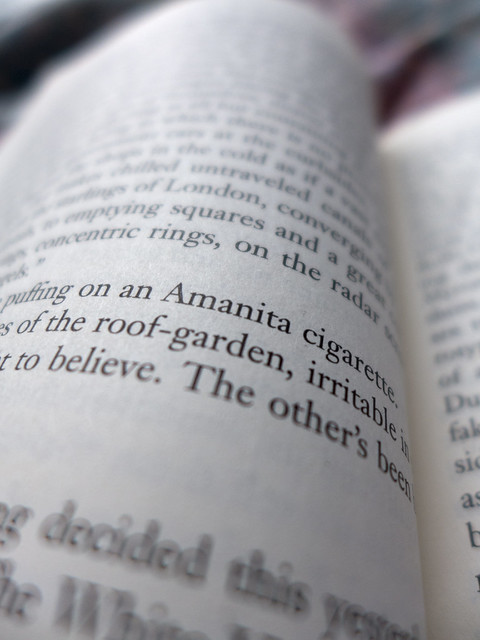
I’ve been wanting for some time now to take this one from the bookshelf and taste a word from it. But what word? Today I finally just grabbed it and opened it and flipped to a page. Nope, not that page. Another. Hmm. A third.

Yes.

There. There is the word I want from this book. A word of hallucination, a word of escape, a key to a Lewis Carroll world of inversions, but a word of a destroying angel, an angel rising above a bombed city, an angel falling in a bomb on a city, an angel eating you from within like unsatisfied desire.

Amanita.

Amanita is a kind of mushroom. In fact, one kind of amanita is the classic toadstool, bright red with white dots: Amanita muscaria, commonly known as fly agaric (the musca in muscaria refers to flies), because it was used dried in bowls of milk to kill flies. But it is also a well known hallucinogen, eaten (and, it seems, smoked) recreationally. It has surely led to the undoing of many flies of more than one kind.

But then – beyond the undone flies – lurks Amanita phalloides, known as the death cap. And different species known as destroying angel: Amanita bisporigera, Amanita exitialis, Amanita ocreata, Amanita virosa. They will be your undoing if you eat them. Not right away – it takes a few days – but by the time you realize something’s wrong, your only hope to live is likely a new liver. Such appealing-looking phallic fungi, not so different in appearance from many table mushrooms, tempting too to those who wish to experience a new reality. Oh, and they will.

It’s a pretty word, isn’t it? Amanita. Like a cross between Amanda and Anita. Perhaps they are cousins of Alice – we should go ask her. It apparently comes from Amanon, a mountain in what is now Turkey. It makes me think of our first microwave oven, an Amana: a very well made machine, a miracle of technology, cooking with radio waves. Amanita could just be a small Amana, a little thing in your hand capable of leaving you fully cooked.

Pynchon’s book is a rainbow of sex and death, an arc with all the visible colours and more, extending into radio waves. It has its destroying angel and it has its angelic young man in an arc of destruction, annihilating at final contact; it has its louche antihero and its picaresque adventures, its half-circle of the demimonde; it has its escape, its hallucination, its alteration. It has its cheap tricks that make you say “Amanita few minutes to absorb this.”

And perhaps you will not fully appreciate what you have let yourself into, what you have let into you, the gravity of the circumstance, until too late. You have swallowed it and it has eaten you from within.

petiole

My bookshelf is a tree. It doesn’t look like a tree, no, but it’s made from trees – the wood of the shelves, the pulp that made the paper in the books – and it has many branches. Branches of knowledge, that is. There’s quite a lot on languages and linguistics, of course. There are also numerous other reference books, many of which acquired at the Oxford University Press sale that used to happen annually. It is a rich tree with many leaves (of paper) on each branch. Some branches are deceptive: on the upper right you see a novel by Irvine Welsh, not a lexicon of Welsh. Some parts of this tree are in the light, some are in the shadows…

…like that book hiding back there. Visual Encyclopedia. What is that, now?

A thick book on glossy paper, richly illustrated and labelled. Its size makes it easy to hold but not so easy to hold open.

You can see that in this book are many branches. This shadowy part of my library tree is quite dense. It is in some ways a microcosm of the shelves around it with their 1200-some books (more than two for each page of this one). Let’s look at the branch of it that has branches.

Plants! Trees and so on. They have branches. There turn out to be quite a few kinds of plants. Let’s go to the gymnosperms.

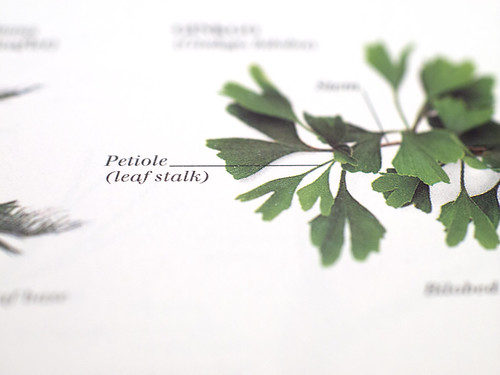
You see some seeds, of course (that’s what the gymnosperms get their name from: naked seeds). You also see some branches. Let us look at this one from the ginkgo tree, a tree that is supposedly good for the brain. (Does it make knowledge stick to your brain? I’m not sure, but if you live near one, it makes its seeds stick to your feet for a few weeks each year.)

Is that a branch or a twig? When does a branch become too small to be a branch? A branch can have branches, but at some point those little branches are not quite big enough to be branches.

Well, we can draw a definite line when the material changes, anyway. A petiole is not a branch; don’t be misled by its branching. It connects a branch and a leaf – indeed, it’s the thing that connects the leaf and the stem.

The book helpfully tells us that petiole means ‘leaf stalk’. Fine, we know leafs talk: this leaf of paper is talking to us right now.

Oh, yes, right, that’s leaves. Even though leaves talk can also mean ‘walks out on speech’. But this is not walk, it is stalk. I think we have taken a wrong branch. Well, anyway: How, in fact, do you put petiole in speech? The British style has the first syllable as like “pet”; the American style has it more like “pede” (as in centipede). But the French, who gave us the word, say the beginning like our “pate” (rhymes with spate – I don’t mean pâté) and spell the word pétiole.

It may make you think of petal. After all, it is a small branching-off part of a plant; it connects to leaves, which are similar to petals in various ways. But that is another misleading branch (though perhaps there is some cross-influence in the form). The Latin source of petiole, petiolus, most likely derives from the ped and pes root meaning ‘foot’ plus a diminutive suffix, meaning it’s related to pedal. Petal, on the other hand (or foot), comes from an unrelated Greek root for ‘spreading out’.

So. There is your knowledge: branch, twig, stem, petiole, leaf. It is true that petiole seems more erudite, perhaps more polite, or perhaps more specific – a cross between a petunia and an oriole? – but the tree doesn’t care; it’s just there. As is this sub-sub-sub-branch of knowledge we have leafed our way to today. Now we will leave it, but at least you may be relieved that, should you see petiole in future, you will twig what it is.

evanescence

I’m on the scent of another word from the bookshelf. Let’s look back here in the dark hidden corner behind the baseball-glove chair.

Tall, thin, graphic, glorious mementoes of my youthful favourites. Let me tug this one out and drop it on the stack next to the chair.

Does it look familiar as I gradually reveal it? It was a revelation to me 30 years ago.

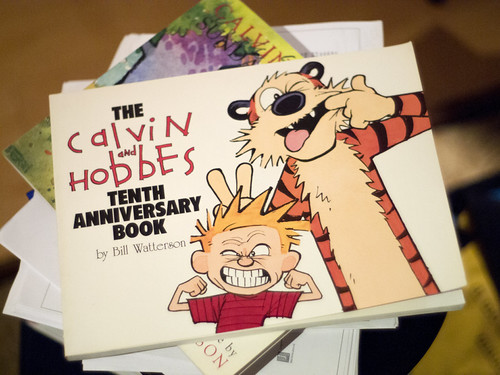
The book is actually 20 years old. It came out in 1995. It’s The Calvin and Hobbes Tenth Anniversary Book. Meaning that Calvin and Hobbes started 30 years ago.

30 years ago today, in fact. November 18, 1985. I’m not one to choose a single favourite in most things, but Calvin and Hobbes is easily my favourite comic strip. Intelligent. Well drawn. With a few simple lines Bill Watterson could express so much character. And then sometimes he’d really go to town.

The strip draws on the impermanence of childhood and the perdurance of childishness. It revels in the ridiculousness of life and luxuriates in ludicrous fantasy, all forever contained and threatened by parents, protectors, and peers who insist on imposing order, stifling imagination, rebuking rambunctiousness. Never mind: for the duration of a strip we may strip ourselves of due ration and see things as… well, as they really are, honestly. (To see the images closer up, by the way, click on them.)

Does Calvinball seem a senseless sport? You’re playing it right now. English is the Calvinball of languages. All natural languages are Calvinball to some extent: we make up rules as we go along, sling slang, even with straight faces collude in ludic creations that come and go with the breezes. There will always be those who try to nail it all down, stop it from changing, paint pretentiousness on the messy pretense, but there will also always be us Calvinist-Hobbesians. And a little Calvinist-Hobbesian in all of us, even the sourest, wafting in and out. Nothing stays the same, of course, but then, nothing stays the same.

Some of us like our play cerebral, very cerebral, even punishingly, showoffishly cerebral. The play of the art gallery placard. The play of academic essays (every word of Derrida and Baudrillard is a game – actually, every word of everything is a game, but some academic word games are like playing racquetball with razors for racquets and kittens for balls). Watterson happily took the piss out of those games while playing them athletically and commenting on life in passing. If thoughts are a penny each, Watterson gives you seven cents.

Calvin and Hobbes is the only comic strip I can recall having learned a word from in my adult life. I admit my memory my be of uneven focus; perhaps I learned the word first and the shortly after saw it again in the strip. But what other strip (well, aside from xkcd) would you find a word like this in?

Evanescence. The sound of a snake s and two soft sickles c c cutting down with ease and taking away. A play of six letters dancing to make eleven letters, here now and moved on in the next moment, melting as they appear. If life never makes any sense, if it is vain and in vain, it is because it is vanishing. Nothing lasts, so there is a last of everything. Just as words can flip their sense inside a sentence, so too our innocent sentience, even our essence, self-incinerates in an instant.

Where does this word come from? Page 166 of the book, yes, but that’s the medium. Before that? First we trace evanescence to English evanesce ‘fade away, vanish into thin air, disappear, be effaced’; then we trace that to Latin evanescere, which contains e ‘out’ (as in E pluribus unum) and vanescere ‘vanish’, which in turn comes from vanus ‘empty, insubstantial’ – the etymon of vain as well as vanish. The Latin equivalent of Japanese mu, the central concept of Zen, so often translated as emptiness but that’s misleading. There is nothing there, yes, but it’s because as soon as you look there there is no there there anymore. Everything is always waving goodbye because everything is always a wave, impermanent, waiving permanence, invincible only because there is nothing to vanquish: it has vanished.

But that is not bad. That is just as it is. Our lives are like a stroll across a paper suspension bridge, dropping lit matches behind us. Everyone walks in time and then runs out of time. In the road trip of life, how often do we see when our touring machine will halt? When I bought this book, did I know that a decade and a month after Calvin and Hobbes had begun it would end? The strip evanesced in December 1995, the eternal six-year-old setting off into eternity with his tiger, and Watterson flowed away invisibly, liberated. No new Calvin and Hobbes strips have been drawn in 20 years. And yet there it still is. It left its marks. They have not finished fading yet.

diaphanous

I really wanted to see my way clear to do another one from the bookshelf today. I had a vision of what it would be, which made it more difficult than just grabbing a book and opening it. But this volume came to light.

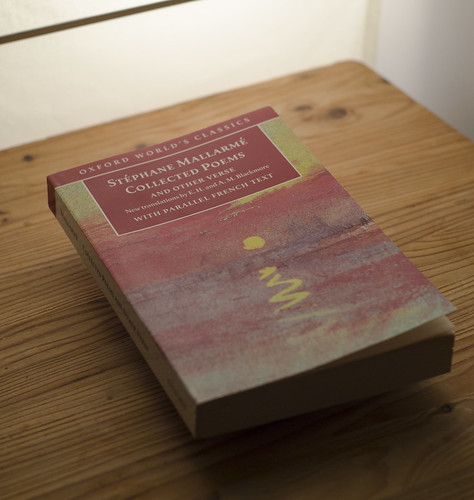
The cover illustration is a detail from Sunset, Rouen, by JMW Turner, who is a painter for those who love light, and glow, and impression, and paint. You do not always see the subject with perfect clarity, but you understand the feeling of it so much better.

The book, as you can see, is collected poems by Stéphane Mallarmé, a French symbolist poet who was 9 years old in 1851 when JMW Turner died. He was born Étienne Mallarmé, but he preferred a more directly Hellenic, less mutated version of his first name, a clarification without clarifying – for what does Stéphane or Στέφανος mean? (It means ‘wreath, crown, circlet’ and was the name of the first Christian martyr, so now you know.) His last name may suggest that he was poorly armed (mal armé) or perhaps badly teared (mal larmé), but those are tiers of resemblance on the base.

In this book you will find “L’Après-midi d’vn favne” (note the classicist use of v), which inspired Claude Débussy. You will find numerous other pieces of poetry as well. As the cover tells us, you will find them in parallel text: French and English, French on the left and English on the right, so that the meaning is clear. Let us open to a page.

“Clear” is relative. A poem translated is a poem traduced. The denotation and the general feel can be preserved in large measure, but translation is truly no clearer than a page held up to a light. You see an obverse; the form is there, largely revealed but somewhat obscured; there is a different rhythm, different overtones, different references and plays on words; the speaker of one language has grown up with a different set of cultural references than the speaker of the other. I will not say it is through a glass darkly, but it is through a page, lit from behind… it seems clear, but it is… what shall we say…

What is that word peaking through there, now, doubling up behind double? Half hidden, showing its back by way of the already yellowing flake of pulp?

diaphanous

Yes, there it is, in “Funerary Toast,” the translation of “Toast funèbre”:

Mindful of your desires, I wish to see
in our task, the idea, that our star’s parks have laid
upon us, for this man who vanished recently,
a solemn stir of words stay alive in the air
in honour of the calm catastrophe—
a huge clear bloom, a purple ecstasy,
which his diaphanous gaze remaining there,
rain and diamond, on these flowers that never fade away,
isolated in the hour and radiance of day!

C’est quoi, ça, en l’original?

Moi, de votre desire soucieux, je veux voir,
À qui s’évanouit, hier, dans le devoir,
Idéal que nous font les jardins de cet astre,
Survivre pour l’honneur du tranquille désastre
Une agitation solennelle par l’air
De paroles, pourpre ivre et grand calice clair,
Que, pluie et diamant, le regard diaphane
Resté là sur ces fleurs dont nulle ne se fane,
Isole parmi l’heure et le rayon du jour!

A diaphanous gaze. How can that be? Diaphanous means showing through, not seeing through. And yet. The word has taken on more of a meaning than it may literally seem to have. It is not merely to appear through something – dia δια ‘through’ and phanés ϕανης ‘showing, appearing’ – but to be a combination of epiphany and phantasm (both also from the same phan). It is not a word for ‘transparent’, even though transparent comes from Latin roots that mean the same as the Greek roots of diaphanous. A diaphanous dress is radiant, a diadem of clothing; a see-through dress is more revealing, and less high-toned; a transparent dress is… well, clear.

Sometimes this word is misrendered as diaphonous, because phon is a more common root. But phon refers to sound. A penetrating sound could be called diaphonous, I suppose, but the word is not used as such. When it comes to poetry, you may think that what is seen is what is heard, but this is not so: the wordplays in Mallarmé do not show so readily on the page. The letters open one window; the sound opens another. But in translation the window always has diaphanous curtains.

In art, we value the diaphanous more than the transparent. We love the word perhaps in part because it has that ph in the balance, that classical hallmark, that crisp and whispering couple that join to be simply soft. We want to see through, but we want to see the fabric too; we want to see the material, the medium. We want obscurity, a challenge, an involvement. We want not just Athena but also Diana and Aphrodite: our learning desires a hunt and hunts for desire.

We want life not through a glass darkly, but not through glass clearly; we want it through the fabric, the fibres, the medium, the texture of life. We want it with feeling. We want something to trip the light and make it phantastic.

enow

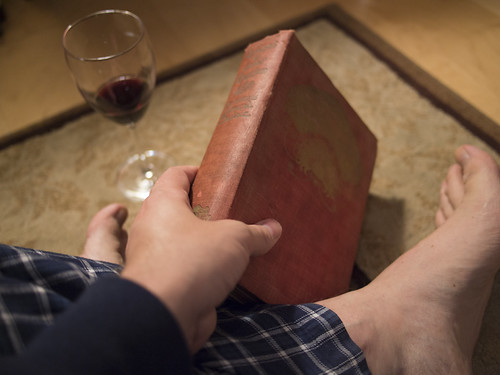
I wasn’t going to do another one from the bookshelf tonight – one a week is enough. But sometimes enough is not enow, and one who floats on the waves of words and images must live in the now. And so, in my jammies, with a glass of wine, on the carpet of my library, I pull from the shelf a book as yellow and foxy in the pages as the library lighting.

The Rubaiyat of Omar Khayyam, in Edward Fitzgerald’s famous English translation, with illustrations by Edmund Dulac.

Look at these lovely pictures, each on its own separate plate complete with onionskin veil to protect it.

The yearning lass looks rather like Meryl Davis, methinks.

I don’t think that’s Charlie White.

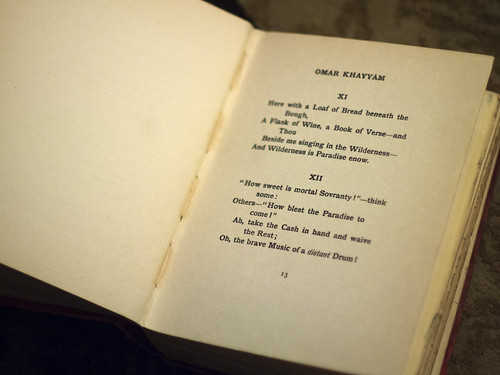
No, these are paintings of Persian love and longing, in a European vision. But their European provenance does not make them un-Persian. The poetry, at least, is part of the Persian dispersion. It is a volume of ruba’iyat, which is the plural of ruba’i. The ruba’i is a Persian quatrain form. The rules are that lines 1, 2, and 4 must rhyme, and that the fourth line must be a high, strong, deep completion of the meaning. There is also expected meter. Fitzgerald has gamely preserved the poetic form in his translation. Number XI is a poem that may seem familiar.

Does it seem familiar yet somehow not right? Let us try that again.

The volume I own, you see, contains editions 1 and 2 of Fitzgerald’s translation. The second edition is different from the first – a whole new essay at the matter, even renumbered. Apparently one was not enough. Are two enow?

Enow.

That is a precious word, isn’t it? Simply a rhyming mutation of enough?

In fact not. Enow, Doctor Johnson explained to us, is the plural of enough.

Does that seem a strange thing to say? In the modern time, it may well, but English words used to have much more thorough sets of inflection. Old English genog became, over time, singular genoh but plural genoge, and those grew to Modern English enough and enow. (It makes more sense if you know that the g’s were fricatives or glides, not stops, and the h was pronounced.)

But in Modern English, once we have learned that one is enough, we take it at its word and stop, and never discover that two are enow.

Remember that, now, the next time someone tells you enough is enough. It may be so, but enow are enow, and two are better than one – especially with that bread, that flask of wine, and that book of verse.

And so there you are. There art thou. There are we. Here we are. Enow. And now?

trice

It’s time for another episode of “from the bookshelf.” But it’s late – I’ve spent the day at a linguistics conference – and I need to be expeditious. So I will quickly pull this volume from the shelf.

I received it for some birthday in my youth, I think. It’s full of Canadian classics, of course. Robert Service was the plucky poet of the Klondike, and there are at least two poems by him that Canadian schoolchildren cannot escape reading (or at least that used to be the case; I can’t say whether it still is). One of them is “The Shooting of Dan McGrew.” The other one is this.

“The Cremation of Sam McGee” is such an essential of the well-read Canadian mind that I once did a quick parody of it on the easy assumption that all of my readers (Canadian editors) would know it in an instance. And I wasn’t wrong.

There is one word I think of in an eyeblink whenever I think of this poem. It’s a word I first saw in this poem, and have read altogether not thrice, not twice, but just that once – or in just that one place, however often returned to. And yet its sense was, by context, immediately grasped.

Trice.

It was jammed in the ice, but I saw in a trice it was called the “Alice May.”

The “it” is a boat, a derelict as Service calls it. Service says he saw in a trice – a slice of the eye in time, a trick, a quick instant, a moment without trace.

Very well. But what is a trice?

Trice was, first of all, a verb, borrowed from a Middle Dutch word meaning ‘haul’. In Middle English it got the sense ‘pull quickly’, ‘pluck’, ‘draw suddenly’. Its first sighting is in Chaucer. Now when it’s used at all as a verb it means ‘pull or haul with a rope’, but don’t count on anyone knowing it.

But that verb came to be converted to a noun, first in the phrase at a trice – as though saying ‘at a hoist’ or ‘at a pluck’ – and thereafter in a trice. It has a long history of use, threading through Shakespeare and Charlotte Brontë. But, at least if you’re Canadian, the telos of all that was its spotlight flash in Robert Service, and all uses since then refer back to that one trace. Now you read it, and in the same second you grasp it; and now it is forever a mirror of that night on the marge of Lake Lebarge.