He pounced on a piece of text and fairly bounced with outrage. “Words don’t get meaning from sounding like other words!” he pronounced, and, having thus denounced, flounced out of the room.
And fair enough: in general, words don’t get their meaning by sounding like other words. If they did, puns would be rather duller, and all those caterers with fare and thyme in their names – and all those hairstylists with mane – would just seem like they were making spelling errors. But there are always exceptions. We do sometimes shift the sense of a word towards what we think it sounds like it’s supposed to mean – outrage, for instance, has nothing in its origins to do with rage, and yet…
Of course, that’s an etymological conjecture. But conjectures on the basis of similarity are always conjectures of relatedness; we need to remember that most speakers of a language don’t actually know which words are cognate and which are not, and so if cognate sounds related to cognition they will think of them as having a similarity of sense. (The two words are, in fact, unrelated.)
And anyway, it goes the other way too: we will take bits from words and put them together to make other words. Of course we will! And we’ll do it in a way that just feels like it makes sense. So we get chocoholic, from choco-, trimmed from chocolate (it is not a word made from a root and a suffix), plus -holic, trimmed from alcohol, which is a one-piece word in English but traces back to Arabic al-kuhl.
So, now. Flounce. You know that it has something in common with bounce, jounce, pounce, and perhaps trounce, but not with ounce or any of the Latin-derived words containing -nounce (pronounce, announce, denounce, etc.). If you were to define flounce, what would you say? Would ‘bounce in a floppy or flailing way’ work? But then can we say that that fl- is adding an element of sense, if not in the origins then at least in the way we think of the word?
Well, fl- isn’t a morpheme – it doesn’t automatically carry meaning. Sure, there are flail, flap, flutter, flounder, and a few others like that; but there are also flat, flake, flank, floor, and a few others that seem to have to do with two-dimensional surfaces; and there are fly, flower, floss, fleer, flaw, and assorted others that relate to neither. In fact, of all the etymologically unrelated words in English that start with fl, about one in seven have something to do with loose motion and about one in six have something to do with surfaces. That’s arguably more than chance, but it’s far from a sure thing. And yet if you’re casting around in your mind looking for words with a similar sense, perhaps to use as a basis for a portmanteau, it could be a quorum.
But that’s not where flounce comes from, is it? Well… we’re not completely sure. There is a verb flunsa that in Norwegian means ‘hurry’ or ‘work briskly’ and in Swedish means ‘fall with a splash’; it seems like it could be related to flounce, but there’s no actual trail of evidence to connect the two; also, the Scandinavian words are first attested from the 1700s, and flounce is first seen in texts from the 1500s, whereas the development of sound and form would require the two to have split apart from their common source at least a few centuries earlier.
And on the other hand, words – especially expressive words – do have something of a history of being formed imitatively in English: sometimes imitating the sound (e.g., splash), but sometimes just imitating other expressive words. And yes, there is the possibility that flounce was formed by analogy with bounce and pounce plus that fl at the start, which might flap or flutter or might just soften the overall effect. After all, we did just that kind of thing with plounce, a (now rare) word that showed up in the 1600s and means ‘plunge into water’ or ‘flounder in water’.
And then, on the other hand, given that people are often more prone to flouncing (either literally, moving in an exaggerated fashion, or more figuratively, making an ostentatious departure, say) when they have had a bit to drink, could a connection to fluid ounce be worth a shot? …No, it could not.
Incidentally, however ostentatious both may seem, the flounce that names a decorative fringe or ruffle is not related to the verb flounce; it comes from the Middle English verb frouncen ‘curl’.
It turns out my sense of traipse is a little out of step with some other people’s. A few readers expressed surprise at or disagreement with my assertion that it always has a negative tone, whether it means ‘walk in an untidy way’ or ‘walk trailing through mud’ or ‘walk aimlessly or needlessly’ or ‘tramp or trudge about’ (all of these are definitions the Oxford English Dictionary has). One friend did some searching and, along with assorted usages that allowed but did not demand a negative tone, found a few that did not fit that sense at all: traipsing comfortably, traipsing warmly, traipsing blithely. And while if I were to read those I would arch an eyebrow as I did when I first read of someone “munching fried eggs” (how long were they fried for, to be munchable?!), it just illustrates once again that sometimes people live in parallel worlds for the senses of certain words.
But let’s just sashay over to a different word today. And when I say different, I mean different: I feel confident that there is no well-read world in which traipse and sashay could be used as synonyms.
You could often use either to describe the same act, certainly, depending on the tone you wish to give it: “I traipsed over to the post office this afternoon”; “I sashayed over to the post office this afternoon.” You might have taken the exact same steps at the exact same pace with the exact same look on your face, but the attitude you are conveying towards the trip in your recounting is frankly different. A sashay may be happy, or sassy, or even insolent, but you are always putting your best foot forward; there is no foot-dragging or aimlessness in a sashay, and yet no undue haste either – you could say that sashaying is not a way of moving as if you were being chased.
Not that everyone agrees on exactly what sashay does or does not convey. Oxford and Merriam-Webster agree that it can imply an ostentatious or conspicuous manner of moving, but while Oxford also specifies that it can also mean “To glide, walk, or travel, usually in a casual manner,” Merriam-Webster does not. But surely no one among us would object to sashaying blithely, and on the other hand few of us would not snicker at sashaying sullenly.
It’s a fun word, isn’t it, sashay? It sounds like the feet are sliding across the floor in slippers, perhaps. There really is something a bit deliciously sassy about it. I’m tempted to make a pun involving French sachet (as in tea bag, for instance) and “papa’s got a brand new bag,” but perhaps I should leave the French out of it.
Which is, in a way, how we got sashay in the first place: leaving the French behind. It’s formed by metathesis (sound-swapping) from a French word for a dance move, chassé. At least to the tongues of some people in America in the earlier 1800s, /sæʃeɪ/ was more sensible to say than /ʃæseɪ/ (let alone /ʃase/). And since this word was used not just in ballet but in folk dances as well, it did come up from time to time.
Do you know how to sashay, which is to say to do a chassé? I think you do, even if you don’t know that’s what it’s called. It’s just the step – usually to the side, though you can also do it en avant or en arrière – where one foot is always forward: each time you step with the leading foot, the trailing foot swings to join it but doesn’t pass, and then the leading foot leads on again. It’s a light, springing step, with no trace of traipse or trudge in it. The one foot chases the other, but any time it catches up to it, the other escapes again. Which is why it is called chassé – French for ‘chased’.
Well. If it must be chased, then it’s chased like the gingerbread man, light and fleet of foot, show-offish, and not at all traipsing or trapped. On any given day, I know I would rather sashay, if not literally then at least attitudinally. And if you won’t let me sashay, I will flounce away.
Thanks to June Casagrande for responding to my traipse WTN with “This right here is why I always sashay.”
In her song “Language Is a Virus,” Laurie Anderson says “paradise is exactly like where you are right now, only much much better.” Well, traipsing is exactly like walking, only much much worse. “I went down to the store”: neutral. “I walked over to the store”: neutral. “I traipsed over to the store”: you hated every step.
Why was it bad? Why is traipsing always bad? Sometimes it’s because you’re going through mud or snow – walking dirty, you might say. Sometimes it’s because you’re tired or it’s a tiring trip, perhaps needlessly so. Sometimes it’s because you’re bored. Sometimes it’s because you have to and you don’t want to. But traipsing can’t be positively toned.
It’s not to say that the destination or cause of traipsing is necessarily undesirable. Heck, that’s often the only reason you’re traipsing at all! “I sure am glad to see you! I traipsed through twenty blocks of snow drifts to get here!” Or perhaps “I traipsed all over hell’s half acre that summer with the most beautiful person I had ever seen.” But if you say “It’s been nice traipsing around the city with you,” you are assuming that the other person agrees that it has at least been a considerable physical effort – or understands that you’re being playfully ironic.
The word itself seems to take extra effort in getting to its destination. Why not a shorter spelling, such as trapse or trapes? Admittedly, there is the issue that trapsing looks like the a is short, and trapesing looks like the e might not be silent, but in fact both spellings have been used in times past. Not only that, it has also been rendered in the 1800s as trapess, trapus, traipass, and some similar words, and pronounced accordingly.
Which kinda suggests an etymology, doesn’t it? Indeed, the source of traipse is thought by many to have been trespass, or, more to the point, its more recent French version, trépass. Not everyone agrees, though; there is an old word trape that seems to trace to Middle Dutch and Middle Low German trappen, ‘tread, trample’. But there’s something of a gap between that word and this one. Sorting out with certainty which is the real source will require more legwork.
What we do know is that traipse has that tr- onset that shows up in some other words relating to effort: trudge, tramp, travail, try, and trek, to name a few. It also has that “long a” (/eɪ/) for extra effort, plus a final s that is not a plural. But of course none of that has any necessary bearing on the sense.
Well, neither does the fact that it’s an anagram of parties, which are quite the opposite of traipsing and yet at the same time are good motivations for traipsing through bad weather. But the relation of sign and signified is supposed to be arbitrary, however much fun we may have finding extra ways to enjoy it. On the other hand, we often focus too much on the denotation and not nearly enough on the connotation, as though the subtle sense differentiations were just something to get through to reach the goal of dictionary meaning. But the trip is worth it, I think, if only for being able to tell of it after.
I have to admit, my word tastings have been somewhat desultory lately.
In truth, they’ve always been desultory, topic-wise – and in fact the largest exception is the two months I lately spent covering one topic (words for ‘butterfly’ around the world). But that’s a horse of a different colour. What I mean is that in recent times the frequency has been a bit uneven, just jumping around the calendar. This is the result of a couple of things: on the one hand, I realized I was writing more than most people would get around to reading, so I reduced my frequency to increase my value; on the other, I travelled unusually often in the past year – sometimes to where it’s more sultry but less suitable for literary pursuits. So it has involved a bit of horsing around, but – rest easy – no physical insults.
Which is a bit different from the original desultors, who were making literal leaps while engaging in extravagant horseplay.
Desultory, you see, means ‘jumping around’ (and extended senses such as ‘irregular’ and ‘haphazard’), and that’s close to what the Latin roots mean – de- meaning ‘from’ or ‘down’ and sult- from salire ‘leap’ (the etymon that also gives us result, insult, exult, and salient). But it didn’t start in the obvious figurative sense of leaping around a document or schedule or a train of thought. No, it started in the circus.
Yes, that circus. The Roman one, where there were chariot races and gladiatorial pursuits and assorted things involving beasts tame and wild. The desultors were not assaulters, don’t worry; they were equestrians who leaped from galloping horse to galloping horse. Similar stunts are still to be observed from time to time at rodeos and modern circuses and – more often involving motor vehicles – carnivals.
It gives a bit of a different vibe to desultory coverage of a topic or schedule, though, doesn’t it? All of a sudden we realize we are not hopping around on a still surface; we are leaping from one train of thought to another, and if it’s hard to maintain a consistent schedule, it may after all be that your many conflicting commitments are wild horses carrying you in different directions (and if you’re tied to several of them, it’s a literal distraction). Life doesn’t stop, and we’re riding it as best we can, but how can we keep from being jumpy now and then?
Speaking of things that make us jumpy, there’s the little matter of pronunciation, which with this word is particularly stressful. But where in particular does the full stress go? The available pronunciations are, well, desultory. If you ask the Oxford English Dictionary, the stress must go on the first syllable, but the third syllable must not have a secondary stress – you are to say it “dessultery,” in that tumbling-downward way in which British English often handles Latinate polysyllabics. But if you ask Merriam-Webster, you can put the stress on the first or the second syllable, and you can pronounce the s in sul as “s” or “z”; if you put the stress on the second syllable, the tor can be reduced so it sounds like “de sultry,” but if you put the stress on the first syllable, the “tor” gets full value: “dessel tory.”
So which way should you say it? Hmm, why not do what I do: don’t be a one-trick pony; go with whichever takes your fancy, changing choices from one context to the next. It only seems apt, after all.
I spent a week at my parents’ house over Christmas doing as little as possible. I went to slothe, and slothe I did.
No, that’s not a misspelling. Just as you bathe by going into a bath, or you clothe by putting on cloth, so too you slothe by engaging in sloth.
Not a word? Of course it is! I just used it and you just understood it. Just half a month ago, Iva Cheung declared “‘Slothe’ should be a word,” and in so doing made it so.
It’s a fun derivation, because sloth is itself already derived from slow (just as the state of being warm is warmth, the state of being slow is slowth, long since respelled as sloth). Now, for full disclosure, there is historical precedent for just using sloth as a verb meaning ‘to be lazy’, and English does have a grand (if often vituperated) tradition of zero-derivation – i.e., converting a word from one class to another without changing its form, the most remarked-on variety of which is commonly called verbing, which is what “Are you going to sloth all day?” does. But who said we can’t have fun with words, deriving new forms on the analogy of other forms?
I won’t say no one said it, because some people do say such things from time to time. But their opinions are no great matter; they’re just being intellectually indolent in the interests of preserving the comfort of their fixed worldview from the faded and stained armchair of their minds. There are better and worse ways to slothe, and I do not count the stodginess of the curmudgeon among the better.
No, if I am going to slothe, I wish my slothing to have at least the tinge of hedonism, and ideally some satisfaction of idle curiosity. I do not want to slothe in hoarded heaps of intellectual candy wrappers. I want to slothe by reading a book (specifically one for which I have no obligation), or cooking something fancy (I know that many people consider cooking an unpleasant chore, but I do not; I do it for recreation), or going for a walk with my camera (again, if walking is not pleasant for you, you will not see it as slothing, but perambulation is one of my favourite ways of squandering the hours). I like to slothe by having a leisurely breakfast with champagne. And, to mix it up, it is nice to slothe in hotels.
In response to Iva’s desideration of lexification of slothe, Karl Martin suggested “Beslothen.” I like that well too. When I am on vacation – be it in a hotel or at my parents’ home or wherever – I am well and truly beslothen. I pledge myself to leisure: I plight thee my sloth. And slothe it goes… slothe a heck down.
Picture a butterfly. What does it look like? What is its dominant colour?
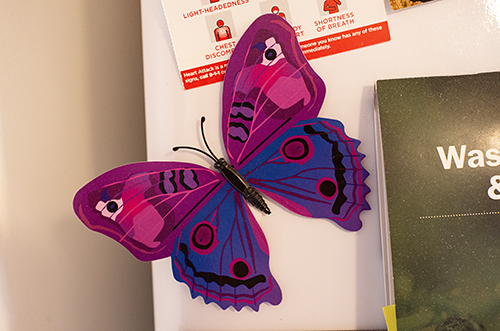
Did you say blue? You might not have, but when I look at renditions of butterflies in art and crafts, they seem to have quite a lot of blue. For example, a business near where I live calls itself Monarch Dentistry, and its sign features a blue butterfly.
As you may know, monarchs are not blue – they’re orangeish and black.
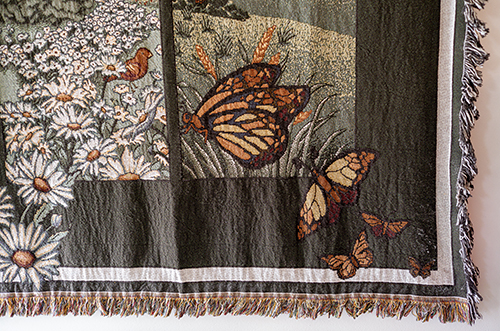
I’ve flown across the continent to visit my parents; I’m sitting at their table writing this. They happen to have a few art and craft butterflies around the house, so I’ve taken pictures of them (and mixed in one from my own place). Have a look at them. All but one has at least some blue (or at least bluish-purple) in it.
Do you reckon they’re representative of butterflies in the real world, or do they skew in a certain direction? If they skew, is it because we think of butterflies as pretty, and of certain colours and features as prettier than others? Is there something essentially butterflyfish about blue, or vice versa? I won’t say there is, but I certainly wouldn’t say there is something un-butterflyish about it. A language might or might not distinguish ‘butterfly’ and ‘moth’, but you wouldn’t expect a language to have one word for ‘butterfly’ and a different word for ‘blue butterfly’.
This brings us again to the butterfly effect. No one has observed the butterfly effect; it’s not observable. It’s an imagining produced by observation, inference, and desire. Likewise, we see butterflies, we infer things about what butterflies are like – from that and from other things that seem relevant, such as that pretty things have pretty features – and we decide what is so on the basis of what we want to be so. Let’s call that the blue butterfly effect. It may be why blue seems to be a butterfly colour. Or it may just be why I think blue seems to be a butterfly colour. Perhaps my data is skewed. Perhaps it just makes for something catchy to write about.
But we definitely expect pretty things to have pretty features, and we definitely think of butterflies as pretty – pretty, decorative, insubstantial, unserious. A “social butterfly” is someone who flits around from person to person and has no depth. It is, as I said in part 11, the curse of the charming and decorative. I went to the Art Gallery of Ontario last week and looked at all the art in all the galleries to see what butterflies I could find. In total, in all the artworks in all the galleries, I saw four butterflies, and all of them were in the same painting (The Wisdom of the Universe, by Christi Belcourt). Then I went into the gift shop, where I immediately saw several times as many butterflies just on one item (a jigsaw puzzle box) – and more elsewhere around the store.
Butterflies, in our minds, are decoration, not art; they are for gifts, not presence. Butterflies are not deep and moody. Well, perhaps they are, but we don’t think of them as such. No one ponders the inner life of a butterfly. In our culture, we have projected on them an insubstantial, carefree quality, because that’s how they seem and that’s what we want them to be, and we can neither confirm nor disconfirm it; it’s a blue butterfly effect.
So, now, what about words for ‘butterfly’? Imagine you’re creating a language – a whole new language, with new grammar and all new words. What will be your word for ‘butterfly’?
I’m genuinely curious at what word comes to mind right away – and whether you would change it to something else after a bit more reflection. Will you choose a pretty word? Pretty in what way? Or will you deliberately choose something unpretty – hengzkog, say, or, um, boterschijte? As we’ve seen, the words for ‘butterfly’ in the languages of our planet are diverse. But if I were to present you a few made-up words – say, gayok, henjitum, dwesp, fenufon, and pilapila, which one would you say is most suitable for a butterfly?
I have no statistics, and it would be difficult to produce ones that didn’t have confounding factors skewing them, but my impression, from the words we have seen over the course of my articles, is that there are three things that seem more common than chance in words for ‘butterfly’: a liquid (/r/ or /l/), probably in the middle of the word somewhere; a labial or labiodental (/p/ or /f/ or sometimes /b/ or /m/) at or near the start of the word; and reduplication. Of these, reduplication is probably the least common, but it still stands out, as we have seen. And, on the other hand, velar consonants (/g/ and /k/ in particular) seem relatively uncommon, as do back vowels (/o/ and /u/). In general, butterfly words are at or near the front of the mouth – they are not, physically, deep.
But is this a real tendency, or just my impression of a tendency? How much is observation, how much is inference, and how much is desire? And if it is a real tendency, is it an effect of something – such as sound symbolism (the same thing that causes people to tend to assume that a word like kiki is better suited to a pointy shape and a word like bouba is better suited to a round shape) or ideas of what sounds are prettier? As with any butterfly effect, we have no real way of knowing for sure. Still, we might get a better idea from words that people have made up for ‘butterfly’ when they’ve made up their own languages.
That’s just might, though. Among constructed languages (“conlangs”), some were based (a little or a lot) on existing languages, and others were made up on the basis of particular features, ideas, and desires. Some were made up as part of a fictional world, while others were made for use in the real world. The ones that were made up for fiction will tend to have features that the author thinks of as appropriate for the kinds of characters who speak them, which might lead to different choices than if the author were making up a word for more general use. Ones that are made for real-world use tend to lean towards learnability and usability – and they often have a European bias.
Among the fictional languages, the two great early examples are the ones J.R.R. Tolkien invented for his Lord of the Rings trilogy: the elvish languages Quenya and Sindarin. He modeled Quenya generally on Finnish and Sindarin generally on Welsh, but that’s not to say there’s a discernible resemblance between his languages and the ones that inspired them. What we do see is a resemblance between the words in the two languages, and there’s no reason to call it mere coincidence: the Quenya word is wilarin and the Sindarin word is gwilwileth or gwiwileth. The w and land th are very characteristic of Tolkien’s elvish languages, and consequently now of ideas of mystical magical languages, and this has connected back to Welsh and ideas of Welsh. (Tolkien also created the rudiments of an evil language of Mordor, which he called the Black Speech, but it’s no surprise that it seems not have a word for ‘butterfly’.)
Perhaps the most popular fictional language, however, is Klingon, from the Star Trek TV and movie series. At first, there was no actual developed and schematized language, but in 1985 Marc Okrand was commissioned to create a well-developed and usable Klingon language for the movie Star Trek III: The Search for Spock, and his results – which were intentionally “alien” – were published in the wildly popular Klingon Dictionary. Why so popular? Klingons represent something that fans enjoy: a very un-butterflyish culture, a culture in which you can wish a person “May all your meals be served live.” But does their language have a word for ‘butterfly’? It does, and not a pretty one: Duj (D stands for /ɖ/, which is a retroflex d).
A very similar group are the Dothraki, from the TV series Game of Thrones, based on books by George R.R. Martin. That language, too, has a word for ‘butterfly’: zhalia. In Valyrian, a more high-toned and noble language from the same fictional world, the word is sōvion.
There are other fictional languages, too, of course, if not as well known. Suzette Haden Elgin, in her novel Native Tongue, set in a dystopian future in which women have had many of their rights taken away, features Láadan, a language created by and for women. Its word for ‘butterfly’, the etymology of which is described as a “visual/aural analog,” is áalaá. And the Indian epic adventure film Baahubali: The Beginning uses the language KiLiKi, created by Madhan Karky; its word for ‘butterfly’ is susutiri.
And what do all these fanciful words suggest to us about what the writers have observed, inferred, and desired about languages and their speakers, and the particular kinds of speakers they have in mind? And how much of what it’s suggesting to me or to you is just our own blue butterfly effects?
Then there are the conlangs intended for actual use, generally as auxiliary languages – easy-to-learn neutral languages that people of different countries can use to talk to each other, rather than learning (not necessarily well) each other’s languages. As they are meant to be easy to learn, their vocabularies are often intended to be as familiar as possible to the intended users. The three best known of these are Volapük, Esperanto, and Interlingua, and you can immediately see what community of speakers they particularly had in mind: their words for ‘butterfly’ are, respectively, pab, papilio, and papilion. Another one, Glosa, also uses papilio. And Sambahsa, which is based on Proto-Indo-European, has pelpel.
But there are others, too, and some of them are more pointedly neutral. Staren Fetcey, of Canada, developed Kotava specifically on the principle of cultural neutrality, with a vocabulary that does not give an advantage to any language or family of languages. And what is the Kotava word for ‘butterfly’? It’s bord.
And there is Mirad (also known as Unilingua), developed by Noubar Agopoff, of France. It is a very carefully constructed language; every letter maps to a semantic value. And, unsurprisingly, its vocabulary is not based on any existing language. Its word for ‘butterfly’, I learn, is gopelat. But its dictionary also gives another word, gipelat: it means ‘blue butterfly’.
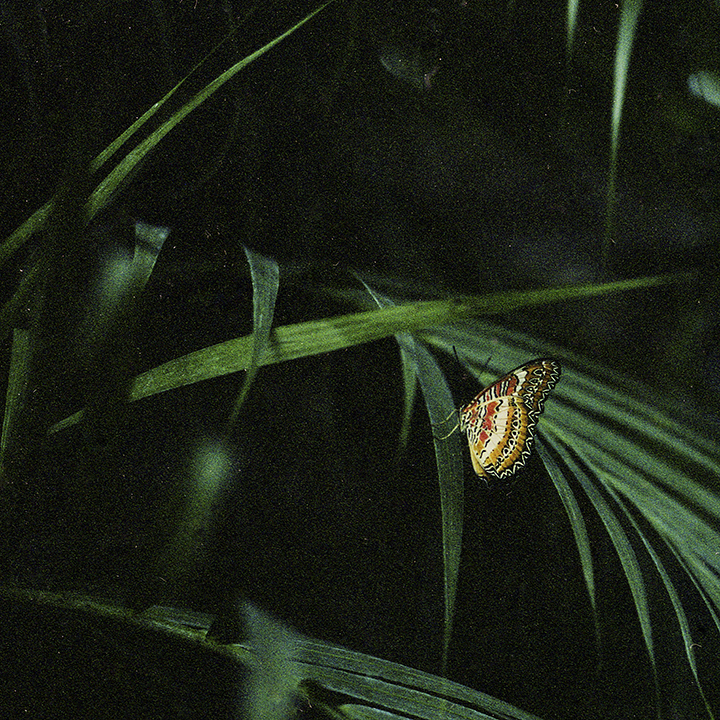
I don’t see butterflies too often, and when I do see one it is for a fleeting moment, and I could not possibly tell you what kind of butterfly it is. I am an etymologist, not an entomologist. And I almost never have my camera at the ready, so I have very few photographs of butterflies – which is why I haven’t included any photos of them yet.
But I do have four that I took nearly 20 years ago. I was using quite a large and clunky camera (a Bronica SQ-A, for the curious), and yet I managed to get reasonably close. Here:
As I said, I don’t know what kinds of butterflies those are (maybe you do!). They may not even all be members of the same family, taxonomically – they could be Hesperiidae, Papilionidae, Pieridae, Lycaenidae, Riodinidae, or Nymphalidae (which in turn has 13 subfamilies). Not that most of us could tell which family they belong to by looking. For example, the monarch butterfly belongs to the Nymphalidae, whereas the common Jezebel butterfly, which to the casual observer could be a different-coloured cousin of the monarch, actually belongs to the Pieridae.
Not that butterflies care about taxonomy. Neither do most of us humans – nor do most of us know or care that the monarch is Danaus plexippus and the common Jezebel is Delias eucharis, names that have been given to them for the sake of tidiness on the basis of what was convenient and somehow appealing to the European men who came up with them (Danaus plexippus is named after Danaus and Plexippos, mythical twin brothers, sons of a king of Egypt; Delias eucharis is from an ancient Greek male name plus Greek for ‘charming’).
And how did I manage to get those photos? I was in the Niagara Parks Butterfly Conservatory. It’s not a butterfly board – the butterflies are live – but it’s still butterflies kept under glass… a glass roof.
“Under glass” is also like how we typically encounter words from the languages of North America. I don’t mean English, Spanish, and French – though those are far and away the most widely spoken languages in North America, they’re like many of the butterflies in the conservatory: brought from elsewhere to a place they didn’t evolve in. No, I mean the languages that were here long before Europeans. They’re the languages from which (sometimes much changed) the names of half the states in the United States of America got their names, and four of ten provinces and two of three territories in Canada – and the country of Canada, and the countries of Mexico, Guatemala, Belize, Nicaragua, and Panama (yes, I’m including Central America in North America – it’s a distinct cultural sphere but not a different continent).
And that shows us yet another kind of butterfly effect: the curse of the charming and decorative. Here in North America, we don’t often notice words from indigenous languages of the places we live in, and when we do, we don’t get to know any more about their origins and actual use in their source language than we get to know about the butterflies used in decor or jewelry. Occasionally indigenous words are used in commercial branding for the flavour their associations give them, especially if they happen to look the right kind of exotic – for instance, with lots of Ks and Xs and perhaps Zs. But for most of us, actual conversation in an indigenous North American language is entirely opaque and unidentifiable – if and when we ever hear it.
But people do still speak these languages, and sometimes – just sometimes – it’s possible to find some resources on them. Such as lexicons that include translations for ‘butterfly’.
I should note, as I head into the words, that the Americas aren’t sharply divided; some language families extend across the official divide between North and South. The Chibchan languages are spoken from Colombia to Honduras, and they include Kuna, in which words for ‘butterfly’ include achamommor, mommor, and sussua, and Bribri, in which words for ‘butterfly’ include kua’kua, kuàkua, and kua’. The Arawakan languages are spread throughout South America and into the Caribbean, but they also include Garifuna, spoken on the Caribbean coasts of Central America; its word for butterfly – or at least one of its words for butterfly – is wurigabagaba.
Central America also has its own language families, an especially well known one of which is Maya. The word for ‘butterfly’ in the variety of Maya spoken in the Yucatan part of Mexico is péepem – the plural of which is péepemo’ob, which to my English eyes conjures up a mob of butterflies, but that’s something I’m bringing to it, not something it’s bringing to me.
And then there are the Aztecs, the people whose great capital, Tenochtitlan, situated in the middle of a lake a mile above sea level, became Mexico City, which is a very different place now. Their language is still spoken – it’s called Nahuatl. It’s the language that gave us words such as avocado (from ahuacatl), cacao (from cacahuatl), chili (from chilli), chocolate (possibly from xocolatl), coyote (from coyotl), guacamole (from ahuacamolli), mesquite (from mizquitl), ocelot (from ocelotl), shack (possibly from xahcalli), tequila (from tequitl), and tomato (from tomatl). (That tl, by the way, is a voiceless lateral affricate – which means it’s like if you tried to say the cl in clue with a “t” instead of a “k” – and the ll is just an l held longer.)
Given those words, you might reasonably expect the word for ‘butterfly’ also to end in tl. And this time, you won’t be disappointed: it’s papalotl (three syllables, stress on the second syllable), plural papalomeh (and again, there is nothing meh about butterflies – what I see in it has nothing to do with what it comes from).
Nahuatl belongs to a family of languages that extends north: the Uto-Aztecan languages. Other members include Tohono O’odham, in which ‘butterfly’ is hohokimal; Paiute, in which it’s tsoapu; and Hopi, in which it’s masivie. But if we’re talking about families of languages that extend a long way or leap over long gaps, the Uto-Aztecan languages – though they cover as much ground as the western monarch butterfly migration – are not the farthest travellers of North America. The Algic languages, for one, stretch farther, covering more ground than the eastern monarch migration: they include Arapaho and Cheyenne, spoken in Colorado, Wyoming, Nebraska, and Kansas, but – leaping across the Great Plains – they also include languages spoken in the Midwestern and Eastern US as well as across Canada from the Rocky Mountains to the east coast.
And of course the Algic languages all have words for ‘butterfly’, since there are butterflies where their speakers live. In Arapaho: nihˀoːteibeihiː. In Cheyenne: hevávȧhkema. In Siksika (also called Blackfoot), spoken in western Canada: apánii. In Cree, spoken across a wide sweep of Canada: ᐧᑳᐦᐧᑳᐱᔒᔥ (rendered in the Latin alphabet as kwâhkwâpišîš) – and, I’m sure, some other words, since there are several varieties of Cree. In Ojibwe, an Anishnaabe language also spoken across a swath of Canada, closer to the Great Lakes: memengwaa. In Mi’kmaq, spoken in the Maritime provinces of Canada: mimikes.
And what about the other Algic languages, including those of the Midwestern and Eastern US, languages from which several states from Illinois to Massachusetts got their names? It’s much harder to find out what their words for ‘butterfly’ are because the languages are mostly not spoken anymore – they’re just randomly fossilized in such things as place names, and you know that a fossil, be it of a butterfly or a language, does not shimmer with colour.
There are other language families in the same parts of the continent, too. The Iroquoian languages are spoken in the area of Lake Erie, Lake Ontario, and the St. Lawrence River, including Mohawk – in which the word for ‘butterfly’ is tsiktsinēnsawen – and Seneca (in their own language, Onödowáʼga) – in which the word for ‘butterfly’ is utsiʼtanôwêʼ. But they also include Cherokee, which is spoken (when it’s still spoken) in Southern states such as North Carolina, Arkansas, and Oklahoma.
Cherokee is unique among indigenous American languages in having a distinct phonetic writing system developed by a member, not an outsider (the Cree syllabics, as in ᐧᑳᐦᐧᑳᐱᔒᔥ, were developed by a missionary). Cherokee has a syllabic writing system created by Sequoyah in the early 1800s. And the Cherokee word for ‘butterfly’ – like many others in the world, as we have been able to observe – can appear reminiscent of a butterfly’s flight path: ᎧᎹᎹ. It’s rendered in the Latin alphabet as ka.ma.ma.
There are also the Muskogean languages of the “Deep South” states. They include Choctaw, in which the word for ‘butterfly’ is hatapushik, and Muksogee (also called Creek), in which the word is tvffolupv (the v stands for a vowel like the a in about – so you could read the word as “tuffolupa”). They also include Chickasaw and Seminole, but I don’t know what their words for butterfly are – or, largely, were, since very few people still speak either language, and soon they, too, are likely to be found only fossilized or preserved under glass.
For all their transcontinental spread, the Algic languages do not have the greatest stretch or the greatest gap in North America. That distinction goes to the Athabaskan languages. In the southwest of the USA, there are two prominent groups that speak Athabaskan languages: the Navajo (their own name for themselves is Diné) and the Apache (by their name, Inde). Along the Pacific coast of Oregon and northern California, there are some other Athabaskan languages spoken in small areas. All the other groups that speak Athabaskan languages (such as the Slavey, or, by their own name, Dené) live near or above the Arctic Circle, in northern Canada and Alaska, with one slight outlier, the Tsuu T’ina (formerly called Sarcee in English), who are just west of Calgary.
How is it that these widely distributed languages are all Athabaskan? Well, about six centuries ago, a group of people headed from what is now northern Canada to what is now the southwestern US. And then they stayed there. Other groups also started in the north at different times but didn’t go as far.
Oh, wait, do you mean how do they come to be called Athabaskan languages? Just the same way nearly all other language families got their usual names: a linguist with European roots chose a word he found convenient. In this case, they’re named after Lake Athabasca, which is a large lake near the north end of the Alberta-Saskatchewan border, the name of which comes from a Cree word (you’ll remember that Cree is an Algic language, not an Athabaskan one), and that name was applied to the languages and people by Albert Gallatin, a Swiss American who was US Secretary of the Treasury for a long time, but in later life took up the study of ethnology. So: a man born in Switzerland and living on the east coast of North America took a name for a lake given by speakers of one language and used it to name a group of entirely different languages spoken in several places on the far side of North America from him. That’s gotta be some kind of butterfly effect.
And what are Athabaskan words for ‘butterfly’? In Diné (Navajo), it’s kʼaalógii. In Inde (Apache), it’s doolé or dólé. In Dënesųłıné (Chipewyan – the language spoken in the Lake Athabasca region), it’s yágole or gálımák. In Dené (Slavey), it’s goménıa. In Tłı̨chǫ Yatıì (Dogrib), it’s gòmǫą, k’àmǫą, or k’òmǫą (by the way, the hooks under vowels indicate nasalization).
And in Gwich’in, spoken in Alaska – well, I ran into a bit of luck, resource-wise: a junior dictionary published by the Alaskan government, which gives me the words neenahotʼii and neenohtʼįį, and, for the Gwich’in spoken in the Canada, a dictionary that tells me not only that the Teel’ıit Gwıch’ın word is nanuht’ee and the Gwıchyah Gwıch’ın word is nanùht’yèe’, but also that both literally mean ‘it flies’.
That might seem to get us just to about the end of our journey, but we’re not quite done yet. For one thing, there are still languages that we’ve leapt over while following the Athabaskan languages northward.
There are the Salishan languages of the interior and coast of British Columbia and Washington State, and I can tell you that in Cowlitz Coast Salish from Washington, ‘butterfly’ is x̣alə́wʼx̣aləwʼ, and in the Nanaimo variety of Salish from Vancouver Island, it’s ťlamux̌un or ťluľamux̌un, but I don’t know the etymology of either.
And there are the Siouan languages, the languages of the Dakota, Lakota, and Nakoda. (Why Siouan? Well, it’s from Sioux, a name given to the Dakota people and language by French traders and missionaries, shortened from Nadouessioux, which apparently comes from an unflattering Ojibwe word.) They stretch across the Great Plains of the US and into Canada. Their northwesternmost branch is the Nakoda, for a long time called the Stoney Indians. And that’s a personal connection for me, since I spent much of my childhood on their reserve west of Calgary, where my parents worked for them.
So you might expect that I would know Nakoda. Alas, although I was surrounded by it for much of my childhood, I was also surrounded – and much more accessibly and insistently – by English, the language of my own ethnic background. So, although my parents learned Nakoda fluently, I learned only a few words, mainly salutations, warnings, and some other interjections. It was like the butterflies I might see – and the birds I might hear, the flowers I might smell, and so on: I heard it and recognized it as the language it was, but I didn’t know anything more about what I was hearing. Place names, family names, and so on, were familiar to me, but only in the same way as butterfly designs on wallpaper might be.
But at least I know people who speak Nakoda, right? Certainly – not just my parents but members of the community who have spoken it since birth. So I had no real trouble finding out that, while the Dakota word for ‘butterfly’ is kimimi and the Lakota word is kimímela, the Nakoda word is unrelated: it’s sâwîwîn (the circumflexes indicate nasalization). But no one I could ask had any idea where that word came from. It doesn’t mean anything else. It flapped in at some point, and it’s just there.
That almost finishes our circuit of the world by butterflies. There are many gaps I haven’t mentioned, but we’ve started in Europe and covered all the continents except Antarctica (which has neither butterflies nor indigenous languages), and now all that’s left is the Arctic Ocean and its shores. So we’ve run out of butterflies, right?
Nah. There aren’t a lot of butterflies in the Arctic, but there are at least a dozen. And though the languages of the Arctic can reasonably be expected to talk more about bears than butterflies (even the name Arctic comes from Greek for ‘bear’ – a coincidence; it’s referring to the constellation Ursa Major), they do indeed have words for ‘butterfly’.
In the far west, at the western edge of Alaska and spreading into Siberia, are the Yupik languages, and I find that Central Yupik for ‘butterfly’ is caqelngataq. In Iñupiaq, also spoken in Alaska, it’s taqalukisaq. In Inuktitut, spoken across the north of Canada, it’s ᑕᕐᕋᓕᑭᑖᖅ (tarralikitaaq – notice that Inuktitut uses a version of the syllabics originally developed for Cree, and in fact you’re more likely to have seen them used with Inuktitut). Are the Iñupiaq and Inuktitut words related? I don’t know for sure, but I’d bet on it, and I’m sure there are people out there who could settle that bet. And what is their etymology? I notice, casually, some possible connection to words for ‘looking’ (such as words for mirrors and movies) or perhaps words for colour, but I have no real information.
But there’s one more language to connect us back around to Europe. Greenland (Kalaallit Nunaat) is – aside from being a very large island mostly covered with ice – an autonomous part of the Kingdom of Denmark, and consequently, though it’s still geologically North America, it’s part of the European Union. And although there are Danish speakers there and it has a long history of connection to Europe, the most common language is Kalaallisut, which is related to Inuktitut; its speakers are Inuit. And in Kalaallisut, the word for ‘butterfly’ – of which there are five kinds in Greenland – is pakkaluaq.
The most common kind of butterfly in Greenland, by the way, is the Arctic fritillary (fritillary means ‘checkered’ and comes from a Latin word for ‘dice-box’), which in Danish is the arktisk perlemorfugl (literally ‘Arctic mother-of-pearl bird’). I don’t have a picture of one, but you can Google it easily enough. It’s a member of the Nymphalidae; its taxonomic name, given as usual by European men more than a century ago, is Boloria chariclea (Boloria is from Greek for ‘fishing net’; chariclea is from a Greek personal name meaning ‘grace’ and ‘fame’). In Kalaallisut, according to the Language Secretariat of Greenland, it’s called pakkaluaq qillaalasortalik.
South America has probably the greatest diversity of butterflies in the world. There are thousands of species, dozens of genera (that’s the plural of genus), and at least a half-dozen distinct families. Their diversity is aided by the same thing that challenges those who wish to study them: the geography of South America, which includes quite a lot of dense jungle and quite a lot of mountains. Isolation and lack of mobility can foster considerable differences over time.
And yet, butterflies of entirely different families sometimes develop considerable similarities when they are in long-term close contact in the same environment – another sort of butterfly effect: two genetically unrelated butterflies might look nearly identical, while two genetically related ones might look quite different, just because of who’s been around whom in what environment.
South America also has – and, much more so, had – one of the greatest diversities of languages in the world. While the Niger-Congo region of Africa is hard to beat for sheer density of different languages, South America is a contender, and in some ways it’s even more diverse: while Africa has, depending on whom you ask, four or maybe five or six families of languages (though each has considerable internal diversity), and perhaps a few isolates (languages that don’t seem to be related to any other language), South America has, as far as linguists have been able to sort out, about 40 language families (including a dozen major ones) and more than 80 isolates. When Europeans first came to South America, there were at least 600 languages. Many of those are extinct now, and many others are endangered, but there are still hundreds of languages spoken there.
And the diversity of South American languages is aided by the same thing that challenges those who wish to study them: the geography of South America, which includes quite a lot of dense jungle and quite a lot of mountains. Isolation and lack of mobility can foster considerable differences over time. But related languages don’t stay all in one place; over time the speakers move around – a map of language families of South America shows a pattern of language families as variegated as a butterfly wing.
And while in a real way language is culture, you can, in a given area, have people with similar culture but unrelated languages, and you can also have people who speak related languages but have quite distinct cultures, just because of who’s been around whom in what environment. And languages of entirely different families sometimes develop considerable similarities when they are in long-term close contact in the same environment.
But butterflies and languages – and language speakers – have some important differences. If you catch and kill some butterflies, you can study them after they’re dead and pinned down on a board, and you’re not going to be killing off the rest – at least not on purpose. By contrast, you can’t study a language if the speakers are dead – and when Europeans came and interacted with the indigenous peoples of South America, there was a lot of killing. And even if the speakers are not killed off, their languages may not survive; in fact, the same kinds of contact that bring people who study the languages (with an aim of recording and even preserving them) also bring commercial and cultural forces that are more than happy to dominate and suffocate languages that hinder them.
Certainly, we can record the words, but dictionaries are the butterfly boards of languages. You see the specimens, inert, isolated, arranged neatly; you don’t see them in motion and transformation. Just as a butterfly on a board is clearly not a bat, but you don’t know whether it flies any different from a bat until you see it in motion, you really don’t know how words are used until you see and hear them in use. You may not even know something as simple as how the word changes when there’s more than one of the thing – one butterfly, a million butterflies.
On the other hand, the cultural contacts that can endanger languages can also create new languages through the contact and interaction of languages, as we’ve seen with Tok Pisin in Papua New Guinea. The area of the Caribbean has some notable creoles: for example, Sranan Tongo is a main language of Suriname; Papiamento is very common in Aruba, Bonaire, and Curaçao; Kreyòl ayisyen (Haitian Creole) is the main language of Haiti; and although English is officially the language of Jamaica, Patwah (Patois) is spoken by the majority of Jamaicans.
One fact coming out of all of this, however, is that while South America is as rich for linguists as it is for lepidopterists, although the armchair entomologist can learn about thousands of pretty bugs from the comfort of home, the armchair etymologist is, frankly, pretty bugged: online resources are limited (and in fact published resources in general are not as abundant as you might think), and those that have lists of words do not, in general, have any information about the origins and development of those words.
Anyway, the truth is that if you study South American linguistics, you are more likely to be studying varieties of Spanish and Portuguese. And while there’s a lot of variation in Spanish varieties between different countries of Latin America, it’s similar to the variation in kinds of English – una mariposa es una mariposa. And while Brazilian Portuguese has various local varieties, and all of it can immediately be distinguished by ear from European Portuguese, no entanto, uma borboleta é uma borboleta.
But at least I can pin down a board of a few words for ‘butterfly’ in South American and Caribbean indigenous languages and creoles. It’s not much, but the languages – and their speakers – live on.
There is panambí, from Guarani, which is spoken by more than 6 million people in Paraguay and nearby areas – and is the most spoken language in Paraguay. Panambí is also the name of a municipality in Argentina (and just across the river from Paraguay) and a different municipality in southern Brazil.
There is pillpintu, from Quechua, which has up to 10 million speakers – mostly in the northern Andes countries – and which was the language of the Inca empire. (The ll is said similar to Italian gl or some versions of Spanish ll).
There is pilpintu, from Aymara, which has nearly 2 million speakers in Bolivia and the adjoining areas of Peru, Argentina, and Chile. Seeing these Quechua and Aymara words, by now you should not be surprised when I tell you that the two languages are… probably not related in their historical origins (it’s “disputed”). Oh, the two words are related – one language got it from the other – but that’s a thing that can happen when languages are in long-term close contact with each other in the same environment.
There is jampvzkeñ, from Mapudungun, which is spoken by about 200,000 people in Chile and Argentina. (The v stands for the vowel also written ü; the z is like English th; the j is like the Quechua ll.)
There is julirü, from Wayuu (also known as Guajiro), which is spoken by more than 400,000 people in Venezuela and Colombia. (The j is said as in Spanish, like English h.)
There is palanpalan, from the Galibi variety of Carib spoken by a few thousand people in the countries of the northern coastal area of South America. I can’t tell you whether this is also the word that was spoken in the Island Carib of the Caribbean Islands; that stopped being spoken a century ago. The Caribbean, like many places heavily settled by people of European extraction (including many suburban subdivisions), is named after something (in this case a people and a language) that was displaced by what it’s known for now (sugar plantations, resorts, et cetera).
I tried, but was not able, to find out the word for ‘butterfly’ in any of a number of other indigenous languages of South America and the Caribbean. But I found words in the creoles I mentioned above.
There is kaperka, from Sranan Tongo, spoken in Suriname by a half million people, including more than 100,000 for whom it’s their first language (Sranan Tongo means ‘Suriname Tongue’). Though Sranan Tongo has a substrate of English, a lot of its vocabulary comes from Dutch, and there are also words from Spanish, Portuguese, and some West African languages. I don’t know for sure where kaperka comes from, but it seems relevant that, while kapel is Dutch for ‘chapel’, in some varieties of Dutch it also means ‘butterfly’.
There is barbulet, from Papiamento, spoken by more than 300,000 people in Aruba, Bonaire, and Curaçao; although it is spoken in the Dutch Caribbean, Papiamento is a Portuguese-based creole (as you may have guessed from the resemblance to borboleta).
There is papiyon, from Haitian Creole, which is spoken by more than 12 million people in Haiti. (And yes, the source of the word is French papillon.)
And, finally, there is bat, from Jamaican Patois, spoken by more than 3 million people in Jamaica. Yes, according to my source, the word for ‘butterfly’ is bat. The word for ‘bat’, on the other hand, is rat-bat.
The world’s second largest migration of butterflies takes place every year in Taiwan.
Given what I’ve said about the long distances that some butterflies travel, you may wonder “between Taiwan and where?” But I don’t mean the second longest distance – this migration covers only about 400 kilometres. I just mean the second largest number (after the monarch butterflies): millions of purple crow butterflies fly from the north of Taiwan to the south, and it can stop traffic – partly because they’re so beautiful and there are so many of them, and partly because some of them can end up on windshields. I suppose occasionally, on the other hand, some of them might fly into a car or truck and get a free lift. Perhaps they will wander from their flight path. But not all those who wander are lost.
Words for ‘butterfly’ also wander, with the languages that carry them. And it happens that one of the world’s longest-distance wanderings of languages started in Taiwan millennia ago: the Austronesian languages.
You may think of Taiwan as a Chinese-speaking country, and that’s true, but it’s true in about the same way as Australia is an English-speaking country. Chinese speakers arrived later and generally crowded out the indigenous languages – of which there were many. But by that time, the spread of languages across the islands to the south, west, and east had been in progress for a long time. By 6,000 years ago, the Austronesian languages had started spreading south to the Philippines. From there they moved, with the people who spoke them, to New Guinea, Borneo, and all of what is now Indonesia. And they kept going: west all the way across the Indian Ocean to Madagascar; east into Melanesia, Micronesia, and Polynesia in the Pacific Ocean. Now their spread goes halfway around the world – Madagascar is almost exactly on the opposite side of the globe from Hawai‘i.
They have subdivisions, of course. The deepest divisions are between the languages of Taiwan itself, which is one way that historical linguists know it all started there – the farther from origin languages of a family are, the less concentrated the diversity. Alas, the indigenous languages of Taiwan have few speakers and a long history of suppression, and consequently few resources, so I have been able to find a word for ‘butterfly’ in only one Taiwanese indigenous language: in Paiwan, it is kalidungudungul.
Does that have a familiar characteristic? Yes: you see the dungul twice. Reduplication, as we have seen, shows up in many other places with words for ‘butterfly’ – but in Austronesian languages, it shows up very frequently throughout the language. It is one of the signal characteristics of many Austronesian languages.
Another characteristic that is not universal among them but very common is one the Paiwan word does not show: very limiting phonological rules. Austronesian languages typically have relatively few phonemes – Hawai‘ian famously uses only twelve letters (well, thirteen, counting the ‘okina, which is ‘ ) – and in many languages their syllables can have only one consonant followed by one vowel (or in some cases a diphthong) or just a vowel by itself.
You’ll see what I mean when we fly across the waters from island to island seeing their words for ‘butterfly’. In Filipino (Tagalog) it’s paruparo. In Balinese, Indonesian (aka Bahasa Indonesia), and Malay – which are all very closely related – it’s kupu-kupu, and in Javanese (from Java, where Indonesia’s capital, Jakarta, is) it’s kupu. In Malagasy – from Madagascar, much closer to Africa than to Indonesia, and yet – it’s lolo.
It’s not that they all have these characteristics. When we look to Micronesian languages, we see Nauruan iyewaeoe and Palauan bangikoi. Meanwhile, Melanesian languages, which include the languages of Papua New Guinea, have the world’s greatest density of languages per square kilometre of land, but Melanesian languages are a geographic grouping, and the Papuan languages in particular include quite a few languages that don’t appear to be related to each other and aren’t part of the Austronesian language family. And I don’t have the resources to tell you what ‘butterfly’ is in any of the Papuan languages, even though some of them have more than a hundred thousand speakers.
But one well-known member of the Melanesian languages is definitely Austronesian, and is also culturally and geographically close to Polynesia: Fijian, in which ‘butterfly’ is bebe. And when we move into the Polynesian languages, which have the simplest syllables and the most reduplication, we see that in Samoan, Tuvaluan, Tahitian, and – I suspect – several others, ‘butterfly’ is pepe; in Māori, of New Zealand, it’s pēpepe, though Google gives me pūrerehua (and I have also gotten pūrehua as an alternative in Tahitian); and in Hawai‘ian, it’s pulelehua, though Google Translate gives me lelelele. (But I’ll trust my actual printed-and-bound dictionaries of Māori and Hawai‘ian over Google Translate.)
That is not much variety over quite a dispersed area, spread originally by boat across long distances with no land in sight for long stretches. And it took time – Samoa has had humans on it for perhaps 5,000 years; Tonga, 3,000 or so years; Tahiti, at least 2,500 years; Easter Island (Rapa Nui) and Hawai‘i, both about 1,000 years; New Zealand (Aotearoa), about 700 years. And over most of Polynesia, the first humans arrived with their Polynesian language.
And then, mostly in the last half millennium or less, other humans arrived with Indo-European languages. It’s like if a butterfly hopped into a car – or onto a boat, as the monarch butterfly did. We know that monarch butterflies are from the Americas, but there are lots of them in Australia, and have been since… the late 1800s. At first there weren’t so many, but then Europeans planted the kinds of plants that monarch butterflies like, and now there are lots, wandering (but not lost) all over the continent. Oh, by the way, monarch butterflies are called wanderer butterflies in Australia.
It’s not that Australia didn’t have butterflies before then. Of course it did! Australia, famous for its odd animals and big bugs, has the largest kind of butterfly in the world: the birdwings, which can have a wingspan of up to almost a foot (although the very biggest of them are actually found in New Guinea, not Australia). And the wanderers haven’t crowded out the indigenous butterflies in Australia. But the same can’t be said for people and languages. There were more than 250 Aboriginal languages spoken in Australia at the time Europeans first arrived. Now there are not much more than 100, and all but about 10 of them have very few remaining speakers. And I can’t tell you too much about them, alas, but I can tell you words for ‘butterfly’ in three of them, according to Glosbe.com: in Dhuwal, it’s buurnba; in Murrinh-Patha, it’s manman; in Warlpiri, it’s cinci-maɭu-maɭu.
And in most of Australia now, the word for ‘butterfly’ is… butterfly, of course, since English speakers are dominant throughout the country now. Indo-European languages have wandered and left their mark throughout the region. Consider the place names, so many of which are formed from our usual Latinized Greek linguistic Lego kit: Oceania, obviously related to ocean; Austronesian, from roots meaning ‘south island’; Micronesia, ‘small islands’; Melanesia, ‘black islands’ (as in dark-skinned people); Polynesia, ‘many islands’; Australia, ‘south place’; and then there are names like New Guinea, New Zealand, Philippines (named after Philip II of Spain), Marshall Islands, Gilbert Islands…
Wait, though: the Gilbert Islands are now called Kiribati. That’s good, right? It’s a Polynesian word? Well… it’s really the name Gilbert as adapted by the local language: gi becomes ki; l becomes ri; ber becomes ba; t becomes ti (actually pronounced “s” but that’s just the way t is said before i in that language, sort of like how ng in English is not the usual “n” sound plus “g”).
So, yes, as we have seen before, languages can take words that have wandered in and make them local. But the process can happen in a much more involved way, too. Local people and international traders develop business languages using reduced versions of the grammar and phonology of the local language along with modified words from the traders’ language, to create what is called a pidgin – in fact, the word pidgin comes from a modified version of the word business in one such. Pidgins are simplified languages, but once a pidgin becomes well developed and situated in a community, children start to grow up speaking it and it becomes a fully elaborated language, known as a creole. There are several of these throughout Oceania; the most widely known one is Tok Pisin (Tok Pisin is from the words talk and pidgin), a language of Papua New Guinea, with about a million people who speak it as their main language and a few million more who are conversant in it; as it spreads it’s increasingly dominating other languages of Papua New Guinea.
And what is the Tok Pisin word for ‘butterfly’? It’s bataplai.
The thing about butterfly effects is that they’re chaotic – the butterfly effect is an idea from chaos theory, after all. What that means is that sometimes it carries through to where you’d think it wouldn’t, and sometimes it doesn’t carry through to where you’d think it would. And, because it doesn’t generally give pictures of where it came from, sometimes – most of the time, in reality – you’re not entirely sure. You can have similar things happening at great distance and have no reason to think they’re connected – right? And you can have very different things happening close together that are connected …maybe.
We can make our best guesses, of course, and rate things as more or less likely. So just because, for instance, butterflies are Lepidoptera and that has given us words such as Croatian leptir, it does not mean that some butterfly word halfway around the world that also has lep- is related. As linguistics like to say, etymology by sound is not sound etymology! Yes, of course similar-sounding words may be related, and similarity of sound can be a lead to follow, but you can’t conclude anything on the basis of sound resemblance alone – for instance, isle and island are unrelated, and the s in island got there by mistake. And on the other hand, as we have already seen, words can sound quite different and yet still be related.
So when we look at the Proto-Sino-Tibetan *lep root, which meant ‘butterfly’, we have no good reason to think it’s related to lepidoptera, nor, for that matter, to flap or any other similar-sounding word from the farther west world. There are various theories on exactly where it comes from. Could be a root meaning ‘thin, flat’; could be one meaning ‘flash; lightning; glitter’; could be ‘flapping’. If you’re interested in more details, Wiktionary is a place to start. But we do know that it descended into Burmese လိပ်ပြာ (/leɪʔpjà/, often rendered as lippra) and to Tibetan ཕྱེ་མ་ལེབ (phye ma leb), with some added bits.
And we know that it added a prefix in Old Chinese to be *ɡaː l’eːb, which became Middle Chinese *ɦuo dep, which became modern Cantonese wu dip, Hakka fu tiab, Wu hhu diq, words in other varieties of Chinese that look more or less like one or more of the preceding, and modern Mandarin húdié. And all of the modern Chinese versions are written the same: 蝴蝶.
Let’s take quick look at those characters, because who doesn’t like to take apart Chinese characters to understand how they work? After all, they literally give you pictures of where they came from. If you’re wondering what the meaning decomposes to, since it’s two characters, the answer is that both of them mean ‘butterfly’ – a redundancy similar to the word pussycat, say, but they’re always used together. And the first thing you can see is that both of them, 蝴 and 蝶, have the same bit on the left: 虫. It’s the semantic component of each, and the right side is the phonetic component (Chinese compound characters are normally composed of semantic and phonetic parts – so they indicate ‘thing with this kind of meaning and this kind of sound’). Want to guess what it means? The answer is ‘insect’ – or ‘worm, snake, or other creepy crawly thing’. The original character looked more like a slithering snake, but it’s changed much over the ages.
As to the phonetic components, the hú, on the left, has 胡, which when used by itself has a lot of meanings, including ‘barbarian’ and ‘recklessly’, and – you may have noticed – it is itself made from two bits: the one on the left, 古, which by itself means ‘old, ancient’, is made further from the character for ‘ten’ (十, but it might originally have been something else) on top of the character for ‘mouth’ (口), and the one on the right looks like the character for moon (月) but is actually a simplified form of the character 肉, which is from something like a side of beef (hmm… maybe a tauriņš? Nah). Even the evidence before your eyes can mislead!
Meanwhile, the dié, on the right, has 枼, which by itself means ‘table, slat, slip, leaf’ and is also made of two parts: 世, made from three of the character for ‘ten’, and meaning ‘thirty’ as in years and thus ‘generation’, and 木, meaning ‘wood’ and looking originally – and still – like a tree. Each year’s worth of leaves are a generation for a tree, you see. Not that that has any reference to the generations of butterflies it takes to complete a migration.
That second half of the Chinese butterfly, 蝶, is also the character used in Japanese for ‘butterfly’. That’s not surprising, since Japanese uses a lot of characters of Chinese origin – although it also uses a lot of characters you won’t see in Chinese. And the Japanese language is historically unrelated to Chinese; grammatically and phonetically it is strikingly different, and, though it has many Chinese influences, its core of vocabulary is also altogether different, even when it uses characters from Chinese to represent the words.
Thus, in Japanese you can see a Chinese character with a pronunciation (sometimes more than one available pronunciation for the same thing) entirely different from any Chinese pronunciation. The way 蝶 is pronounced in modern Japanese (and rendered in Roman), for example is chō. That traces, historically, to teu, which came from tewu, from tefu, from tepu, from… Middle Chinese dep. Yes, Mandarin dié and Japanese chō not only use the same character, they come from the same original pronunciation. Don’t ask me why Japanese took its word for ‘butterfly’ from Chinese – it took quite a few things from Chinese, but far from everything!
We can’t talk about Chinese and Japanese without talking about Korean, though it’s not related to either of them (unless so far back that it’s all arrant speculation). The Korean word for ‘butterfly’ is 나비 (nabi), which might – might – originally have meant ‘flutterer’.
We also can’t move away from East Asia without looking at the other language families spoken in the area. One of them is the Austroasiatic family, the best-known members of which are Khmer (Cambodian) and Vietnamese, though it has a large number of other members spoken as far south as Malaysia and as far west as India. The Khmer word for ‘butterfly’ is មេអំបៅ (mei ʼɑmbaw). In Vietnamese, the word for ‘butterfly’ is bướm – but sometimes they call it bướm bướm, and some related languages also reduplicate the word: Wiktionary lists as cognates Thổ pəmpɨam, Hoà Bình Muong pɨəm pɨəm, Sơn La Muong pɨəm, Thanh Hoá Muong bɨəm, and Muong Bi pươm pưởm. All of those seem to mean just ‘butterfly’ and not come from anything else – though of course other things may be named subsequently after butterflies, and if you’re curious about what kinds of other things, you can always look at, for instance, the Wiktionary entry.
But when we turn to the Kra-Dai family of languages, which include Lao, Thai, and a number of other languages, including some spoken in inland southern China, we find a more poetic approach. In both Lao ຜີເສື້ອ (phi seu) and Thai ผีเสื้อ (pǐi-sʉ̂ʉa), the name of the insect means literally ‘tutelary spirit’. Tutelary? That means ‘guardian’ – as in your guardian angel, or, in this case, perhaps an ancestor who is there to guide you. You may remember Persian parvâne, from a root meaning ‘guide’. Of course it’s not related – for one thing, in Lao and Thai the word order is ‘spirit guide’ and so you can forget about connecting the p’s. But why wouldn’t people in different parts of the world look at the same airborne miracles and get similar ideas about them?
Mind you, I’m sure that they had different ideas of who the guide might be. But, as I’m thinking about guides and butterfly coincidences, I must also mention the Mongolic languages, which include Buryat, Kalmyk, Santa (yes, really – but it’s also called Dongxiang), and of course Mongolian. Their words – as far as I can see – are all pretty similar: Buryat эрбээхэй, Kalmyk эрвәкә, Mongolian эрвээхэй (apologies for not including the Mongolian-alphabet versions, but I can’t render them in the proper vertical orientation here). In case you don’t read Cyrillic letters, they’re pronounced erbeehey, ervəkə, and erveehey (the ee is like “ehh” not “eee”). And they all trace to Proto-Mongolic *herbekei. Which, I assure you, has an only purely coincidental resemblance to Harbeck, though I am serving as your butterfly guide here.













 Sesquiotica