Tag Archives: word tasting notes

ahold

Sorry if you were trying to get ahold of me. I was… What? Did you say something? No? OK. Well, as I was saying, I was trying to get ahold of some parts for my… Yes? I’m sure you said something. Well, you look like you’re about to say something. Come on, grab ahold of yourself. I…

What’s not a word?

Are you kidding me?

Look, I grew up with the phrase get ahold of. Yes, one word; I’ve seen it in print enough times.

Get hold of? I mean, yes, I guess people say that too, but what’s your point? People say come around and come round, and no one is getting all twisted up about it or saying the English language isn’t big enough for both of them. Because, come on, the English language is big enough for anything. It’s as capacious as a suburban American big-box store parking lot. If we don’t have more than one word for something, it’s weird.

Well, I’m not going to force you to use ahold. But I wouldn’t say that hold is an exact equivalent. Sure, there are places where ahold can be replaced by hold – as in grab hold of this or grab ahold of this – and the main difference is just the rhythm and that handy extra grip of the a-, like a thumb adding to the four fingers of hold. But that a- also has a sort of prepositional sense to it – there’s a sense of a- that means ‘to’ (seen in a-hunting we will go and also as in well-known words such as ahead) – and so can have more of an implication of motion and of presence. And, on the other hand, because of patterns of usage, it might tend more to bring to mind interpersonal contact. 

Consider this sentence, from the Journal of Biblical Literature in 1934 (thanks, Google Books!):

Haggai had no further interest in the nations than to get hold of their money.

What if it were

Haggai had no further interest in the nations than to get ahold of their money.

If it’s not making you think of trying to phone their cash, it at least might more clearly posit that there definitely is money, and a defined amount of it.

How about this sentence, from the 2019 book Forever Alpha by John K. Balor:

In Earthbound, he is willing to kill all the Kaldorians, to get ahold of their ship.

How about without the a?

In Earthbound, he is willing to kill all the Kaldorians, to get hold of their ship.

OK, yes, the differences are subtle. And they’re not lexicalized – a dictionary won’t tell you that one means one thing and the other means another. It’s not even like further and farther, where there is an acknowledged tendency for one to be used figuratively more than the other. This is partly because many subtle differences in usage aren’t reflected in dictionary definitions. And it’s partly because your dictionary might not have ahold – but then again, it might. 

The Oxford English Dictionary has it, though it notes that it’s generally “colloquial” and “nonstandard.” Its earliest citation is 1850. I can show you a use of it by Walt Whitman in the 1892 version of “Song of Myself”: 

Lads ahold of fire-engines and hook-and-ladder ropes no less to me than the gods of the antique wars

But if you check Google Ngrams, you will get a chart showing evidence that it really got into regular published use in the 20th century, and especially the later 20th century, and has not overtaken hold in the contexts it’s used in. But, then, so did quite a lot of other words we have no issue with.

If you’ve clicked on that Ngrams link, you’ll notice a third line, for get a hold of. Of course that makes sense; in fact, if you’re not familiar with English idioms, get a hold of makes more sense than either of get hold of or get ahold of. Notwithstanding that, in my youth I assumed that get a hold of was an error for get ahold of. (I didn’t think get hold of was an error; I thought it was just like come round versus come around.) I don’t think it’s an error now. It’s just the third option! 

And why not? English likes to have all the words and usages it can get ahold of. Some people find our language untidy, but that’s just because it is. (You want tidy? Try Esperanto. Or maybe Finnish.) We have as many words as we can get hold of. Adding a word to English makes me think of that scene at the end of Raiders of the Lost Ark, after Indiana Jones has managed to get ahold of the Ark of the Covenant and it’s being added to a vast storeroom of treasures looted from around the world:

But ahold isn’t a word we pilfered from anywhere else. It’s home grown. And I grew up with it, and I still use it and like it. So there.

fugu

I’m finally going to taste fugu. I’ve been wanting to taste it for a while, and today’s the day.

What? Ha ha, no! I’m not tasting fugu, the puffer fish. I’m tasting fugu, the word. These are word tasting notes, remember?

It’s not that I wouldn’t enjoy having fugu. It’s just that I’m not in Japan and I’m not going to spend a couple hundred bucks on sashimi.

I’m tempted to say “Also, I don’t want to die.” But these days you have a higher chance of being killed by undercooked turkey. Sure, half a century ago up to a hundred people a year died from eating fugu in Japan. Quite famously, in 1975 it killed one of Japan’s most famous kabuki actors, Bandō Mitsugorō VIII. But these days they’re much better at preparing it. Also, there are low-poison versions available. So the annual deaths are in the low single digits.

That still doesn’t sound inviting, though, does it? It sounds like, uh, bad marketing.

Except when it’s very good marketing. You narrow down your target market, sure. But you can charge a lot for the product. Fugu is a luxury food in Japan, and there are hundreds of restaurants that specialize in it – every one of them with a chef specially trained and licensed in the art of not killing you. (The people who die from eating fugu these days are pretty much always people who tried to prepare it themselves or had an untrained chef prepare it.)

So, you know, you almost certainly won’t die. But you have the idea that you could. It may even give you a little tingling in your tongue and lips as you eat it, just as a reminder that you’re eating trace amounts of an extremely potent neurotoxin. Fugu? Yolo! It’s like an FU to death (or, I suppose, as they say in Italy, fanculo!).

Anyway, the word fugu is fun in the mouth. It may not give your lips and tongue a light tingle, but it does feel like it might be risky. It also makes a good vocal gesture: a little puff of air through the teeth, and then blowing through a tunnel (“oo”) with a little echo knock at the back of the tongue. It could be good for blowing out a candle (out, out, brief candle)—slightly less so in Japanese, by the way, because they don’t round the lips for the vowel.

It’s even more fun in Japanese writing. Just as preparing fugu requires special knowledge, so does reading the kanji for it. Japanese has multiple writing systems used in parallel, and while the hiragana and katakana systems are phonetic (and fugu is most typically written with katakana, as フグ), the kanji system is borrowed from Chinese, and the relation between what you see and what you say has to be learned carefully. And the kanji for fugu is a good example of this.

In kanji, fugu is 河豚. Now, if you read those characters one at a time, you will say “ka buta,” which means ‘river pig’ (which is what the Chinese name of the fugu means; in the pinyin representation of Mandarin it’s hétún). If you say them as though they’re one word rather than two, you’ll say “katon,” which is the other way of saying the name of the puffer fish – if you call it that, you can reasonably expect to be understood. But normally, when you see 河豚, you say “fugu,” which is the usual Japanese name for the fish – it’s probably derived from the Japanese word for ‘blow’. It’s kind of like if in English we wrote aubergine but said it as “eggplant.”

So when you come to fugu, you have to be prepared. And when you come to fugu, you have to be prepared, and so does the fugu.

What happens if you catch a fugu unprepared? It’s a puffer fish, so it inflates and gets all spiky. It doesn’t do it in an instant, like in the cartoons; it takes several seconds. But it’s what makes these fish famous, even more than their toxicity. I’ve often said that if you say certain things to me or raise certain topics I will turn into a puffer fish; in Japanese, a normal sense of fugu is ‘someone with a quick temper’.

And puffing up is typically the last thing a fugu does, because the chef fishes it out of the tank live right before preparing it. It gets pulled out of the water and carried to a cutting board, so yeah, you can expect a reaction. And then, gradually, it de-puffs. (You might want to think it makes a sound like “fuu… guu…” as it does that, but no.)

As to what follows, well, there are plenty of videos on YouTube of chefs preparing fugu, if you feel like seeing someone cut up a very newly dead fish. You think eating fugu takes guts? Cutting up one takes lots of guts… out of the fish. And, by the way, they’re all extremely toxic. Don’t cut yourself. The liver is especially full of tetrodotoxin. You should never eat it. Not even if you’re Bandō Mitsugorō VIII and sure you’re immune to it. Because no, you’re not.

And then the flesh is sliced into many very thin slices with a very sharp knife and served on a plate in a pattern like flower petals. You dip them in ponzu (a sauce made with soy, citrus fruits, and a few other things) and you eat them raw. You can also have them in a hot pot. What does it taste like? According to my friend Daniel, who had it several times while living in Japan, “The closest I can think of is hirame (flounder). Very delicate. You savor this. It’s exquisite.”

Oh, and also there’s that tingling on the lips and tongue. Apparently you can’t count on that; if it’s been very carefully prepared, you might not get any noticeable amount. But why pay all that dough if not for at least a little taste of death, a memento mori?

If fugu hasn’t been carefully prepared, it’s still edible… but only once. It doesn’t kill you instantly; it takes several hours. Your whole body is gradually paralyzed, and you die of respiratory failure while fully conscious (not even in a state of fugue) and unable to communicate. That’s how that kabuki guy snuffed it. Oh, and there’s no antidote.

Yeah, yolo, You Only Live Once, but you know, I’d rather make it last as long as possible. And, come to think of it, my bank account too. Because if you’re gone fugu, you’re gone for good.

thulge

“We’re sorry. Wait times are longer than usual. Please thulge.”

Pause. Long pause. Very long pause. Go-get-yourself-something pause.

“Thank you for thulging with us. How may we help you?”

OK, I agree, it’s not likely to catch on. In fact, it, uh, de-caught-on, or however you want to put it for something that has been left by the wayside. Thulge was a verb in English back when English was “English? … I’m sorry, I don’t recognize that name; do you have a reservation?” But on its way to fame, fortune, hegemony, and so on, it left a number of little words by the wayside, and this is one of them.

Or else it has just been patiently thulging its turn.

You get what it means, right? It has an intransitive sense – per the Oxford English Dictionary, “To be patient, have patience, bear or put up with” – and a transitive sense – “To wait for.” It seems to be related to an Old English root meaning ‘patient’. It shows up, for instance, in Sir Gawain and the Green Knight (the original, not the movie version): “Þenne he þulged with hir þrepe, & þoled hir to speke, & ho … bede hit hym swyþe.” (In case you don’t know, in the English of the time – in this case circa 1400 – þ was a letter for a sound that has since been spelled th because of technology, specifically movable type imported from Europe that didn’t have þ.)

The OED does not have any citations since Sir Gawain.

Thulge does have the advantage of concision, as well as not having any conflicting other senses. “Please be patient with us” has a certain tone; “Please bear with us” has another tone; and I think “Please thulge us” or “Please thulge with us” would have yet another tone. We tend to be influenced in our interpretation of words by other words they sound like, and thulge brings, on the one hand, the same beginning as thump, thuck, thud, and similar dramatic (and generally onomatopoeic) words, and on the other hand the same ending as indulge, divulge, and bulge. So it might have some sense of being something dramatic and perhaps a bit shady that you’re being let in on. Or it might just feel like you’re digging a hole into your spare time.

Or, not being familiar with the word and not being able to guess from context, a person might guess something completely different. I mean, if you saw this word with no context, what would you think?

No, seriously. Tell me. I want to know. It’s OK – I’ll thulge.

54

54 has always seemed to me a somehow oddly significant number. It’s not my favourite multiple of nine by any means (it has a good run with 27, 36, and 45, and 72 is pretty nice, but I’ve always been iffy on 81, 18, and 54), but still, they all have some force, and… what are its other associations?

Well, there’s Studio 54, for one. I wasn’t in New York for the glam disco club’s heyday, and I would have been too young (and poor and unknown) to go if I had been, but even in distant Alberta I heard of it. And anyway, I have been there – when it was back to the building’s original role as a theatre. Aina and I saw Cabaret there with Brooke Shields. (I can’t remember now how we managed to get tickets when we were in town, but I’m sure it had to do with dedication to the task on Aina’s part.)

There’s also the Canadian band 54•40, who came out with (among many others) the song “Walk in Line.” They’re named after the slogan “Fifty-four forty or fight!” from the Oregon boundary dispute of the 1840s, when some Americans wanted to push the US border west of the Rockies up to 54°40′north – which, if you don’t know, is just north of Prince Rupert, British Columbia, and just below the very southern tip of the panhandle of Alaska (which was owned by Russia at the time); it’s also a bit farther north than Edmonton, Alberta.

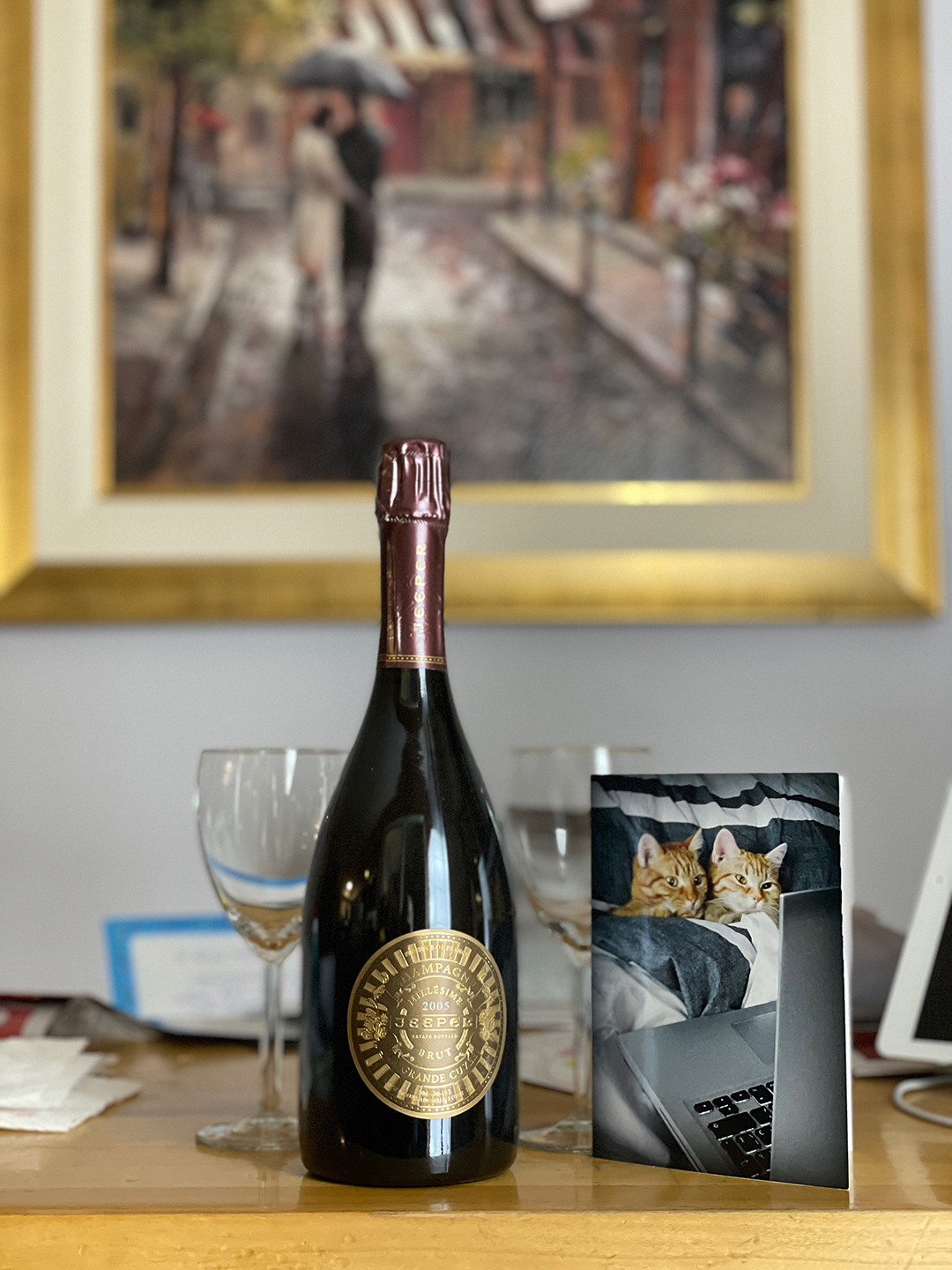
And then there’s this bottle that I’ve seen in liquor stores for I don’t know how many years, though not as often recently.

Stroh’s “54” spiced rum. So named because it’s 54% alcohol. I had never had it, but I decided, since I am now reaching 54 years of age, that I would buy it and see how it is. I looked on the Liquor Control Board of Ontario app and discovered that there was only one bottle for sale in the whole of downtown Toronto. I went to the store that was supposed to have it, and no one had bought it yet. I scanned the run section and found the bottle on the shelf, sitting there, just waiting for me; it looked lonely and hopeful. I brought it up to the cash, and the woman who rang it through informed me, as I put it in my bag, that they weren’t going to be ordering any more of it in that store.

Well. Just in time, I guess. I will decide that it was meant to be. I, too, will not be 54 any more after this one time. And it remains to be seen whether the bottle will last longer than my current age.

By the way, it tastes exactly as I expected (which is like most other spiced rums, but with a bit more alcohol). On the other hand, being 54 years old is weird so far. It feels normal, but my whole life I’d heard it was old. Oh well – clearly that’s not true.

harumphspex

We know what a haruspex is, right? Well, if you don’t, you can read my word tasting note on it (from 2009), but in short it’s someone who does divination by reading entrails. They sacrifice a bird or sheep or other critter, cut it open, and look at its guts, and somehow, by seeing the state of them, make determinations about something in the future: the weather, someone’s health, or some similar outcome.

And we know what harumph is, right? Originally it’s onomatopoeia for clearing the throat, but in established usage it is, as Wiktionary puts it, “an expression of disdain, disbelief, protest, or dismissal.” It’s most typically associated with stodgy old people.

Put them together and we get harumphspex: someone who makes harumphing statements about the future. Not just “Kids these days!” and “Get off my lawn!” but prescriptions for the proper education of the youth – which is to say, the education of the youth in the things the harumphspex thinks proper. 

Harumphspices (that’s the plural of harumphspex, by analogy with haruspices, and the spices is said not like “spices” but like “spissies”) believe that impressionable young minds need to be challenged by being taught the prejudices that their grandparents learned in their youth. They believe that it is crucial that children exposed to “modern,” “liberal” ideas also get the benefit of the “full spectrum” of viewpoints – though if the children are in fact being exposed principally to the same ideas the harumphspices grew up with, you will not see them insisting on bringing in “modern,” “liberal” ideas for the sake of exposure to the full spectrum. 

And of course along with these prescriptions are predictions: the degradation and ultimate destruction of society if their dire warnings are not heeded. But they get their view of the future not from the entrails of animals but from their own disgruntlements. They do not want to make sacrifices, so they just read their own gut feelings, the rumblings in their bellies, which are in reality a borborygmus caused by a dwindling ability to stomach anything new. 

We hear their erumpent harumphing quite often in the world of words; few things are subject to such petulant jeremiads as the supposed decline of grammar into barbarism. But society has many aspects, changing at various speeds, so harumphspices have ample avenues to practice their specious harumphspicy. They raise their noses and proclaim they smell the air of decay… but it’s always just the miasmal effusions of their own dyspepsia.

egress

“Oh, get out.”

I stood in front of a door. It was not in a wall. It was in an open outdoor plaza. It was free-standing, supported by simple braces on its frame. You could open it and walk through it, or you could walk around it with equal effect. 

But that was not the cause of my comment. I was looking at the sign in front of it. There, standing independently on a post, was a large arrow, with the words “THIS WAY TO THE EGRESS.”

I turned to the artist: Marcus Brattle, my former mentee, now 24 years old and an art school graduate, and apparently no less fond of taking the piss than he ever was.

“It’s been done,” I said.

“Not this way it hasn’t!” he replied with a grin. “I’ve taken Barnum’s misdirection and made it a door not out of a building but into a Cage… John Cage!”

I walked around it to view it edge-on. “Looks the same on the other side,” I said. In fact, it had an identical sign on that side too.

“But it’s like Cage’s four minutes thirty-three seconds,” Marcus said. “It’s the door frame itself that frames perception. Wait…” He reached into his pocket and pulled out his phone. As he tapped and scrolled on it, he said, “I got my inspiration from this article in The Mark Twain Annual by, uh,” he read off the screen, “Christine Brenner Dixon. Here!” He handed me the phone and I read the beginning of the abstract:

When P.T. Barnum needed to move dawdling spectators out of his museum, he posted signs over the exits that read, “This Way to the Egress.” Standing suddenly on the street, Barnum’s gullible patrons were left with two choices: pay for reentry or choose to see the world as the grand spectacle, the ultimate humbug.

“I see,” I said. “From huckster to Huxley.”

The Doors of Perception!” Marcus said. (He always was an especially sharp instrument – that’s why he was able to be so exquisitely annoying at will.) He started singing a line from The Doors: “Break on through to the other side! Break on through to the other side!” He paused. “But we digress.”

“Well, then,” said I, walking back around to his side of the door, “let us regress.”

“When I was a child,” Marcus said, “I thought an egress was something like an egret or a tigress. Or maybe a lepress. Like Kilimanjaro.”

I raised an eyebrow. “I would have thought you’d have been an early fan of P.T. Barnum.”

“I’m not the one who went to the school that was halfway founded by him,” Marcus said with a smirk. He knew I went to Tufts University and he knew that Barnum was a major early benefactor and even has a building named after him there – and its mascot (and namesake of its sports teams) is Jumbo, Barnum’s famous elephant.

“Well,” I said, “compared with him, or with a tigress, this barely seems to transgress.”

Marcus raised a finger. “I have another work in progress. It should be ready in time for the congress. It will be a door within a door within a door within a door… a sort of…” I laughed and joined him as he said “infinite egression!”

“Well,” I said, “that really is as funny as all get out.”

“Oh, it’s not just clever, though,” Marcus said. “It’s a cleaver. It divides and joins at the same time.”

“E pluribus unum?” I said, trusting Marcus would know that the e in egress is the same as the one in that phrase on American coins, and that the motto means “Out of many, one.”

“One ingredient, many egredients,” Marcus said. “Or vice versa.” Bonus points for that: an egredient is something that goes out, just as an ingredient is something that goes in (as in into a recipe).

“Well, I hope you can see it through,” I said, “and I hope the viewers can see through it. Or not.”

“And now,” Marcus said, “let me see you through.” He stepped up, opened the door, and gestured for me to proceed.

I remembered Marcus’s many practical jokes of his younger years. “I think I’ll pass,” I said.

“I think you’ll pass through,” Marcus said. “Even if I have to lift the door and pass it around you.” He started to grab the frame as if to move it.

“Oh, no, don’t make the effort,” I said. I stepped forward and boldly went through the doorway. “I don’t want to be needlessly passive-egressive.”

sillykin

What’s a sillykin? Is it an inane family member? No… well, it might be, but that’s not what the kin part is. A sillykin is any sort of fool or simpleton. It can be a term of endearment or mild reproach, when uttered towards a family member or friend (or perhaps paramour), but it can also be about as flatting as nitwit.

The -kin, in this case, is a diminutive suffix. It’s related to German -chen, as in Liebchen and Mädchen and Gretchen. It shows up in English words such as munchkin and bumpkin and gherkin. And you know silly, of course: it comes from the same Germanic root as modern German selig, ‘blessed’; the original sense in English was also ‘blessed’, but it shifted over time through ‘innocent’ and ‘naïve’ to ‘inane’. And you could say that in a way it has come full circle (or perhaps never fully went away from its origins), since a sillykin is the sort of person of whom you might say “Well, bless his little heart.”

The history of its construction also means that sillykin isn’t said like “silly kin.” The suffix is typically destressed to the point of neutralization (which, come to think of it, is what some of us are trying to achieve when we drink ourselves into sillykins), and the second vowel is also reduced, so that it’s more like “sillikin” or “sillakin” or “sillikan.”

We tend to have old-fashioned ideas about what a fool or simpleton might be: some buffoon in farcical clothing making obvious mistakes in the management of horses, for example. But in the modern era, a sillykin could be some guy sitting at his computer, thinking himself very smart but making something with very obvious security flaws – such as an “anonymous free speech” platform that’s easily hacked so the full identifying details of everyone on it can be downloaded – or perhaps thinking that he’s invented the convenience store of the future when he’s just re-created the automat, or thinking that the solution to traffic problems is a system that, among other things, moves only one car at a time and requires an elevator to get the car into and out of it. And that is why they call all those guys the Sillykin Valley.

What? Silicon Valley? Are you sure? They sound the same, you know…

gubernatorial

Hey, why say “governor election” or “election for governor” when you can say “gubernatorial election,” am I right?

Of course, most of us don’t say “gubernatorial election” or “gubernatorial” anything else, but most of us aren’t in the news business or the writing-about-politics business, where the feedback seems to lead to genre-specific words that are meant to sound somehow more knowledgeable (cf. temblor and pontiff). This is a word that has a fancy machine sound to it, and its six syllables – two dactyls, like two long middle fingers aimed at each other – are impressive too. And, just incidentally, America’s favourite ex-robot (OK, he just played one in the movies) was sometimes styled the Gubernator (well, and sometimes the Governator).

On the other hand, gubernatorial also has that somewhat less-than-dignified sound of goober (to say nothing of booger). At least governor can be shortened to gov; imagine if it had to be gub – what a sound of a gobstopper, or perhaps a mouth submerged and drowning (gub, gub, gub). But if governor had retained its Latin form, that’s what it would have been, because the Latin original is gubernator, from which we get this strictly classical adjective.

And how did gubernator become governor? In the incessant production-response-and-revision cycle of speech, as it passed through Old French, the -nator was worn down to -neur, which became Middle English -nour and our modern -nor; and the [b] sound just softened over time to [v], a sound shift that won’t surprise anyone who speaks Spanish, in which the two sounds are treated as two versions of the same sound (which is why, for instance, the adjective from Havana is habanero). The same shift happened in the shimmy from Latin to French.

Oh, but don’t worry about our abilities to govern our tongues. It has ever been thus: consonants often go over time from stop to fricative, as in from [b] to [v], and even more often from voiceless to voiced, as in [k] to [g].* Which is another thing that has happened to this word. 

Because gubernator didn’t spring fully formed from the brow of Minerva or whoever. It came from Greek κυβερνήτης, kubernḗtēs, ‘steersman, pilot, guide’. But the interesting thing is that it came over in an organic, speech-based way; it didn’t get borrowed into Latin in the way many Greek words did: the κ didn’t become Latin c, and the υ wasn’t rendered in Latin as y, as was so typically the case. 

What that meant, though, was that when the Greek root was borrowed directly into English in 1948 to refer to feedback systems of communication and control, it could be borrowed using the usual Latin-styled transliteration and wouldn’t look like its Latinate descendant. In fact, since cybernetics has also had its pronunciation governed by English practices, you can’t even notice that it’s from the same root as gubernatorial. There’s no governetics and no cybernatorial.

Well, not yet, anyway. But once Skynet takes over our politics…


* They can also go in the other direction about as easily.

sepia

Would you ever squid your family?

How about your family photos?

OK, not squid, not really. Cuttlefish.

Cuttlefish isn’t quite snugglebunny, is it? But there’s something classy about it, you know… [touches earpiece] Wait, I’m just being told that no, there’s not.

But oh, yes, there is. You know that classic golden-brown tone of some old photographs? What’s called sepia?

Well. I was just making supper tonight, and, as one may from time to time, I was using pasta with squid ink colouring. And on the front of the package, I noticed that, along with a photo of a tentacled sea creature on a bed of parsley, it said “tagliatelle con nero do seppia.”

Huh. Seppia

I turned over the package. It gave the ingredients in several languages. “Durum wheat semolina with squid ink,” it said. And in German, “Hartweizengriess mit Sepia-Tinte.”

Hmm.

So I looked it up. And here’s the deal. Cephalopods – octopus, squid, cuttlefish – produce ink, as you probably know. That ink has been historically used not just for the obvious purpose of colouring pasta but also, strangely enough, for drawing and writing. Squid ink, as seen in pasta, is a blueish black, often with green tinges; cuttlefish ink, the more popular kind for art, tends towards a rich brownish black. In both cases, the original cephalopod uses the ink as a means of escaping. And in pasta as in photography, the original cephalopod has escaped.

In pasta, it has escaped because squid ink is not cuttlefish ink and yet they say it is. Sepia (or, in Italian, seppia) is cuttlefish; it comes from Latin, which got it from Greek, basically unaltered, meaning the same critter. But my pasta is evidently coloured with squid ink; you can see the bluish-green tint, rather than the brownish tint of cuttlefish ink. Yet the Italians and Germans call it sepia ink nonetheless. And if they are right, then English – which, as on my pasta package, calls it squid ink – is wrong. Either way, someone has a disconnect between ink producer and ink name.

In photography, the cephalopod has escaped because although the photographs have the same kind of brownish-black tint as you see in drawings made with actual sepia ink, they are not actually made with ink from cuttlefish. Rather, it’s called sepia just because it looks about the same as cuttlefish ink. In actuality, the silver in the print has been converted to silver sulfide, which, aside from having a warmer look, is more stable and lasts longer.

And, of course, in photos such as the ones I have here, the tint isn’t ink at all; it’s just a tinge in the image presented by your computer screen. The squid has quit town; the cuttlefish has scuttled away.

So there you have it. And there you have my lovely pasta dinner, which I cooked for my lovely wife.

lacustrine

What a delight to live in a lovely lacustrine location, to scud across a glinting harbour and land on an island as though leaping from lily pad to lily pad, to look at leaves in lagoons and reflections in ponds…

Certainly, instead of lacustrine (or lacustrian or lacustral, both less-common synonyms, and all three said with the stress on the cus), we could just say lake attributively. But while lake comes from the same lacus as lacustrine, it lacks a little something. A couple of syllables, yes, but also the sense of belonging, of inhabitation. 

A lake house is a house at a lake, but a lacustrine house, should you wish to call one that, is one that is somehow part of the lake, involved in its ecosystem. A lacustrine plant is a member of the polis of the lake – or, perhaps, of the lagoon. (A lagoon is a lake-like bit of the sea – or, as we use it in Toronto by the islands, a sub-lake of a lake – between the mainland and the vast open water, set apart by some earthy barrier, literally a lacuna, since lagoon is lacuna in English country clothing, by way of Italy and France. And lacuna is also from lacus, so a lily in a lagoon is literally lacustrine.)

There are lacustrine plants, lacustrine animals, lacustrine layers of sediment. All are not just on or in or under the lake, like cars on a road or trains in a tunnel; they are members of the family that is the lake. A large city on a lake, on the other hand – and that’s “on” as in “on the edge of” rather than “floating on” – often tries to keep itself separate from the lake, to keep the lake as an ornament like a lawn, to be looked at and to increase property values but not to be a member of. But if we’re honest, if we reflect on the subject, we can’t live without it; we cycle our water from it and back into it, our weather is affected by it, and we – at least some of us – are bodily into it and out of it often enough. Life is at least a little different when you are of a lake, when you are not just a lake city but a lacustrine one.