You do well to be cagey when unlacing a language’s insouciant linguistic genius, for you may find its dark underside, its cabinet of Doctor Caligari, its closet of Caligula. But sometimes these dark undersides are callipygian: light and lithe on the tongue, prettily curved for the eyes, exquisite for lexical carousing. So fine, in fact, that they may slip into a party purely by pulchritude and do a star turn on a stage not their own.
Consider this line from The Wizard of Oz: “You clinking, clanking, clattering collection of caliginous junk!” So expressive, so sound-symbolic. But therein is an obscurity: caliginous. What is this abecedarian coelacanth or architeuthis dux doing scaling de profundis into the mechanical racket as a sesquipedalian expletive? What, in fact, would caliginous junk be?
I’m rather inclined to think it’s what one finds in a Jawa sandcrawler or perhaps the corners of an HR Giger painting or an issue of Heavy Metal magazine, or second after second of Blade Runner. We know what junk is, especially clinking, clanking, clattering collected junk. But what can make it caliginous is just darkness and mist.
Caliginous is not just an obscure word; it is a word of obscurity. It is obnubilation. Latin caliginosus means ‘misty, dark, obscure’; it comes from a root referring to fog. You may thus picture dim heaps of rusting metal dripping with oil and condensed smog. And yet they are named with this shining lexeme, so suited to lamprophony. It is a light and dry way to refer to wet darkness.
Is the meaning of this word clear when you look at it?
It’s a lovely long word with a nice balance on the page. If you are an inveterate word taster, you will surely see that phony and know that it’s not a fake: it’s the same as you see in symphony and cacophony. So this word refers to a kind of sound. And the sound of this word, you will also guess correctly, puts the stress on the pivot o in the middle. But what kind of light do we get from the lamp?
Too easy, isn’t it? There’s no way that that lamp could be the same lamp that lights your desk. Perhaps it is part of a lamprey? Or an electric eel on an electric guitar? Or perhaps it is softly glowing, lambent.
But in fact this really is one that you can see clearly through. Greek λάμπειν lampein meant ‘shine’; the derived λαμπρός lampros meant ‘shining, bright’. From the first we get lamp, and from the second we get lamprophony and a few other lampro– words. So lamprophony is bright, shining sound. Specifically, it refers to a quality of voice: loud and clear – good enunciation, good projection, good resonance. The sort of person you can hear across a crowded room, like a bright lamp in the caliginous fog.
Sometimes you meet someone and you sit to talk or listen for a spell. They say a few words and you listen closer, led, and you are bewitched, gradually or suddenly, until you list ensorcelled and you cast your lot with this person, you know this mouth full of words is your sort. The die is cast, and he is killing you softly with his song – or she with hers – and he is a magic man, she a magic woman; the curtains flew and he or she appeared, saying don’t be afraid… you started to fly… you were bewitched, bothered, bewildered. It is all a song; it soars as it sings, and it is sorcery.
Do we not all seek, at one time or another, to be ensorcelled? To take leave of our senses, to rise up from the world, wafting on the draft of the scent of another, the words, the inner curves, the corners of the mind, the webs of the fingers, the tongue and eyes and their many uses? To pass through a lens to the core of… of what? Ourselves or what we want to be or what we want another person to be? Remember that every magnet is a dipole, and one pole is attracted to another: the face we present to the world is one pole, and our deepest internal is the other, and we are attracted to those who present the same as that inner pole to us. We are drawn to this rare person of the earth.
Because there are only two kinds of magnets but there are many sorts of people. And it is perhaps aleatory to find the right match. But when we meet, it is sorcery indeed. And it pulls together and it pulls apart, on both sides. Here is a passage from The English Patient by Michael Ondaatje:
Her life with others no longer interests him. He wants only her stalking beauty, her theatre of expressions. He wants the minute and secret reflection between them, the depth of field minimal, their foreignness intimate like two pages of a closed book.
He has been disassembled by her.
And if she has brought him to this, what has he brought her to?
He and she have ensorcelled each other.
I think we all seek at one time or another such ensorcellment. We all seek to look back, later in life, on having been ensorcelled. To know that our plot could not have been as it was without it.
Such as soft silver word, ensorcel. All the consonants on the licking tip of the tongue or with a little caress of its curve: the nose-kiss of /n/, the purr of /r/ and the liquor chill of /l/, and the curving serpent s whispering softly in the ear c, which echoes the same sound. It is a word made to be spoken in a breath across a dim table. And yet it is a word for fireworks.
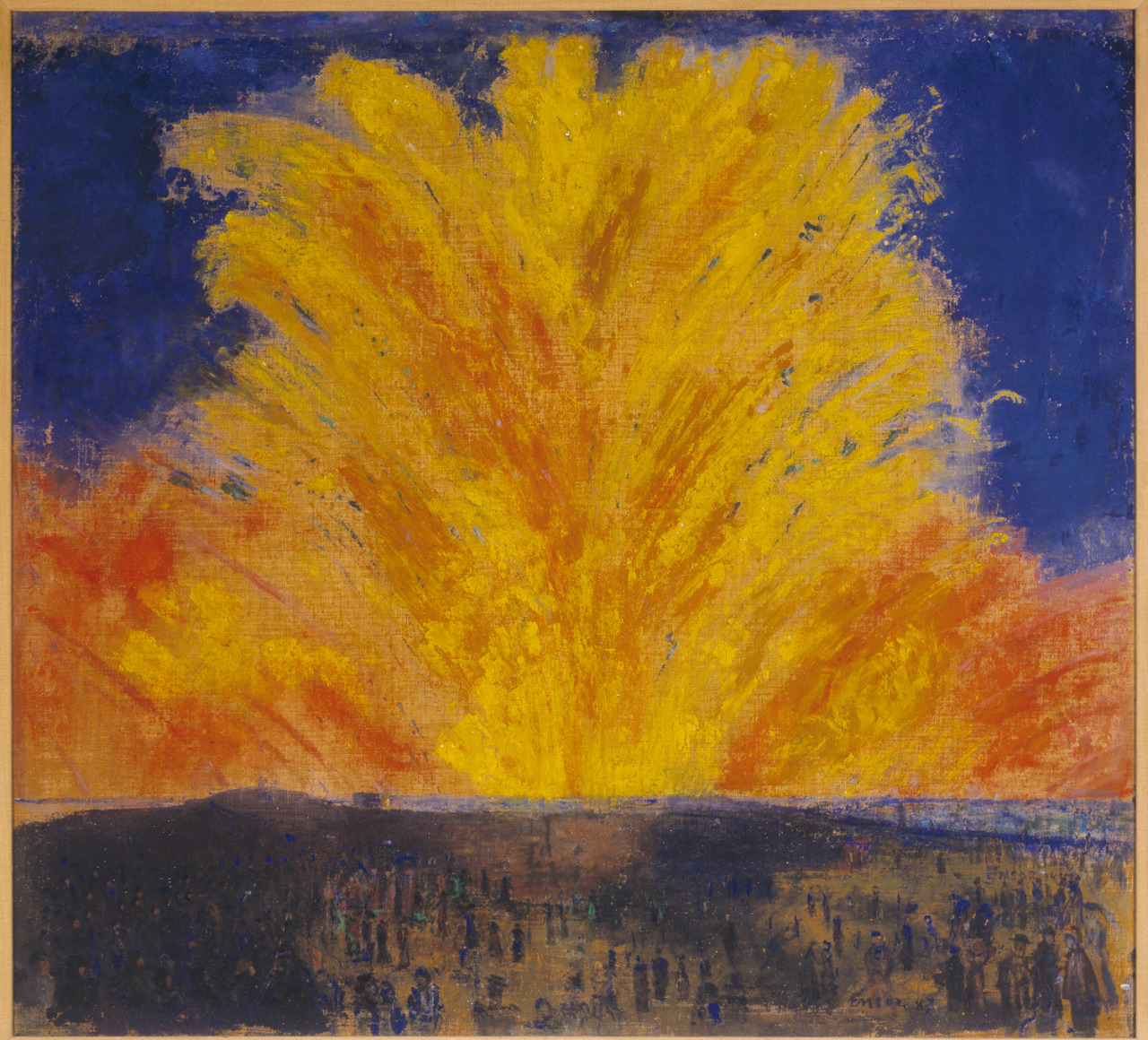
I have a book of paintings from the Albright-Knox Museum. On page 47 is a bold, symmetrical fountain of yellow and red on a dark blue background: “Fireworks” by James Ensor. The original French title is “Le feu d’artifice” – the artificial fire, the fire of artifice. It is an artifice by Ensor, celestial fire touched off by sparks on powder on the ground, calculated magic and a ballistic result.
Ballistic? From Greek βάλλω balló ‘I throw’. Throw and it leaves your hand, and you see the result. What do we throw? All sorts of things. Dice, yes – alea iacta est, the die is cast, an aleatory situation – but also glances, caution, hearts, lots. Not just lots of things; things called lots: any of various objects used for casting in random divination. The practice of using this is sortition, also called allotment; a person who divined using lots was, in Latin, a sortarius.
But divination is magic. If someone divines, by wit or by feel, what note to strike to resonate with the strings of your heart, so that you will cast your lot with them or feel out of sorts, they are surely a mage, a magician, a witch, a sort of sorcerer. A sortarius, which is where our word sorcerer comes from, by way of French. To bewitch was, in Middle French, ensorcerer, which became ensorceler to make it easier to say. And from that we gained English ensorcel, also spelled ensorcell.
We are told to avoid sorcerers and sorcery. But while we do not want necromancers, we want neck romancers, not a Dracula but someone who will give us love bites. We know there are lots of people in the world, and we want to find the right sort, the divine one who will divine what is in us. The other half to our magnet, perhaps. The one who will cast his or her lot with us, and stay with us for a spell. We want, if only to sing songs of it later, to have been ensorcelled.
“How,” Maury’s owlish uncle Evelyn harrumphed, “could they have let such a howler pass?” He swatted his newspaper onto the table in front of him and jabbed a nicotine-stained fingertip at the offending line. “I shall have to write a letter.”
Maury and I leaned towards the paper from our respective sides. “Monkey business?” Maury said.
“Mournfully bad,” Evelyn said, drawing forth his fountain pen and a small coil-bound notebook.
“Cart before horse or leg before wicket?” I said. Evelyn merely turned his head towards me for a moment, lowered his lunettes so he could peer at me significantly over them, and turned back to his scrawling in bilious green ink.
Since it takes Evelyn a few minutes to write one of his wonted screeds, I have time to explain the comments above. A howler is a thing that howls, of course, but it is seldom applied to wolves. Rather, it is often a short form for howler monkey, a kind of monkey that – well, you can guess what kind of noise it makes. Howler is also a now-rare term applied to professional mourners at funerals (one does see them so seldom today). And it also refers to an egregious error. That can be an error on the sporting field, especially in British parlance, or it can be an error of fact, logic, or grammar.
Is an error so named because it makes you howl with angst or laughter? It seems that it is in fact the error itself that exclaims: as the Oxford English Dictionary puts it, it is “Something ‘crying’, ‘clamant’, or excessive; spec. a glaring blunder, esp. in an examination, etc.” Glaring is a visual metaphor; its auditory equivalent is howling. We don’t refer to things as glarers, however, perhaps in part because that’s a word that requires extra effort to say. But I do think that people like howler because of the how and ow that it contains – and perhaps the suggestion of who, as in “Who is responsible for this?”
Now, then. Maury’s uncle Evelyn (and we can understand how a man with a name that in the past century has gradually become a “woman’s” name might be sensitive to gaffes) finished writing his latest lance at the boils of journalism. He held up the notebook – I could see the numerous cross-outs and interlinear additions – and commenced reading aloud.
“Sirs: Your author has committed one of the most egregious schoolboy howlers in his choice of a rhetorical connective: he begins a sentence with ‘Now, then,’ a patent contradiction in terms. Is it now, or is it then? As the great Roman orator Cato – unlikely known to your woefully undereducated scribblers – was wont to say…”
Somewhere in the middle of his baterful oration I was seized by a coughing fit and had to leave the room to treat it with ethanol in solution taken orally. It occurs to me that I have failed to mention the use of howler commonly seen among dyspeptic writers of letters to the editor: to refer to something that few other than the author would even consider an error, but that the author wishes to present as about as bad as calling the pope a Muslim. In these uses, howler means “Ha! You have touched on a fine point that I have learned or figured out and that I am confident sets me above you ignorant fools, and now I get to run it up the flagpole! Howl in despair and bow before me, ye wretches! Et cetera.”
I remained in the other room for some time, coughing occasionally as needed, until the sound of the re-lifting of the newspaper signaled a return to quietude… at least until the next owlish hoot and holler.
Ah, to put on the Ritz. To be rich, or live the life of the rich. Money, it seems, is power: the power to have luxuries, the power to be treated as though you’re always right…
In my world, Ritz was first of all a cracker. And I don’t mean a white person (you may know that cracker is a negatively toned word for a white person in the US). I mean a roughly circular orange crunchy thing made of flour and who knows what else. You probably know them; their current campaign is “Life’s Rich.” I ate many a square of cheddar on top of many a Ritz cracker in my youth. Thus, when I first saw reference to a Ritz Hotel, I wondered why a cracker hotel was so special.
Ritz also makes me think of a taco – specifically Taco Ockerse, who in 1983 came out with a hit version of Irving Berlin’s 1927 song “Puttin’ on the Ritz.” By that time, I knew the reference. I knew a Ritz Hotel was a luxurious place, old-school luxury, something like the Palliser Hotel in Calgary or the Banff Springs Hotel, both CP Hotels at the time and now both Fairmont Hotels. Grand lobby, plush rooms, classic service. I knew what ritzy meant and what Taco was singing about: the well-to-do strolling up and down Park Avenue, “high hats and Arrow collars, white spats and lots of dollars, spending every dime for a wonderful time.” Ritz was a name, but I didn’t think that much about where the name came from; it was just rich razzmatazz.
The name, as it happens, comes from César Ritz, a poor Swiss boy who came to be one of the great hoteliers of a century ago. He moved up through the ranks, becoming general manager of the Savoy in London, where he installed the famous French chef Auguste Escoffier. If you’re wondering who to blame for “the customer is always right,” apparently it’s him – of course, he was following the golden rule: whoever has the gold makes the rules. It’s a productive approach in expensive hotels (though it can produce questionable results in more modest establishments). After he was sacked from there at age 48, accused of fraud, he started up his own hotels, the Ritz in Paris and the Carlton in London, and several others thereafter, including one in Madrid.
Which is where I come back in. Our recent trip to Portugal and Spain was the sort of thing one saves up for, and our last hotel was the Ritz Madrid. It’s the kind of hotel where, with the light switches by the bed, there are buttons to call for the bellboy, the maid, and the handyman:
The rooms were plush, though of fairly normal size:
The hotel did not have a swimming pool. We wouldn’t have booked it by our own choosing for that reason alone. It did have a lobby bar, where, if you wanted, you could have very good champagne for as much as €150 a glass. Our breakfast, if it had not been included with our room rate, would have cost us €35 each in its restaurant:
It was not the most luxurious and exclusive hotel of our stay; actually, I would put it in third or fourth place out of four, though its published rates make it nearly the most expensive. But, yes, plush, posh, all that. A good place to display your ability to pay, and the power that comes with it.
Well, the word rich does come from an old Germanic word meaning ‘power’ first of all, and ‘wealth’ just consequently. You can see this same root in Richard and Heinrich, one or both of which contributed to the Swiss personal name Rizo, which is the evident source of the family name Ritz. All the Ritz words we have trace back to César Ritz – even Ritz Crackers, which managed to take the name once it had become common coin with such phrases as putting on the Ritz.
About that song, by the way. The version Taco Ockerse sang, which was the version Fred Astaire sang in Blue Skies, was the 1946 version. The original 1927 version was not about rich white people. It was about poor black people from Harlem spending all their money to dress up. They weren’t up and down Park Avenue; they were up on Lenox Avenue. It wasn’t “where fashion sits,” it was “where Harlem sits.” Not “lots of dollars” but “fifteen dollars” (admittedly the equivalent of a couple hundred today). Not “Come let’s mix where Rockefellers walk with sticks and umberellas in their mitts” – one of the great masterstrokes of lyric writing – but “Come with me and we’ll attend their jubilee and see them spend their last two bits.” After all, it wasn’t “putting on the ritz”; it was “puttin’ on the ritz.”
But while the customer may be always right, Berlin found that the customer was not always white, and the original lyrics were, shall we say, belittling. So Berlin ritzed it up a bit more by filling it instead with rich crackers, loaded with real cheddar. So to speak.
Language is not ballistic – it’s not something that was thrown with a set trajectory and held a steady course until it hit the present. It is not something that even always moves forward. It is certainly not something frozen. It is sometimes raw, sometimes thawed, sometimes cooked, always decaying and growing at the same time. It is perverse, willful, refractory, twisted, froward. It is thraward.
Froward is not a typo for forward. It’s a word you may have seen in Shakespeare. It means inclined to go against what is normal, reasonable, or expected. You know to and fro? The fro is another form of from and is opposite to to. If something will not move toward, if it is deliberately untoward, it is froward.
But thraward? Well. In the beginning (or, well, not the beginning, but as long ago as we have any record of) there was a word thraw – actually a verbal root þraw, but we’ve long since lost that nice þ letter and replaced it with the messier th, and we’ve dropped most of the verbal inflectional endings too. This word thraw meant ‘twist’ or ‘turn’. You still see it in throw a pot or throw your back. You also see it in throw meaning ‘toss, hurl’, except that now it doesn’t mean ‘twist’; it’s gotten its new twist probably from the twisting the body does when throwing an object. The act of what we call throwing used to be named with the word weorpan (oh, that w was another letter, too, derived from a rune, but that’s a whole other story again). That word comes down to us as modern warp, which now has more to do with twisting than with tossing.
Anyway, froward – or its alternative version fraward – was turned into thraward by some speakers, particularly in Scotland. (It is pronounced with the same a as in warp.) It turned away, turned astray, twisted, was thrown off course, got warped, whatever you will. But then so did throw and warp. They did not turn back; they did not push against time. They simply spiralled, turned athwart. Thraward thus seems a better word for language than froward. Especially since it’s evidence itself of such perversity.
“Naïveté is one of the mothers of invention.” Tom Cochrane wrote that, and I think it’s true. As witness, I present the naspritus tree.
In the early 1980s, I listened to a lot of rock music, mostly on CJAY-92 (which, unlike many stations, you could still get as far up the Bow Valley from Calgary as Banff). I listened mainly on car stereos and the monophonic speakers of my bedroom clock radio and similar devices. If something was a hit in southern Alberta at the time, I heard it. Some songs that were big in many places were utterly foreign to me; others that were big hits in my world were little known elsewhere (for example “Love Me Today”). One song that was somewhere in between was “White Hot,” by Red Rider.
“White Hot” had the distinction, along with April Wine’s “Say Hello,” of having had a section of its instrumentals used for a time as theme music for the CTV station CFCN’s 6 pm news show. But that’s a bit of local side fame. The song was actually number 20 on the Canadian charts (and number 48 in the US) in 1980. So I heard it often enough.
But, you know, I heard it on those not-that-great radios, never with headphones, and almost always doing something else at the time. So I just had this sense of the song as being something about some war memories involving random African places, in particular Tripoli and Tanzania. The person singing it was white hot and couldn’t take it anymore and needed rain. And there were trees of various sorts. (“Fuselli, foxy rifles, and the trees, in Tanzania!”)* The one that stuck out for me was the naspritus tree – the words I heard every time it played were these:
I can remember the naspritus tree in Tripoli
We were so much bolder then
Had you in my core tree to protect me
We were both soldiers then, older then, colder then,
I need rain, I need rain, I need rain
The word naspritus was pronounced /ˈnæspraɪtəs/, like “nass pry tus.” Oddly for me, I never bothered looking it up, probably because (a) I wasn’t in a position to when I heard the song and (b) to be honest, it wasn’t a song I liked so well I would buy the album, so I wasn’t really going out of my way for it. Look, it took me a couple of decades to look up one odd phrase in a song I did like well – which led me to the made-up word classiomatic. (Who just makes up a word like that?)
I had an imagined idea of this naspritus tree when I listened to the song, of course. It seemed likely to be some kind of fruit tree, tall, leafy, in which a soldier might hide with his gun to protect another soldier. Somehow it had some local importance. Was it eternal like a Joshua tree, folkloric like a baobab tree, just one of those things one encounters locally like a maple tree, or some personal memory like, perhaps, a bergamot tree? Were its fruits like nectarines or tangerines? Its name was obviously a Latin species name – not something well enough known to have a non-technical name, unless it had gotten the name and then became known, like flowers such as acanthus or aspidistra. It seemed to me to be, most likely, a tree that wasn’t really all that special but was one of those convenient sufficiently exotic pegs on which to hang the superiority of a foreign memory.
But all that seeming barely outlasted the duration of the play of the song. Only occasionally would it cross my mind at other times to wonder what a naspritus tree might be, or what in fact Tom Cochrane actually was singing if not that.
A naspritus tree, as it turns out, is a tree on which grow the fruits of naïveté and illumination. When we pick up its fruit as we find it lying, it is naïveté. In naïveté we hear a thing and fill it in as best we can according to sound patterns we’re used to, much as we fill faces and figures into furniture when looking around a dark room. Names need not have obvious sense, after all; as long as it sounds plausible you can assume some reality for it. Why would there not be a Lady Mondegreen, or a car called a classiomatic?
But when we finally look up, the fruit we see is illumination.
Look up into the tree? Look up in our references. Look up the word or words we had heard. We are at last illuminated.
So now, having consulted transcriptions of the lyrics, having listened more closely on a better system, I can tell you that the words I heard are these:
I can remember the nights by the sea in Tripoli
We were so much bolder then
Had you and my poetry to protect me
We were both soldiers then, older then, colder then
I need rain, I need rain, I need rain
Does that still not make perfect sense? It will help a little in the context of the song, which by this point you really ought to listen to:
I guess it proves that naivete is one of the mothers of invention… I wrote most of the lyrics in a dusty corner of Guelph University’s Porter Hall library after reading Henry Miller’s White Heat/Time of The Assassins, an essay on Rimbaud. Kenny came up with the mystical piano intro after I played him the song at his place in north Toronto. I would travel to Somalia during the crisis there some 15 years later with World Vision. This was a country in which Rimbaud had sold guns, and unfortunately that legacy still remains.
There are two more things I must mention. First, if you listen to the song, you will hear something that sounds sort of like “summer lie” and, later, in the chorus, something that sounds sort of like “summer lyin’ shore.” These are in fact references to Somalia, as Cochrane says in the quote above. I’m really not sure how he got that odd hyper-Anglic pronunciation; it’s not in Oxford, let alone anywhere else. Perhaps it is one of the ground-lying fruits of the naspritus tree. Second, Arthur Rimbaud was the author of, among other things, the volume of poems Illuminations. I wonder whether Tom Cochrane had the occasion to read it while he was holed up in the library at Guelph… Illumination is, after all, one of the daughters of curiosity.
PS Guelph, pronounced “gwelf,” is a small city about an hour west of Toronto.
* The actual lyrics turn out to be “For selling faulty rifles to the thieves in Tanzania”
Who can bear life adjacent to the jaculiferous? Who would not rather let sleeping fugu lie than suffer the slings and arrows of tetrodotoxin? Who would not reject a brush with a porcupine? And yet it can be so hard to spot them, swimming through social spheres innocuously until someone darts an odd glance or malapert word… and then the spines come out.
Well, there’s the long and the short of it: It can take a sharp eye to spot the danger, to see what will lie and what will dart. In Latin, jacere (really iacere, since Latin did not have separate letters for i and j, and what we now write as j was a consonantal version said like “y”) with a long e before the r (often represented now as jacēre) means ‘lie’ – as in lie there. Something that lies next to something else is adjacent. But jacere (iacere) with a short e (sometimes set down as jacĕre for clarity) means ‘throw’. As in alea jacta est, ‘the die is cast’. Modern words such as reject derive from that root. The Latin word jaculare is derived from it; it is a verb meaning ‘dart’. The noun jacula means the noun ‘dart’.
There are a few words that derive from this. Today’s word is one such. It combines with Latin ferre ‘bear, carry’ (ferre is related to the verb bear way back) to give us jaculiferous, ‘dart-bearing’ (if it were a common word, the puncturing would surely lead to occasional misconstrual as draculiferous, but it’s not). It refers to things that have darts or dart-like spines on them. An example is the genus Diodon, which contains the pufferfish, among which is one kind of fugu, a name for a few different blowfish that bear a deadly tetrodotoxin and just happen to be a famous item in Japanese cuisine. Of course you try to eat the parts without the toxin, or with just enough toxin to give you a slight tingle in the lips without actually, you know, paralyzing your respiratory system and killing you. As happened to the Kabuki actor Bandō Mitsugorō VIII, who rolled the dice (so to speak) and finally lost.
And we thought porcupines were hazardous. Oh, yes, porcupines are jaculiferous too. They don’t puff up like the fish, but they have the dart-like spines (the fact that they don’t throw them does not disqualify them). Both kinds of porcupines count. Say, did you know that New World porcupines are only distantly related to Old World porcupines? Old World porcupines are Hystricidae; New World porcupines are Erethizontidae. Something to think about when you’re pulling out the quills.
Jaculiferous things are best avoided. Jaculiferous people (figuratively speaking, of course) are also usually better treated with circumspection. But, as with the written form of the word, we carry on with life in the midst of them. We are always rolling the dice, never quite sure for whom the darts are borne.
My undergraduate alma mater (well, my first one, when I got my BFA in drama) is the University of Calgary. The campus was built in the mid-late 1960s, as were the neighbourhoods next to it, standard curvy-street suburban developments utterly typical of that sprawling hilly city (and many others). To the south is University Heights. To the north are Varsity Acres, Varsity Village, and Varsity Estates.
Those neighbourhoods were my first encounter with the word varsity. (I knew of them in my childhood, well before I went to university – a mall we often shopped at was right there too.) At first I didn’t know what it meant; I just took it as a name, like James or Calgary or Dalhousie (another neighbourhood in the area, and one we lived in for a year). Once I grew enough to learn that names came from somewhere and meant something, I knew that varsity referred to scholastic things, higher education – or rather the air and milieu of higher education, especially the sports.
Varsity, to me, is a word like a V-neck sweater with an athletic team name or letter or logo sewn onto it. (And this from a Canadian – you have to understand, collegiate sport means nothing to Canadians, and we are always at least a little nonplussed at the mania Americans have for it.) Its most common collocations are with sport things: junior varsity, varsity team, varsity athletes, and various specific sports such as varsity football. It can also be found in terms such as varsity cheer.
Athletics in higher education serve – or at least used to serve – a social function, an opportunity for group solidarity and boosterism. Places of education have an unavoidable social function, after all, and I think that’s good. As the saying goes, a university is a fountain of knowledge where students gather to drink. Perhaps varsity is a fountain of sports.
The words likewise have different flavours. University may be a place where you go to learn the classics and unlock the knowledge of the universe, a noble city of learning, with that cold but embracing U at its head and that unifying air of uni, even as it embraces diversity; varsity is more vibrant and aggressive, more rah-rah, more party, but also more class-conscious. It could be a word for varmints who just like team sports, but it could more readily be a word for the louche rich who go to Darby.
Sorry, I mean to Derby. Funny, that, how Derby came to be said as Darby. Well, not so funny, really; we may associate that sort of shift with a specific moneyed class in England, but it was common enough at one time. Person became parson (though we also kept the former); clerk became Clark (and those same upper-class types say clerk as “clark”); vermin became varmint (and then got taken up by certain people in the US); at one time mercy was said as “marcy” and certain as “sartain,” though those have not lasted generally. If this shift seems odd, then you haven’t been listening to many younger people (females even more than males) lately, especially among the university-educated set: a similar lowering is audible in many cases, making test sound like “tast,” for instance. It’s a quite unexceptional kind of sound shift.
It just happens to have become associated with a sartain, I mean certain, set in the case of varsity. Undoubtedly this has something to do with who would even be talking of varsity: those who could manage to go to one of the great universities of England, notably Cambridge and Oxford. It is they who have done the most to preserve this word, this aphetic and vowel-shifted variant of university, by having an annual extramural slaughter: the Varsity Match, a rugby game between Ox’ and ’Bridge. This casual, group-solidarity colloquial version of university persisted with the sports and spread to North America, while the precise and attentive university retained its reign over the institutions as a whole. In England, they shorten university to uni as they shorten television to telly; one might imagine that uni is where they learn and varsity where they play.
So in the classrooms and libraries we learn how university came to be varsity, while on the field they play varsity and chant and sing and drink and all that and care not a whit about the provenance of the word. But really they are the two sides of the university – north and south, if you will.
That isn’t to say that I would want to be clustered too closely with monastics. That could induce some closet-like claustrophobia. But outside of such cloying, there is much to be said for cloisters, the oysters of the academic and spiritual worlds: enclosed shells within which may be found great pearls. Shells, moreover, that are open on one side, often to a beautiful, peaceful little space. A place to walk, and think, and breathe, where the clutter of the world is occluded. A warm heart made of cool stone: all that cloisters is not cold.
There are many famous cloisters in the world. One of my favourites is a museum in New York City, an outpost of the Metropolitan Museum of Art in the far north of Manhattan, in Fort Tryon Park. The building is a bricolage of medieval stonework, a modern monastery of centuries-old aesthetics. If you wish to try on this overcoat of stone and art, just take the A Train past where Duke Ellington got off, walk through the park, and meander in the enclosure taking in some of the best works of six, seven, and eight centuries ago.
The Met is not the only museum to have cloisters. We were in another one such in Madrid recently: the Prado (pray do not confuse that with Prada). Enter at the Jerónimos entrance and, instead of going to the right towards the main building, go to the left, up the escalators, up and up; follow the signs that say Claustro and you will find yourself in an old cloister, the Jerónimos building. (Does Jerónimos look like Geronimo or Hieronymus? Yes.) It features sculpture, sublime statuary frozen in poses of passion and devotion for all time, like Lot’s wife but not subject to dissolution in tears or rain.
We saw some other cloisters on the trip, too. We stayed in a hotel that was a converted (and substantially reconstructed) 12th-century monastery. It is now named Le Domaine. It has a lovely central garden surrounded by a quadrangle of cloistered walks. It remains a place for serene and rarefied pursuits, but now those pursuits are, while sublime, not metaphysical; the devotion is to the epicurean, and the pearls are of pecuniary price. It is surrounded by vineyards, and we drank sparkling wine in our finery where monks had once chanted. One may say we brought in some of what they had been closing out – but we still left behind what we had to face most every day.
When we were in Porto, we passed by cloisters on our visit to their cathedral. I won’t say we visited the cloisters; they required time, and an entrance fee, and we hadn’t enough of the first to justify the second. I satisfied myself with a photo through the door, a glimpse, past the sign that says Claustro, past the guard. Click.
As one gets: a glimpse of what one could have if one had the time and the money. But of course that was our whole vacation – what we had because we had the time and the money. A step through a half-open door into a closed world, inward-looking, peaceful. A place for contemplation and appreciation. If you are not claustrophobic.
Yes, cloister is related to claustrophobic. And to close, and closet, and occluded. They all trace back to the Latin root claus- and claud-, having to do with closing, shutting, locking. Cloister came altered by Old French (Latin claustrum, clostrum > Old French clostre, cloistre). At first it was just a closed and enclosed place; then a place of religious seclusion; then a structure often found in those, an inward-looking arcade.
Arcade? This sounds like a place of amusement. Ah, but there are so many kinds of amusement. We have an arcade on the ground level of the building I live in; in fact, it is 27 floors directly down from my feet and butt now as I sit near my window. It is open to the city, though; my personal cloister is more likely my library. But oh, et in Arcadia ego. The world is still my cloister.