Monthly Archives: September 2018

JJ Bean

IMG_8593

Look, it’s a street

Listen to the audio version of this coffice space review on Patreon.

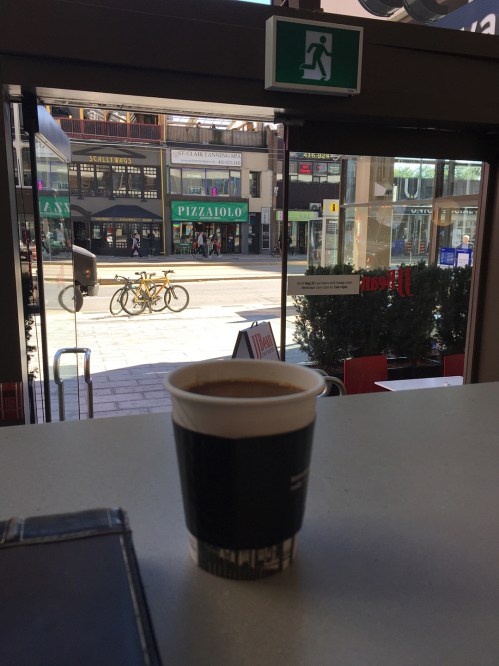
If, by some accident of fate, you find yourself near Yonge and St. Clair needing to get some work done, and you don’t want to go downhill to Boxcar Social, you don’t have to resign yourself to the local world-eating chain coffee joint. Just go a couple of doors west to the office building lobby facing the streetcar stop. Continue reading

Eye rhymes and iRhymes

(or: Can you rhyme emoji?)

Originally published on The Editors’ Weekly

An eye rhyme is when two words that only look like they rhyme are used for a rhyme. This was an early annoyance from my childhood, when elementary poems rhymed good with food. Another famous one is from Shakespeare:

If this be error and upon me prov’d
I never writ, nor no man ever lov’d.

Both of those examples may be excused by having been real rhymes at one time (indeed, for the Bard, the o’s in both prov’d and lov’d were like the oo ingood). Other eye rhymes have always been for your eyes only: come and home, for instance, which have never rhymed, or the name Sean Bean.

But if we can get away (at least occasionally) with rhyming things by appearance, then rhyme can be visual. In which case visual things can rhyme. Such as emoji. Continue reading

innove

Does this word disorientate you? Or should I say disorient you?

We have many ways to innovate in English, to form new words, and one of them is to press existing words into new uses. We can do this by adding a suffix, and we can also do it by adding no suffix. So, for example, we have the word orient, meaning ‘the east’, and we make it a verb meaning ‘point to the east’ or ‘find the east’ or just ‘know which way is east and which way is west’. If we’re in England, we are likely to add a suffix and make the verb orientate. But if we’re in North America, we’ll go with the older version of the verb (older by a century, mid-1700s instead of mid-1800s), the version that, like so many English words, was formed by what linguists like to call “zero derivation” – that is, a new form is derived from the old one with zero change of form. We say orient.

You see, two important but typically competing forces in the evolution of language are economy and clarity. One the one hand, we don’t want to expend unnecessary effort; on the other hand, we need to be clear (or our listeners will expend unnecessary effort, or perhaps by not understanding us will cause us to expend unnecessary effort). So we are incentivized to innovate and incented to innove. Continue reading

lode

O, how we are misled by appearances and strange attractions! We use a lodestone or follow a lodestar to lead us to the motherlode, but so often we find ourselves stuck in load-eye again, with loadstones and loadstars and motherloads. How can we load such ill-starred stones? But, you see, it is all because we see what we want to see. We see a difference just if we want to see one. Continue reading

Pronunciation tip: Agincourt

My latest pronunciation tip is on Agincourt. Oh, did you think I meant the place where Henry V defeated the French? Well, that too, but first of all the one in Scarborough, which means in Toronto.

The Carafted Bean

IMG_8514

We’re at the corner of art and more art

Listen along with this on Patreon while you look at the pictures below.

There are many places in Toronto to observe how badly Toronto drivers suck, but the corner view from the Carafted Bean at Dundas and McCaul truly reveals what an absolute art they make of sucking. In any half hour, you have sixty occasions to see appallingly stupid decisions made by drivers at a really quite simple intersection. And don’t blame the streetcars or buses – they’re the only kind of vehicle guaranteed to behave predictably and in full accordance with the law.

Let it not, therefore, be said that the Carafted Bean is without its entertainment. But the dickheads in shiny metal boxes aren’t the only good viewing. There are people walking past on the sidewalks, interesting people, artistic people even. After all, the Art Gallery of Ontario is directly kitty-corner and OCAD University’s big lofty pencil-box building is just south of it. Across McCaul is the Village Idiot Pub, probably not named after the drivers but there you are. Continue reading

How do you know who wrote it?

People – some people, anyway, I guess not all people – are abuzz about the anonymous op-ed printed in The New York Times by a senior White House person. Naturally, people want to know who the author is! But how can they know? One way some people are trying is through looking at word choice. It wouldn’t be the first time choice of words has seemed to unmask an anonymous author or a forger. But does it work? Read my latest article for The Week:

The delicate art of using linguistics to identify an anonymous author


satispassion

There will never be satisfaction: He can never do enough.

If you break ice, you can melt it and freeze it back to what it was. If you break a diamond, it is beyond your means to make it whole again.

If you break a heart?

If you cause suffering, can you suffer enough to atone for it? Continue reading

zillet

I need a new key purse. The one I bought just a year or two ago is falling apart already (!). But it’s hard to find one with the necessary features: it has to be able to hold a few bills and some coins, it has to withstand getting wet on occasion (I sometimes go running in the rain, for instance), and it has to have well-made, usable zillets. Not a ring, zillets, and not crappy ones either. Continue reading

Reading: afflatus

I’m reading every one of my blog entries for my Patreon subscribers who subscribe for at least $2 a month. I’m making this one a freebie. If you’d like to listen to more of Sesquiotica rather than just seeing it on the screen, you can subscribe at www.patreon.com/sesquiotic. You’ll also get to read all the blog posts that are password protected.