kohlrabi

This is a strange-looking word for a strange-looking plant.

Many people get boxes of produce delivered regularly. Many others go wandering through farmers’ markets or surfing the interesting-vegetables corner in their local grocery store. And many times they see this plant, this word, or both, and say “What the heck is that?”

The plant they behold is a sort of creepy sphere with up-dripping appendages, like an organic earth sputnik or an amputee vegan squid or a modernist house design fad from 1952, or some ineffable eldritch animate orb bemusing space travellers on the cover of a mid-century sci-fi novel.

The word they behold is more ungainly than rutabaga. It is an oversized Scrabble-grab of letters that defeat permutation into a single word fitting the usual Anglo-Saxon practices. It could almost name a famous diamond or a southern African desert or an Asian range of mountains.

Or a cabbage-turnip.

Kohl, German, ‘cabbage’. Rabi, related to German Rübe and both ultimately from Latin rapa, ‘turnip’. The plant’s Italian name is cavolo rapa, also ‘cabbage turnip’. The Germans just took that and did that thing that German does with words. Why have a farfalla flutter above your cavolo rapa when you can have a Schmetterling besetting your Kohlrabi?

But even if you don’t find the word appealing, and don’t find the look of the plant appealing, if you buy it, you will be a-peeling, because it’s best to take the skin off. What’s inside is crispy and juicy and similar in taste to the heart of a broccoli stem. Fair enough: they’re related. Kohlrabi was selectively bred from the same wild cabbage (Brassica oleracea) progenitor of cabbage, broccoli, kale, cauliflower, and other crucifers. Technically they’re all varieties of the same plant in the same way as victuals and vittles are varieties of the same word, or thresh and thrash, or vermin and varmint. Or Kohlrabi and cavoli rapa. It’s not a turnip, it’s a cabbage, but it’s a turnip-looking cabbage.

Well, fine, whatever. Here’s a fact for you: some of the ugliest food is some of the best. Same with words.

poltroon

To me, this is, always has been, and always will be a Captain Haddock insult.

You know Captain Haddock, from the Tintin books? He is given to very colourfully cussing out the various reprobates and recreants he and Tintin have to face in the adventures. Well, not cussing out. They’re kids’ books, after all! His shouted epithets for the fleeing villains include such wonders as bashi-bazouks, coelecanths, troglodytes, visigoths – look, there’s a whole list of 213 of them at www.tintinologist.org – and poltroons, which, if my memory is true, serves to set off a Himalayan avalanche.

Not all of these words are, in our real world, names for bad things or bad people. But a poltroon? A poltroon is just about the worst kind of person you’re likely to encounter. “A spiritless coward” and “a mean-spirited wretch,” Merriam-Webster Unabridged says; “an utter coward; a mean-spirited person; a worthless wretch,” the Oxford English Dictionary tells us. A poltroon is a soldier who shoots at his countrymen if they try to make him fight the enemy. A poltroon is a middle manager who won’t lift a finger to help his employees or advocate for them to upper management but will eagerly trap them in his office and belittle them at length. Captain Queeg, Herman Wouk tells us in The Caine Mutiny, is a poltroon.

But somehow, this term is not much used for full effect these days. As the OED says, it’s now chiefly archaic or humorous. For me, the Haddock effect is insuperable, but that can’t be the case for everyone. I think the echoes of goon, buffoon, baboon, loon, and such words probably have some effect. Echoes of dragoon, pantaloon, and saloon might add to the archaic feeling. And we have much more vulgar – and vividly metaphorical – terms to replace it, anyway.

What, originally, is a poltroon? It brings poultry to my mind, but that’s not quite what it is. A 17th-century author suggested that the word came from pollice truncus ‘maimed thumb’, referring to men who mutilated their thumbs to avoid military service. This was long accepted as the source, but it probably isn’t. Poltroon comes from Middle French poltron ‘coward’, from Italian poltrone ‘worthless person, coward’, tracing back to Latin pullus ‘young animal’ – which does connect closely to pullet and poultry, but they’re not the direct source of this word. But a poltroon is a chicken, so to speak – a chicken crossed with a jackal. Also an anthropophagus, an ostrogoth, a picanthropic pickpocket, and so much more…

vellum

Today brought the news that the opening of the British parliament is being set back by the time required for the ink to dry on the official copy of the Queen’s speech. And with that comes the disappointment of Merriam-Webster’s Kory Stamper that lookups for vellum have not spiked.

Not that the Queen’s speech is calligraphed on vellum. No, it’s done on an archival paper called goatskin, although it’s not made of goat skin. Well, fine. Onionskin isn’t made of onions either, and, for that matter, vellum is these days not often made of calf skin.

Why should it be? Ah, well. The name is not quite as pellucid as vellum is. It has a flavour of historical importance and gravitas, and of fillum – sorry, I mean film – but is nearly as factitious as Velma, Selma, and Thelma (all three names literary inventions, as far as can be seen). Its historical origin has been masked in the process of making it seem more historic.

Vellum was originally made of calf skin, yes: a parchment made of membrane cured and scraped and further prepared for receiving ink and sealing with a signet or binding in a volume. Latin for ‘calf’ is vitulus, and ‘of calf’ or ‘from calf’ is vitulinum (in the neuter). From vitulus came, scraped and polished by time, Old French veel (whence modern French veau and modern English veal), and from vitulinum came velin (whence modern French vélin), which – by some velleity of dissimulation – shifted the final n back to m in English to make it sound more Latin (compare venom from venin and pilgrim from pelegrinus). So now that parchment-type material called vellum is often not made from animal skin at all, the name has gained a fake classical look that masks its real classical origin. It has been treated to make it not what it simply is but what better serves our desires and displays our impressions. Let that soak in.

Milan

Our northern Italian transect culminated in Milan, city of millionaire milliners, the Toronto of Italy. Neither the prettiest nor the ugliest of cities, but an oversized cutlet of urbanism and urbanity plated on a broad plain, breaded with money and spiced with art, education, society, alcohol, and fashion.

Milan has been there since forever, in the middle of that plain. A common derivation of its Latin name, Mediolanum, means ‘middle of the plain’. It’s tempting to say it’s a plain city, but while it may be relatively plain for Italy, it’s still far more presentable than, say, Indianapolis or Winnipeg. And it has long been a magnet for power and money. The Castello Sforzesco is there to help you remember that fact.

From there you can walk along Via Dante and Via dei Mercanti, past all the stores, to the heart of the thing: the Piazza del Duomo.

You can see that the statue horse under the statue dude on the right is frightened by the festival of fancy spikes it sees before it. And also maybe by the crowds: the line just to get a ticket to be let into the line to get into the duomo (cathedral) was a solid block long, almost Godardesque in extent.

Or maybe the horse is spooked by that golden angel madonna on the top of the highest spike. I’m not sure how the palm trees, a gift from Starbucks for letting them open a store there (which is like opening a Taco Bell in Puebla or, um, a Starbucks in Italy, for heaven’s sake), are affecting the beast or the assorted tourists seated beneath its upturned tail. (The second photo is from two hours later. The sky cleared.)

We were with a group and had tickets in advance, so we had much less wait time to get in. The cathedral is, as expected, exalting, and, as is also to be expected, took exactly forever (6 centuries at least) to build – providing you can consider it finished, which I’m not sure it truly is. It is the largest church in Italy. (The pope’s place, St. Peter’s, is in the Vatican City, which is its own separate state. You knew that, right?)

People come to look up to the stone-and-glass heavens.

There’s even a sort of gaudy mechanical nimbus the bishop takes up to ceiling level once a year.

There’s a statue of St. Bartholomew, who is holding his own skin. I’m guessing he’s on the way to have it altered or to swap it in for the new season’s latest.

There’s a replica of the angel madonna (the one that’s spooking the horse). It’s covered in gold and guards an area that only a select few can get into. I suspect it’s the mascot of Fashion Week.

Speaking of gold and getting skinned alive, off the north side of the Piazza del Duomo is the Galleria, its entrance guarded by the Scylla and Charybdis of Campari and Prada, the original locations of both, so you can get something intensely bittersweet and then go and have a cocktail after.

A view through it towards the south reveals the splendor not of the duomo – that’s at the east end of the piazza, with a western narthex as is normal – but the headquarters of Martini and Rossi.

Keep an eye out for the fashion police, though.

Milan has always been a city of fashion. The term milliner for a hat-maker (formerly used more broadly of purveyors of women’s fashion) comes from Milaner, i.e., someone from Milan – which used to be said like “millin’” by the British.

And there is millin’ around, especially in the piazza, but Milan is really a city that is going places. At night it goes, perhaps, to the opera (I did not visit La Scala, so no photo of that); at day it gets around, by underground train or above-ground streetcar

(most of which more modern than this classic one) or bike or simple perambulation. Or by car, though I can’t consider that the best idea. It goes shopping

or for lunch, perhaps to have one of the city’s eponymous expansive breaded veal cutlets,

but it goes, above all, to see and be seen.

In some cities, the sightseeing is all about the things that don’t move. In Milan, it is, above all, about what does move. And eyes are everywhere.

Bergamo

Bergamo is a city of highs and lows, of broad views and surprise turns, of windows on history, of glimpsed secrets.

Yes, yes, just like lots of Italy. When you have that much history, what do you expect? But Bergamo has perhaps a bit more and other.

Let’s get something out of the way to start: It’s pronounced like “bare ga mo,” with the stress on the first syllable, and it’s not related to bergamot, the citrus flavouring in Earl Grey tea (which is best said with the t on the end nice and crisp). Fair enough. Bergamo is not a tea-drinking kind of city.

You can see Bergamo from a distance across the lowlands to the south. You can see one part of it, that is. Bergamo is a city of two parts: the città alta, upper city, a dense medieval Italian town set on a thumb of mountain projecting into the plain and surrounded with 16th-century walls built by Venetians (who owned the place at the time), and the città bassa, lower city, which looks like any other modern northern Italian city, with buildings of a broad range of ages, all built for living and working in but not as much for showing off. Many people think the lower city only appeared in modern times, but it’s been there as long as the upper city has – the difference is just that the lower city has been erased and redone over time like a whiteboard, while the upper city is like that “please leave on” corner of the board.

And the lower city is the lower-class place, historically. The commedia dell’arte, a form of masked improvisatory comedy, drew three of its zany characters from Bergamo (zany? the term for them was zanni, which is the source of the English word): Arlecchino, who became Harlequin, he of the patchwork costume, emblem of romance novels and dime-store paintings; Brighella, who was the smarter and nastier big brother of Arlecchino; and Pedrolino, who may have been a forerunner of Pierrot. All three were lower-class sorts from the lower city who spoke in a broad Bergamasque accent.

Bergamasque? Yes. The term in Italian for a citizen of Bergamo is bergamasco. This shows up in English as bergamasque or, sometimes, bergamask. The latter also names a kind of rustic dance and associated music. And since Bergamo was held by the Venetians for some time and picked up some of the masquery and revelry, which also influenced the commedia dell’arte, it was quite reasonable for the French poet Paul Verlaine to write, in his 1869 poem Clair de lune,

Votre âme est un paysage choisi
Que vont charmant masques et bergamasques
Jouant du luth et dansant et quasi
Tristes sous leurs déguisements fantasques.

This poem’s second line inspired Claude Debussy’s Suite bergamasque for piano (from which we get his famous “Clair de lune”) and Gabriel Fauré’s orchestral suite Masques et bergamasques.

All of which is very romantic and elevated. Lofty, even. Like that other part of Bergamo, the one you can see from a distance, the one you come from a distance to see. It’s on the mountain – which probably contributed the berg to the name. It’s a bit of a hike up, so you take the funicular.

You get off that and walk a stone-paved street uphill until you get to the old square in the heart of the old high city.

There’s a tower there that looms over the town: the Campanone. It has large bells in it that chime the time every quarter hour. At its base in an equally old building (with, in place of a lobby, an open pit showing excavated ruins) is the Museo Storico di Bergamo, the Bergamo Historic Museum, where you get a window onto the past – figuratively, in its detailed and digitally enhanced displays on the great cultural (musical, literary) and economic history of the town, and literally.

When you have done reflecting on that, you can climb the Campanone. There is an elevator if you prefer, or there are stairs if you prefer. At the top there is a view.

You can see the anfractuous streets of the old high city.

You can see that people actually live in this town (they also drive cars around it – watch out!).

You can see the cathedral.

You can descend before the bells right above your head chime the time.

The alta città is a nice place for wandering among the old narrow stony streets. Don’t expect to do too much shopping; there are stores, but fewer than you may expect, and many of them are not open when you pass by. You may lose your way, but if you do you will within 5 or 10 minutes find yourself somewhere you know, probably back where you started. It is small up there.

You can walk down to a gate and see a view to the spread of the lower city.

You can walk past closed gardens and open university buildings. You can go into the cathedral and see the beautiful architecture and beautifully painted walls. And perhaps you will even get a glimpse of something more.

You can buy one of their ubiquitous polenta sweets.

And have espresso with grappa in a brew pub for 3 euros for two. So much more fitting than Earl Grey tea.

And who knows what else you’ll see of the old and the new?


Oberbozen

This name may look odd and perhaps funny to Anglophone eyes, with its rubbery double b and the quirky z, and the hints of bozo and booze. But it’s not an English word, it’s a German one, and the z is pronounced /ts/. It’s the name of a village in northern Italy.

Why would an Italian village have a German name? Because a century ago it was an Austrian village. The borders were redrawn after World War I. As with all towns in this part of Italy, it now also has an Italian name: Soprabolzano. Which looks even more superb. But both names mean the same thing: ‘over Bozen/Bolzano’. Or, I guess, ‘above Bozen/Bolzano’. It’s not exactly above Bozen (Bolzano); it’s uphill from it. Way uphill. And a little ways over (not over Bozen, over from Bozen). You can’t actually see Bozen from Oberbozen (or Bolzano from Soprabolzano).

What is Bozen/Bolzano? A city in the Italian (formerly Austrian) province of Trentino-Alto Adige (or, in German, Südtirol). On our recent lavish wine and food tour of Italy, we stopped through there and did a bit of sightseeing. We were left to our own devices for a few hours before we had to rejoin the group and go visit more wineries.

Bolzano (let’s just call it that henceforth, shall we? I could have used Bozen but I like the sound of Bolzano better) is a very attractive place for tourists once you get to the part that is attractive to tourists. There is a big square in its heart.

There are several blocks of cute pedestrian streets full of shops and cafés.

There is a musem there where you can see the more-than-5000-year-old body of the fellow now known as Ötzi. He was found by serendipitous chance by a couple, Helmut and Erika Simon, who were hiking on a high pass above the Ötztal, a valley north of Bolzano. His recovery and preservation have been a joint Italian-Austrian effort, but the place he fell and lay for five millennia was about 93 metres inside Italy. Well, not at the time; in fact, not until about a century ago. But when he was found, he was found in Italy (as a reanalysis of the borders after his finding revealed – the previous lines were on top of glaciers that were now no longer there), so the Italians get to show him off in a whole museum dedicated entirely to him and his appurtenances.

Photos are not allowed.

Never mind. You can look him up if you want to see him. He looks like a big scary doggie-chew-toy coated in whatever that stuff is they put on Krispy Kremes. Actually, in this case it’s just ice.

After Aina and I had seen him and gone for an Aperol spritz and bought a military-sized loaf of olive cheesebread,

we had more time to fill.

I had a map. On the map I saw that there were three cablecars of some sort (the map indicated each as funivia and Seilbahn) that went to places high above the town. One of them, the Rittner Seilbahn (Funivia del Renon), had a base that was an easy walk from the centre of town. We walked there, bought tickets, and got on, having no idea what we would see.

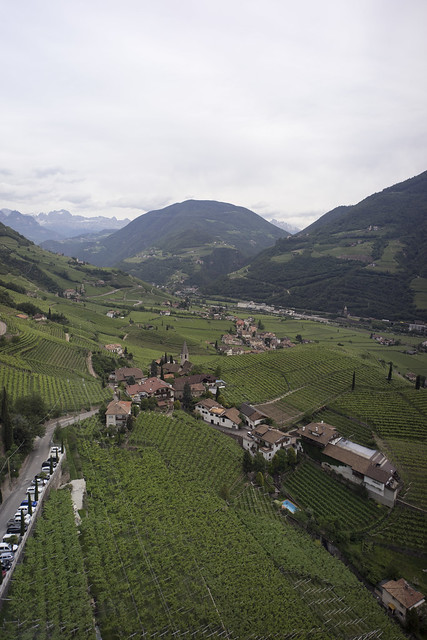
A heck of a view on the way up, for one thing.

It reached a summit and then kept on going, high across an alpine valley.

And let us off, 12 minutes after we got on and 1000 metres farther above sea level, in Oberbozen. We had found something higher, unexpected, out of sight, far above the valley.

People sat drinking beer on a patio. Hotels ringed a large open lawn. Everything looked Tyrolean. How charming. And alpine. And not at all what we had thought, when we got up that morning, that we would be seeing.

There was a church farther uphill.

We walked up to see it. It’s a striking modernist edifice, dedicated in 1991.

It has a statue outside it of its namesake: Blessed Rupert Mayer (1876–1945), a German priest who was outspoken for justice, a vocal opponent of Nazis and fascism.

I’m not sure the statue does him justice, but the building does. (Ötzi gets just ice, but Rupert Mayer gets justice.)

And the door was open.

How serendipitous.

Verona

“In fair Verona, where we lay our scene…”

Do you want a fiction based on a fiction, both more and less real than reality? Do you want a city of layers where buildings lie far below the streets, and streets have run beneath the river waters? A town of dreamlike inversions that, after all of it, is just a lovely place to sit and drink or go shopping, or listen to music?

Old Verona sits under a bend in the Adige river, smoothly triangular like an incense cone, water on the upper sides, walls no longer there across the base. Beyond the old part is more Verona, a modern Italian city not without its charm, but it’s not what you go there for.

No one is really sure just when and by whom Verona was founded, but it was there in Roman times. There’s a big Roman arena right at the biggest piazza in town. Every year you can go there to hear Verdi’s Aïda or something else. As you wander around the old town, here and there you can look down and see the Roman foundations, two or more metres down, visible through a hole left open for architectural exegesis. The city has piled stone upon stone and here we are, a metre higher per millennium.

If, instead of looking down, you look up just a bit, slightly higher than eye level, you will see, in desultory spots, a plaque on the wall with a line showing how high the waters of the Adige reached one day in 1882. After that, the river trade traffic that had been so important to the city was done away with: big banks were built in place of landings, and flood controls were put in upstream that left the river flow too low for boats.

Most people don’t come here to look at either of those things, though, it seems. They come because of a nasty tale of fatal adolescent infatuation written by an Englishman who had never been to Verona. They come to see a balcony that was built in the 1930s just to keep the illusion-besotted happy, on a house in which a young lady never lived because she never lived anywhere, and in which her family may not have lived either – if they existed at all. They come to see this fraudulent balcony on a probably fraudulent house just because of a scene in that Englishman’s play. A scene that doesn’t involve a balcony. The word balcony didn’t even exist in English then, not quite yet. The idea of balconies was a rather odd and scandalous one for the English when it was first told to them, a decade and a half after Romeo and Juliet was first performed. Here, read.

Well, people believe all sorts of strange things about Romeo and Juliet. But have a look at Act II, scene ii. Romeo starts:

But, soft! what light through yonder window breaks?
It is the east, and Juliet is the sun.

Window. Not balcony. Window. She doesn’t come out onto a balcony. There isn’t one in the text, no matter how it’s been staged so many times more recently. Put her on one if you want, but Shakespeare didn’t.

And what does Juliet first say when she speaks, thinking herself unheard?

O Romeo, Romeo! wherefore art thou Romeo?

Which means “Why are you Romeo?” She’s lamenting the fact that this desirable young man must be a member of a family that is a sworn enemy of hers. She’s not asking where Romeo is. I know that millions of people think “wherefore art thou” means “where are you,” but millions of people also come to stick love notes with bubble gum on a graffiti-covered wall in a passageway to a fake balcony that not only never existed in reality but never even existed in the play it’s supposedly from. At the very least, there should be a sign below the balcony that says “‘Wherefore’ means ‘why’.”

People do love their fantasies of Liebestod. Even Japanese literature has famous classics about love suicides. But, as the artist Jenny Holzer has written (on many surfaces), “Expiring for love is beautiful but stupid.” Especially when you’re only 13 years old.

You did know that Juliet was 13, right? It’s in the text: she turns 14 soon. Romeo’s age is not mentioned, but he’s likely in his late teens. Which would make him a child abuser and sexual predator in modern law, by the way (OK, he marries her before he beds her, but shall we get into that?). Well, whatever. He ends up dead five days after he first meets her. So does she. And, nearly four centuries later, Blue Öyster Cult writes “Don’t Fear the Reaper.”

Romeo and Juliet were together in eternity (and the tomb), but Verona continued on in Shakespeare’s mind. The anti-hero of Taming of the Shrew, Petruchio, is from Verona; perhaps he left because he was sick of all the teenage emo love death, but anyway he brings his more cynical outlook to Padua (now Padova in Italian) and meets Katherine, whom he cheats into marrying him. There’s one more play, The Two Gentlemen of Verona; its main action takes place in Venice. It’s another silly concealed-identity love comedy, and is most notable for being the play in which a dog with no lines upstages everyone else. Why not? People seem to like what’s not in the script better than what is.

But after all the flood of tourists and illusions recedes, Verona remains, sitting on top of its historical accretions. The real Verona is just a nice place to have dinner and a drink out on the street on a warm evening, the acme of charming Italian cities. Even with the occasional pop concert in the arena drowning out more local sounds while you dine at a table in a stone-paved lane three inches from where cars roll past. It’s all good. Here are some pictures. Verona in the day is pretty, and Verona at night is like a dream. One in which people don’t kill themselves for stupid reasons.

Venice

Aina and I were touring northern Italy last week. I’ll be doing word tastings with pictures for several of our stops. Venice first.

A map of Venice, in its barest outlines, looks to me like two hands grasping each other in help or contention, or two fish trying to eat each other. Below them is a third thing, a table or piece of cloth or another fish swimming past.

But most people don’t think of the map first when they think of Venice. They think of a grand illusion, the ageless fantasy of a city rising from a lagoon, of glorious palazzi on the Grand Canal, of romance and gondoliers and music and masks and carnivalesque inversions and art and novels and golden light and water, water, water.

They may think of narrow alleys and passages between buildings and a myriad of small bridges.

They may think of the innumerable wooden pilings, permanently submerged, that every building in the city rests on. They probably think of buildings sinking and pavements flooding, problems that are only going to get worse unless – and possibly even if – hands join other hands to apply technology.

People who have been to Venice in the warmer months think of people, endless throngs of people. Especially near St. Mark’s Square you almost can’t get through at times.

The city gets 18 million visitors a year. That’s an average of nearly 50,000 a day (if you assume each visits for just one day, which not all do) – and you know that it gets rather fewer in the winter months, and far too many in the summer months.

The current population of Venice, the island part (not the mainland part), is 55,000.

That’s a third of what it was at its peak, or even a century ago. There’s not much work to do other than the tourist trade there now – not so much fishing, let alone marine conquest – and even people who work in tourism may find it better to live on the mainland and rent out such property as they own in old Venice to tourists. Or sell it to hoteliers.

Venice is being invaded by tourists. Venice is being invaded by water. But Venice is there in the first place because of invasion. The Veneti people took refuge on the islands in the lagoon to escape Germanic and Hun invasions. It was a good move. The citizens formed a republic and maintained independence for a long time. Venice became a military and commercial power, aided strongly by its location – and by its grasp of how to band together to work with the surrounding sea. Finally it was conquered by Napoleon, and then became part of Austria, no wait, Napoleon’s kingdom, wait, no, back to Austria. And finally it joined the Kingdom of Italy, which later became a republic. But through all of it, it accumulated wealth and culture and art.

Many of the bridges between Venice’s 118 islands owe their presence to the Austrians, who preferred to go around on horseback rather than use boats. I don’t think you can ride horses around Venice now. But you can spend all day in Venice without getting into a boat, although boats will still get you from A to B quicker over any real distance (not the gondolas, though – those are slow and expensive and for show; getting places requires motors).

And Venice is most archetypally a city of canals – when another city is called “the Venice of [wherever]” (have a look at how many cities have been called “the Venice of the North”), it’s not because it’s built on wooden pilings, not because it’s pretty, not because it’s sinking, not because it’s beset with impossible throngs of tourists. It’s because it has canals.

The irony of it. Canals are usually things dug into land, interruptions in the prevailing earth. In Venice, the water was always there; the land was built up between it, reinforcing marshy islands by dredging earth from below the water, pounding wooden pilings in to hold up the buildings. Hands joining hands, working together and taking together. Where there were fish, there are humans. The grand illusion and ageless fantasy – still there…

Nazgûl

A person who is severely prescriptive in matters of English usage is often called a “grammar Nazi.” I must say I dislike this term. Real-life fascists and racists do not amuse me, and I am resistant to trivializing them. We wouldn’t think it reasonable to call a person a “grammar rapist,” after all, would we?

Various replacements have been suggested, among which I like “grammar numpty” – a numpty being a stupid person (it’s a Britishism). But that’s not quite optimal either; ‘stupid’ is arguably different from ‘obnoxiously purblind’. I find myself more partial to “grammar Nazgûl” (you can leave off the circumflex on the u if you want).

If you’re a Tolkien (Lord of the Rings) fan, I don’t need to tell you what a Nazgûl is, so off you go. You can spend the next few minutes writing a piece explaining something like how Gollum would not fall into lava with the ring; lava, being molten rock, is still so dense that a person falling on it would fall onto it, not into it, and would immediately combust on the surface (and the ring would of course melt). Facts, after all.

For the rest of you: ring? Yes, ring. Sauron, the great sorceror, forged rings of power, which gave their wearers great powers but gave him greater powers over them, for he had the one ring that had power over all of them, a ring that bore this inscription:

Ash nazg durbatulûk, ash nazg gimbatul,
Ash nazg thrakatulûk agh burzum-ishi krimpatul.

Which means

One ring to rule them all, one ring to find them,
One ring to bring them all and in the darkness bind them.

It’s a tidy little exercise in morphology – frankly, I’m surprised it’s not more often used in introductory linguistics classes. You can see readily enough that ash nazg must mean ‘one ring’, that a verb root plus –atul means the verb is done to ‘them’ and a verb root plus –atulûk means it is done to ‘them all’ (meaning –ûk must mean ‘all’, more or less). Other details that are known, though not inevitable from the text, are that burzum means ‘darkness’ and ishi is a postposition, and agh means ‘and’, and in –atul the –at is a verbal ending (meaning something like ‘to’) and –ul means ‘them’. Also, ash means ‘one’ and nazg means ‘ring’, not vice-versa (nothing in the sample itself makes that necessarily so).

So is nazgûl ‘ring them’? No, because of the difference between ul and ûl – the circumflex means it’s a long vowel (literally: hold it longer, just like you hold the /k/ in bookkeeper longer than the one in bookie). That makes it a different sound. Also, nazg isn’t a verb. Nazgûl is from nazg plus gûl, which means ‘wraith’. What’s a wraith? Kind of like a ghoul. Hmm.

Well, it is a constructed language. ‘Bind’ uses the root krimp, like English crimp, for instance. Whether Nazi influenced Tolkien’s invention of nazg here I don’t know (the Nazis did like Wagner’s Ring Cycle), but he was writing this in the 1940s.

What is a Nazgûl, then? A ring-wraith, yes, but what are those? Men who took up rings of power forged by Sauron, came under Sauron’s control, and, after Sauron lost the One Ring, were tasked with seeking it out mercilessly. If anyone was carrying it, and especially if anyone was wearing it, they could sense it, and they would swoop down with the aim of destroying the wearer and restoring the ring to its rightful condition. They descended as if from nowhere, uttering unbearable sounds.

I’m not saying that the parallel is exact. But consider: A person learns a set of tidy rules about English that give a sense of knowledge and control. They believe that in enforcing them they are serving the betterment of English and their own expression, but the rules become ends in themselves, and their enforcement an exercise in condemnation and destruction. They dedicate themselves to seeking out transgressions. A hapless person uses a bit of grammar that falls within their set of magical rules – or, rather, strays against it – and they swoop in as if from nowhere, making sounds terrible to the hearer.

Does that seem a bit of an extreme caricature? Not all that extreme. Look, I was one in my younger days, so I have some idea.

That does mean that, unlike a Nazgûl, one may always stop being one. Nonetheless grammar Nazgûl is at least as viable as any other similar term. And it has a good ring to it.

conversate, incent

Hmm. I wonder what will incentivize me to conversate today.

What?

Oh.

(Clears throat.) Hmm. I wonder what will incent me to converse today.

Huh?

(Sigh)

Would you prefer I orate? Would that make you ovate? Would you be less disorientated? Or disoriented?

Look, I’m not sure why you’re fixated on something that’s not fixed. I will be happy to notate these usages if you will note them.

Conversate is, according to many people, “not a word.” Of course that’s not true; it’s a distinct lexical item, established in usage, with a clear meaning. But it’s generally dispreferred in many a person’s idea of the prestige standard version of English. It’s not new, though of course age doesn’t automatically make a word part of the prestige standard (ain’t is very old indeed); it’s attested since 1811, mainly in American colloquial usage. The Oxford English Dictionary notes that it is “In later use associated esp. with African-American usage.”

But the verb converse has been around far longer. And why have that extra –ate when you don’t need it, right? You’d think that logic would incent people to accept incent. Instead, many get incensed by it. “Give incentive to!” some insist. Others allow incentivize. But before the mid-1800s, there was no verb form for incentive, and between the 1840s and the 1960s the only available verb for it was incent. Finally someone added those extra syllables to make incentivize – so much more acceptable, right?

Well, yes, incent is a backformation from incentive. But if you want to edit it out, remember that edit is a backformation from editor. And if, like some excitable word-warriors, you would like to get a syringe and euthanize anyone who uses incent, you might pause to consider that syringe is backformed from the plural syringes – the original singular is syrinx – and euthanize is backformed from euthanasia. And orate is backformed from oration, and ovate is from ovation, and yet, although those two words have similar ages and traditions of use (both tracing back to the 1600s), I’ll bet orate sounds more acceptable to you than ovate does (though, to be fair, some people dislike orate too – not so much now as a century ago, however).

And then of course there are fix and fixate, and note and notate, which have different meanings. And the verbs orient and orientate, which mean exactly the same thing except one says you’re American or Canadian and the other says you’re from Britain or Australia or New Zealand or…

Meanwhile, incent is generally associated with business-speak, that buzzword-laden argot that seems far too impressed with itself and not nearly thoughtful enough. And yet it’s short and effective. Like orient.

Conversate, of course, is the converse: longer than it needs to be. Just like orientate. But it’s not really about length, is it. Not when incent is just as ardently dispreferred. When people inveigh against “abuses” and “barbarisms,” if you listen for a bit, you find that what exercises them is often that they attribute the words to people who don’t know how stupid they sound. Who think too highly of themselves. Who lack educational status and don’t know their place. Who are, in short, uppity.

Hmm. Almost makes you wonder if the word-peevers are compensing for something.

Say what?

Oh. Yeah. The tidy verb compense, directly formed from Latin compensare, was current from the 1300s to the 1700s but, starting in the 1600s, came to be displaced by compensateCompense can’t be used as a verb anymore. What a botheration.

We can’t magically instantly change which words are associated with which variety of English, of course, and we are not obliged – or even obligated – to use words that we dislike if words we like are available. Skillful writers should be aware of how their audiences will receive and react to the words they choose. But we should stop to consider how we react to words we dislike, and ask ourselves why.

Well, nice conversating with you. So to speak.