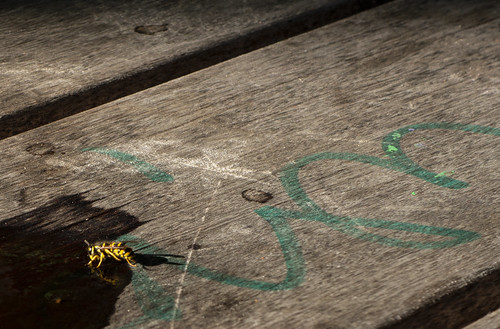
derf

Because yet again an article talking about different generations skipped straight from the Baby Boomers to the Millennials as if Generation X didn’t even exist, I decided to read, at last, Douglas Coupland’s Generation X. I picked up a copy of the 25th Anniversary Edition, because kill me now, how was my youth a quarter century ago. And on page 25 I saw a word that really caught my attention.

Derf.

Actually, I saw a derived form of derf, but I’ll get to that.

Don’t mistake derf for derp. The word derp (suggesting stupidity) is much more recent – really only current since after the turn of the millennium. Derf has nothing to do with it. It also has nothing to do with dearth (which is from dear+th like width is from wide+th and sloth is from slow+th) or deaf.

Derf is not much used anymore as such, but it shows up in Oxford in two basic versions, with several derivative forms.

Derf the noun is (per Oxford) “trouble, tribulation, hurt.” It comes from deorfan “labour.”

Derf the adjective and adverb is either “bold, daring, courageous, brave” or “in a bad sense: bold, audacious, daringly wicked.” It can also mean “strong, sturdy, stout” or “vigorous, forcible, violent” or “painful, grievous; terrible, dreadful; cruel” or “troublesome, hard, difficult” or “grievously, terribly.” It apparently comes from Old Norse djarfr “bold, daring, audacious, impudent.”

So. Imagine the sound a superhero or supervillain makes when punching through a superobstacle or hitting the turf: DERF! That should make it stick in the mind. To put it another way, why say “This is tough” when you can really be forceful and say “This is derf!”

From derf and derf we get a few other words, and they are too good not to include.

There’s derfful, which looks wonderful but is quite the opposite – “troublous, hurtful” (yes, Oxford uses “troublous” in the derfinition).

There’s derfly, which Word insists should be deerfly though I think it’s more like the end of alderfly. It comes in adjective and adverb flavours. The adjective means “grievous, terrible, dreadful” and the adverb means “boldly; fiercely” or “forcibly, violently” or “quickly, promptly” or “grievously, terribly.” In other words, derfly is used in all the places we used wicked when I was in high school.

There’s derfness, which is not as in “Your Derfness” and also has nothing to do with deafness; it means “trouble, hardship” and “boldness, audacity.”

There’s derfship, which means “audacity.”

And there’s also a verb derve, derived not from derf but from the same deorfian that gave us the noun derf; it means “labour” or “trouble, grieve, hurt, afflict, molest.” (But who has deserved to be derved?)

There are also other derivatives not listed in Oxford that we can form, of course. For instance, just as I can say I’m hatted or jacketed or even re-beered, or for that matter puced or happied, without implying the existence of hat, jacket, beer, puce, or happy as verbs because -ed can be used to form adjectives from nouns and other adjectives, I can be derfed. Which means I can be endowed or afflicted with boldness, force, courage, audacity, trouble, or any of those other qualities that the adjective or noun derf implies. Or I can be described as having those, just as I might be puced if someone says “Whoa, dude, you look puce.” I could also be said to be bepuced, I suppose, and if no one has said I look puce, then I am un-puced.

Of course, since no one (except Gen Xers and Douglas Coupland, who is actually a late Boomer) talks about Generation X practically at all, and when they ever have it’s always about how we’re the “meh” generation (because that’s our reaction to the self-derfed Boomers) and “slackers” (because we don’t want to be the red shirts in their Enterprise expeditions), we are chronically un-derfed.

Which is the word I saw in Generation X.

The quote from Generation X is (ironically?) from a description of a Boomer character: “like an underfed Chihuahua baring its teeny fangs and waiting to have its face kicked in.”

What.

What.

You think it’s under-fed?

Well.

This book is the song of my generation and I will be so derf as to read it however I want.

chthononosology

Imagine if someone were to show you a map of diseases. Every disease, splayed out across the globe, signified by colour and shaded for concentration. All the ways of getting sick, and the ways and places they’re spreading. You look at it and you react, trying to grasp it: “Ch—… Th—… O no no… so…”

All the ways to zero in on sickness. All the repeats, and the confusion, and the things you’re not sure you can say. The down-and-dirty, down in the dirt and spread out over the earth. Here’s your chance to geek out… or Greek out. Every map of a pandemic, an epidemic, or an academic exercise in the glory of sickness transiting the monde, it’s all chthononosology.

Just look at those letters: c g h h l n n o o o o o s t y. So many o’s (five of them, like the number of zeros in ten myriads). Doubled h, then (with the chimneys cut off) doubled n. And ending, logically, with the logy of words and science.

It’s all from Greek, of course: χθών khthón ‘earth’ (as in the surface of the planet, or the dirt that makes it) and νόσος nosos ‘disease’ and λόγος logos ‘word, discourse’. Talking about the diseases of the surface of the earth, which means all over the world. We know these roots: every -logy, logically; a few nos- words such as nosocomial (which refers to diseases that have been acquired in a hospital – the kind that make hospitals bright hot spots on disease maps); and chthonic, having to do with the ground, the earth, the dirt, the surface of the planet or something burrowed beneath it… perhaps something deep and dark and dirty and evil…

This word was put together as such by someone probably in England in the later 1800s. It shows up in the New Sydenham Society’s Lexicon of Medicine and the Allied Sciences of 1881. Honestly, it probably could have been geonosology or nosogeography, but it wasn’t and that’s just the way it is. And fair enough: disease calls for something more deep, dark, dirty, and hard to say; even a map of diseases looks like the tracings of an ancient earth spirit, and experiencing an actual affliction may lead to an unusual increase in utterances of “ch” (the hard kind) and “th” and especially “ooooo.” And now, when someone shows you yet another map of worldly unwellness, you have a word to characterize it.

theriodic

It is an event as yet periodic, though not infrequent, that the weather turns… theriodic. There is a tempest to suit the temperature of the times and tides. It may be Hobbesian – nasty, brutish, and short – and it may be scenic, but it is vicious while it lasts.

This afternoon, for example, I was seated working at a table under an expansive overhang, several metres from the edge, and when the foretold rain began I was not disturbed. And then there was a bit of breeze from behind, causing a minor mist onto my screen, so I closed the computer and put it away in my backpack for the time being and resolved to wait out the weather. And then, within a span of seconds, the patio became a scene from a sea storm: the wind increased to a gale force, hosing down the environs, blowing folding metal chairs and signs and nearly tipping heavy tables, and chasing me and my backpack inside, where I watched with moistened amusement. Ten minutes later it abated, but there was no dry place left to sit. It was as though a herd of water buffalo – by which I mean buffalo made of water – had stampeded through.

Meanwhile, in Death Valley, temperatures hit a record high. But at least it was dry. Nonetheless, that weather too is, in its way, theriodic.

Theriodic is not a word exclusively or even mainly for weather, though it certainly serves the turn. It’s more often medical in use when it’s used at all, and in that context it means ‘malignant’ or, I suppose, ‘fulminating’. The root gives you the clue: theriodic is taken from Greek θηριωδία theriodia, which means ‘brutality’ or ‘savagery’ and in turn comes from θηρίον therion ‘wild beast’ (though it has nothing to do with the lion nor, on the other hand, with Charlize Theron). That same ther- shows up here and there, like in theriomorph and anoplothere.

So, in other words, what is theriodic is like a wild animal – whether it be one that stalks you and abruptly craunches and devours you or one that by mischance has gotten trapped in a minivan and tears the interior to ribbons and bits – and when faced with theriodic weather or other affliction, it is best not to dither, lest the next threnody be for you (or your electronic devices).

barge

Look at the large barge, sarge! Who’s in charge of the large barge? And what’s that sparged on its marge? Is that parge? Is it going to Canada Cement Lafarge?

Barges get a bad rep, but flat-bottomed boats make the world go ’round. Or anyway they make stuff go ’round the world. It’s known that to succeed in logistics you have to be a bit anal-retentive, but for many times and places (and sometimes still) you also have had to be canal-retentive. Many things are moved more smoothly over water than over land, especially because you can fit much bigger loads on a floating vessel than on anything that has to navigate road or rail. Take as example the construction materials and equipment I see cruising into the eastern entrance to Toronto Harbour nearly every early evening.

DSC07816_640

Should I say “barging into”? Well, it is a barge, being pushed by a… hmm, it’s not tugging, so it’s not a tugboat… well, a pusher boat, OK? But it’s where it’s supposed to be. Not like some personal sport watercraft ripping into the picture.

Does that seem fair? That if I’m taking a picture of a barge that I fully expected to be at that place at that time, and a Sea-Doo or whatever tears across in front of it, the interloper is said to be “barging in” while the barge is being all polite and invited? Why does a barjaun “barge on,” anyway?

Well, before there was barging in there was barging around and barging along and barging through, and barging into or barging against someone or something, and the sense was of bumping, of being big and heavy and inertious and unbrakeable just like a fully laden barge. Perhaps the kind of cad or bounder that a less bumptious person wouldn’t want to touch with a bargepole… which, by the way, is literally a pole used for keeping smaller canal barges from touching other barges or the shore or whatever (and occasionally for propelling barges, though really human musclepower is mostly not up to the task).

Where did this word barge come from? French, of course, like the other words ending in -arge, and French got all of them from Latin. But this ­-arge has a lot of cargo of many sorts from various origins: while large comes from Latin larga, and marge (as in margin) from margo, charge comes from carricare (cargo is descended from that too, but charge didn’t come by way of cargo), and sarge is short for sergeant, which French made from Latin servientem – that g just kinda… pushed its way in (it’s not the only time a “w” sound has been changed to or from a “g” sound). And while sparge comes from spargo, parge comes from French porjeter, from Latin porro plus jactare. There’s also litharge, via Latin lithargyrus from for ‘silver stone’, and targe from Latin targa, from a Germanic word – look them up if you’re curious. The name Marge takes us back to Latin Margarita, which in turn came from farther east. As for Lafarge, the name of a large cement company that does have a small facility in Toronto’s docklands, well, that’s a variant of La Forge, and forge traces to fabrica, because, well, why the heck not.

As to barge, it came by way of barga from late Latin barca (also the source of barque but not of bark), from earlier Latin baris, ultimately by way of Greek and Coptic from Egyptian (you can see the hieroglyphics on Wiktionary). All the way back, it’s all words for boats of various kinds. And there are still various kinds of vessels called barge, including ones that can be wind- or self-propelled, even big glamour boats for royalty rowed by peons. But mainly, these days, a barge is a big floating cargo platform. And regardless of where it comes from, when it’s loaded up, it goes where it’s going and will not be quickly diverted.

bedog

To bedog or not to bedog? Or to be a bedog?

Not to be doggèd about it, but this is a word that seems to shift to suit – you or it, we’re not sure. It’s sort of like a big dog that you can lie on – or that can lie on you. Or that can follow you, or you can follow it. Or maybe you are the dog, and the dog is you.

Here’s what this is all about. The first time I can think of seeing the word bedog, it was in a sense that (I now know) is not at all the dictionary sense, and I can tell you it did not lie easy on me, or I on it. It was in Frank Herbert’s sci-fi novel The Dosadi Experiment, wherein a bedog is a bed that’s a dog, or a dog that’s a bed. It’s a big furry critter than you can sleep on and that is docile and very happy with the arrangement:

McKie stretched his arms high over his head, twisted his blocky torso. The bedog rippled with pleasure at his movements. He whistled softly and suffered the kindling of morning light as the apartment’s window controls responded. A yawn stretched his mouth. He slid from the bedog and padded across to the window.

Later,

Jedrik moved softly with her own preparations, straightened the bedog and caressed its resilient surface.

Of course, this means that this bedog is pronounced like “bed dog” but with only one “d,” and I am not comfortable with that. Even if you degeminate the [dd] you should, in English orthography, write it as dd (which we would usually say as just “d” anyway) because otherwise the e becomes “long.”

Which, in the real-world version, it is. Because bedog is really the verb dog (formed from the noun dog, of course) plus the prefix be, as in befall, bemoan, benight, bewitch, bedaub, become, believe, behave (yes, of course behave is beplus have; it’s just travelled a long way since the joining), and many others. But that be can be many things, as it happens, as is evidenced by the different definitions of bedog. The Oxford English Dictionary gives the options as “To call ‘dog’” (so “I bedogged him” means ‘I called him a dog’) and “To follow about like a dog, to dog” (which also means that to bedog can be to be doggèd) with the addition of bedogged meaning “Become like a dog.” Wiktionary, for its parts, gives us “to refer to or treat like a dog; (by extension) to follow like a dog, harass, torment; bully” and “to become or behave as a dog.” And Webster’s Third New International Dictionary is succinct but in line with Oxford: “to call (a person) a dog” (meaning you can’t bedog a dog, because that dog do be a dog and if you do be dog you do not be bedogged) and “dog vt” (i.e., the transitive verb dog, as opposed to “dog, VT,” which is a dog in Vermont).

So. To debog this:  You can bedog someone else by calling them a dog or by dogging them (which means acting like a dog in their direction, generally), or, supposedly, you can bedog and just, you know, be a dog. (However, the quotations in Wiktionary in support of that latter sense do not support it: “That envy, malice, and hatred bedogged his steps” is clearly the first sense, and “So they went to sleep like a pair of chain gangers, and bedogged if during the night Rose didn’t get up and start for the bathroom, and down she went” is equally clearly using bedogged like doggone or any less canine and less polite turn of speech involving g with b and/or d.)

And can you be bedogged by a dog? Seems redundant, dunnit. But can you be bedogged by a dog star? Hmm, is that serious? Ha, it’s Sirius. We are in the dog days, and the heat is both canine and incandescent. So if you don’t want to be bedogged, beware of updog.

archetope

Where are you from?

What is the landscape of your childhood imagination, the place where you learned placeness, the paths and houses and landscapes that taught you the lines and limits of being somewhere and going somewhere? When you imagined other places, what is the mental modelling clay you used? What are your archetopes?

Now that you have grown, you have seen much more of the world, many places that are many different ways, but as you travelled, each new-to-you place had things about it that surprised you in how they differed from what you were used to. Piccadilly Circus was smaller than you expected, Michigan’s Upper Peninsula was bigger, Manhattan was more homey, Tel Aviv was more modern, Quebec was older, San Francisco seemed so closed in, Mexico City seemed so vast, Ireland had endless stone walls, Boston had brick sidewalks, New Zealand had one-lane bridges; lanes didn’t go the way you thought they would, and buildings were used differently, and hills had odd shapes, and roads took odd routes up them, and houses welcomed you different ways and smelled different from the houses you knew when you were small. And these are all wonderful discoveries, and as you live you build your knowledge of somewhereness in the world – of ubiety – as surely as you build your understanding of people and things. Every mental ramification is exciting. But all those new branches are grown on the same roots, of where you learned what it was to be somewhere, to have a world around you with places to go and to be. They are all built on and with your archetopes.

I live in Toronto; I have lived here for nearly a quarter of a century now. I am at home, I know the geography, the shape of the city, the wheres and whats of it, and have seen more of it than many people who have lived nowhere else. But it’s not where I’m from. It’s not where I learned how places are connected, or what going away and coming home feels like. It’s not where I mapped my desires and hopes over hills and valleys, where I draped my dreams on peaks and plains. It’s not steeped in the mythos of my childhood.

If I go with my wife through the east side of Toronto, past certain intersections and into certain parks, we pass the places where her childhood and youth happened: this is where her track team ran, that is where she broke her arm, here is the arena she learned to skate in, there is the McDonald’s she worked in. For her it is blood, running in her veins; for me it is water, like a stream I am stepping into and can step out of. If we go to Alberta, to Calgary and Banff and the Bow Valley in between, it is the converse: though my family lived in many different houses, everything I see is where I imagined a million things, where I extrapolated the lands of books and movies and televisions shows from, where I ran and sat and read and sang and made things and broke things and imagined what I would be in fifty years. And for my wife it is scenery and a place to visit.

These are our archetopes, our original places. You know archetype, I’m sure; it is from Greek ἀρχή arkhé ‘beginning, origin’ and τῠ́πος tupos ‘type, sort, impression’. Archetope has the same arche, but in place of type is tope, as in biotope and chronotope: ‘place’, from Greek τόπος topos.

There is an important distinction to be made: whereas archetypes are, per Jung, stored deep in our collective unconscious – the operating-system software we are born with – and they shape stories and understandings in generally the same ways wherever there are humans, archetopes have a more individual quality. Certainly we may be born with ideas of shapes of places, and narratives of going through places, but each of us learns geography in a way that anchors certain places deep in our imaginations and helps shape even the world of our dreams. We develop our archetopes also by travelling as children, and if we live in many places in our early years we build our archetopes from all of them. But each of us has navigated the places of the world differently, has learned differently what to feel about certain houses and roads, has come to different encounters with the wild parts.

Have you seen or heard this word archetope before? Perhaps not. You may have if you’ve read the revisionist physics of one James Carter, but he uses it differently, to name an atom’s most “archetypal isotope.” But his models of physics are, shall we say, not widely adopted; I don’t mind ignoring him. This word is much more needed for a facet of lived being that I have always felt existed but never had a word for. And now I do, and so do you. Yes, it’s a new old word, but everything is new at some time or another.

selenotropic

This word seems so serene and tropical – and it is, in its way. It is from Classical Greek σελήνη seléné ‘moon’ (also the name of the moon goddess: Σελήνη) and τροπος tropos ‘turning’, and it means ‘turning to the moon’. It is used technically of plants that follow the cold mottled white orb of the night in its celestial transit, but all humans (and not just on tropical nights) – and especially all poets – do it too.

The noun from which selenotropic is derived, selenotropism, was confected by M.C. Musset in 1883 following an experiment (read his short summary) in which he raised plants in darkness and then exposed them to moonlight to see if they would follow it, and they did.

I’ve written a poem on this theme. While you read it, why not listen to Claude Débussy playing his own Clair de Lune, recorded on piano roll, inspired by Paul Verlaine’s poem of the same name?

You can read Verlaine’s poem in the description on the video, if you click through to YouTube. Here is mine:

selenotropic

Did you turn to the moon?

After sprouting in shadow,
after you grew in darkness,
grew slender, long, sun-starved,
grew leaves and tendrils knowing
no warmth, no joy, no mist,
no riot of birds, no bee-kiss,
nothing to trample or eat you,
nothing to touch or greet you,

after one warm hand took you,
after your captor exposed you,
exposed you to glass, to sky,
exposed you to whispers, to watching
your stems, your terminal buds,
your eyes, your fingers of blood
wanting the sun, the rain,
wanting the wings, the pain,

did you pull at your roots,
did you lean to see
what this lover was,
what this almost-light—
not sun, not day, not bulb,
not flame, not lightning flash—
wanted, running and sinking,
wanted behind the mountain?

Did you, in all your paleness,
did you, in never-green,
in your concavities,
in your internal cause,
know then that you were seen,
know then that you were named,
and glow with unowned light,
and grow, and shine, and fade?

Did you turn to the moon?

fellowred

What would we call a model for society that considered its most important aspect to be care and compassion for others rather than the opportunity to take as much as possible for oneself? A model that started with the genuine assumption that it’s worth helping and taking care of each other, and that by making sure to contribute well to our common good we will truly raise the tide and lift all boats, without worrying about making sure that the ones we think don’t deserve it don’t get lifted, and rather than thinking that if a few people can build yachts with decks high above the rest the tide will follow?

Does this sound like something reds and fellow-travellers would say? Well, it is what we can call fellowred, but it has nothing in specific to do with communism. It’s just an attitude of mutual respect, friendship, comity…

I mean, we ought to have a more common word than fellowred for just this kind of thing, and we do, but we don’t, because the sense of that word has shifted: for many people, fellowship has taken on a distinct religious, especially Christian (and perhaps in particular Evangelical), air; in academic contexts, it has a particularly pecuniary air; in some other contexts, it has a Tolkienian air, as in The Fellowship of the Ring. But in general it gives an feeling of a coterie, a chosen few, rather than a broader sense of an attitude or society.

We also have the word companionship, but these days that mainly seems to refer to a Platonic (or not) relationship with a specific other person with the end of not being lonely. And we have comradeship, which is not bad, but may imply tighter ties that bind.

So. There’s fellowred, which is fellow plus red, not as in the colour but as in kindred (and hatred): an old suffix seldom seen now, forming nouns of condition or quality. Fellowred hasn’t been used much in the past half millennium, but, then, we haven’t always focused as much on what it names as we should have, either.

By the way, in spite of collocations such as fellow man and common uses to mean ‘guy’, ‘dude’, ‘bloke’, etc., fellow is not originally or intrinsically masculine. It comes from an old Scandinavian root meaning ‘partner, business associate, companion, comrade, spouse, collaborator, ally’, and that’s what it came into English meaning and still, in many uses, means. So although it has long had some specifically masculine uses, there remain many senses that haven’t become gender-specific (the academic sense comes right to mind again).

And so we can, if we want, talk of doing things not for profit or for the team or for spite or for #winning, but for fellowred. Because, to lightly paraphrase Kurt Vonnegut, there’s only one rule I know of: you’ve got to be kind.

subsannate

When you feel you’re slipping into sub-sanity at the basic buffoonery, unsubstantiated transubstantiation of pumpkins into pantocrators (apocolocyntosis), and far too much of the tail wagging the dog, sometimes the only riposte is to be waggish: to deride the pale rider, to dump Humpty, to subsannate the saboteurs.

I promise you I am not taking the piss (so to speak): I have not made this word up. But you won’t find it often in modern texts; it has slipped into desuetude. Which is a pity, because we still have use for it – or at least for the act it names. But come, follow me as I trace this carbuncle up from the mines of ancient time.

In Ancient Greek, there was a word σαίνειν sainein, meaning ‘wag the tail’ or, figuratively, ‘fawn [over someone]’. Be a happy puppy for a person, in other words. We don’t really know where this word came from, but I’m sure it was nice, wherever it was.

Anyway, σαίνειν was adapted into the noun σάννας sannas, which meant ‘clown’ or ‘buffoon’ (I guess they quickly smoked out the sycophants). That noun in turn got grabbed into Latin as sanna to mean ‘mocking grimace’ – the sort of thing I usually call ‘a sneer’, though I suppose they may have done it differently at the time; different cultures have different mocking faces.

That Latin noun then, with the addition of sub (‘under’), got converted to the verb subsannare, ‘sneer, mock, deride’. And from that came a whole set of English words: not just subsannate but subsannation, subsannator, and – in at least one text – a more lace-at-the-throat version of the verb: subsanne.

And, yes, subsannate means ‘mock, deride’ – in particular with an implication of a mean face: as Thomas Blount’s 1656 dictionary Glossographia puts it, “to scorn or mock with bending the Brows, or snuffing up the nose.”

Oh, with BeNdiNg tHe bRoWs or snUfFinG uP tHe NoSe. Huh. Funny way you have of expressing mockery, mister Blount. Well, you do you.

And to all the other Dumpty Pumpkins out there: I subsannate you too. And not just in your general direction, either.

muskellunge

A muskellunge walks into a bar. The bartender says, “Why the long face?” The muskie says “Because you guys messed up my name!” The bartender ducks below the counter because it’s about to get ugly.

Some people have heard of a muskellunge, or at least have heard of it by the name muskie. Others have not, or at least not until they had a muskie lunge at them. Or more likely read a story about someone who had a muskellunge lunge at them.

Muskellunge do lunge muscularly! They’re ambush predators. But they rarely attack people. Not never, but not often. They prefer smaller things: muskrats, rats, frogs, ducks, and other fish.

Oh, yes, a muskellunge is a fish. It’s a popular sport fish, owing to the fact that they’re big enough to do some damage: typically two to four feet long (in 2000, someone caught one weighing more than 60 pounds – nearly 28 kilograms – in Georgian Bay). They live mostly in the Great Lakes area of North America, though they have been introduced to some other parts of the continent for the entertainment of the rod-and-reel set.

A muskie is like a northern pike – a big, ugly one. In fact, that’s how it got its name (nothing to do with lunging at muskrats). In English we now say the name as three syllables (or two, if you just say muskie), but it used to be four; we got it from French masque allongé, which means ‘long face’ (see joke above). But…

masque allongé is an eggcorn, like sparrowgrass for asparagus: it’s a reconstrual of a word as something made of more recognizable bits. The word entered French as manskinongé. It came from Ojibwe ma:škino:še: (also spelled maashkinoozhe), from ma:š ‘ugly’ and kino:še:northern pike’.

Apparently the dark bodies with light markings that real northern pike have are prettier than the silver, brown, or green bodies with stripes and spots that muskellunge present. But I wouldn’t say so in front of one of them.