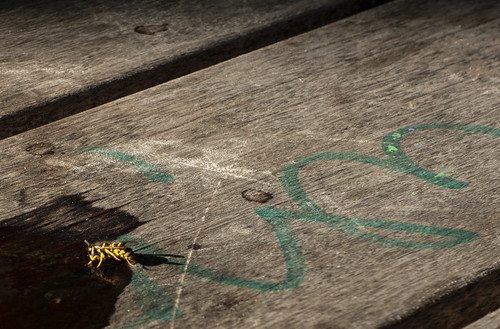
perissology

A principle often elucidated, and famously so by such paper deities of prose styling as Strunk and White and George Orwell, is that in any circumstance where the total word count of an expression may be surplus to requirement, it is best to strive to diminish the quantity of lexemes so as to achieve a cogent, coherent, cohesive conciseness. This is to say, in other words, and to cut the long short: perish perissology.

Perish perissology! What is this judgment of perissology, this hard choice between the lush love of words and the militant wisdom of brevity? Is this the phrase that launched a thousand cuts?

Well… yes. Perissology is also known as garrulousness, verbal diarrhea, prolixity, verbosity… To be fair, though, it is focused more particularly on the phrase level: saying “in spite of the fact that” in place of “although,” or “at this point in time” in place of “now,” or “when everything is considered” or “in the final analysis” or “at the end of the day” in place of, hmm, nothing at all, really.

Editors, of course (“of course”! Now there’s a phrase that can often be left out), are possessed of perisscopes to spot these and deal mercilessly with them. Yes, perisscopes is a word I just made up, but perissology does have the same peri as in periscope: it’s Greek περί ‘round about’ derived into περισσός (perissos) ‘superfluous, redundant’ plus, of course (oh, allow me my twitches), the ology that comes from λόγος (logos) ‘word’. So it means ‘superfluous speech’ or ‘roundabout words’.

Whichdoes actually have a Latin counterpart, come to think of it: circumlocution. That isn’t used in exactly the same sense as perissology these days, but there’s plenty of overlap.

So, yes, perish perissology. But it doesn’t automatically follow from that that, as Orwell wrote, “If it is possible to cut a word out, always cut it out” (and as has been pointed out, that dictum doesn’t strictly heed itself); there are some cases where adding a few extra words will help the meaning to be clearer and require less effort in the reading. And while “Omit needless words” seems almost trivially true, it leaves the judgement of “needless” up to the writer or editor. Should I konmari the prose, and cut a word out if it doesn’t give me a spark of joy? But what if I’m paid by the word and every extra dime I get is another spark of joy? Or what if I just love frolicking in a lush word garden? And how short could some classic books become if the trimming were overenthusiastic? (Proust: “I dipped a madeleine into my tea and it reminded me of my whole life. The end.”)

Of course (eeps) we don’t mean that you should remove words that add enjoyment and flavour, do we. Perissology is use of words that really don’t add a damn thing: not insight, not clarity, not ease of reading, not enjoyment. So “perish perissology” means “don’t be tedious.” This doesn’t resolve the issue universally, however; different people find different things tedious. So how about this: Know your audience and try not to waste their time.

And, after all is said and done, if you just wanted that last sentence, without all the information in between, well… I guess you’re not my audience. Heh heh.

Pronunciation tip: German philosophers

For my latest pronunciation tip, I’m focusing on something that has given me some issues over the years: the names of German philosophers. One can’t grow up in Canada without seeing their names just all over the place, of course, and yet no one seems to know how to say many of them. So I called in some help. Now you too can find out the German way to say the names of Gottfried Wilhelm (von) Leibniz, Immanuel Kant, Johann Gottlieb Fichte, Friedrich Wilhelm Joseph Schelling, Georg Wilhelm Friedrich Hegel, Johann Christian Friedrich Hölderlin, Karl Wilhelm Friedrich (von) Schlegel, Friedrich Heinrich Jacobi, Friedrich Daniel Ernst Schleiermacher, Arthur Schopenhauer, Ludwig Andreas von Feuerbach, Jakob Friedrich Fries, Wilhelm Dilthey, Ernst Alfred Cassirer, Friedrich Wilhelm Nietzsche, Friedrich Ludwig Gottlob Frege, Ludwig Josef Johann Wittgenstein, Edmund Gustav Albrecht Husserl, Karl Theodor Jaspers, Martin Heidegger, Hannah Arendt, and Jürgen Habermas. Sing along, now!

satiety

Have you, after this social season, attained satiety with society? Have you had your fill? Have you had enough? Have you had so much that you are starting to satiety things about it?

Wait. What, now?

The pronunciation of satiety is a bit of… a blivet, I guess you could say, in Kurt Vonnegut’s sense of “ten pounds of shit in a five-pound sack.” Since everyone who reads Sesquiotica is painfully well educated or at least is quite lexically attentive, you all know that satiety is the noun for the state of being satiated. And there is general agreement on how to say satiated: although a few people might be heard saying it like “say tee ate id,” it’s well enough established and accepted that it’s like “say she ate it” only with “id” instead of “it.” But that fact just causes mischief when we turn to satiety.

I should give a bit of an appetizer here about the origins of this word. The English word has, as the OED puts it, multiple origins: “Partly a borrowing from French. Partly a borrowing from Latin.” The French source, satieté, came from the Latin source, satietas, of course, but the point is that English wasn’t fully satisfied with what it got from French and reached past it to Latin to get some more. And it just happens that when it first came to English from French, it reflected the phonological derivations current at the time: we spelled it with a c as in sacietye. In other words, it sounded like “society.”

Indeed, it kept sounding like that well into the early 1800s. But by that time the spelling had long since been updated to reflect its glorious Latin origins, and, as has often happened, pronunciation eventually followed spelling, and so it came to be said with a /t/ in place of the /s/: “sa tie a tee.”

Except, of course, for those of us who think first of satiated. I do not recall if I ever earnestly thought that “say shitty” was the proper pronunciation of satiety, but I do know I’ve long been aware of it as the pronunciation one might expect by analogy with satiated. And now I have confirmation that I am not alone in this. I was watching a History Channel documentary on YouTube this evening and the narrator pronounced it exactly that way (and yes, he was definitely saying satiety).

So what we have with this word now is a feast and a half. There’s one way you’re supposed to say it, but there are other ways you could say it, at least one of which seems more logical to many people. And you have multiple options for wordplay too.

And, for that matter, there are multiple shades of sense. These days it’s usually positive: you’re full and happy about it, not overstuffed; you have been fed and the world is just right. Back when it sounded like “society” it was as often used to mean ‘overstuffed, fed up to the point of disgust, surfeited, crapulous, and so on’. And I would venture to say that you could still try your luck at using it that way – if you can get away with saying it as “say shitty,” why not use it to say shitty things?

jape

The first time I saw jape, somewhere in my earlier teens, I was japed and japed again (japers crapers!). It was in the introduction to Ambrose Bierce’s 1911 classic The Devil’s Dictionary, a collection of cynical definitions (“Education, n. That which discloses to the wise and disguises from the foolish their lack of understanding”; “Learning, n. The kind of ignorance distinguishing the studious”; “Vote, n. The instrument and symbol of a freeman’s power to make a fool of himself and a wreck of his country”).

Many of Bierce’s definitions are several sentences long, and some even have illustrative poems, which I did not at first understand were all made up by Bierce himself (ironic, that, given that I did the same myself for high school English class, inventing poets with names like Les McLove and Dirk E. Oldman to flesh out an anthology rather than bothering to dig through the library). Most notable of Bierce’s fake poets was – well, here, read the sentence in question for yourself:

A conspicuous, and it is hoped not unpleasing, feature of the book is its abundant illustrative quotations from eminent poets, chief of whom is that learned and ingenious cleric, Father Gassalasca Jape, S.J., whose lines bear his initials.

I was not particularly familiar yet with this word jape (I may have seen it in Wodehouse somewhere, but those books were full of all sorts of quaint toffee-nosed terms). I was also not in the least familiar with the initials S.J. and I thought at first that this was some literary way of indicating that his initials were S.J. rather than G.J. However, I quickly saw that all the Jape poems were attributed G.J.; I think I then inferred that it was one of those obscure Latin references like Ibid. (which for years I thought was some often-quoted Latin work like the Iliad or the Aeneid, but boringer). It was a number of years before I somehow learned that it meant the bearer was a Jesuit priest, and when I learned that I immediately thought of Gassalasca Jape and thought “Ohhhhhh.”

Which is, really, the classic response to a jape, especially if you are the object. Jape is both noun and verb, and is now mostly treated as meaning ‘joke, trick, jest’ – not so much a humorous story as a one-liner, sly dig, or practical joke. But when it first showed up in English in the 1300s, it meant ‘trick, cheat, deceive’ (and also ‘seduce’ and ‘have sex’). It moved on through ‘mock’ to its current sense, which is perhaps less unkind. Perhaps. We’re not sure where we filched the word from, by the way; evidence suggests that the form came from the Old French verb japer (‘bark, yelp’) and the sense came from the Old French verb gaber (‘mock, deride’), because why wouldn’t a tricky word be tricky.

And jape has the jab of jab and the capering vowelscape of caper, not to mention that it apes ape. So it sounds right, or at least I think it does. And it has by our own times become just merry and innocent enough not to break any commandments, at least most of the time.

Speaking of which, I would be playing too mean a trick if I were not to quote one of Bierce’s poems by Father Jape. Here is Bierce’s definition of decalogue:

Decalogue, n. A series of commandments, ten in number – just enough to permit an intelligent selection for observance, but not enough to embarrass the choice. Following is the revised edition of the Decalogue, calculated for this meridian.

Thou shalt no God but me adore:
’Twere too expensive to have more.

No images nor idols make
For Robert Ingersoll to break.

Take not God’s name in vain; select
A time when it will have effect.

Work not on Sabbath days at all,
But go to see the teams play ball.

Honor thy parents. That creates
For life insurance lower rates.

Kill not, abet not those who kill;
Thou shalt not pay thy butcher’s bill.

Kiss not thy neighbor’s wife, unless
Thine own thy neighbor doth caress.

Don’t steal; thou’lt never thus compete
Successfully in business. Cheat.

Bear not false witness – that is low –
But “hear ’tis rumored so and so.”

Covet thou naught that thou hast not
By hook or crook, or somehow, got.
G. J.

chaoize

I can’t think of any good reason for this word to be easy to read or easy to guess how to say. Or even suitably derived from its etymological roots. What would be the point of that? It’s not just that English spelling and pronunciation are like a bad relationship that has been allowed to get too tangled and to play too many perverse games for too long, grabbing bits from one place and applying rules from another place with the evident goal of keeping everything from being too easy – enforcing the idea that following a tangle of capricious and arbitrary rules is some sign of intellectual and moral superiority. It’s that this word in particular is an apposite instance for form to follow function.

Can you see what it is and where it comes from? Do you want any clues? OK: it’s three syllables. And the vowel at the heart of each syllable is what we (for anachronistic reasons, seldom explained or understood, that mess with the perception of millions of people) call “long.” And, of course, the ch is said as /k/.

Got it? Yeah, it’s from chaos (from Greek χάος, naming the primordial state of the universe, and also the state of the spoon-and-spatula drawer in my kitchen) plus ize as in Bette Davis (surely we all Bette-Davisize on occasion).

Of course the Greek pronunciation of χάος is just like the English pronunciation… if you only count the last sound in it, and don’t get too sticky about the specific articulation of /s/. The first consonant is different and so are the vowels, but that’s just because English merged the voiceless velar fricative with the stop, the long vowels changed during the Great Vowel Shift, and the short vowels shifted a bit except for where they didn’t. And then, when chaos and ize got mashed together and the s disappeared (about which more in a moment), the o also became “long” because there’s another vowel right after it and we just wouldn’t know what else to do there. Because while we’re all trying to follow and enforce weird rules to make sure we don’t look dumb (and other people do), we’re actually just guessing and making it up by analogy a lot of the time. When you sow the wind, you reap the whirlwind!

Anyway. About the form of this word. The usual way to make it, on the basis of Greek morphological derivation (which of course we all know, right?), the same thing that gave us chaotic rather than chaosic, would be chaotize. And that’s a word, and it means the same thing as chaoize. But I think we can all agree that chaoize is a much weirder, messier, more chaotic word (does it not K.O. your eyes?), and also it looks like Charlize (it’s right theron the page) and sort of like a weird spelling of chaise, which I can get onto as well. So we owe a little debt of thanks to Cyril Tourneur, author of The Transformed Metamorphosis (1600), who for his own reasons transformed and metamorphosized those roots into this version of the word, and whose book provides the sole citations for it in the Oxford English Dictionary.

I think we can all agree that a word meaning (again, quoting Oxford) “reduce to chaos or utter confusion” is quite handy, pretty much all the time but now more than ever. And I trust you can see why I prefer the version that’s more patently chaotic, capricious, unpredictable, and all those other things. Sometimes language change is like natural processes such as erosion and glaciation and sometimes it’s like letting kids loose in a sandbox, not just chaotic but chaoizing; why shouldn’t we have a word to name that that represents it?

nulleporte

I came then at last, after much walking and climbing, to the door. It was set at the top step, without so much as a landing; and it was beautifully fashioned, and its handle was ornate. The lock was a master piece: cleverly crafted, designed as much for admission of its maker to the highest level of the guild as for admission of key-holders to what lay on the other side. I had carried the key for it these many miles, an intricate and nearly cylindrical item with the aspect of a forest of metal. I carefully inserted it into the lock, and with some manipulation at last caused it to work. The bolt slid with surprising ease. I turned the handle and opened the portal. It swung and revealed… nothing. And everything.

The door at the climax of my travels was a nulleporte.

—Alexis de Saint-Morissette, La Couronne des hommes (Corona virorum), translated by Alana Leroy

The translator can be forgiven for not translating nulleporte: there is no single word in English for it. Oh, yes, we have an expression, door to nowhere, and it serves well enough, I suppose (and, at least for me, immediately cues up “Road to Nowhere” by the Talking Heads). But it’s so much tidier and cuter as nulleporte: French for ‘nowhere’ is nulle part, and French for ‘door’ is porte.

We expect doors to go to places. They are limens, literally; they are transition points, places to stop and reflect for a fleeting instant as you move from one state of body and mind to another. Gaston Bachelard asks in The Poetics of Space (translated by Maria Jolas, and my apologies for the default to masculine), “is he who opens a door and he who closes it the same being?” My answer is that we are not ever the same from moment to moment, but doors give a particularly clear and prescribed instant of change. The state you are in as you approach them is known; the state on the other side is expected or at least guessed at. A door is a conjunction in the grammar of spaces.

A nulleporte is a door that you open and.

A door is a passage through a boundary. A nulleporte has a boundary but no passage, or a passage but no boundary. It is a solecism in the grammar of spaces.

Of course a door, even a nulleporte, always has not-nothing on the other side. It may defeat your expectation of a room, or a hallway, or the enterable outdoors, and at least something to step forward onto. But even if you pull it open only to find a wall, or open air and a drop-off, there is still not nothing. And if, as is the case with some nulleportes, it’s just a door to more of the same space (there are doors standing in the middle of the countryside, inviting you to pass through though you could always just go around), there is no less potential than there was – you just have the added experience of a gratuitous transition. But in all cases, a nulleporte is not a door you can use as you expected to. The expected potential has not been realized, so the options are undefined.

One thing has been prescribed: you have to do something other than what you thought you would. If the door is in the middle of a field or standing free in a gallery, you can pass through and continue, and your mind will tell you both that something has changed and that nothing significant has changed, and you have a decision to make about what you tell yourself. If it opens to wall or to sky, you can turn around and go back where you came, perhaps; that’s usually an option with doors (though certain doors in places such as airports – remember those? – have a requirement of not reversing course). But you came with a plan to go forward, no? Is there, after all, turning back?

When a door is a literal nulleporte, the realistic decision can be clear-cut and unavoidable: few people will step into open air with a long drop down, and fewer still will walk into (or through) a wall, and let us not condemn those who choose to keep living unbruised. When it is not clear-cut, it is likely inconsequential: some will step through a door that leads to the same space, and some will go around it, and the result is, physically, functionally indistinguishable.

But when in the course of our lives we reach a figurative nulleporte – a transition point anticipated but not providing the expected outcome – we still must do something. We can walk into a wall and somehow pass through it (or at least hope to). We can step off into air and manage to fly before we become a Wile E. Coyote canyon-floor dust cloud. We can pass through into the same space as we were in and truly see it and be in it differently. Nothing… and everything: a transition because you decide it is one.

Or not, of course. We can also come up to a nulleporte in our lives and find no sensible way to go through, and go back and choose another route. That’s better than hitting a wall or becoming a dust cloud on the canyon floor, or pretending things have changed when they haven’t. Sometimes a nulleporte opens a door only to recognizing our own assumptions, expectations, and plans. It makes a difference, of course, whether no door was expected and you came to one only to find it not what it looks like, or whether you’ve been waiting for this moment for all your life only to find it’s all been a pack of lies.

Now here’s a question: if we have a meaning for something, and a phrase to signify that meaning, does it make a difference if we have a single word? We know what door to nowhere is; it’s a collocation, well established, and clear enough for most people. The idea of a word is that it unlocks new meanings, but nulleporte means nothing more than ‘door to nowhere’; it just says it in one word, and more cleverly, and plainly borrowed from French (which is classy or something). It gives it a new air and a new thingness, but is that just imagination? Is nulleporte a nulleporte? Are you exactly where you were before you had it? Or has it led to a state change? Is there something not just liminal but numinous about doors, and about the linguistic doors that words are? Per Bachelard, “Why not sense that, incarnated in the door, there is a little threshold god?”

And have you, by the way, stopped to think about who goes and puts nulleportes in places? It seems like such a frank (and perhaps passive-aggressive) bit of spatial communication. Or perhaps it’s a gift, meant to give a new perspective. Or it’s just fun or diversion or fantasy. Bachelard: “And what of all the doors of mere curiosity, that have tempted being for nothing, for emptiness, for an unknown that is not even imagined?” What of them? In fact, life is full of them, incessantly, and we don’t even notice most of them.

I can’t speak for everyone, of course. But I can speak for the person who created the word nulleporte, because I am that person. It’s a new old word. (I created the quoted passage at the start as well, but the Bachelard quotes are all real.) And I suggest using this nulleporte for the best reason for using a nulleporte: because why not.

wabbit

Notwithstanding – or even perhaps because of – the season, I think many of us are getting to be a little wabbit.

No, I don’t mean Elmer Fudd–style, although, well, come on, here, you may need this:

But, regardless of the wiles of Bugs Bunny, if you are wabbit (not a wabbit), you are more likely to be wiped out than to prevail. Not that it has anything to do with being hunted or being a rabbit. No, wabbit means ‘exhausted’, ‘dog tired’, ‘not feeling at all up to it’, et cetera, and it’s from Scots.

I don’t mean Scotch – though that may help you if you’re wabbit (or, on the other hand, it may help you to end up wabbit if you have too much). Scots is a sister language to English spoken in Scotland (as distinct from Scots Gaelic, which is a Celtic language and sister to Irish). And in Scots, the past participle suffix (which in English is -ed) is -it. As in that little rhyme by Robert Burns I first learned as a child and was instantly irritated by, because I didn’t see why they had to use all these weird versions of words and that forced rhyme:

Some hae meat and canna eat,
And some wad eat that want it,
But we hae meat and we can eat,
And sae the Lord be thankit.

So if thankit equals thanked, wabbit equals… uh…

Well, Scots is a different language, you know, and it doesn’t always have one-to-one word correspondences with English. And its etymological record is less replete too, due to its having fewer speakers, fewer books, and less investment in its teaching and research. So anyway, exhaustive search has turned up only possibilities. It might be a past participle of the verb wap, which has a good reason for looking like English whap: it means ‘throw quickly or with violence” (per the OED). (No explanation is given for the shift from p to b.) Or it might be somehow from woubit, which is a “woolly bear” kind of caterpillar or, figuratively, a contemptible person. Or it might be from neither. Ah, who knows?

Wabbit has been borrowed into English, anyway, so you can use it without having to try to emulate Rabbie Burns. But if you’d like to see it in context, here’s a poem by William Stewart, from his 1895 book Lilts and Larks frae Larkie (look for our word halfway through the second stanza):

Adversity Sweetens Success

Here, within my cot in Machan,
I’ve got landed richt and ticht,
Face aglow, an’ lungs apechan’,
Wi’ the fury o’ the nicht.
Hech, but I’d a michty battle
Comin’ ’tween the toon an’ manse,
Hail, like jaury-bools, play’d rattle
’Gainst my nose an’ garr’d me dance.

Doon it pelted, helter skelter,
Like as gif my banes ’twould pyke,
Deil the bit whaur I could shelter
Till I got to Crichton’s dyke.
Braithless, blinded, a’ but wabbit,
On I sprauchled, heid agee.
Till against the wa’ I labbit,
Frae the bitin’ halestones free.

Noo I’m plantit by the ingle,
King or prince can never ken
Hoo wi’ joy my heart strings tingle,
Noo my trauchel’s at an en’.
Wife an’ bairnies a’ sae cheery,
Pipe aluntin’, hearth aflame,
Mak’s me bless the ootside fury,
For it hichtens joys o’ hame.

Would ye ken sweet plenty’s pleesure?
First ken poortith’s bitin’ sting;
Would ye ken true comfort’s leisure?
First ken labour’s constant hing.
Would ye ken the joys o’ simmer?
First ken winter’s bitin’ blast,
Hope’s bit stamy’s faintest glimmer
Beems a bleeze whem storms are past.

Are you wabbit now? That poem might have been a bit much exercise for some readers. But so is quite a lot of life these days. Well, noo yer trauchel’s at an en’, at least for the time being. Go get some rest if you can. It may be all the sweeter if you been befuddled.

kallipyg

I’ve been biking quite a bit this summer, and running too, and while this is unlikely to make a kallipyg of me, one can but hope. My wife, like pretty much all lifelong high-level figure skaters, is a noteworthy kallipyg. One need not be athletic to be a kallipyg, but it seldom hurts.

It is not always easy to judge whether a person is a kallipyg. It depends on the clothing they’re wearing, but more particularly it depends on the angle you see them from. If you can see their face, for instance, you are probably not in a position to judge whether they are a kallipyg.

Does this word look like somehow it’s been cut off? It has not. Does it make you think of a pygmy? It has nothing to do with pygmies (except for inasmuch as any among them may be kallipygs, which some probably are, but not because they are pygmies). Perhaps a calliope? No, though a kallipyg may be music to the eyes of some. And the connection between kalli and calli is well made: they both come from Ancient Greek κάλλος kallos, ‘beauty’.

Some of you will see the meaning of this word coming by now. But all of you have seen it going. The pyg, you see, is from Greek πυγή pugé, ‘buttocks’. I think many of you know the word callipygian, which means ‘having beautiful buttocks’. It comes from an epithet for Aphrodite: καλλίπυγος, an adjective meaning ‘callipygian’ which, as a substantive used as an epithet, could be rendered as “sweetcheeks” or “the one with the nice bum.” (“You know, Aphrodite, the one with the buns.”)

Well, kallipyg is a rather less common word, but it comes from the same source, and it’s a noun for a callipygian person. If you want to say it out loud, the stress is on the beginning – although we could say the weight is on the end.

scopulous

There’s a link between rocks, looking, and Dutch cookies. I expect you’ll be skeptical, but it’s not just speculation: the path from one to another is scopulous, but the view in the end is spectacular.

Let’s start with the cookies. You may know speculaas; they are those spicy brown cinnamon ginger cookies, also called “windmill cookies,” that are typically shaped like animals or edifices, especially windmills. The Belgian version are called speculoos, and so are the crumbs made from them that are used for various purposes, sort of like delicious food gravel.

There are arguments about exactly why the cookies are named speculaas, but it is known that the spec is the same as in Latin speculum and speculator, which trace farther back to specula, Latin for ‘watchtower’ or ‘lookout’, which comes from the same root as scopulus, ‘crag’ or ‘rock’. Which is the origin of scopulous, meaning ‘rocky’. Promontories and crags are rocky, you see. It’s true that a pebble in your shoe can impede you from getting to the point of one, but if you can scamper up the escarpment you will find that much larger rocks can give much bolder outlooks. One way or another, it’s scopulous all the way.

Is it mere coincidence, or perhaps merging, that brings the spec of looking and the scop also of looking together with this scop as in rock? Nope, it really is that the rock, the headland, gets its name from the eyes in the head, or anyway from what they’re doing. The Latin scopulus came from Greek σκόπελος skopelos, ‘watchtower’ or ‘rock’ or ‘promontory’ or ‘crag’, which most likely came from σκοπέω skopeo, ‘I look’, ‘I contemplate’, ‘I consider’. It comes from the Indo-European *sḱep- root, which is a metathesis of the *speḱ- root. Apparently neither the Proto-Indo-Europeans nor the Ancient Greeks could mind their p’s and k’s. Anyway, an amazing number of words in many languages, including quite a few in English, trace back to these roots, all coming by one path or another from looking: spectrum, spectacle, species, specimen, expect, skeptic, scopophilia, telescope, and so many others.

And if you follow the crumbs to climb the scopulous path to the spectacular promontory from which you can trace your trail back with a telescope, do you get a cookie? I expect you may, if you bring one, but you’ll have to look out for yourself.

gup

Marry gup! This is fishy indeed.

What, sir, what is fishy? What say you, ha?

This… hodge-podge of hucksters and mountebanks, this hippo-crate of hypocrites, this convention of worms and weeds and watersnakes, this whited seppuku, this monstrous erection of eructations and vice versa, this pond of piranhas, this immoral morass of morays… Gup! ’Tis an ill thing indeed.

But “gup,” sir? Is this like “welp,” sir? or “gulp”? Or is it of a guppy?

Like “welp”? Or a little fish named in 1866 after one R.J. Lechmere Guppy and not to be gulped by bumptious youths? Mary and gup, you whelp! “Gup” is a word one says to express surprise, dismay, derision – or to chide a recalcitrant horse. It comes from “go up”; it has on occasion arrived by some oblique process to be said or written “quep”; it is frequently prefaced with “marry,” which is to say “Mary,” which is to say an invocation of the mother of Our Lord.

Ah, I see. So “gup” is more readily pronounced than if the g were replaced with w, the u with t, and the with f? And otherwise is used to much the same effect?

Indeed, just as “marry” is better said than “Mary,” which is better said than the name of her Son.

And people still say this, do they? Today, in our times?

I’ faith they do, so long as ’tis understood that “our times” are mainly before the year 1700, when many a fine author (such as Messrs. Heywood, Middleton, and Fletcher) had recourse to it. Later than that… not so much. But I find that what goeth around cometh around. And a brief but not censorable exclamation is often needed in many a time.

…Yup.