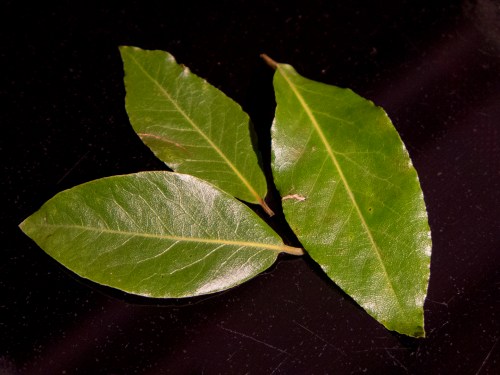
What is up with this leaf. Why even is there bay leaf? It sits in stews and sauces and it’s as easy to eat as a polymer five-dollar bill (this is a Canadian reference; Americans who don’t travel won’t get it, but most other people will understand). Bay leaf is like the quiet, dignified, hard-to-get-your-teeth-into guest at a party. No one seems sure why that person is there. And eventually you discover that the guest has secrets, and also secrets behind those secrets, and is nobility, and kind of famous under another name, actually more than one other name, and played a bigger part than you thought in the enjoyment of the party.
The bay leaf gets its name from its tree, the bay tree, which in turn gets its name from its berries; bay comes from an Old English word meaning ‘berry’ and is not related to the bay that means a convexity of water and concavity of land, or the bay that is a sound hunting dogs make, or the bay that means ‘reddish-brown’, and those aren’t related to each other either. Bay (the tree) originally meaning ‘berry’ is sort of like how deer originally meant any animal (especially any wild animal). If a deer eats a bay leaf, you have a nexus of semantic reduction and shift. (Makes note to self: cook venison in a bay leaf sauce and make a reduction. Uh, while wearing a shift, I guess.)
But most other languages do not call it anything like bay. Many of their names for it trace back to the Latin, which I have been holding back from you. The Linnaean name for the tree that makes this seasoning is Laurus nobilis. Which means ‘noble laurel’. As in the thing you make wreaths of, such as Julius Caesar wore. Which is how I discovered bay leaves and laurel leaves were the same thing.
I grew up reading Asterix comic books, you see. One of them was Asterix and the Laurel Wreath. In it, the chief of their Gaulish tribe makes a boast that he will serve a stew “caesoned with Caesar’s laurel wreath!” (props to Anthea Bell and Derek Hockridge for the witty English renditions). This helped me to notice that the container of bay leaves that sat perennially unperturbed in my mother’s spice drawer (an herbal pharmacopeia of dozens of Empress metal tins and McCormick glass jars plus a few Spice Islands glass jars and some flat plastic sachets) bore the French legend (we’re in Canada, remember) “feuilles de laurier.”
Laurier is, as seems guessable, French for laurel; it is also French for bay tree because they’re the same thing. You can see that the Latin Laurus over time cooked into French laurier, and English – because people don’t like having to say two r’s in a row – changed the second r into an l. You may know of the English surname Laurel, as in Stan Laurel (who performed with Oliver Hardy). French people also get named after trees, and any Canadian ought to know that one of the great nobility of Canadian history is one such: Sir Wilfrid Laurier, the seventh prime minister. He’s featured on the five-dollar bill. I would like to say that French Canadians refer to five-dollar bills as feuilles de Laurier, but I have no evidence that anyone does. It doesn’t help that the fivers are blue; they might stand a greater chance of it if they were green (but that’s the twenties; in Canada the money is colour-coded).
Sir Wilf is not depicted wearing a laurel wreath, but I have to say, it would suit him. What is it about laurel wreaths? Is it that they indicate a well-seasoned person? In fact, the Romans didn’t start it. They stole it, like nearly damn everything in their mythology (but somehow not their politics or cuisine), from Greece. Laurel wreaths were a symbol of victory starting with the Pythian Games, which were held at Delphi in honour of Apollo.
I’m tempted to say Apollo got his name because his behaviour was appalling, but not really. In this case, however, the association between him and the laurel is that he lusted after a young woman who wanted to be chaste and didn’t want to be chased. When he wouldn’t leave her alone, she pleaded to the river god (Ovid says he was named Peneus, and no, don’t go there), who turned her into a tree. A laurel tree, in specific. And so Apollo, feeling either contrite or perdurably concupiscent, formed a special fondness for the tree and saw to it that the victors at the games would be adorned with leaves from the tree named after the object of his infatuation, whose name was…
…Daphne.
Yes. Greek for laurel (or laurus) is Δάφνη, usually rendered as Daphne – or, well, for the tree (not the person), δάφνη dafne. Various dictionaries assure me that laurus and δάφνη are etymologically related, but not one of them has the decency to say how. I can see that /l/and /d/ have the same place of articulation (tip of the tongue), and so do /n/ and /r/ (though that’s a weird flex), and it’s well known that /u/ and /w/ can turn into /f/ over time in the right context. But I’d still like some kind of string of evidence. It is not forthcoming. (Although, OK, if it were fourth-coming it would get no laurels.)
There are no great English poems dedicated to Daphne; as the Oxford Dictionary of First Names explains, “The name was not used in England until the end of the 19th century, when it seems to have been adopted as part of the vogue for flower names at that time” – so it showed up just in time for Daphne du Maurier (1907–1989). Before that you’ll more likely find references to Daphnis, as in Daphnis and Chloe, which is a masculine version of the same; since Daphnis is supposedly the inventor of pastoral poetry, he probably lounged under the branches of his namesake playing his pan pipe and singing to his sheep. The name Laurel also came into vogue at the same time as Daphne, as did the name Laura, which also means “bay tree” but comes by way of Italian (in particular it was the name of the girlfriend of Petrarch). Laurence was around already, but may or may not be related (yeah, it probably is, but you know how weird names can be; if Laurel can be from the same source as Daphne, then Laurence can also not be from the same source as Laurel).
None of this answers why people put laurel leaves – bay leaves – in stews and sauces. To know that, go get a bay leaf. If you can find a fresh one, so much the better, but at the very least, don’t do what I did and store them in the same jar as another bit of desiccated cortex: cinnamon bark. I now have cinnamon-flavoured bay leaves. Which is great, but I’ve bought some new ones for all those times I might need bay leaves that don’t taste like cinnamon.
Have you inferred that I don’t use bay leaves too often? It’s true. They’re a nuisance. But they do have a nice flavour! You won’t know what it is by smelling them. You won’t know what it is by licking them. You need to bite one with your incisors, repeatedly. Then you will get a flavour that is in the range between oregano and basil, with hints of mint and strong notes of “oh, that’s what that is!” You can also buy powdered bay leaf. You will get a stronger taste sensation from it, but then your mouth will want to know exactly why you put that dry powder into it, sir or ma’am, and will become a little bitter about it too.
Bay leaves have long been used in cooking. They are a key ingredient of the bouquet garni, the compulsory French seasoning. They are also found in various pickling recipes, as well as recipes for assorted other savouries that involve simmering a liquid for long enough to get the flavour out of the damn things. Here is a recipe from the sixteenth-century court cookbook of the Prince of Transylvania, yes actually, in translation by Bence Kovacs, edited by Glenn Gorsuch:
Italian sardine.
Cook the sardine like this. Wash it and add salt to the fish like I told you among the other fish. Prepare its sauce like this. Wash the salt from fish, put it in a pot, pour vinegar and wine onto it and add some bay laurel.
Laurel doesn’t grow in Transylvania, so have someone bring it from Turkey or Italy. When you’re about to cook the fish, add laurel. This is not for one day. Cook it, and once cooked, put it into a pot where you can take it out with a spoon. Once you’re ready to slice it and serve it, don’t take out the water, leave it there, and don’t cook it like you cook beef or pork, this doesn’t need that much time. It should be coagulated.
Remember: this is not for one day. Nobility takes time! But not as much as beef or pork. Also, it has to be brought from Turkey or Italy. (Just by the way, though, Hungarian for “laurel” or “bay leaf” is babér. And, for the curious, Finnish is laakeri, Basque is erramu, Polish is wawrzyn, Irish is labhrais, German is Lorbeer, Turkish is defne… This silent guest goes by many names in many places.)
Or you can skip trying to get the flavour from the laurel and cut straight to the ennoblement. Here’s an ancient recipe (from Ancient Cookery A.D. 1381, published as the second part of a volume with The Forme of Cury, with some typographical misrendering):
FOR TO MAKE A GELY.
Tak hoggys fet other pyggys other erys other partrichys other chiconys and do hem togedere and serh hem in a pot and do hem in flowre of canel and clowys other or grounde do thereto vineger and tak and do the broth in a clene vessel of al thys and tak the Flesch and kerf yt in smal morselys and do yt therein tak powder of galyngale and cast above and lat yt kels tak bronches of the lorer tre and styk over it and kep yt al so longe as thou wilt and serve yt forth.
That, of course, means this:
TO MAKE A JELLY
Take hog’s feet or pig’s or ears or partridge’s or chicken’s [so, um, like the feet or ears of hogs or piglets, or the feet of partridges or chickens, I guess, but probably not the ears of partridges or chickens] and do them together and simmer them in a pot and do them in powdered or ground cinnamon or cloves; add vinegar and take and make the broth in a clean vessel of all this and take the flesh and carve it in small morsels and put it in; take powder of galingale and sprinkle it over and let it cool; take branches of the laurel tree and stick them over it and keep it as long as you want and serve it forth.
And that, my friends, is how you make noble food from a sow’s ear: tak bronches of the lorer tre and styk over it and kep yt al so longe as thou wilt. Which sounds like Apollo’s permanent wood.
But that does preclude one of the secret pleasures of a cook: licking off the leaf after fishing it out of the sauce. Why serve it to unappreciative diners? Let your mysterious noble guest stay in your kitchen with you. Or, if you are done making magnificent cuisine, you may take the leaves and put them in your pillowcase (bought at The Bay)… and rest on your laurels.